- Base Value(2026): 1.32 Bn
- Estimated Value(2026): 1.3 Bn
- Forecast Value (2036): 1.9 Bn
- CAGR (2026 - 2036): 3.6%
Limited-Slip Differential Couplings Market Forecast and Outlook 2026 to 2036
Limited-slip differential couplings market is likely to be valued at USD 1.32 billion in 2026 and is projected to reach USD 1.88 billion by 2036, reflecting a 3.6% CAGR, according to Fact.MR analysis.
Summary of Limited-Slip Differential Couplings Market - Key Takeaways
- The limited-slip differential couplings market covers mechanical and electronically assisted systems designed to manage torque biasing between drive wheels, improving traction, stability, and cornering performance across performance, SUV, and AWD vehicle platforms.
- The global market is valued at USD 1.32 billion in 2026 and is projected to reach USD 1.88 billion by 2036, expanding at a 3.6% CAGR, supported by steady adoption in high-performance, AWD, and electrified drivetrains.
- By LSD type, clutch-type LSDs dominate with a 44% share, driven by standardized assembly, predictable procurement cycles, and repeatable deployment across high-volume OEM vehicle programs.
- By vehicle segment, performance cars account for the largest share at 34%, reflecting concentrated demand where handling precision, torque control, and drivetrain responsiveness are core functional requirements.
- China and Brazil represent the fastest-growing markets, with CAGR of 4.9% and 4.7% respectively, supported by rising SUV and EV production, localization of drivetrain components, and modernization of automotive manufacturing.
- Competition is defined by suppliers such as Schaeffler, ZF, and BorgWarner, where validated durability, OEM-aligned calibration, and integration with advanced vehicle control systems form durable competitive advantages.
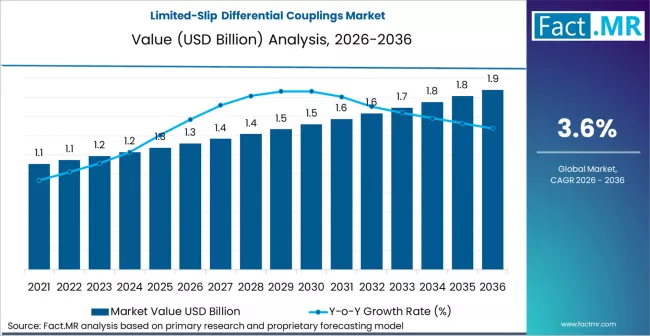
Limited Slip Differential Couplings Market Market Value Analysis | Source: Fact.MR
Market growth is being driven by the increasing adoption of all-wheel and high-performance drivetrains in passenger vehicles and light commercial transport, where limited-slip differentials enhance traction, cornering stability, and torque distribution under varying load conditions. Operational deployment focuses on standardized material selection, precision engineering, and compatibility with automated assembly processes to maintain consistent performance across production lines.
Supply chains prioritize reliable alloy sourcing, scalable manufacturing, and multi-region distribution to meet OEM demand and maintenance cycles. Competitive differentiation arises from innovations in low-friction, high-durability couplings that optimize energy efficiency and drivetrain response. Adoption accelerates as manufacturers integrate limited-slip solutions into modular platforms, enabling predictable performance, reduced assembly errors, and operational scalability across global vehicle programs.
Limited-Slip Differential Couplings Market
| Metric | Value |
|---|---|
| Market Value (2026) | USD 1,320.0 million |
| Forecast Value (2036) | USD 1,880.0 million |
| Forecast CAGR (2026-2036) | 3.6% |
Source: Fact.MR analysis. Updated Feb 13, 2026
Category
| Category | Segments |
|---|---|
| By LSD Type | Clutch-type LSD; Torque-sensing (Torsen); Electronic LSD (eLSD); Other |
| By Vehicle Segment | Performance cars; SUVs/Crossovers; Pickups/Off-Road; Other |
| By Drive Layout | RWD; AWD; FWD; Other |
| By Sales Channel | OEM line-fit; Aftermarket; Motorsport/Performance; Other |
| Region | North America; Europe; Asia Pacific; Latin America; Middle East & Africa |
Source: Fact.MR analysis. Updated Feb 13, 2026
Segmental Analysis
By LSD Type, Why Do Clutch-Type LSDs Lead the Market?
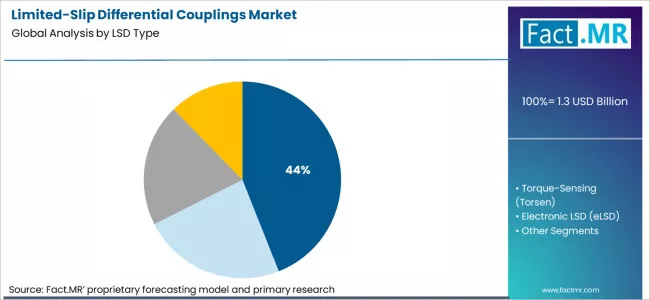
Limited Slip Differential Couplings Market Analysis By Lsd Type | Source: Fact.MR
Clutch-type LSDs lead the market with 44% share, reflecting high adoption across passenger and commercial vehicles where repeatable procurement and predictable supply support stable production cycles. Market demand is driven by standardized assembly processes, scalable distribution, and multi-site deployment that streamline logistics and reduce operational complexity. Suppliers benefit from recurring orders, repeatable manufacturing runs, and efficient workflow integration. Segment prominence is defined by structural market factors such as supply chain reliability, channel coverage, and high-volume adoption rather than the mechanical design of the differential itself. Repeatable deployment underpins consistent market activity.
By Vehicle Segment, Why Do Performance Cars Represent the Largest Segment?
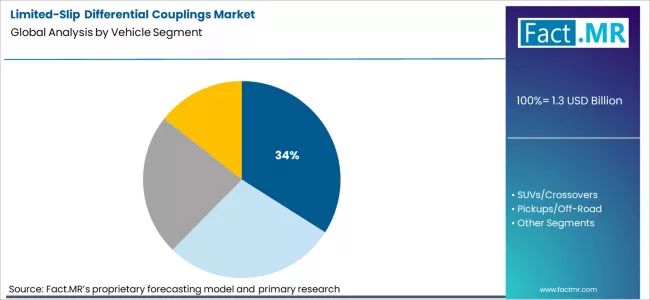
Limited Slip Differential Couplings Market Analysis By Vehicle Segment | Source: Fact.MR
Performance cars account for 34% share, reflecting concentrated demand in high-volume, repeatable production programs where procurement cycles and supply chain predictability are critical. Market growth is supported by multi-channel distribution, streamlined logistics, and standardized integration across OEM platforms. Suppliers benefit from predictable production scheduling, recurring orders, and scalable operations. Segment dominance is shaped by structural market drivers such as workflow repeatability, channel penetration, and volume concentration rather than the vehicle type itself. Adoption is driven by high-frequency integration, consistent demand patterns, and operational efficiency, making performance cars the primary contributor to overall market activity.
Country/Region
| Country/Region | Driver | Restraint | Trend |
|---|---|---|---|
| USA | Rising adoption of AWD and high-performance vehicles → drives demand for LSD couplings | OEM safety and regulatory certifications → increase CapEx and slow entry for smaller suppliers | Growth of high-durability, precision-engineered LSD couplings |
| Germany | Expansion of EVs and premium vehicles → fuels adoption of lightweight, high-efficiency LSD systems | Stringent EU automotive material and testing regulations → increases compliance costs | Adoption of multi-material LSD couplings for enhanced efficiency |
| India | Growing SUV and EV market → accelerates penetration of LSD couplings | Limited local advanced manufacturing infrastructure → slows rollout for smaller suppliers | Growth of locally manufactured, cost-effective LSD couplings |
| China | Large-scale EV and automotive production → drives demand for high-performance LSD couplings | Regional quality and safety standard variability → delays approvals for new designs | Expansion of automated precision manufacturing for LSD couplings |
| Brazil | Automotive localization policies → increase demand for LSD couplings | Import restrictions and regulatory compliance → raise production costs | Growth of locally sourced, high-performance LSD couplings |
Source: Fact.MR analysis. Updated Feb 13, 2026
Analysis of the Limited-Slip Differential Couplings Market by Key Country
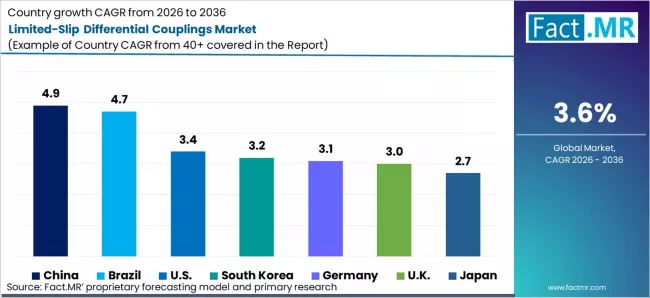
Limited Slip Differential Couplings Market Cagr Analysis By Country | Source: Fact.MR
| Country | CAGR (2026-2036) |
|---|---|
| U.S. | 3.4% |
| Japan | 2.7% |
| South Korea | 3.2% |
| Germany | 3.1% |
| China | 4.9% |
| U.K. | 3.0% |
| Brazil | 4.7% |
Source: Fact.MR analysis. Updated Feb 13, 2026
The report covers an in-depth analysis of 30+ countries; top-performing countries are highlighted below.
How Is Demand for Limited-Slip Differential Couplings Growing in the United States?
Demand in the United States grows at 3.4% CAGR through 2036. SUV and pickup adoption drives need for couplings that optimize torque distribution during cornering and off-road conditions. Manufacturers prioritize high-durability designs suitable for hybrid and electric drivetrains. Regional differences influence product deployment, with northern states valuing cold-weather performance. Production lines integrate precision machining and automated quality checks. Premium models lead uptake, while mid-tier vehicles adopt gradually. Market expansion is influenced by consumer expectations for enhanced handling, industrial standards for drivetrain reliability, and incremental EV integration, creating steady but measured growth.
What Is the Growth in Adoption of Limited-Slip Differential Couplings in Japan?
Growth in Japan reaches 2.7% CAGR through 2036. Compact vehicle dominance limits widespread application, but hybrid and electric SUV segments integrate differential couplings to improve stability and efficiency. Operational emphasis lies on low-noise performance and vibration minimization. Urban assembly plants implement precise calibration routines to ensure consistent torque delivery. Premium and specialty vehicles adopt couplings first, with gradual penetration in mainstream segments. Market growth reflects cautious adoption, where regulatory standards and consumer demand for smooth, reliable drivetrains guide incremental integration of high-performance limited-slip solutions.
How Is the Limited-Slip Differential Couplings Market Shaping in South Korea?
Adoption in South Korea grows at 3.2% CAGR through 2036. SUV and crossover demand fuels the need for enhanced torque management in AWD systems. Urban and coastal production hubs integrate quality assurance processes and automated calibration for consistent performance. Manufacturers develop modules resistant to local climate effects, such as humidity and temperature fluctuations. Premium vehicle segments see highest uptake, while mid-tier models integrate gradually. Market expansion is supported by increasing hybrid and EV production, consumer preference for drivability and handling, and incremental adoption in industrial machinery requiring torque-distribution optimization.
What Is the Outlook on Limited-Slip Differential Couplings in Germany?
Outlook in Germany grows at 3.1% CAGR through 2036. High-performance and premium vehicle segments prioritize torque distribution for handling precision, energy efficiency, and safety compliance. Operational improvements focus on automated assembly, quality validation, and material standardization. Urban automotive clusters integrate couplings into hybrid and electric drivetrains. Regulatory mandates on emissions and drivetrain durability influence design and adoption. Mid-tier mass-market vehicles gradually implement limited-slip couplings. Market expansion reflects a balance between consumer expectations for performance, industrial production capabilities, and incremental technological advancements in drivetrain systems.
How Is the Limited-Slip Differential Couplings Market Growing in China?
Growth in China reaches 4.9% CAGR through 2036. Rapid SUV and EV adoption drives demand for high-performance couplings to optimize torque, stability, and energy efficiency. Manufacturers focus on corrosion resistance, high-strength materials, and automated production calibration. Urban production hubs integrate predictive testing and quality monitoring. Premium and mid-tier vehicles adopt modules at varying rates. Market expansion is fueled by government incentives for energy-efficient vehicles, technological investment in drivetrain components, and increasing consumer expectations for smooth handling. Industrial machinery and commercial vehicles also adopt limited-slip couplings, contributing to overall market acceleration.
What Are the Growth Patterns of Limited-Slip Differential Couplings in the United Kingdom?
Growth in the United Kingdom reaches 3.0% CAGR through 2036. Adoption is strongest among urban SUV and crossover models, where traction and handling stability are critical. Operational improvements include assembly precision, quality control, and integration with hybrid drivetrain electronics. Premium vehicles lead uptake, while mass-market integration progresses more slowly. Market expansion is influenced by consumer expectations for reliable drivetrains, local safety standards, and gradual electrification trends. Incremental adoption occurs in industrial and commercial vehicle segments, supporting steady growth and functional differentiation across multiple automotive categories.
How Is the Limited-Slip Differential Couplings Market Developing in Brazil?
Outlook in Brazil grows at 4.7% CAGR through 2036. Rising SUV popularity and urban infrastructure challenges drive adoption for enhanced torque distribution and vehicle stability. Manufacturers emphasize corrosion-resistant materials and high-performance module design for diverse road conditions. Operational improvements include automated quality assurance and assembly calibration in industrial hubs. Premium and imported vehicles lead adoption, while domestic mid-tier segments integrate couplings progressively. Market growth reflects consumer demand for handling performance, increasing hybrid and EV production, and localized adaptation of drivetrain components to suit Brazilian urban and semi-urban driving conditions.
How Are System Integration, Durability Validation, and OEM Alignment Creating Competitive Moats in the LimitedSlip Differential Couplings Market?
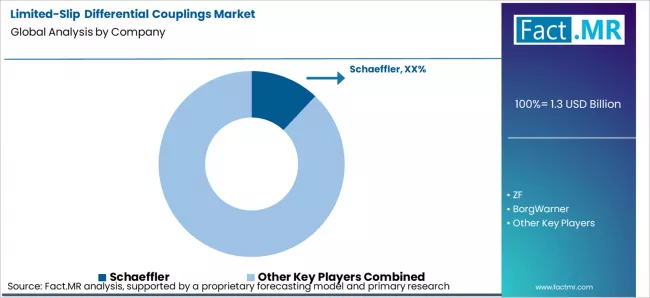
Limited Slip Differential Couplings Market Analysis By Company | Source: Fact.MR
As per Fact.MR analysis, the limited slip differential (LSD) couplings market in 2026 is defined by a transition from basic friction plates to fully validated torque transfer systems where proven durability, integrated vehicle control compatibility, and original equipment manufacturer (OEM) alignment determine competitive advantage. Schaeffler and ZF leverage comprehensive test data on torque biasing and wear performance, which strengthens their adoption with global OEMs requiring consistent handling and safety outcomes across diverse vehicle classes. BorgWarner and GKN Automotive emphasise modular designs with validated multi domain simulation support, which reduces integration risk and accelerates development cycles. Eaton and JTEKT focus on optimized friction interfaces and material toughness, which improves service life under high load gradients. Aisin and Dana provide sealed, low maintenance architectures with documented thermal stability, which enhances uptime and reliability. Quaife and OS Giken cater to performance and enthusiast segments with precision engineered mechanical systems, which sustains niche demand. Across the market, validated system performance, integrated control compatibility, and strong OEM partnerships form enduring competitive moats, reducing reliance on price or isolated component claims.
Recent Industry Developments
- Eaton launches EV-specific Truetrac Limited-Slip Differential at Auto Shanghai 2025 - Eaton announced a new EV Truetrac LSD solution tailored for electric vehicles, addressing low-viscosity oil environments and high torque loads while improving traction and noise control.
- Eaton product info on IntelliTrac eLSD - Eaton publishes details of its IntelliTrac electronic limited-slip differential on its official products site, showing ongoing development of advanced torque-variable differential tech for varied vehicle applications.
- Schaeffler promotes new mechanical Limited Slip Differential (mLSD) solutions - Schaeffler updated its global product catalog highlighting mechanical LSD technology features aimed at performance and reliability (indicative of ongoing product emphasis from a key drivetrain supplier).
Key Players in Limited-Slip Differential Couplings Market
- Schaeffler
- ZF
- BorgWarner
- GKN Automotive
- Eaton
- JTEKT
- Aisin
- Dana
- Quaife
- OS Giken
References
- International Organization for Standardization. (2024). ISO 26262-3:2024 Road vehicles - Functional safety - Part 3: Concept phase. ISO.
- International Organization for Standardization. (2023). ISO 21448:2023 Road vehicles - Safety of the intended functionality (SOTIF). ISO.
- UNECE World Forum for Harmonization of Vehicle Regulations. (2024). UN Regulation No. 79: Steering equipment (including electronic torque distribution systems). United Nations Economic Commission for Europe.
- SAE International. (2023). SAE J2552_202311 - Limited slip differential performance test procedures. SAE International Standards.
Segmentation
Scope of the Report
| Items | Values |
|---|---|
| Quantitative Units (2026) | USD 1,320 million |
| By LSD Type | Clutch-Type LSD, Torque-Sensing (Torsen), Electronic LSD (eLSD), Other |
| By Vehicle Segment | Performance Cars, SUVs/Crossovers, Pickups/Off-Road, Other |
| By Drive Layout | RWD, AWD, FWD, Other |
| By Sales Channel | OEM Line-Fit, Aftermarket, Motorsport/Performance, Other |
| Region | Asia Pacific, Europe, North America, Latin America, Middle East & Africa |
| Countries Covered | China, Japan, South Korea, India, Australia & New Zealand, ASEAN, Rest of Asia Pacific, Germany, UK, France, Italy, Spain, Nordic, BENELUX, Rest of Europe, USA, Canada, Mexico, Brazil, Chile, Rest of Latin America, KSA, Other GCC, Turkey, South Africa, Other African Union, Rest of Middle East & Africa |
| Key Companies Profiled | Schaeffler, ZF, BorgWarner, GKN Automotive, Eaton, JTEKT, Aisin, Dana, Quaife, OS Giken |
| Additional Attributes | Dollar by sales by LSD type, vehicle segment, and drive layout; torque distribution optimization; cornering stability; low-friction, high-durability designs; AWD and performance vehicle integration; standardized assembly compatibility; predictive maintenance alignment; multi-region production and distribution; modular drivetrain platforms; energy efficiency; OEM-aligned calibration; validated durability and torque biasing; workflow repeatability; channel penetration; high-volume adoption and operational scalability. |
Source: Fact.MR analysis. Updated Feb 13, 2026
Limited-Slip Differential Couplings Market Segmentation
-
By LSD Type :
- Clutch-Type LSD
- Torque-Sensing (Torsen)
- Electronic LSD (eLSD)
- Other
-
By Vehicle Segment :
- Performance Cars
- SUVs/Crossovers
- Pickups/Off-Road
- Other
-
By Drive Layout :
- RWD
- AWD
- FWD
- Other
-
By Sales Channel :
- OEM Line-Fit
- Aftermarket
- Motorsport/Performance
- Other
-
Region :
- Asia Pacific
- China
- Japan
- South Korea
- India
- Australia & New Zealand
- ASEAN
- Rest of Asia Pacific
- Europe
- Germany
- United Kingdom
- France
- Italy
- Spain
- Nordic
- BENELUX
- Rest of Europe
- North America
- United States
- Canada
- Mexico
- Latin America
- Brazil
- Chile
- Rest of Latin America
- Middle East & Africa
- Kingdom of Saudi Arabia
- Other GCC Countries
- Turkey
- South Africa
- Other African Union
- Rest of Middle East & Africa
- Asia Pacific
Frequently Asked Questions
How big is the limited-slip differential couplings market in 2026?
What will be the size of limited-slip differential couplings market in 2036?
How much will be the limited-slip differential couplings market growth between 2026 and 2036?
What are the key product types in the limited-slip differential couplings market?
Which vehicle segment segment to contribute significant share in the limited-slip differential couplings market in 2026?
Who worked on this report


Preview the report firsthand - request a free sample
Free SampleGet the brochure for pricing and purchase details
Download PDF