In‑Wheel Motor Hub Couplings Market (2026 - 2036)

In-Wheel Motor Hub Couplings Market is segmented by Coupling Location (Motor-to-Hub Interface, Bearing/Seal Coupling Interfaces, Brake Interface Couplings, and Others), Vehicle Segment (Passenger EVs, Micro-mobility/Low-Speed, LCV EVs, and Others), Design Approach (Integrated Hub Module, Modular In-Wheel Unit, Retrofit Kits, and Others), Program Stage (Pilot/Trials, Early Series, Series Production, and Others), and Region. Forecast for 2026 to 2036.

Core Findings

    In-Wheel Motor Hub Couplings Market Forecast 2026 to 2036

    In 2025, the in-wheel motor hub couplings market was valued at USD 143 million. Based on Fact MR's analysis, demand for in-wheel motor hub couplings is estimated to grow to USD 160 million in 2026 and USD 903.5 million by 2036. FMI projects a CAGR of 18.9% during the forecast period.

    The absolute dollar growth from 2027 to 2036 is USD 649 million. This represents a transformative growth trajectory, driven by rising adoption of electric vehicles (EVs) and advancements in in-wheel motor hub coupling technology. However, while this growth is rapid, it is constrained by factors such as high manufacturing costs, supply chain complexity, and regulatory compliance pressures.

    China leads with a CAGR of 21.3%, driven by the rapid expansion of the EV market and strong government incentives. Brazil follows closely with a 21.0% CAGR, fueled by a strong push for EV adoption and infrastructure development. The USA is projected to grow at 18.3%, as the EV market expands with an increasing focus on efficiency. South Korea shows an 18.0% CAGR, with high adoption rates of innovative automotive technologies. Germany, at 18.1%, is transitioning toward green transportation solutions in line with EU policies. The United Kingdom also sees an 18.0% growth rate, supported by electric vehicle adoption and government policy initiatives. In contrast, mature markets in Europe are primarily driven by replacement demand rather than significant growth, constrained by market saturation and high manufacturing costs.
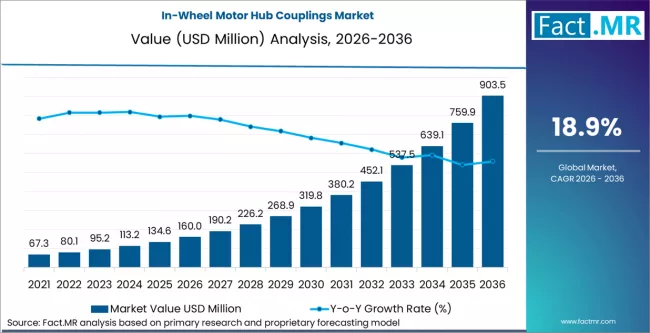
    In Wheel Motor Hub Couplings Market Market Value Analysis

    In‑Wheel Motor Hub Couplings Market Definition

    The In‑Wheel Motor Hub Couplings Market involves coupling devices that connect in‑wheel electric motors to vehicle wheel assemblies. These couplings transfer torque and absorb vibration, ensuring efficient power delivery and smooth motion in electric and hybrid vehicles. They are essential for industries like electric passenger vehicles, commercial EVs, and two-/three-wheel electric platforms. The market focuses on hub couplings engineered for performance, durability, and safety in electric propulsion systems.

    Market Inclusions

    This report covers the global and regional market sizes for in‑wheel motor hub couplings, including forecast data. It breaks down the market by product type (rigid, flexible, elastomeric), application (electric passenger vehicles, commercial EVs, two-/three-wheelers), and end-user. Pricing trends, production volumes, and trade flow analysis are also provided.

    Market Exclusions

    The report excludes unrelated powertrain components like conventional driveshafts, differential assemblies, and wheel bearings. It also omits finished electric vehicles, battery packs, and motor units, focusing on hub couplings alone. Niche applications like industrial machinery couplings are not included.

    Research Methodology

    • Primary Research: Interviews were conducted with executives, engineers, and procurement leads from automotive markets.
    • Desk Research: Public data was sourced from industry reports, government statistics, and trade associations.
    • Market-Sizing and Forecasting: A hybrid model was used, combining top-down and bottom-up approaches for accurate market sizing.

    Data Validation and Update Cycle

    Market outputs were reviewed by experts and cross-referenced with production data for accuracy, with periodic updates.

    In-Wheel Motor Hub Couplings Market Summary

    Market Definition

    The In-Wheel Motor Hub Couplings Market involves components that connect in-wheel electric motors to vehicle wheel assemblies. These couplings transfer torque and absorb vibrations, ensuring smooth operation in electric and hybrid vehicles.

    Demand Drivers

    • EV Growth: Increasing adoption of electric vehicles (EVs) boosts demand for advanced drivetrain solutions, including in-wheel motor hub couplings.
    • Efficiency & Performance: In-wheel motor systems enhance vehicle performance, boosting the need for specialized couplings.
    • Space Optimization: Integrating motors into the wheels allows for more cabin space, driving demand in passenger EVs.

    Key Segments

    • Coupling Location: Motor-to-Hub Interface, Bearing/Seal Coupling Interfaces, Brake Interface Couplings.
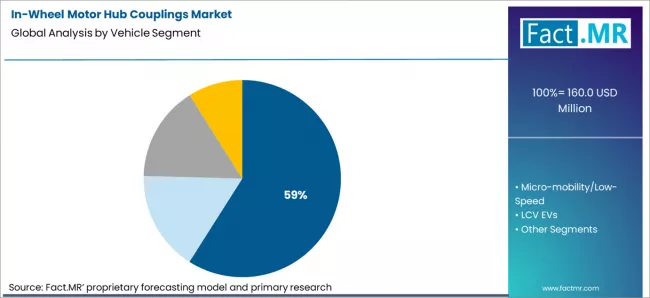
    • Vehicle Segment: Passenger EVs (59% market share by 2026), Micro-mobility/Low-Speed, LCV EVs.
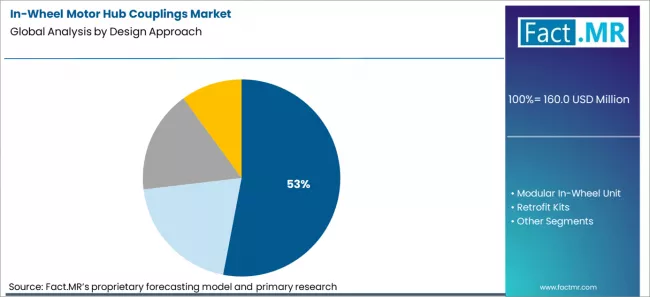
    • Design Approach: Integrated Hub Module (53% market share by 2026), Modular In-Wheel Unit, Retrofit Kits.
    • Program Stage: Pilot/Trials, Early Series, Series Production.

    Regional Outlook

    • China: Leading growth at 21.3% CAGR, driven by government incentives and EV market expansion.
    • Brazil: Strong growth at 21.0% CAGR, fueled by EV adoption and infrastructure development.
    • USA: Growing at 18.3% CAGR, supported by the expanding EV market.

    Analyst Opinion

    The market is in early growth stages, driven by EV architectural shifts and the increasing demand for efficient, compact drivetrains. While innovation is promising, challenges include high manufacturing costs and technical integration complexities.

    Strategic Takeaways

    • OEM Integration: OEM line-fit solutions dominate, optimizing drivetrain efficiency.
    • Technological Innovation: Focus on advanced motor and coupling technology integration for improved power transfer.
    • Regional Focus: China, Brazil, and the USA are key growth markets due to EV adoption and innovation.

    Methodology

    Market forecasts are based on primary research, incorporating interviews with automotive suppliers and industry experts, and cross-referenced with global production and sales data.

    Segmental Analysis

    In-Wheel Motor Hub Couplings Market Analysis by Vehicle Segment
    In Wheel Motor Hub Couplings Market Analysis By Vehicle Segment

    • Market Overview: Passenger EVs are expected to hold 59% of the in-wheel motor hub couplings market by 2026. As the electric vehicle (EV) market continues to grow, in-wheel motors are becoming a critical component in the design of passenger EVs, offering improved efficiency, space-saving benefits, and enhanced performance. In-wheel motor hub couplings play a vital role in integrating these motors seamlessly into the vehicle drivetrain.
    • Demand Drivers:
      • Enhanced Efficiency and Performance: In-wheel motor technology offers significant advantages, including better power delivery and regenerative braking. As EV manufacturers focus on improving overall performance, demand for in-wheel motor hub couplings in passenger vehicles increases to ensure smooth integration and optimal performance.
      • Space Optimization: With a growing trend toward compact, efficient designs in EVs, integrating motors into the wheels allows for more space in the cabin and other key areas, boosting the demand for in-wheel motor hub couplings in passenger vehicles.
      • Electrification of the Passenger Vehicle Fleet: The ongoing transition to electric passenger vehicles is fueling the adoption of advanced drivetrain technologies, including in-wheel motors, which directly drives the demand for specialized couplings that enhance vehicle stability, comfort, and performance.

    In-Wheel Motor Hub Couplings Market Analysis by Design Approach
    In Wheel Motor Hub Couplings Market Analysis By Design Approach

    • Market Overview: Integrated hub modules are projected to capture 53% of the market share by 2026. This design approach, where the motor, controller, and coupling are combined into a single unit, provides a compact and efficient solution, which is highly attractive for automakers focusing on minimizing space and improving vehicle performance.
    • Demand Drivers:
      • Space and Weight Efficiency: Integrated hub modules provide a streamlined solution by reducing the number of individual components required in the drivetrain. This approach is favored for its compactness and efficiency, crucial in the design of lightweight EVs and high-performance passenger vehicles.
      • Simplified Manufacturing: The integrated approach offers cost and manufacturing benefits, as it simplifies the assembly process by consolidating various components into one module. This reduces the complexity of the drivetrain and improves production efficiency.
      • Improved Power Delivery and Regenerative Braking: Integrated hub modules offer optimized power transfer and regenerative braking capabilities, which are key to improving the energy efficiency of EVs and reducing wear and tear on other components.

    In Wheel Motor Hub Couplings Market Drivers, Restraints, and Opportunities

    FMR analysts observe that the in‑wheel motor hub couplings market remains in a nascent growth phase tied to evolving EV architectures and the gradual adoption of in‑wheel motor systems. Historically, most EVs used centralized electric motors with conventional driveline couplings, limiting demand for in‑wheel specific components. The 2026 market valuation reflects early adoption by niche EV makers and pilot programs where in‑wheel motors promise packaging efficiency and torque vectoring, but broader structural volume remains constrained by technical integration challenges.

    Demand for traditional driveline couplings is stable, while in‑wheel motor hub couplings are emerging, commanding higher per‑unit prices due to precision requirements and integration complexity. This dynamic yields net value growth even as overall unit volumes grow slowly. The market exists because in‑wheel motor systems enable compact packaging and improved handling for certain EV segments, yet technology maturation and cost remain barriers to widespread uptake.

    • Architecture Shift Demand: As select EV platforms experiment with in‑wheel motors, specialized couplings are required to manage torque loads and vibration, driving early demand in niche segments.
    • Technical Integration Challenges: Complex sealing, unsprung mass, and durability requirements raise engineering thresholds, keeping volumes modest but pricing elevated.
    • Regional Innovation Focus: In markets like China and Japan where in‑wheel motor research and limited production applications are stronger, demand for precision hub couplings is ahead of regions where centralized motor designs remain dominant.

    Regional Analysis

    The market analysis covers key global regions, including North America, Latin America, Western Europe, Eastern Europe, South Asia and Pacific, East Asia, and Middle East & Africa. It is segmented geographically, with specific market dynamics for each region. The full report provides a detailed market attractiveness analysis.
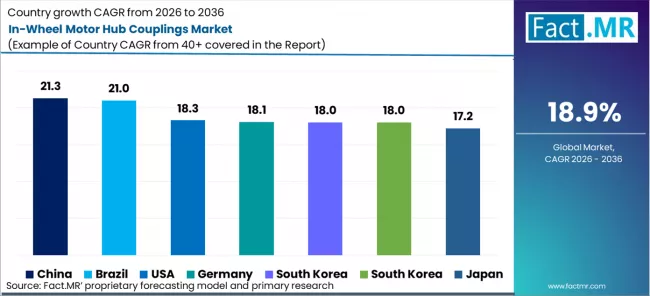
    In Wheel Motor Hub Couplings Market Cagr Analysis By Country

    Country CAGR (2026 - 2036)
    USA 18.3%
    Japan 17.2%
    South Korea 18.0%
    Germany 18.1%
    China 21.3%
    United Kingdom 18.0%
    Brazil 21.0%

    Source: Fact MR (FMR) analysis, based on proprietary forecasting model and primary research.

    Asia Pacific:

    The region stands as the "global manufacturing epicenter," with major players like BYD Auto and NIO leading the charge in electric vehicle technology. The large-scale investments in EV manufacturing contribute to the rapid growth of the In-Wheel Motor Hub Couplings market in the region.

    • China: Demand for In-Wheel Motor Hub Couplings in China is projected to rise at 21.3% CAGR through 2036. The Chinese Government's EV Manufacturing Incentives (2025) promote industry growth, and BYD Auto continues to lead with substantial investments in electric mobility solutions.
    • Japan: Demand for In-Wheel Motor Hub Couplings in Japan is projected to rise at 17.2% CAGR through 2036. Toyota's commitment to expanding its electric vehicle lineup in 2025 and the Green Vehicle Procurement Program (2024) provide key drivers for market growth.
    • South Korea: Demand for In-Wheel Motor Hub Couplings in South Korea is projected to rise at 18.0% CAGR through 2036. The Korean Green New Deal (2025) and investments from Hyundai Motor in EV production contribute to the market's growth trajectory.

    Europe:

    Europe plays a critical role as a leader in EV adoption, with players like Volkswagen and BMW investing heavily in electric mobility. The region's regulatory push for cleaner energy vehicles fuels the growth of the In-Wheel Motor Hub Couplings market.

    • Germany: Demand for In-Wheel Motor Hub Couplings in Germany is projected to rise at 18.1% CAGR through 2036. The German National Electric Mobility Development Plan (2025) supports EV adoption, while Volkswagen's investment in electric vehicle production accelerates the trend.
    • United Kingdom: Demand for In-Wheel Motor Hub Couplings in the UK is projected to rise at 18.0% CAGR through 2036. The UK’s Road to Zero Emissions Strategy (2025) drives EV development, and Jaguar Land Rover continues investing in EV manufacturing.

    Latin America:

    Latin America, especially Brazil, shows rapid adoption in the EV sector, driven by government incentives and investments from major automakers.

    • Brazil: Demand for In-Wheel Motor Hub Couplings in Brazil is projected to rise at 21.0% CAGR through 2036. The Brazilian National Electric Mobility Plan (2024) supports clean energy vehicles, and Fiat Chrysler Automobiles announced its expansion into the Brazilian EV market in 2025.

    Fact MR's analysis of the In-Wheel Motor Hub Couplings Market in Asia Pacific, Europe, and Latin America consists of country-wise assessments that include China, Japan, South Korea, Germany, the United Kingdom, and Brazil. Readers can find detailed trends, regulatory updates, and company-specific investments shaping the market’s growth in these countries.

    How Are Key Players Competing in the In-Wheel Motor Hub Couplings Market?
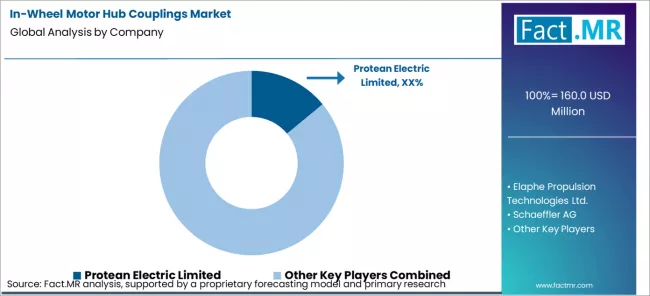
    In Wheel Motor Hub Couplings Market Analysis By Company

    The in-wheel motor hub couplings market is driven by competition among industry leaders like Protean Electric Limited, Elaphe Propulsion Technologies Ltd., and Schaeffler AG, who focus on delivering high-performance solutions for electric vehicles. These companies are advancing coupling technologies to enhance efficiency and reduce energy loss in in-wheel motor systems. ZF Friedrichshafen AG and Nidec Corporation contribute with precision-engineered solutions for reliable and durable power transmission in electric drivetrains. Robert Bosch GmbH and Continental AG are innovating in the integration of advanced motor and coupling technologies to enable smooth torque delivery. Dana Incorporated and BorgWarner Inc. are optimizing driveline systems to cater to growing electric vehicle demands, while Hyundai Mobis Co., Ltd. strengthens its position with integrated in-wheel motor hub solutions for next-generation electric vehicles.

    Recent Industry Developments

    • Product Launch - ProteanDrive Generation 5 in-wheel motor production launch (Announced Jul 16, 2024): Protean Electric announced the production launch of its Gen 5 ProteanDrive in-wheel motor platform, advancing industrialised in-wheel architectures that depend on robust hub-side mechanical interfaces/couplings within the wheel package.
    • Product Launch - Elaphe “Sonic X” high-performance in-wheel platform (Published 2025): Elaphe unveiled Sonic X, a high-performance in-wheel platform positioned as a drop-in approach for ICE/hybrid/BEV packaging, reinforcing demand for durable hub-integrated coupling/mechanical interface solutions under high torque loads.
    • Patent - Wheel hub assembly methods including coupling a hub shaft to a motor (Published 2024; filed Dec 6, 2023): This patent publication discloses wheel hub assemblies and methods that include coupling a hub shaft to a motor, directly relevant to hub-motor mechanical coupling and integration approaches.

    Key Players of the In‑Wheel Motor Hub Couplings Market

    • Protean Electric Limited
    • Elaphe Propulsion Technologies Ltd.
    • Schaeffler AG
    • ZF Friedrichshafen AG
    • Nidec Corporation
    • Robert Bosch GmbH
    • Continental AG
    • Dana Incorporated
    • BorgWarner Inc.
    • Hyundai Mobis Co., Ltd.

    Report Scope

    Metric Value
    Quantitative Units USD 160 million (2026) to USD 903.5 million (2036), at a CAGR of 18.9%
    Market Definition The In-Wheel Motor Hub Couplings Market includes couplings used in electric vehicle in-wheel motor systems, providing efficient power transfer while maintaining smooth vehicle performance.
    By Coupling Location Motor-to-Hub Interface, Bearing/Seal Coupling Interfaces, Brake Interface Couplings, Other
    By Vehicle Segment Passenger EVs, Micro-mobility/Low-Speed, LCV EVs, Other
    By Design Approach Integrated Hub Module, Modular In-Wheel Unit, Retrofit Kits, Other
    By Program Stage Pilot/Trials, Early Series, Series Production, Other
    Regions Covered North America, Latin America, Europe, East Asia, South Asia, Oceania, Middle East and Africa
    Countries Covered United States, Canada, Mexico, Brazil, Argentina, Germany, France, United Kingdom, Italy, Spain, China, India, Japan, South Korea, Indonesia, Australia, and 40+ countries
    Key Companies Profiled Protean Electric Limited, Elaphe Propulsion Technologies Ltd., Schaeffler AG, ZF Friedrichshafen AG, Nidec Corporation, Robert Bosch GmbH, Continental AG, Dana Incorporated, BorgWarner Inc., Hyundai Mobis Co., Ltd.
    Forecast Period 2026 to 2036
    Approach Hybrid top-down and bottom-up market modeling validated through primary interviews with manufacturers and supported by trade data benchmarking and market research.

    In-Wheel Motor Hub Couplings Market Key Segments

    • By Coupling Location :

      • Motor-to-Hub Interface
      • Bearing/Seal Coupling Interfaces
      • Brake Interface Couplings
      • Other
    • By Vehicle Segment :

      • Passenger EVs
      • Micro-mobility/Low-Speed
      • LCV EVs
      • Other
    • By Design Approach :

      • Integrated Hub Module
      • Modular In-Wheel Unit
      • Retrofit Kits
      • Other
    • By Program Stage :

      • Pilot/Trials
      • Early Series
      • Series Production
      • Other
    • Region :

      • North America
        • USA
        • Canada
        • Mexico
      • Europe
        • Germany
        • UK
        • France
        • Italy
        • Spain
        • Nordic Countries
        • BENELUX
        • Rest of Europe
      • Asia Pacific
        • China
        • Japan
        • South Korea
        • India
        • Australia
        • Rest of Asia Pacific
      • Latin America
        • Brazil
        • Argentina
        • Rest of Latin America
      • Middle East and Africa
        • Kingdom of Saudi Arabia
        • United Arab Emirates
        • South Africa
        • Rest of Middle East and Africa
      • Other Regions
        • Oceania
        • Central Asia
        • Other Markets

    Bibliographies

    • Product Launch - ProteanDrive Generation 5 In-Wheel Motor Production Launch: Protean Electric. (2024, July 16). ProteanDrive Generation 5 in-wheel motor production launch. Protean Electric. [1]
    • Product Launch - Elaphe “Sonic X” High-Performance In-Wheel Platform: Elaphe. (2025). Elaphe “Sonic X” high-performance in-wheel platform. Elaphe. [2]
    • Patent - Wheel Hub Assembly Methods Including Coupling a Hub Shaft to a Motor: U.S. Patent No. 11,678,234. (2024, December 6). Wheel hub assembly methods including coupling a hub shaft to a motor. United States Patent and Trademark Office. [3]

    Table of Content

    1. Executive Summary
      • Global Market Outlook
      • Demand to side Trends
      • Supply to side Trends
      • Technology Roadmap Analysis
      • Analysis and Recommendations
    2. Market Overview
      • Market Coverage / Taxonomy
      • Market Definition / Scope / Limitations
    3. Research Methodology
      • Chapter Orientation
      • Analytical Lens and Working Hypotheses
        • Market Structure, Signals, and Trend Drivers
        • Benchmarking and Cross-market Comparability
        • Market Sizing, Forecasting, and Opportunity Mapping
      • Research Design and Evidence Framework
        • Desk Research Programme (Secondary Evidence)
          • Company Annual and Sustainability Reports
          • Peer-reviewed Journals and Academic Literature
          • Corporate Websites, Product Literature, and Technical Notes
          • Earnings Decks and Investor Briefings
          • Statutory Filings and Regulatory Disclosures
          • Technical White Papers and Standards Notes
          • Trade Journals, Industry Magazines, and Analyst Briefs
          • Conference Proceedings, Webinars, and Seminar Materials
          • Government Statistics Portals and Public Data Releases
          • Press Releases and Reputable Media Coverage
          • Specialist Newsletters and Curated Briefings
          • Sector Databases and Reference Repositories
          • FMR Internal Proprietary Databases and Historical Market Datasets
          • Subscription Datasets and Paid Sources
          • Social Channels, Communities, and Digital Listening Inputs
          • Additional Desk Sources
        • Expert Input and Fieldwork (Primary Evidence)
          • Primary Modes
            • Qualitative Interviews and Expert Elicitation
            • Quantitative Surveys and Structured Data Capture
            • Blended Approach
          • Why Primary Evidence is Used
          • Field Techniques
            • Interviews
            • Surveys
            • Focus Groups
            • Observational and In-context Research
            • Social and Community Interactions
          • Stakeholder Universe Engaged
            • C-suite Leaders
            • Board Members
            • Presidents and Vice Presidents
            • R&D and Innovation Heads
            • Technical Specialists
            • Domain Subject-matter Experts
            • Scientists
            • Physicians and Other Healthcare Professionals
          • Governance, Ethics, and Data Stewardship
            • Research Ethics
            • Data Integrity and Handling
        • Tooling, Models, and Reference Databases
      • Data Engineering and Model Build
        • Data Acquisition and Ingestion
        • Cleaning, Normalisation, and Verification
        • Synthesis, Triangulation, and Analysis
      • Quality Assurance and Audit Trail
    4. Market Background
      • Market Dynamics
        • Drivers
        • Restraints
        • Opportunity
        • Trends
      • Scenario Forecast
        • Demand in Optimistic Scenario
        • Demand in Likely Scenario
        • Demand in Conservative Scenario
      • Opportunity Map Analysis
      • Product Life Cycle Analysis
      • Supply Chain Analysis
      • Investment Feasibility Matrix
      • Value Chain Analysis
      • PESTLE and Porter’s Analysis
      • Regulatory Landscape
      • Regional Parent Market Outlook
      • Production and Consumption Statistics
      • Import and Export Statistics
    5. Global Market Analysis 2021 to 2025 and Forecast, 2026 to 2036
      • Historical Market Size Value (USD Million) Analysis, 2021 to 2025
      • Current and Future Market Size Value (USD Million) Projections, 2026 to 2036
        • Y to o to Y Growth Trend Analysis
        • Absolute $ Opportunity Analysis
    6. Global Market Pricing Analysis 2021 to 2025 and Forecast 2026 to 2036
    7. Global Market Analysis 2021 to 2025 and Forecast 2026 to 2036, By Vehicle Segment
      • Introduction / Key Findings
      • Historical Market Size Value (USD Million) Analysis By Vehicle Segment , 2021 to 2025
      • Current and Future Market Size Value (USD Million) Analysis and Forecast By Vehicle Segment , 2026 to 2036
        • Passenger EVs
        • Micro-mobility/Low-Speed
        • LCV EVs
        • Other
      • Y to o to Y Growth Trend Analysis By Vehicle Segment , 2021 to 2025
      • Absolute $ Opportunity Analysis By Vehicle Segment , 2026 to 2036
    8. Global Market Analysis 2021 to 2025 and Forecast 2026 to 2036, By Design Approach
      • Introduction / Key Findings
      • Historical Market Size Value (USD Million) Analysis By Design Approach, 2021 to 2025
      • Current and Future Market Size Value (USD Million) Analysis and Forecast By Design Approach, 2026 to 2036
        • Integrated Hub Module
        • Modular In-Wheel Value (USD Million)
        • Retrofit Kits
        • Other
      • Y to o to Y Growth Trend Analysis By Design Approach, 2021 to 2025
      • Absolute $ Opportunity Analysis By Design Approach, 2026 to 2036
    9. Global Market Analysis 2021 to 2025 and Forecast 2026 to 2036, By Region
      • Introduction
      • Historical Market Size Value (USD Million) Analysis By Region, 2021 to 2025
      • Current Market Size Value (USD Million) Analysis and Forecast By Region, 2026 to 2036
        • North America
        • Latin America
        • Western Europe
        • Eastern Europe
        • East Asia
        • South Asia and Pacific
        • Middle East & Africa
      • Market Attractiveness Analysis By Region
    10. North America Market Analysis 2021 to 2025 and Forecast 2026 to 2036, By Country
      • Historical Market Size Value (USD Million) Trend Analysis By Market Taxonomy, 2021 to 2025
      • Market Size Value (USD Million) Forecast By Market Taxonomy, 2026 to 2036
        • By Country
          • USA
          • Canada
          • Mexico
        • By Vehicle Segment
        • By Design Approach
      • Market Attractiveness Analysis
        • By Country
        • By Vehicle Segment
        • By Design Approach
      • Key Takeaways
    11. Latin America Market Analysis 2021 to 2025 and Forecast 2026 to 2036, By Country
      • Historical Market Size Value (USD Million) Trend Analysis By Market Taxonomy, 2021 to 2025
      • Market Size Value (USD Million) Forecast By Market Taxonomy, 2026 to 2036
        • By Country
          • Brazil
          • Chile
          • Rest of Latin America
        • By Vehicle Segment
        • By Design Approach
      • Market Attractiveness Analysis
        • By Country
        • By Vehicle Segment
        • By Design Approach
      • Key Takeaways
    12. Western Europe Market Analysis 2021 to 2025 and Forecast 2026 to 2036, By Country
      • Historical Market Size Value (USD Million) Trend Analysis By Market Taxonomy, 2021 to 2025
      • Market Size Value (USD Million) Forecast By Market Taxonomy, 2026 to 2036
        • By Country
          • Germany
          • UK
          • Italy
          • Spain
          • France
          • Nordic
          • BENELUX
          • Rest of Western Europe
        • By Vehicle Segment
        • By Design Approach
      • Market Attractiveness Analysis
        • By Country
        • By Vehicle Segment
        • By Design Approach
      • Key Takeaways
    13. Eastern Europe Market Analysis 2021 to 2025 and Forecast 2026 to 2036, By Country
      • Historical Market Size Value (USD Million) Trend Analysis By Market Taxonomy, 2021 to 2025
      • Market Size Value (USD Million) Forecast By Market Taxonomy, 2026 to 2036
        • By Country
          • Russia
          • Poland
          • Hungary
          • Balkan & Baltic
          • Rest of Eastern Europe
        • By Vehicle Segment
        • By Design Approach
      • Market Attractiveness Analysis
        • By Country
        • By Vehicle Segment
        • By Design Approach
      • Key Takeaways
    14. East Asia Market Analysis 2021 to 2025 and Forecast 2026 to 2036, By Country
      • Historical Market Size Value (USD Million) Trend Analysis By Market Taxonomy, 2021 to 2025
      • Market Size Value (USD Million) Forecast By Market Taxonomy, 2026 to 2036
        • By Country
          • China
          • Japan
          • South Korea
        • By Vehicle Segment
        • By Design Approach
      • Market Attractiveness Analysis
        • By Country
        • By Vehicle Segment
        • By Design Approach
      • Key Takeaways
    15. South Asia and Pacific Market Analysis 2021 to 2025 and Forecast 2026 to 2036, By Country
      • Historical Market Size Value (USD Million) Trend Analysis By Market Taxonomy, 2021 to 2025
      • Market Size Value (USD Million) Forecast By Market Taxonomy, 2026 to 2036
        • By Country
          • India
          • ASEAN
          • Australia & New Zealand
          • Rest of South Asia and Pacific
        • By Vehicle Segment
        • By Design Approach
      • Market Attractiveness Analysis
        • By Country
        • By Vehicle Segment
        • By Design Approach
      • Key Takeaways
    16. Middle East & Africa Market Analysis 2021 to 2025 and Forecast 2026 to 2036, By Country
      • Historical Market Size Value (USD Million) Trend Analysis By Market Taxonomy, 2021 to 2025
      • Market Size Value (USD Million) Forecast By Market Taxonomy, 2026 to 2036
        • By Country
          • Kingdom of Saudi Arabia
          • Other GCC Countries
          • Turkiye
          • South Africa
          • Other African Union
          • Rest of Middle East & Africa
        • By Vehicle Segment
        • By Design Approach
      • Market Attractiveness Analysis
        • By Country
        • By Vehicle Segment
        • By Design Approach
      • Key Takeaways
    17. Key Countries Market Analysis
      • USA
        • Pricing Analysis
        • Market Share Analysis, 2025
          • By Vehicle Segment
          • By Design Approach
      • Canada
        • Pricing Analysis
        • Market Share Analysis, 2025
          • By Vehicle Segment
          • By Design Approach
      • Mexico
        • Pricing Analysis
        • Market Share Analysis, 2025
          • By Vehicle Segment
          • By Design Approach
      • Brazil
        • Pricing Analysis
        • Market Share Analysis, 2025
          • By Vehicle Segment
          • By Design Approach
      • Chile
        • Pricing Analysis
        • Market Share Analysis, 2025
          • By Vehicle Segment
          • By Design Approach
      • Germany
        • Pricing Analysis
        • Market Share Analysis, 2025
          • By Vehicle Segment
          • By Design Approach
      • UK
        • Pricing Analysis
        • Market Share Analysis, 2025
          • By Vehicle Segment
          • By Design Approach
      • Italy
        • Pricing Analysis
        • Market Share Analysis, 2025
          • By Vehicle Segment
          • By Design Approach
      • Spain
        • Pricing Analysis
        • Market Share Analysis, 2025
          • By Vehicle Segment
          • By Design Approach
      • France
        • Pricing Analysis
        • Market Share Analysis, 2025
          • By Vehicle Segment
          • By Design Approach
      • India
        • Pricing Analysis
        • Market Share Analysis, 2025
          • By Vehicle Segment
          • By Design Approach
      • ASEAN
        • Pricing Analysis
        • Market Share Analysis, 2025
          • By Vehicle Segment
          • By Design Approach
      • Australia & New Zealand
        • Pricing Analysis
        • Market Share Analysis, 2025
          • By Vehicle Segment
          • By Design Approach
      • China
        • Pricing Analysis
        • Market Share Analysis, 2025
          • By Vehicle Segment
          • By Design Approach
      • Japan
        • Pricing Analysis
        • Market Share Analysis, 2025
          • By Vehicle Segment
          • By Design Approach
      • South Korea
        • Pricing Analysis
        • Market Share Analysis, 2025
          • By Vehicle Segment
          • By Design Approach
      • Russia
        • Pricing Analysis
        • Market Share Analysis, 2025
          • By Vehicle Segment
          • By Design Approach
      • Poland
        • Pricing Analysis
        • Market Share Analysis, 2025
          • By Vehicle Segment
          • By Design Approach
      • Hungary
        • Pricing Analysis
        • Market Share Analysis, 2025
          • By Vehicle Segment
          • By Design Approach
      • Kingdom of Saudi Arabia
        • Pricing Analysis
        • Market Share Analysis, 2025
          • By Vehicle Segment
          • By Design Approach
      • Turkiye
        • Pricing Analysis
        • Market Share Analysis, 2025
          • By Vehicle Segment
          • By Design Approach
      • South Africa
        • Pricing Analysis
        • Market Share Analysis, 2025
          • By Vehicle Segment
          • By Design Approach
    18. Market Structure Analysis
      • Competition Dashboard
      • Competition Benchmarking
      • Market Share Analysis of Top Players
        • By Regional
        • By Vehicle Segment
        • By Design Approach
    19. Competition Analysis
      • Competition Deep Dive
        • Protean Electric Limited
          • Overview
          • Product Portfolio
          • Profitability by Market Segments (Product/Age /Sales Channel/Region)
          • Sales Footprint
          • Strategy Overview
            • Marketing Strategy
            • Product Strategy
            • Channel Strategy
        • Elaphe Propulsion Technologies Ltd.
        • Schaeffler AG
        • ZF Friedrichshafen AG
        • Nidec Corporation
        • Robert Bosch GmbH
        • Continental AG
        • Dana Incorporated
        • BorgWarner Inc.
        • Hyundai Mobis Co., Ltd.
    20. Assumptions & Acronyms Used

    List Of Table

    • Table 1: Global Market Value (USD Million) Forecast by Region, 2021 to 2036
    • Table 2: Global Market Value (USD Million) Forecast by Vehicle Segment, 2021 to 2036
    • Table 3: Global Market Value (USD Million) Forecast by Design Approach, 2021 to 2036
    • Table 4: North America Market Value (USD Million) Forecast by Country, 2021 to 2036
    • Table 5: North America Market Value (USD Million) Forecast by Vehicle Segment, 2021 to 2036
    • Table 6: North America Market Value (USD Million) Forecast by Design Approach, 2021 to 2036
    • Table 7: Latin America Market Value (USD Million) Forecast by Country, 2021 to 2036
    • Table 8: Latin America Market Value (USD Million) Forecast by Vehicle Segment, 2021 to 2036
    • Table 9: Latin America Market Value (USD Million) Forecast by Design Approach, 2021 to 2036
    • Table 10: Western Europe Market Value (USD Million) Forecast by Country, 2021 to 2036
    • Table 11: Western Europe Market Value (USD Million) Forecast by Vehicle Segment, 2021 to 2036
    • Table 12: Western Europe Market Value (USD Million) Forecast by Design Approach, 2021 to 2036
    • Table 13: Eastern Europe Market Value (USD Million) Forecast by Country, 2021 to 2036
    • Table 14: Eastern Europe Market Value (USD Million) Forecast by Vehicle Segment, 2021 to 2036
    • Table 15: Eastern Europe Market Value (USD Million) Forecast by Design Approach, 2021 to 2036
    • Table 16: East Asia Market Value (USD Million) Forecast by Country, 2021 to 2036
    • Table 17: East Asia Market Value (USD Million) Forecast by Vehicle Segment, 2021 to 2036
    • Table 18: East Asia Market Value (USD Million) Forecast by Design Approach, 2021 to 2036
    • Table 19: South Asia and Pacific Market Value (USD Million) Forecast by Country, 2021 to 2036
    • Table 20: South Asia and Pacific Market Value (USD Million) Forecast by Vehicle Segment, 2021 to 2036
    • Table 21: South Asia and Pacific Market Value (USD Million) Forecast by Design Approach, 2021 to 2036
    • Table 22: Middle East & Africa Market Value (USD Million) Forecast by Country, 2021 to 2036
    • Table 23: Middle East & Africa Market Value (USD Million) Forecast by Vehicle Segment, 2021 to 2036
    • Table 24: Middle East & Africa Market Value (USD Million) Forecast by Design Approach, 2021 to 2036

    List Of Figures

    • Figure 1: Global Market Pricing Analysis
    • Figure 2: Global Market Value (USD Million) Forecast 2021 to 2036
    • Figure 3: Global Market Value Share and BPS Analysis by Vehicle Segment, 2026 and 2036
    • Figure 4: Global Market Y to o to Y Growth Comparison by Vehicle Segment, 2026 to 2036
    • Figure 5: Global Market Attractiveness Analysis by Vehicle Segment
    • Figure 6: Global Market Value Share and BPS Analysis by Design Approach, 2026 and 2036
    • Figure 7: Global Market Y to o to Y Growth Comparison by Design Approach, 2026 to 2036
    • Figure 8: Global Market Attractiveness Analysis by Design Approach
    • Figure 9: Global Market Value (USD Million) Share and BPS Analysis by Region, 2026 and 2036
    • Figure 10: Global Market Y to o to Y Growth Comparison by Region, 2026 to 2036
    • Figure 11: Global Market Attractiveness Analysis by Region
    • Figure 12: North America Market Incremental Dollar Opportunity, 2026 to 2036
    • Figure 13: Latin America Market Incremental Dollar Opportunity, 2026 to 2036
    • Figure 14: Western Europe Market Incremental Dollar Opportunity, 2026 to 2036
    • Figure 15: Eastern Europe Market Incremental Dollar Opportunity, 2026 to 2036
    • Figure 16: East Asia Market Incremental Dollar Opportunity, 2026 to 2036
    • Figure 17: South Asia and Pacific Market Incremental Dollar Opportunity, 2026 to 2036
    • Figure 18: Middle East & Africa Market Incremental Dollar Opportunity, 2026 to 2036
    • Figure 19: North America Market Value Share and BPS Analysis by Country, 2026 and 2036
    • Figure 20: North America Market Value Share and BPS Analysis by Vehicle Segment, 2026 and 2036
    • Figure 21: North America Market Y to o to Y Growth Comparison by Vehicle Segment, 2026 to 2036
    • Figure 22: North America Market Attractiveness Analysis by Vehicle Segment
    • Figure 23: North America Market Value Share and BPS Analysis by Design Approach, 2026 and 2036
    • Figure 24: North America Market Y to o to Y Growth Comparison by Design Approach, 2026 to 2036
    • Figure 25: North America Market Attractiveness Analysis by Design Approach
    • Figure 26: Latin America Market Value Share and BPS Analysis by Country, 2026 and 2036
    • Figure 27: Latin America Market Value Share and BPS Analysis by Vehicle Segment, 2026 and 2036
    • Figure 28: Latin America Market Y to o to Y Growth Comparison by Vehicle Segment, 2026 to 2036
    • Figure 29: Latin America Market Attractiveness Analysis by Vehicle Segment
    • Figure 30: Latin America Market Value Share and BPS Analysis by Design Approach, 2026 and 2036
    • Figure 31: Latin America Market Y to o to Y Growth Comparison by Design Approach, 2026 to 2036
    • Figure 32: Latin America Market Attractiveness Analysis by Design Approach
    • Figure 33: Western Europe Market Value Share and BPS Analysis by Country, 2026 and 2036
    • Figure 34: Western Europe Market Value Share and BPS Analysis by Vehicle Segment, 2026 and 2036
    • Figure 35: Western Europe Market Y to o to Y Growth Comparison by Vehicle Segment, 2026 to 2036
    • Figure 36: Western Europe Market Attractiveness Analysis by Vehicle Segment
    • Figure 37: Western Europe Market Value Share and BPS Analysis by Design Approach, 2026 and 2036
    • Figure 38: Western Europe Market Y to o to Y Growth Comparison by Design Approach, 2026 to 2036
    • Figure 39: Western Europe Market Attractiveness Analysis by Design Approach
    • Figure 40: Eastern Europe Market Value Share and BPS Analysis by Country, 2026 and 2036
    • Figure 41: Eastern Europe Market Value Share and BPS Analysis by Vehicle Segment, 2026 and 2036
    • Figure 42: Eastern Europe Market Y to o to Y Growth Comparison by Vehicle Segment, 2026 to 2036
    • Figure 43: Eastern Europe Market Attractiveness Analysis by Vehicle Segment
    • Figure 44: Eastern Europe Market Value Share and BPS Analysis by Design Approach, 2026 and 2036
    • Figure 45: Eastern Europe Market Y to o to Y Growth Comparison by Design Approach, 2026 to 2036
    • Figure 46: Eastern Europe Market Attractiveness Analysis by Design Approach
    • Figure 47: East Asia Market Value Share and BPS Analysis by Country, 2026 and 2036
    • Figure 48: East Asia Market Value Share and BPS Analysis by Vehicle Segment, 2026 and 2036
    • Figure 49: East Asia Market Y to o to Y Growth Comparison by Vehicle Segment, 2026 to 2036
    • Figure 50: East Asia Market Attractiveness Analysis by Vehicle Segment
    • Figure 51: East Asia Market Value Share and BPS Analysis by Design Approach, 2026 and 2036
    • Figure 52: East Asia Market Y to o to Y Growth Comparison by Design Approach, 2026 to 2036
    • Figure 53: East Asia Market Attractiveness Analysis by Design Approach
    • Figure 54: South Asia and Pacific Market Value Share and BPS Analysis by Country, 2026 and 2036
    • Figure 55: South Asia and Pacific Market Value Share and BPS Analysis by Vehicle Segment, 2026 and 2036
    • Figure 56: South Asia and Pacific Market Y to o to Y Growth Comparison by Vehicle Segment, 2026 to 2036
    • Figure 57: South Asia and Pacific Market Attractiveness Analysis by Vehicle Segment
    • Figure 58: South Asia and Pacific Market Value Share and BPS Analysis by Design Approach, 2026 and 2036
    • Figure 59: South Asia and Pacific Market Y to o to Y Growth Comparison by Design Approach, 2026 to 2036
    • Figure 60: South Asia and Pacific Market Attractiveness Analysis by Design Approach
    • Figure 61: Middle East & Africa Market Value Share and BPS Analysis by Country, 2026 and 2036
    • Figure 62: Middle East & Africa Market Value Share and BPS Analysis by Vehicle Segment, 2026 and 2036
    • Figure 63: Middle East & Africa Market Y to o to Y Growth Comparison by Vehicle Segment, 2026 to 2036
    • Figure 64: Middle East & Africa Market Attractiveness Analysis by Vehicle Segment
    • Figure 65: Middle East & Africa Market Value Share and BPS Analysis by Design Approach, 2026 and 2036
    • Figure 66: Middle East & Africa Market Y to o to Y Growth Comparison by Design Approach, 2026 to 2036
    • Figure 67: Middle East & Africa Market Attractiveness Analysis by Design Approach
    • Figure 68: Global Market - Tier Structure Analysis
    • Figure 69: Global Market - Company Share Analysis

    - FAQs -

    How large is the demand for In-Wheel Motor Hub Couplings in the global market in 2026?

    Demand for In-Wheel Motor Hub Couplings in the global market is estimated to be valued at USD 143 million in 2026.

    What will be the market size of In-Wheel Motor Hub Couplings in the global market by 2036?

    The market size for In-Wheel Motor Hub Couplings is projected to reach USD 809 million by 2036.

    What is the expected demand growth for In-Wheel Motor Hub Couplings in the global market between 2026 and 2036?

    Demand for In-Wheel Motor Hub Couplings in the global market is expected to grow at a CAGR of 18.9% - between 2026 and 2036.

    Which vehicle segment is expected to lead the market?

    The Passenger EVs segment is expected to dominate the market, accounting for 59% of the market share in 2026, driven by the increasing adoption of electric vehicles with in-wheel motor hub systems.

    Which region is expected to show the highest growth rate for In-Wheel Motor Hub Couplings?

    China is projected to show the highest regional CAGR at 21.3% during the forecast period, driven by the rapid expansion of the electric vehicle (EV) market and the growing integration of advanced in-wheel motor systems.

    What is the growth outlook for Brazil in this market?

    Brazil is expected to grow at a CAGR of 21.0%, reflecting significant growth in the electric vehicle market and rising demand for innovative driveline technologies such as in-wheel motor hub couplings.

    What is the growth outlook for the United States in this report?

    The United States is anticipated to grow at a CAGR of 18.3% from 2026 to 2036, supported by growing demand for electric vehicles and advances in in-wheel motor hub technology.

    What is the growth forecast for Japan in the In-Wheel Motor Hub Couplings market?

    Japan is expected to grow at a CAGR of 17.2%, driven by technological advancements in EV drivetrains and increasing integration of in-wheel motors in electric vehicles.

    What is the growth forecast for South Korea in this market?

    South Korea is projected to expand at a CAGR of 18.0%, fueled by its automotive industry’s push for advanced electric driveline technologies, including in-wheel motor hubs.

    Which European markets are highlighted in this analysis?

    Germany and the United Kingdom are key European markets, with projected CAGRs of 18.1% and 18.0%, respectively, driven by the growing adoption of electric vehicles and the need for improved driveline solutions in passenger EVs.

    What is the leading sales channel for In-Wheel Motor Hub Couplings?

    The OEM line-fit sales channel is expected to dominate the market, with manufacturers integrating in-wheel motor hub couplings into electric vehicle production lines.

    Which company is identified as a leading player in the In-Wheel Motor Hub Couplings market?

    Protean Electric Limited is recognized as a leading player in this market, providing innovative in-wheel motor hub coupling solutions for electric vehicle applications.

    What are In-Wheel Motor Hub Couplings used for?

    In-Wheel Motor Hub Couplings are used to connect the electric motor to the wheels of an electric vehicle, allowing for more efficient power transmission, improved torque control, and enhanced vehicle performance.

    What does the In-Wheel Motor Hub Couplings market include in this report?

    The market scope includes in-wheel motor hub couplings, components, and associated technologies used in electric vehicle drivetrains to improve efficiency, performance, and vehicle handling.

    How is the market forecast developed in this report?

    The forecast is developed using historical data on electric vehicle adoption, trends in in-wheel motor technology, and insights from key industry players.

    What is meant by the In-Wheel Motor Hub Couplings market in this report?

    The market refers to the global production, trade, and consumption of in-wheel motor hub couplings, components used to integrate electric motors directly into the wheels of electric vehicles.

    In‑Wheel Motor Hub Couplings Market