- Market Value (2025): USD 112.4 Bn
- Estimated Value (2026): USD 119.8 Bn
- Forecast Value (2036): USD 225.5 Bn
- CAGR (2026-2036): 6.5%
What is the High Fashion Market forecast to be worth by 2036?
USD 119.75 billion in 2026 to USD 225.52 billion by 2036, at a 6.53% CAGR.
- Fact.MR values the High Fashion Market at USD 112.4 billion for 2025.
- Revenue is estimated at USD 119.8 billion in 2026 and is forecast to reach USD 225.5 billion in 2036.
- The 2026–2036 CAGR is 6.5%. Successful collections, returning customers and selective expansion are expected to account for much of the growth.
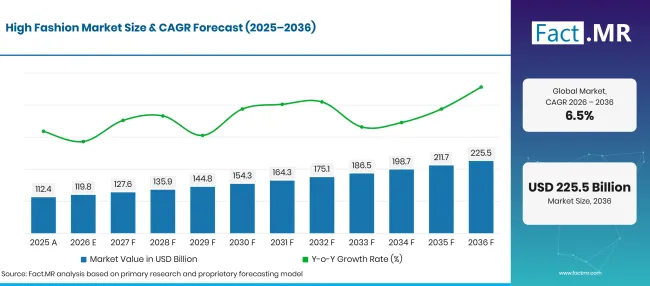
Factmr High Fashion Market Forecast Global | Source: Fact.MR
| Year | Basis | Market Value (USD billion) |
|---|---|---|
| 2025 | Historical estimate | 112.4 |
| 2026 | Estimate | 119.8 |
| 2036 | Forecast | 225.5 |
| CAGR 2026 to 2036 | Forecast period | 6.5% |
Source: Fact.MR analysis. Updated Oct 22, 2026
What are the defining numbers behind High Fashion Market growth?
The forecast adds USD 105.77 billion in annual sales by 2036. That opportunity is not simply a matter of opening more shops. Houses need designs that customers want at their intended price, disciplined production commitments and enough continuity to bring established clients back between seasons.
- Demand Drivers in the Market
- Recognizable products give a house a credible starting point for renewed demand. Burberry's 2025/26 annual report identifies outerwear and scarves as outperforming categories. A customer can connect these products with the brand's established identity before assessing a new collection. That familiarity can help support a premium within the wider women's apparel market. The commercial opportunity is to refresh the product without losing the characteristics that made the customer interested in the first place. [1]
- Strong collection response can increase sales without relying on a larger store estate. Prada Group reported 8% organic retail-sales growth at constant currency in 2025 and linked its retail performance to like-for-like full-price sales. This is evidence of one group's execution rather than a uniform industry recovery. For other houses the implication is to judge creative investment by repeat customer purchases and product-level sell-through. Wider distribution becomes valuable when demand can sustain it. [10]
- Craft capacity constrains how quickly a successful product can reach buyers. Hermès opened its twenty-fourth leather-goods workshop in September 2025 and reported further planned openings. Such investment creates productive capacity around an established business. It also shows why growth in the handbag and purse manufacturing market requires attention to trained workers and finishing consistency. High-fashion houses must protect those capabilities as orders expand because a visible quality failure can weaken a premium price. [5]
- A product launch can bring new attention to a house when the item has a clear identity. Chanel's 2025 results identify Ready-to-Wear and the CHANEL 25 handbag as contributors to positive Fashion performance. For the market this supports an assortment-led view of growth. A successful item can give store staff a concrete starting point for customer conversations. Follow-on revenue depends on whether the rest of the offer meets the expectations created by that first purchase. [2]
- Key Segments Analyzed
- Apparel accounts for 43.2% of estimated 2026 revenue. The category carries a house's seasonal design language and requires careful size and style planning.
- Department Stores hold 32.2% of the 2026 channel allocation. They bring multiple houses into one shopping visit while creating shared responsibility for inventory and presentation.
- Women represent 54.1% of 2026 demand. Retaining established clients matters alongside acquiring buyers through new collections.
- Luxury contributes 48.3% of the 2026 price-range allocation. Product quality and service must support the price after initial brand interest.
- Analyst Opinion at Fact.MR
- Shambhu Nath Jha, Lead Consultant, Fact.MR
- In fashion, a successful launch can hide problems that show up later. A collection may attract press coverage while unsold sizes accumulate in the stockroom. Brands that know which products customers return for can replenish those lines and take smaller risks on less certain designs. Full-price sell-through matters because repeated discounting weakens both margin and the reason to buy early. Store growth should follow a proven customer base, not substitute for one.
- Strategic Implications
- Decide what happens to unsold stock before committing to production. The EU ban on destroying unsold apparel and footwear began applying to large companies on 19 July 2026. [3] Resale, transfer and reuse need to be practical options, not plans drafted after a season fails. A smaller initial order can be less costly than creating excess inventory that later damages the brand through discounting or disposal.
- Authenticity has become part of product service. The OECD and EUIPO's 2025 report lists clothing, footwear and handbags among major counterfeit categories, drawing on global seizures from 2021. [9] Brands need reliable product identification and an authorised route for customers seeking advice, repairs or confirmation of provenance. That service remains valuable when an item is resold.
- Use scarves and small leather goods carefully as first purchases. They can bring customers into a designer house through the wider apparel accessories market, but the next item still has to justify its own price. Filling entry-level shelves with generic branded products can dilute the very identity that attracts a buyer in the first place.
- Keep reliable records of materials, suppliers and repairs. The European Commission has identified textile apparel as a digital-product-passport priority and indicated a delegated act in the fourth quarter of 2027. [4] Detailed obligations will follow that decision. Better records already help stores answer customer questions and help brands manage repairs and resale.
Germany leads the five-country forecast at 7.59% CAGR. The United States provides a substantial base of high-fashion revenue. Brazil requires a carefully supported local offer. The United Kingdom faces a distinct visitor-shopping tax position. Japan demonstrates why buyer numbers and fashion expenditure need to be assessed separately.
How does the High Fashion Market break down by segment?
High fashion includes designer apparel and related fashion goods across the stated price ranges. Luxury and Premium describe positioning within that boundary. Affordable covers entry-price designer assortments. Department-store concessions are assigned to Department Stores so the channel allocation reflects the selling venue without counting the same transaction twice.
Why does Apparel account for 43.2% of high-fashion revenue?
Apparel holds a 43.2% share of estimated 2026 market revenue.
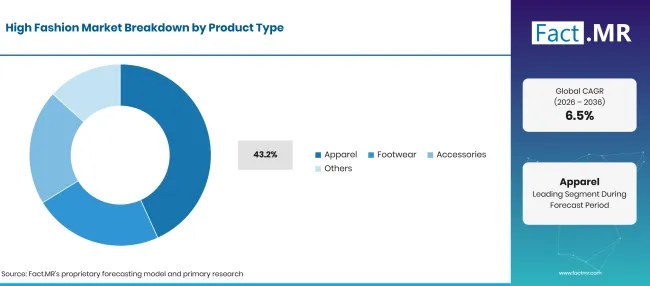
Factmr High Fashion Market Breakdown Product Type | Source: Fact.MR
| Product Type | Share (2026) |
|---|---|
| Apparel | 43.2% |
| Other segments combined | 56.8% |
| Total | 100.0% |
Source: Fact.MR analysis. Updated Oct 22, 2026
Apparel gives a designer the widest scope to express shape and construction across a collection. It also creates the most visible inventory challenge because styles must be offered in appropriate sizes. A strong collection can still leave costly gaps between customer demand and stock availability. Buyers should assess the depth behind a limited number of convincing products before increasing the number of distinct styles on the floor. Footwear introduces another fit-sensitive purchase within the wider footwear market. Accessories can serve gifting and repeat purchases with different size requirements. Assortment planning should respect these differences. A balanced collection gives each category a clear job in the customer's relationship with the house.
What sustains the role of Department Stores?
Department Stores account for 32.2% of the estimated 2026 channel allocation.
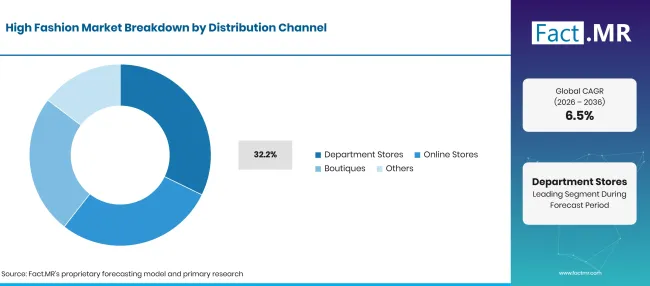
Factmr High Fashion Market Breakdown Distribution Channel | Source: Fact.MR
| Distribution Channel | Share (2026) |
|---|---|
| Department Stores | 32.2% |
| Other segments combined | 67.8% |
| Total | 100.0% |
Source: Fact.MR analysis. Updated Oct 22, 2026
Department stores let customers compare several houses during one visit and can introduce a collection to shoppers already spending in adjacent departments. That reach creates a useful sales opportunity. It also requires agreement on stock ownership and the timing of price reductions. A brand gains little from prominent space if the assortment is poorly maintained or staff cannot explain the product. Japan's department-store association recorded JPY 1.51 trillion in clothing sales during 2025 with a 2.2% decline on its store-adjusted comparison. This broader clothing measure shows that an established channel can still face demand pressure. High-fashion concessions need their own customer and category discipline within it. [7]
How should houses serve the 54.1% Women segment?
Women represent 54.1% of estimated high-fashion revenue in 2026.
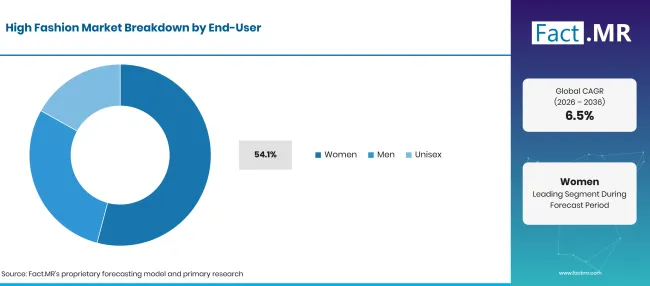
Factmr High Fashion Market Breakdown End User 1 | Source: Fact.MR
| End-User | Share (2026) |
|---|---|
| Women | 54.1% |
| Other segments combined | 45.9% |
| Total | 100.0% |
Source: Fact.MR analysis. Updated Oct 22, 2026
The commercial task is to understand which wardrobe decisions bring a client back. Occasion dressing and everyday purchases can have different budgets and replacement patterns. A house needs enough continuity for existing customers to recognize its offer while giving them a reason to consider something new. Personal service is most useful when it improves fit and selection rather than simply increasing contact frequency. Prada Group reported 35% constant-currency growth for Miu Miu retail sales in 2025 while Prada retail sales declined 1%. The contrast within one group illustrates how sharply individual brand performance can differ. The aggregate Women share does not make every womenswear collection equally attractive. [10]
What allows the Luxury tier to retain a premium?
Luxury contributes 48.3% of estimated 2026 market revenue.
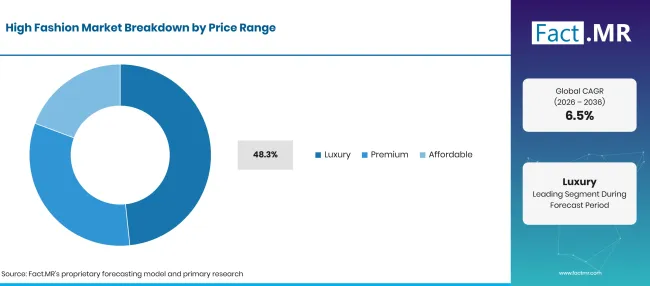
Factmr High Fashion Market Breakdown Price Range | Source: Fact.MR
| Price Range | Share (2026) |
|---|---|
| Luxury | 48.3% |
| Other segments combined | 51.7% |
| Total | 100.0% |
Source: Fact.MR analysis. Updated Oct 22, 2026
A high price needs support at the point of use. Materials and construction matter because the customer will judge the garment or accessory after leaving the store. Service then influences the relationship when an adjustment or repair is needed. Luxury houses should maintain those capabilities while deciding which new products deserve a place in the range. Raising the ticket on an undifferentiated item makes that decision harder for the buyer. Premium and Affordable describe lower price positions within designer fashion. Affordable does not bring mass-market fast fashion into the scope. The distinction lets the analysis examine accessible designer purchases without treating all branded clothing as high fashion.
What is accelerating High Fashion Market adoption, and what is holding it back?
Fashion houses face a familiar problem: collections must be designed and made before anyone knows their full commercial reception. A standout piece may sell out while nearby styles require markdowns. Signature products that can be replenished provide stability, but they cannot remove the risk of seasonal design. The most revealing measures are sell-through at full price, stock carried forward and the margin remaining after returns and discounting.
Drivers Impact Analysis
| DRIVER | (~) % IMPACT ON CAGR | GEOGRAPHIC RELEVANCE | IMPACT TIMELINE |
|---|---|---|---|
| Repeat purchases of recognizable house signatures | +1.2% | Europe; United States; Japan | Medium term (2 to 4 years) |
| Successful collection renewal at full price | +1.6% | Global designer retail | Short term (up to 2 years) |
| Expanded skilled capacity for desirable accessories | +0.8% | European production; global sales | Medium term (2 to 4 years) |
| Customer development beyond established flagship locations | +0.7% | United States; Brazil | Long term (4 years or more) |
| Better fit and service supporting returning clients | +0.5% | Department stores and boutiques | Medium term (2 to 4 years) |
Source: Fact.MR analysis. Updated Oct 22, 2026
Opportunity Impact Analysis
| OPPORTUNITY | (~) % IMPACT ON CAGR | GEOGRAPHIC RELEVANCE | IMPACT TIMELINE |
|---|---|---|---|
| Smaller initial collections with timely replenishment | +0.9% | Global seasonal apparel | Short term (up to 2 years) |
| Product records supporting repair and authenticated resale | +0.4% | Europe; United States; Japan | Long term (4 years or more) |
| Designer entry assortments that retain brand identity | +1.1% | Brazil; United States; selected Asian markets | Medium term (2 to 4 years) |
| Closer control of specialist production capabilities | +0.6% | European manufacturing clusters | Long term (4 years or more) |
Source: Fact.MR analysis. Updated Oct 22, 2026
Restraints Impact Analysis
| RESTRAINT | (~) % IMPACT ON CAGR | GEOGRAPHIC RELEVANCE | IMPACT TIMELINE |
|---|---|---|---|
| Inventory commitments that exceed collection demand | -1.3% | Global houses and wholesale partners | Short term (up to 2 years) |
| Prices moving beyond perceived product value | -0.9% | Premium and aspirational buyers | Medium term (2 to 4 years) |
| Volatile expenditure by traveling customers | -0.6% | Japan; European destination retail | Short term (up to 2 years) |
| Counterfeit availability and uncertain product provenance | -0.4% | Cross-border and secondary channels | Long term (4 years or more) |
Source: Fact.MR analysis. Updated Oct 22, 2026
Which countries are scaling the High Fashion Market through 2036?
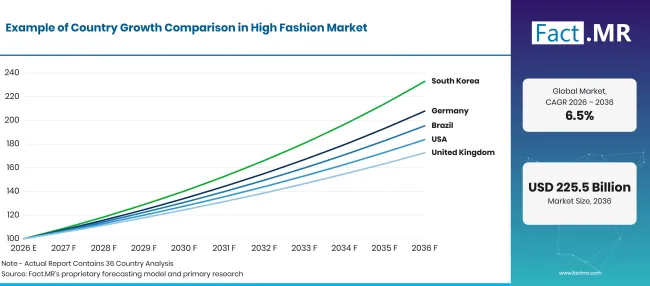
Factmr High Fashion Market Growth Index | Source: Fact.MR
| Country | CAGR (2026 to 2036) |
|---|---|
| Germany | 7.59% |
| Brazil | 6.93% |
| United States | 6.3% |
| United Kingdom | 5.61% |
| Japan | 4.95% |
Source: Fact.MR analysis. Updated Oct 22, 2026
What supports Germany's leading forecast growth?
7.59% CAGR. Collection planning and product accountability shape a stronger offer.
Germany has the highest forecast growth of the five assessed markets at 7.59%. Large fashion groups selling there must also plan for the EU's rules on unsold apparel and footwear. The Commission identifies resale and preparation for reuse as alternatives to destruction. [3] This makes stock transfer and end-of-season planning a matter for merchandisers well before a collection arrives.
Better stock management can improve the economics of serving German clients. It does not, by itself, make them buy more fashion. The brands most likely to gain are those with desirable products, a credible full-price offer and enough flexibility to move unsold sizes where demand still exists.
How can designer houses build a dependable offer in Brazil?
6.93% CAGR. Local product support should accompany carefully chosen distribution.
Brazil's textile-labelling requirements, clarified by Inmetro in April 2026, cover fibre composition, origin and responsible-party information, with prescribed details in Portuguese. [6] A fashion house entering Brazil must coordinate with its importer and ensure that the actual products arriving in stores carry the right information.
Brazil's CAGR is forecast at 6.93%. For a premium purchase, service matters after the garment leaves the store: alterations, repairs and access to another size can decide whether a buyer returns. Establishing those basics through a limited local network may be more productive than an ambitious store-opening programme.
Where is the next layer of United States demand?
6.3% CAGR. The market is estimated at USD 44.94 billion in 2026.
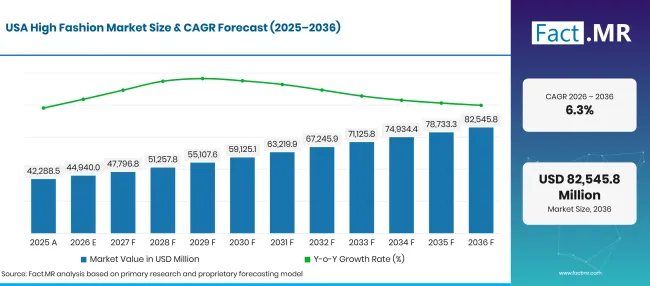
Factmr High Fashion Market Forecast Usa | Source: Fact.MR
The United States market is estimated at USD 44.94 billion in 2026. Hermès opened stores in Scottsdale and Nashville in 2025, showing how an established house can seek customers outside traditional flagship locations. [5] The commercial question is whether each new store has enough demand for its particular assortment, not whether expansion attracts attention.
U.S. high fashion is forecast to grow 6.27% annually. Regular clients and skilled local teams can make a new location worthwhile, especially when staff understand the wardrobe needs of customers beyond a first statement purchase. A store that depends mainly on opening-week curiosity is a weak base for long-term revenue.
How does the UK's visitor-shopping position affect fashion retail?
5.61% CAGR. The sales proposition must account for the destination's tax treatment.
Great Britain's visitor-shopping rules differ from the assumptions many international customers bring to a luxury store. UK guidance permits tax-free sales in Great Britain when goods are delivered directly outside the country; Northern Ireland follows a separate framework. [11] Staff must explain the applicable treatment before a customer makes a purchase, not after an incorrect expectation becomes a complaint.
With a 5.61% forecast CAGR, UK growth will still rely heavily on domestic customers and the quality of the store experience. Reliable alterations, knowledgeable service and access to sought-after products can matter more than promises about a tax refund that the shopper may not be entitled to receive.
Why does Japan require more than growing visitor numbers?
4.95% CAGR. The 2026 market is valued at USD 4.60 billion.
Japan's department-store figures make it necessary to separate shopping traffic from spending. The Japan Department Stores Association reported changes in customer patterns and category sales during 2025. [8] More visitors to a shopping district does not guarantee higher high-fashion receipts, especially when purchasing is concentrated in a narrow group of brands.
Japan's forecast CAGR is 4.95%, with a 2026 market value of USD 4.60 billion. Houses should monitor repeat domestic purchases alongside tourist sales and avoid assuming that stronger visitor numbers raise sales evenly across apparel, leather goods and accessories. Assortment and service still determine which clients return.
Who leads the High Fashion Market?
Chanel holds leading share of high-fashion revenue in 2026. Its competitive position includes control of product identity and specialist capabilities. The company's 2025 results report more than USD 700 million invested in long-standing suppliers and expertise across areas including leather goods. This is a company-wide investment disclosure. Within fashion it illustrates the importance of preserving access to the materials and skilled work that make a differentiated product possible. [2]
Ownership changes can strengthen operating resources without settling a brand's creative direction. Prada completed the acquisition of Versace on 2 December 2025. The two houses enter the same group with different identities and customer expectations. The commercial challenge is to improve sourcing and retail execution while giving each brand a convincing reason to be chosen. Shared ownership provides options. Collection relevance still has to be earned at the level of the individual house. [10]
Gucci, Louis Vuitton and Dior compete with the other houses listed below for discretionary purchases that customers can defer. The strongest product usually has an identity customers recognise and a consistent level of service behind it. Burberry's renewed focus on established categories shows one approach to restoring customer interest. [1] Full-price sell-through and sales per store are more useful tests of progress than the number of openings announced in a year.
Which companies are the key providers?
- Chanel
- Gucci
- Louis Vuitton
- Prada
- Hermès
- Dior
- Versace: Part of Prada Group following completion of its acquisition on 2 December 2025.
- Burberry
- Armani
- Fendi
Bibliography
- [1] Burberry Group plc. (2026). Annual report 2025/26.
- [2] Chanel Limited. (2026, May 19). Chanel Limited financial results for the year ended 31 December 2025.
- [3] European Commission. (2026, July 17). Ban on destruction of unsold clothes and shoes enters into application.
- [4] European Commission. (n.d.). Textile apparel and the digital product passport (DPP).
- [5] Hermès International. (2026, February 12). 2025 full-year results.
- [6] Instituto Nacional de Metrologia, Qualidade e Tecnologia. (2026, April 8). Quais são as informações obrigatórias no produto e na embalagem dos produtos têxteis?
- [7] Japan Department Stores Association. (2026, January 23). Nationwide department store sales: January-December 2025 [Statistical tables].
- [8] Japan Department Stores Association. (2026, January 23). Overview of nationwide department store sales in December 2025.
- [9] Organisation for Economic Co-operation and Development, & European Union Intellectual Property Office. (2025). Mapping global trade in fakes 2025.
- [10] Prada Group. (2026, March 5). Prada Group: FY 2025 financial results.
- [11] UK Government. (n.d.). Tax on shopping and services: Tax-free shopping.
This Report Answers
- Which products give a fashion house a stronger basis for repeat sales?
- How can brands expand without committing to excessive seasonal stock?
- What determines the commercial value of a department-store concession?
- Where can production control protect a premium product offer?
- How do visitor-shopping conditions affect country opportunities?
- What product information can remain useful through repair and resale?
What does the High Fashion Market cover?
The High Fashion Market covers designer-led products across four product categories and the stated price ranges. It evaluates purchase activity through department stores and other sales venues. End-user allocation follows the intended customer category. The five country forecasts examine distinct retail conditions alongside the global 2026 to 2036 revenue outlook.
What is included in the scope?
Included revenue comes from newly sold high-fashion apparel and footwear together with designer fashion accessories. Leather goods and scarves sit within accessories. Other fashion goods include designer eyewear and costume jewelry where sold within the house's fashion assortment. Couture garments remain within apparel. Entry-price designer products remain inside the stated high-fashion boundary.
What is excluded from the scope?
Mass-market fast fashion and undifferentiated apparel are excluded. Fragrance and beauty products are outside the scope together with fine jewelry and watches. Resale transaction value and separate repair fees do not enter new-product revenue. A store concession sale is counted once within its assigned venue. Parent-group revenue from unrelated activities is excluded.
How Was the Analysis Built?
The analysis draws on 120+ sources, 35+ company portfolios, 25+ countries, and more than 20 industry interviews.
- Primary Research: Primary research includes discussions with manufacturers, service providers, technology developers, distributors, end users, and subject-matter experts. These conversations examine purchasing priorities, product adoption, operational challenges, approval requirements, competitive positioning, and the factors that influence wider market acceptance.
- Desk Research: Desk research covers government statistics, regulatory publications, company filings, trade data, technical studies, industry associations, standards, public policy, and other authoritative sources. Every source used in the analysis is documented in the bibliography.
- Market Sizing and Forecasting: Market estimates combine historical performance, demand indicators, pricing and volume trends, segment shares, company participation, country-level growth, adoption patterns, investment activity, and barriers to market expansion.
- Data Validation and Update Cycle: Findings are validated by comparing primary interviews with public data, company activity, regulatory changes, trade patterns, and industry developments. Regular updates review new product launches, capacity changes, partnerships, approvals, and shifts in commercial adoption.
Segmentation
What is the report’s scope and coverage?
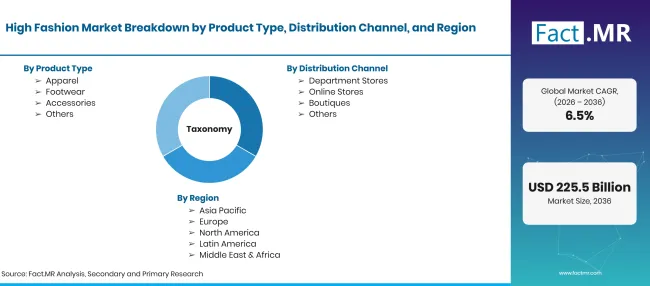
Factmr High Fashion Market Taxonomy | Source: Fact.MR
| Attribute | Details |
|---|---|
| Quantitative Units | USD billion in 2025, 2026 and 2036; CAGR for 2026 to 2036 |
| Market Definition | Designer apparel, footwear and fashion accessories sold as new goods under high-fashion positioning. The boundary includes luxury and premium lines together with designer entry-price assortments. Beauty products and investment jewelry are outside the market. |
| Product Type | Apparel; Footwear; Accessories; Others |
| Distribution Channel | Department Stores; Online Stores; Boutiques; Others |
| End-User | Women; Men; Unisex |
| Price Range | Luxury; Premium; Affordable |
| Regions Covered | North America; Latin America; Western Europe; Eastern Europe; East Asia; South Asia & Pacific; Middle East & Africa |
| Countries Covered | Germany; Brazil; United States; United Kingdom; Japan |
| Companies Profiled | Chanel; Gucci; Louis Vuitton; Prada; Hermès; Dior; Versace; Burberry; Armani; Fendi |
| Forecast Period | 2026 to 2036 |
| Approach | Assessment of collection demand, assortment depth and retained selling price alongside craft capacity and customer service. Regional analysis examines distribution conditions and the distinction between local spending and visitor purchases. |
Source: Fact.MR analysis. Updated Oct 22, 2026
How is the market segmented?
-
By Product Type
- Apparel
- Footwear
- Accessories
- Others
-
By Distribution Channel
- Department Stores
- Online Stores
- Boutiques
- Others
-
By End-User
- Women
- Men
- Unisex
-
By Price Range
- Luxury
- Premium
- Affordable
-
By Region
- North America
- Latin America
- Western Europe
- Eastern Europe
- East Asia
- South Asia & Pacific
- Middle East & Africa
Frequently Asked Questions
What is the High Fashion Market worth in 2026?
How fast will the market grow through 2036?
Which product category leads high-fashion revenue?
Why are Department Stores important to high fashion?
Which country has the highest forecast CAGR?
Who worked on this report


Preview the report firsthand - request a free sample
Free SampleGet the brochure for pricing and purchase details
Download PDF