- Market Value (2025): USD 23.6 Bn
- Estimated Value (2026): USD 25.0 Bn
- Forecast Value (2036): USD 44.7 Bn
- CAGR (2026-2036): 6.0%
What is the Baby Fashion Accessories Market forecast to be worth by 2036?
USD 25.0 billion in 2026 to USD 44.7 billion by 2036, at a 6.0% CAGR.
- The baby fashion accessories market reached USD 23.6 billion in 2025.
- Sales are projected to rise from USD 25.0 billion in 2026 to USD 44.7 billion by 2036.
- The market is forecast to grow at a 6.0% CAGR during 2026 to 2036 as parents replace size-sensitive footwear and purchase everyday accessories for children
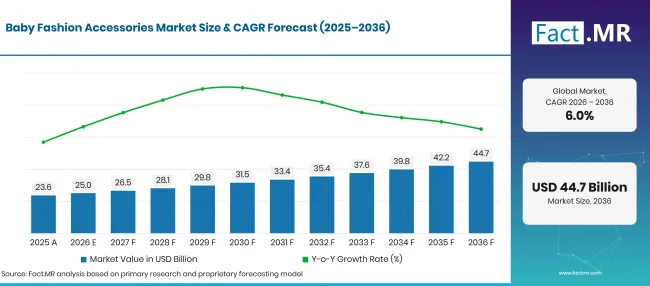
Factmr Baby Fashion Accessories Market Forecast Global | Source: Fact.MR
|
Year |
Basis | Market Value (USD billion) |
|---|---|---|
| 2025 | Historical estimate | 23.6 |
| 2026 | Estimate | 25.0 |
| 2036 | Forecast | 44.7 |
| CAGR 2026 to 2036 | Forecast period | 6.0% |
Source: Fact.MR analysis. Updated Oct 17, 2026
What are the defining numbers behind Baby Fashion Accessories Market growth?
The market offers USD 19.7 billion in additional value between 2026 and 2036, with shoes, cotton and online retail shaping the product mix.
- Demand Drivers in the Market
- Parents buying first-walker shoes pay close attention to fit, flexible soles and the ease of putting shoes on a moving child. Repeat purchases occur as children outgrow earlier sizes, while clear sizing guidance helps online shoppers choose between products.
- Caregivers regularly replace socks and bibs because these products face frequent washing and daily use. Cotton offers a familiar feel against skin, while care instructions and secure closures affect product selection during the first years of life.
- Gift shoppers often choose hats and coordinated headbands when buying outfits for newborn celebrations or family occasions. Matching accessories have a different purchase rhythm from basic socks and bibs, giving retailers a reason to carry both everyday and occasion-led ranges.
- Online babywear shoppers compare sizes and material details before ordering accessories with related clothing. Retailers that display practical fit information alongside return policies are more likely to reduce ordering uncertainty for parents shopping remotely.
- Key Segments Analyzed
- By Product Type: Shoes account for 28.4% share in 2026 as changing foot sizes support repeat purchases.
- By Material: Cotton holds 46.2% share in 2026, reflecting its use across soft everyday baby accessories.
- By Distribution Channel: Online Retail holds 38.5% share in 2026 as parents compare product options from home.
- By End-User: Infants represent 42.6% share in 2026 owing to frequent size and clothing changes.
- Analyst Opinion at Fact.MR
- Shambhu Nath Jha, Principal Consultant at Fact.MR, states, “Baby fashion accessory sales depend strongly on fit, comfort, and how quickly children move into new sizes. Brands that provide clear measurements, easy-care material information, and practical product descriptions are better positioned to support repeat purchases. Online retailers also need accurate sizing and return guidance, especially for footwear, where parents cannot check fit before ordering.”
- Strategic Implications
- Footwear brands should give parents clear size charts and explain the intended stage of use so first-walker products are easier to compare.
- Cotton accessory makers should keep washing and care information clear because bibs and socks are used repeatedly throughout the week.
- Online retailers should group matching accessories with relevant baby sizes while making returns and material information easy to find.
- Specialty stores should allow shoppers to check fabric feel and footwear fit in person when comfort is the main reason for visiting.
Germany has a 6.9% CAGR forecast, while Brazil follows at 6.3% as babywear distribution serves different income groups. The United States is projected at 5.7% as specialist chains and online stores compete for family purchases. The United Kingdom records 5.1%, while Japan reaches 4.5% amid a smaller newborn population and an established retail system.
How does the Baby Fashion Accessories Market break down by segment?
Leading segments include shoes at 28.4%; Cotton 46.2%; Online Retail 38.5%; Infants 42.6% in 2026.
Which Product Type dominates?
Shoes holds 28.4% share in 2026.
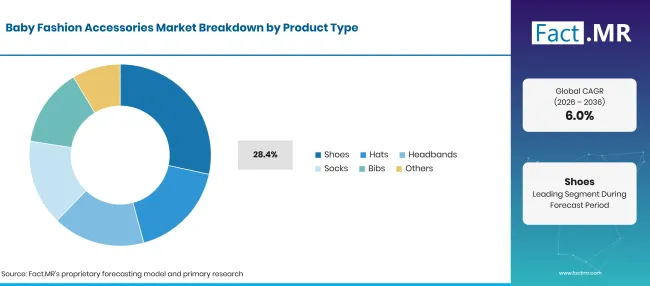
Factmr Baby Fashion Accessories Market Breakdown Product Type | Source: Fact.MR
| Product Type | Share (2026) |
|---|---|
| Shoes (Leading segment) | 28.4% |
| Other segments combined | 71.6% |
| Total | 100.0% |
Source: Fact.MR analysis. Updated Oct 17, 2026
Shoes are forecast to hold 28.4% share in 2026. Children move between footwear sizes as their feet grow, so parents compare fit and fastenings whenever a replacement becomes necessary. Flexible designs appeal to families shopping for early walkers, while socks cover frequent daily use. Hats serve weather-related needs and headbands often complete coordinated outfits. Retailers can improve shoe selection by showing actual measurements alongside age guidance.
What leads the Material segment?
Cotton holds 46.2% share in 2026.
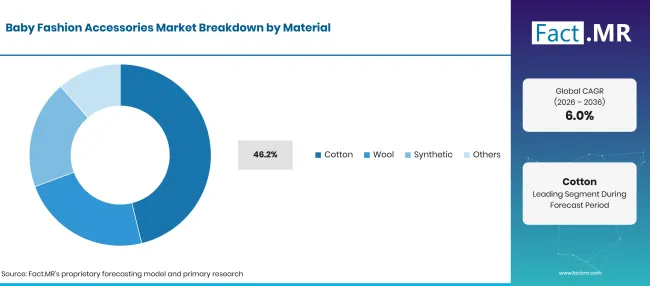
Factmr Baby Fashion Accessories Market Breakdown Material | Source: Fact.MR
| Material | Share (2026) |
|---|---|
| Cotton (Leading segment) | 46.2% |
| Other segments combined | 53.8% |
| Total | 100.0% |
Source: Fact.MR analysis. Updated Oct 17, 2026
Cotton is forecast to account for 46.2% share in 2026. Parents often choose cotton for bibs and socks because these items touch the skin and need regular washing. Wool serves colder-weather headwear, while synthetic fabrics can suit accessories where shape retention matters. Fabric labels help families compare care needs before buying, especially when several accessory types are purchased together.
Which Distribution Channel serves the largest share?
Online Retail holds 38.5% share in 2026.
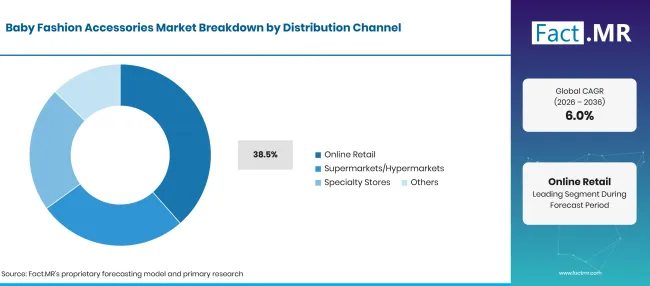
Factmr Baby Fashion Accessories Market Breakdown Distribution Channel | Source: Fact.MR
| Distribution Channel | Share (2026) |
|---|---|
| Online Retail (Leading segment) | 38.5% |
| Other segments combined | 61.5% |
| Total | 100.0% |
Source: Fact.MR analysis. Updated Oct 17, 2026
Online retail is estimated to account for 38.5% share in 2026. Parents can compare baby shoes and matching accessories while shopping for clothing at home. Clear product photographs help with color selection, while accurate size charts are especially useful for shoes. Physical specialty stores remain relevant when shoppers want to feel fabrics or check a child’s footwear fit. Online sellers can improve repeat purchases by keeping familiar sizes easy to reorder.
How does End-User purchasing shape sales?
Infants holds 42.6% share in 2026.
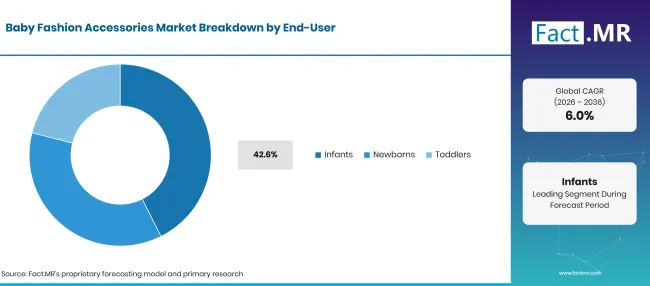
Factmr Baby Fashion Accessories Market Breakdown End User | Source: Fact.MR
| End-User | Share (2026) |
|---|---|
| Infants (Leading segment) | 42.6% |
| Other segments combined | 57.4% |
| Total | 100.0% |
Source: Fact.MR analysis. Updated Oct 17, 2026
What is accelerating Baby Fashion Accessories Market adoption, and what is holding it back?
Size-related replacement purchases and convenient online shopping support sales, while changing birth numbers and uncertain fit influence purchasing decisions.
Drivers Impact Analysis
| DRIVER | (~) % IMPACT ON CAGR | GEOGRAPHIC RELEVANCE | IMPACT TIMELINE |
|---|---|---|---|
| Repeat shoe sizing | +1.0% | Global | Medium term (2–4 years) |
| Everyday cotton accessories | +0.8% | Global | Short term (<= 2 years) |
| Online assortments | +0.7% | North America, Europe | Medium term (2–4 years) |
| Coordinated gifting | +0.5% | Global | Short term (<= 2 years) |
| Seasonal headwear | +0.4% | Europe, Japan | Medium term (2–4 years) |
Source: Fact.MR analysis. Updated Oct 17, 2026
Opportunity Impact Analysis
| OPPORTUNITY | (~) % IMPACT ON CAGR | GEOGRAPHIC RELEVANCE | IMPACT TIMELINE |
|---|---|---|---|
| Fit guidance online | +0.8% | Global | Short term (<= 2 years) |
| Coordinated sets | +0.6% | Global | Medium term (2–4 years) |
| Easy-care materials | +0.5% | Global | Medium term (2–4 years) |
| Specialty footwear fitting | +0.4% | Urban markets | Medium term (2–4 years) |
Source: Fact.MR analysis. Updated Oct 17, 2026
Restraints Impact Analysis
| RESTRAINT | (~) % IMPACT ON CAGR | GEOGRAPHIC RELEVANCE | IMPACT TIMELINE |
|---|---|---|---|
| Birth cohort contraction | -0.8% | Germany, Japan | Long term (>= 4 years) |
| Sizing uncertainty | -0.6% | Global | Short term (<= 2 years) |
| Household price sensitivity | -0.5% | Global | Medium term (2–4 years) |
| Seasonal inventory mismatch | -0.4% | Global | Short term (<= 2 years) |
Source: Fact.MR analysis. Updated Oct 17, 2026
Which countries are scaling the Baby Fashion Accessories Market through 2036?
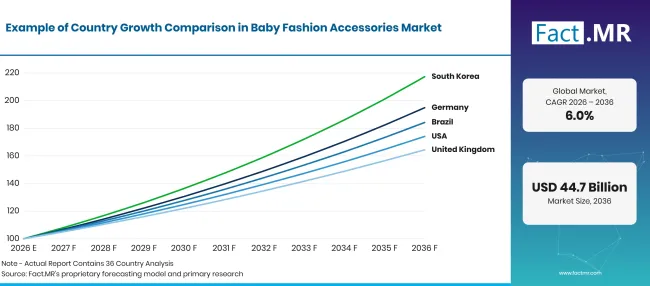
Factmr Baby Fashion Accessories Market Growth Index | Source: Fact.MR
| Country | CAGR (2026–2036) |
|---|---|
| Germany | 6.9% |
| Brazil | 6.3% |
| United States | 5.7% |
| United Kingdom | 5.1% |
| Japan | 4.5% |
Source: Fact.MR analysis. Updated Oct 17, 2026
Why is Germany expanding baby accessory sales?
6.9% CAGR, linked to practical footwear purchases and organized babywear retail.
German parents compare baby shoe fit and textile care before choosing accessories for daily wear. In July 2026, Destatis reported a final count of 654,241 live births in Germany for 2025 [1]. Each birth represents a potential starting point for newborn accessory purchases, while repeat shoe sizing and everyday cotton products serve families after the initial purchase.
How is Brazil developing baby accessories retail?
6.3% CAGR, shaped by mass-market purchase options and babywear availability.
Brazilian families buy baby accessories from general clothing retailers and stores specializing in children’s products. The Ministry of Health recorded 2,442,647 live births in Brazil in 2025 in its annual management report [2].
What supports the United States outlook?
5.7% CAGR, supported by established specialist retailers and repeat size purchases.
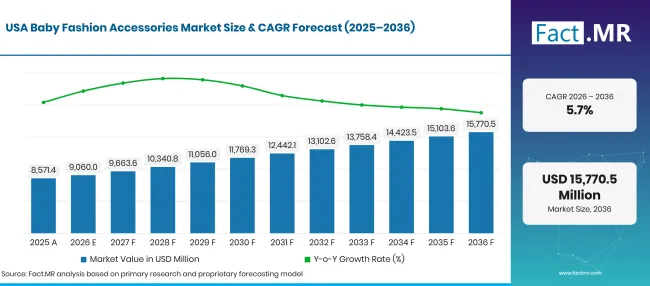
Factmr Baby Fashion Accessories Market Forecast Usa | Source: Fact.MR
Specialist children’s retailers give United States families access to shoes and coordinated accessories through stores and their online ranges. The CDC reported in April 2026 a provisional estimate of 3,606,400 births in the United States in 2025 [3]. These births provide a measurable reference for potential first-time purchases, while later footwear replacements follow each child’s changing size.
How is the United Kingdom influencing channel purchases?
5.1% CAGR, connected to online retail use and everyday babywear replacement.
British families commonly compare infant clothing accessories online before visiting a store for footwear fitting or fabric checks. The Office for National Statistics reported in May 2026 that England and Wales recorded 585,396 live births in 2025 [4]. This population measure helps describe the starting pool of newborn shoppers rather than accessory sales.
Why is Japan maintaining a measured outlook?
4.5% CAGR, shaped by careful product selection and demographic pressure.
Japanese baby accessory retailers serve families who consider material quality and product sizing for early childhood. The country’s official population estimates provide a useful demographic background for planning newborn product assortments [5].
Who leads the Baby Fashion Accessories Market?
Carter’s and The Children’s Place have direct babywear assortments, while H&M, Zara and Gap offer accessories alongside children’s clothing.
H&M and Zara offer baby and children’s clothing ranges, while Gap sells babywear through its namesake brands. Burberry and Ralph Lauren occupy a premium styling position within children’s clothing assortments. Mothercare operates as a baby and child retail brand with international franchise activity. Competitive differences center on product assortment and material choices, while online size guidance and availability influence everyday purchases.
Which companies are the key providers?
Key companies include Carter’s Inc.; The Children’s Place Inc.; H&M Hennes & Mauritz AB; Zara (Inditex Group); Gap Inc.; Mothercare plc; Burberry Group plc; Ralph Lauren Corporation.
- Carter’s Inc.
- The Children’s Place Inc.
- H&M Hennes & Mauritz AB
- Zara (Inditex Group)
- Gap Inc.
- Mothercare plc
- Burberry Group plc
- Ralph Lauren Corporation
Bibliography
- [1] Statistisches Bundesamt (Destatis). (2026, July 1). Zusammengefasste Geburtenziffer sinkt im Jahr 2025 auf 1,32 Kinder je Frau.
- [2] Ministério da Saúde. (2026, March). Relatório Anual de Gestão 2025.
- [3] Centers for Disease Control and Prevention. (2026, April 9). U.S. births down 1% in 2025.
- [4] Office for National Statistics. (2026, May 27). Births in England and Wales: 2025.
- [5] Statistics Bureau of Japan. (2026, September 24). Population estimates.
- [6] Office for National Statistics. (2026, August 21). Retail sales, Great Britain: July 2026.
- [7] Carter’s, Inc. (2026, July 8). Carter’s, Inc. releases 2025 Raise the Future Impact Report.
- [8] The Children’s Place, Inc. (2025, September 18). Sidoti Small Cap Conference [Investor presentation].
This Report Answers
- The report compares footwear and other accessory product categories across infant and toddler purchasing needs.
- Material analysis examines cotton accessories alongside wool and synthetic alternatives used for different purposes.
- Channel analysis reviews how online buying compares with in-store checks for size and fabric feel.
- Country sections describe purchasing conditions and demographic context across five national markets.
What does the Baby Fashion Accessories Market cover?
The market covers wearable accessories for newborns, infants and toddlers, including shoes and hats. Headbands, socks and bibs enter the category when sold as accessories for everyday use or coordinated outfits. Related childrenswear and baby footwear categories help explain the broader retail setting without changing the accessory market boundary.
What is included in the scope?
Products are included when they are sold as baby fashion accessories through online retail, specialty shops or general retail outlets. Footwear is counted where intended for baby and toddler use, including early-walking products. The scope also includes cotton and alternative material accessories that complement everyday baby outfits. Retailer assortments may combine these goods with wider babywear collections, but the analysis focuses on the accessory purchase.
What is excluded from the scope?
The market excludes full outfits and clothing categories sold without a distinct accessory component. It also excludes strollers, furniture, feeding equipment and baby-care appliances. Bibs are included as wearable accessories, while bottles and other feeding products remain outside the fashion accessory category. The report does not treat independent apparel chains and the brands they own as separate corporate competitors.
How Was the Analysis Built?
The analysis draws on 120+ sources, 35+ company portfolios, 25+ countries, and more than 20 industry interviews.
- Primary Research: Primary research includes discussions with manufacturers, service providers, technology developers, distributors, end users, and subject-matter experts. These conversations examine purchasing priorities, product adoption, operational challenges, approval requirements, competitive positioning, and the factors that influence wider market acceptance.
- Desk Research: Desk research covers government statistics, regulatory publications, company filings, trade data, technical studies, industry associations, standards, public policy, and other authoritative sources. Every source used in the analysis is documented in the bibliography.
- Market Sizing and Forecasting: Market estimates combine historical performance, demand indicators, pricing and volume trends, segment shares, company participation, country-level growth, adoption patterns, investment activity, and barriers to market expansion.
- Data Validation and Update Cycle: Findings are validated by comparing primary interviews with public data, company activity, regulatory changes, trade patterns, and industry developments. Regular updates review new product launches, capacity changes, partnerships, approvals, and shifts in commercial adoption.
Segmentation
What is the report’s scope and coverage?
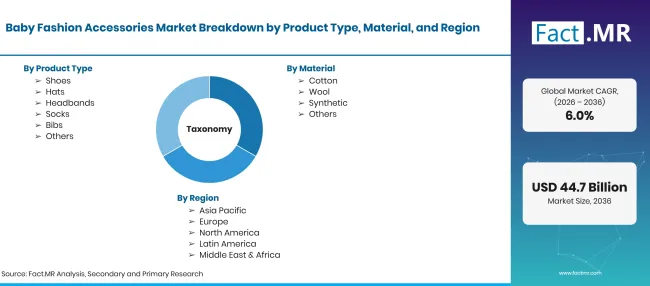
Factmr Baby Fashion Accessories Market Taxonomy | Source: Fact.MR
| Attribute | Details |
|---|---|
| Quantitative Units | USD billion in 2026 to USD billion by 2036 at CAGR |
| Market Definition | Fashion and everyday wearable accessories designed for newborns, infants and toddlers |
| Product Type | Shoes; Hats; Headbands; Socks; Bibs; Others |
| Material | Cotton; Wool; Synthetic; Others |
| Distribution Channel | Online Retail; Supermarkets/Hypermarkets; Specialty Stores; Others |
| End-User | Infants; Newborns; Toddlers |
| Regions Covered | North America; Latin America; Western Europe; Eastern Europe; East Asia; South Asia & Pacific; Middle East & Africa |
| Countries Covered | Germany; Brazil; United States; United Kingdom; Japan |
| Companies Profiled | Carter’s Inc.; The Children’s Place Inc.; H&M Hennes & Mauritz AB; Zara (Inditex Group); Gap Inc.; Mothercare plc; Burberry Group plc; Ralph Lauren Corporation |
| Forecast Period | 2026 to 2036 |
| Approach | Segment mix, buyer needs, official demographics, retail conditions and company disclosures |
Source: Fact.MR analysis. Updated Oct 17, 2026
How is the market segmented?
-
By Product Type
- Shoes
- Hats
- Headbands
- Socks
- Bibs
- Others
-
By Material
- Cotton
- Wool
- Synthetic
- Others
-
By Distribution Channel
- Online Retail
- Supermarkets/Hypermarkets
- Specialty Stores
- Others
-
By End-User
- Infants
- Newborns
- Toddlers
-
By Region
- North America
- Latin America
- Western Europe
- Eastern Europe
- East Asia
- South Asia & Pacific
- Middle East & Africa
Frequently Asked Questions
How big is the baby fashion accessories market in 2026?
What is the CAGR from 2026 to 2036?
Which product type has the specified largest share?
Which material leads?
Who are the main companies in the baby fashion accessories market?
Who worked on this report


Preview the report firsthand - request a free sample
Free SampleGet the brochure for pricing and purchase details
Download PDF