- Base Value(2024): Bn
- Estimated Value(2025): 2.3 Bn
- Forecast Value (2035): 4.3 Bn
- CAGR (2025 - 2035): 6.5%
High-Fat Low-Protein Snacks Market Outlook 2025 to 2035
The global High-Fat Low-Protein Snacks Market is expected to grow from USD 2.3 Billion in 2025 to USD 4.3 Billion by 2035, at a CAGR of 6.5%. These snacks are popular in keto and low-carb diets for their energy density and satiety benefits. Nuts and trail mixes dominate due to natural fat content, while dried fruit and meat snacks are expanding with innovations in shelf-stable formulations and clean-label offerings.
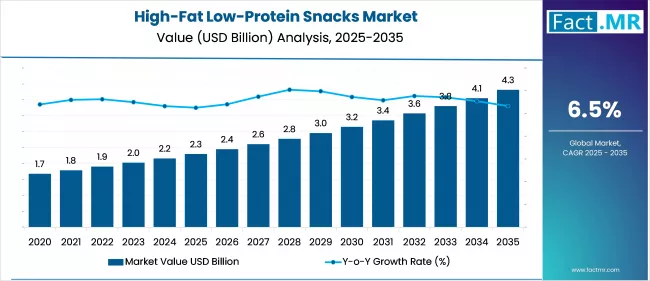
High Fat Low Protein Snacks Market Value Analysis | Source: Fact.MR
| Metric | Value |
|---|---|
| High-Fat Low-Protein Snacks Market Estimated Value in (2025 E) | USD 2.3 billion |
| High-Fat Low-Protein Snacks Market Forecast Value in (2035 F) | USD 4.3 billion |
| Forecast CAGR (2025 to 2035) | 6.5% |
Source: Fact.MR analysis. Updated Aug 20, 2025
According to FACT.MR latest study the global high-fat low-protein snacks is expected to grow at a compound annual growth rate (CAGR) of 6.2% from 2021 to 2031.
Over the last few years, the increasing health and wellness trend has resulted in a major increase in demand for functional and fortified foods and beverages.
The high-fat low-protein snacks are fat-fortified snacking choices low in protein that may provide customers with functional benefits. The high-fat low-protein snacks are made from both animal and plant-based protein sources and are designed to be consumed on the go.
| Countries | CAGR |
|---|---|
| U.S. | 6.1% |
| Germany | 5.4% |
| China | 7.0% |
| India | 7.6% |
Source: Fact.MR analysis. Updated Aug 20, 2025
Nutrition’s On-The-Go is a Growing Trend Driving Innovation in the Snacking Industry.
The growing number of people joining the formal workforce, as well as their hectic lifestyles, has resulted in an increase in high-fat low-protein snack demand. This is due to the fact that high-fat low-protein snacks offer immediate satiation and a much desired break during a busy day.
Additionally, the market of high-fat low-protein snacks is being driven by the rising trend of dodging the risk of some chronic diseases and preserving health and wellbeing through attentive consumption of high-fat low-protein snacks.
Furthermore, as working adults and millennials search for snacking healthy solutions to combat food shortages and other health problems in their busy lives, the on-the-go diet trend is quickly gaining popularity. Both of the above factors are fueling the rapid growth of the high-fat low-protein snacks.
Healthy Snacking a Prominent Trend
The COVID crisis has had two effects on high-fat low-protein snacks: more time at home means more snacking, and a global pandemic means health is top of mind.
Furthermore, the high-fat low-protein snacks market is being driven by consumer preferences for healthy alternatives.
Demand for Healthy Snack Items Fueled by the Demand for Functional Healthy Food.
The growing demand for functional foods among consumers to preserve overall health and reduce the risk of certain lifestyle-related chronic health conditions is driving the market.
Consumers continue to search out healthier food choices in the grocery store. Natural, plant-based, and clean-label food items enriched with functional ingredients such as micronutrients, protein, and fiber.
The demand for high-fat low-protein snacks is growing due to the increasing promotion of such functional foods for digestive health, weight loss and lowering the risk of obesity, diabetes, and cardiovascular disease.
US and Canada Demand Outlook for High-fat Low-protein Snacks Market
North America leads the world in packaged and processed food items, and demand for high-fat low-protein snacks is increasing as people in the United States and Canada become more conscious of the health risks associated with eating a variety of heavy snacks.
Furthermore, producers in these areas employ advanced food processing technology, which aids in the development of high-fat low-protein snacks.
Europe High-Fat Low-Protein Snacks Market outlook
Europe is expected to be a huge opportunity for the high-fat low-protein snacks industry, which is unsurprising given the region's high consumption of refined and convenient snacks.
Furthermore, increasing obesity rates in the area have changed people's preferences toward natural, organic, and plant-based snacks, resulting in a massive opportunity for the high-fat low-protein snacks market in the region.
High-Fat Low-Protein Snacks Market: Key Players
Some key manufacturers operating the business in the high-fat low-protein snacks market globally include
- Pepsico Inc.
- Mondelez
- Nestle S.A
- Unilever
- Tyson
- B&G foods
- Danone
- Calbee
- Kellogg
- Buff Bake
- General Mills
- Premier Nutrition Corporation
- Bounce Foods ltd.
- Kashi Company
- Hormel Foods Corporation
In developed and emerging markets manufacturers are attracted as consumptions in regions like India, China, and Mexico, of packaged and ready-to-eat foods, as well as healthy snacks, has fueled demand for high-fat low-protein snacks. It is also expected to have a large market in developing Asian and Latin American markets.
High-Fat Low-Protein Snacks Market Report Highlights
- Detailed overview of the parent market
- Changing market dynamics in the industry
- In-depth market segmentation
- Historical, current and projected market size in terms of volume and value
- Recent industry trends and developments
- Competitive landscape
- Strategies of key players and products offered
- Potential and niche segments, geographical regions exhibiting promising growth
- A neutral perspective on market performance
- Must-have information for market players to sustain and enhance their market footprint
Segmentation
High-Fat Low-Protein Snacks Market Segmentation
-
Based on Product Type, the global high-fat low-protein snacks market can be segmented as:
- Nuts, Seeds & trail Mixes
- Dried Fruits snacks
- Meat snacks
- Cereal & granola bars
- others
-
Based on Nature, the global high-fat low-protein snacks market can be segmented as:
- Organic
- Conventional
-
Based on source, the global high-fat low-protein snacks market can be segmented as:
- Animal-based
- Plant-based
-
Based on the distribution channel, the global high-fat low-protein snacks market can be segmented as:
- B2B (Direct Sales)
- B2C (Indirect Sales)
- Store-based Retailing
- Supermarket/Hypermarket
- Convenience Stores
- Groceries
- Specialty Stores
- Other Retailing Formats
- Online Retailing
- Store-based Retailing
-
Based on the region, the global high-fat low-protein snacks market can be segmented as:
- North America
- U.S. and Canada
- Latin America
- Mexico, Brazil, Peru, Chile, and others
- Western Europe
- Germany, U.K., France, Spain, Italy, Nordic countries, Belgium, Netherlands, and Luxembourg
- Eastern Europe
- Poland and Russia
- Asia Pacific
- China, India, Japan, ASEAN, Australia, and New Zealand
- The Middle East and Africa
- GCC, Southern Africa, and North Africa
- North America
NOTE - Although care has been taken to maintain the highest levels of accuracy in Fact.MR’s reports, recent market/vendor-specific changes may take time to reflect in the analysis.
Frequently Asked Questions
What is the growth rate of the High-Fat Low-Protein Snacks?
Why is the High-Fat Low-Protein Snacks market witnessing major growth?
Where will the High-Fat Low-Protein Snacks market generate its major market share?
Who worked on this report


Preview the report firsthand - request a free sample
Free SampleGet the brochure for pricing and purchase details
Download PDF