- Base Value(2025): 16.8 Bn
- Estimated Value(2025): 16.8 Bn
- Forecast Value (2035): 22.4 Bn
- CAGR (2025 - 2035): 2.9%
Demand for Snacks in UK 2025 to 2035
The snacks industry in the UK is projected to grow from USD 16.8 billion in 2025 to approximately USD 22.4 billion by 2035, expanding at a compound annual growth rate (CAGR) of 2.9% between 2025 and 2035. Growth is driven by evolving consumption patterns that favor grazing over formal meals, intense innovation in health conscious product development, and the sustained cultural integration of snacking into daily life. The market is further propelled by premiumization, where consumers seek indulgence with quality ingredients, and a parallel demand for value driven, everyday staples.
The industry demonstrates remarkable resilience and adaptability, with manufacturers navigating dual pressures: to create cleaner label, nutrient dense options while also delivering on sensory pleasure and convenience. Innovation is particularly acute in England, where startup brands and global giants compete fiercely on supermarket shelves and through direct to consumer digital channels, constantly reshaping category boundaries.
Quick Stats for UK Snacks Industry
- UK Snacks Sales Value (2025): USD 16.8 billion
- UK Snacks Forecast Value (2035): USD 22.4 billion
- UK Snacks Forecast CAGR: 2.9%
- Leading Product Type: Savory Snacks (41.2%)
- Leading Distribution Channel: Supermarkets/Hypermarkets (58.3%)
- Key Growth Regions: England, Scotland, Wales, and Northern Ireland
- Regional Leadership: England holds the leading position in demand
- Key Players in UK Snacks Industry: PepsiCo UK (Walkers, Doritos), Mondelēz International (Cadbury), pladis UK (McVitie's), Kellanova (Pringles, Pop-Tarts), Nestlé UK, Burton's Biscuit Company, Tyrrells Potato Crisps, graze Ltd, Proper Snacks, Love Cocoa.
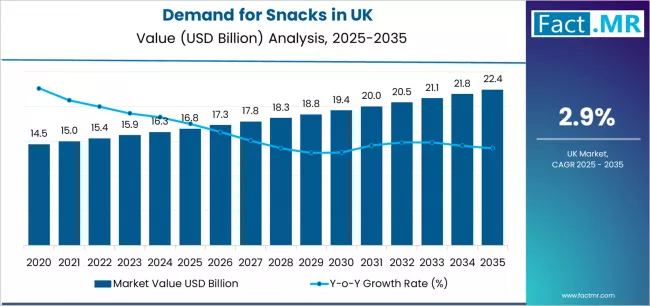
Demand For Snacks In Uk Market Value Analysis | Source: Fact.MR
The avory snacks segment, encompassing crisps, nuts, and pretzels, is projected to account for 41.2% of market demand by value in 2025. This dominance reflects its deep rooted position in UK food culture, extensive brand loyalty, and continuous flavor innovation that drives repeat purchase. Its versatility, from sharing bags for social occasions to smaller format on the go packs, ensures relevance across a wide range of consumption occasions and channels.
The supermarkets/hypermarkets channel is expected to hold 58.3% of market demand in 2025. This channel's strength lies in its one stop shop convenience, ability to offer extensive choice and promotional deals, and the strategic use of in store placement to drive impulse purchases. Its scale allows for the successful launch of new products and the maintenance of large volumes for established household brands.
From 2030 to 2035, demand is forecast to grow from USD 19.7 billion to USD 22.4 billion, adding USD 2.7 billion, which constitutes 48.2% of the overall decade's expansion. This latter period will be characterized by the maturation of functional snacking, with products targeting specific wellness benefits like gut health or sustained energy.
The rise of ultra personalized nutrition, leveraging AI for customized snack box subscriptions, and the mainstream adoption of alternative protein snacks (e.g., insect based, lab grown) will become more significant. Sustainability will transition from a marketing claim to a non negotiable cost of doing business, influencing every aspect from sourcing to compostable packaging, particularly influencing urban consumers across England and Scotland.
The UK snacks industry is experiencing steady, innovation led growth primarily due to the fusion of convenience and wellbeing in consumer priorities. The market's emphasis on ingredient transparency, ethical sourcing, and occasion based marketing necessitates ongoing investment in product reformulation (reducing salt, sugar, saturated fat) and supply chain modernization (agility, waste reduction) to meet the diverse and discerning demands of the modern British snacker.
Metric
| Metric | Value |
|---|---|
| UK Snacks Sales Value (2025) | USD 16.8 billion |
| UK Snacks Forecast Value (2035) | USD 22.4 billion |
| UK Snacks Forecast CAGR (2025-2035) | 2.90% |
Source: Fact.MR analysis. Updated Dec 4, 2025
Why is the UK Snacks Industry Growing?
Modern UK consumers rely on snacks for sustenance, pleasure, and functional benefits, driving demand for products that align with multifaceted lifestyle needs from hectic workdays to mindful relaxation. Evolving consumption habits necessitate a diverse portfolio that spans indulgent treats, better for you options, and nutritionally complete mini meals, requiring manufacturers to excel in rapid consumer trend anticipation and agile supply chain execution.
Brands and manufacturers are emphasizing ingredient provenance, bold and global flavor exploration, and packaging that balances convenience with environmental responsibility to maintain relevance. Stricter government regulations, such as the HFSS (High in Fat, Sugar, or Salt) placement restrictions and incoming mandatory calorie labelling, are reshaping retail landscapes and reformulation priorities. UK based innovators are pioneering in areas like reduced waste upcycled ingredients and vegan friendly protein snacks, responding to deep seated consumer values around health, sustainability, and ethical consumption.
The UK snacks industry is shaped by Food Law and specific policies like the Soft Drinks Industry Levy which indirectly pressures snack reformulation. The impending HFSS marketing and promotion restrictions represent a seismic shift, limiting the placement and promotion of certain products in key retail locations. Furthermore, retailer specific sustainability charters, such as those from Tesco or Waitrose, often exceed baseline legal requirements, mandating ambitious reductions in plastic use and carbon footprints, thereby raising the operational and ethical benchmark for all suppliers.
Segmental Analysis
The UK snacks industry is segmented by product type, distribution channel, and purchase intent to provide a detailed understanding of market dynamics. By product type, the industry is divided into savory snacks, sweet snacks & biscuits, fruit & nut snacks, and health focused/alternative snacks. In terms of distribution, the industry is segmented into supermarkets/hypermarkets, convenience stores, online retail, and discounters. Regionally, market demand is distributed across England, Scotland, Wales, and Northern Ireland, each with distinct taste preferences and retail landscapes.
This granular segmentation is critical for analyzing the tension between traditional indulgence and the health imperative. The regulatory push against HFSS products disproportionately impacts the sweet and savory segments, catalyzing accelerated innovation in reformulation. Simultaneously, the enduring cultural love for classic biscuits and crisps sustains massive volume, creating a market where legacy and innovation must strategically coexist.
Why do Savory Snacks Dominate the Product Segment?
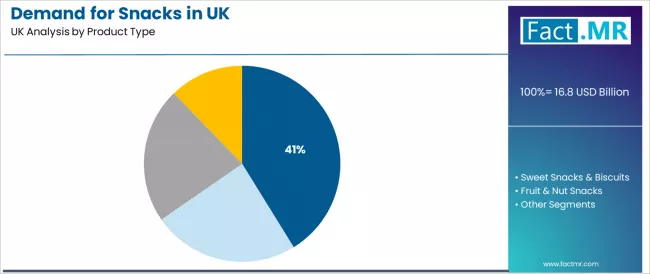
Demand For Snacks In Uk Analysis By Product Type | Source: Fact.MR
The savory snacks segment is projected to account for 41.2% of total demand by value in 2025, underlining its status as a non negotiable staple of British pantries. This dominance is rooted in unparalleled consumer familiarity, constant innovation in flavors and textures, and powerful brand equity held by giants like Walkers. The segment's versatility is key, serving as a standalone snack, a lunchbox addition, a sharing centerpiece for social gatherings, and a companion to beverages, embedding it into countless daily occasions.
The segment's leadership is further reinforced by its ability to navigate health trends through sub categories like baked crisps, lentil chips, and vegetable crisps, offering perceived better for you options without abandoning core indulgence. The premium craft segment, led by brands like Tyrrells and Kettle Chips, continues to grow by emphasizing artisanal production, distinctive flavor profiles, and cleaner labels, capturing higher margin spend. Continuous innovation focuses on exotic global flavors, limited edition collaborations, and improving the nutritional profile of core lines through reductions in salt and saturated fat.
Growth is sustained by massive scale in retail and constant marketing support. Demand is particularly robust in England, where urban consumers drive experimentation with premium and world flavors, and across all regions where traditional flavors maintain strong loyalty. The channel is also benefiting from the growth of snacking occasions replacing meals, a trend accelerated by hybrid working patterns.
Why is the Supermarkets/Hypermarkets Channel the Largest?
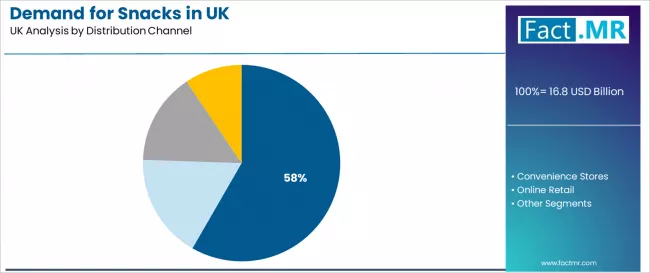
Demand For Snacks In Uk Analysis By Distribution Channel | Source: Fact.MR
The supermarkets/hypermarkets channel is expected to capture 58.3% of total demand in 2025, representing the dominant artery of snack distribution. This channel's strength lies in its fundamental role in the weekly grocery shop, where consumers expect full category choice, competitive pricing, and the ability to buy in bulk. It offers manufacturers the volume and visibility necessary for mass market success, utilizing end of aisle displays, multi buy offers, and strategic placement to maximize impulse purchases, a critical driver in the snack category.
This channel's pre-eminence is fundamentally underpinned by its monopsony like power, allowing retailers to set stringent terms for suppliers regarding cost, promotional support, and compliance with their own health and sustainability standards. The ongoing implementation of HFSS location restrictions is fundamentally altering in store dynamics within this channel, forcing a revolutionary shift in category management and placing renewed emphasis on better for you products that can be prominently featured. Retailer own label ranges are also a major competitive force, often leading on price and quickly mimicking successful innovations from branded players.
Demand fulfillment through this channel is universal across all UK regions, but its format and strategy vary. In England, large format stores offer the widest range, including extensive world food aisles that influence snack tastes. In Wales and Northern Ireland, the supermarket remains the primary destination for family sized packs and mainstream brand loyalty. The channel's evolution towards more local sourcing and healthier portfolios is a direct response to nationwide consumer shifts, ensuring its continued centrality despite the growth of alternatives.
What are the Drivers, Restraints, and Key Trends in the UK Snacks Industry?
The UK's snack demand is advancing due to the normalization of all day grazing and the demand for multifunctional products that deliver both pleasure and purpose, with England serving as the primary testbed for global and domestic innovation. The sector faces significant challenges including stringent and evolving HFSS regulations, intense margin pressure from retailer competition and commodity cost inflation, and a saturated marketplace that makes brand loyalty fragile. Evolving consumer values around naturalness and sustainability continue to influence production processes, packaging formats, and brand storytelling at a fundamental level.
The Premiumization and Experiential Consumption Trend
Consumers are increasingly trading up within the snack category, seeking premium ingredients, authentic artisanal storytelling, and unique sensory experiences. This driver moves snacks beyond mere sustenance into the realm of affordable luxury and exploration. It supports growth for brands offering high cocoa chocolate, crisps cooked in premium oils with exotic seasonings, and biscuits with provenance led ingredients. This trend is particularly strong among urban adults and higher income households across the UK, allowing manufacturers to improve margin mix even in a cost sensitive environment.
Health and Wellness Convergence
The irreversible integration of health considerations into snacking is a powerful structural driver. This encompasses demand for products with functional benefits including protein, fibre, and probiotics, free from attributes such as gluten free, vegan, and simple, recognizable ingredient lists. It is no longer a niche but a mainstream expectation, compelling even the largest incumbents to reformulate legacy brands and develop new, health positioned sub brands. This driver is amplified by public health policy and is consistent across all UK regions, though interpretation varies from active nutrition in Scotland to natural wellness in Wales.
The Regulatory Onslaught of HFSS Policies
The UK's groundbreaking restrictions on the promotion and placement of HFSS products represent a severe and sustained restraint on a significant portion of the traditional snack market. Removing these products from prominent store locations, checkouts, and volume price promotions disrupts decades of established marketing and sales strategies. Compliance requires costly product reformulation, portfolio restructuring, and a complete rethink of category management, disproportionately burdening smaller manufacturers and potentially stifling innovation in the short to medium term as resources are diverted to compliance.
Intense Cost Pressure and Retailer Power
The industry is caught in a vice of rising input costs for ingredients, energy, and labor, coupled with the immense purchasing power of a concentrated retail grocery sector. Retailers demand ever lower prices and higher promotional payments from suppliers, compressing manufacturer margins to extreme levels.
This restraint makes significant investment in innovation and sustainability initiatives challenging, particularly for mid sized players, and can lead to a reduction in product quality or size (shrinkflation) as brands seek to protect profitability, risking consumer backlash.
Digital First Engagement and Personalization
The entire consumer journey for snacks is becoming digitized, from discovery on social media platforms like TikTok, where viral flavors are born, to subscription services for curated snack boxes. Brands are leveraging direct to consumer channels to gather first party data, test new products with agile feedback loops, and build community.
The trend extends to personalization, where AI driven recommendations and customizable multipacks allow consumers to tailor snack selections to household preferences. This trend empowers agile digital native brands and forces traditional manufacturers to accelerate their digital transformation to maintain relevance.
Analysis of UK Snacks Industry by Key Countries
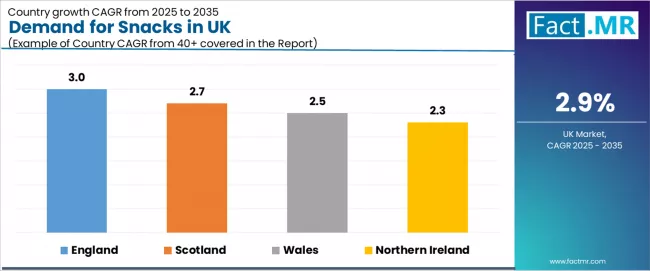
Demand For Snacks In Uk Cagr Analysis By Country | Source: Fact.MR
| Region | CAGR (2025 to 2035) |
|---|---|
| England | 3.00% |
| Scotland | 2.70% |
| Wales | 2.50% |
| Northern Ireland | 2.30% |
Source: Fact.MR analysis. Updated Dec 4, 2025
The UK snacks industry exhibits regional growth nuances, shaped by demographic profiles, economic activity, and cultural taste preferences. England leads with a projected CAGR of 3.0%, driven by its large, diverse population, high density of urban consumers open to experimentation, and concentration of manufacturing and brand HQs.
Scotland follows at 2.7%, supported by strong independent brand presence and a culture of hearty appetites. Wales grows at 2.5%, with demand shaped by traditional tastes and value focus, while Northern Ireland demonstrates growth at 2.3%, anchored in a stable retail landscape and distinct brand loyalties.
What Strategic Advantages Position England as the Dominant Growth Engine?
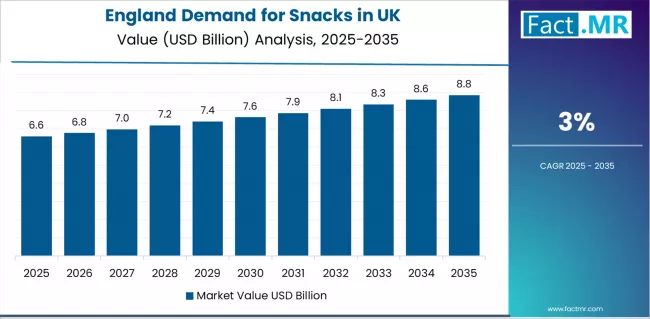
Demand For Snacks In Uk Country Value Analysis | Source: Fact.MR
Demand in England is projected to grow at a leading CAGR of 3.0% through 2035, fueled by its role as the UK's primary economic and cultural trendsetter. London and other major cities are melting pots of global culinary influence, driving rapid adoption of international snack flavors and formats, from Korean corn snacks to Mexican inspired tortilla chips.
The region's high disposable income supports premiumization and trial of novel better for you products. England is also the frontline for regulatory adaptation, with retailers and brands piloting new HFSS compliant store layouts and marketing strategies that are later rolled out nationally.
How does Scotland's Distinct Food Culture Influence its Market Growth?
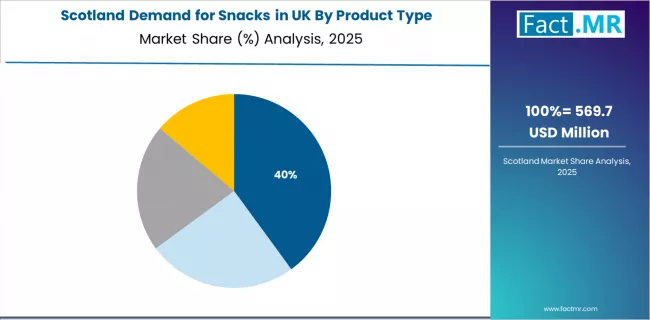
Demand For Snacks In Uk Scotland Market Share Analysis By Product Type | Source: Fact.MR
The snacks market in Scotland is forecast to grow at a CAGR of 2.7%, characterized by robust demand for traditional sweet bakery items like shortbread and for hearty savory snacks. Scottish consumers exhibit strong national pride and loyalty to homegrown brands, such as Mackie's crisps or Tunnock's teacakes, which maintain resilient market shares.
The region's active outdoor lifestyle also supports demand for portable, energy dense snacks, including protein bars and oat based products. Retail promotion often leverages local identity, and the discount channel holds significant sway, making value for money a persistent key purchase criterion alongside brand heritage.
What Factors Underpin the Steady Growth of the Industry in Wales?
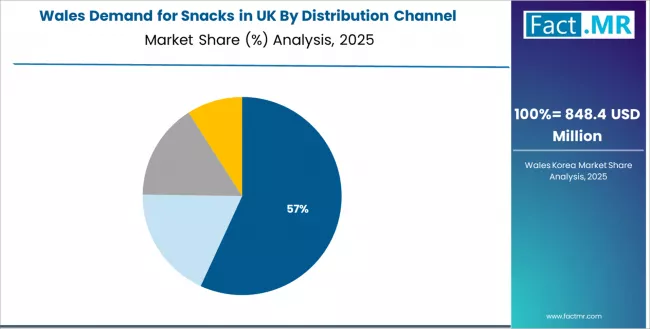
Demand For Snacks In Uk Wales Market Share Analysis By Distribution Channel | Source: Fact.MR
Wales demonstrates steady growth for snacks at a CAGR of 2.5%, anchored by a preference for familiar, trusted brands and a notable strength in the convenience store and community supermarket channel. Welsh consumers tend to be pragmatic, with demand focused on family sized packs, value led offerings, and classic flavors that deliver consistent satisfaction.
There is a growing, though measured, interest in premium Welsh produced goods, such as artisan sea salted crisps or Welsh cake inspired biscuits, which cater to local pride. The market is less driven by fleeting flavor fads and more by sustained loyalty, leading to stable volume sales for established mainstream products.
How Does Northern Ireland's Unique Retail Landscape Shape its Growth?
The snacks market in Northern Ireland is expected to grow at a CAGR of 2.3%, shaped significantly by its distinct retail ecosystem, including strong local chains and cross border shopping influences. Brand loyalties can differ from the mainland, with certain local and Republic of Ireland brands holding strong market positions.
The grocery landscape is competitive, with a high penetration of discounters, which intensifies price competition and focuses supplier efforts on cost leadership. Consumption patterns are traditional, with a strong skew towards savory snacks and biscuits for in home enjoyment. Growth is steady and volume driven, with less emphasis on high value, experimental segments compared to other UK regions.
Competitive Landscape of UK Snacks Industry
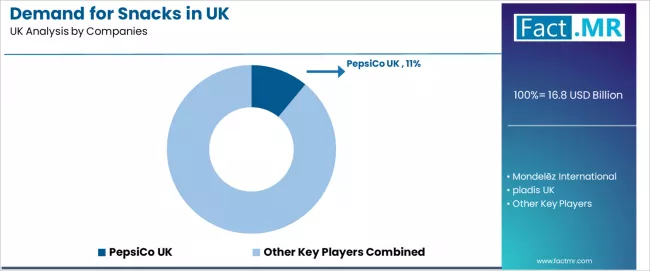
Demand For Snacks In Uk Analysis By Company | Source: Fact.MR
The UK snacks industry is defined by fierce competition between global food conglomerates, strong private label offerings from major retailers, and a vibrant ecosystem of disruptive independent brands. Competition revolves around brand equity, supply chain efficiency to manage volatile costs, innovation speed, and the ability to navigate the complex new HFSS regulatory environment. Companies are investing heavily in reformulation science to create compliant yet tasty products, in sustainable packaging solutions, and in digital marketing to connect directly with consumers and build loyalty beyond the supermarket aisle.
PepsiCo UK, through its Walkers and Doritos brands, dominates the savory sector with unrivalled scale, marketing power, and distribution. Its competitive strength lies in massive manufacturing efficiency, ubiquitous brand recognition, and a constant pipeline of flavor innovations and limited editions that keep the portfolio fresh. Mondelēz International commands the sweet and biscuits aisle with iconic brands like Cadbury and Oreo, competing on deep emotional nostalgia, consistent quality, and significant investment in brand building advertising that reinforces its market position.
pladis UK (McVitie's) and Burton's Biscuit Company represent the strong British heritage players in biscuits and cake snacks, competing on tradition, trusted recipes, and strong relationships with retailers. Their challenge is to modernize portfolios within HFSS constraints while preserving the taste that defines their brands. Conversely, Kellanova competes with distinct format brands like Pringles and Pop Tarts, leveraging unique packaging and a global brand footprint to occupy specific snacking occasions.
The competitive landscape is intensely pressured by the rise of retailer own label. Supermarkets have dramatically elevated their quality and innovation, often offering close equivalents to branded products at lower price points. Their agility in responding to trends, like veganism or free from, and their control over shelf space make them a dual customer and competitor to branded manufacturers. This dynamic squeezes margins and forces branded players to continuously demonstrate superior value through innovation and marketing.
Simultaneously, agile independents like graze, Proper Snacks, and Love Cocoa compete by championing specific attributes: subscription models, clean label nutrition, or ethical sourcing. They build direct consumer relationships, leverage social media for targeted marketing, and often pioneer new categories that larger players later enter. Their success forces incumbents to act through acquisition, imitation, or the creation of internal venture teams to foster similar innovation.
Stakeholders' Contribution Framework
The UK snacks industry ecosystem functions through the interdependent contributions of key stakeholders who collectively drive market dynamics, from setting the rules of operation to determining final purchase decisions. Their interactions create a complex web of incentives and pressures that shape product availability, innovation, and pricing.
Manufacturers and retailers engage in a perpetual negotiation over value, while regulators and consumers set the boundaries of acceptability. The balance of power among these groups determines the pace and direction of market evolution, with each stakeholder wielding distinct tools of influence.
| Stakeholder Group | Primary Influence | Contribution Type | Key Activities | Impact Metric |
|---|---|---|---|---|
| Retailers (Supermarkets, Discounters) | Market Access & Commercial Terms | Gatekeepers & Curators | Dictating shelf space/placement; setting pricing/promotion terms; developing own-label competition. | Brand market share; speed of innovation adoption; overall industry margin structure. |
| Branded Manufacturers & Indie Brands | Product Supply & Innovation | Innovators & Portfolio Managers | Developing new products/flavors; managing brand equity; navigating supply chain/logistics. | Category growth rate; consumer choice diversity; trend creation. |
| Consumers & Households | Ultimate Demand Signal | Taste-makers & Adopters | Voting with wallet; driving trends via social media; demanding transparency/sustainability. | Product success/failure; direction of R&D investment; brand loyalty levels. |
| Regulators & Public Health Bodies | Rule-setting & Public Guidance | Rule-setters & Health Arbiters | Implementing HFSS/ labelling laws; issuing dietary guidelines; monitoring claims. | Reformulation pace; portfolio composition; market structure & barriers to entry. |
Source: Fact.MR analysis. Updated Dec 4, 2025
Key Players in UK Snacks Industry
- PepsiCo UK
- Mondelēz International
- pladis UK
- Kellanova
- Nestlé UK
- Burton's Biscuit Company
- Tyrrells Potato Crisps
- graze Ltd
- Proper Snacks
- Love Cocoa
- Kettle Foods Ltd
- Mackie's of Scotland
- Tunnock's
Segmentation
Scope of the Report
| Item | Value / Coverage |
|---|---|
| Quantitative Units | Revenue in USD Billion |
| Market Valuation (2025) | USD 16.8 Billion |
| Market Valuation (2035) | USD 22.4 Billion |
| Forecast Period | 2025-2035 |
| Product Type Segmentation | Savory Snacks, Sweet Snacks & Biscuits, Fruit & Nut Snacks, Health Focused Snacks |
| Distribution Channel Segmentation | Supermarkets/Hypermarkets, Convenience Stores, Online Retail, Discounters |
| Regions Covered | England, Scotland, Wales, Northern Ireland |
| Key Companies Profiled | PepsiCo, Mondelēz, pladis, Kellanova, Nestlé, Burton's, Tyrrells, graze, Proper Snacks |
| Additional Attributes | Analysis by product type and distribution channel; regional CAGRs and consumption analysis; competitive landscape; impact of HFSS regulations and health trends; private label vs. branded dynamics. |
Source: Fact.MR analysis. Updated Dec 4, 2025
UK Snacks Industry by Segments
-
Product Type :
- Savory Snacks (Crisps, Nuts, Pretzels)
- Sweet Snacks & Biscuits
- Fruit & Nut Snacks
- Health Focused/Alternative Snacks
-
Distribution Channel :
- Supermarkets/Hypermarkets
- Convenience Stores
- Online Retail
- Discounters
-
Region :
- England
- Scotland
- Wales
- Northern Ireland
Frequently Asked Questions
How big is the demand for snacks in UK in 2025?
What will be the size of snacks in UK in 2035?
How much will be the demand for snacks in UK growth between 2025 and 2035?
What are the key product types in the snacks in UK?
Which distribution channel segment is expected to contribute significant share in the snacks in UK in 2025?
Who worked on this report


Preview the report firsthand - request a free sample
Free SampleGet the brochure for pricing and purchase details
Download PDF