- Base Value(2026): 1.4 Bn
- Estimated Value(2026): 1.4 Bn
- Forecast Value (2036): 2.4 Bn
- CAGR (2026 - 2036): 5.4%
High Performance Brake Calipers Market Forecast and Outlook 2026 to 2036
In 2025, the high performance brake calipers market was valued at approximately USD 1.33 billion. Based on Fact.MR analysis, demand for high performance brake calipers is estimated to reach USD 1.4 billion in 2026 and expand to USD 2.4 billion by 2036, registering a CAGR of 5.4% during the forecast period. Growth is supported by rising penetration of performance and premium passenger vehicles, wider OEM adoption of multi-piston braking systems, and increasing regulatory emphasis on braking stability under repeated high-load conditions.
The market adds nearly USD 1.1 billion in value over the decade, reflecting steady compounding rather than cyclical expansion. Early period growth is driven by OEM fitment on performance trims and luxury vehicles, particularly in Asia Pacific. Mid-cycle momentum aligns with broader integration of fixed and monobloc calipers into premium SUVs and electrified platforms. In later years, growth moderates as electrified powertrains extend replacement intervals, though value expansion is sustained through higher unit pricing tied to advanced materials, precision machining, and system-level braking compliance.
China records the fastest growth at 6.2% CAGR supported by premium vehicle production and domestic performance brand expansion. India follows at 6.0% driven by rising demand for high-output passenger vehicles, while South Korea grows at 5.1% linked to OEM performance platform exports. The United States expands at 4.9% supported by premium aftermarket demand, while Germany grows at 4.4% under performance vehicle homologation requirements. Japan remains replacement-led at 3.2%, constrained by stable vehicle parc size and extended service intervals.
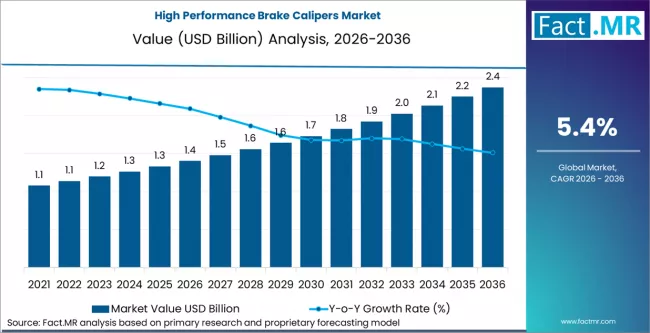
High Performance Brake Calipers Market Market Value Analysis | Source: Fact.MR
High Performance Brake Calipers Market Definition
The high performance brake calipers market covers braking components that apply clamping force to brake pads against discs in vehicles designed for higher thermal load and stopping requirements. These calipers are engineered to maintain consistent hydraulic pressure, heat dissipation, and mechanical stability under repeated braking. They are manufactured from materials such as aluminum alloys or cast iron and are produced to meet braking system regulations defined under UNECE Regulation No. 13 and ISO braking standards [1]. High performance brake calipers are supplied to vehicle manufacturers and aftermarket channels for passenger and performance oriented vehicles.
High Performance Brake Calipers Market Inclusions
The report covers global and regional market size estimates in volume and value terms with a forecast period from 2026 to 2036. Segmentation includes caliper type such as fixed and floating designs referenced in ISO braking system documentation, application by vehicle category including passenger and performance vehicles, and end use covering original equipment and replacement demand. The scope includes regional demand patterns, pricing benchmarks, and international trade flows tracked through UN Comtrade [2].
High Performance Brake Calipers Market Exclusions
The scope excludes standard brake calipers designed solely for low load passenger vehicles without enhanced thermal or pressure requirements. Brake discs, pads, hoses, pipes, and hydraulic fluids are not included. Complete braking systems sold as integrated assemblies are excluded. Motorsport specific calipers without road homologation, prototype components, and laboratory test units are outside the scope. Installation services, maintenance labor, and vehicle repair contracts are not considered.
High Performance Brake Calipers Market Research Methodology
- Primary Research: Primary research involved interviews with brake caliper manufacturers, automotive OEM suppliers, performance vehicle component distributors, and braking system engineers.
- Desk Research: Desk research used braking regulations from UNECE, ISO brake component standards, vehicle production data from national transport authorities, customs trade statistics from UN Comtrade, and company annual reports and technical disclosures filed with securities regulators.
- Market Sizing and Forecasting: Market sizing applied a hybrid top down and bottom up model using vehicle production volumes, caliper fitment rates by vehicle category, and replacement cycles derived from service data.
Data Validation and Update Cycle
Outputs were cross checked against vehicle registration data, trade statistics, OEM supply disclosures, and regulatory documentation, with updates applied when verified public sources release revisions.
Summary of High Performance Brake Calipers Market
Market Definition
- The high performance brake calipers market includes braking components engineered to apply controlled, uniform clamping force under high thermal and mechanical loads, designed for performance and premium vehicles in compliance with UNECE Regulation No. 13 and ISO braking standards.
Demand Drivers
- Stricter braking performance and stability requirements under vehicle type approval frameworks drive OEM adoption of multi-piston and monobloc calipers in premium and high-output passenger vehicles.
- Rising production of performance trims, luxury vehicles, and premium SUVs increases factory fitment of high load braking systems capable of repeated high-energy deceleration.
- Expansion of premium and performance aftermarket channels supports replacement demand for upgraded calipers where thermal control, pedal response, and force distribution are specified.
Key Segments Analyzed
- Caliper type: Fixed multi-piston calipers lead with about 54% share, selected for uniform pad pressure, improved thermal control, and compatibility with large vented brake discs used in performance vehicles.
- Application: Performance passenger cars account for roughly 52% share, reflecting broader OEM integration of upgraded braking systems on high output sedans, coupes, and sport utility vehicles.
- Geography: Asia Pacific records the fastest growth, led by China and India, where premium vehicle production and homologation driven adoption of advanced braking systems are expanding.
Analyst Opinion at Fact.MR
- Shambhu Nath Jha, Principal Consultant at Fact.MR, opines, ‘CXOs will find that demand for high performance brake calipers is governed by regulated braking stability, thermal tolerance, and homologation compliance, with value growth driven more by OEM specification depth than discretionary aftermarket upgrades.’
Strategic Implications / Executive Takeaways
- Align product development with UNECE and ISO braking performance requirements to secure OEM homologation across premium and performance vehicle platforms
- Expand portfolios of lightweight aluminium and multi-piston calipers to address thermal load management and system integration needs in electrified and high output vehicles.
- Strengthen OEM and premium aftermarket partnerships in Asia Pacific to capture growth tied to rising performance vehicle production and certification driven demand.
Methodology
- Market sizing is derived from vehicle production volumes, caliper fitment rates by vehicle category, and validated replacement cycles, cross checked with UN Comtrade trade data.
- Technical assumptions reference UNECE Regulation No. 13 and ISO braking standards governing caliper performance, testing, and certification.
- Insights are validated through primary interviews with brake caliper manufacturers, OEM suppliers, and braking system engineers, supported by regulatory and production disclosures.
Segmental Analysis
High Performance Brake Calipers Market Analysis by Caliper Type
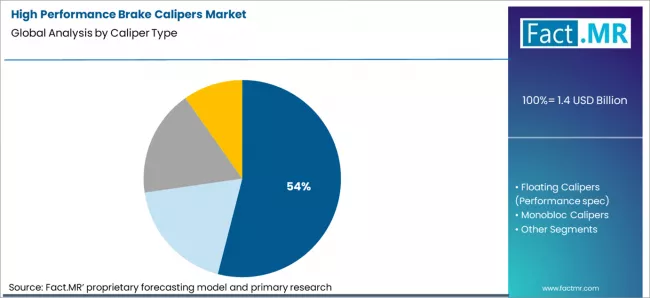
High Performance Brake Calipers Market Analysis By Caliper Type | Source: Fact.MR
Based on Fact.MR analysis, consumption of fixed multi-piston brake calipers is estimated to hold 54.0% share in 2026. Fact.MR analysts note that fixed multi-piston designs are selected because they apply uniform clamping force across the brake pad, improving pedal response and thermal control during repeated high-load braking. As per Fact.MR, this caliper type addresses performance vehicle requirements for braking consistency, reduced pad taper wear, and compatibility with large diameter vented discs used in high output passenger cars.
- OEM deployment: Brembo supplies fixed multi-piston calipers as original equipment for high performance passenger vehicles, with product documentation detailing force distribution and heat management characteristics.
- Design validation: Society of Automotive Engineers technical papers describe fixed multi-piston caliper layouts as effective for managing brake torque and thermal load in performance applications.
- Vehicle specification trend: Fact.MR analysts reference manufacturer brake system specifications showing wider adoption of fixed calipers on performance oriented vehicle trims.
High Performance Brake Calipers Market Analysis by Application
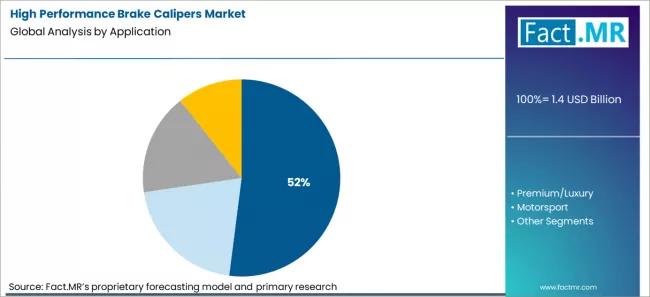
High Performance Brake Calipers Market Analysis By Application | Source: Fact.MR
Based on Fact.MR analysis, consumption in performance passenger car applications is estimated to hold 52% share in 2026. Fact.MR opines that this segment leads due to rising installation of upgraded braking systems on high output sedans, coupes, and sport utility vehicles. As per Fact.MR, performance passenger cars require calipers that maintain braking stability during repeated deceleration events encountered in aggressive road driving, while remaining compatible with electronic braking and stability control systems.
- Vehicle integration: BMW Group specifies multi-piston performance brake calipers across M Performance vehicle variants, as outlined in official technical and product documentation.
- System compatibility: Bosch publishes braking system integration guidelines that reference caliper compatibility with ABS and electronic stability control in performance vehicles.
- Market linkage: Fact.MR analysts reference global performance vehicle sales disclosures that support steady demand for factory installed high performance braking components.[3]
High-Performance Brake Calipers Market Drivers, Restraints, And Opportunities
Fact.MR analysis indicates that the high-performance brake calipers market exists as a specialised segment of automotive brake systems focused on enhanced deceleration control and heat management in high-load applications. As per Fact.MR assessment, brake calipers house pistons that apply clamping force to brake pads, a system tested under regulated performance criteria such as UNECE Regulation No. 13-H, which defines uniform provisions for braking systems and components including performance thresholds applicable to caliper assemblies. Fact.MR analysts observe that market value is supported by demand from sport, luxury, and commercial vehicles where dynamic braking performance, heat dissipation, and force distribution are specified within vehicle type approval and homologation procedures.
Fact.MR is of the opinion that current market dynamics reflect transitional application demand as automotive powertrain trends evolve toward electrification and weight-reduction strategies. Based on Fact.MR assessment, internal combustion engine vehicles (ICEVs) continue to drive base demand for high-performance brake calipers due to established maintenance intervals and dynamic load profiles, while growth in hybrid and electric vehicles creates opportunities for calipers designed to integrate with regenerative braking systems. Electrified powertrains reduce reliance on friction braking during normal driving, which can lengthen component replacement intervals, resulting in moderate volume gains even as premium high-performance segments maintain higher unit values because of material and machining requirements. Fact.MR analysis suggests this combination of evolving application dynamics and differentiated pricing profiles will influence market progression over the near term.
- Regulated braking component criteria: Fact.MR analysts note that compliance with performance provisions in UNECE Regulation No. 13-H affects design, testing, and certification of high-performance caliper assemblies for both OEM and aftermarket vehicles
- Material and machining requirements: Based on Fact.MR assessment, demand for calipers made from aluminium alloys, multi-piston designs, and enhanced heat management materials supports premium segments where performance documentation is required by manufacturers and vehicle owners.
- Asia Pacific automotive volume expansion: Fact.MR opines that increasing light vehicle manufacturing and rising consumer interest in performance vehicles in China, India, and Southeast Asia supports regional demand for high-performance brake calipers in both OEM and aftermarket channels.
Regional Analysis
Based on regional assessment, the high performance brake calipers sector is analyzed across North America, Europe, East Asia, South Asia, and other major automotive manufacturing regions, spanning more than 40 countries. Regional performance varies according to production of performance vehicles, penetration of advanced braking systems, and replacement demand within premium passenger and sports vehicle segments. The report also presents a comparative market attractiveness evaluation grounded in region-specific demand trends.
High Performance Brake Calipers Market CAGR Analysis by Country (2026-2036)
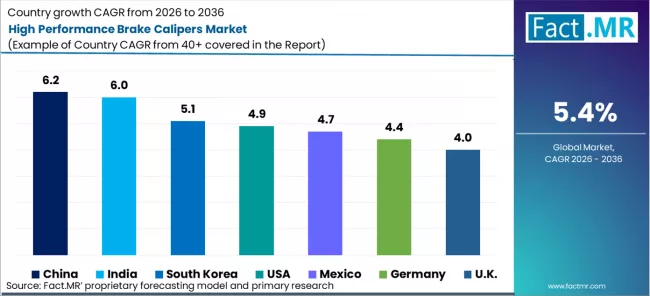
High Performance Brake Calipers Market Cagr Analysis By Country | Source: Fact.MR
| Country | CAGR |
|---|---|
| China | 6.2% |
| India | 6.0% |
| South Korea | 5.1% |
| United States | 4.9% |
| Mexico | 4.7% |
| Germany | 4.4% |
| U.K. | 4.0% |
| Japan | 3.2% |
Source: Fact.MR analysis. Updated Feb 17, 2026
Source: Fact.MR analysis, based on proprietary forecasting models and primary research.
Asia Pacific High-Performance Brake Calipers Market Analysis
Asia Pacific functions as a manufacturing- and homologation-driven region for high-performance brake calipers, supported by large passenger vehicle production, premium vehicle assembly, and motorsport-linked components manufacturing. Demand is governed by national vehicle safety regulations, braking performance standards, and OEM homologation requirements. Adoption is enforced through type approval systems, periodic inspection regimes, and compliance with performance benchmarks applied to passenger and performance-oriented vehicles.
- China: Demand for high-performance brake calipers in China is projected to rise at 6.2% CAGR through 2036. Application follows braking performance requirements under GB automotive standards revised during 2021 and reinforced through domestic production of performance passenger vehicles subject to national type approval systems, as per Fact.MR.
- India: Demand for high-performance brake calipers in India is projected to rise at 6.0% CAGR through 2036. Usage is governed by Automotive Industry Standards aligned with CMVR updates issued during 2021 and reinforced through OEM sourcing for premium and performance vehicle platforms produced during 2022-2023, according to Fact.MR.
- South Korea: Demand for high-performance brake calipers in South Korea is projected to rise at 5.1% CAGR through 2036. Application follows vehicle braking system standards enforced under national safety regulations and reinforced through domestic OEM production and certification programs applied during 2021-2022, as per Fact.MR.
Fact.MR’s analysis of the high-performance brake calipers market in Asia Pacific consists of country-wise assessment that includes China, India, and South Korea. Readers can find safety standards references, homologation frameworks, and production-linked demand documentation.
North America High-Performance Brake Calipers Market Analysis
North America operates as a standards-led automotive components market for high-performance brake calipers, with adoption governed by federal safety regulations, OEM performance specifications, and public fleet procurement norms. Demand is shaped by compliance with braking performance requirements, certification under federal standards, and replacement cycles within performance and utility vehicle segments.
- United States: Demand for high-performance brake calipers in the United States is projected to rise at 4.9% CAGR through 2036. Application is governed by FMVSS braking system requirements and reinforced through OEM performance vehicle production and certification programs applied during 2021-2022, as per Fact.MR.
- Mexico: Demand for high-performance brake calipers in Mexico is projected to rise at 4.7% CAGR through 2036. Use follows NOM automotive safety standards and is reinforced through export-oriented OEM production serving North American markets during 2022, according to Fact.MR.
Fact.MR’s analysis of the high-performance brake calipers market in North America consists of country-wise assessment that includes the United States and Mexico. Readers can find federal standards references, homologation rules, and production-based demand documentation.
Europe High-Performance Brake Calipers Market Analysis
Europe functions as a regulation-led automotive components market for high-performance brake calipers, with adoption governed by harmonized vehicle type approval frameworks and braking performance standards. Demand is defined through conformity assessments, inspection regimes, and OEM compliance with EU-wide safety regulations, particularly for performance and premium vehicle segments.
- Germany: Demand for high-performance brake calipers in Germany is projected to rise at 4.4% CAGR through 2036. Application follows EU type approval regulations and braking performance standards applied in domestic vehicle manufacturing and inspection cycles during 2021-2022, according to Fact.MR.
- United Kingdom: Demand for high-performance brake calipers in the UK is projected to rise at 4.0% CAGR through 2036. Usage is governed by UK vehicle type approval rules aligned with UNECE braking regulations and reinforced through domestic performance vehicle certification applied during 2021-2022, as per Fact.MR.
- Japan: Demand for high-performance brake calipers in Japan is projected to rise at 3.2% CAGR through 2036. Application is governed by Road Transport Vehicle Act braking requirements and enforced through national vehicle certification systems applied during 2021-2022, according to Fact.MR.
Fact.MR’s analysis of the high-performance brake calipers market in Europe consists of country-wise assessment that includes Germany, the UK, and Japan. Readers can find regulatory frameworks, inspection regimes, and component compliance references.
Competitive Landscape of High Performance Brake Calipers Market
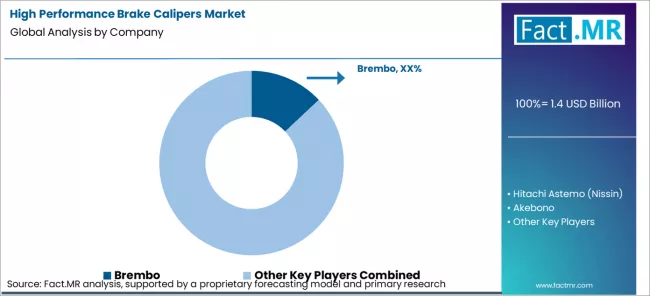
High Performance Brake Calipers Market Analysis By Company | Source: Fact.MR
As per Fact.MR analysis, the 2026 high-performance brake calipers market is defined by validated stopping power, heat dissipation, and material durability, which determine competitive advantage. Brembo and ZF performance calipers deliver consistent braking under high-stress conditions, which strengthens adoption in premium and sports vehicle segments. Hitachi Astemo (Nissin) and Akebono focus on precision-machined caliper assemblies with documented thermal stability, which reduces performance degradation and warranty claims. ADVICS and AP Racing emphasise lightweight, high-strength materials, which improve vehicle handling and efficiency. Mando and Wilwood provide niche performance calipers with verified friction and NVH characteristics, which sustain demand among specialized OEMs and aftermarket users. Bosch and Continental combine multi-region compliance with validated production tolerances, which supports global adoption and system-level reliability. Across the market, performance validation, material consistency, and OEM alignment create enduring competitive moats that outweigh reliance on price or single-component claims.
Recent Industry Developments
- Akebono’s Shift to 50% Lower-Emission Manufacturing: In a move to align with the 2026 Euro 7 standards, Akebono Brake Industry announced a breakthrough in their manufacturing process that reduces $CO_2$ emissions by 50% compared to conventional methods. As of early 2026, they are scaling the production of copper-free friction materials and lightweight aluminum-opposed piston calipers. These are specifically designed to reduce "non-exhaust" emissions (brake dust) while maintaining the high thermal stability required for track-focused cars. [4]
- Brembo and ZF Strategic Brake-by-Wire Alliance: In early 2025, Brembo and ZF Friedrichshafen AG entered a major technical partnership to co-develop advanced brake-by-wire systems. By 2026, this collaboration has moved into the production phase, focusing on integrating Brembo’s high-performance calipers with ZF’s electronic control units. This system eliminates hydraulic lines in favor of electronic actuators, providing faster response times essential for autonomous and semi-autonomous performance vehicles. [5]
Key Players in High Performance Brake Calipers Market
- Brembo
- Hitachi Astemo (Nissin)
- Akebono
- ZF (Performance calipers)
- ADVICS
- AP Racing
- Mando
- Wilwood
- Bosch
- Continental
Bibliography
- [1] United Nations Economic Commission for Europe. (2018). UNECE Regulation No. 13: Uniform provisions concerning the approval of vehicles with regard to braking. UNECE; International Organization for Standardization. (2020). Road vehicles - Braking systems - General performance requirements. ISO.
- [2] United Nations Statistics Division. (2024). UN Comtrade database. United Nations.
- [3] International Organization of Motor Vehicle Manufacturers. (2024). World motor vehicle production statistics. OICA.
- [4] Akebono Brake Industry Co., Ltd. (2026). Environmental initiatives and development of low-emission braking components. Akebono Brake Industry.
- [5] The Business Research Company. (2025). Brake caliper global market report. TBRC.
Segmentation
Scope of the Report
| Metric | Value |
|---|---|
| Quantitative Units | USD 1.4 billion (2026) to USD 2.4 billion (2036), CAGR 5.4% |
| Market Definition | The high performance brake calipers market covers calipers engineered for performance and premium vehicles, designed to provide controlled, uniform clamping force under high thermal and mechanical loads. Components comply with UNECE Regulation No. 13 and ISO braking standards. Products are supplied to OEMs, performance aftermarket channels, and motorsport suppliers. |
| Caliper Type Segmentation | Fixed Multi-Piston Calipers, Floating Calipers (Performance Spec), Monobloc Calipers, Other |
| Application Segmentation | Performance Passenger Cars, Premium/Luxury, Motorsport, Other |
| Material Segmentation | Aluminum, Cast Iron, Forged/High Strength Alloy, Other |
| Sales Channel Segmentation | OEM Fitment, Performance Aftermarket, Motorsport Supply, Other |
| Regions Covered | Asia Pacific, Europe, North America, Latin America, Middle East & Africa |
| Countries Covered | China, India, South Korea, United States, Mexico, Germany, United Kingdom, Japan |
| Key Companies Profiled | Brembo, Hitachi Astemo (Nissin), Akebono, ZF (Performance Calipers), ADVICS, AP Racing, Mando, Wilwood, Bosch, Continental |
| Forecast Period | 2026 to 2036 |
| Approach | Hybrid top-down and bottom-up modelling using vehicle production volumes, caliper fitment rates, and replacement cycles. Desk research used UNECE and ISO braking standards, UN Comtrade trade flows, and OEM production data. Primary interviews included caliper manufacturers, OEM suppliers, performance aftermarket distributors, and braking system engineers. |
Source: Fact.MR analysis. Updated Feb 17, 2026
High Performance Brake Calipers Market Analysis by Segments
-
By Caliper Type :
- Fixed Multi-Piston Calipers
- Floating Calipers (Performance spec)
- Monobloc Calipers
- Other
-
By Application :
- Performance Passenger Cars
- Premium/Luxury
- Motorsport
- Other
-
By Material :
- Aluminum
- Cast Iron
- Forged/High-Strength Alloy
- Other
-
By Sales Channel :
- OEM Fitment
- Performance Aftermarket
- Motorsport Supply
- Other
-
Region :
- Asia Pacific
- India
- China
- Japan
- South Korea
- Indonesia
- Australia & New Zealand
- ASEAN
- Rest of Asia Pacific
- Europe
- Germany
- Italy
- France
- United Kingdom
- Spain
- Benelux
- Nordics
- Central & Eastern Europe
- Rest of Europe
- North America
- United States
- Canada
- Mexico
- Latin America
- Brazil
- Argentina
- Chile
- Rest of Latin America
- Middle East & Africa
- Kingdom of Saudi Arabia
- United Arab Emirates
- South Africa
- Turkey
- Rest of Middle East & Africa
- Asia Pacific
Frequently Asked Questions
How large is the high performance brake calipers market in 2026?
What is the projected market size by 2036?
What CAGR is expected during the forecast period?
How much absolute value will the market add over the decade?
What fundamentally governs demand for high performance brake calipers?
Is growth driven more by OEM fitment or aftermarket upgrades?
Which caliper type leads the market by share?
Why are fixed multi-piston calipers preferred in performance vehicles?
Which application segment accounts for the largest share?
What factors drive caliper adoption in performance passenger cars?
Which country records the fastest growth rate?
What is India’s projected CAGR and key driver?
How fast is the South Korean market growing?
What is the growth outlook for the United States?
How does Germany compare in terms of growth?
What is the projected CAGR for Japan?
How does electrification affect long-term caliper demand?
What materials support premium pricing in this market?
Why is Asia Pacific the fastest-growing region overall?
What should suppliers prioritize to sustain long-term value growth?
Who worked on this report


Preview the report firsthand - request a free sample
Free SampleGet the brochure for pricing and purchase details
Download PDF