High-Voltage Isolation and Leakage Sensor Components Market Size, Share, Growth and Forecast (2026 - 2036)

The high-voltage isolation and leakage sensor components market is segmented by Type (AC Isolation Monitoring, DC Isolation Monitoring), Application (Electric Vehicles, Energy Storage Systems, Industrial Equipment, Renewable Energy Systems, Others), and Region. Forecast for 2026 to 2036.

Fact.MR analysis indicates that the high-voltage isolation and leakage sensor components market is experiencing a safety-versus-electrification scaling dynamic. Increasing deployment of high-voltage architectures in electric mobility and grid-connected energy systems is driving demand for continuous insulation monitoring. At the same time, industrial buyers remain cost-sensitive, limiting adoption of advanced sensing solutions in non-critical applications and creating divergence between compliance-driven and cost-driven demand segments.

High-Voltage Isolation and Leakage Sensor Components Market Forecast and Outlook by Fact.MR

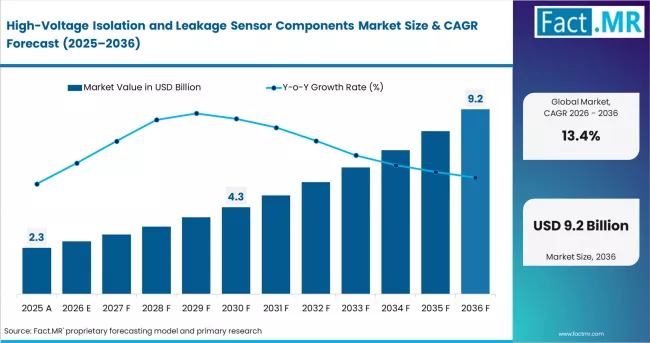
In 2025, the high-voltage isolation and leakage sensor components market was valued at USD 2.1 billion. Based on Fact.MR analysis, demand is estimated to grow to USD 2.3 billion in 2026 and USD 7.9 billion by 2036. FACT.MR projects a CAGR of 13.4% during the forecast period.
High Voltage Isolation And Leakage Sensor Components Market Value Analysis

Summary of High-Voltage Isolation and Leakage Sensor Components Market

  • Market Definition
    • High-voltage isolation and leakage sensor components monitor insulation integrity and leakage current in high-voltage systems to ensure safe operation.
  • Demand Drivers
    • EV battery systems require continuous insulation monitoring to meet safety regulations.
    • Energy storage installations are increasing demand for leakage detection in grid-connected systems.
    • Industrial electrification is driving adoption of safety-compliant monitoring components.
  • Key Segments Analyzed
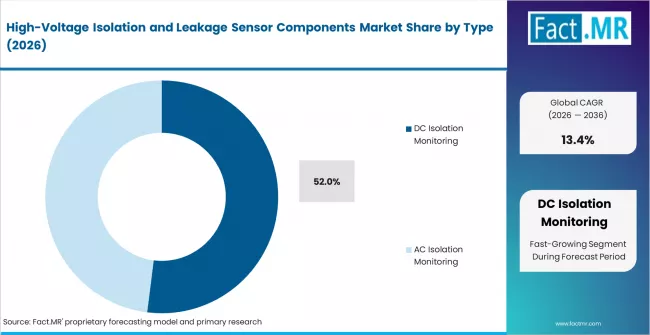
    • By Type: DC isolation monitoring is expected to account for 52% share in 2026, driven by battery-based systems.
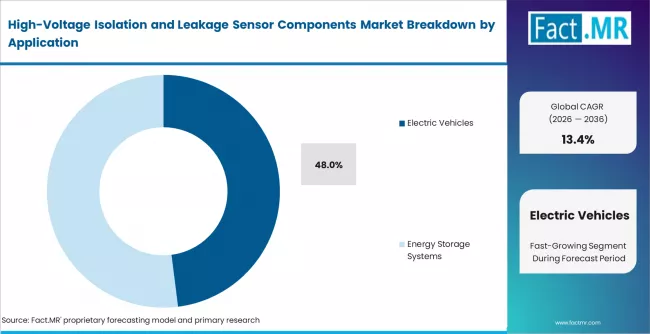
    • By Application: Electric vehicles are projected to hold 48% share in 2026, supported by high-voltage battery adoption.
    • By Geography: India leads with 21.2% CAGR, supported by EV and renewable energy expansion.
  • Analyst Opinion at FACT.MR
    • Shambhu Nath Jha, Senior Analyst at Fact.MR, states that isolation monitoring is moving beyond a basic compliance requirement and becoming a core element in high-voltage system design. CXOs are expected to recognize its growing role in ensuring safety, system stability, and fault detection in advanced EV architectures. As battery systems become more complex, isolation monitoring supports reliable operation and helps meet stricter regulatory standards, making it a key consideration in long-term platform development decisions.
  • Strategic Implications
    • Prioritize development of high-accuracy monitoring solutions for EV and storage systems.
    • Expand presence in emerging markets with rapid electrification.
    • Develop cost-optimized solutions for industrial applications.
  • Methodology
    • Market sizing integrates electrification data with sensor deployment rates.
    • Analysis includes regulatory standards and OEM sourcing strategies.
    • Forecasts incorporate EV and energy storage growth trends.
Metric Value
Estimated Value in 2026 USD 2.3 billion
Forecast Value in 2036 USD 7.9 billion
Forecast CAGR (2026 to 2036) 13.4%

The market is projected to generate USD 5.6 billion in absolute opportunity between 2026 and 2036. Growth is driven by rapid electrification across automotive, energy storage, and industrial systems. Increasing voltage levels in EV platforms and grid-connected battery systems are raising the need for continuous isolation monitoring. Compliance requirements are strengthening system-level integration, while cost sensitivity in industrial applications continues to moderate adoption of advanced solutions.

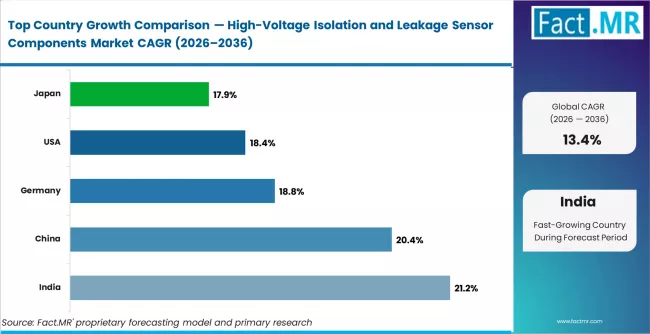
India is estimated to lead with a CAGR of 21.2% through 2036, supported by EV adoption policies and expanding renewable energy deployment. China is anticipated to grow at 20.4%, driven by large-scale electrification and battery manufacturing expansion. Germany is projected to record 18.8%, supported by regulatory compliance and industrial electrification. The United States is expected to register 18.4%, reflecting grid modernization and EV platform expansion. Japan is likely to grow at 17.9%, supported by advanced electronics integration and energy storage deployment.

Segmental Analysis

High-Voltage Isolation and Leakage Sensor Components Market Analysis by Type
High Voltage Isolation And Leakage Sensor Components Market Analysis By Type

DC isolation monitoring is estimated to account for 52% share of the high-voltage isolation and leakage sensor components market in 2026, as continuous insulation resistance tracking is critical for battery safety, fault detection, and regulatory compliance in high-voltage systems. Increasing battery voltage levels and system complexity are further strengthening the need for precise and reliable monitoring solutions.

  • Bender expansion: Bender GmbH & Co. KG expanded insulation monitoring solutions for EV platforms in 2024, focusing on high-voltage battery applications and improving system-level safety integration [1].
  • Analog Devices innovation: Analog Devices introduced precision isolation measurement ICs in 2024, enabling higher accuracy and faster response in battery management systems [2].
  • Storage demand trend: Global grid-scale energy storage installations increased in 2024, raising the need for continuous isolation monitoring across large battery arrays and supporting segment growth [3].

High-Voltage Isolation and Leakage Sensor Components Market Analysis by Application
High Voltage Isolation And Leakage Sensor Components Market Analysis By Application

Electric vehicles are expected to account for 48% share of the market in 2026, as safety monitoring is mandatory across high-voltage battery packs and integrated battery management systems. Rising EV production and increasing sensor density per vehicle are supporting sustained demand growth.

  • TI expansion: Texas Instruments expanded its EV sensing portfolio in 2024 to support battery safety systems and improve monitoring accuracy in high-voltage environments [4].
  • Renesas launch: Renesas Electronics introduced automotive-grade isolation sensing solutions in 2025, designed for reliable performance under demanding EV operating conditions [5].
  • EV growth trend: Continued global growth in EV production is increasing the number of isolation and leakage monitoring components required per vehicle, reinforcing application demand [6].

Drivers, Restraints, and Opportunities
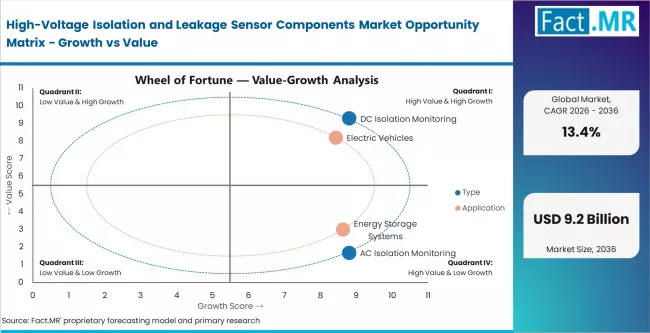
High Voltage Isolation And Leakage Sensor Components Market Opportunity Matrix Growth Vs Value

Market expansion is accelerating as electrification spreads across transport and energy systems. Demand is closely tied to the deployment of high-voltage architectures in electric vehicles and grid-scale storage, where continuous monitoring of insulation and leakage becomes essential for safe operation. The current valuation reflects a scaling phase, where adoption is increasing but still shaped by strict safety standards and validation requirements. As battery systems operate at higher voltages and capacities, monitoring needs become more complex, supporting steady growth in sensor integration across platforms.

System design is moving toward integrated monitoring solutions that combine isolation detection, leakage sensing, and real-time diagnostics within a single architecture. Higher precision is required to manage fault detection and ensure compliance with evolving safety regulations. Standard components are gradually being replaced in high-performance systems, where redundancy, faster response time, and accuracy are critical. Advanced solutions come with higher costs, which are absorbed more easily in premium EV platforms and large-scale energy storage systems. Regulatory pressure and safety requirements continue to support this transition, as reliable monitoring becomes a core part of system design rather than an optional feature.

  • IEC Safety Standards: IEC 61557 and ISO 6469 standards mandate insulation monitoring in high-voltage systems, increasing adoption across EV and industrial applications.
  • EV Platform Growth: Expansion of high-voltage EV architectures is increasing demand for leakage detection and isolation monitoring systems.
  • Grid Storage Expansion: Growth in renewable energy storage is increasing demand for monitoring systems in battery installations.

Regional Analysis

The high-voltage isolation and leakage sensor components market is assessed across Asia Pacific, North America, Europe, Latin America, and Middle East & Africa. Demand patterns reflect EV production, energy storage deployment, and industrial electrification. The full report provides market attractiveness analysis.

Top Country Growth Comparison High Voltage Isolation And Leakage Sensor Components Market Cagr (2026 2036)

Country CAGR (2026 to 2036)
India 21.2%
China 20.4%
Germany 18.8%
USA 18.4%
Japan 17.9%

Source: Fact.MR (FACTMR) analysis, based on proprietary forecasting model and primary research
High Voltage Isolation And Leakage Sensor Components Market Cagr Analysis By Country

Asia Pacific High-Voltage Isolation and Leakage Sensor Components Market Analysis
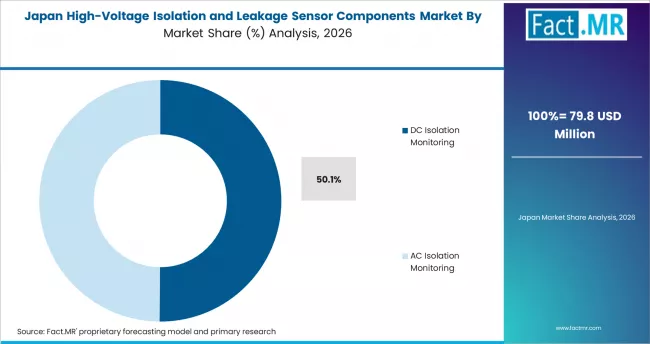
High Voltage Isolation And Leakage Sensor Components Market Japan Market Share Analysis By Type

Asia Pacific functions as the global production and deployment hub for high-voltage systems. Strong EV manufacturing in China and accelerating electrification in India define regional demand. BYD Company Ltd. and Contemporary Amperex Technology Co., Limited maintain dominant positions through integrated battery and vehicle production.

  • India: Demand for high-voltage isolation and leakage sensor components in India is projected to rise at 21.2% CAGR through 2036. Government initiatives such as the FAME II scheme (extended in 2024) continue to support EV adoption. Tata Motors expanded EV production capacity in 2025, increasing demand for battery safety components. The Ministry of Power introduced grid-scale battery storage tenders in 2024, supporting deployment of monitoring systems across renewable energy projects. Domestic manufacturing incentives are improving supply chain depth and reducing dependency on imports.
  • China: Sales of high-voltage isolation monitoring components in China are expected to increase at 20.4% CAGR during the forecast period. National NEV policies updated in 2024 continue to support EV production targets. CATL expanded battery manufacturing capacity in multiple provinces in 2025, increasing demand for integrated safety monitoring systems. The State Grid Corporation initiated large-scale energy storage projects in 2024, further strengthening demand for isolation monitoring in grid-connected applications. Growth remains production-driven with strong domestic integration.
  • Japan: Demand for high-voltage isolation and leakage sensor components in Japan is projected to rise at 17.9% CAGR through 2036. Automotive electrification remains a core driver, supported by hybrid and battery electric vehicle production led by Toyota Motor Corporation and Nissan Motor Co., Ltd. Japan’s Ministry of Economy, Trade and Industry (METI) updated its Green Growth Strategy in 2024, reinforcing electrification targets and supporting investments in battery technologies and associated safety systems.

North America High-Voltage Isolation and Leakage Sensor Components Market Analysis
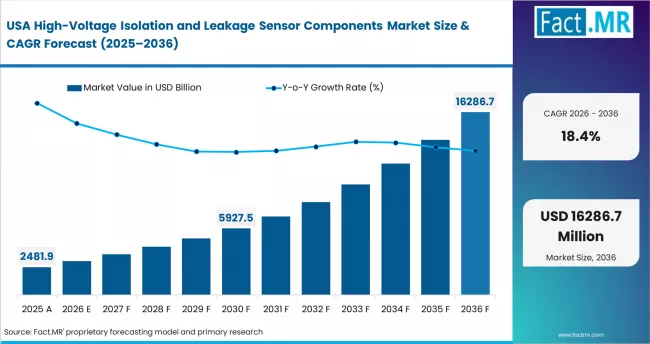
High Voltage Isolation And Leakage Sensor Components Market Country Value Analysis

North America represents a technology-driven and policy-supported electrification region. Strong investment in EV manufacturing and grid modernization supports steady demand growth.

  • USA: The market for high-voltage isolation and leakage sensor components in the United States is expected to grow at 18.4% CAGR during the study period. The Inflation Reduction Act implementation in 2024 accelerated domestic EV and battery manufacturing. General Motors expanded its Ultium battery production network in 2025, increasing demand for integrated monitoring systems. The Department of Energy funded grid-scale battery storage projects in 2024, requiring advanced leakage detection systems for safety compliance. Procurement is driven by long-term contracts and regulatory compliance requirements, supporting consistent demand.

Europe High-Voltage Isolation and Leakage Sensor Components Market Analysis
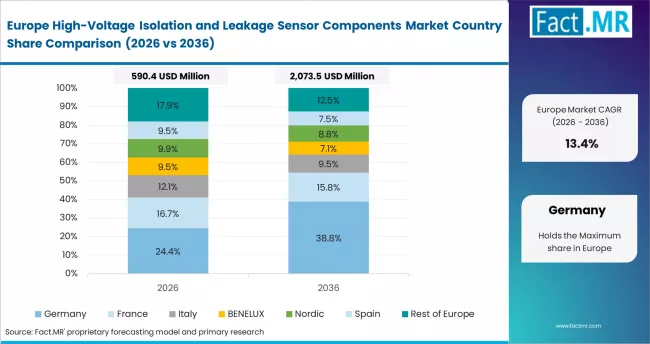
High Voltage Isolation And Leakage Sensor Components Market Europe Country Market Share Analysis, 2026 & 2036

Europe operates as a compliance-intensive and technologically advanced market. Strict safety standards and industrial electrification define regional demand.

  • Germany: Demand for high-voltage isolation and leakage sensor components in Germany is projected to rise at 18.8% CAGR through 2036. EU battery regulations implemented in 2024 require advanced safety monitoring systems. Volkswagen expanded battery cell manufacturing facilities in 2025, increasing demand for integrated sensing solutions. Siemens Energy deployed grid-scale storage systems in 2024, requiring isolation monitoring for compliance. Procurement decisions are strongly influenced by regulatory standards and supplier certification requirements, shaping long-term demand.

FACTMR's analysis of high-voltage isolation and leakage sensor components market consists of country-wise assessment that includes India, China, Germany, USA, and Japan. Readers can find insights on electrification trends, regulatory impact, and supplier positioning across regions.

Competitive Aligners for Market Players
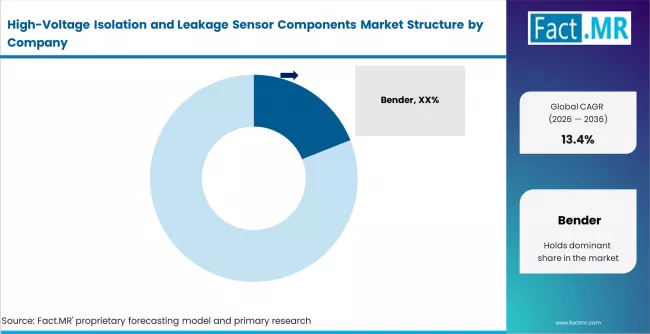
High Voltage Isolation And Leakage Sensor Components Market Analysis By Company

The market remains moderately concentrated, with key semiconductor and electrical safety companies holding a significant share. Competition is defined by sensing accuracy, operational reliability, and adherence to international safety standards, which limit the role of price as a primary differentiator. Qualification requirements and validation cycles create entry barriers, favoring suppliers with established performance records.

Companies with strong engineering capabilities and close OEM alignment hold structural advantages. Bender GmbH & Co. KG, Texas Instruments, and Analog Devices benefit from integration within EV and industrial supply chains, where system-level compatibility and long-term support are critical. Their ability to deliver reliable solutions across multiple applications strengthens their position in sourcing programs.

OEMs retain high bargaining power through multi-sourcing strategies and extended qualification cycles. This approach limits pricing flexibility and encourages suppliers to invest in innovation, improve integration capabilities, and align closely with evolving system requirements.

Key Players

  • Bender
  • Texas Instruments
  • Analog Devices
  • Vishay Intertechnology
  • Renesas

Bibliography

  • [1] Bender GmbH, Insulation Monitoring Systems Portfolio Update, 2024
  • [2] Analog Devices, Precision Isolation Measurement IC Release, 2024
  • [3] International Energy Agency (IEA), Energy Storage Outlook, 2024
  • [4] Texas Instruments, EV Battery Monitoring Solutions Update, 2024
  • [5] Renesas Electronics, Automotive Isolation Sensor Launch, 2025
  • [6] International Energy Agency (IEA), Global EV Outlook, 2024

This Report Addresses

  • Provides strategic intelligence on high-voltage safety monitoring systems, covering isolation detection, leakage sensing, and integration across EV and industrial platforms.
  • Covers market forecast from USD 2.3 billion in 2026 to USD 7.9 billion by 2036, reflecting expansion driven by electrification and stricter safety requirements.
  • Identifies growth opportunities across electric vehicles, grid-scale energy storage, and industrial high-voltage systems with clear application mapping.
  • Offers segment and regional analysis across key applications and geographies, highlighting demand patterns and adoption trends.
  • Evaluates competitive positioning of leading sensor and semiconductor companies, focusing on integration capability and OEM alignment.
  • Tracks product innovation and compliance developments linked to evolving safety standards and monitoring requirements.
  • Analyzes regulatory impact, including IEC standards and automotive safety frameworks influencing system design and validation.
  • Delivered in PDF, Excel datasets, and presentation formats to support technical, commercial, and strategic decision-making needs.

High-Voltage Isolation and Leakage Sensor Components Market Definition

High-voltage isolation and leakage sensor components are electronic monitoring devices used to detect insulation faults and leakage currents in high-voltage electrical systems. These components ensure safe operation by identifying abnormal current paths that could lead to electric shock, fire, or system failure. They are widely used in electric vehicles, battery energy storage systems, industrial automation equipment, and renewable energy installations, where maintaining electrical isolation is critical for safety and regulatory compliance.

High-Voltage Isolation and Leakage Sensor Components Market Inclusions

Covers global and regional forecasts from 2026 to 2036. Includes AC and DC isolation monitoring systems across EVs, energy storage, industrial equipment, and renewable energy systems. The report evaluates system integration, pricing trends, and supplier positioning within high-voltage electrical architectures.

High-Voltage Isolation and Leakage Sensor Components Market Exclusions

Excludes full battery management systems, inverters, and power electronics modules. Does not include general-purpose current sensors or low-voltage monitoring devices. The focus remains strictly on isolation monitoring and leakage detection components embedded within high-voltage systems.

High-Voltage Isolation and Leakage Sensor Components Market Research Methodology

  • Primary Research
    • Interviews with EV OEMs, battery integrators, industrial equipment manufacturers, and sensor suppliers.
  • Desk Research
    • Uses EV policy frameworks, grid infrastructure reports, and international electrical safety standards.
  • Market-Sizing and Forecasting
    • Hybrid model using electrification deployment rates and system-level sensor integration ratios.
  • Data Validation and Update Cycle
    • Validated through supplier shipment tracking and OEM sourcing data, updated annually.

Scope of Report

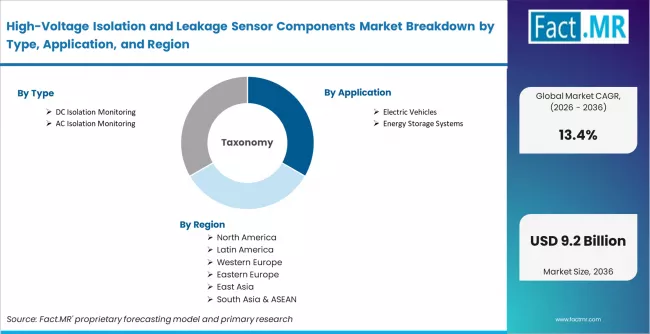
High Voltage Isolation And Leakage Sensor Components Market Breakdown By Type Application And Region

Attribute Details
Quantitative Units USD 2.3 billion (2026) to USD 7.9 billion (2036), at a CAGR of 13.4%
Market Definition High-voltage isolation and leakage sensor components used to monitor insulation resistance and detect leakage currents in high-voltage systems, ensuring safe operation across electric vehicles, energy storage systems, industrial equipment, and renewable energy installations globally.
Type Segmentation AC Isolation Monitoring, DC Isolation Monitoring
Application Segmentation Electric Vehicles, Energy Storage Systems, Industrial Equipment, Renewable Energy Systems, Others
Application Coverage Battery safety monitoring, insulation fault detection, leakage current detection, grid-connected energy storage safety, industrial high-voltage system protection, and renewable energy system compliance
Regions Covered North America, Europe, Asia Pacific, Latin America, Middle East & Africa
Countries Covered USA, Canada, Mexico, Germany, UK, France, Italy, Spain, China, Japan, India, South Korea, ASEAN, Brazil, Argentina, GCC, South Africa
Key Companies Profiled Bender, Texas Instruments, Analog Devices, Vishay Intertechnology, Renesas
Forecast Period 2026 to 2036
Approach Hybrid top-down and bottom-up model using EV production volumes, energy storage deployment data, industrial electrification rates, sensor integration ratios per system, average selling prices, and primary interviews with OEMs, utilities, and component suppliers

High-Voltage Isolation and Leakage Sensor Components Market Segments

  • By Type

    • AC Isolation Monitoring
    • DC Isolation Monitoring
  • By Application

    • Electric Vehicles
    • Energy Storage Systems
    • Industrial Equipment
    • Renewable Energy Systems
    • Others
  • By Region

    • North America
      • United States
      • Canada
      • Mexico
    • Europe
      • Germany
      • United Kingdom
      • France
      • Italy
      • Spain
    • Asia Pacific
      • China
      • Japan
      • India
      • South Korea
      • ASEAN
    • Latin America
      • Brazil
      • Argentina
    • Middle East & Africa
      • GCC
      • South Africa

Table of Content

  1. Executive Summary
    • Global Market Outlook
    • Demand to side Trends
    • Supply to side Trends
    • Technology Roadmap Analysis
    • Analysis and Recommendations
  2. Market Overview
    • Market Coverage / Taxonomy
    • Market Definition / Scope / Limitations
  3. Research Methodology
    • Chapter Orientation
    • Analytical Lens and Working Hypotheses
      • Market Structure, Signals, and Trend Drivers
      • Benchmarking and Cross-market Comparability
      • Market Sizing, Forecasting, and Opportunity Mapping
    • Research Design and Evidence Framework
      • Desk Research Programme (Secondary Evidence)
        • Company Annual and Sustainability Reports
        • Peer-reviewed Journals and Academic Literature
        • Corporate Websites, Product Literature, and Technical Notes
        • Earnings Decks and Investor Briefings
        • Statutory Filings and Regulatory Disclosures
        • Technical White Papers and Standards Notes
        • Trade Journals, Industry Magazines, and Analyst Briefs
        • Conference Proceedings, Webinars, and Seminar Materials
        • Government Statistics Portals and Public Data Releases
        • Press Releases and Reputable Media Coverage
        • Specialist Newsletters and Curated Briefings
        • Sector Databases and Reference Repositories
        • Fact.MR Internal Proprietary Databases and Historical Market Datasets
        • Subscription Datasets and Paid Sources
        • Social Channels, Communities, and Digital Listening Inputs
        • Additional Desk Sources
      • Expert Input and Fieldwork (Primary Evidence)
        • Primary Modes
          • Qualitative Interviews and Expert Elicitation
          • Quantitative Surveys and Structured Data Capture
          • Blended Approach
        • Why Primary Evidence is Used
        • Field Techniques
          • Interviews
          • Surveys
          • Focus Groups
          • Observational and In-context Research
          • Social and Community Interactions
        • Stakeholder Universe Engaged
          • C-suite Leaders
          • Board Members
          • Presidents and Vice Presidents
          • R&D and Innovation Heads
          • Technical Specialists
          • Domain Subject-matter Experts
          • Scientists
          • Physicians and Other Healthcare Professionals
        • Governance, Ethics, and Data Stewardship
          • Research Ethics
          • Data Integrity and Handling
      • Tooling, Models, and Reference Databases
    • Data Engineering and Model Build
      • Data Acquisition and Ingestion
      • Cleaning, Normalisation, and Verification
      • Synthesis, Triangulation, and Analysis
    • Quality Assurance and Audit Trail
  4. Market Background
    • Market Dynamics
      • Drivers
      • Restraints
      • Opportunity
      • Trends
    • Scenario Forecast
      • Demand in Optimistic Scenario
      • Demand in Likely Scenario
      • Demand in Conservative Scenario
    • Opportunity Map Analysis
    • Product Life Cycle Analysis
    • Supply Chain Analysis
    • Investment Feasibility Matrix
    • Value Chain Analysis
    • PESTLE and Porter’s Analysis
    • Regulatory Landscape
    • Regional Parent Market Outlook
    • Production and Consumption Statistics
    • Import and Export Statistics
  5. Global Market Analysis 2021 to 2025 and Forecast, 2026 to 2036
    • Historical Market Size Value (USD Million) Analysis, 2021 to 2025
    • Current and Future Market Size Value (USD Million) Projections, 2026 to 2036
      • Y to o to Y Growth Trend Analysis
      • Absolute $ Opportunity Analysis
  6. Global Market Pricing Analysis 2021 to 2025 and Forecast 2026 to 2036
  7. Global Market Analysis 2021 to 2025 and Forecast 2026 to 2036, By Type
    • Introduction / Key Findings
    • Historical Market Size Value (USD Million) Analysis By Type , 2021 to 2025
    • Current and Future Market Size Value (USD Million) Analysis and Forecast By Type , 2026 to 2036
      • DC Isolation Monitoring
      • AC Isolation Monitoring
    • Y to o to Y Growth Trend Analysis By Type , 2021 to 2025
    • Absolute $ Opportunity Analysis By Type , 2026 to 2036
  8. Global Market Analysis 2021 to 2025 and Forecast 2026 to 2036, By Application
    • Introduction / Key Findings
    • Historical Market Size Value (USD Million) Analysis By Application, 2021 to 2025
    • Current and Future Market Size Value (USD Million) Analysis and Forecast By Application, 2026 to 2036
      • Electric Vehicles
      • Energy Storage Systems
      • Industrial Equipment
      • Renewable Energy Systems
      • Others
    • Y to o to Y Growth Trend Analysis By Application, 2021 to 2025
    • Absolute $ Opportunity Analysis By Application, 2026 to 2036
  9. Global Market Analysis 2021 to 2025 and Forecast 2026 to 2036, By Region
    • Introduction
    • Historical Market Size Value (USD Million) Analysis By Region, 2021 to 2025
    • Current Market Size Value (USD Million) Analysis and Forecast By Region, 2026 to 2036
      • North America
      • Latin America
      • Western Europe
      • Eastern Europe
      • East Asia
      • South Asia and Pacific
      • Middle East & Africa
    • Market Attractiveness Analysis By Region
  10. North America Market Analysis 2021 to 2025 and Forecast 2026 to 2036, By Country
    • Historical Market Size Value (USD Million) Trend Analysis By Market Taxonomy, 2021 to 2025
    • Market Size Value (USD Million) Forecast By Market Taxonomy, 2026 to 2036
      • By Country
        • USA
        • Canada
        • Mexico
      • By Type
      • By Application
    • Market Attractiveness Analysis
      • By Country
      • By Type
      • By Application
    • Key Takeaways
  11. Latin America Market Analysis 2021 to 2025 and Forecast 2026 to 2036, By Country
    • Historical Market Size Value (USD Million) Trend Analysis By Market Taxonomy, 2021 to 2025
    • Market Size Value (USD Million) Forecast By Market Taxonomy, 2026 to 2036
      • By Country
        • Brazil
        • Chile
        • Rest of Latin America
      • By Type
      • By Application
    • Market Attractiveness Analysis
      • By Country
      • By Type
      • By Application
    • Key Takeaways
  12. Western Europe Market Analysis 2021 to 2025 and Forecast 2026 to 2036, By Country
    • Historical Market Size Value (USD Million) Trend Analysis By Market Taxonomy, 2021 to 2025
    • Market Size Value (USD Million) Forecast By Market Taxonomy, 2026 to 2036
      • By Country
        • Germany
        • UK
        • Italy
        • Spain
        • France
        • Nordic
        • BENELUX
        • Rest of Western Europe
      • By Type
      • By Application
    • Market Attractiveness Analysis
      • By Country
      • By Type
      • By Application
    • Key Takeaways
  13. Eastern Europe Market Analysis 2021 to 2025 and Forecast 2026 to 2036, By Country
    • Historical Market Size Value (USD Million) Trend Analysis By Market Taxonomy, 2021 to 2025
    • Market Size Value (USD Million) Forecast By Market Taxonomy, 2026 to 2036
      • By Country
        • Russia
        • Poland
        • Hungary
        • Balkan & Baltic
        • Rest of Eastern Europe
      • By Type
      • By Application
    • Market Attractiveness Analysis
      • By Country
      • By Type
      • By Application
    • Key Takeaways
  14. East Asia Market Analysis 2021 to 2025 and Forecast 2026 to 2036, By Country
    • Historical Market Size Value (USD Million) Trend Analysis By Market Taxonomy, 2021 to 2025
    • Market Size Value (USD Million) Forecast By Market Taxonomy, 2026 to 2036
      • By Country
        • China
        • Japan
        • South Korea
      • By Type
      • By Application
    • Market Attractiveness Analysis
      • By Country
      • By Type
      • By Application
    • Key Takeaways
  15. South Asia and Pacific Market Analysis 2021 to 2025 and Forecast 2026 to 2036, By Country
    • Historical Market Size Value (USD Million) Trend Analysis By Market Taxonomy, 2021 to 2025
    • Market Size Value (USD Million) Forecast By Market Taxonomy, 2026 to 2036
      • By Country
        • India
        • ASEAN
        • Australia & New Zealand
        • Rest of South Asia and Pacific
      • By Type
      • By Application
    • Market Attractiveness Analysis
      • By Country
      • By Type
      • By Application
    • Key Takeaways
  16. Middle East & Africa Market Analysis 2021 to 2025 and Forecast 2026 to 2036, By Country
    • Historical Market Size Value (USD Million) Trend Analysis By Market Taxonomy, 2021 to 2025
    • Market Size Value (USD Million) Forecast By Market Taxonomy, 2026 to 2036
      • By Country
        • Kingdom of Saudi Arabia
        • Other GCC Countries
        • Turkiye
        • South Africa
        • Other African Union
        • Rest of Middle East & Africa
      • By Type
      • By Application
    • Market Attractiveness Analysis
      • By Country
      • By Type
      • By Application
    • Key Takeaways
  17. Key Countries Market Analysis
    • USA
      • Pricing Analysis
      • Market Share Analysis, 2025
        • By Type
        • By Application
    • Canada
      • Pricing Analysis
      • Market Share Analysis, 2025
        • By Type
        • By Application
    • Mexico
      • Pricing Analysis
      • Market Share Analysis, 2025
        • By Type
        • By Application
    • Brazil
      • Pricing Analysis
      • Market Share Analysis, 2025
        • By Type
        • By Application
    • Chile
      • Pricing Analysis
      • Market Share Analysis, 2025
        • By Type
        • By Application
    • Germany
      • Pricing Analysis
      • Market Share Analysis, 2025
        • By Type
        • By Application
    • UK
      • Pricing Analysis
      • Market Share Analysis, 2025
        • By Type
        • By Application
    • Italy
      • Pricing Analysis
      • Market Share Analysis, 2025
        • By Type
        • By Application
    • Spain
      • Pricing Analysis
      • Market Share Analysis, 2025
        • By Type
        • By Application
    • France
      • Pricing Analysis
      • Market Share Analysis, 2025
        • By Type
        • By Application
    • India
      • Pricing Analysis
      • Market Share Analysis, 2025
        • By Type
        • By Application
    • ASEAN
      • Pricing Analysis
      • Market Share Analysis, 2025
        • By Type
        • By Application
    • Australia & New Zealand
      • Pricing Analysis
      • Market Share Analysis, 2025
        • By Type
        • By Application
    • China
      • Pricing Analysis
      • Market Share Analysis, 2025
        • By Type
        • By Application
    • Japan
      • Pricing Analysis
      • Market Share Analysis, 2025
        • By Type
        • By Application
    • South Korea
      • Pricing Analysis
      • Market Share Analysis, 2025
        • By Type
        • By Application
    • Russia
      • Pricing Analysis
      • Market Share Analysis, 2025
        • By Type
        • By Application
    • Poland
      • Pricing Analysis
      • Market Share Analysis, 2025
        • By Type
        • By Application
    • Hungary
      • Pricing Analysis
      • Market Share Analysis, 2025
        • By Type
        • By Application
    • Kingdom of Saudi Arabia
      • Pricing Analysis
      • Market Share Analysis, 2025
        • By Type
        • By Application
    • Turkiye
      • Pricing Analysis
      • Market Share Analysis, 2025
        • By Type
        • By Application
    • South Africa
      • Pricing Analysis
      • Market Share Analysis, 2025
        • By Type
        • By Application
  18. Market Structure Analysis
    • Competition Dashboard
    • Competition Benchmarking
    • Market Share Analysis of Top Players
      • By Regional
      • By Type
      • By Application
  19. Competition Analysis
    • Competition Deep Dive
      • Bender
        • Overview
        • Product Portfolio
        • Profitability by Market Segments (Product/Age /Sales Channel/Region)
        • Sales Footprint
        • Strategy Overview
          • Marketing Strategy
          • Product Strategy
          • Channel Strategy
      • Texas Instruments
      • Analog Devices
      • Vishay Intertechnology
      • Renesas
  20. Assumptions & Acronyms Used

List Of Table

  • Table 1: Global Market Value (USD Million) Forecast by Region, 2021 to 2036
  • Table 2: Global Market Value (USD Million) Forecast by Type, 2021 to 2036
  • Table 3: Global Market Value (USD Million) Forecast by Application, 2021 to 2036
  • Table 4: North America Market Value (USD Million) Forecast by Country, 2021 to 2036
  • Table 5: North America Market Value (USD Million) Forecast by Type, 2021 to 2036
  • Table 6: North America Market Value (USD Million) Forecast by Application, 2021 to 2036
  • Table 7: Latin America Market Value (USD Million) Forecast by Country, 2021 to 2036
  • Table 8: Latin America Market Value (USD Million) Forecast by Type, 2021 to 2036
  • Table 9: Latin America Market Value (USD Million) Forecast by Application, 2021 to 2036
  • Table 10: Western Europe Market Value (USD Million) Forecast by Country, 2021 to 2036
  • Table 11: Western Europe Market Value (USD Million) Forecast by Type, 2021 to 2036
  • Table 12: Western Europe Market Value (USD Million) Forecast by Application, 2021 to 2036
  • Table 13: Eastern Europe Market Value (USD Million) Forecast by Country, 2021 to 2036
  • Table 14: Eastern Europe Market Value (USD Million) Forecast by Type, 2021 to 2036
  • Table 15: Eastern Europe Market Value (USD Million) Forecast by Application, 2021 to 2036
  • Table 16: East Asia Market Value (USD Million) Forecast by Country, 2021 to 2036
  • Table 17: East Asia Market Value (USD Million) Forecast by Type, 2021 to 2036
  • Table 18: East Asia Market Value (USD Million) Forecast by Application, 2021 to 2036
  • Table 19: South Asia and Pacific Market Value (USD Million) Forecast by Country, 2021 to 2036
  • Table 20: South Asia and Pacific Market Value (USD Million) Forecast by Type, 2021 to 2036
  • Table 21: South Asia and Pacific Market Value (USD Million) Forecast by Application, 2021 to 2036
  • Table 22: Middle East & Africa Market Value (USD Million) Forecast by Country, 2021 to 2036
  • Table 23: Middle East & Africa Market Value (USD Million) Forecast by Type, 2021 to 2036
  • Table 24: Middle East & Africa Market Value (USD Million) Forecast by Application, 2021 to 2036

List Of Figures

  • Figure 1: Global Market Pricing Analysis
  • Figure 2: Global Market Value (USD Million) Forecast 2021 to 2036
  • Figure 3: Global Market Value Share and BPS Analysis by Type, 2026 and 2036
  • Figure 4: Global Market Y-o-Y Growth Comparison by Type,2026 to 2036
  • Figure 5: Global Market Attractiveness Analysis by Type
  • Figure 6: Global Market Value Share and BPS Analysis by Application, 2026 and 2036
  • Figure 7: Global Market Y-o-Y Growth Comparison by Application,2026 to 2036
  • Figure 8: Global Market Attractiveness Analysis by Application
  • Figure 9: Global Market Value (USD Million) Share and BPS Analysis by Region, 2026 and 2036
  • Figure 10: Global Market Y-o-Y Growth Comparison by Region,2026 to 2036
  • Figure 11: Global Market Attractiveness Analysis by Region
  • Figure 12: North America Market Incremental Dollar Opportunity,2026 to 2036
  • Figure 13: Latin America Market Incremental Dollar Opportunity,2026 to 2036
  • Figure 14: Western Europe Market Incremental Dollar Opportunity,2026 to 2036
  • Figure 15: Eastern Europe Market Incremental Dollar Opportunity,2026 to 2036
  • Figure 16: East Asia Market Incremental Dollar Opportunity,2026 to 2036
  • Figure 17: South Asia and Pacific Market Incremental Dollar Opportunity,2026 to 2036
  • Figure 18: Middle East & Africa Market Incremental Dollar Opportunity,2026 to 2036
  • Figure 19: North America Market Value Share and BPS Analysis by Country, 2026 and 2036
  • Figure 20: North America Market Value Share and BPS Analysis by Type, 2026 and 2036
  • Figure 21: North America Market Y-o-Y Growth Comparison by Type,2026 to 2036
  • Figure 22: North America Market Attractiveness Analysis by Type
  • Figure 23: North America Market Value Share and BPS Analysis by Application, 2026 and 2036
  • Figure 24: North America Market Y-o-Y Growth Comparison by Application,2026 to 2036
  • Figure 25: North America Market Attractiveness Analysis by Application
  • Figure 26: Latin America Market Value Share and BPS Analysis by Country, 2026 and 2036
  • Figure 27: Latin America Market Value Share and BPS Analysis by Type, 2026 and 2036
  • Figure 28: Latin America Market Y-o-Y Growth Comparison by Type,2026 to 2036
  • Figure 29: Latin America Market Attractiveness Analysis by Type
  • Figure 30: Latin America Market Value Share and BPS Analysis by Application, 2026 and 2036
  • Figure 31: Latin America Market Y-o-Y Growth Comparison by Application,2026 to 2036
  • Figure 32: Latin America Market Attractiveness Analysis by Application
  • Figure 33: Western Europe Market Value Share and BPS Analysis by Country, 2026 and 2036
  • Figure 34: Western Europe Market Value Share and BPS Analysis by Type, 2026 and 2036
  • Figure 35: Western Europe Market Y-o-Y Growth Comparison by Type,2026 to 2036
  • Figure 36: Western Europe Market Attractiveness Analysis by Type
  • Figure 37: Western Europe Market Value Share and BPS Analysis by Application, 2026 and 2036
  • Figure 38: Western Europe Market Y-o-Y Growth Comparison by Application,2026 to 2036
  • Figure 39: Western Europe Market Attractiveness Analysis by Application
  • Figure 40: Eastern Europe Market Value Share and BPS Analysis by Country, 2026 and 2036
  • Figure 41: Eastern Europe Market Value Share and BPS Analysis by Type, 2026 and 2036
  • Figure 42: Eastern Europe Market Y-o-Y Growth Comparison by Type,2026 to 2036
  • Figure 43: Eastern Europe Market Attractiveness Analysis by Type
  • Figure 44: Eastern Europe Market Value Share and BPS Analysis by Application, 2026 and 2036
  • Figure 45: Eastern Europe Market Y-o-Y Growth Comparison by Application,2026 to 2036
  • Figure 46: Eastern Europe Market Attractiveness Analysis by Application
  • Figure 47: East Asia Market Value Share and BPS Analysis by Country, 2026 and 2036
  • Figure 48: East Asia Market Value Share and BPS Analysis by Type, 2026 and 2036
  • Figure 49: East Asia Market Y-o-Y Growth Comparison by Type,2026 to 2036
  • Figure 50: East Asia Market Attractiveness Analysis by Type
  • Figure 51: East Asia Market Value Share and BPS Analysis by Application, 2026 and 2036
  • Figure 52: East Asia Market Y-o-Y Growth Comparison by Application,2026 to 2036
  • Figure 53: East Asia Market Attractiveness Analysis by Application
  • Figure 54: South Asia and Pacific Market Value Share and BPS Analysis by Country, 2026 and 2036
  • Figure 55: South Asia and Pacific Market Value Share and BPS Analysis by Type, 2026 and 2036
  • Figure 56: South Asia and Pacific Market Y-o-Y Growth Comparison by Type,2026 to 2036
  • Figure 57: South Asia and Pacific Market Attractiveness Analysis by Type
  • Figure 58: South Asia and Pacific Market Value Share and BPS Analysis by Application, 2026 and 2036
  • Figure 59: South Asia and Pacific Market Y-o-Y Growth Comparison by Application,2026 to 2036
  • Figure 60: South Asia and Pacific Market Attractiveness Analysis by Application
  • Figure 61: Middle East & Africa Market Value Share and BPS Analysis by Country, 2026 and 2036
  • Figure 62: Middle East & Africa Market Value Share and BPS Analysis by Type, 2026 and 2036
  • Figure 63: Middle East & Africa Market Y-o-Y Growth Comparison by Type,2026 to 2036
  • Figure 64: Middle East & Africa Market Attractiveness Analysis by Type
  • Figure 65: Middle East & Africa Market Value Share and BPS Analysis by Application, 2026 and 2036
  • Figure 66: Middle East & Africa Market Y-o-Y Growth Comparison by Application,2026 to 2036
  • Figure 67: Middle East & Africa Market Attractiveness Analysis by Application
  • Figure 68: Global Market - Tier Structure Analysis
  • Figure 69: Global Market - Company Share Analysis

- Frequently Asked Questions -

How large is the high-voltage isolation and leakage sensor components market in 2025?

The market was valued at USD 2.1 billion in 2025.

What is the estimated market size in 2026?

The market is projected to reach USD 2.3 billion in 2026.

What will the market size be by 2036?

The market is expected to grow to USD 7.9 billion by 2036.

What is the expected CAGR for this market?

The market is forecast to expand at a 13.4% CAGR from 2026 to 2036.

What are high-voltage isolation and leakage sensor components?

These are electronic devices used to detect insulation faults and leakage currents in high-voltage systems. They help prevent electrical failures and improve system safety.

Why are these sensors important in electric vehicles?

They monitor battery insulation and detect leakage currents, helping prevent short circuits, electric shock, and battery failure.

Which type segment is expected to lead the market?

DC isolation monitoring is expected to account for approximately 52% share in 2026, due to its use in battery-based systems.

Which application segment dominates the market?

Electric vehicles are projected to hold around 48% share in 2026, driven by high-voltage battery requirements.

Which region is growing the fastest?

India is expected to be the fastest-growing market, with a 21.2% CAGR through 2036.

What is driving growth in this market?

Growth is driven by EV adoption, expansion of energy storage systems, and stricter electrical safety standards.

What are the main challenges in this market?

Key challenges include high system costs and complexity of integrating sensors into high-voltage architectures.

How is energy storage affecting demand?

The growth of grid-scale battery storage is increasing demand for leakage detection and insulation monitoring systems to ensure safe operation.

High-Voltage Isolation and Leakage Sensor Components Market