- Base Value(2025): 152.8 Mn
- Forecast Value (2035): 221.9 Mn
- CAGR (2035): 3.8%
High Purity Quartz Sand Market in Europe Outlook (2025 to 2035)
The high purity quartz sand market in Europe is projected to increase from USD 152.8 million in 2025 to USD 221.9 million by 2035, with a CAGR of 3.8% during the forecast period. Growth is driven by rising semiconductor demand due to purity requirements in chip fabrication. The trend toward energy transition boosts solar PV manufacturing, which raises HPQ consumption.
Quick Facts about the High Purity Quartz Sand Market in Europe
- Industry Value (2025): USD 152.8 Million
- Projected Value (2035): USD 221.9 Million
- Forecast CAGR (2025 to 2035): 3.8%
- Leading Segment (2025): 3N (38% Market Share)
- Country Growth Rate (2025 to 2035): France (2.0% CAGR)
- Top Key Players: NORDIC MINING ASA, Sibelco, Quartz Corp., and HPQM High Purity Quartz Mines
What are the Drivers of High Purity Quartz Sand Market in Europe?
The growing semiconductor industry in Europe is a key driver of the high-purity quartz sand (HPQ) market. Countries such as Germany and the Netherlands are expanding chip manufacturing capacity under the EU Chips Act, which is expected to boost demand for ultra-pure quartz used in diffusion tubes, crucibles, and etching chambers.
The rapid expansion of the solar photovoltaic (PV) sector bolsters HPQ demand. With countries such as France and Spain investing in large-scale solar projects to meet renewable energy targets, the demand for quartz crucibles in silicon wafer production is rapidly increasing.
The European renewable energy sector requires high-purity quartz sand for solar panel production. Germany and Spain lead Europe in solar capacity installations. The European Commission reported a 20% increase in EU solar capacity installations last year. Need for high-purity quartz sand rises with demand for efficient, high-quality solar cells. SolarPower Europe promotes solar technology, which affects the photovoltaic and market.
Europe's specialty glass and optics industries also help to drive demand. The region is a world leader in the production of high-performance optical lenses and glass components, which require a steady supply of high-grade quartz for precision and purity.
Moreover, Europe's emphasis on securing strategic raw materials domestically opens up opportunities to explore local HPQ resources and reduce reliance on imports from the U.S. and Asia.
| Metric | Value |
|---|---|
| Industry Size (2025E) | USD 152.8 million |
| Industry Size (2035F) | USD 221.9 million |
| CAGR (2025-2035) | 3.8% |
Source: Fact.MR analysis. Updated Aug 1, 2025
What are the Regional Trends of High Purity Quartz Sand Market in Europe?
Northern Europe, including Sweden and Finland, is prioritizing sustainability and the exploration of domestic mineral reserves in order to reduce reliance on imports. While not traditional HPQ hotspots, these countries are increasing their investments in geological surveys and green technology integration, creating long-term opportunities for upstream quartz development.
Southern European countries such as Italy and Spain are seeing a steady increase in HPQ usage, owing primarily to solar energy expansion and precision manufacturing. Their warm climate and commitment to EU renewable directives encourage more solar panel installations, which in turn increases HPQ consumption.
Eastern Europe, particularly Poland, Hungary, and the Czech Republic, is emerging as a low-cost manufacturing hub for electronics and solar components. These countries benefit from EU investment and supply chain decentralization, which promotes the development of new HPQ demand centers as part of regional industrial diversification.
The U.K. continues to be an important importer and user of HPQ in advanced R&D, photonics, and clean technology sectors. Despite Brexit, the country continues to align with European innovation initiatives, ensuring that demand for specialized quartz applications remains relatively strong.
What are the Challenges and Restraining Factors of High Purity Quartz Sand Market in Europe?
The high-purity quartz sand (HPQ) market in Europe faces significant challenges due to the region's scarcity of ultra-pure quartz resources. While Europe has silica deposits, most lack the extremely low impurity levels required for HPQ applications, necessitating imports from the U.S. and Asia. This reliance makes the market vulnerable to price fluctuations and geopolitical risks, especially as global demand for semiconductors and solar energy grows.
Another significant barrier is the complex and costly purification process. Achieving 4N (99.99%) or higher purity levels necessitates advanced beneficiation, chemical treatment, and thermal processing, all of which require significant capital investment and specialized knowledge. This discourages new entrants and limits domestic production scalability.
Europe's environmental regulations complicate HPQ production even more. Stringent mining and emissions regulations increase operational costs and lengthen permitting timelines, making it difficult for businesses to build new processing facilities or expand existing ones. For example, the EU's push for sustainable raw material sourcing requires HPQ producers to meet stringent environmental standards, putting pressure on supply chains.
In addition, the highly competitive global landscape, particularly from low-cost suppliers in Asia, puts pricing pressure on European companies. These factors make it difficult for local producers to compete without government subsidies or long-term supply contracts with end users.
Country-Wise Outlook
| Country | CAGR (2025 to 2035) |
|---|---|
| United Kingdom | 1.4% |
| Germany | 5.0% |
| France | 2.2% |
Source: Fact.MR analysis. Updated Aug 1, 2025
U.K. High Purity Quartz Sand Market in Europe sees Growth Driven by Advanced Materials and Clean Tech Sectors
The U.K. has a modest but growing presence in the European high purity quartz sand (HPQ) market, owing to investments in semiconductor research, advanced materials, and clean energy technology. Although the U.K. does not have a large-scale HPQ mining industry, it does import high-quality quartz sand for precision applications in photonics, electronics, and solar research.
One of the primary drivers is the U.K.'s desire to rebuild its semiconductor ecosystem. In 2023, the U.K. government announced a £1 billion semiconductor strategy aimed at increasing design and R&D capacity, including the requirement for high-purity raw materials such as HPQ for advanced wafer processing and cleanroom technologies.
In terms of trends, universities and private labs in Cambridge, Oxford, and London are actively researching materials science, where HPQ has applications in optics, quantum computing, and specialty glass. Additionally, photonics companies in Scotland and southern England use ultra-pure quartz in laser and fiber optic applications.
Environmental and import regulations for silica and critical raw materials are also influencing the market. The U.K.'s compliance with REACH and UKCA standards ensures high safety and quality standards for imported HPQ materials. This makes quality control and traceability critical for local buyers.
Germany Leading HPQ Demand Driven by Semiconductors, Photovoltaics, and Precision Glass
Germany is a key player in the European high-purity quartz sand (HPQ) market, due to its leading position in semiconductor manufacturing, photovoltaics, and precision glass production. The country's industrial backbone is heavily reliant on ultrapure materials for high-tech processes, making HPQ a strategic asset.
Germany is also a market leader for solar photovoltaic installations. According to Fraunhofer ISE, Germany will install more than 14 GW of new solar capacity in 2023 alone. HPQ is required in the production of crucibles used in monocrystalline silicon growth for solar wafers, which drives consistent domestic demand.
Environmental regulations influence the HPQ landscape in Germany. The country's strict mining and industrial emissions policies limit the scope of local quartz extraction, leaving it reliant on imported ultra-pure quartz, primarily from the U.S. However, this opens up opportunities for domestic purification technologies and circular economy models in which quartz from used components is reclaimed and refined.
Research and development is another significant strength. German institutions and businesses are investing in refining techniques to convert lower-grade quartz into HPQ via advanced thermal and chemical processing, creating long-term cost savings and reducing import dependency.
France Strategic Consumer Driving HPQ Demand in Semiconductor and Renewable Sectors
France is emerging as a key player in Europe's high-purity quartz sand (HPQ) market, owing to its strong presence in semiconductor research, specialty glass manufacturing, and renewable energy transition. Though not a major HPQ producer, France is an important consumer and innovator in downstream applications.
The specialty glass and optics industry in France, which includes companies such as Saint-Gobain, also drives HPQ consumption. High purity quartz is required for the production of high-performance glass products used in aerospace, laboratory equipment, and medical technologies, all of which are sectors in which France competes globally.
France is also committed to EU sustainability goals and carbon reduction policies, which indirectly benefit the HPQ market via solar energy. By 2023, the French government had increased its target to 100 GW of solar capacity by 2050. HPQ is a critical component in the production of silicon ingots and crucibles used in photovoltaic production, indicating long-term growth potential for solar-related quartz applications.
On the regulatory front, France enforces strict environmental and resource extraction laws, limiting large-scale quartz mining in the country. This regulatory stance has resulted in a shift toward importing raw quartz and investing in purification technologies for high-end applications.
Category-wise Analysis
3N to Exhibit Leading by Grade
3N grade high-purity quartz sand dominates the market in Europe. This sand is primarily used in Europe for industrial and commercial applications that do not require ultra-high purity. It is suitable for manufacturing glass containers, general lighting products, and construction-grade specialty glass. While it has good thermal and chemical properties, the impurities make it unsuitable for semiconductor or high-end solar manufacturing. European manufacturers prefer 3N for high-volume, cost-sensitive applications where precision is secondary.
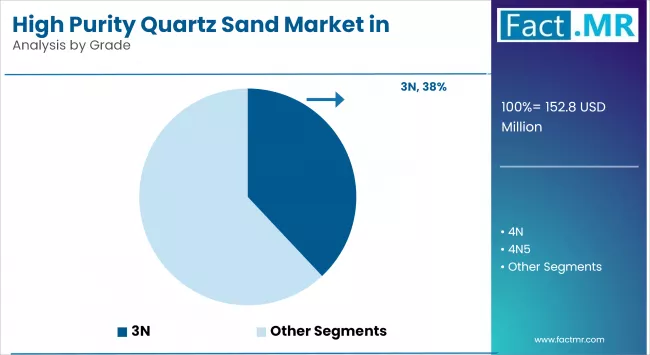
High Purity Quartz Sand Market In Europe By Grade | Source: Fact.MR
4N8 grade quartz sand is the fastest-growing segment in the high-purity quartz sand market in Europe, driven by high demand from Europe's advanced manufacturing sectors, particularly in the semiconductor and optics industries. This ultra-pure material is required to manufacture quartz crucibles and tubes used in wafer fabrication and high-precision optical components.
Countries such as Germany and the Netherlands use 4N8 quartz in applications with low contamination risk, bolstering the region's push for high-performance microelectronics and photonics. Europe's stringent quality standards drive up demand for this grade in critical technologies.
Wafer Processing to Exhibit Leading by Application
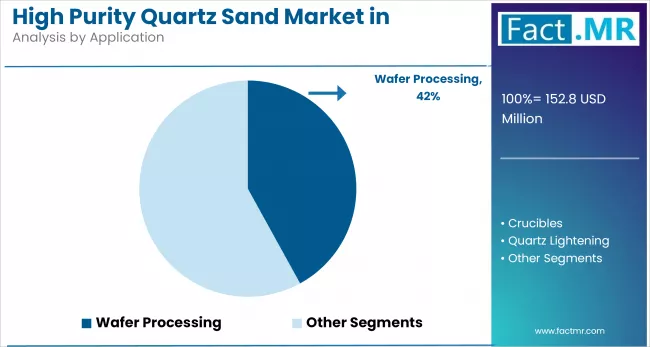
High Purity Quartz Sand Market In Europe By Application | Source: Fact.MR
Wafer processing dominates the high-purity quartz sand market in Europe. The wafer processing is a key application for high-purity quartz sand in Europe, particularly in Germany, France, and the Netherlands, which have advanced semiconductor industries. HPQ is used to create quartz tubes, boats, and crucibles that can withstand high temperatures and chemical exposure during wafer fabrication processes such as thermal diffusion and chemical vapor deposition. As Europe aims to double its global chip production share by 2030 under the EU Chips Act, demand for ultra-pure quartz materials is rapidly increasing.
High-purity quartz sand is the fastest-growing segment, due to rising use of this sand for the production of specialty glass in Europe, particularly for automotive, pharmaceutical, and aerospace applications. Countries such as Switzerland and Italy use HPQ to produce glass with high optical clarity, chemical resistance, and thermal stability. This glass is used in labware, optical instruments, and heat-resistant windows. The European emphasis on high-end manufacturing and quality standards ensures a high demand for HPQ in this segment.
Semiconductor to Exhibit Leading by End-Use
Semiconductor manufacturing holds the largest revenue share in the high purity quartz sand market in Europe, due to the increasing need for high purity quartz sand in semiconductor manufacturing (HPQ) in Europe. Germany and the Netherlands are at the forefront of chip production and equipment manufacturing, and they require ultra-pure quartz for crucibles, diffusion tubes, and etching components. The EU Chips Act, which allocates more than €43 billion in semiconductor investments, is boosting regional production. This increases demand for 4N+ purity quartz sand, which is required for the precision and reliability of semiconductor processes.
Glass manufacturing in Europe is another major application for HPQ, particularly in the production of high-end optical and specialty glass. Countries such as France and Italy are world leaders in premium glassware and optics. HPQ is valued here for its high thermal and chemical stability, enabling the manufacture of products such as laboratory glassware, fiber optics, and architectural glass. The region's push for energy-efficient and smart glass technologies also contributes to the increasing use of HPQ in the industry.
Competitive Analysis
The European High Purity Quartz Sand (HPQS) market is becoming increasingly competitive, driven by a mix of cutting-edge technological applications, strict environmental regulations, and a wide range of end-use industries. Key drivers include increased demand from the semiconductor, solar, and optical fiber industries, all of which require high-quality HPQS. The market's competitive landscape is shaped by the demand for high-purity materials, advanced processing capabilities, and environmentally friendly production practices.
The competitive analysis of the European HPQS market reveals a landscape in which companies compete across multiple fronts. These include product purity, processing technologies, and supply chain efficiency. Companies are also distinguished by their ability to meet stringent environmental standards and innovate in both product development and sustainable mining practices.
The presence of established manufacturers as well as the emergence of new players both have an impact on the market. Competitive dynamics include strategic alliances, acquisitions, and continuous improvement of manufacturing processes to meet changing end-user demands. The regulatory environment, particularly in terms of environmental sustainability, is an important factor in encouraging businesses to adopt environmentally friendly practices.
Key players in the market are NORDIC MINING ASA, Sibelco, Quartz Corp., HPQM High Purity Quartz Mines, Minerali Industriali S.r.l. and other players.
Recent Development
- In October 2023, Sibelco, a leading global industrial minerals company, finalized a key investment in Diatreme Resources Ltd, an emerging Australian producer of mineral and silica sands headquartered in Brisbane. Sibelco's second tranche investment of $24 million into the joint venture company, Cape Silica Holdings Pty Ltd, was completed ahead of schedule, increasing Sibelco's total joint venture interest to 26.8%.
- In April 2023, Sibelco, a leading global industrial minerals company, announced a significant investment of USD 200 million to double the installed capacity of high purity quartz (HPQ) at its Spruce Pine facility in North Carolina, USA. This expansion, referred to as "Expansion 1," was planned to be executed between 2023 and 2025 and aimed to increase production capacity to meet the growing global demand for HPQ.
Segmentation
Segmentation of High Purity Quartz Sand Market in Europe
-
By Grade :
- 3N
- 4N
- 4N5
- 4N6
- 4N7
- 4N8
- 5N
-
By Application :
- Wafer Processing
- Crucibles
- Quartz Lightening
- Xenon for Automotive
- Halogen Lamps
- High-intensity Discharge Lamps
- Ultra-high Performance Lamps
- Others
- Solar Cells
- Optical Lenses
- Quartz Fibers
- Specialty Glass
- LCD Glasses
- Lenses
- Ceramics
- Epoxy Molding Compounds
-
By End-Use :
- Semiconductor Manufacturing
- Solar Energy
- Lighting Equipment
- Telecommunication Equipment Production
- Optical Product Manufacturing
- Polymer Modification
- Glass Manufacturing
-
By Region :
- Germany
- Italy
- France
- United Kingdom
- Spain
- BENELUX
- Russia
- Rest of Europe
Frequently Asked Questions
What is the Global High Purity Quartz Sand Market in Europe size in 2025?
Who are the Major Players Operating in the High Purity Quartz Sand Market in Europe?
What is the Estimated Valuation of the High Purity Quartz Sand Market in Europe by 2035?
What Value CAGR Did the High Purity Quartz Sand Market in Europe Exhibit over the Last Five Years?
Who worked on this report


Preview the report firsthand - request a free sample
Free SampleGet the brochure for pricing and purchase details
Download PDF