3D Medical Imaging Devices Market Size, Share, Growth and Forecast (2026 - 2036)
The 3D Medical Imaging Devices Market is segmented by Product Type, by Application, by Technology, by End User, and by Sales Channel and Region. Forecast for 2026 to 2036.
Fact.MR states that 3D medical imaging device demand is shifting toward clearer anatomy review and procedure planning. Hospitals need systems that reduce diagnostic uncertainty. Imaging centers require scanners that improve case throughput and reporting confidence.
3D Medical Imaging Devices Market Size, Market Forecast and Outlook by Fact.MR
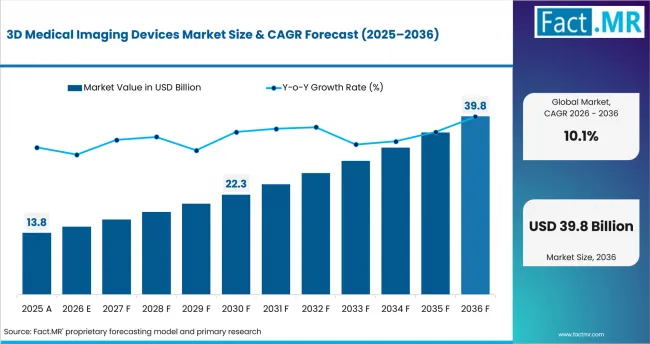
- The 3D medical imaging devices market was valued at USD 13.8 billion in 2025.
- Demand is expected to increase from USD 15.2 billion in 2026 to USD 39.8 billion by 2036.
- The market is forecast to record 10.1% CAGR during 2026 to 2036 as hospitals and imaging centers expand depth-based diagnostic workflows.
Metric Details
| Metric | Details |
|---|---|
| Industry Size 2026 | USD 15.2 billion |
| Industry Value 2036 | USD 39.8 billion |
| CAGR 2026 to 2036 | 10.1% |
Summary of 3D Medical Imaging Devices Market
- Demand Drivers in the Market
- Diagnostic Depth: Radiology departments use 3D imaging to improve anatomical review and treatment planning.
- Procedure Planning: Surgeons need 3D views to prepare for complex orthopedic and oncology cases.
- Scanner Replacement: Hospitals replace older systems to improve image quality and reporting workflow.
- Key Segments Analyzed
- By Product Type: 3D CT systems are expected to hold 34.0% share in 2026 because CT supports broad emergency and surgical planning use.
- By Application: Diagnostic imaging leads as hospitals use 3D views for anatomical review. The segment is projected to hold 41.0% share in 2026.
- By Technology: 3D reconstruction software is likely to account for 32.0% share in 2026 as radiology departments need clearer post-scan visualization.
- By End User: Hospitals lead because they manage advanced imaging workloads across departments. The segment is anticipated to capture 48.0% share in 2026.
- By Sales Channel: Direct sales are expected to hold 52.0% share in 2026 because high-value imaging systems require installation and service planning.
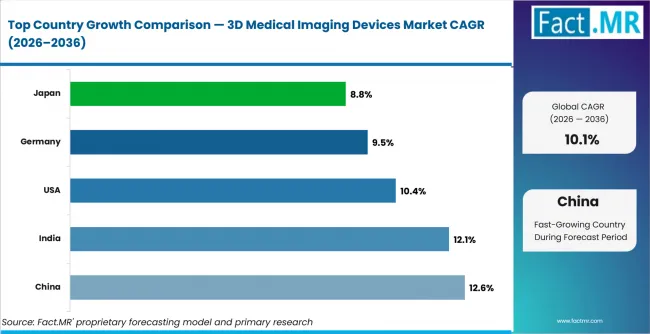
- By Geography: China is projected to record 12.6% CAGR through 2036 as hospital imaging capacity and specialist care expand.
- Analyst Opinion at Fact.MR
- Shambhunath Jha, Principal Consultant at Fact.MR, states, “3D medical imaging devices are moving from scanner purchases into workflow decisions. We see hospitals asking whether images can support diagnosis and faster reporting. Suppliers that combine device quality with clinical software support will gain better access.”
- Strategic Implications
- Imaging Quality: Device suppliers need systems that help radiologists reduce repeat scans and improve review confidence.
- Workflow Planning: Hospitals should assess storage and reporting needs before adding advanced 3D systems.
- Service Depth: Distributors need application support that helps clinical staff use 3D visualization correctly.
3D medical imaging device demand is becoming more workflow focused. Radiology departments need scan output that helps clinicians move from image review to treatment planning. GE HealthCare reported full-year 2025 activity with growth in Imaging and Advanced Visualization Solutions. [1] This supports the role of advanced visualization in medical imaging investment.
The market is moving beyond basic scan capture. Hospitals need devices that support 3D reconstruction and multi-specialty review. Orthopedic surgeons use 3D images for joint and spine assessment. Interventional departments need image-guided systems that support process confidence. This shift gives device suppliers a larger role in clinical workflow design.
China is projected to record 12.6% CAGR by 2036 as hospital imaging capacity and specialist care expand. India is likely to post 12.1% CAGR as diagnostic center networks grow. The United States is expected to register 10.4% CAGR since replacement demand and software-assisted imaging deepen. Germany is forecast to advance at 9.5% CAGR because hospital modernization supports advanced scanner use. Japan is set to record 8.8% CAGR by 2036 as aging care and imaging replacement sustain device purchases.
Segmental Analysis
3D Medical Imaging Devices Market Analysis by Product Type
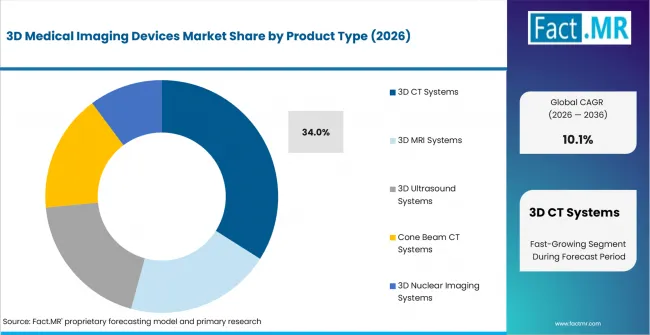
3D CT systems are expected to hold 34.0% share in 2026 because CT supports broad emergency and surgical planning use. Hospitals use CT for fast anatomical review across chest and trauma cases. 3D MRI systems serve soft-tissue imaging and neurological review. Cone beam CT supports dental and interventional workflows. 3D ultrasound serves obstetrics and selected cardiac reviews. Canon’s annual report notes diagnostic imaging equipment across CT, MRI, ultrasound, and X-ray systems. [2] Suppliers with strong CT service coverage can protect placement opportunities.
- CT Base: 3D CT systems support fast anatomical review across hospital departments.
- MRI Depth: 3D MRI systems help clinicians review soft tissue and neurological cases.
- Ultrasound Access: 3D ultrasound supports selected obstetric and cardiac workflows.
3D Medical Imaging Devices Market Analysis by Application
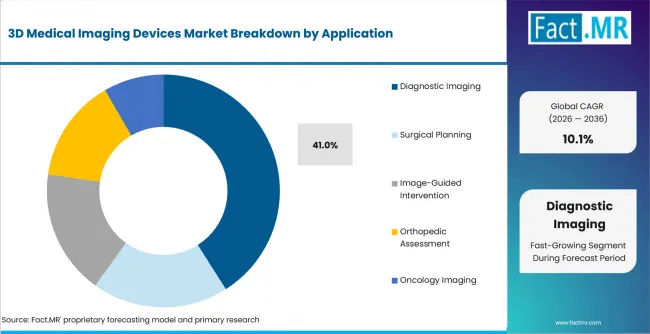
Diagnostic imaging remains the main application because most 3D device use starts with anatomy review. Hospitals use 3D scans to support diagnosis before treatment decisions. The segment is projected to hold 41.0% share in 2026 because radiology departments handle large imaging volumes. Surgical planning follows as orthopedic and oncology specialists use 3D views before complex procedures. Image-guided intervention supports catheter labs and interventional radiology. Application demand will rise fastest in departments that can connect scan output with treatment decisions.
- Diagnostic Review: 3D imaging helps radiologists view anatomy with greater spatial clarity.
- Surgical Planning: Surgeons use 3D views to prepare for complex cases.
- Guided Care: Image-guided intervention supports procedure navigation and treatment confirmation.
3D Medical Imaging Devices Market Analysis by Technology
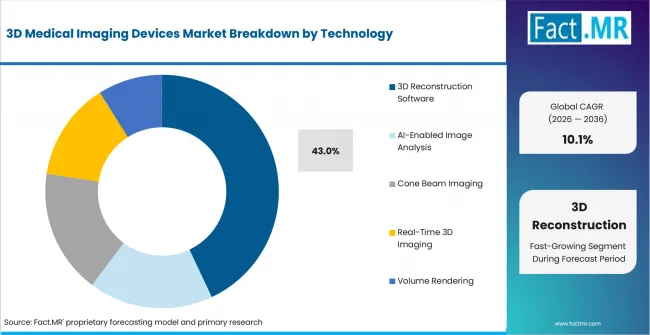
3D reconstruction software is likely to account for 32.0% share in 2026 as radiology departments need clearer post-scan visualization. Volume rendering supports anatomical viewing across CT and MRI data. AI-enabled image analysis helps clinicians review large imaging workloads. Cone beam imaging supports focused scan areas with lower space needs. Real-time 3D imaging helps interventional departments during guided procedures. Technology choice depends on clinical workflow and scanner compatibility. Hospitals that underinvest in reconstruction tools may limit the value of advanced imaging hardware.
- Reconstruction Value: 3D reconstruction software turns scan data into usable anatomical views.
- Volume Review: Volume rendering helps clinicians inspect complex structures.
- AI Support: AI-enabled analysis helps radiology departments manage image review pressure.
3D Medical Imaging Devices Market Analysis by End User
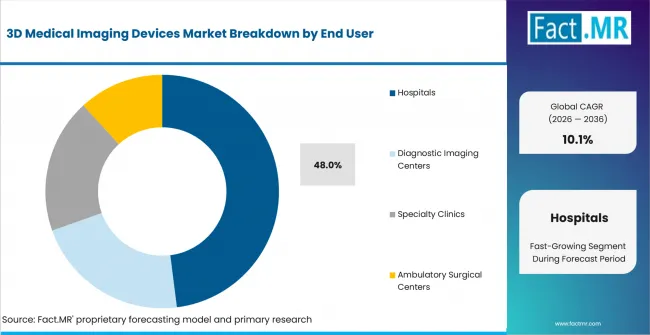
Hospitals lead because they manage advanced imaging workloads across departments. Radiology and emergency care all use 3D medical imaging devices. Hospitals are anticipated to capture 48.0% share in 2026 because they have the capital budgets and case complexity needed for advanced systems. Diagnostic imaging centers use 3D systems to improve reporting depth and compete on scan quality. Specialty clinics buy focused systems for orthopedics or women’s health. Ambulatory surgical centers need compact systems for procedure planning and guidance.
- Hospital Base: Hospitals use 3D imaging across diagnosis and procedure planning.
- Imaging Centers: Diagnostic centers invest in 3D systems to improve reporting confidence.
- Specialty Use: Specialty clinics need focused devices for targeted clinical workflows.
3D Medical Imaging Devices Market Analysis by Sales Channel
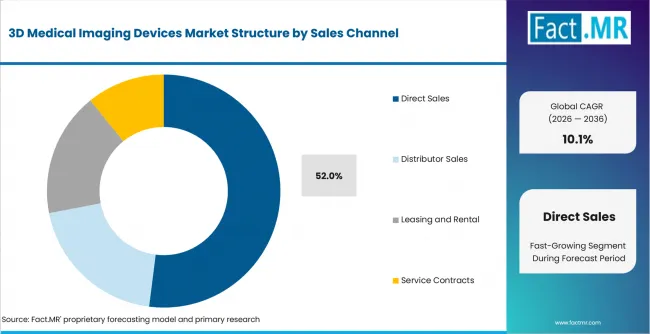
Direct sales are expected to hold 52.0% share in 2026 because high-value imaging systems require installation and service planning. Hospitals need vendor involvement during site preparation and system training. Distributor sales support regional diagnostic centers and specialty clinics. Leasing and rental models help facilities manage capital pressure. Service contracts protect uptime and image quality after installation. Philips’ annual report covers Diagnosis & Treatment activities that include image-guided therapy systems and related services. [3] Sales models that include training and service support will gain stronger adoption.
- Direct Placement: Direct sales help hospitals manage installation and training needs.
- Regional Reach: Distributor sales improve access for smaller imaging facilities.
- Service Continuity: Service contracts protect scanner uptime and clinical workflow reliability.
3D Medical Imaging Devices Market Drivers, Restraints, and Opportunities

Clinical demand for better anatomical review is the main driver for 3D medical imaging devices. Siemens Healthineers reported 6.5% comparable revenue growth in Imaging for fiscal year 2025. [4] This shows continued activity in advanced imaging equipment. Hospitals use 3D views to improve diagnosis and specialist communication. Diagnostic centers use upgraded scanners to strengthen service depth.
High system cost can restrain adoption. Advanced MRI and interventional imaging systems need capital budgets and trained staff. Smaller facilities may delay purchases if patient volume does not justify equipment expansion. Data storage and service costs can raise the total cost of ownership.
Opportunities in the 3D Medical Imaging Devices Market
- AI-Assisted Imaging: Device suppliers can support radiology departments that face heavy image review pressure.
- Compact Systems: Manufacturers can serve specialty clinics with smaller 3D imaging devices.
- Service Contracts: Vendors can build repeat revenue through maintenance and software support.
Regional Analysis
Based on regional analysis, the 3D medical imaging devices market is segmented into North America, Latin America, Europe, East Asia, South Asia and Pacific, and Middle East and Africa.
.webp)
Country CAGR 2026 to 2036
| Country | CAGR |
|---|---|
| China | 12.6% |
| India | 12.1% |
| United States | 10.4% |
| Germany | 9.5% |
| Japan | 8.8% |

East Asia 3D Medical Imaging Devices Market Analysis

East Asia demand comes from hospital imaging expansion and specialist care needs. China leads regional demand because large hospitals are adding advanced diagnostic capacity. Japan has steady replacement demand due to aging care needs and established hospital imaging infrastructure.
- China: China is projected to record 12.6% CAGR through 2036 as hospital imaging capacity and specialist care expand. Large urban hospitals need 3D CT and MRI systems for oncology and surgical planning. Regional hospitals are improving diagnostic access. Domestic equipment supply can support lower acquisition barriers. Service support will decide how quickly adoption spreads beyond top-tier cities. Suppliers with local training and maintenance reach will gain better hospital access.
- Japan: Japan has an aging population base and a mature hospital system. The country is set to post 8.8% CAGR over the forecast period as diagnostic replacement and advanced care needs sustain device purchases. Hospitals need reliable CT and ultrasound systems for specialist care. Imaging departments value uptime and service continuity. Japan’s demand profile favors quality and lifecycle support over rapid expansion. Suppliers with stable maintenance support and workflow software can defend long-term accounts.
North America 3D Medical Imaging Devices Market Analysis

North America demand is led by the United States because hospitals and imaging centers have deep advanced imaging use. Radiology departments need better scan review and AI-assisted analysis. The FDA maintains a list of AI-enabled medical devices authorized for marketing in the United States. [5] This supports greater transparency around software-assisted medical devices.
- United States: The United States is forecast to register 10.4% CAGR during 2026 to 2036 as replacement demand and software-assisted imaging deepen. Hospital systems use 3D imaging for diagnosis and interventional care. Outpatient imaging centers invest in advanced systems to improve service depth. AI-enabled review tools are gaining attention in radiology. Suppliers with FDA-cleared device portfolios and strong service networks will hold stronger positions.
South Asia and Europe 3D Medical Imaging Devices Market Analysis
South Asia has faster headroom because diagnostic infrastructure is expanding from major cities into regional hubs. India leads this group through private hospital growth and diagnostic center networks. Europe has steady demand because hospital systems focus on replacement and imaging quality. Germany benefits from specialist care and advanced hospital infrastructure.
- India: India is likely to post 12.1% CAGR through 2036 as diagnostic center networks grow. Private hospitals are expanding advanced imaging access in metro and tier-two cities. Oncology and orthopedic departments need clearer 3D views for diagnosis and planning. Capital cost still limits adoption in smaller facilities. Leasing and service-linked models can support scanner placement. Suppliers with regional training and maintenance support can improve adoption beyond large hospitals.
- Germany: Germany hospital system and specialist care base support steady 3D imaging device purchases. This supports 9.5% CAGR by 2036 as modernization and replacement cycles continue. Radiology departments need CT and MRI systems that integrate with clinical reporting workflows. Orthopedic and oncology specialists use 3D images for treatment planning. German hospitals value image quality and service reliability. Suppliers with strong application support can defend accounts in university hospitals and specialist centers.
Competitive Aligners for Market Suppliers

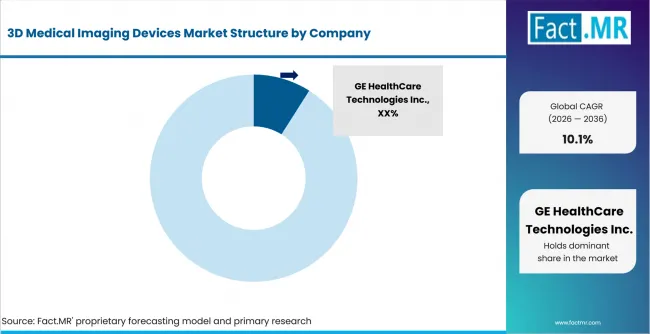
The 3D medical imaging devices market is served by global medical technology companies with deep imaging portfolios. GE HealthCare Technologies Inc. and Siemens Healthineers AG compete through advanced CT systems and MRI platforms. Koninklijke Philips N.V. and Canon Medical Systems Corporation support demand through ultrasound systems and image guided solutions. FUJIFILM Healthcare Corporation adds competition through imaging systems and healthcare software. Product difference depends on image clarity and software depth. Clinical workflow integration supports hospital adoption.
Device suppliers compete through installed base support and service reliability. Hospitals need scanners that connect smoothly with radiology information systems. Reporting software support is important for faster image review. Imaging centers focus on uptime and predictable maintenance costs. Suppliers with training support can improve adoption after system placement.
Competition will depend on scanner performance and lifecycle support through 2036. Companies with broad modality coverage can serve hospital departments across imaging needs. Suppliers with strong service networks will stay better placed in replacement and upgrade cycles. Clinical software and workflow support will remain important in supplier selection.
Key Companies in 3D Medical Imaging Devices Market
- GE HealthCare Technologies Inc.
- Siemens Healthineers AG
- Koninklijke Philips N.V.
- Canon Medical Systems Corporation
- FUJIFILM Healthcare Corporation
Bibliography
- [1] GE HealthCare Technologies Inc. (2026, February 4). GE HealthCare reports fourth quarter and full year 2025 financial results. GE HealthCare Technologies Inc.
- [2] Canon Inc. (2026, March 25). Canon annual report 2025. Canon Inc.
- [3] Koninklijke Philips N.V. (2026, February 19). Annual report 2025. Koninklijke Philips N.V.
- [4] Siemens Healthineers AG. (2025, November 5). Siemens Healthineers successfully closes 2025 fiscal year in challenging environment. Siemens Healthineers AG.
- [5] U.S. Food and Drug Administration. (2026, March 4). Artificial intelligence-enabled medical devices. U.S. Food and Drug Administration.
This Report Addresses
- Strategic intelligence on 3D medical imaging device demand across product type, application, technology, end user, and sales channel.
- Forecast mapping from USD 15.2 billion in 2026 to USD 39.8 billion by 2036.
- Segment analysis covering 3D CT systems, diagnostic imaging, 3D reconstruction software, hospitals, and direct sales.
- Regional outlook covering China, India, the United States, Germany, and Japan.
- Competitive analysis of GE HealthCare Technologies Inc., Siemens Healthineers AG, Koninklijke Philips N.V., Canon Medical Systems Corporation, FUJIFILM Healthcare Corporation.
- Product assessment covering CT systems, MRI systems, ultrasound systems, cone beam CT systems, and nuclear imaging systems.
- Channel assessment covering direct sales, distributor sales, leasing and rental, and service contracts.
- Primary interviews, supplier checks, official source review, and hospital imaging workflow validation support the forecast.
3D Medical Imaging Devices Market Definition
The 3D medical imaging devices market covers scanners and imaging systems that create depth-based medical views for diagnosis and treatment planning. It includes 3D CT and nuclear imaging devices. The market differs from 2D medical imaging because the output supports anatomical measurement and spatial review.
3D Medical Imaging Devices Market Inclusions
The scope includes medical imaging devices that capture or reconstruct 3D anatomical views. MRI and cone beam CT systems are included when used for clinical imaging. Software supplied with imaging devices is included when it supports scan reconstruction or image-guided review.
3D Medical Imaging Devices Market Exclusions
The scope excludes general 2D imaging equipment without 3D reconstruction capability. Standalone radiology software is excluded unless sold with or tied to a device workflow. Dental imaging services are excluded when they involve only service revenue. Consumer imaging devices and non-clinical visualization tools are outside scope.
3D Medical Imaging Devices Market Research Methodology
- Primary Research
- Primary research includes interviews with radiology department heads and hospital equipment planners. It includes input from diagnostic center owners and medical device distributors.
- Desk Research
- Desk research reviews company filings and product portfolios. It covers medical device guidance and hospital imaging procurement records.
- Market-Sizing and Forecasting
- Forecasting uses product type demand and application use. End-user purchasing and regional scanner replacement signals support the forecast.
- Data Validation and Update Cycle
- Forecasts are validated through supplier checks and hospital feedback. Imaging center expansion and service contract trends help confirm demand direction.
Scope of the Report

| Attribute | Details |
|---|---|
| Quantitative Units | USD 15.2 billion in 2026 to USD 39.8 billion by 2036 at 10.1% CAGR |
| Market Definition | Medical imaging devices that capture or reconstruct depth-based anatomical views |
| Product Type | 3D CT Systems, 3D MRI Systems, 3D Ultrasound Systems, Cone Beam CT Systems, 3D Nuclear Imaging Systems |
| Application | Diagnostic Imaging, Surgical Planning, Image-Guided Intervention, Orthopedic Assessment, Oncology Imaging |
| Technology | Volume Rendering, 3D Reconstruction Software, AI-Enabled Image Analysis, Cone Beam Imaging, Real-Time 3D Imaging |
| End User | Hospitals, Diagnostic Imaging Centers, Specialty Clinics, Ambulatory Surgical Centers |
| Sales Channel | Direct Sales, Distributor Sales, Leasing and Rental, Service Contracts |
| Regions Covered | North America, Latin America, Europe, East Asia, South Asia and Pacific, Middle East and Africa |
| Countries Covered | China, India, United States, Germany, Japan |
| Key Companies Profiled | GE HealthCare Technologies Inc., Siemens Healthineers AG, Koninklijke Philips N.V., Canon Medical Systems Corporation, FUJIFILM Healthcare Corporation |
| Forecast Period | 2026 to 2036 |
| Approach | Hybrid top-down and bottom-up approach using product type demand, application use, technology uptake, end-user purchasing, sales channel movement, and regional validation |
3D Medical Imaging Devices Market Analysis by Segments
-
By Product Type:
- 3D CT Systems
- 3D MRI Systems
- 3D Ultrasound Systems
- Cone Beam CT Systems
- 3D Nuclear Imaging Systems
-
By Application:
- Diagnostic Imaging
- Surgical Planning
- Image-Guided Intervention
- Orthopedic Assessment
- Oncology Imaging
-
By Technology:
- Volume Rendering
- 3D Reconstruction Software
- AI-Enabled Image Analysis
- Cone Beam Imaging
- Real-Time 3D Imaging
-
By End User:
- Hospitals
- Diagnostic Imaging Centers
- Specialty Clinics
- Ambulatory Surgical Centers
-
By Sales Channel:
- Direct Sales
- Distributor Sales
- Leasing and Rental
- Service Contracts
-
Region:
- North America
- United States
- Canada
- Europe
- Germany
- United Kingdom
- France
- Italy
- Spain
- Asia Pacific
- China
- Japan
- South Korea
- Taiwan
- Singapore
- Latin America
- Brazil
- Mexico
- Argentina
- Middle East & Africa
- GCC Countries
- South Africa
- Israel
- North America
- Frequently Asked Questions -
What is the 3D Medical Imaging Devices Market size in 2026?
The 3D medical imaging devices market is estimated to reach USD 15.2 billion in 2026 as hospitals expand depth-based imaging use.
What will the 3D Medical Imaging Devices Market be worth by 2036?
The 3D medical imaging devices market is projected to reach USD 39.8 billion by 2036 as advanced diagnostic imaging use expands.
What CAGR is projected for the 3D Medical Imaging Devices Market?
The 3D medical imaging devices market is forecast to record 10.1% CAGR during 2026 to 2036.
Which product type leads the 3D Medical Imaging Devices Market?
3D CT systems lead with 34.0% share in 2026 because CT supports emergency and surgical planning use.
Which country expands faster in the 3D Medical Imaging Devices Market?
China is projected to record 12.6% CAGR through 2036 as hospital imaging capacity and specialist care expand.
How does India perform in the 3D Medical Imaging Devices Market?
India is likely to post 12.1% CAGR through 2036 as diagnostic center networks grow.
How does the United States perform in the 3D Medical Imaging Devices Market?
The United States is forecast to register 10.4% CAGR as replacement demand and software-assisted imaging deepen.
What is the primary driver in the 3D Medical Imaging Devices Market?
The primary driver is the need for better anatomical review. Hospitals use 3D imaging to support diagnosis and procedure planning.
What is the main restraint in the 3D Medical Imaging Devices Market?
The main restraint is high system cost. Advanced scanners need capital budgets and trained clinical staff.
Why are 3D CT systems important in this market?
3D CT systems are important because they support fast anatomical review across emergency and surgical planning cases.
Why are service contracts important in this market?
Service contracts are important because imaging systems need uptime and software support after installation.
Table of Content
- Executive Summary
- Global Market Outlook
- Demand to side Trends
- Supply to side Trends
- Technology Roadmap Analysis
- Analysis and Recommendations
- Market Overview
- Market Coverage / Taxonomy
- Market Definition / Scope / Limitations
- Research Methodology
- Chapter Orientation
- Analytical Lens and Working Hypotheses
- Market Structure, Signals, and Trend Drivers
- Benchmarking and Cross-market Comparability
- Market Sizing, Forecasting, and Opportunity Mapping
- Research Design and Evidence Framework
- Desk Research Programme (Secondary Evidence)
- Company Annual and Sustainability Reports
- Peer-reviewed Journals and Academic Literature
- Corporate Websites, Product Literature, and Technical Notes
- Earnings Decks and Investor Briefings
- Statutory Filings and Regulatory Disclosures
- Technical White Papers and Standards Notes
- Trade Journals, Industry Magazines, and Analyst Briefs
- Conference Proceedings, Webinars, and Seminar Materials
- Government Statistics Portals and Public Data Releases
- Press Releases and Reputable Media Coverage
- Specialist Newsletters and Curated Briefings
- Sector Databases and Reference Repositories
- Fact.MR Internal Proprietary Databases and Historical Market Datasets
- Subscription Datasets and Paid Sources
- Social Channels, Communities, and Digital Listening Inputs
- Additional Desk Sources
- Expert Input and Fieldwork (Primary Evidence)
- Primary Modes
- Qualitative Interviews and Expert Elicitation
- Quantitative Surveys and Structured Data Capture
- Blended Approach
- Why Primary Evidence is Used
- Field Techniques
- Interviews
- Surveys
- Focus Groups
- Observational and In-context Research
- Social and Community Interactions
- Stakeholder Universe Engaged
- C-suite Leaders
- Board Members
- Presidents and Vice Presidents
- R&D and Innovation Heads
- Technical Specialists
- Domain Subject-matter Experts
- Scientists
- Physicians and Other Healthcare Professionals
- Governance, Ethics, and Data Stewardship
- Research Ethics
- Data Integrity and Handling
- Primary Modes
- Tooling, Models, and Reference Databases
- Desk Research Programme (Secondary Evidence)
- Data Engineering and Model Build
- Data Acquisition and Ingestion
- Cleaning, Normalisation, and Verification
- Synthesis, Triangulation, and Analysis
- Quality Assurance and Audit Trail
- Market Background
- Market Dynamics
- Drivers
- Restraints
- Opportunity
- Trends
- Scenario Forecast
- Demand in Optimistic Scenario
- Demand in Likely Scenario
- Demand in Conservative Scenario
- Opportunity Map Analysis
- Product Life Cycle Analysis
- Supply Chain Analysis
- Investment Feasibility Matrix
- Value Chain Analysis
- PESTLE and Porter’s Analysis
- Regulatory Landscape
- Regional Parent Market Outlook
- Production and Consumption Statistics
- Import and Export Statistics
- Market Dynamics
- Global Market Analysis 2021 to 2025 and Forecast, 2026 to 2036
- Historical Market Size Value (USD Million) Analysis, 2021 to 2025
- Current and Future Market Size Value (USD Million) Projections, 2026 to 2036
- Y to o to Y Growth Trend Analysis
- Absolute $ Opportunity Analysis
- Global Market Pricing Analysis 2021 to 2025 and Forecast 2026 to 2036
- Global Market Analysis 2021 to 2025 and Forecast 2026 to 2036, By Component
- Introduction / Key Findings
- Historical Market Size Value (USD Million) Analysis By Component , 2021 to 2025
- Current and Future Market Size Value (USD Million) Analysis and Forecast By Component , 2026 to 2036
- Antennas and RF Components
- Brackets and Structural Parts
- Propulsion Components
- Thermal Control Parts
- Payload Housings
- Antennas and RF Components
- Y to o to Y Growth Trend Analysis By Component , 2021 to 2025
- Absolute $ Opportunity Analysis By Component , 2026 to 2036
- Global Market Analysis 2021 to 2025 and Forecast 2026 to 2036, By Satellite Mass
- Introduction / Key Findings
- Historical Market Size Value (USD Million) Analysis By Satellite Mass, 2021 to 2025
- Current and Future Market Size Value (USD Million) Analysis and Forecast By Satellite Mass, 2026 to 2036
- Small Satellites
- Medium Satellites
- Large Satellites
- Nanosatellites
- Microsatellites
- Small Satellites
- Y to o to Y Growth Trend Analysis By Satellite Mass, 2021 to 2025
- Absolute $ Opportunity Analysis By Satellite Mass, 2026 to 2036
- Global Market Analysis 2021 to 2025 and Forecast 2026 to 2036, By Manufacturing Technique
- Introduction / Key Findings
- Historical Market Size Value (USD Million) Analysis By Manufacturing Technique, 2021 to 2025
- Current and Future Market Size Value (USD Million) Analysis and Forecast By Manufacturing Technique, 2026 to 2036
- Laser Powder Bed Fusion
- Selective Laser Melting
- Electron Beam Melting
- Fused Deposition Modeling
- Binder Jetting
- Laser Powder Bed Fusion
- Y to o to Y Growth Trend Analysis By Manufacturing Technique, 2021 to 2025
- Absolute $ Opportunity Analysis By Manufacturing Technique, 2026 to 2036
- Global Market Analysis 2021 to 2025 and Forecast 2026 to 2036, By Application
- Introduction / Key Findings
- Historical Market Size Value (USD Million) Analysis By Application, 2021 to 2025
- Current and Future Market Size Value (USD Million) Analysis and Forecast By Application, 2026 to 2036
- Communication
- Earth Observation
- Navigation
- Scientific Research
- Defense and Security
- Communication
- Y to o to Y Growth Trend Analysis By Application, 2021 to 2025
- Absolute $ Opportunity Analysis By Application, 2026 to 2036
- Global Market Analysis 2021 to 2025 and Forecast 2026 to 2036, By End User
- Introduction / Key Findings
- Historical Market Size Value (USD Million) Analysis By End User, 2021 to 2025
- Current and Future Market Size Value (USD Million) Analysis and Forecast By End User, 2026 to 2036
- Commercial Satellite Operators
- Space Agencies
- Defense Organizations
- Satellite Manufacturers
- Research Institutes
- Commercial Satellite Operators
- Y to o to Y Growth Trend Analysis By End User, 2021 to 2025
- Absolute $ Opportunity Analysis By End User, 2026 to 2036
- Global Market Analysis 2021 to 2025 and Forecast 2026 to 2036, By Region
- Introduction
- Historical Market Size Value (USD Million) Analysis By Region, 2021 to 2025
- Current Market Size Value (USD Million) Analysis and Forecast By Region, 2026 to 2036
- North America
- Latin America
- Western Europe
- Eastern Europe
- East Asia
- South Asia and Pacific
- Middle East & Africa
- Market Attractiveness Analysis By Region
- North America Market Analysis 2021 to 2025 and Forecast 2026 to 2036, By Country
- Historical Market Size Value (USD Million) Trend Analysis By Market Taxonomy, 2021 to 2025
- Market Size Value (USD Million) Forecast By Market Taxonomy, 2026 to 2036
- By Country
- USA
- Canada
- Mexico
- By Component
- By Satellite Mass
- By Manufacturing Technique
- By Application
- By End User
- By Country
- Market Attractiveness Analysis
- By Country
- By Component
- By Satellite Mass
- By Manufacturing Technique
- By Application
- By End User
- Key Takeaways
- Latin America Market Analysis 2021 to 2025 and Forecast 2026 to 2036, By Country
- Historical Market Size Value (USD Million) Trend Analysis By Market Taxonomy, 2021 to 2025
- Market Size Value (USD Million) Forecast By Market Taxonomy, 2026 to 2036
- By Country
- Brazil
- Chile
- Rest of Latin America
- By Component
- By Satellite Mass
- By Manufacturing Technique
- By Application
- By End User
- By Country
- Market Attractiveness Analysis
- By Country
- By Component
- By Satellite Mass
- By Manufacturing Technique
- By Application
- By End User
- Key Takeaways
- Western Europe Market Analysis 2021 to 2025 and Forecast 2026 to 2036, By Country
- Historical Market Size Value (USD Million) Trend Analysis By Market Taxonomy, 2021 to 2025
- Market Size Value (USD Million) Forecast By Market Taxonomy, 2026 to 2036
- By Country
- Germany
- UK
- Italy
- Spain
- France
- Nordic
- BENELUX
- Rest of Western Europe
- By Component
- By Satellite Mass
- By Manufacturing Technique
- By Application
- By End User
- By Country
- Market Attractiveness Analysis
- By Country
- By Component
- By Satellite Mass
- By Manufacturing Technique
- By Application
- By End User
- Key Takeaways
- Eastern Europe Market Analysis 2021 to 2025 and Forecast 2026 to 2036, By Country
- Historical Market Size Value (USD Million) Trend Analysis By Market Taxonomy, 2021 to 2025
- Market Size Value (USD Million) Forecast By Market Taxonomy, 2026 to 2036
- By Country
- Russia
- Poland
- Hungary
- Balkan & Baltic
- Rest of Eastern Europe
- By Component
- By Satellite Mass
- By Manufacturing Technique
- By Application
- By End User
- By Country
- Market Attractiveness Analysis
- By Country
- By Component
- By Satellite Mass
- By Manufacturing Technique
- By Application
- By End User
- Key Takeaways
- East Asia Market Analysis 2021 to 2025 and Forecast 2026 to 2036, By Country
- Historical Market Size Value (USD Million) Trend Analysis By Market Taxonomy, 2021 to 2025
- Market Size Value (USD Million) Forecast By Market Taxonomy, 2026 to 2036
- By Country
- China
- Japan
- South Korea
- By Component
- By Satellite Mass
- By Manufacturing Technique
- By Application
- By End User
- By Country
- Market Attractiveness Analysis
- By Country
- By Component
- By Satellite Mass
- By Manufacturing Technique
- By Application
- By End User
- Key Takeaways
- South Asia and Pacific Market Analysis 2021 to 2025 and Forecast 2026 to 2036, By Country
- Historical Market Size Value (USD Million) Trend Analysis By Market Taxonomy, 2021 to 2025
- Market Size Value (USD Million) Forecast By Market Taxonomy, 2026 to 2036
- By Country
- India
- ASEAN
- Australia & New Zealand
- Rest of South Asia and Pacific
- By Component
- By Satellite Mass
- By Manufacturing Technique
- By Application
- By End User
- By Country
- Market Attractiveness Analysis
- By Country
- By Component
- By Satellite Mass
- By Manufacturing Technique
- By Application
- By End User
- Key Takeaways
- Middle East & Africa Market Analysis 2021 to 2025 and Forecast 2026 to 2036, By Country
- Historical Market Size Value (USD Million) Trend Analysis By Market Taxonomy, 2021 to 2025
- Market Size Value (USD Million) Forecast By Market Taxonomy, 2026 to 2036
- By Country
- Kingdom of Saudi Arabia
- Other GCC Countries
- Turkiye
- South Africa
- Other African Union
- Rest of Middle East & Africa
- By Component
- By Satellite Mass
- By Manufacturing Technique
- By Application
- By End User
- By Country
- Market Attractiveness Analysis
- By Country
- By Component
- By Satellite Mass
- By Manufacturing Technique
- By Application
- By End User
- Key Takeaways
- Key Countries Market Analysis
- USA
- Pricing Analysis
- Market Share Analysis, 2025
- By Component
- By Satellite Mass
- By Manufacturing Technique
- By Application
- By End User
- Canada
- Pricing Analysis
- Market Share Analysis, 2025
- By Component
- By Satellite Mass
- By Manufacturing Technique
- By Application
- By End User
- Mexico
- Pricing Analysis
- Market Share Analysis, 2025
- By Component
- By Satellite Mass
- By Manufacturing Technique
- By Application
- By End User
- Brazil
- Pricing Analysis
- Market Share Analysis, 2025
- By Component
- By Satellite Mass
- By Manufacturing Technique
- By Application
- By End User
- Chile
- Pricing Analysis
- Market Share Analysis, 2025
- By Component
- By Satellite Mass
- By Manufacturing Technique
- By Application
- By End User
- Germany
- Pricing Analysis
- Market Share Analysis, 2025
- By Component
- By Satellite Mass
- By Manufacturing Technique
- By Application
- By End User
- UK
- Pricing Analysis
- Market Share Analysis, 2025
- By Component
- By Satellite Mass
- By Manufacturing Technique
- By Application
- By End User
- Italy
- Pricing Analysis
- Market Share Analysis, 2025
- By Component
- By Satellite Mass
- By Manufacturing Technique
- By Application
- By End User
- Spain
- Pricing Analysis
- Market Share Analysis, 2025
- By Component
- By Satellite Mass
- By Manufacturing Technique
- By Application
- By End User
- France
- Pricing Analysis
- Market Share Analysis, 2025
- By Component
- By Satellite Mass
- By Manufacturing Technique
- By Application
- By End User
- India
- Pricing Analysis
- Market Share Analysis, 2025
- By Component
- By Satellite Mass
- By Manufacturing Technique
- By Application
- By End User
- ASEAN
- Pricing Analysis
- Market Share Analysis, 2025
- By Component
- By Satellite Mass
- By Manufacturing Technique
- By Application
- By End User
- Australia & New Zealand
- Pricing Analysis
- Market Share Analysis, 2025
- By Component
- By Satellite Mass
- By Manufacturing Technique
- By Application
- By End User
- China
- Pricing Analysis
- Market Share Analysis, 2025
- By Component
- By Satellite Mass
- By Manufacturing Technique
- By Application
- By End User
- Japan
- Pricing Analysis
- Market Share Analysis, 2025
- By Component
- By Satellite Mass
- By Manufacturing Technique
- By Application
- By End User
- South Korea
- Pricing Analysis
- Market Share Analysis, 2025
- By Component
- By Satellite Mass
- By Manufacturing Technique
- By Application
- By End User
- Russia
- Pricing Analysis
- Market Share Analysis, 2025
- By Component
- By Satellite Mass
- By Manufacturing Technique
- By Application
- By End User
- Poland
- Pricing Analysis
- Market Share Analysis, 2025
- By Component
- By Satellite Mass
- By Manufacturing Technique
- By Application
- By End User
- Hungary
- Pricing Analysis
- Market Share Analysis, 2025
- By Component
- By Satellite Mass
- By Manufacturing Technique
- By Application
- By End User
- Kingdom of Saudi Arabia
- Pricing Analysis
- Market Share Analysis, 2025
- By Component
- By Satellite Mass
- By Manufacturing Technique
- By Application
- By End User
- Turkiye
- Pricing Analysis
- Market Share Analysis, 2025
- By Component
- By Satellite Mass
- By Manufacturing Technique
- By Application
- By End User
- South Africa
- Pricing Analysis
- Market Share Analysis, 2025
- By Component
- By Satellite Mass
- By Manufacturing Technique
- By Application
- By End User
- USA
- Market Structure Analysis
- Competition Dashboard
- Competition Benchmarking
- Market Share Analysis of Top Players
- By Regional
- By Component
- By Satellite Mass
- By Manufacturing Technique
- By Application
- By End User
- Competition Analysis
- Competition Deep Dive
- SWISSto12 SA
- Overview
- Product Portfolio
- Profitability by Market Segments (Product/Age /Sales Channel/Region)
- Sales Footprint
- Strategy Overview
- Marketing Strategy
- Product Strategy
- Channel Strategy
- Fleet Space Technologies
- Airbus Defence and Space
- Lockheed Martin Corporation
- Northrop Grumman Corporation
- SWISSto12 SA
- Competition Deep Dive
- Assumptions & Acronyms Used
List Of Table
- Table 1: Global Market Value (USD Million) Forecast by Region, 2021 to 2036
- Table 2: Global Market Value (USD Million) Forecast by Component, 2021 to 2036
- Table 3: Global Market Value (USD Million) Forecast by Satellite Mass, 2021 to 2036
- Table 4: Global Market Value (USD Million) Forecast by Manufacturing Technique, 2021 to 2036
- Table 5: Global Market Value (USD Million) Forecast by Application, 2021 to 2036
- Table 6: Global Market Value (USD Million) Forecast by End User, 2021 to 2036
- Table 7: North America Market Value (USD Million) Forecast by Country, 2021 to 2036
- Table 8: North America Market Value (USD Million) Forecast by Component, 2021 to 2036
- Table 9: North America Market Value (USD Million) Forecast by Satellite Mass, 2021 to 2036
- Table 10: North America Market Value (USD Million) Forecast by Manufacturing Technique, 2021 to 2036
- Table 11: North America Market Value (USD Million) Forecast by Application, 2021 to 2036
- Table 12: North America Market Value (USD Million) Forecast by End User, 2021 to 2036
- Table 13: Latin America Market Value (USD Million) Forecast by Country, 2021 to 2036
- Table 14: Latin America Market Value (USD Million) Forecast by Component, 2021 to 2036
- Table 15: Latin America Market Value (USD Million) Forecast by Satellite Mass, 2021 to 2036
- Table 16: Latin America Market Value (USD Million) Forecast by Manufacturing Technique, 2021 to 2036
- Table 17: Latin America Market Value (USD Million) Forecast by Application, 2021 to 2036
- Table 18: Latin America Market Value (USD Million) Forecast by End User, 2021 to 2036
- Table 19: Western Europe Market Value (USD Million) Forecast by Country, 2021 to 2036
- Table 20: Western Europe Market Value (USD Million) Forecast by Component, 2021 to 2036
- Table 21: Western Europe Market Value (USD Million) Forecast by Satellite Mass, 2021 to 2036
- Table 22: Western Europe Market Value (USD Million) Forecast by Manufacturing Technique, 2021 to 2036
- Table 23: Western Europe Market Value (USD Million) Forecast by Application, 2021 to 2036
- Table 24: Western Europe Market Value (USD Million) Forecast by End User, 2021 to 2036
- Table 25: Eastern Europe Market Value (USD Million) Forecast by Country, 2021 to 2036
- Table 26: Eastern Europe Market Value (USD Million) Forecast by Component, 2021 to 2036
- Table 27: Eastern Europe Market Value (USD Million) Forecast by Satellite Mass, 2021 to 2036
- Table 28: Eastern Europe Market Value (USD Million) Forecast by Manufacturing Technique, 2021 to 2036
- Table 29: Eastern Europe Market Value (USD Million) Forecast by Application, 2021 to 2036
- Table 30: Eastern Europe Market Value (USD Million) Forecast by End User, 2021 to 2036
- Table 31: East Asia Market Value (USD Million) Forecast by Country, 2021 to 2036
- Table 32: East Asia Market Value (USD Million) Forecast by Component, 2021 to 2036
- Table 33: East Asia Market Value (USD Million) Forecast by Satellite Mass, 2021 to 2036
- Table 34: East Asia Market Value (USD Million) Forecast by Manufacturing Technique, 2021 to 2036
- Table 35: East Asia Market Value (USD Million) Forecast by Application, 2021 to 2036
- Table 36: East Asia Market Value (USD Million) Forecast by End User, 2021 to 2036
- Table 37: South Asia and Pacific Market Value (USD Million) Forecast by Country, 2021 to 2036
- Table 38: South Asia and Pacific Market Value (USD Million) Forecast by Component, 2021 to 2036
- Table 39: South Asia and Pacific Market Value (USD Million) Forecast by Satellite Mass, 2021 to 2036
- Table 40: South Asia and Pacific Market Value (USD Million) Forecast by Manufacturing Technique, 2021 to 2036
- Table 41: South Asia and Pacific Market Value (USD Million) Forecast by Application, 2021 to 2036
- Table 42: South Asia and Pacific Market Value (USD Million) Forecast by End User, 2021 to 2036
- Table 43: Middle East & Africa Market Value (USD Million) Forecast by Country, 2021 to 2036
- Table 44: Middle East & Africa Market Value (USD Million) Forecast by Component, 2021 to 2036
- Table 45: Middle East & Africa Market Value (USD Million) Forecast by Satellite Mass, 2021 to 2036
- Table 46: Middle East & Africa Market Value (USD Million) Forecast by Manufacturing Technique, 2021 to 2036
- Table 47: Middle East & Africa Market Value (USD Million) Forecast by Application, 2021 to 2036
- Table 48: Middle East & Africa Market Value (USD Million) Forecast by End User, 2021 to 2036
List Of Figures
- Figure 1: Global Market Pricing Analysis
- Figure 2: Global Market Value (USD Million) Forecast 2021-2036
- Figure 3: Global Market Value Share and BPS Analysis by Component, 2026 and 2036
- Figure 4: Global Market Y-o-Y Growth Comparison by Component, 2026 to 2036
- Figure 5: Global Market Attractiveness Analysis by Component
- Figure 6: Global Market Value Share and BPS Analysis by Satellite Mass, 2026 and 2036
- Figure 7: Global Market Y-o-Y Growth Comparison by Satellite Mass, 2026 to 2036
- Figure 8: Global Market Attractiveness Analysis by Satellite Mass
- Figure 9: Global Market Value Share and BPS Analysis by Manufacturing Technique, 2026 and 2036
- Figure 10: Global Market Y-o-Y Growth Comparison by Manufacturing Technique, 2026 to 2036
- Figure 11: Global Market Attractiveness Analysis by Manufacturing Technique
- Figure 12: Global Market Value Share and BPS Analysis by Application, 2026 and 2036
- Figure 13: Global Market Y-o-Y Growth Comparison by Application, 2026 to 2036
- Figure 14: Global Market Attractiveness Analysis by Application
- Figure 15: Global Market Value Share and BPS Analysis by End User, 2026 and 2036
- Figure 16: Global Market Y-o-Y Growth Comparison by End User, 2026 to 2036
- Figure 17: Global Market Attractiveness Analysis by End User
- Figure 18: Global Market Value (USD Million) Share and BPS Analysis by Region, 2026 and 2036
- Figure 19: Global Market Y-o-Y Growth Comparison by Region, 2026 to 2036
- Figure 20: Global Market Attractiveness Analysis by Region
- Figure 21: North America Market Incremental Dollar Opportunity, 2026 to 2036
- Figure 22: Latin America Market Incremental Dollar Opportunity, 2026 to 2036
- Figure 23: Western Europe Market Incremental Dollar Opportunity, 2026 to 2036
- Figure 24: Eastern Europe Market Incremental Dollar Opportunity, 2026 to 2036
- Figure 25: East Asia Market Incremental Dollar Opportunity, 2026 to 2036
- Figure 26: South Asia and Pacific Market Incremental Dollar Opportunity, 2026 to 2036
- Figure 27: Middle East & Africa Market Incremental Dollar Opportunity, 2026 to 2036
- Figure 28: North America Market Value Share and BPS Analysis by Country, 2026 and 2036
- Figure 29: North America Market Value Share and BPS Analysis by Component, 2026 and 2036
- Figure 30: North America Market Y-o-Y Growth Comparison by Component, 2026 to 2036
- Figure 31: North America Market Attractiveness Analysis by Component
- Figure 32: North America Market Value Share and BPS Analysis by Satellite Mass, 2026 and 2036
- Figure 33: North America Market Y-o-Y Growth Comparison by Satellite Mass, 2026 to 2036
- Figure 34: North America Market Attractiveness Analysis by Satellite Mass
- Figure 35: North America Market Value Share and BPS Analysis by Manufacturing Technique, 2026 and 2036
- Figure 36: North America Market Y-o-Y Growth Comparison by Manufacturing Technique, 2026 to 2036
- Figure 37: North America Market Attractiveness Analysis by Manufacturing Technique
- Figure 38: North America Market Value Share and BPS Analysis by Application, 2026 and 2036
- Figure 39: North America Market Y-o-Y Growth Comparison by Application, 2026 to 2036
- Figure 40: North America Market Attractiveness Analysis by Application
- Figure 41: North America Market Value Share and BPS Analysis by End User, 2026 and 2036
- Figure 42: North America Market Y-o-Y Growth Comparison by End User, 2026 to 2036
- Figure 43: North America Market Attractiveness Analysis by End User
- Figure 44: Latin America Market Value Share and BPS Analysis by Country, 2026 and 2036
- Figure 45: Latin America Market Value Share and BPS Analysis by Component, 2026 and 2036
- Figure 46: Latin America Market Y-o-Y Growth Comparison by Component, 2026 to 2036
- Figure 47: Latin America Market Attractiveness Analysis by Component
- Figure 48: Latin America Market Value Share and BPS Analysis by Satellite Mass, 2026 and 2036
- Figure 49: Latin America Market Y-o-Y Growth Comparison by Satellite Mass, 2026 to 2036
- Figure 50: Latin America Market Attractiveness Analysis by Satellite Mass
- Figure 51: Latin America Market Value Share and BPS Analysis by Manufacturing Technique, 2026 and 2036
- Figure 52: Latin America Market Y-o-Y Growth Comparison by Manufacturing Technique, 2026 to 2036
- Figure 53: Latin America Market Attractiveness Analysis by Manufacturing Technique
- Figure 54: Latin America Market Value Share and BPS Analysis by Application, 2026 and 2036
- Figure 55: Latin America Market Y-o-Y Growth Comparison by Application, 2026 to 2036
- Figure 56: Latin America Market Attractiveness Analysis by Application
- Figure 57: Latin America Market Value Share and BPS Analysis by End User, 2026 and 2036
- Figure 58: Latin America Market Y-o-Y Growth Comparison by End User, 2026 to 2036
- Figure 59: Latin America Market Attractiveness Analysis by End User
- Figure 60: Western Europe Market Value Share and BPS Analysis by Country, 2026 and 2036
- Figure 61: Western Europe Market Value Share and BPS Analysis by Component, 2026 and 2036
- Figure 62: Western Europe Market Y-o-Y Growth Comparison by Component, 2026 to 2036
- Figure 63: Western Europe Market Attractiveness Analysis by Component
- Figure 64: Western Europe Market Value Share and BPS Analysis by Satellite Mass, 2026 and 2036
- Figure 65: Western Europe Market Y-o-Y Growth Comparison by Satellite Mass, 2026 to 2036
- Figure 66: Western Europe Market Attractiveness Analysis by Satellite Mass
- Figure 67: Western Europe Market Value Share and BPS Analysis by Manufacturing Technique, 2026 and 2036
- Figure 68: Western Europe Market Y-o-Y Growth Comparison by Manufacturing Technique, 2026 to 2036
- Figure 69: Western Europe Market Attractiveness Analysis by Manufacturing Technique
- Figure 70: Western Europe Market Value Share and BPS Analysis by Application, 2026 and 2036
- Figure 71: Western Europe Market Y-o-Y Growth Comparison by Application, 2026 to 2036
- Figure 72: Western Europe Market Attractiveness Analysis by Application
- Figure 73: Western Europe Market Value Share and BPS Analysis by End User, 2026 and 2036
- Figure 74: Western Europe Market Y-o-Y Growth Comparison by End User, 2026 to 2036
- Figure 75: Western Europe Market Attractiveness Analysis by End User
- Figure 76: Eastern Europe Market Value Share and BPS Analysis by Country, 2026 and 2036
- Figure 77: Eastern Europe Market Value Share and BPS Analysis by Component, 2026 and 2036
- Figure 78: Eastern Europe Market Y-o-Y Growth Comparison by Component, 2026 to 2036
- Figure 79: Eastern Europe Market Attractiveness Analysis by Component
- Figure 80: Eastern Europe Market Value Share and BPS Analysis by Satellite Mass, 2026 and 2036
- Figure 81: Eastern Europe Market Y-o-Y Growth Comparison by Satellite Mass, 2026 to 2036
- Figure 82: Eastern Europe Market Attractiveness Analysis by Satellite Mass
- Figure 83: Eastern Europe Market Value Share and BPS Analysis by Manufacturing Technique, 2026 and 2036
- Figure 84: Eastern Europe Market Y-o-Y Growth Comparison by Manufacturing Technique, 2026 to 2036
- Figure 85: Eastern Europe Market Attractiveness Analysis by Manufacturing Technique
- Figure 86: Eastern Europe Market Value Share and BPS Analysis by Application, 2026 and 2036
- Figure 87: Eastern Europe Market Y-o-Y Growth Comparison by Application, 2026 to 2036
- Figure 88: Eastern Europe Market Attractiveness Analysis by Application
- Figure 89: Eastern Europe Market Value Share and BPS Analysis by End User, 2026 and 2036
- Figure 90: Eastern Europe Market Y-o-Y Growth Comparison by End User, 2026 to 2036
- Figure 91: Eastern Europe Market Attractiveness Analysis by End User
- Figure 92: East Asia Market Value Share and BPS Analysis by Country, 2026 and 2036
- Figure 93: East Asia Market Value Share and BPS Analysis by Component, 2026 and 2036
- Figure 94: East Asia Market Y-o-Y Growth Comparison by Component, 2026 to 2036
- Figure 95: East Asia Market Attractiveness Analysis by Component
- Figure 96: East Asia Market Value Share and BPS Analysis by Satellite Mass, 2026 and 2036
- Figure 97: East Asia Market Y-o-Y Growth Comparison by Satellite Mass, 2026 to 2036
- Figure 98: East Asia Market Attractiveness Analysis by Satellite Mass
- Figure 99: East Asia Market Value Share and BPS Analysis by Manufacturing Technique, 2026 and 2036
- Figure 100: East Asia Market Y-o-Y Growth Comparison by Manufacturing Technique, 2026 to 2036
- Figure 101: East Asia Market Attractiveness Analysis by Manufacturing Technique
- Figure 102: East Asia Market Value Share and BPS Analysis by Application, 2026 and 2036
- Figure 103: East Asia Market Y-o-Y Growth Comparison by Application, 2026 to 2036
- Figure 104: East Asia Market Attractiveness Analysis by Application
- Figure 105: East Asia Market Value Share and BPS Analysis by End User, 2026 and 2036
- Figure 106: East Asia Market Y-o-Y Growth Comparison by End User, 2026 to 2036
- Figure 107: East Asia Market Attractiveness Analysis by End User3D Medical Imaging Devices Market, Global Market Analysis Report - 2036
- Figure 108: South Asia and Pacific Market Value Share and BPS Analysis by Country, 2026 and 2036
- Figure 109: South Asia and Pacific Market Value Share and BPS Analysis by Component, 2026 and 2036
- Figure 110: South Asia and Pacific Market Y-o-Y Growth Comparison by Component, 2026 to 2036
- Figure 111: South Asia and Pacific Market Attractiveness Analysis by Component
- Figure 112: South Asia and Pacific Market Value Share and BPS Analysis by Satellite Mass, 2026 and 2036
- Figure 113: South Asia and Pacific Market Y-o-Y Growth Comparison by Satellite Mass, 2026 to 2036
- Figure 114: South Asia and Pacific Market Attractiveness Analysis by Satellite Mass
- Figure 115: South Asia and Pacific Market Value Share and BPS Analysis by Manufacturing Technique, 2026 and 2036
- Figure 116: South Asia and Pacific Market Y-o-Y Growth Comparison by Manufacturing Technique, 2026 to 2036
- Figure 117: South Asia and Pacific Market Attractiveness Analysis by Manufacturing Technique
- Figure 118: South Asia and Pacific Market Value Share and BPS Analysis by Application, 2026 and 2036
- Figure 119: South Asia and Pacific Market Y-o-Y Growth Comparison by Application, 2026 to 2036
- Figure 120: South Asia and Pacific Market Attractiveness Analysis by Application
- Figure 121: South Asia and Pacific Market Value Share and BPS Analysis by End User, 2026 and 2036
- Figure 122: South Asia and Pacific Market Y-o-Y Growth Comparison by End User, 2026 to 2036
- Figure 123: South Asia and Pacific Market Attractiveness Analysis by End User
- Figure 124: Middle East & Africa Market Value Share and BPS Analysis by Country, 2026 and 2036
- Figure 125: Middle East & Africa Market Value Share and BPS Analysis by Component, 2026 and 2036
- Figure 126: Middle East & Africa Market Y-o-Y Growth Comparison by Component, 2026 to 2036
- Figure 127: Middle East & Africa Market Attractiveness Analysis by Component
- Figure 128: Middle East & Africa Market Value Share and BPS Analysis by Satellite Mass, 2026 and 2036
- Figure 129: Middle East & Africa Market Y-o-Y Growth Comparison by Satellite Mass, 2026 to 2036
- Figure 130: Middle East & Africa Market Attractiveness Analysis by Satellite Mass
- Figure 131: Middle East & Africa Market Value Share and BPS Analysis by Manufacturing Technique, 2026 and 2036
- Figure 132: Middle East & Africa Market Y-o-Y Growth Comparison by Manufacturing Technique, 2026 to 2036
- Figure 133: Middle East & Africa Market Attractiveness Analysis by Manufacturing Technique
- Figure 134: Middle East & Africa Market Value Share and BPS Analysis by Application, 2026 and 2036
- Figure 135: Middle East & Africa Market Y-o-Y Growth Comparison by Application, 2026 to 2036
- Figure 136: Middle East & Africa Market Attractiveness Analysis by Application
- Figure 137: Middle East & Africa Market Value Share and BPS Analysis by End User, 2026 and 2036
- Figure 138: Middle East & Africa Market Y-o-Y Growth Comparison by End User, 2026 to 2036
- Figure 139: Middle East & Africa Market Attractiveness Analysis by End User
- Figure 140: Global Market - Tier Structure Analysis
- Figure 141: Global Market - Company Share Analysis