- Base Value(2025): 170.9 Mn
- Estimated Value(2026): 177.9 Mn
- Forecast Value (2036): 265.9 Mn
- CAGR (2026 - 2036): 4.1%
High Security Wedge Barricades Market Forecast 2026 to 2036
In 2025, the high security wedge barricades market was valued at USD 170.9 million. Based on Fact MR’s analysis, demand for high security wedge barricades is estimated to grow to USD 177.9 million in 2026 and USD 265.9 million by 2036. FMR projects a CAGR of 4.1% during the forecast period.
The absolute dollar growth from 2026 to 2036 is USD 88 million. This growth is driven by the increasing need for enhanced perimeter security in critical infrastructure such as government buildings, airports, and military installations. High security wedge barricades provide robust protection against vehicle-based threats, contributing to the rising demand. However, challenges such as the high upfront cost of installation and ongoing maintenance expenses could influence growth in some regions.
As David Dickinson, Chief Executive Officer of Delta Scientific, noted regarding innovation in high-security perimeter protection solutions including barricades and related systems, ‘Delta is proud of our long history of innovation and full scale crash testing.’
China leads with a CAGR of 5.5%, supported by increasing investments in national security and infrastructure. India follows with a 5.1% CAGR, driven by growing concerns over public safety and increasing infrastructure development. Germany grows at 4.7%, reflecting the demand for robust security solutions in both public and private sectors. Brazil grows at 4.3%, fueled by rising security needs in critical areas. The USA shows growth at 3.9%, driven by ongoing demand in security-conscious regions. The UK grows at 3.5%, while Japan experiences the slowest growth at 3.1%, reflecting a mature market for security infrastructure.
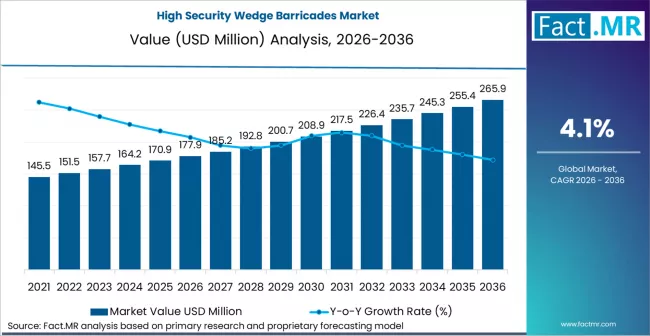
High Security Wedge Barricades Market Market Value Analysis | Source: Fact.MR
High Security Wedge Barricades Market
| Metric | Value |
|---|---|
| Estimated Value in (2026E) | USD 177.9 million |
| Forecast Value in (2036F) | USD 265.9 million |
| Forecast CAGR (2026 to 2036) | 4.1% |
Source: Fact.MR analysis. Updated Feb 26, 2026
High Security Wedge Barricades Market Definition
The High Security Wedge Barricades Market involves the manufacture and sale of retractable, powered wedge barriers designed to stop or slow unauthorized vehicle access at sensitive sites such as government facilities, critical infrastructure, and commercial campuses.
Market Inclusions
This report covers global and regional market sizes for high security wedge barricades over a defined forecast period, including product types (fixed, retractable, mobile), application segments (government, transportation hubs, commercial facilities), and sales channels.
Market Exclusions
The scope excludes other perimeter security products such as bollards, roadblocks, and fences not specific to wedge barrier technology, as well as unrelated access control systems like card readers or surveillance equipment.
Research Methodology
- Primary Research: Interviews were conducted with security designers, barrier manufacturers, and facility security managers.
- Desk Research: Data was sourced from industry reports, infrastructure security publications, and trade association statistics.
- Market‑Sizing and Forecasting: A hybrid model combining top‑down security investment forecasts with bottom‑up shipment and revenue data was used.
- Data Validation and Update Cycle: Findings were validated through expert review and aligned with recent production and deployment statistics.
High Security Wedge Barricades Market Overview
- Market Definition
- The High Security Wedge Barricades Market involves the manufacture and sale of retractable, powered wedge barriers designed to prevent or slow unauthorized vehicle access at sensitive sites like government buildings, airports, military installations, and commercial facilities.
- Market Drivers
- Increased Security Needs: Rising demand for perimeter protection in critical infrastructure, government buildings, and transportation hubs is driving the market growth.
- Robust Protection Against Vehicle Threats: Wedge barricades offer a high level of security against vehicle-based attacks, especially in high-risk environments.
- Technological Advancements: Integration of automation and hydraulic systems enhances the performance, speed, and reliability of wedge barricades, contributing to their increasing adoption.
- Key Segments
- Type: Hydraulic-powered wedge barricades (59.2% of the market share in 2026) are expected to dominate due to their high strength, speed of deployment, and reliability.
- Application: The commercial buildings segment, with a 53% share, is projected to grow rapidly as businesses increase their focus on security.
- Installation Type: Surface-mounted installations (47% market share) are expected to dominate due to their ease of installation, low cost, and adaptability to existing infrastructure.
- Key Analyst Insights at FactMR
- "The high-security wedge barricades market is expanding as governments, commercial operators, and critical infrastructure sectors seek more effective ways to secure their perimeters against increasing vehicle-based threats. The growing trend toward cashless, automated solutions is a driving force in the market’s development." - Shambhu Nath Jha, Principal Consultant at FactMR.
- Market Trends and Innovations
- Hydraulic-Powered Systems: The demand for hydraulic-powered wedge barricades is expected to grow due to their superior performance, fast response times, and tamper-resistant design.
- Surface-Mounted Systems: Growing demand for cost-effective, easy-to-install surface-mounted barricades, which are suited for retrofitting existing sites without requiring significant infrastructure changes.
- Integration with Access Control Systems: Increasing adoption of wedge barricades integrated with access control and automated monitoring systems to enhance overall security measures.
- Strategic Recommendations
- Focus on Automated Solutions: Companies should prioritize offering automated, hydraulic-powered systems that allow remote operation and improve efficiency in high-security environments.
- Invest in Retrofit-Friendly Options: There is an opportunity to expand the market by developing solutions that are easy to install in existing infrastructures, particularly in commercial and industrial sectors.
- Enhance Product Durability and Certification: With the growing need for high-performance security, ensuring that products meet international standards like ASTM F2656 M50/P1 will help companies cater to high-security applications.
- Forecast Methodology
- Primary Research: Interviews with security designers, barrier manufacturers, and facility managers.
- Desk Research: Data sourced from industry reports, infrastructure security publications, and trade association statistics.
Segmental Analysis
High Security Wedge Barricades Market Analysis by Type
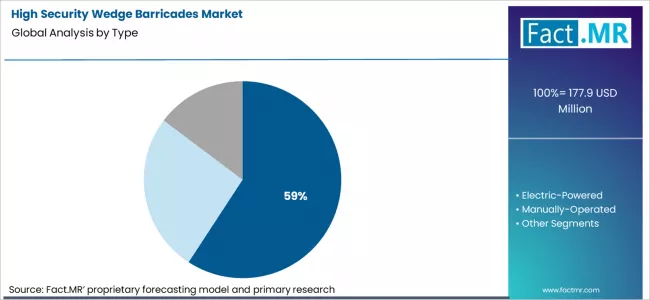
High Security Wedge Barricades Market Analysis By Type | Source: Fact.MR
- Market Overview: Hydraulic-powered wedge barricades are expected to capture 59.2% of the market share by 2026. Hydraulic-powered barricades offer high strength, fast deployment, and reliable performance, making them the preferred choice for high-security areas such as government buildings, airports, and military installations.
- Demand Drivers:
- Efficiency and Speed: Hydraulic-powered wedge barricades can be deployed and retracted quickly, providing a fast response to security threats. Their ability to function efficiently in high-stakes environments is a key driver for their widespread use in security systems.
- Strength and Durability: Hydraulic systems provide superior strength and reliability, making hydraulic-powered barricades the ideal solution for situations where robustness is paramount. Their ability to withstand significant forces and resist tampering makes them crucial for high-security applications.
- Automation and Integration: The integration of hydraulic-powered barricades into automated security systems, allowing for remote control and monitoring, is increasing their adoption in high-security locations. These systems offer a seamless and efficient way to manage security measures.
High Security Wedge Barricades Market Analysis by Installation Type
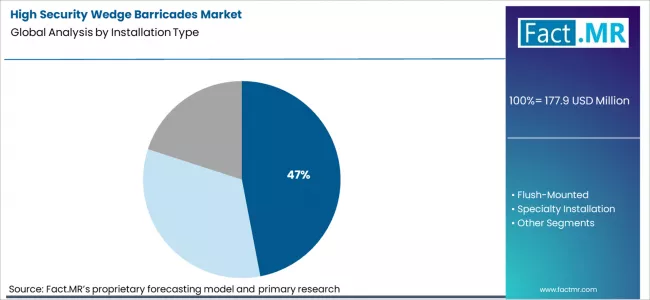
High Security Wedge Barricades Market Analysis By Installation Type | Source: Fact.MR
- Market Overview: Surface-mounted wedge barricades are projected to capture 47% of the market share by 2026. Surface-mounted barricades are easier and faster to install compared to flush-mounted systems, making them a more cost-effective and accessible option for various security applications.
- Demand Drivers:
- Ease of Installation and Maintenance: Surface-mounted installations are simpler and quicker to deploy, which is especially important in high-traffic areas where security measures need to be implemented rapidly. Their relatively low installation complexity also leads to lower costs, making them attractive to organizations with budget constraints.
- Flexibility in Application: Surface-mounted barricades can be installed on existing roadways or entry points without the need for significant structural modifications. This flexibility makes them suitable for both new and retrofit installations in locations such as parking lots, entrances, and access points to secure facilities.
- Cost-Effectiveness: Compared to flush-mounted barricades, which require more complex installation and modifications to the ground surface, surface-mounted systems are more affordable and less disruptive, contributing to their popularity in the market.
High Security Wedge Barricades Market Drivers, Restraints, and Opportunities
FMR analysts observe that the high security wedge barricades market is a growth‑aligned, threat‑response segment driven by rising requirements for vehicle access control and hostile vehicle mitigation across critical infrastructure, government facilities, and commercial sites. Historically, static barriers and bollards provided basic perimeter control; as incidents involving vehicle‑borne attacks increased and security standards evolved, structural demand emerged for powered wedge systems that offer rapid deployment, high stopping force, and integration with access control. The 2026 valuation reflects this shift, with demand anchored in protective security planning and regulatory requirements for hard‑stopping capability where traditional barriers are insufficient.
While demand for basic passive barriers remains in lower‑risk applications, advanced wedge barricades with higher impact ratings (e.g., certification to ASTM F2656 M50/P1) are gaining share for high‑threat environments. These certified systems command higher per‑unit prices, contributing to net value growth even as physical deployment volumes grow with security planning cycles rather than continuous replacement. The market exists because many protected facilities require tested, rated solutions to satisfy safety criteria and risk mitigation mandates.
- Threat & Risk Mitigation Demand: Government, military, and critical infrastructure sites adopt wedge barricades to achieve high‑level hostile vehicle mitigation where passive solutions cannot meet required stopping performance.
- Regulatory & Standards Pressure: Standards such as ASTM F2656 vehicle impact test ratings and local security codes push specification of certified wedge solutions that meet defined performance criteria.
- Regional Security Dynamics: In North America and Europe, stringent site security mandates and infrastructure protection programs drive higher uptake of advanced wedge barriers compared with regions with lower regulatory enforcement intensity.
Regional Analysis
The market analysis covers key global regions, including East Asia, South Asia, Western Europe, North America, and Brazil. It is segmented geographically, with specific market dynamics for each region. The full report provides a detailed market attractiveness analysis.
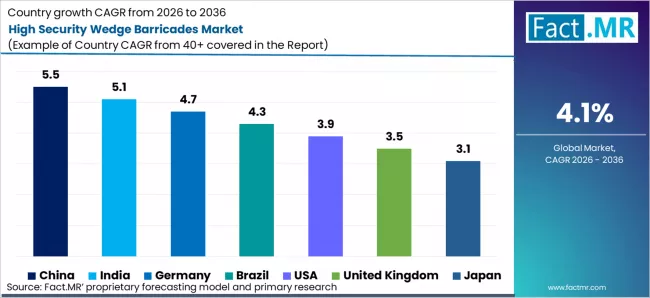
High Security Wedge Barricades Market Cagr Analysis By Country | Source: Fact.MR
| Country | CAGR (%) |
|---|---|
| China | 5.5% |
| India | 5.1% |
| Germany | 4.7% |
| Brazil | 4.3% |
| USA | 3.9% |
| United Kingdom | 3.5% |
| Japan | 3.1% |
Source: Fact.MR analysis. Updated Feb 26, 2026
Source: Fact MR (FMR) analysis, based on proprietary forecasting model and primary research.
East Asia:
In East Asia, China and Japan are leading the demand for high-security wedge barricades, supported by increasing infrastructure developments and the need for advanced security solutions in critical areas.
- China: Demand for high-security wedge barricades in China is projected to rise at 5.5% CAGR through 2036. China’s rapid infrastructure growth, increased focus on public safety and security, and growing investments in security solutions continue to drive market growth.
- Japan: Demand for high-security wedge barricades in Japan is projected to rise at 3.1% CAGR through 2036. Japan’s technological advancements and focus on high-level security at public venues continue to support the demand for high-security barriers.
South Asia:
In South Asia, India is seeing significant growth in the high-security wedge barricades market, driven by increasing concerns about public safety and rising security requirements in urban developments.
- India: Demand for high-security wedge barricades in India is projected to rise at 5.1% CAGR through 2036. India’s growing urbanization and expansion of critical infrastructure projects contribute to the rising demand for advanced security solutions such as high-security wedge barricades.
Western Europe:
In Western Europe, Germany and the United Kingdom are key markets for high-security wedge barricades, supported by robust infrastructure, increasing security regulations, and a strong focus on public safety.
- Germany: Demand for high-security wedge barricades in Germany is projected to rise at 4.7% CAGR through 2036. Germany’s strong industrial and infrastructure sectors and focus on high-security standards continue to support the demand for wedge barricades.
- United Kingdom: Demand for high-security wedge barricades in the UK is projected to rise at 3.5% CAGR through 2036. The UK’s expanding use of security solutions and rising concern about public safety drive steady market growth for advanced security barriers.
North America:
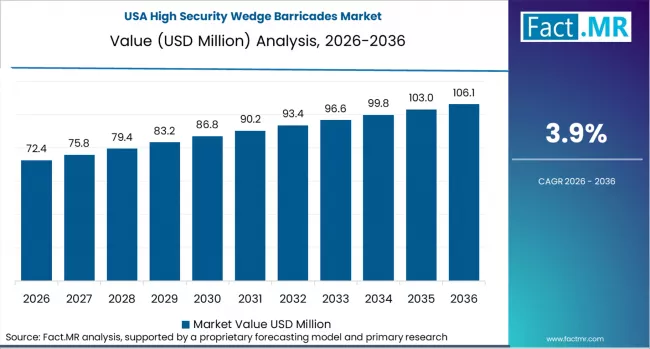
High Security Wedge Barricades Market Country Value Analysis | Source: Fact.MR
In North America, the USA is a leading market for high-security wedge barricades, driven by increasing investments in infrastructure security and the growing need to safeguard critical assets and high-risk areas.
- USA: Demand for high-security wedge barricades in the U.S. is projected to rise at 3.9% CAGR through 2036. The USA’s focus on infrastructure protection and the rise in demand for advanced security solutions in both public and private sectors contribute to steady market growth.
Latin America:
In Latin America, Brazil is a key market for high-security wedge barricades, supported by growing urbanization and the need for enhanced security solutions in public spaces and critical infrastructure.
- Brazil: Demand for high-security wedge barricades in Brazil is projected to rise at 4.3% CAGR through 2036. Brazil’s growing urban security concerns and increased demand for advanced perimeter security continue to drive the market for high-security barricades.
Fact MR's analysis of the High Security Wedge Barricades Market in East Asia, South Asia, Western Europe, North America, and Brazil consists of country-wise assessments that include China, India, Germany, Brazil, the USA, the United Kingdom, and Japan. Readers can find detailed trends, regulatory updates, and company-specific investments shaping the market’s growth in these countries.
How Are Key Players Competing in the High Security Wedge Barricades Market?
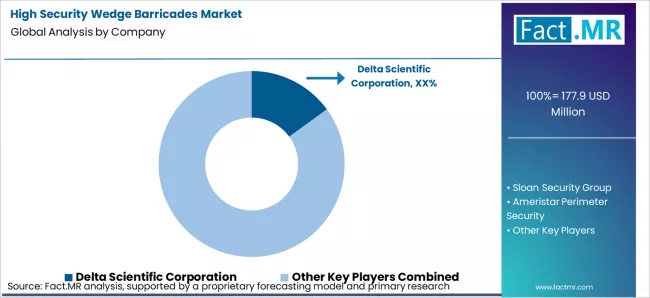
High Security Wedge Barricades Market Analysis By Company | Source: Fact.MR
In the high-security wedge barricades market, Delta Scientific Corporation and Sloan Security Group lead the way with robust, innovative solutions that meet stringent security standards for government and military applications. Ameristar Perimeter Security and Beijing ZhuoAoShiPeng Technology Co., Ltd. provide competitive, cutting-edge products designed for high-risk environments. A1 Americas, Inc. and Barrier1 Systems LLC focus on creating flexible, scalable barricade systems suited for critical infrastructure protection. HySecurity, a brand of The Hillman Group, emphasizes integration of automation and accessibility features in its barricades, while ASSA ABLOY AB, Perimeter Security Partners, and Avon Barrier Company, Inc. leverage global reach and strong R&D to offer advanced perimeter security solutions, addressing both commercial and governmental needs.
Recent Industry Developments
- U.S. Judiciary Court Security Budget: The federal Judiciary requested $892 million for the Court Security account in its FY 2026 budget, which includes $91 million for critical equipment like vehicle barriers to harden building ingress and egress.Delta Scientific DSC50 “S”
- Barrier LaunchL: Delta Scientific launched the DSC50 “S” Barrier in August 2025, a lightweight, portable wedge system that was crash-tested on July 29, 2025, achieving an ASTM SC30 rating for temporary urban protection.
- India Union Budget Defense Modernization: In the Union Budget 2026–27 presented on February 1, 2026, the Ministry of Defence was allocated ₹7.85 lakh crore, with a 22% increase in capital outlay to fund next-generation infrastructure and strategic security projects
Key Players of the High Security Wedge Barricades Market
- Delta Scientific Corporation
- Sloan Security Group
- Ameristar Perimeter Security
- Beijing ZhuoAoShiPeng Technology Co., Ltd.
- A1 Americas, Inc.
- Barrier1 Systems LLC
- HySecurity (a brand of The Hillman Group)
- ASSA ABLOY AB
- Perimeter Security Partners
- Avon Barrier Company, Inc.
Report Scope
| Metric | Value |
|---|---|
| Quantitative Units | USD 170.9 million (2026) to USD 177.9 million (2036), at a CAGR of 4.1% |
| Market Definition | The High Security Wedge Barricades Market includes physical security barriers designed to prevent unauthorized access, with applications in commercial, government, and industrial sectors. |
| By Type | Hydraulic-Powered, Electric-Powered, Manually-Operated, Others |
| By Application | Commercial Buildings, Government and Public Sector, Industrial Buildings, Others |
| By Barrier Height | Medium Height (12-18 inches), High Height (above 18 inches), Low Height (up to 12 inches) |
| By Installation Type | Surface-Mounted, Flush-Mounted, Specialty Installation |
| Regions Covered | North America, Latin America, Europe, East Asia, South Asia, Oceania, Middle East and Africa |
| Countries Covered | United States, Canada, Mexico, Brazil, Argentina, Germany, France, United Kingdom, Italy, Spain, China, India, Japan, South Korea, Indonesia, Australia, and 40+ countries |
| Key Companies Profiled | Delta Scientific Corporation, Sloan Security Group, Ameristar Perimeter Security, Beijing ZhuoAoShiPeng Technology Co., Ltd., A1 Americas, Inc., Barrier1 Systems LLC, HySecurity (a brand of The Hillman Group), ASSA ABLOY AB, Perimeter Security Partners, Avon Barrier Company, Inc. |
| Forecast Period | 2026 to 2036 |
| Approach | Hybrid top-down and bottom-up market modeling validated through primary interviews with manufacturers and supported by trade data benchmarking and market research. |
Source: Fact.MR analysis. Updated Feb 26, 2026
Bibliographies
- Press Information Bureau. (2026, February 1). Union Budget 2026–27: Defence modernization allocation of ₹7.85 lakh crore [Press release]. Government of India.
- Administrative Office of the U.S. Courts. (2025). Fiscal year 2026 budget request: Court security and infrastructure protection funding. Administrative Office of the U.S. Courts.
- A1 Americas, Inc. (2024). Hydraulic and electric-powered wedge barricade systems for perimeter security applications. A1 Americas, Inc.
- Ameristar Perimeter Security USA, Inc. (2024). Perimeter protection and vehicle barrier solutions for government and critical infrastructure. Ameristar Perimeter Security USA, Inc.
- ASSA ABLOY AB. (2024). High-security vehicle barriers and access control systems for sensitive facilities. ASSA ABLOY AB.
- Avon Barrier Corporation Ltd. (2024). Wedge barricade and hostile vehicle mitigation systems for high-security sites. Avon Barrier Corporation Ltd.
- Barrier1 Systems LLC. (2024). Customizable wedge barricade systems for government and commercial security applications. Barrier1 Systems LLC.
This report addresses:
- Market Intelligence enabling comprehensive assessment of leading countries and service segments across the Vending Massage Chair Payment Solution Market globally.
- Market Volume (Sales Units) estimates and 10-year revenue forecasts from 2026 to 2036, validated through manufacturer shipment data, channel partner surveys, and country-level demand modeling.
- Growth Opportunity Mapping across payment modes (cashless, mobile wallets, RFID), applications (massage chair commercial operators, manufacturers), and regions.
- Segment and Regional Revenue Forecasts by payment mode, application, and geography across 40+ countries.
- Competition Strategy Analysis covering dealer network structure, recent developments, product portfolio, USPs, and market share analysis.
- Product and Regulatory Compliance Tracking aligned with payment and data protection standards and transaction security guidelines.
- Regulatory Impact Analysis addressing global market compliance, payment regulations, and evolving standards for self-service wellness solutions.
- Report Delivery in PDF, Excel, PowerPoint, and interactive dashboard formats for executive, procurement, and operational planning use.
Segmentation
High Security Wedge Barricades Market Key Segments
-
Type :
- Hydraulic-Powered
- Electric-Powered
- Manually-Operated
- Others
-
Application :
- Commercial Buildings
- Government and Public Sector
- Industrial Buildings
- Others
-
Barrier Height :
- Medium Height (12-18 inches)
- High Height (above 18 inches)
- Low Height (up to 12 inches)
-
Installation Type :
- Surface-Mounted
- Flush-Mounted
- Specialty Installation
-
Region :
- North America
- USA
- Canada
- Mexico
- Europe
- Germany
- UK
- France
- Italy
- Spain
- Nordic Countries
- BENELUX
- Rest of Europe
- Asia Pacific
- China
- Japan
- South Korea
- India
- Australia
- Rest of Asia Pacific
- Latin America
- Brazil
- Argentina
- Rest of Latin America
- Middle East and Africa
- Kingdom of Saudi Arabia
- United Arab Emirates
- South Africa
- Rest of Middle East and Africa
- Other Regions
- Oceania
- Central Asia
- Other Markets
- North America
Frequently Asked Questions
How large is the demand for High Security Wedge Barricades in the global market in 2026?
What will be the market size of High Security Wedge Barricades in the global market by 2036?
What is the expected demand growth for High Security Wedge Barricades in the global market between 2026 and 2036?
Which type of High Security Wedge Barricades is expected to dominate the market?
Which region is expected to show the highest growth rate for High Security Wedge Barricades?
How significant is the growth outlook for India in this market?
What is the growth outlook for Germany in the High Security Wedge Barricades market?
What is the growth forecast for Brazil in the High Security Wedge Barricades market?
What is the growth forecast for the United States in the High Security Wedge Barricades market?
What is the growth forecast for the United Kingdom in the High Security Wedge Barricades market?
What is the growth forecast for Japan in the High Security Wedge Barricades market?
Which company is identified as a leading player in the High Security Wedge Barricades market?
What are High Security Wedge Barricades used for?
What does the High Security Wedge Barricades market include in this report?
How is the market forecast developed in this report?
What is meant by the High Security Wedge Barricades market in this report?
Who worked on this report


Preview the report firsthand - request a free sample
Free SampleGet the brochure for pricing and purchase details
Download PDF