- Market Value (2025): USD 266.5 Mn
- Estimated Value (2026): USD 290.0 Mn
- Forecast Value (2036): USD 674.0 Mn
- CAGR (2026-2036): 8.8%
High-Solubility Soy Isolates Market Forecast and Outlook 2026 to 2036
According to the Fact.MR analysis, the high-solubility soy isolates market was valued at USD 266.5 million in 2025 and is projected to grow from USD 290.0 million in 2026 to USD 674.0 million by 2036. Demand for high-solubility soy isolates is likely to grow at a CAGR of 8.8% over the forecast period.
Demand for high-solubility soy isolates is rising as makers of protein drinks, medical nutrition and powdered shakes look for a plant protein that dissolves fully, stays in suspension and costs less than whey. Suppliers of high-solubility soy isolates are offering enzymatically hydrolyzed, agglomerated and pH-optimized isolates with 90% protein, low viscosity and reduced beany flavor. For example, in June 2026, industry reports said whey protein isolate prices had reached about USD 11 per pound, a record level. Similar whey costs are projected to drive sales of high-solubility soy isolates as formulators blend or switch proteins.
Key Takeaways from the High-Solubility Soy Isolates Market
- High-Solubility Soy Isolates Market Value (2025): USD 266.5 million
- High-Solubility Soy Isolates Market Value (2026): USD 290.0 million
- High-Solubility Soy Isolates Market Forecast Value (2036): USD 674.0 million
- High-Solubility Soy Isolates Market Forecast CAGR (2026-2036): 8.8%
- Leading Product Type: Enzymatically hydrolyzed SPI (28.3%)
- Key Market Participants: ADM, Cargill, CHS, Bunge, Wilmar, Fuji Oil
- Key Growth Regions: United States, France, Germany, Italy, United Kingdom
In November 2026, ADM reported third-quarter Nutrition segment operating profit of USD 134 million, up 3%, with Human Nutrition profit of USD 93 million as its Decatur East specialty protein plant recovered. Demand for high-solubility soy isolates is growing as supply from major U.S. plants normalizes and brands regain confidence in availability. Suppliers of high-solubility soy isolates are rebuilding inventories and customer programs. Similar supply recovery is projected to drive sales of high-solubility soy isolates across North America and Europe.
High-Solubility Soy Isolates Market
| Metric | Value |
|---|---|
| Estimated Value in (2026) | USD 290.0 million |
| Forecast Value in (2036) | USD 674.0 million |
| Forecast CAGR (2026 to 2036) | 8.8% |
Source: Fact.MR analysis. Updated Nov 23, 2026
Source: Fact.MR analysis.
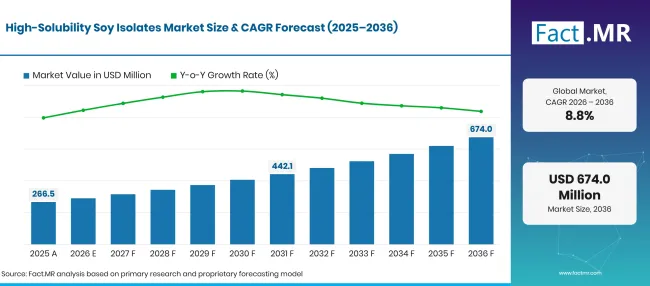
High Solubility Soy Isolates Forecast Global | Source: Fact.MR
Category
| Category | Segments |
|---|---|
| Product Type | Enzymatically hydrolyzed SPI, Specialty dispersible SPI, Agglomerated instant SPI, High-solubility SPI, pH-optimized SPI |
| Product Form | Dry powder, Custom premix, Liquid concentrate, Encapsulated, Granule and agglomerate |
| Application | Nutrition and supplements, Beverages, Dairy and alternatives, Bakery and confectionery, Savory and other |
| Buyer Type | Ingredient blender, Beverage producer, Nutrition brand, Food manufacturer, Contract formulator |
| Region | United States; France; Germany; Italy; United Kingdom |
Source: Fact.MR analysis. Updated Nov 23, 2026
Source: Fact.MR analysis.
Segmental Analysis
Why does enzymatically hydrolyzed SPI lead product demand in the High-Solubility Soy Isolates Market?
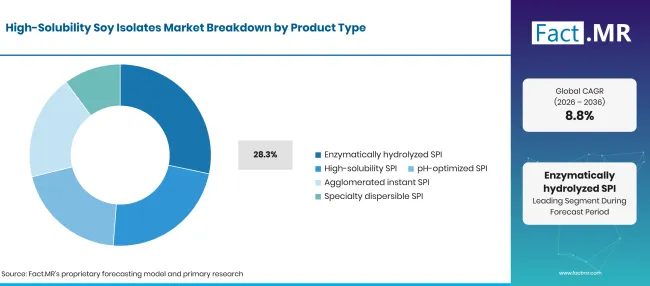
High Solubility Soy Isolates Breakdown Product Type | Source: Fact.MR
Demand for Enzymatically hydrolyzed soy protein isolate accounts for 28.3% of the high-solubility soy isolates market in 2026, about USD 82.1 million, because controlled hydrolysis cuts proteins into smaller peptides that dissolve readily and keep drinks thin at high protein levels. Hydrolysis also improves digestibility for clinical products. Suppliers of high-solubility soy isolates are limiting bitterness through enzyme selection. Similar solubility gains are projected to keep hydrolyzed grades the leading product type.
How is dry powder leading form demand in the High-Solubility Soy Isolates Market?
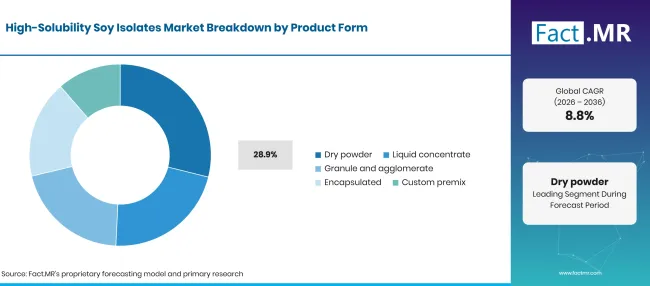
High Solubility Soy Isolates Breakdown Product Form | Source: Fact.MR
Sales of Dry powder holds 28.9% of high-solubility soy isolates revenue in 2026, about USD 83.8 million, because spray-dried isolate is the standard commercial form for shipping, storage and dry blending into powders and bars. It has a long shelf life at ambient temperature. Suppliers of high-solubility soy isolates are controlling bulk density and particle size for each use. Similar handling needs are projected to keep dry powder the leading product form.
Why do nutrition and supplements lead application demand in the High-Solubility Soy Isolates Market?
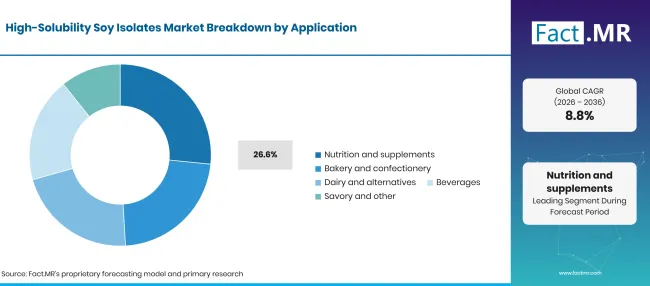
High Solubility Soy Isolates Breakdown Application | Source: Fact.MR
Demand for nutrition and supplements to represent 26.6% of high-solubility soy isolates revenue in 2026, about USD 77.1 million, as sports powders, meal replacements, infant and clinical formulas need complete protein that mixes smoothly. Soy offers a high protein quality score among plant sources. Suppliers of high-solubility soy isolates are serving brands in the protein supplements market. Similar product growth is projected to keep nutrition and supplements the leading application.
How are ingredient blenders leading buyer demand in the High-Solubility Soy Isolates Market?
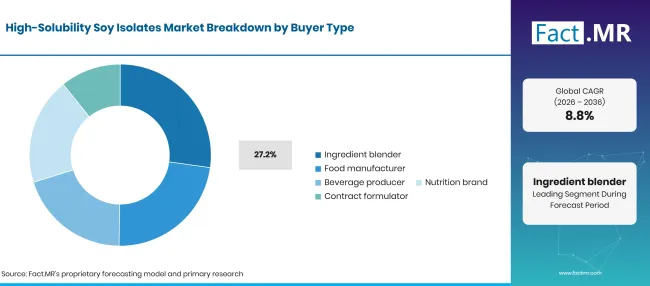
High Solubility Soy Isolates Breakdown Buyer Type | Source: Fact.MR
Adoption by Ingredient blenders account for 27.2% of high-solubility soy isolates revenue in 2026, about USD 78.9 million, because protein premix companies combine soy isolate with pea, rice or dairy proteins, flavors and vitamins for brand owners. Blends balance cost, taste and amino acid profile. Suppliers of high-solubility soy isolates are supporting blenders with solubility and flavor data, as covered in the high-solubility protein isolates market. Similar blending is projected to keep ingredient blenders the leading buyer type.
High-Solubility Soy Isolates Market-Drivers, Restraints & Trends
Drivers:
Demand for high-solubility soy isolates is rising as protein consumption grows and whey becomes expensive. For example, in November 2026, Glanbia reported that whey inflation pushed its third-quarter pricing up by about 26% and said it expected higher whey costs in early 2027. Suppliers of high-solubility soy isolates are promoting soy as a cost-stable partner protein in shakes and bars. Similar price gaps are projected to drive sales of high-solubility soy isolates through the forecast period.
Restraints:
Demand for high-solubility soy isolates is constrained by new traceability rules and consumer preferences for other plant proteins. For example, the EU Deforestation Regulation will apply to soy placed on the EU market by large and medium operators from 30 December 2026, requiring due diligence statements that trace beans to their plots. Similar compliance costs are projected to raise prices for imported soy protein. Suppliers of high-solubility soy isolates must document origin and segregate supply chains.
Trend: Hybrid Protein Systems
Demand for blends of soy with dairy and other plant proteins is rising as brands manage cost and taste. Suppliers are designing isolates that match whey solubility in ready-to-mix powders. In August 2026, Glanbia said weight-loss drugs were boosting demand for protein products. Similar demand is projected to drive sales of high-solubility soy isolates in hybrid formulas, alongside clean soy isolates.
Trend: Plant-Based Retail Recovery in Europe
In June 2026, GFI Europe reported that Europe's plant-based food retail market grew as prices became more competitive, with French plant-based meat volumes up 16.8%. Demand for functional plant proteins is rising as volumes recover. Similar retail growth is projected to drive sales of high-solubility soy isolates in drinks and dairy alternatives. Suppliers of high-solubility soy isolates are offering non-GMO and European-origin options.
High-Solubility Soy Isolates Market by Analysis by Key Country
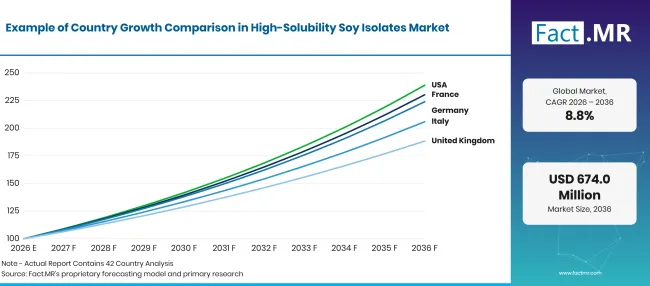
High Solubility Soy Isolates Growth Index | Source: Fact.MR
| Country | CAGR (2026-2036) |
|---|---|
| United States | 9.1% |
| France | 8.7% |
| Germany | 8.4% |
| Italy | 7.5% |
| United Kingdom | 6.5% |
Source: Fact.MR analysis. Updated Nov 23, 2026
Source: Fact.MR analysis.
What is driving high-solubility soy isolates demand in the United States?
In November 2026, ADM said the recovery of its Decatur East plant supported Human Nutrition results, with segment operating profit of USD 93 million in the third quarter.
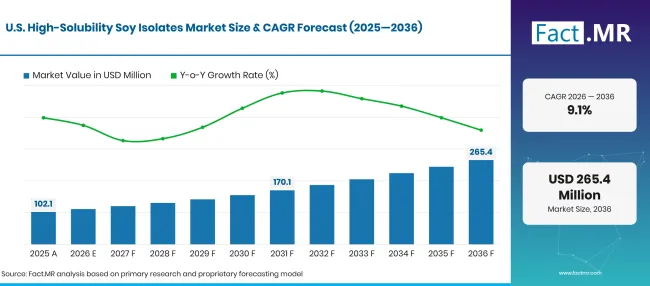
High Solubility Soy Isolates Forecast Usa | Source: Fact.MR
Demand for high-solubility soy isolates in the United States is projected to grow at a 9.1% CAGR, the fastest among the five key countries, as protein drinks and powders expand and whey stays costly. Suppliers of high-solubility soy isolates, including ADM, Cargill and CHS, are serving U.S. nutrition brands. Similar supply recovery is projected to drive sales in the United States.
How is plant-based growth supporting high-solubility soy isolates sales in France?
Sales of high-solubility soy isolates in France are projected to increase at an 8.7% CAGR through 2036, supported by expanding plant-based food consumption and increasing demand for protein-enriched beverages.
According to GFI Europe, plant-based meat was France's fastest-growing plant-based category in 2025, with sales volume increasing by 16.8%. Plant-based milk and drinks also recorded 14.8% volume growth, highlighting opportunities for functional protein ingredients. Danone reported strong growth in its French dairy and plant-based business in October 2026, supported by established brands and product innovation. Suppliers of high-solubility soy isolates are targeting beverage and dessert manufacturers seeking improved protein dispersion and formulation stability.
What is shaping high-solubility soy isolates demand in Germany?
Demand for high-solubility soy isolates in Germany is anticipated to hold an 8.4% CAGR through 2036, supported by the country's leading position in Europe's plant-based food industry.
In June 2026, GFI Europe reported that German plant-based food sales reached EUR 1.71 billion in 2025, representing 3.1% value growth and 6.2% volume growth. Plant-based milk remained a particularly strong category, with sales volume increasing by 7.7%. These developments are encouraging food manufacturers to expand protein-enriched beverages, dairy alternatives and sports nutrition products. Suppliers of high-solubility soy isolates are serving private-label and branded manufacturers seeking consistent dispersion, smooth texture and reliable protein content.
How is local soy supporting high-solubility soy isolates sales in Italy?
Sales of high-solubility soy isolates in Italy are projected to record a 7.5% CAGR through 2036, supported by expanding domestic soybean production and growing interest in plant-based food innovation.
According to Istat's September 2026 agricultural production report, Italian soybean output increased by 94.6% between 2006 and 2025, reflecting improvements in cultivation and expanding production capacity. Valsoia reported consolidated revenue of EUR 97.6 million for the first nine months of 2026, representing 6.8% year-on-year growth, while international sales increased by 45.8%. These developments highlight opportunities for protein ingredient suppliers serving plant-based beverage, dessert and nutritional product manufacturers.
Why is growth slower for high-solubility soy isolates in the United Kingdom?
Demand for high-solubility soy isolates in the United Kingdom is estimated to increase at a 6.5% CAGR through 2036, the slowest among the five key countries.
Growth is moderated by strong competition from oat- and pea-based alternatives, alongside consumer preferences for familiar ingredients and established beverage formulations. In October 2026, Danone reported strong performance from its dairy and plant-based business in the UK, supported by brands including Alpro. However, GFI Europe reported that UK plant-based food sales volume declined by 2.5% in 2025, indicating uneven category performance. Suppliers of high-solubility soy isolates are therefore focusing on sports nutrition, clinical nutrition and specialized protein beverages to identify additional growth opportunities.
Competitive Landscape for High-Solubility Soy Isolates Market
Competition in the high-solubility soy isolates market is led by oilseed processors with protein isolation plants. ADM and Cargill compete through large North American isolate capacity and application support, CHS and Bunge compete through soy processing and protein concentrates, Wilmar competes from Asia, and Fuji Oil competes with specialty soy proteins from Japan. Buyers select high-solubility soy isolates on solubility, viscosity, flavor, protein content, origin and price.
From 2025 onward, competition shifted toward supply reliability and traceability. ADM's Decatur East plant recovered in 2026, whey prices reached records, European plant-based sales returned to growth, and the EU Deforestation Regulation neared application for soy. Suppliers that deliver clean-tasting, traceable isolate at stable prices are best placed to grow.
Recent Developments
- In November 2026, ADM reported third-quarter Nutrition operating profit of USD 134 million.
- In November 2026, Glanbia reported third-quarter pricing up about 26% on whey inflation.
- In October 2026, Bunge reported third-quarter 2026 results including its soy protein concentrate business.
- In June 2026, GFI Europe reported that France's plant-based meat volumes rose 16.8%.
Key Players in High-Solubility Soy Isolates Market
Key companies operating in the market include ADM, Cargill, CHS, Bunge, Wilmar, and Fuji Oil.
- ADM
- Cargill
- CHS
- Bunge
- Wilmar
- Fuji Oil
Bibliography
- Archer-Daniels-Midland Company. (2026, November 3). ADM reports third quarter 2026 results.
- Bunge Global SA. (2026, October 29). Bunge reports third quarter 2026 results.
- Danone. (2026, October 28). Solid performance in Q3: Broad-based growth across categories and geographies.
- Donau Soja. (2026, August 20). Donau Soja market report July: Heat, drought and logistics risks push non-GM prices higher.
- European Commission. (2026). EU Deforestation Regulation (EUDR).
- Glanbia plc. (2026, November 4). Q3 2026 interim management statement.
- Good Food Institute Europe. (2026, June 9). Plant-based food: Germany remains Europe's largest market.
- Good Food Institute Europe. (2026). European plant-based sales data: Sales and growth rates across European countries.
- Good Food Institute Europe. (2026). Europe's plant-based food retail market grows as prices become more competitive, but good taste remains key.
- U.S. Department of Agriculture, Agricultural Marketing Service. (2026, April 30). Whey protein concentrate – Central and West U.S.. Dairy Market News.
- Donau Soja. (2026, August 18). European Soy Monitor 2024 (published 2026).
- European Commission. (2025, December 19). EU Deforestation Regulation: Second amendment and postponement of application dates.
Segmentation
Scope of Report
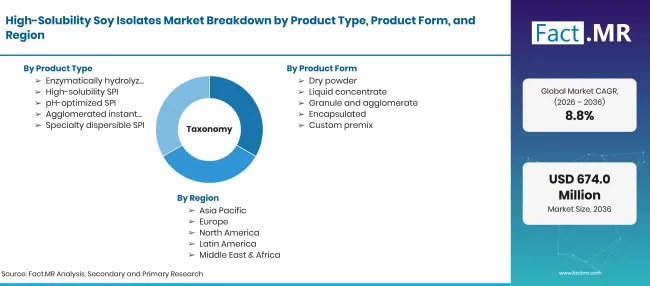
High Solubility Soy Isolates Taxonomy | Source: Fact.MR
| Items | Values |
|---|---|
| Quantitative Units (2026) | USD 290.0 Million |
| Product Type | Enzymatically hydrolyzed SPI, Specialty dispersible SPI, Agglomerated instant SPI, High-solubility SPI, pH-optimized SPI |
| Product Form | Dry powder, Custom premix, Liquid concentrate, Encapsulated, Granule and agglomerate |
| Application | Nutrition and supplements, Beverages, Dairy and alternatives, Bakery and confectionery, Savory and other |
| Buyer Type | Ingredient blender, Beverage producer, Nutrition brand, Food manufacturer, Contract formulator |
| Regions Covered | North America, Latin America, Europe, East Asia, South Asia and Pacific, Middle East & Africa |
| Countries Covered | United States, France, Germany, Italy, United Kingdom, and other countries |
| Key Companies Profiled | ADM, Cargill, CHS, Bunge, Wilmar, Fuji Oil |
| Additional Attributes | Dollar revenue in the High-Solubility Soy Isolates Market is segmented by product type (enzymatically hydrolyzed, agglomerated instant, pH-optimized, specialty dispersible), product form, application, buyer type and region. |
Source: Fact.MR analysis. Updated Nov 23, 2026
Source: Fact.MR analysis.
High-Solubility Soy Isolates Market by Segments
-
Product Type
- Enzymatically hydrolyzed SPI
- Specialty dispersible SPI
- Agglomerated instant SPI
- High-solubility SPI
- pH-optimized SPI
-
Product Form
- Dry powder
- Custom premix
- Liquid concentrate
- Encapsulated
- Granule and agglomerate
-
Application
- Nutrition and supplements
- Beverages
- Dairy and alternatives
- Bakery and confectionery
- Savory and other
-
Buyer Type
- Ingredient blender
- Beverage producer
- Nutrition brand
- Food manufacturer
- Contract formulator
-
Region:
- North America
- United States
- Canada
- Mexico
- Europe
- Germany
- United Kingdom
- France
- Italy
- Spain
- Rest of Europe
- Asia Pacific
- China
- India
- Japan
- South Korea
- Australia
- Rest of Asia Pacific
- Latin America
- Brazil
- Mexico
- Argentina
- Rest of Latin America
- Middle East & Africa
- GCC Countries
- South Africa
- Rest of Middle East & Africa
- North America
Frequently Asked Questions
How big is the global High-Solubility Soy Isolates Market in 2026?
What will be the size of the High-Solubility Soy Isolates Market by 2036?
How fast will the High-Solubility Soy Isolates Market grow during the forecast period?
Which product type segment holds the largest share of the High-Solubility Soy Isolates Market?
Who worked on this report


Preview the report firsthand - request a free sample
Free SampleGet the brochure for pricing and purchase details
Download PDF