- Market Value (2025): USD 55.0 Mn
- Estimated Value (2026): USD 60.0 Mn
- Forecast Value (2036): USD 142.0 Mn
- CAGR (2026-2036): 9.0%
High-Stability Edible Coatings Market Forecast and Outlook 2026 to 2036
Fact.MR studies, the high-stability edible coatings market surpassed a value of USD 55.0 million and is projected to grow from USD 60.0 million in 2026 to USD 142.0 million by 2036. Demand for high-stability edible coatings is likely to grow at a CAGR of 9.0% over the forecast period.
Demand for high-stability edible coatings is rising as food and beverage makers need edible films that hold up through heat, humidity, freezing and long distribution without cracking or dissolving. Reinforcement with nanocellulose, lipids or cross-linking makes films strong enough for straws, cups, capsules and coated inclusions. For example, the EU Single-Use Plastics Directive banned plastic straws and stirrers from July 2021, opening space for edible and plant-based alternatives. Similar plastic restrictions are projected to drive sales of high-stability edible coatings through 2036.
Key Takeaways from the High-Stability Edible Coatings Market
- High-Stability Edible Coatings Market Value (2025): USD 55.0 million
- High-Stability Edible Coatings Market Value (2026): USD 60.0 million
- High-Stability Edible Coatings Market Forecast Value (2036): USD 142.0 million
- High-Stability Edible Coatings Market Forecast CAGR (2026-2036): 9.0%
- Leading Coating stability mechanism: Nanocellulose reinforcement (25.5%)
- Key Market Participants: Apeel Sciences, Mori, Sufresca, Xampla, Mantrose-Haeuser, Akorn Technology
- Key Growth Regions: India, Spain, Netherlands, United States, China
Notpla, a London start-up making seaweed-based edible packaging, won the Earthshot Prize in 2022 for its plastic alternatives, including edible drink pods used at sporting events. Demand for high-stability edible coatings is growing as brands test edible and dissolvable packaging for drinks and sauces. Suppliers such as Xampla and Mori are developing stronger plant-protein and silk-based films. Similar innovation is projected to drive sales of high-stability edible coatings worldwide.
High-Stability Edible Coatings Market
| Metric | Value |
|---|---|
| Estimated Value in (2026) | USD 60.0 million |
| Forecast Value in (2036) | USD 142.0 million |
| Forecast CAGR (2026 to 2036) | 9.0% |
Source: Fact.MR analysis. Updated Nov 18, 2026
Source: Fact.MR analysis. Updated 16 Nov 2026
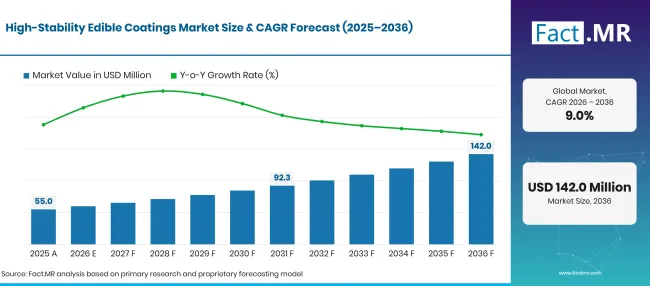
High Stability Edible Coatings Forecast Global | Source: Fact.MR
Category
| Category | Segments |
|---|---|
| Coating stability mechanism | Cross-linked biopolymer, Lipid reinforcement, Nanocellulose reinforcement, Multilayer hybrid, Moisture-adaptive |
| Commercial form | Powder, Liquid concentrate, Granulate, Encapsulated bead, Ready-to-use premix |
| Food application | Bakery, Dairy / alternatives, Beverage, Meat / savory, Confectionery / snacks |
| Primary function | Shelf-life, Texture / rheology, Taste / color, Nutritional functionality, Processing stability |
| Region | India; Spain; Netherlands; United States; China |
Source: Fact.MR analysis. Updated Nov 18, 2026
Source: Fact.MR analysis. Updated 16 Nov 2026
Segmental Analysis
Why does Nanocellulose reinforcement lead stability-mechanism demand in the High-Stability Edible Coatings Market?
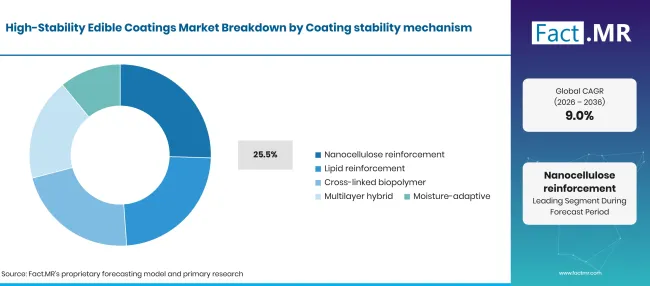
High Stability Edible Coatings Breakdown Coating Stability Mechanism | Source: Fact.MR
Demand for nanocellulose reinforcement accounts for 25.5% of 2026 revenue, about USD 15.3 million, as food manufacturers seek coating materials that combine mechanical strength with improved barrier performance. Cellulose nanofibers can reinforce thin edible films, helping them resist cracking and maintain their structure during packaging, transport and storage. In appropriately formulated composites, they can also help reduce water-vapor transmission. Performance depends on the coating formulation and humidity conditions, so nanocellulose does not automatically provide a moisture barrier in every application. The commercial opportunity is supported by the expansion of food processing and preservation infrastructure. The Indian government reported in April 2026 that investments under its food-processing incentive scheme had added 34 lakh metric tonnes per year of processing and preservation capacity. This expanding production base creates opportunities for functional coating materials that protect food quality across processing and distribution.
How do Granulates lead commercial-form demand in the High-Stability Edible Coatings Market?
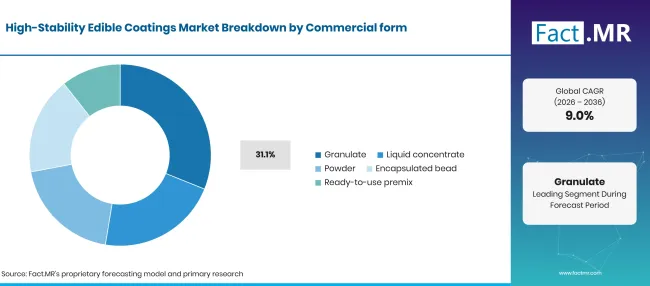
High Stability Edible Coatings Breakdown Commercial Form | Source: Fact.MR
Granulates segment leads with 31.1% of revenue in 2026, about USD 18.7 million, as granular coating materials store well and feed accurately into film-casting and coating equipment. Powders follow closely. Suppliers are offering free-flowing granules. India’s food-processing expansion provides a relevant demand backdrop. A government factsheet published in 2026 reported that sales of products supported by the Production Linked Incentive Scheme increased to ₹1,08,854 crore in FY 2025–26, compared with ₹58,758 crore in FY 2019–20. The growth in processed-food output and commercial manufacturing creates a larger potential customer base for standardized coating ingredients supplied in production-friendly forms. The figures indicate growth in the wider processing industry, rather than granulated edible-coating sales specifically.
Which application leads demand in the High-Stability Edible Coatings Market?
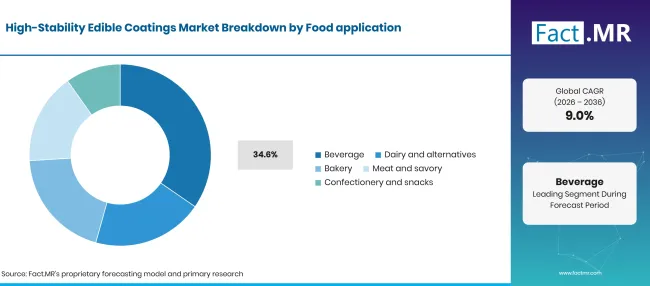
High Stability Edible Coatings Breakdown Food Application | Source: Fact.MR
Sales of beverages are projected to capture 34.6% of revenue in 2026, about USD 20.8 million, as edible straws, cup linings, drink pods and coated inclusions such as boba pearls need films that survive contact with liquids. Bakery and meat uses follow. Suppliers are working with beverage brands and venues. Edible straws, drink pods, cup linings and coated inclusions such as boba pearls create demand for coatings with controlled dissolution, adequate wet strength and resistance to cracking during filling, serving and consumption. Beverage manufacturers also need formulations that preserve taste and texture while meeting food-contact safety requirements. India’s beverage manufacturing activity provides a useful indicator of the scale of this end-use sector. The government’s Index of Industrial Production showed that beverage manufacturing increased 12.7% year on year during April–September 2026. This expansion strengthens the potential customer base for beverage-compatible edible materials, particularly where brands and food-service operators are testing alternatives to conventional single-use components.
What drives Shelf-life demand in the High-Stability Edible Coatings Market?
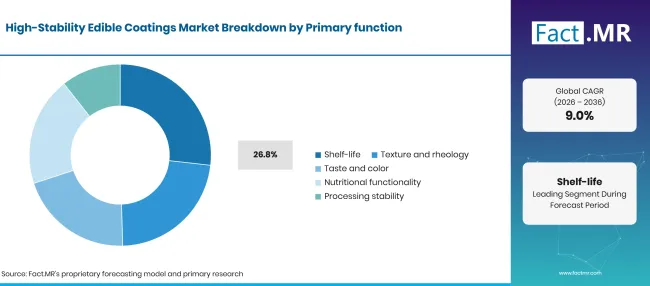
High Stability Edible Coatings Breakdown Primary Function | Source: Fact.MR
Demand for shelf-life represent 26.8% of revenue in 2026, about USD 16.1 million, as buyers value coatings that keep products intact through storage. Processing stability follows. Suppliers are marketing stability under heat and humidity. Depending on the food and formulation, edible coatings can help regulate moisture transfer, limit oxygen exposure and reduce surface damage. These functions are relevant to fresh produce, bakery products and selected meat applications, where quality loss can reduce saleable inventory and increase waste. Processing stability is also important, but shelf-life performance has a more direct link to product quality after manufacture. The Ministry of Food Processing Industries’ 2025–26 Annual Report presents the scale of the preservation challenge: its cited 2022 NABCONS study estimated post-harvest losses of 6.02%–15.05% for fruits and 4.87%–11.61% for vegetables. Nevertheless, their inclusion in the 2026 government report highlights the continuing need for preservation technologies that can protect food quality between harvest, processing and sale.
High-Stability Edible Coatings Market-Drivers, Restraints & Trends
Drivers: Regulatory Pressure to Reduce Single-Use Plastic Packaging -:
Demand for high-stability edible coatings is increasing as governments strengthen restrictions on selected single-use plastic products and encourage alternatives for food service and packaging applications. Food manufacturers and hospitality operators are evaluating edible coatings, biodegradable films and compostable materials to reduce dependence on conventional disposable packaging. India's Ministry of Environment, Forest and Climate Change reported in February 2026 that enforcement of the single-use plastic ban had resulted in 862,356 inspections, 1,990 tonnes of banned plastic items seized and approximately INR 19.85 crore in penalties between July 2022 and January 2026. This enforcement activity is encouraging manufacturers to assess alternative materials for food-contact applications.
Restraints: Higher Production Costs and Food-Contact Safety Requirements-:
Commercial adoption of high-stability edible coatings is constrained by higher production costs, formulation complexity and the need to demonstrate safety under food-contact conditions. Bio-based coatings can require additional processing, moisture-resistance improvements and shelf-life validation to achieve performance comparable with conventional plastic packaging. Nanomaterial-containing formulations face further scrutiny because particle size and migration characteristics can influence safety assessments. The European Commission's February 2026 food-packaging factsheet confirms that food-contact materials must meet requirements concerning chemical migration, composition and sensory changes. Its regulatory framework for engineered nanomaterials also requires specific risk assessment, increasing the compliance burden for manufacturers developing nano-enabled edible coatings.
Opportunities: Edible Beverage Packaging and Dissolvable Formats -:
Edible beverage packaging presents an opportunity as food-service companies explore alternatives to conventional disposable cups, straws and beverage containers. Edible drink pods, dissolvable sachets, edible straws and protective cup linings can reduce packaging waste while offering new product formats for hospitality, catering and on-the-go consumption. Companies such as Notpla are developing seaweed-based packaging and edible applications for beverage and food service. India's Central Pollution Control Board and Ministry of Environment identified nearly 1,000 manufacturers and sellers of alternatives to banned single-use plastic products in their government compendium. This developing supplier ecosystem creates opportunities for companies commercializing edible and bio-based beverage packaging.
Trend: Nanocellulose Reinforcement
Demand for plant-based nanocellulose in films is rising. Suppliers are scaling nanocellulose supply. Nanocellulose reinforcement is gaining attention as manufacturers seek to improve the mechanical strength, barrier performance and stability of plant-based edible films. Cellulose nanofibers and nanocrystals can strengthen biopolymer matrices and potentially improve resistance to oxygen and moisture transfer. Research is increasingly examining their compatibility with starch, chitosan and other biodegradable coating materials. India's Department of Commerce, in its 2025–26 Annual Report, identified polysaccharide-based films and their applications in food packaging among its research and development activities. This government-supported research direction provides a relevant indication of growing institutional interest in bio-based packaging materials.
High-Stability Edible Coatings Market by Analysis by Key Country
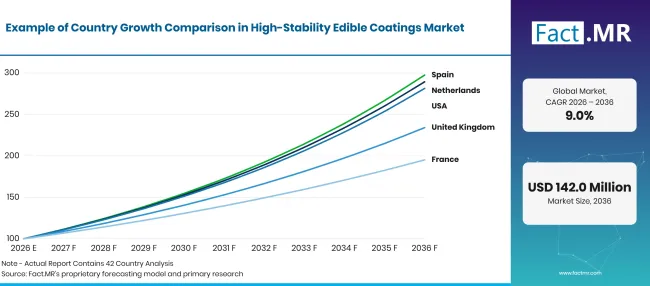
High Stability Edible Coatings Growth Index | Source: Fact.MR
| Country | CAGR (2026-2036) |
|---|---|
| India | 11.3% |
| Spain | 11.1% |
| Netherlands | 11.0% |
| United States | 10.9% |
| China | 10.6% |
Source: Fact.MR analysis. Updated Nov 18, 2026
Source: Fact.MR analysis. Updated 16 Nov 2026
Why is India the fastest-growing market for high-stability edible coatings?
Demand for high-stability edible coatings in India is estimated to expand at an 11.3% CAGR through 2036, supported by restrictions on single-use plastics and growing investment in sustainable food packaging.
The Ministry of Environment, Forest and Climate Change reported that India generated approximately 41.36 lakh tonnes of plastic waste in 2022–23. In March 2026, the government also reported 196.97 lakh tonnes of plastic waste processed under the country's recycling framework. The food-processing sector's 2026–27 budget allocation increased by 13.79% to ₹4,064 crore. These developments strengthen opportunities for edible coatings that help preserve fresh produce, reduce dependence on conventional packaging and extend product shelf life.
What is driving high-stability edible coating demand in Spain?
Sales of high-stability edible coatings in Spain are projected to increase at an 11.1% CAGR through 2036, supported by regulatory pressure on non-reusable plastic packaging and demand for sustainable produce preservation.
Spain's Law 7/2022 imposes a tax of €0.45 per kilogram on non-recycled plastic contained in non-reusable packaging, including packaging used to protect and distribute goods. The Ministry for Ecological Transition identifies plastic as 23% of Spain's 8.74 million tonnes of packaging waste generated in 2022. This regulatory environment encourages food producers and retailers to assess edible coatings, particularly for fresh fruits and vegetables, as a way to reduce packaging requirements while maintaining product quality.
What is shaping high-stability edible coating demand in the Netherlands?
Demand for high-stability edible coatings in the Netherlands is estimated to record an 11.0% CAGR through 2036 as food retailers and fresh-produce suppliers explore alternatives to conventional plastic packaging.
Government rules restrict disposable plastic cups and containers for on-site food consumption and require businesses to offer reusable alternatives for takeaway and delivery. Importantly, the Netherlands Enterprise Agency confirms that the mandatory surcharge on disposable plastic cups and containers is no longer being enforced in 2026, with the formal regulatory amendment planned for 2027. The rules also cover packaging for ready-to-eat salads and portion-sized vegetables. This creates opportunities for edible coatings that preserve produce quality and reduce reliance on disposable packaging, particularly in retail and food-service applications.
What is shaping high-stability edible coating sales in the United States?
Sales of high-stability edible coatings in the United States are projected to expand at a 10.9% CAGR through 2036, supported by state-level packaging regulations and the need to preserve large volumes of fresh produce.
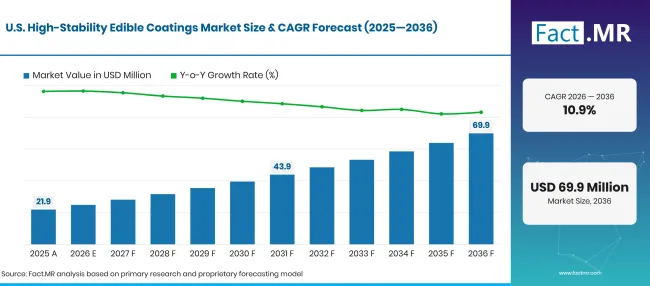
High Stability Edible Coatings Forecast Usa | Source: Fact.MR
California's SB 54 requires a 25% reduction in single-use plastic packaging and plastic food-service ware by 2032, alongside requirements for recyclable or compostable packaging. Its permanent regulations became effective on May 1, 2026. The USDA's February 2026 Vegetable Annual Summary reported that U.S. cabbage production reached 22.0 million hundredweight in 2025, up 7% from 2024, while fresh-market production of several vegetables also recovered. These conditions create opportunities for high-stability edible coatings that help maintain freshness, reduce moisture loss and extend the marketable life of fresh produce.
Why is high-stability edible coating growth slower in China?
Demand for high-stability edible coatings in China is estimated to grow at a 10.6% CAGR through 2036, comparatively slower than in the other four key markets, as established paper-based packaging and conventional biodegradable materials compete with edible preservation technologies.
According to China's National Bureau of Statistics, the country produced approximately 890 million tonnes of vegetables and 350 million tonnes of garden fruits and melons in 2025, as reported in a June 2026 government publication. However, the State Administration for Market Regulation reported in January 2026 that its quality inspection covered 1,133 batches of 18 food-related product categories, identifying 9 non-compliant food-contact paper-container batches and 6 non-compliant cling-film batches. This highlights the importance of packaging safety and quality alongside material substitution. Edible coatings are therefore likely to gain adoption selectively in fresh-produce preservation and bakery applications rather than replacing established packaging materials across the wider food industry.
Competitive Landscape for High-Stability Edible Coatings Market
Competition in the high-stability edible coatings market is shaped by Apeel Sciences Inc., Cambridge Crops Inc. (Mori), Sufresca Ltd., Mantrose-Haeuser Co. Inc. and Akorn Technology Inc. These companies compete through different coating technologies and applications. Apeel focuses on plant-derived lipid coatings, while Mori develops silk-based protective coatings. Sufresca specializes in algal-based edible coatings, Akorn offers plant-derived post-harvest coatings, and Mantrose-Haeuser supplies edible coating solutions for fresh produce and confectionery applications. Buyers evaluate products based on coating durability, freshness retention, taste neutrality, food safety, application compatibility and cost.
From 2024 onward, competition has increasingly focused on replacing conventional plastic packaging and improving post-harvest preservation. Companies that can demonstrate consistent coating performance, meet food-safety requirements and scale production while controlling costs are better positioned to strengthen their market presence.
Recent Developments
- On February 25, 2026, Akorn announced expansion into the United Arab Emirates through a new venture following its selection as a winner of the UAE FoodTech Challenge. The development supports the commercialization and scaling of its natural post-harvest treatment and edible-coating technologies across international produce supply chains. It is a commercial expansion rather than a newly announced coating formulation.
- On April 28, 2026, Cambridge Crops received U.S. Patent US 12,612,203 B2, covering methods and compositions for improving the storage and transportation of produce, flowers and plants using protective coatings. The patent describes coating materials such as silk fibroin, chitin, cellulose, pectin and alginate to maintain product quality, improve freshness and extend shelf life. This strengthens Mori's intellectual property position in protective edible and non-edible coating technologies.
- In June 2025: Akorn launched Natural Advantage edible coating for English cucumbers and bell peppers. The plant-derived coating forms an invisible protective barrier, maintains freshness and firmness, and reduces the need for single-use plastic wrapping.
- On April 9, 2026, Apeel Technology Inc. published U.S. Patent Application US 2026/0096569 A1, titled Edible coatings with antimicrobial properties. The application describes edible coating compositions designed to provide antimicrobial functionality for food preservation. This is directly relevant to high-stability edible coatings, although the application was filed on September 12, 2025, rather than in 2026.
Key Players in High-Stability Edible Coatings Market
Key companies operating in the market include Apeel Sciences Inc., Cambridge Crops Inc. (Mori), Sufresca Ltd., Mantrose-Haeuser Co. Inc., and Akorn Technology Inc.
- Apeel Sciences Inc.
- Cambridge Crops Inc. (Mori)
- Sufresca Ltd.
- Mantrose-Haeuser Co. Inc.
- Akorn Technology Inc.
Bibliography
- Akorn Technology. (2025, June 4). Cutting-edge cucumber coating could spell end to single-use plastic wraps on supermarket shelves. Perishable News.
- Apeel Technology Inc. (2026). Edible coating with antimicrobial properties (U.S. Patent Application Publication No. US 2026/0096569 A1). United States Patent and Trademark Office.
- Cambridge Crops, Inc. (2026). Storage and/or transportation of produce, flowers and plants (U.S. Patent No. 12,612,203 B2). United States Patent and Trademark Office.
- Collen, C. (2026, February 25). Akorn Technology expands to UAE with natural post-harvest solutions. Eurofruit.
- 1. Central Pollution Control Board. (n.d.). National dashboard for elimination of single-use plastic and effective implementation of Plastic Waste Management Rules: Frequently asked questions. Ministry of Environment, Forest and Climate Change, Government of India.
- 2. Department of Commerce. (2026). Annual report 2025–26. Ministry of Commerce and Industry, Government of India.
- 3. European Commission. (2026, February 23). How the EU ensures safe food packaging. Directorate-General for Health and Food Safety.
- 4. European Commission. (n.d.). Nanomaterials in food. Directorate-General for Health and Food Safety.
- 5. Food Safety and Standards Authority of India. (2026, August 7). Food Safety and Standards (Packaging) Regulation, 2018: Fourth amendment. Government of India.
- 6. Ministry of Environment, Forest and Climate Change. (2026, February 9). Measures to reduce plastic consumption and promote alternatives (Lok Sabha Unstarred Question No. 1547). Government of India.
- 7. Ministry of Environment, Forest and Climate Change. (2026, March 23). Plastic waste management (Lok Sabha Starred Question No. 435). Government of India.
- 8. Office of the Principal Scientific Adviser to the Government of India. (2026, January 22). PSA chairs stakeholder consultation on use of bio-plastics in packaging of paan masala and gutkha. Press Information Bureau.
- Ministry of Environment, Forest and Climate Change. (2026, March 23). Parliament question: Plastic waste management. Press Information Bureau.
- Press Information Bureau. (2026, June 4). India's green transformation: Twelve years of Vishwaas, Nirman, and Jan Kalyaan. Government of India.
- Ministry of Food Processing Industries. (2026). Detailed demands for grants 2026–27. Government of India.
- Agencia Estatal Boletín Oficial del Estado. (2022, April 9). Ley 7/2022, de 8 de abril, de residuos y suelos contaminados para una economía circular.
- Agencia Estatal de Administración Tributaria. (n.d.). Customs formalities.
- Ministerio para la Transición Ecológica y el Reto Demográfico. (n.d.). Generación y gestión de residuos de envases en España 2022 [Generation and management of packaging waste in Spain 2022].
- Netherlands Enterprise Agency. (n.d.). No more surcharge for disposable plastic cups and containers to go. Business.gov.nl.
- California Department of Resources Recycling and Recovery. (2026). SB 54 Plastic Pollution Prevention and Packaging Producer Responsibility Act: Permanent regulations.
- U.S. Department of Agriculture, National Agricultural Statistics Service. (2026, February). Vegetables 2025 summary.
- National Bureau of Statistics of China. (2026, June 4). 农业强国建设加快推进 乡村全面振兴阔步前行——“十四五”经济社会发展成就系列报告之九 [Accelerating the development of an agricultural powerhouse and advancing comprehensive rural revitalization: Report on economic and social development achievements during the 14th Five-Year Plan, No. 9].
Segmentation
Scope of Report
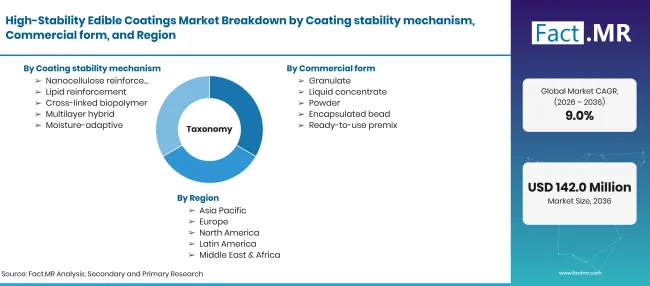
High Stability Edible Coatings Taxonomy | Source: Fact.MR
| Items | Values |
|---|---|
| Quantitative Units (2026) | USD 60.0 Million |
| Coating stability mechanism | Cross-linked biopolymer, Lipid reinforcement, Nanocellulose reinforcement, Multilayer hybrid, Moisture-adaptive |
| Commercial form | Powder, Liquid concentrate, Granulate, Encapsulated bead, Ready-to-use premix |
| Food application | Bakery, Dairy / alternatives, Beverage, Meat / savory, Confectionery / snacks |
| Primary function | Shelf-life, Texture / rheology, Taste / color, Nutritional functionality, Processing stability |
| Regions Covered | North America, Latin America, Europe, East Asia, South Asia and Pacific, Middle East & Africa |
| Countries Covered | India, Spain, Netherlands, United States, China, and other countries |
| Key Companies Profiled | Apeel Sciences, Mori, Sufresca, Xampla, Mantrose-Haeuser, Akorn Technology |
| Additional Attributes | Dollar revenue in the High-Stability Edible Coatings Market is segmented by coating stability mechanism (cross-linked biopolymer, lipid reinforcement, nanocellulose reinforcement, multilayer hybrid, moisture-adaptive); commercial form (powder, liquid concentrate, granulate, encapsulated bead, ready-to-use premix); food application (bakery, dairy / alternatives, beverage, meat / savory, confectionery / snacks); primary function (shelf-life, texture / rheology, taste / color, nutritional functionality, processing stability) and region. |
Source: Fact.MR analysis. Updated Nov 18, 2026
High-Stability Edible Coatings Market by Segments
-
Coating stability mechanism
- Cross-linked biopolymer
- Lipid reinforcement
- Nanocellulose reinforcement
- Multilayer hybrid
- Moisture-adaptive
-
Commercial form
- Powder
- Liquid concentrate
- Granulate
- Encapsulated bead
- Ready-to-use premix
-
Food application
- Bakery
- Dairy / alternatives
- Beverage
- Meat / savory
- Confectionery / snacks
-
Primary function
- Shelf-life
- Texture / rheology
- Taste / color
- Nutritional functionality
- Processing stability
-
Region:
- North America
- United States
- Canada
- Mexico
- Europe
- Germany
- United Kingdom
- France
- Italy
- Spain
- Rest of Europe
- Asia Pacific
- China
- India
- Japan
- South Korea
- Australia
- Rest of Asia Pacific
- Latin America
- Brazil
- Mexico
- Argentina
- Rest of Latin America
- Middle East & Africa
- GCC Countries
- South Africa
- Rest of Middle East & Africa
- North America
Frequently Asked Questions
How big is the global High-Stability Edible Coatings Market in 2026?
What will be the size of the High-Stability Edible Coatings Market by 2036?
How fast will the High-Stability Edible Coatings Market grow during the forecast period?
Which coating stability mechanism segment holds the largest share of the High-Stability Edible Coatings Market?
Who worked on this report


Preview the report firsthand - request a free sample
Free SampleGet the brochure for pricing and purchase details
Download PDF