- Base Value(2026): 155.0 Mn
- Estimated Value(2026): 155.0 Mn
- Forecast Value (2036): 420.0 Mn
- CAGR (2026 - 2036): 10.5%
Home Uroflowmetry Devices Market Forecast
Valuation of the home uroflowmetry devices market stood at USD 140.0 million in 2025. According to Fact MR, demand for home-based uroflowmetry monitoring devices is expected to reach USD 155.0 million in 2026 and USD 420.0 million by 2036. A CAGR of 10.5% is projected for the forecast timeline.
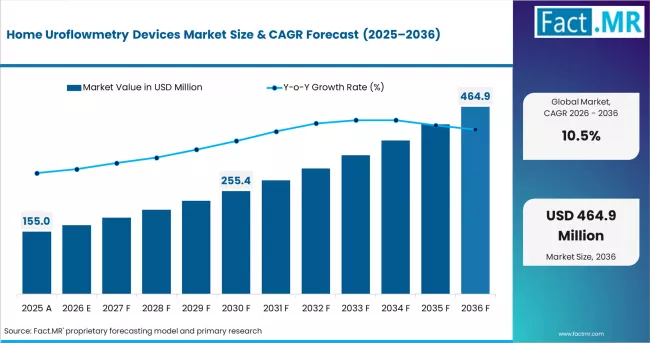
Home Uroflowmetry Devices Market Value Analysis | Source: Fact.MR
Summary of the Home Uroflowmetry Devices Market
- Market Definition
- The market comprises portable diagnostic devices designed to measure urine flow rate, voiding volume, and urination patterns in home environments. These devices enable remote assessment of lower urinary tract function and support monitoring of urological disorders through digital health platforms and telehealth enabled clinical workflows.
- Demand Drivers
- Increasing adoption of remote patient monitoring technologies supporting longitudinal evaluation of urinary flow characteristics.
- Rising prevalence of benign prostatic hyperplasia and urinary dysfunction requiring repeated measurement of voiding parameters.
- Growing integration of digital health platforms enabling transmission of uroflowmetry data to healthcare providers.
- Expanding demand for non clinical diagnostic solutions supporting reduction of hospital visits for chronic urology conditions.
- Increasing use of portable diagnostic tools supporting continuous monitoring of urinary tract function across home care environments.
- Growing adoption of connected diagnostic devices enabling data driven evaluation of treatment response across urology care pathways.
- Key Segments Analyzed
- End User: Home care patients account for 48% share supported by increasing preference for remote monitoring of urinary flow parameters.
- Product Type: Portable uroflowmetry devices represent 46% share supported by compact design enabling repeated measurement across home environments.
- Application: Benign prostatic hyperplasia monitoring and urinary incontinence assessment represent key diagnostic use cases.
- Technology Type: Connected smart devices and app enabled kits support transmission of urinary flow data across telehealth platforms.
- Geography: Asia Pacific, North America, and Europe demonstrate increasing adoption supported by expansion of digital healthcare infrastructure.
- Analyst Opinion at Fact MR
- Shambhu Nath Jha, Principal Consultant, Fact MR, opines, 'In this updated edition of the Home Uroflowmetry Devices Market report, connected diagnostic monitoring platforms demonstrate increasing clinical relevance for remote evaluation of urinary flow patterns across digital urology care environments through 2036.'
- Strategic Implications or Executive Takeaways
- Improve device accuracy capability supporting reliable measurement of urinary flow rate across home diagnostic environments.
- Strengthen integration with telehealth platforms supporting remote interpretation of uroflowmetry data.
- Expand development of connected monitoring devices supporting continuous evaluation of lower urinary tract function.
- Enhance software analytics capability supporting interpretation of voiding curve patterns across patient datasets.
- Improve device usability supporting patient compliance across long term home monitoring workflows.
- Strengthen interoperability capability supporting integration with electronic health record systems across healthcare providers.
- Methodology
- Primary interviews conducted with urology device manufacturers, clinicians, and digital health platform providers.
- Benchmarked against prevalence of urological disorders influencing demand for home based diagnostic monitoring tools.
- Evaluated connected diagnostic device development trends supporting telehealth enabled patient monitoring workflows.
- Hybrid modeling applied combining top-down digital health adoption estimation with bottom-up home diagnostic device utilization assessment.
- Validation conducted using clinical data related to urinary flow measurement and remote monitoring technology adoption.
- Peer review applied using Fact MR analytical frameworks linking telehealth growth with home diagnostic device demand trends.
Home Uroflowmetry Devices Market
| Metric | Details |
|---|---|
| Industry Size (2026E) | USD 155.0 million |
| Industry Value (2036F) | USD 420.0 million |
| CAGR (2026 to 2036) | 10.5% |
Source: Fact.MR analysis. Updated Apr 22, 2026
A CAGR of 10.5% indicates transformational expansion supported by demand for remote urological monitoring and reduced hospital visits. Growth remains driven by telehealth integration and patient convenience benefits, while constraints persist from reimbursement coverage variability, device accuracy validation, and data integration with clinical information systems.
China leads with a projected CAGR of 11.9%, supported by increasing adoption of home-based diagnostic monitoring tools across urology patient management programs. India follows with a CAGR of 11.5%, driven by expanding deployment of remote urinary flow measurement devices across outpatient care environments. The United Kingdom records a CAGR of 11.2%, reflecting steady integration of home diagnostic monitoring technologies across telehealth-enabled patient evaluation workflows. Germany shows a CAGR of 10.9%, supported by consistent use of digital urology monitoring devices across patient self-assessment programs. The United States records the slowest growth at 10.5%, reflecting a relatively mature digital health ecosystem tied to replacement demand within established home diagnostic device supply chains.
Segmental Analysis
Home Uroflowmetry Devices Market Analysis by End User
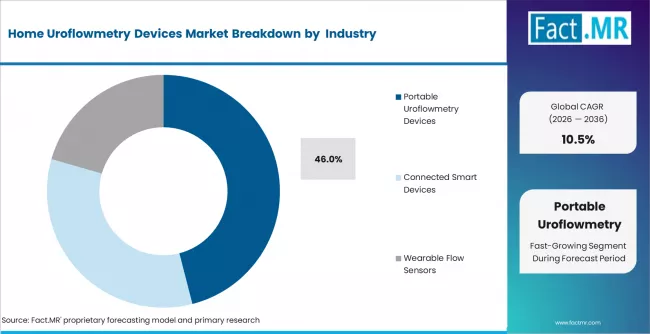
Home Uroflowmetry Devices Market Analysis By Product Type | Source: Fact.MR
- Market Overview: Based on Fact MR assessment, home care patients are projected to account for 48% share of the home uroflowmetry devices market in 2026. Home based uroflowmetry monitoring systems enable measurement of urinary flow rate parameters supporting evaluation of lower urinary tract function outside clinical settings. Portable diagnostic equipment records urine flow velocity, voided volume, and flow pattern characteristics enabling assessment of urological conditions including bladder outlet obstruction and urinary retention. Device utilization supports remote monitoring of patient condition enabling continuity of diagnostic observation across chronic urological disorder management requiring consistent measurement of urinary flow parameters across non clinical environments.
- Demand Drivers:
- Remote Monitoring Requirements: Home uroflowmetry devices support measurement of urinary flow characteristics enabling evaluation of lower urinary tract function across home care environments.
- Patient Convenience Parameters: Home based diagnostic devices enable data collection without requirement for frequent clinical visits supporting continuity of monitoring workflows.
- Clinical Data Collection Needs: Recorded flow metrics support assessment of urinary function enabling clinical evaluation of treatment response across urology care pathways.
Home Uroflowmetry Devices Market Analysis by Product Type
Home Uroflowmetry Devices Market Analysis By Product Type | Source: Fact.MR
- Market Overview: Portable uroflowmetry devices are estimated to hold 46% share of the home uroflowmetry devices market in 2026, supported by compact device architecture enabling ease of use across home diagnostic settings requiring simplified measurement of urinary flow parameters. Portable systems incorporate electronic sensors enabling capture of flow rate curves supporting evaluation of urinary performance characteristics across repeated testing sessions. Device configuration supports integration with digital data recording interfaces enabling transfer of diagnostic measurements supporting interpretation by healthcare providers across remote patient monitoring environments.
- Demand Drivers:
- Device Portability Requirements: Compact uroflowmetry devices support ease of placement within home environments enabling repeated urinary flow measurement procedures.
- Measurement Accuracy Parameters: Sensor integrated devices support capture of flow rate data enabling assessment of urinary function characteristics.
Remote Data Access Needs: Portable diagnostic systems enable transmission of recorded data supporting clinical evaluation across telehealth monitoring workflows.
Key Dynamics
Home Uroflowmetry Devices Market Drivers, Restraints, and Opportunities
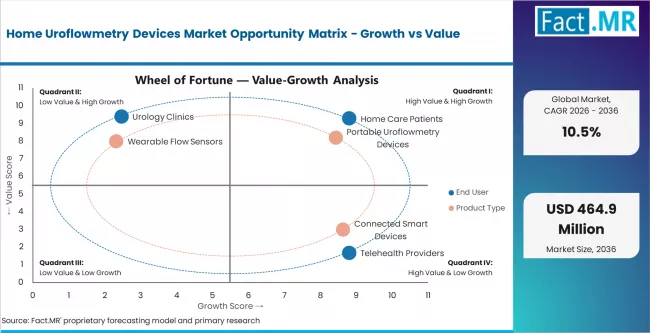
Home Uroflowmetry Devices Market Opportunity Matrix Growth Vs Value | Source: Fact.MR
FMR analysts observe that historical uroflowmetry testing has been structurally confined to hospital-based urodynamic labs where specialized equipment measured urinary flow rate as part of lower urinary tract dysfunction diagnostics. The current market size reflects a transition toward portable and home-based uroflowmetry devices that enable repeated measurement of voiding parameters in real-world conditions rather than single-point clinical observations. Structural reality indicates an early growth digital diagnostics segment because conditions such as benign prostatic hyperplasia, urinary incontinence, and neurogenic bladder require longitudinal monitoring of flow rate metrics including maximum flow rate (Qmax), voiding time, and volume trends. Home-based uroflowmetry improves data reliability by capturing multiple readings across different time intervals, addressing variability associated with single clinical tests.
The present structural shift reflects declining reliance on standalone clinic-based flowmeters as wearable and smartphone-connected sensors enable passive monitoring through acoustic, weight-based, and accelerometer-driven measurement techniques. Device cost per unit remains relatively high due to calibration requirements and clinical validation standards, yet improved diagnostic continuity and remote patient monitoring integration support value growth despite modest shipment volumes. Emerging solutions incorporate AI-based curve recognition capable of identifying abnormal voiding patterns, improving diagnostic efficiency in tele-urology workflows.
- Remote Urology Monitoring: Home uroflowmetry devices enable repeated measurement of urinary flow metrics, improving clinical decision accuracy through longitudinal patient data collection.
- Digital Health Validation: FDA SaMD frameworks and EU MDR medical device requirements influence product development timelines due to clinical accuracy verification needs.
- Aging Population Demand: North America, Europe, and Japan drive adoption due to higher prevalence of prostate disorders and urinary dysfunction requiring continuous monitoring solutions.
Regional Analysis
The Home Uroflowmetry Devices Market is assessed across North America, Europe, and Asia Pacific, segmented by country-level demand in portable urinary flow measurement devices, remote urology monitoring systems, digital voiding pattern analytics tools, and connected home diagnostic platforms. Regional demand reflects expansion of remote patient monitoring adoption and integration of digital urology assessment technologies. The full report offers market attractiveness analysis.
.webp "Top Country Growth Comparison Home Uroflowmetry Devices Market Cagr (2026 2036)")
Top Country Growth Comparison Home Uroflowmetry Devices Market Cagr (2026 2036) | Source: Fact.MR
CAGR Table
| Country | CAGR (2026–2036) |
|---|---|
| China | 11.9% |
| India | 11.5% |
| United Kingdom | 11.2% |
| Germany | 10.9% |
| United States | 10.5% |
Source: Fact.MR analysis. Updated Apr 22, 2026
Source: Fact MR analysis, based on proprietary forecasting model and primary research
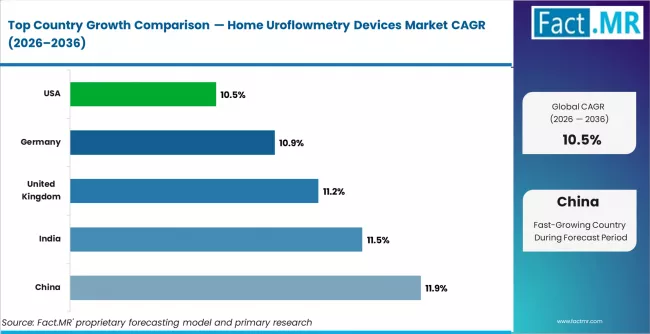
Home Uroflowmetry Devices Market Cagr Analysis By Country | Source: Fact.MR
Asia Pacific
Asia Pacific functions as the digital home diagnostics adoption hub, supported by expansion of telehealth monitoring infrastructure and increasing use of connected urology assessment technologies. Laborie Medical Technologies strengthens uroflowmetry device engineering capability. Medtronic plc expands remote patient monitoring analytics platforms. HealthSTATS International supports portable diagnostic device innovation.
- China: China is projected to record 11.9% CAGR in home uroflowmetry devices through 2036. Healthy China digital healthcare integration update (National Health Commission, March 2024) supports adoption of remote diagnostic monitoring tools. Laborie Medical Technologies expanded portable uroflowmetry device engineering capability (June 2023).
- India: Utilization of home uroflowmetry devices in India is forecast to grow at 11.5% CAGR through 2036. National Digital Health Mission remote patient monitoring framework update (Ministry of Health and Family Welfare, January 2024) supports home-based urology diagnostic technology deployment. HealthSTATS International expanded connected diagnostic device capability (May 2023).
Europe
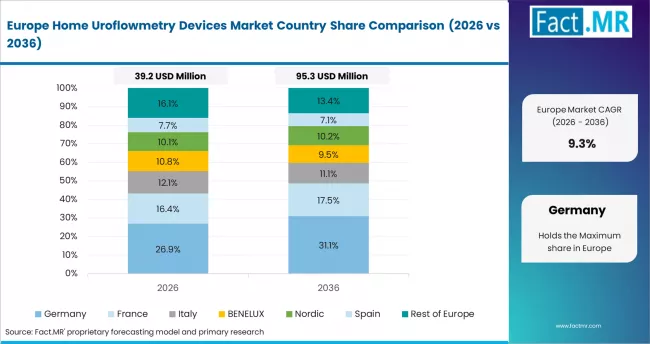
Home Uroflowmetry Devices Market Europe Country Market Share Analysis, 2026 & 2036 | Source: Fact.MR
Europe operates as the regulated digital medical monitoring environment, supported by structured medical device compliance pathways and integration of home-based diagnostic technologies in urology care pathways. Medtronic plc strengthens remote monitoring platform capability. Laborie Medical Technologies expands urology diagnostic system expertise. SCHILLER AG supports digital patient monitoring innovation.
- United Kingdom: Deployment of home uroflowmetry devices in United Kingdom is expected to expand at 11.2% CAGR through 2036. NHS digital health strategy update (Department of Health and Social Care, February 2024) supports home diagnostic monitoring adoption. SCHILLER AG expanded remote uroflowmetry device capability (July 2023).
- Germany: Germany is anticipated to observe 10.9% CAGR in home uroflowmetry devices through 2036. Digital Healthcare Act reimbursement framework update (Federal Ministry of Health, October 2023) supports connected home diagnostic device utilization. Medtronic plc expanded remote urology monitoring analytics capability (April 2023).
North America
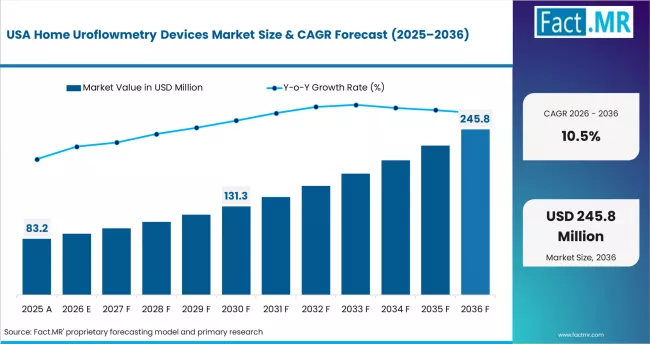
Home Uroflowmetry Devices Market Country Value Analysis | Source: Fact.MR
North America represents the connected home diagnostics commercialization environment, supported by strong adoption of remote patient monitoring tools and integration of digital urology assessment technologies across healthcare systems. Laborie Medical Technologies strengthens portable uroflowmetry capability. Medtronic plc expands digital health monitoring platforms. Boston Scientific Corporation supports urology diagnostic innovation.
- United States: The United States is forecast to witness 10.5% CAGR in home uroflowmetry devices through 2036. FDA digital health policy framework update (April 2024) supports commercialization of connected home diagnostic devices. Boston Scientific Corporation expanded remote urology monitoring solution capability (August 2023).
Fact MR's analysis of home uroflowmetry devices market in global regions consists of country-wise assessment that includes China, India, United Kingdom, Germany, and United States. Readers can find remote urology monitoring trends, connected diagnostic device developments, digital health adoption signals, and competitive positioning across key markets.
Competitive Landscape
What is the Competitive Structure of the Home Uroflowmetry Devices Market?
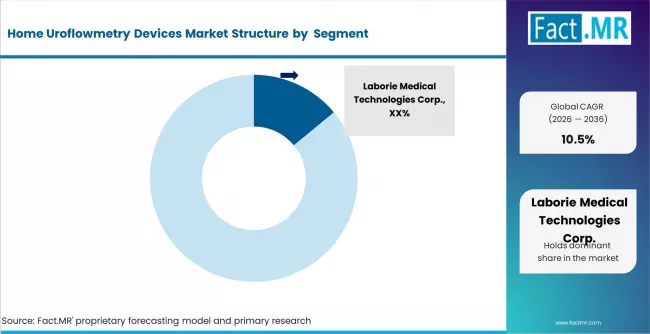
Home Uroflowmetry Devices Market Analysis By Company | Source: Fact.MR
The Home Uroflowmetry Devices Market reflects a moderately fragmented competitive structure, characterized by participation from specialized urology diagnostic equipment manufacturers and digital health device developers. Key companies including Laborie Medical Technologies Corp., MMS Medical Measurement Systems B.V., MEDICA S.p.A., Andromeda Medizinische Systeme GmbH, Verathon Inc., and SRS Medical Systems Inc. collectively account for approximately 50–60% of global market presence, particularly in portable uroflowmetry systems designed for remote urinary function monitoring. Competitive differentiation is primarily determined by measurement accuracy, ease of home use, data recording reliability, and integration with telehealth platforms used in urology care. Product design considerations such as device portability, hygienic construction, and digital reporting capabilities influence supplier positioning in clinical and home-based diagnostic workflows.
Structural advantages are held by companies with established expertise in urodynamic diagnostics and existing distribution relationships with urology clinics and hospitals. Laborie Medical Technologies Corp. and MMS Medical Measurement Systems B.V. benefit from broad product portfolios covering both clinical and portable urodynamic assessment solutions. Buyers including healthcare providers and homecare distributors typically reduce supplier dependency through evaluation of device accuracy, interoperability with clinical software systems, and compliance with medical device standards. Procurement decisions often consider long-term service reliability and calibration stability to ensure consistent measurement output. Pricing power remains relatively balanced, though suppliers retain moderate leverage where validated measurement precision and clinical acceptance create switching costs for healthcare providers implementing remote monitoring solutions.
Key Players of the Home Uroflowmetry Devices Market
- Laborie Medical Technologies Corp.
- MMS Medical Measurement Systems B.V.
- MEDICA S.p.A.
- Andromeda Medizinische Systeme GmbH
- Oruba Medical Technologies
- SRS Medical Systems Inc.
- Albyn Medical Ltd.
- Verathon Inc.
- Urovalve Ltd.
- The Prometheus Group
Bibliographies
- [1] National Health Commission. (2024, March). Healthy China digital healthcare integration update. Government of China.
- [2] Ministry of Health and Family Welfare. (2024, January). National digital health mission remote patient monitoring framework update. Government of India.
- [3] Department of Health and Social Care. (2024, February). NHS digital health strategy update. UK Government.
- [4] Federal Ministry of Health. (2023, October). Digital healthcare act reimbursement framework update. Government of Germany.
- [5] U.S. Food and Drug Administration. (2024, April). FDA digital health policy framework update. U.S. Department of Health and Human Services.
- [6] Laborie Medical Technologies Corp. (2023, June). Portable uroflowmetry device engineering capability expansion. Laborie Medical Technologies Corp.
- [7] HealthSTATS International. (2023, May). Connected diagnostic device capability expansion. HealthSTATS International.
- [8] Medtronic plc. (2023, April). Remote urology monitoring analytics capability expansion. Medtronic plc.
- [9] SCHILLER AG. (2023, July). Remote uroflowmetry device capability expansion. SCHILLER AG.
- [10] Boston Scientific Corporation. (2023, August). Remote urology monitoring solution capability expansion. Boston Scientific Corporation.
This Report Addresses
- Market size forecasts for 2026 to 2036 based on adoption of remote urinary flow monitoring technologies in home care environments.
- Opportunity mapping across portable uroflowmetry devices, connected smart devices, wearable flow sensors, and app enabled diagnostic kits.
- Segment and regional forecasts covering benign prostatic hyperplasia monitoring, urinary incontinence assessment, post surgical monitoring, neurogenic bladder monitoring, and pediatric urology evaluation.
- Competition benchmarking based on measurement accuracy performance, device usability, data connectivity capability, and integration with telehealth monitoring platforms.
- Regulatory review covering digital health device compliance pathways, clinical validation requirements, and remote patient monitoring data governance standards.
- Report delivery in PDF, Excel, PPT, and dashboard formats supporting urology device manufacturers, telehealth providers, and digital health stakeholders.
- Supply risk evaluation covering calibration sensitivity, reimbursement variability, interoperability limitations with clinical information systems, and adoption variability across home healthcare environments.
Home Uroflowmetry Devices Market Definition
The Home Uroflowmetry Devices Market includes portable medical devices used to measure urine flow rate, volume, and voiding patterns in non clinical settings, enabling remote assessment and monitoring of urinary tract function to support diagnosis and management of urological conditions such as benign prostatic hyperplasia, urinary retention, and bladder dysfunction.
Home Uroflowmetry Devices Market Inclusions
The report includes global and regional market size estimates, forecast analysis, and segmentation by device type, measurement technology, connectivity capability, application area, end use sector, pricing structure, and integration with digital health and remote patient monitoring platforms.
Home Uroflowmetry Devices Market Exclusions
The scope excludes hospital based uroflowmetry systems not intended for home use, diagnostic imaging technologies such as ultrasound cystography, general urinary health monitoring applications without flow measurement capability, and urological treatment devices not designed for flow rate analysis.
Home Uroflowmetry Devices Market Research Methodology
- Primary Research
- Interviews were conducted with medical device manufacturers, urology specialists, digital health providers, and healthcare technology distributors.
- Desk Research
- Public sources included clinical urology publications, regulatory documentation, company technical materials, patent literature, and research studies on portable uroflowmetry technologies.
- Market-Sizing and Forecasting
- A hybrid model combining top-down digital health device demand evaluation and bottom-up analysis of home uroflowmetry device adoption across remote monitoring applications was applied.
- Data Validation and Update Cycle
- Outputs were validated through cross comparison of clinical utilization data, expert consultation, and periodic monitoring of home based diagnostic technology adoption trends.
Segmentation
Report Scope
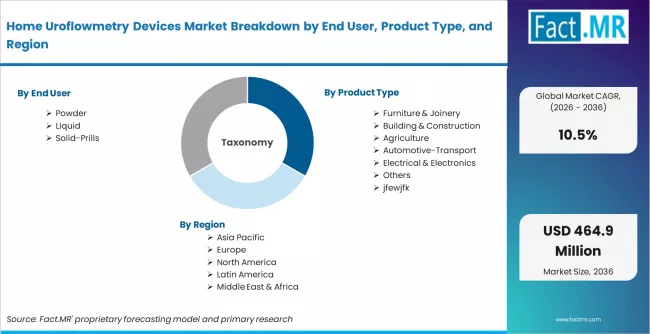
Home Uroflowmetry Devices Market Breakdown By End User, Product Type, And Region | Source: Fact.MR
| Metric | Value |
|---|---|
| Quantitative Units | USD 155.0 million (2026) to USD 420.0 million (2036), at a CAGR of 10.5% |
| Market Definition | The home uroflowmetry devices market includes diagnostic instruments designed to measure urine flow rate and voiding patterns in non-clinical settings to support remote urological assessment, treatment monitoring, and telehealth-based patient management. |
| Product Type Segmentation | Portable uroflowmetry devices, Connected smart devices, Wearable flow sensors, App-enabled diagnostic kits |
| Application Segmentation | Benign prostatic hyperplasia monitoring, Urinary incontinence assessment, Post-surgical monitoring, Neurogenic bladder monitoring, Pediatric urology assessment |
| End User Segmentation | Home care patients, Telehealth providers, Urology clinics, Research institutes |
| Regions Covered | North America, Latin America, Europe, East Asia, South Asia, Oceania, Middle East and Africa |
| Countries Covered | United States, Canada, Germany, France, United Kingdom, Italy, Spain, Netherlands, China, Japan, South Korea, India, Australia, Singapore, Brazil, Mexico, United Arab Emirates, South Africa, and 40+ countries |
| Key Companies Profiled | Laborie Medical Technologies Corp., MMS Medical Measurement Systems B.V., MEDICA S.p.A., Andromeda Medizinische Systeme GmbH, Oruba Medical Technologies, SRS Medical Systems Inc., Albyn Medical Ltd., Verathon Inc., Urovalve Ltd., The Prometheus Group |
| Forecast Period | 2026 to 2036 |
| Approach | Hybrid top-down and bottom-up market estimation based on remote patient monitoring adoption trends, home diagnostic device demand benchmarking, telehealth urology assessment growth patterns, digital health device integration analysis, and validation through primary interviews with medical device manufacturers, urology specialists, and telemedicine solution providers. |
Source: Fact.MR analysis. Updated Apr 22, 2026
Home Uroflowmetry Devices Market Key Segments
-
Product Type:
- Portable Uroflowmetry Devices
- Connected Smart Devices
- Wearable Flow Sensors
- App Enabled Diagnostic Kits
-
Application:
- Benign Prostatic Hyperplasia Monitoring
- Urinary Incontinence Assessment
- Post Surgical Monitoring
- Neurogenic Bladder Monitoring
- Pediatric Urology Assessment
-
End User:
- Home Care Patients
- Telehealth Providers
- Urology Clinics
- Research Institutes
-
Region:
- North America
- USA
- Canada
- Mexico
- Europe
- Germany
- UK
- France
- Italy
- Spain
- Nordic Countries
- BENELUX
- Rest of Europe
- Asia Pacific
- China
- Japan
- South Korea
- India
- Australia
- Rest of Asia Pacific
- Latin America
- Brazil
- Argentina
- Rest of Latin America
- Middle East and Africa
- Kingdom of Saudi Arabia
- United Arab Emirates
- South Africa
- Rest of Middle East and Africa
- Other Regions
- Oceania
- Central Asia
- Other Markets
- North America
Frequently Asked Questions
How large is the demand for Home Uroflowmetry Devices in the global market in 2026?
What will be the market size of Home Uroflowmetry Devices in the global market by 2036?
What is the expected demand growth for Home Uroflowmetry Devices in the global market between 2026 and 2036?
Which company is identified as a leading manufacturer in the Home Uroflowmetry Devices market?
Which end user segment is projected to dominate home uroflowmetry device adoption by 2026?
Why are home uroflowmetry devices widely used in remote patient monitoring environments?
What is driving demand for home uroflowmetry devices in China?
What is the growth outlook for the Home Uroflowmetry Devices market in China?
Why is India an important market for home-based urology monitoring technologies?
What is the growth outlook for the Home Uroflowmetry Devices market in India?
How is demand for home uroflowmetry devices evolving in the United Kingdom healthcare sector?
What is the growth outlook for the Home Uroflowmetry Devices market in the United Kingdom?
What is the growth outlook for the Home Uroflowmetry Devices market in Germany?
How is the United States positioned in the Home Uroflowmetry Devices market?
What is the growth outlook for the Home Uroflowmetry Devices market in the United States?
What are home uroflowmetry devices and what are they mainly used for?
What does the Home Uroflowmetry Devices market include in this report?
What applications are included in the scope of the Home Uroflowmetry Devices market?
What is excluded from the scope of the Home Uroflowmetry Devices market report?
What does market forecast mean in the Home Uroflowmetry Devices market report?
How is the Home Uroflowmetry Devices market forecast developed in this report?
What does primary validation indicate in the Home Uroflowmetry Devices market analysis?
Who worked on this report


Preview the report firsthand - request a free sample
Free SampleGet the brochure for pricing and purchase details
Download PDF