- Market Value (2025): USD 1.0 Bn
- Estimated Value (2026): USD 1.1 Bn
- Forecast Value (2036): USD 2.5 Bn
- CAGR (2026-2036): 8.9%
What is the Hydroxypropyl Starch Phosphates Market forecast to be worth by 2036?
USD 1.1 billion in 2026 to USD 2.5 billion by 2036 at an 8.9% CAGR.
- The Hydroxypropyl Starch Phosphates Market reached USD 1.0 billion in 2025.
- Demand is projected to increase from USD 1.1 billion in 2026 to USD 2.5 billion by 2036.
- The market is forecast to record an 8.9% CAGR from 2026 to 2036 while personal care formulators and food processors qualify starch-based systems for texture stability.
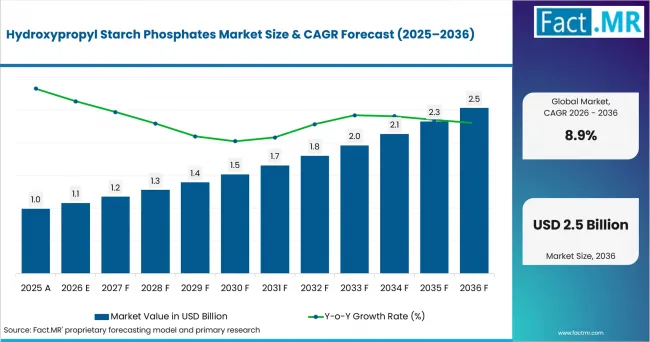
Hydroxypropyl Starch Phosphates Market Value Analysis | Source: Fact.MR
What are the defining numbers behind Hydroxypropyl Starch Phosphates Market growth?
An absolute opportunity of USD 1.45 billion is expected between 2026 and 2036.
- Demand Drivers in the Market
- Personal care formulators need texture builders that thicken cold-process creams and support a soft skin feel after application.
- Food manufacturers need reliable starch systems for sauces and dressings. The U.S. Census Bureau reported July 2026 retail and food services sales of USD 763.6 billion, indicating a large consumer channel for packaged-product reformulation and portfolio activity.
- Brands working with starch inputs track adjacent activity in food thickening agents when reformulating viscosity systems for processed foods.
- Topical product developers need powders that support suspension and spreadability in opaque lotions, rinse-off products and selected pharmaceutical formats.
- Technical teams need ingredient systems with clear food-additive and cosmetic documentation before scale-up across regulated product categories.
- Key Segments Analyzed
- By Grade: Personal care grade is expected to hold 43.00% share in 2026 since creams and masks require starches with smooth skin feel.
- By Function: Rheology modification is projected to account for 36.00% share in 2026 owing to its role in viscosity building and suspension control.
- By Application: Skin care is anticipated to capture 32.00% share in 2026 where formulators use starch phosphates in creams and lotions.
- By Physical Form: Native-flow powder is estimated to represent 46.00% share in 2026 since it supports flexible handling and direct use in dry premixes.
- Analyst Opinion at Fact.MR
- Shambhu Nath Jha, Principal Consultant at Fact.MR states, "Hydroxypropyl starch phosphates draw attention by addressing a practical formulation issue: texture must stay stable while the finished product still feels pleasant. Suppliers that combine documentation, grade consistency and application support are better placed with formulators than firms selling only a basic starch powder."
- Strategic Implications
- Ingredient producers should maintain separate food, cosmetic and topical documentation files so customer qualification moves cleanly across grades.
- Formulation laboratories should test viscosity after heat exposure and storage since starch phosphate performance is judged inside the finished formulation.
- Distributors should explain powder handling and hydration behavior before sample trials, especially where native-flow powder replaces pregelatinized material.
- Brand teams should compare hydroxypropyl starch phosphate against adjacent cosmetic chemicals when the purchase decision depends on texture, skin feel and ingredient labeling.
USA is forecast to advance at 10.1% CAGR through personal care reformulation and processed food texture demand. The UK is projected to record 9.6% CAGR with cosmetic notification discipline supporting documented ingredients. Germany is estimated to reach 8.9% CAGR through export-oriented chemical and ingredient channels. France is anticipated to post 8.5% CAGR owing to beauty formulation depth. Japan is forecast to register 8.0% CAGR, supported by e-commerce beauty channels and careful additive review.
How does the Hydroxypropyl Starch Phosphates Market break down by segment?
Personal care grade leads Grade at 43.0%; native-flow powder leads Physical Form at 46.0%.
Which Grade dominates?
Personal care grade is expected to hold 43.0% share in 2026.
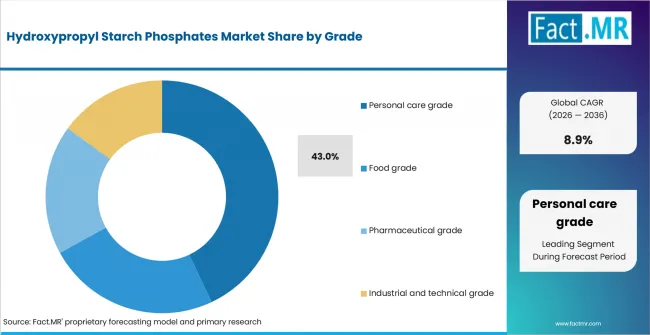
Hydroxypropyl Starch Phosphates Market Analysis By Grade | Source: Fact.MR
Personal care grade leads on the strength of cosmetic formulation needs for water-based thickening and improved sensory feel. Roquette lists Beauté by Roquette ST 325 as hydroxypropyl starch phosphate for cold-process cosmetic formulations, with use in skin care and hair care applications.
The grade also fits broader personal care ingredient decisions where starch-based powders compete with polymers and gums. Skin care ingredients helps frame the application base for creams, masks and lotions.
What leads the Function segment?
Rheology modification is projected to account for 36.0% share in 2026.
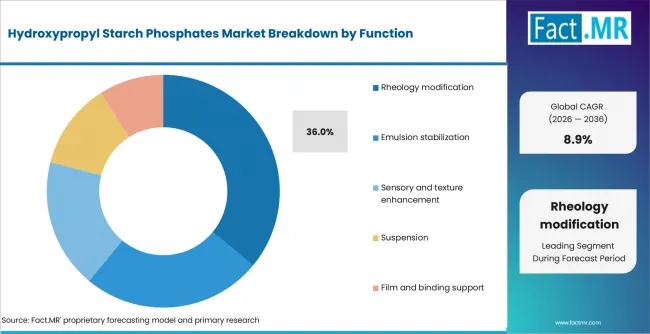
Hydroxypropyl Starch Phosphates Market Analysis By Function | Source: Fact.MR
Rheology modification leads by meeting formulator needs for viscosity control, flow behavior and suspension stability. Nouryon describes Structure XL starch as a rheology and aesthetic modifier for hair and skin care emulsions, which directly aligns with the function share.
The function extends beyond thickening alone. It helps formulators manage how a lotion spreads, how a dressing pours and how suspended ingredients stay distributed during storage.
How does Application shape demand?
Skin care is anticipated to capture 32.0% share in 2026.
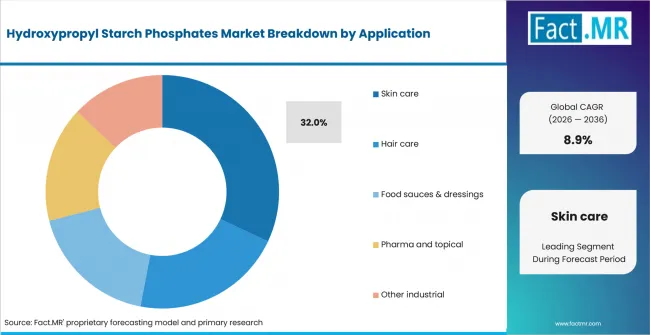
Hydroxypropyl Starch Phosphates Market Analysis By Application | Source: Fact.MR
Skin care leads where creams and lotions require stable viscosity and a smooth after-feel. BASF identifies Cosmedia HP Starch as hydroxypropyl starch phosphate with thickening and texturizing use, showing direct supplier participation in cosmetic applications.
Food sauces and dressings provide an additional application route. Eurostat reported in August 2026 that the EU’s value of sold production for food products increased by 3.8% in constant prices in 2025 compared with 2024, indicating a growing food-manufacturing base relevant to functional texture systems used across prepared foods.
What supports native-flow powder within Physical Form?
Native-flow powder is estimated to represent 46.0% share in 2026.
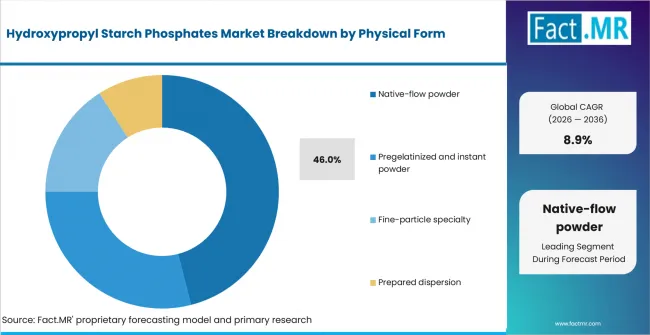
Hydroxypropyl Starch Phosphates Market Analysis By Physical Form | Source: Fact.MR
Native-flow powder leads through flexible handling during blending, storage and staged hydration. Primient lists TEXTURLUX products with hydroxypropyl starch phosphate as thickener and viscosity modifier options, supporting powder-based use in personal care systems.
Upstream starch choices remain relevant where formulators compare botanical bases and supply continuity. The analysis separates hydroxypropyl starch phosphate from broader waxy maize starch coverage while recognizing that starch origin affects grade design.
What is accelerating Hydroxypropyl Starch Phosphates Market adoption, and what is holding it back?
Demand is expected to rise through texture stability, personal care grade use and processed food applications. Adoption is restrained by qualification time, grade separation and substitute competition.
| DRIVER | (~) % IMPACT ON CAGR | GEOGRAPHIC RELEVANCE | IMPACT TIMELINE |
|---|---|---|---|
| Personal care reformulation toward starch-based rheology systems | +1.7% | North America, Europe, East Asia | Short term (<= 2 years) |
| Processed food need for sauce and dressing texture stability | +1.3% | USA, UK, France, Japan | Medium term (2-4 years) |
| Documented additive and INCI pathways for regulated products | +0.9% | North America, Western Europe, Japan | Medium term (2-4 years) |
| Native-flow powder handling and blending flexibility | +0.7% | Global | Long term (>= 4 years) |
- Personal care reformulation toward starch-based rheology systems: Cosmetic brands use hydroxypropyl starch phosphate where a powder can thicken, stabilize and improve the finished sensory profile.
- Processed food need for sauce and dressing texture stability: Prepared food manufacturers use starch phosphates where products face heat, filling and storage steps before retail sale.
- Documented additive and INCI pathways: FDA listings and cosmetic ingredient naming help technical teams prepare files for food and personal care applications.
| OPPORTUNITY | (~) % IMPACT ON CAGR | GEOGRAPHIC RELEVANCE | IMPACT TIMELINE |
|---|---|---|---|
| Cold-process cosmetic texture systems | +1.2% | USA, France, Japan | Short term (<= 2 years) |
| Food sauces and dressings with stable pour behavior | +0.8% | North America, Europe | Medium term (2-4 years) |
| Pharma and topical formats using suspension support | +0.6% | USA, Germany, UK | Long term (>= 4 years) |
- Cold-process cosmetic texture systems: Starch phosphate suppliers can support brands that want simpler processing and soft sensory profiles across mass beauty and personal care products.
- Food sauces and dressings with stable pour behavior: The ingredient can be positioned alongside food stabilizers where texture, heat tolerance and shelf stability guide reformulation.
- Pharma and topical formats using suspension support: Pharmaceutical grade use stays linked to topical formulations and selected sustained release excipients decisions where binder behavior and release needs are assessed separately.
| RESTRAINT | (~) % IMPACT ON CAGR | GEOGRAPHIC RELEVANCE | IMPACT TIMELINE |
|---|---|---|---|
| Qualification time across food and cosmetic grades | -0.6% | USA, Europe, Japan | Short term (<= 2 years) |
| Competition from gums, carbomers and other texture systems | -0.5% | Global | Medium term (2-4 years) |
| Performance variation by hydration method and formulation pH | -0.4% | Global | Long term (>= 4 years) |
- Qualification time across food and cosmetic grades: Formulators require stability trials, sensory checks and labeling review before moving from sample use into regular purchasing.
- Competition from gums and carbomers: Ingredient selection depends on cost and process fit. Starch phosphate must prove its value inside each formulation.
- Performance variation by hydration method and formulation pH: Product teams need clear processing guidance since viscosity response changes when water temperature and shear conditions shift.
Which countries are scaling the Hydroxypropyl Starch Phosphates Market through 2036?
- The country comparison spans 2.05 percentage points and forms three practical growth bands across the forecast period.
- USA remains 0.51 percentage point above the UK through a large finished-product base and active reformulation in food and personal care.
- The UK remains 0.65 percentage point above Germany with cosmetic notification discipline and food manufacturing scale supporting documented ingredients.
- Germany remains 0.44 percentage point above France through export-oriented ingredient channels and formulation testing depth.
- France remains 0.45 percentage point above Japan through beauty formulation strength and food manufacturing reach.
- Japan closes the displayed range through e-commerce beauty demand and careful additive review for finished goods.
Comparable CAGRs can create different entry conditions due to cosmetic documentation, food manufacturing scale, additive review and distributor support. Full report coverage includes North America; Latin America; Western Europe; Eastern Europe; East Asia; South Asia & Pacific; Middle East & Africa.
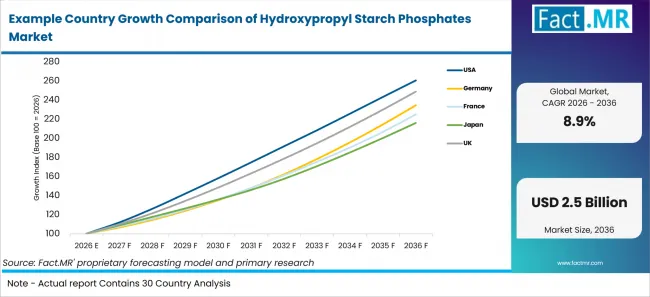
Example Country Growth Comparison Of Hydroxypropyl Starch Phosphates Market | Source: Fact.MR
| Country | CAGR (2026-2036) |
|---|---|
| United States | 10.1% |
| United Kingdom | 9.6% |
| Germany | 8.9% |
| France | 8.5% |
| Japan | 8.0% |
What supports USA adoption?
10.1% CAGR, supported by processed food scale and personal care grade selection.
USA adoption is anchored in a large finished-product base where texture, stability and labeling support repeat ingredient qualification. USDA ERS reported in June 2026 that total U.S. food spending reached USD 2.51 trillion in 2025. FDA lists hydroxypropyl distarch phosphate as a modified food starch used as a stabilizer or thickener and cites 21 CFR 172.892 and 21 CFR 175.105, giving food formulators a defined federal regulatory reference when evaluating food grade materials.
What supports the United Kingdom’s growth?
9.6% CAGR, backed by cosmetic notification discipline and food manufacturing demand.
UK demand is shaped by food manufacturers and beauty brands that require documented ingredient behavior before reformulation. ONS reported in July 2026 that UK manufacturers sold £452.0 billion of products in 2025, with food manufacturing representing 22.9% of that value. Cosmetic product records under the SCPN system add another documentation checkpoint for personal care grade ingredients.
What is supporting Germany’s adoption?
8.9% CAGR, supported by export-oriented ingredient channels and technical formulation depth.
Germany benefits from technical distribution channels that serve cosmetics, food processing and industrial formulation customers across Europe. Destatis reported on August 20, 2026 that German exports amounted to €817.8 billion in the first half of 2026, up 3.9% from the same period of 2025. That export reach supports ingredient suppliers that can provide consistent documentation and repeatable powder performance.
How does France perform?
8.5% CAGR, led by beauty formulation depth and food production scale.
France combines beauty formulation expertise with a broad agro-food manufacturing base, giving starch phosphate suppliers several application routes. INSEE reported in July 2026 that the production value of France’s agri-food industry, including food, beverages and tobacco products, reached EUR 203,464 million in 2024. Cosmetic formulators use personal care grade starch phosphates where skin feel, emulsion stability and sensory finish are evaluated before launch.
How does Japan perform?
8.0% CAGR, shaped by e-commerce beauty channels and additive review discipline.
Japan demand is supported by beauty retail shifts and careful finished-product testing. METI reported in August 2025 that Japan’s domestic B-to-C e-commerce market reached ¥26.1 trillion in 2024. Within the merchandising sector, B-to-C e-commerce for cosmetics and pharmaceuticals reached ¥1.015 trillion, up 4.54% from 2023, demonstrating an established digital sales channel relevant to personal-care products. Food and cosmetic formulators continue to favor clear grade documentation before adding starch phosphate systems to local products.
Who leads the Hydroxypropyl Starch Phosphates Market?
The competitive set is defined by active product portfolios across Roquette; Nouryon; Cargill; BASF; and Primient. These companies participate through food starches, personal care rheology systems, cosmetic texturizers and specialty starch platforms. Competition centers on grade documentation, powder consistency, application testing and the ability to guide formulators through food or cosmetic qualification.
Roquette participates through Beauté by Roquette® ST 320 and ST 325, hydroxypropyl starch phosphate ingredients used for cosmetic thickening, texturizing and stabilization. Nouryon participates through Structure® XL starch, a rheology and aesthetic modifier for hair and skin care emulsions.
Cargill Beauty offers starch-based personal care ingredients that include hydroxypropyl starch phosphate systems for texture and viscosity. BASF participates through Cosmedia HP Starch for thickening and texturizing. Primient lists TEXTURLUX products with hydroxypropyl starch phosphate for thickening and viscosity modification, giving formulators another powder-based route.
Which companies are the key providers?
Key companies include Roquette; Nouryon; Cargill; BASF; and Primient.
- Roquette
- Nouryon
- Cargill
- BASF
- Primient
Bibliography
- Eurostat. (2026, August 24). EU industrial production rebounds in 2025.
- U.S. Food and Drug Administration. (2026, May 4). Inventory of food contact substances listed in 21 CFR: Starch, food, modified: Hydroxypropyl distarch phosphate.
- Institut national de la statistique et des études économiques. (2026, July 21). Indicateurs macroéconomiques de l’industrie agroalimentaire.
- Ministry of Economy, Trade and Industry. (2025, August 26). Results of FY2024 E-Commerce Market Survey compiled.
- Office for National Statistics. (2026, July 24). UK manufacturers' sales by product: 2025.
- Roquette. (2026, April 8). Four new solutions to elevate texture and sensorial performance in cosmetics.
- Statistisches Bundesamt (Destatis). (2026, August 20). German exports in first half of 2026: +3.9% on the same period a year earlier.
- U.S. Census Bureau. (2026, August 14). Advance monthly sales for retail and food services.
- Zeballos, E., & Sinclair, W. (2026, June 11). Total U.S. food spending reached $2.51 trillion in 2025. Economic Research Service, U.S. Department of Agriculture.
This Report Answers
- The report explains how hydroxypropyl starch phosphates are used across grade and function. It also covers application and physical form, together with regional demand.
- Segment analysis identifies the leading subsegments and the formulation reasons manufacturers prioritize them.
- Country analysis examines the listed markets and the food, cosmetic and documentation mechanisms supporting adoption.
- Competitive analysis reviews current providers across modified starches, personal care rheology products and specialty powder formats.
- Application analysis assesses how viscosity, sensory feel and stability influence supplier selection across finished goods.
What does the Hydroxypropyl Starch Phosphates Market cover?
The Hydroxypropyl Starch Phosphates Market covers starch derivatives used to adjust viscosity and suspension in formulated products. The assessment focuses more narrowly than the modified starch market by concentrating on hydroxypropyl starch phosphate chemistry and closely related grade behavior.
The analysis covers personal care, food, topical pharmaceutical and industrial uses. It assesses how grade selection changes with finished-product requirements such as skin feel, sauce stability, powder handling and documentation depth.
What is included in the scope?
The scope includes hydroxypropyl starch phosphate products sold as powders and prepared dispersions. It also covers pregelatinized grades and fine specialty particles. It includes food grade, personal care grade, pharmaceutical grade and industrial or technical grade material.
Food application coverage includes sauces and dressings, plus adjacent formulation roles near food stabilizers. Personal care coverage includes creams, lotions, hair products and rinse-off systems where starch phosphate modifies rheology and sensory feel.
What is excluded from the scope?
The scope excludes unmodified native starches when they are sold without hydroxypropyl phosphate functionality. It also excludes starch derivatives where a different chemical modification defines the performance profile.
Finished food products, finished cosmetics and finished pharmaceutical products fall outside the ingredient market boundary. General polymers, gums and carbomers are treated only as competitive alternatives when they influence formulation decisions.
How Was the Analysis Built?
The analysis draws on 120+ sources, 35+ company portfolios, 25+ countries, and more than 20 industry interviews.
- Primary Research: Primary research includes discussions with manufacturers, service providers, technology developers, distributors, end users, and subject-matter experts. These conversations examine purchasing priorities, product adoption, operational challenges, approval requirements, competitive positioning, and the factors that influence wider market acceptance.
- Desk Research: Desk research covers government statistics, regulatory publications, company filings, trade data, technical studies, industry associations, standards, public policy, and other authoritative sources. Every source used in the analysis is documented in the bibliography.
- Market Sizing and Forecasting: Market estimates combine historical performance, demand indicators, pricing and volume trends, segment shares, company participation, country-level growth, adoption patterns, investment activity, and barriers to market expansion.
- Data Validation and Update Cycle: Findings are validated by comparing primary interviews with public data, company activity, regulatory changes, trade patterns, and industry developments. Regular updates review new product launches, capacity changes, partnerships, approvals, and shifts in commercial adoption.
What is the report’s scope and coverage?
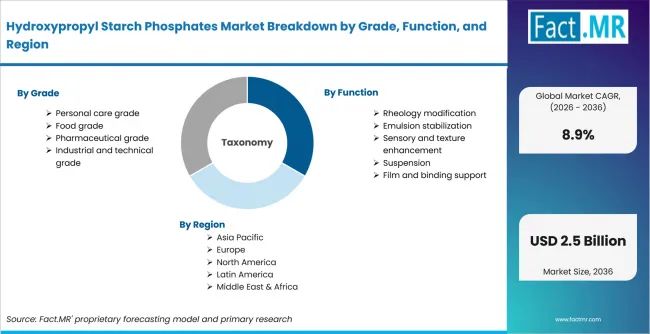
Hydroxypropyl Starch Phosphates Market Breakdown By Grade, Function, And Region | Source: Fact.MR
| Attribute | Details |
|---|---|
| Quantitative Units | USD billion |
| Market Definition | Hydroxypropyl starch phosphates used to modify texture, viscosity, suspension, emulsion stability, film support and sensory behavior across food, personal care, pharmaceutical topical and industrial applications. |
| Grade | Personal care grade; Food grade; Pharmaceutical grade; Industrial and technical grade |
| Function | Rheology modification; Emulsion stabilization; Sensory and texture enhancement; Suspension; Film and binding support |
| Application | Skin care; Hair care; Food sauces & dressings; Pharma and topical; Other industrial |
| Physical Form | Native-flow powder; Pregelatinized and instant powder; Fine-particle specialty; Prepared dispersion |
| Regions Covered | North America; Latin America; Western Europe; Eastern Europe; East Asia; South Asia & Pacific; Middle East & Africa |
| Countries Covered | United States; United Kingdom; Germany; France; Japan |
| Key Companies Profiled | Roquette; Nouryon; Cargill; BASF; Primient |
| Forecast Period | 2026 to 2036 |
| Approach | Hybrid top-down and bottom-up approach using grade demand, function mix, application penetration, physical-form handling, country indicators and verified provider portfolios. |
How is the market segmented?
-
By Grade:
- Personal care grade
- Food grade
- Pharmaceutical grade
- Industrial and technical grade
-
By Function:
- Rheology modification
- Emulsion stabilization
- Sensory and texture enhancement
- Suspension
- Film and binding support
-
By Application:
- Skin care
- Hair care
- Food sauces & dressings
- Pharma and topical
- Other industrial
-
By Physical Form:
- Native-flow powder
- Pregelatinized and instant powder
- Fine-particle specialty
- Prepared dispersion
-
By Region:
- North America
- Latin America
- Western Europe
- Eastern Europe
- East Asia
- South Asia & Pacific
- Middle East & Africa