- Base Value(2025): 150.2 Mn
- Estimated Value(2026): 162.6 Mn
- Forecast Value (2036): 360.9 Mn
- CAGR (2026 - 2036): 8.3%
Pea Starch for Clean-Label Confectionery Applications Market Forecast and Outlook By Fact.MR
In 2025, the pea starch for clean-label confectionery applications market was valued at USD 150.2 million. Based on Fact.MR analysis, demand for pea starch in clean-label confectionery applications is estimated to grow to USD 162.6 million in 2026 and USD 360.9 million by 2036. FACT.MR projects a CAGR of 8.3% during the forecast period.
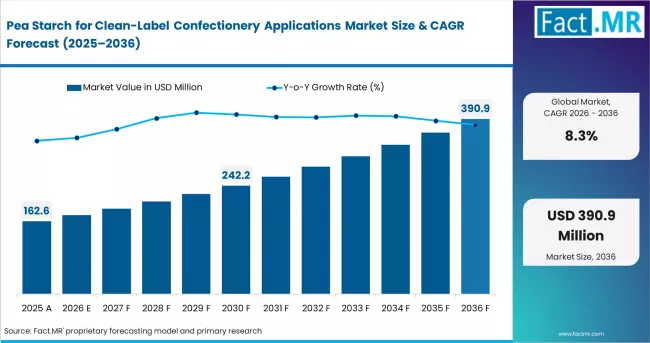
Pea Starch For Clean Label Confectionery Applications Market Market Value Analysis | Source: Fact.MR
| Metric | Value |
|---|---|
| Estimated Value in 2026 | USD 162.6 million |
| Forecast Value in 2036 | USD 360.9 million |
| Forecast CAGR (2026 to 2036) | 8.3% |
Source: Fact.MR analysis. Updated Apr 16, 2026
Summary of the Pea Starch for Clean-Label Confectionery Applications Market
- Market Definition
- Covers non-GMO and organic pea starch used as a functional ingredient for thickening, gelling, binding, and texturizing across confectionery and food manufacturing globally.
- Demand Drivers
- China’s confectionery expansion drives demand for clean-label pea starch in gummies and jellies.
- EU regulations push replacement of modified starch and gelatine with non-GMO pea starch.
- U.S. retailer mandates accelerate clean-label reformulation using certified pea starch.
- Key Segments Analyzed
- By Type: Conventional pea starch leads with 80% share in 2026 due to cost advantage and wide application use.
- By Application: Food & beverages lead with 89% share, driven by confectionery and snack reformulation demand.
- By Geography: China leads growth 10.3% CAGR supported by production scale and export supply.
- Analyst Opinion at FACT.MR
- Shambhu Nath Jha highlights margin pressure on commodity supply. Premium growth lies in certified, performance-documented pea starch.
- Strategic Implications
- Invest in gelling and texturizing performance validation for confectionery use.
- Target U.S. and EU reformulation programmes with certified products.
- Develop heat-stable variants for coating and industrial applications.
- Methodology
- Based on shipment volumes, pricing, and 2024–2025 producer data.
- Supported by EU, FDA, Canada Pea Industry Board, and certification data.
- Forecasts include reformulation trends, retail demand, and processing capacity insights.
Between 2026 and 2036, the market is expected to generate USD 198.3 million in absolute opportunity. This reflects strong and accelerating rather than merely incremental growth. Demand is sustained by confectionery brand reformulation away from modified starches and gelatine, and rising clean-label food regulation adoption across European and North American retail. Growth is moderated by higher pea starch processing costs versus corn and wheat starch alternatives, limited functional performance data versus established modified starch systems, and pea raw material supply concentration in Canada and France.
Country growth reflects clean-label food regulation stringency, confectionery manufacturer reformulation activity, pea processing infrastructure depth, and organic certification market scale. China leads at 10.3% CAGR through strong domestic confectionery production expansion and growing pea starch supply investment supporting export-oriented ingredient manufacturing. The United States follows at 10.0% as the fastest-growing consumption market through FDA clean-label food guidance and confectionery brand reformulation mandates from major retailers. Germany records 9.5% through EU clean-label confectionery demand and established ingredient innovation channels. France records 9.1% as a major pea processing and ingredient innovation hub supplying European confectionery manufacturers. Canada records 8.8% as the leading raw material supplier and pea starch export hub with expanding value-added processing capacity. Structural constraints across mature import-dependent markets include higher pea starch input costs versus locally sourced alternatives and extended supplier qualification timelines for confectionery-grade ingredient approvals.
Segmental Analysis
Pea Starch for Clean-Label Confectionery Applications Market Analysis by Type
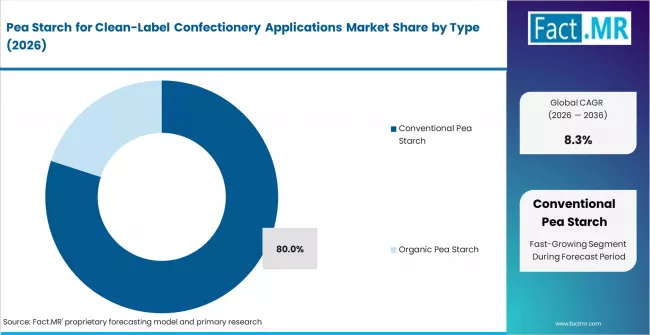
Pea Starch For Clean Label Confectionery Applications Market Analysis By Type | Source: Fact.MR
Based on FACT.MR's pea starch for clean-label confectionery applications market report, conventional pea starch holds 80% share in 2026. It leads due to lower cost versus organic grades and strong compatibility with large-scale confectionery production. It is widely used in gummy, jelly, and coating reformulation.
- Roquette Capacity Investment: Roquette Freres expanded pea starch capacity at Vic-sur-Aisne, France in 2024. Focus is on confectionery-grade demand from European clean-label manufacturers. [1]
- Ingredion Product Launch: Ingredion introduced HOMECRAFT Pulse PG 100 in 2025. It offers pea starch-based gelling for gummies and jellies as a gelatine alternative. [2]
- Organic Grade Trend: Organic pea starch demand rose 24% in 2024. Growth is driven by retailer organic requirements in Germany and France. [3]
Pea Starch for Clean-Label Confectionery Applications Market Analysis by Application
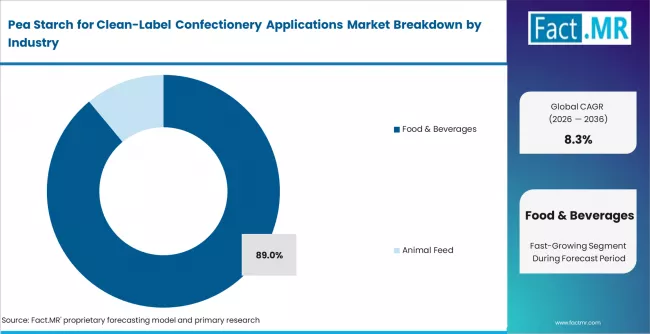
Pea Starch For Clean Label Confectionery Applications Market Analysis By Application | Source: Fact.MR
Food & beverages hold 89% share in 2026. Pea starch supports gelling, binding, and texture in confectionery. Clean-label and plant-based reformulation is the key driver.
- Cosucra Supply Investment: Cosucra Groupe Warcoing expanded supply agreements in 2024. Targets gummy and functional bar applications in Belgium and the Netherlands. [4]
- ADM Functional Development: ADM launched a cold-water-swelling pea starch in 2024. It supports no-cook confectionery and reduces processing energy. [5]
- Clinical Nutrition Trend: Clinical nutrition products using pea starch grew 18% in 2024. Driven by allergen-free formulation demand. [6]
Drivers, Restraints, and Opportunities
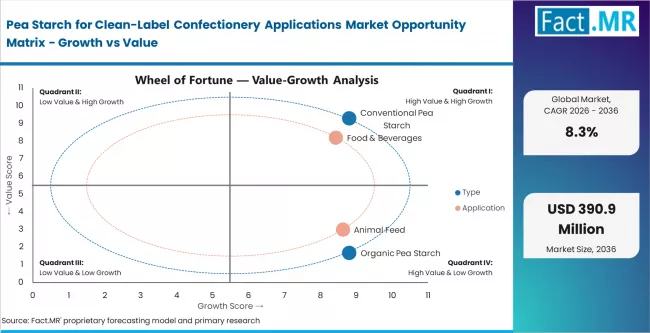
Pea Starch For Clean Label Confectionery Applications Market Opportunity Matrix Growth Vs Value | Source: Fact.MR
FACT.MR notes a shift from commodity starch to clean-label functional ingredient positioning. Modified starch and gelatine are being replaced due to retailer mandates and EU regulations. Certified pea starch with functional validation gains premium pricing.
The market is moving toward certified functional-grade contracts. Bulk, non-validated pea starch is losing share in Europe and North America. Certified suppliers achieve 30–60% price premiums over corn starch. Growth continues despite cost and substitution limits.
- EU Clean-Label Food Regulation: Regulation (EC) No 1169/2011 and 2024 updates push replacement of modified starch with natural pea starch. Demand is rising in Germany, France, and the UK. [7]
- U.S. Retailer Clean-Label Mandates: Walmart and Whole Foods updated standards in 2024. Removal of modified starch and gelatine drives pea starch adoption. [8]
- China Confectionery Production Expansion: China’s 2024 food plan supports premium, plant-based confectionery. Domestic pea starch capacity is expanding for local and export markets. [9]
Regional Analysis
The pea starch for clean-label confectionery applications market is assessed across Asia Pacific, Europe, North America, Latin America, and Middle East and Africa, covering 40+ countries with distinct demand profiles shaped by clean-label food regulation stringency, confectionery manufacturer reformulation programme scale, pea processing infrastructure depth, and organic certification market maturity. The full report offers market attractiveness analysis by region and country.
.webp "Top Country Growth Comparison Pea Starch For Clean Label Confectionery Applications Market Cagr (2026 2036)")
Top Country Growth Comparison Pea Starch For Clean Label Confectionery Applications Market Cagr (2026 2036) | Source: Fact.MR
| Country | CAGR (2026 to 2036) |
|---|---|
| China | 10.3% |
| United States | 10.0% |
| Germany | 9.5% |
| France | 9.1% |
| Canada | 8.8% |
Source: Fact.MR analysis. Updated Apr 16, 2026
Source: Fact.MR (FACT.MR) analysis, based on proprietary forecasting model and primary research
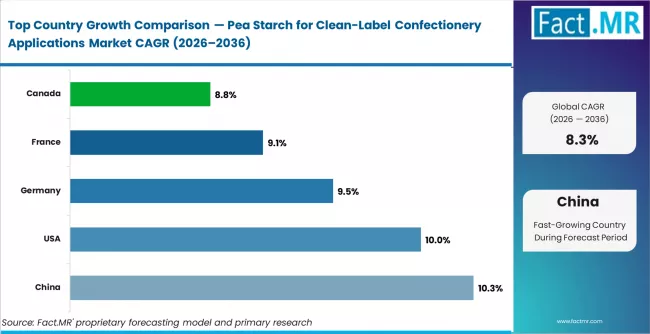
Pea Starch For Clean Label Confectionery Applications Market Cagr Analysis By Country | Source: Fact.MR
Asia Pacific Pea Starch for Clean-Label Confectionery Applications Market Analysis
Pea Starch For Clean Label Confectionery Applications Market Japan Market Share Analysis By Type | Source: Fact.MR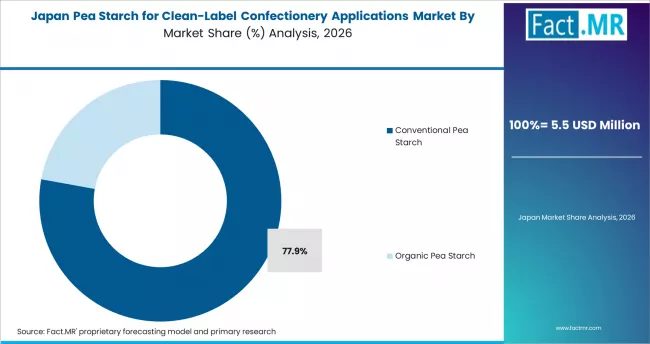
Asia Pacific is the fastest-growing region. Growth is driven by China’s confectionery expansion and rising domestic pea starch capacity. Shandong producers and Canadian imports support supply. The region serves both local demand and export manufacturing.
- China: Strong production push supports ~10.3% CAGR through 2036. The 2024 National Food Industry Plan boosts plant-based confectionery. Capacity expanded in Shandong and Inner Mongolia, reducing imports. Brands like Want Want and Yake use non-GMO pea starch in premium gummies. Growth is driven by domestic production and consumption.
- Japan: Innovation-led demand supports steady growth. 2024 labelling updates encourage plant-based starch use in confectionery. Companies like Meiji and Morinaga are testing pea starch as a gelatine alternative. Demand focuses on allergen-free and compliant formulations, not volume scale.
FACT.MR covers China, Japan, South Korea, India, ASEAN, and ANZ. Includes capacity data, regulation trends, and procurement forecasts.
Europe Pea Starch for Clean-Label Confectionery Applications Market Analysis
Pea Starch For Clean Label Confectionery Applications Market Europe Country Market Share Analysis, 2026 & 2036 | Source: Fact.MR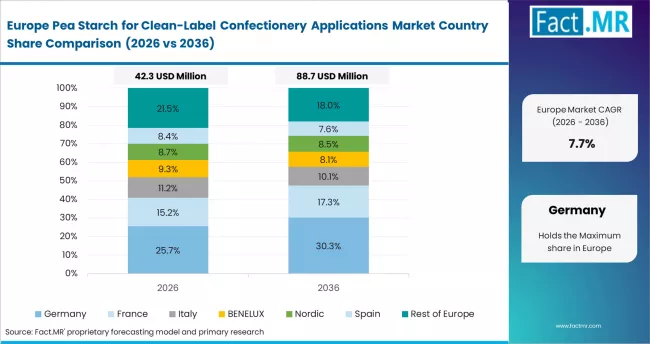
Europe leads in regulation-driven adoption. EU labelling laws and retailer mandates define ingredient standards. Roquette, Cosucra, and Emsland Group lead supply. Certification and performance data are key.
- Germany: Retail-driven reformulation supports 9.5% CAGR through 2036. EU Regulation (EC) No 1169/2011 and retailer standards from Edeka and REWE push removal of modified starch. Emsland expanded supply to gummy manufacturers in 2024. Growth is led by private label reformulation.
- France: Production strength supports ~9.1% CAGR through 2036. Roquette expanded capacity at Vic-sur-Aisne in 2024. France 2030 funded clean-label ingredient innovation projects. Growth is driven by production and R&D, not retail mandates.
FACT.MR covers Germany, France, UK, Italy, Spain, Nordics, and BENELUX. Includes EU rules, production data, and market forecasts.
North America Pea Starch for Clean-Label Confectionery Applications Market Analysis
Pea Starch For Clean Label Confectionery Applications Market Country Value Analysis | Source: Fact.MR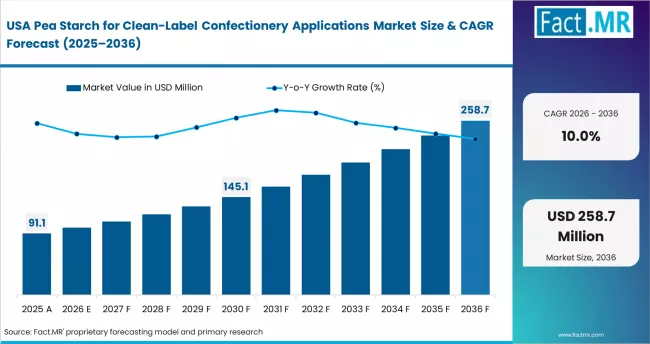
North America is the largest value market. Growth comes from retailer mandates and Canada’s raw material strength. Ingredion and ADM lead supply. Certification defines premium access.
- United States: Retail pressure supports ~10.0% CAGR through 2036. Walmart and Whole Foods updated clean-label standards in 2024. Ingredion launched HOMECRAFT Pulse PG 100 in 2025 for gummy reformulation. FDA guidance supports ingredient transparency. Growth is driven by mandates and innovation.
Canada: Supply advantage supports 8.8% CAGR through 2036. Over 3.5 million tonnes of peas produced in 2024. Government invested CAD 65 million to expand processing in Saskatchewan and Alberta. Growth is export and raw material driven.
FACT.MR covers the U.S., Canada, and Mexico. Includes retailer mandates, production data, and market forecasts.
Competitive Aligners for Market Players
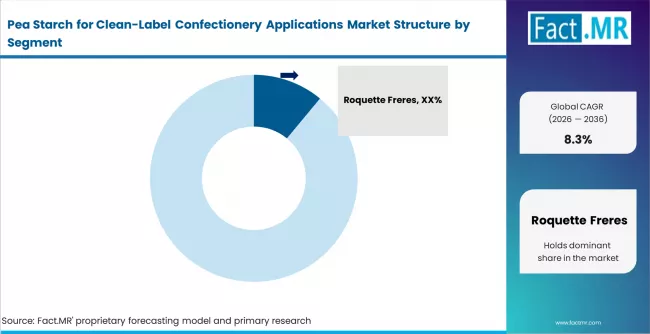
Pea Starch For Clean Label Confectionery Applications Market Analysis By Company | Source: Fact.MR
The pea starch for clean-label confectionery applications market is shaped more by functional performance than by scale alone. Buyers are not just looking for volume. They require proven gelling and texturising consistency across different manufacturing conditions, including both hot and cold processing. Suppliers must demonstrate stable functionality along with full regulatory and clean-label compliance documentation. This is especially important in Europe and North America, where retailer standards are strict and continuously evolving.
In premium confectionery-grade segments, competition is limited to a smaller group of capable suppliers. Companies such as Roquette Freres and Cosucra Groupe Warcoing offer EU-compliant and organic-certified pea starch. Meanwhile, Ingredion Incorporated and ADM (Archer Daniels Midland) focus on non-GMO, confectionery-grade systems backed by application expertise. These suppliers succeed because they provide validated performance data along with certifications required by major food brands and retailers. This allows them to maintain premium pricing.
Among these players, Roquette stands out due to its vertically integrated model, covering everything from raw pea sourcing to advanced functional ingredient development. Ingredion benefits from strong relationships with confectionery manufacturers and offers technical support that helps brands reformulate products efficiently. Canadian suppliers such as Puris and Meelunie gain an advantage from access to abundant pea raw materials, which helps keep costs competitive in standard-grade supply. To reduce risk, most confectionery manufacturers rely on dual sourcing. They typically partner with one certified supplier in Europe or North America and maintain a secondary source in Canada or China. Switching suppliers is not simple, as it requires revalidation of certifications and product performance, which encourages long-term supplier relationships.
Key Players
- Roquette Freres
- Ingredion Incorporated
- Emsland Group
- Cosucra Groupe Warcoing
- ADM (Archer Daniels Midland)
- Puris
- Vestkorn Milling AS
- Meelunie B.V.
- Axiom Foods Inc.
Bibliography
- [1] Roquette Freres. (2024). Production Expansion Announcement: Confectionery-Grade Pea Starch Capacity Expansion at Vic-sur-Aisne Facility Targeting European Clean-Label Gummy Candy and Functional Food Bar Manufacturer Supply. 2024. roquette.com/newsroom
- [2] Ingredion Incorporated. (2025). Product Launch: HOMECRAFT Pulse PG 100 Pea Starch Texturising System for Clean-Label Gummy and Jelly Confectionery Gelatine Alternative Applications. January 2025. ingredion.com/newsroom
- [3] Organic Trade Association. (2024). European Organic Confectionery Ingredient Procurement Survey 2024: Organic Pea Starch Adoption Growth Data Including German and French Retailer Private Label Clean-Label Product Programme Demand. December 2024. ota.com/resources
- [4] Cosucra Groupe Warcoing. (2024). Supply Agreement Expansion: Confectionery-Grade Non-GMO Pea Starch Supply Agreements with Belgian and Dutch Food Manufacturers for Gummy Candy and Functional Food Bar Applications. October 2024. cosucra.com/news
- [5] ADM (Archer Daniels Midland). (2024). Ingredient Innovation Launch: Cold-Water-Swelling Pea Starch System for No-Cook Confectionery Applications with Clean-Label Ingredient Declaration Compliance and Reduced Processing Energy Requirements. 2024. adm.com/innovation
- [6] SPINS. (2024). Plant-Based Clinical Nutrition Product Launch Tracker 2024: 18% Growth in Pea Starch Textured and Thickened Allergen-Free Nutritional Supplement Formulations Across Hospital and Care Home Procurement Categories. November 2024. spins.com/insights
- [7] European Commission. (2024). Regulation (EC) No 1169/2011 Clean-Label Enforcement Guidance Update: E-Number Modified Starch Labelling and Natural Origin Ingredient Declaration Requirements for Confectionery Product Manufacturers in EU Member States. 2024. ec. europa.eu/food
- [8] Walmart Inc. (2024). Clean Ingredients Policy Update: Walmart and Sam's Club Private Label Confectionery Product Ingredient Standards Requiring Non-GMO Certification and Modified Starch Removal from Clean-Label Product Lines. September 2024. corporate.walmart.com/purpose
- [9] National Development and Reform Commission, China. (2024). National Food Industry Development Plan 2024: Premium and Plant-Based Confectionery Production Investment Priority Categories Including Pea Starch Clean-Label Ingredient Processing Capacity Expansion. 2024. ndrc.gov.cn
This Report Addresses
- Strategic insights on pea starch demand across China confectionery production expansion, U.S. retailer clean-label reformulation mandates, Germany EU food regulation-driven certified ingredient adoption, France pea processing innovation, and Canada raw material supply and export capacity development.
- Market forecast from USD 162.6 million in 2026 to USD 360.9 million by 2036 at a CAGR of 8.3%.
- Growth opportunity mapping across clean-label gummy and jelly confectionery gelatine replacement, organic pea starch premium retail channel expansion, allergen-free clinical nutrition thickener demand, and cold-process confectionery no-cook application development.
- Segment analysis by type (conventional, organic), application (food and beverages, animal feed, cosmetics, clinical nutrition), and function (thickening, gelling, binding, texturizing).
- Regional outlook covering Asia Pacific China-production-and-consumption-led growth, North America retailer-mandate-driven reformulation demand, and Europe EU-regulation-and-pea-processing-led certified ingredient adoption trends.
- Competitive landscape analysis of Roquette, Ingredion, Emsland Group, Cosucra, ADM, Puris, Vestkorn, Meelunie, and Axiom Foods covering functional performance documentation depth, certification credential strategy, and confectionery manufacturer supply relationship positioning.
- Regulatory impact analysis covering EU Regulation (EC) No 1169/2011 clean-label labelling enforcement, FDA clean-label food ingredient declaration guidance, Canada Sustainable Agricultural Partnership pea processing investment, and China National Food Industry Development Plan confectionery production expansion.
- Report delivery in PDF, Excel datasets, and presentation formats supported by primary interviews, producer investment disclosures, EU food regulation data, Canada Pea Industry Board statistics, and clean-label retail category procurement records.
Pea Starch for Clean-Label Confectionery Applications Market Definition
The pea starch for clean-label confectionery applications market includes non-GMO and organic starch from yellow peas used as a functional ingredient. It provides thickening, gelling, binding, and texturizing as a plant-based alternative to gelatin and modified starch.
Pea Starch for Clean-Label Confectionery Applications Market Inclusions
Covers global forecasts (2026–2036) by type, application, and function. Includes conventional and organic pea starch across food, feed, cosmetics, and clinical nutrition for confectionery and food manufacturers.
Pea Starch for Clean-Label Confectionery Applications Market Exclusions
Excludes corn, wheat, and tapioca starch. Omits pea protein and flour without starch function. Excludes finished confectionery products. Focus is on pea starch ingredient supply.
Pea Starch for Clean-Label Confectionery Applications Research Methodology
- Primary Research:Interviews with producers, formulators, and food technologists. Inputs from clean-label buyers and certification managers across North America, Europe, China, and Canada.
- Desk Research:Uses EU clean-label regulations, FDA guidance, Canada Pea Industry Board data, and organic certification records. Includes producer reports (2024–2025).
- Market-Sizing and Forecasting:Based on shipment volumes and pricing by grade and certification. Includes reformulation trends and clean-label demand benchmarks.
- Data Validation and Update Cycle:Validated using producer revenues and manufacturer procurement data. Cross-checked with retail category data. Regular updates applied.
Segmentation
Scope of Report
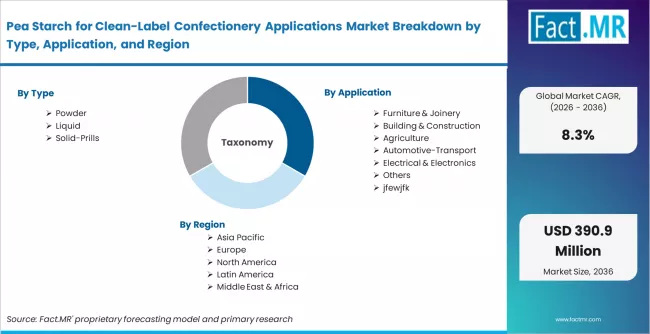
Pea Starch For Clean Label Confectionery Applications Market Breakdown By Type, Application, And Region | Source: Fact.MR
| Attribute | Details |
|---|---|
| Quantitative Units | USD 162.6 million (2026) to USD 360.9 million (2036), at a CAGR of 8.3% |
| Market Definition | Non-GMO and organic-certified pea starch in conventional and organic grades sold as functional thickening, gelling, binding, and texturizing ingredient to confectionery, food and beverage, and clinical nutrition manufacturers through direct and distributor supply channels globally. |
| Type Segmentation | Conventional Pea Starch, Organic Pea Starch |
| Application Segmentation | Food and Beverages, Animal Feed, Cosmetics, Clinical Nutrition |
| Function Segmentation | Thickening, Gelling, Binding, Texturizing |
| Application Coverage | Clean-label gummy and jelly confectionery gelatine replacement supply, non-GMO bakery and snack bar texturising ingredient, allergen-free clinical nutrition thickener formulation, organic confectionery coating starch supply, and functional food bar binding ingredient for plant-based product manufacturing. |
| Regions Covered | North America, Europe, Asia Pacific, Latin America, Middle East and Africa |
| Countries Covered | USA, Canada, Mexico, Germany, UK, France, Italy, Spain, Nordic, BENELUX, China, Japan, South Korea, India, ASEAN, Australia and New Zealand, Brazil, Argentina, Chile, Saudi Arabia, GCC, Turkey, South Africa, Rest of MEA |
| Key Companies Profiled | Roquette Freres, Ingredion Incorporated, Emsland Group, Cosucra Groupe Warcoing, ADM, Puris, Vestkorn Milling AS, Meelunie B.V., Axiom Foods Inc. |
| Forecast Period | 2026 to 2036 |
| Approach | Hybrid top-down and bottom-up model using pea starch shipment volumes by type, application, and function, average selling prices by certification grade and geography, confectionery manufacturer reformulation programme procurement data, and primary interviews with pea starch producers, confectionery ingredient formulators, and clean-label retail buyers. |
Source: Fact.MR analysis. Updated Apr 16, 2026
Pea Starch for Clean-Label Confectionery Applications Market by Segments
-
By Type:
- Conventional Pea Starch
- Organic Pea Starch
-
By Application:
- Food and Beverages
- Animal Feed
- Cosmetics
- Clinical Nutrition
-
By Function:
- Thickening
- Gelling
- Binding
- Texturizing
-
By Region:
-
North America
- United States
- Canada
- Mexico
-
Latin America
- Brazil
- Mexico
- Argentina
- Chile
- Rest of Latin America
-
Western Europe
- Germany
- United Kingdom
- France
- Italy
- Spain
- Nordic Countries
- BENELUX
- Rest of Western Europe
-
Eastern Europe
- Russia
- Poland
- Hungary
- Balkan and Baltic
- Rest of Eastern Europe
-
East Asia
- China
- Japan
- South Korea
-
South Asia and Pacific
- India
- ASEAN
- Australia and New Zealand
- Rest of South Asia and Pacific
-
Middle East and Africa
- Kingdom of Saudi Arabia
- Other GCC Countries
- Turkey
- South Africa
- Rest of Middle East and Africa
-
Frequently Asked Questions
How large is the pea starch for clean-label confectionery applications market in 2025?
What will the market size be in 2026?
What is the projected market size by 2036?
What is the expected CAGR of the pea starch for clean-label confectionery applications market?
What is the absolute dollar opportunity in this market?
Which type segment leads the market?
Which application segment holds the largest share?
Which region grows fastest?
Which country shows the fastest growth?
What factors are driving market growth?
What are the major restraints?
Who worked on this report


Preview the report firsthand - request a free sample
Free SampleGet the brochure for pricing and purchase details
Download PDF