Hypersonic Testbed Additive Jet Blades Market

Hypersonic Testbed Additive Jet Blades Market Size and Share Forecast Outlook 2026 to 2036

Hypersonic testbed additive jet blades market is projected to grow from USD 51.6 million in 2026 to USD 133.8 million by 2036, at a CAGR of 10.0%. Scramjet engines will dominate with a 40.8% market share, while nickel superalloys will lead the material type segment with a 35.7% share.

Hypersonic Testbed Additive Jet Blades Market Forecast and Outlook 2026 to 2036

The global market for hypersonic testbed additive jet blades is projected to total USD 51.60 million in 2026, advancing to USD 133.79 million by 2036. A compound annual growth rate of 10.0% is expected for the period from 2026 to 2036. Growth is driven by the global race to develop and validate hypersonic propulsion systems, where traditional manufacturing cannot produce the complex, cooled blade geometries required for Mach 5+ environments.

Key Takeaways from the Hypersonic Testbed Additive Jet Blades Market

  • Market Value for 2026: USD 51.60 Million
  • Market Value for 2036: USD 133.79 Million
  • Forecast CAGR 2026 to 2036: 10.0%
  • Leading Engine Type Segment (2026): Scramjet Engines (41%)
  • Leading Material Type Segment (2026): Nickel Superalloys (36%)
  • Leading Customer Segment (2026): Defense Agencies (76%)
  • Key Growth Countries: UK (11.6% CAGR), USA (10.9% CAGR), Australia (10.5% CAGR), France (10.0% CAGR)
  • Key Players in the Market: GE Aerospace, Pratt & Whitney, Rolls-Royce, Safran, MTU Aero Engines, IHI Corporation
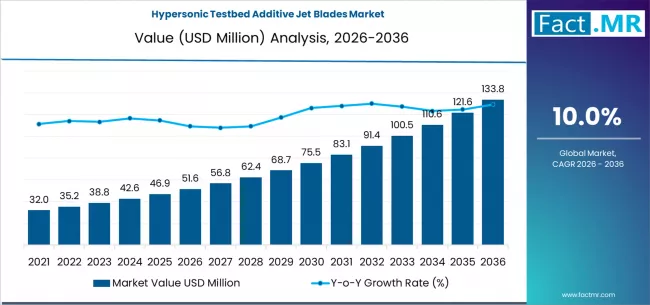
Hypersonic Testbed Additive Jet Blades Market Market Value Analysis

The extreme thermal, pressure, and acoustic loads within scramjet and combined-cycle engines render conventionally machined blades inadequate. Additive manufacturing, specifically using advanced powders and laser sintering, has become indispensable for creating integrally cooled blade structures, lightweight lattice internals, and material compositions that withstand temperatures exceeding 2000°C. These components are critical for enabling sustained testbed engine runs, gathering vital performance data, and de-risking the path to operational hypersonic vehicles.

The market's growth is a direct product of national defense modernization programs and the parallel push for commercial high-speed flight. This landscape, encompassing government test facilities and private aerospace R&D, makes additively manufactured blades a key technological enabler for prototyping and proving next-generation hypersonic propulsion concepts.

Metric

Metric Value
Market Value (2026) USD 51.60 Million
Market Forecast Value (2036) USD 133.79 Million
Forecast CAGR 2026 to 2036 10.0%

Category

Category Segments
Engine Type Scramjet Engines, Turbo-ramjet, Combined-Cycle Engines, Experimental Testbeds
Material Type Nickel Superalloys, Ceramic Matrix Composites, Titanium Alloys, Refractory Alloys
Customer Defense Agencies, OEM R&D Divisions, Research Institutes
Region North America, Latin America, Western Europe, Eastern Europe, East Asia, South Asia & Pacific, MEA

Segmental Analysis

By Engine Type, Which Propulsion System Presents the Greatest Challenge?
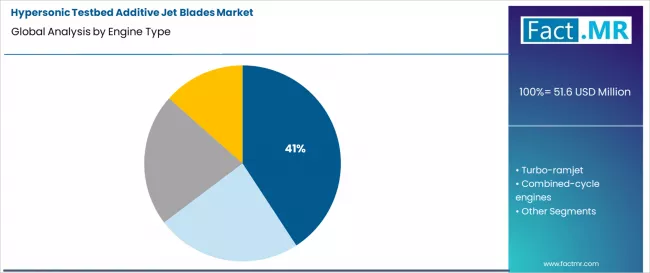
Hypersonic Testbed Additive Jet Blades Market Analysis By Engine Type

Scramjet engines command a leading 41% share. This segment's dominance is tied to the extreme material demands of air-breathing hypersonic propulsion, where inlet compression and combustion generate unparalleled thermal loads.

Scramjet blades require intricate internal cooling channels that are only feasible through additive manufacturing. The focus on developing reliable scramjet technology for missiles and reusable test vehicles drives the most advanced and frequent prototyping efforts for additive blades, making it the primary application.

By Material Type, Which Class Offers a Balance of Strength and Temperature Resistance?
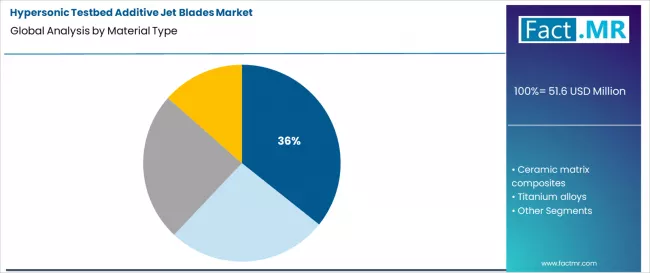
Hypersonic Testbed Additive Jet Blades Market Analysis By Material Type

Nickel-based superalloys lead the material segment with a 36% share. While ceramic matrix composites are used for the hottest sections, nickel superalloys printed via AM are favored for many high-stress rotating and static blade applications in hypersonic testbeds.

They offer a proven balance of high-temperature strength, creep resistance, and toughness, and are more readily printable into complex shapes with integrated cooling than some more exotic materials, serving as a workhorse for current experimental engine programs.

By Customer, Who Drives the Funding and Specification for Prototypes?
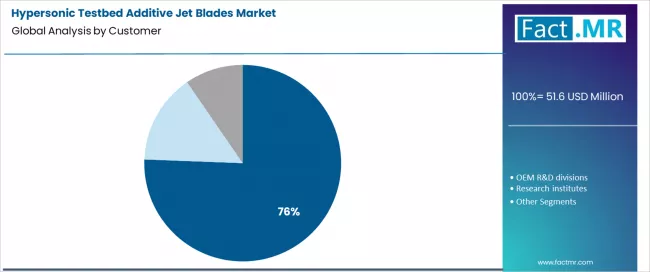
Hypersonic Testbed Additive Jet Blades Market Analysis By Customer

Defense agencies constitute the overwhelmingly dominant customer segment, holding 76% of the market. National security imperatives to develop hypersonic strike and reconnaissance capabilities provide the substantial, classified funding required for these low-volume, high-cost testbed components.

Defense customers set the extreme performance specifications, drive the rapid iteration cycles for prototype blades, and often own the test facilities, making their requirements the primary market force.

What are the Principal Drivers, Constraints, and Evolving Dynamics of this Market?

DROT Element Analysis
Driver State-funded hypersonic propulsion R&D mandates AM to produce uniquely complex, cooled blade geometries for testbed engines.
Restraint Extreme technical difficulty and cost in qualifying AM blades, due to novel materials and defect-free requirements, constrain development speed.
Opportunity Maturation of multi-material and functionally graded AM, combined with AI process control, to optimize blade performance and yield.
Trend Co-location of AM cells within research facilities enables rapid design-test cycles and deep technical co-development partnerships.

Analysis of the Hypersonic Testbed Additive Jet Blades Market by Key Countries
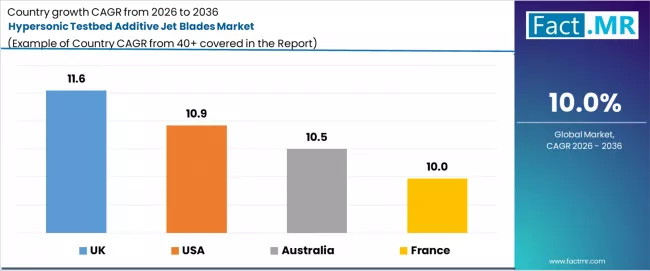
Hypersonic Testbed Additive Jet Blades Market Cagr Analysis By Country

Country CAGR 2026 to 2036
UK 11.6%
USA 10.9%
Australia 10.5%
France 10.0%

How does the UK's Consortium-Based Research Model Fuel Innovation?

The UK's leading growth rate of 11.6% CAGR is anchored in its cohesive national strategy, exemplified by programs like the Hypersonic Propulsion Centre of Excellence. This model integrates defense entities, academia, and engine manufacturers such as Rolls-Royce.

Growth is characterized by focused investment in additive manufacturing research for high-temperature materials and the use of domestic test facilities like the Mach 7 wind tunnel at Oxfordshire. This collaborative ecosystem efficiently translates fundamental research into prototype blade manufacturing for next-generation engine concepts.

What Underpins the USA's Broad and Well-Funded Technological Base?
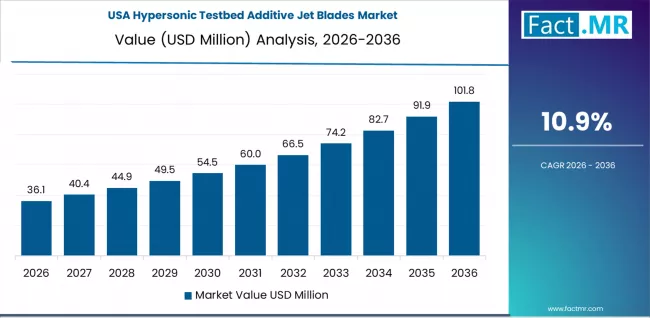
Hypersonic Testbed Additive Jet Blades Market Country Value Analysis

A diversified hypersonic research portfolio propels the USA’s strong growth at 10.9% CAGR globally, spanning Defense Advanced Research Projects Agency, Air Force Research Laboratory, and NASA programs.

The market is driven by massive defense budgets funding multiple parallel engine approaches, from scramjets to combined cycles. This creates demand for a wide array of additive blade prototypes and fosters intense collaboration between national labs, prime contractors, and specialized AM foundries, pushing the boundaries of material and geometric complexity.

How does Australia's Unique Testing Infrastructure Attract Global Partnerships?

Australia's significant growth at 10.5% CAGR is driven by its world-class hypersonic testing infrastructure, notably the scramjet-equipped HIFiRE flight test program and ground facilities at the University of Queensland. This established capability attracts international defense and aerospace partners to conduct sensitive flight tests.

Local demand consequently grows for additively manufactured blades that are integrated into test vehicles flown from Australian ranges, fostering a niche but high-value domestic AM and engineering services sector around supporting these campaigns.

What drives France's Focus on Technological Sovereignty and European Collaboration?

The pursuit of strategic autonomy in hypersonics through its national defense agency and the leadership of Safran in propulsion define France’s growth, forecast at 10.0% CAGR. The focus is on developing a sovereign industrial capability across the entire value chain, including advanced AM for critical engine parts.

The market in France is further amplified through European collaborative frameworks, where it partners with nations like Germany and Italy, pooling resources and specializing in specific technological challenges like ceramic matrix composite printing for hypersonic applications.

Competitive Landscape of the Hypersonic Testbed Additive Jet Blades Market
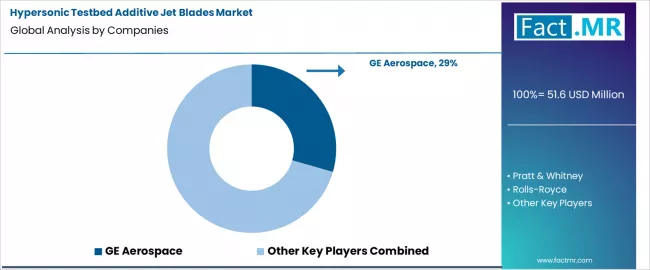
Hypersonic Testbed Additive Jet Blades Market Analysis By Company

The competitive landscape is an oligopoly of established global aerospace propulsion giants, for whom hypersonic testbed work is a strategic advanced R&D activity. These companies compete based on their proprietary material and cooling designs, their mastery of additive manufacturing processes for extreme environments, and their privileged access to government research contracts.

Success is determined by the ability to rapidly produce and validate reliable test components that yield high-quality data, thereby securing a company's role in downstream operational programs. The market features intense competition for talent and a focus on protecting intellectual property related to novel alloy formulations and printing parameters.

Company Representative Product/Technology Focus
GE Aerospace Advanced turbine-based combined cycle (TBCC) concepts and additively manufactured heat exchanger blades for pre-coolers.
Pratt & Whitney Scramjet and combined-cycle engine development, with expertise in cooled ceramic matrix composite structures for hypersonic inlets and combustors.
Rolls-Royce Focus on advanced metallic alloys for high-stress applications and participation in UK-led hypersonic technology demonstrator programs.
Safran Development of turbo-ramjet technologies and investment in refractory metal and CMC AM for hot-section components within European collaborative projects.
MTU Aero Engines Specialization in high-pressure turbine and compressor technologies adapted for hypersonic combined-cycle engines, leveraging precision AM.
IHI Corporation Research into dual-mode scramjet propulsion and development of thermal protection systems integrated into additively manufactured blade structures.

Key Players in the Hypersonic Testbed Additive Jet Blades Market

  • GE Aerospace
  • Pratt & Whitney
  • Rolls-Royce
  • Safran
  • MTU Aero Engines
  • IHI Corporation

Scope of Report

Items Values
Quantitative Units USD Million
Engine Type Scramjet Engines, Turbo-ramjet, Combined-Cycle Engines, Experimental Testbeds
Material Type Nickel Superalloys, Ceramic Matrix Composites, Titanium Alloys, Refractory Alloys
Customer Defense Agencies, OEM R&D Divisions, Research Institutes
Key Countries UK, USA, Australia, France
Key Companies GE Aerospace, Pratt & Whitney, Rolls-Royce, Safran, MTU Aero Engines, IHI Corporation
Additional Analysis Comparative analysis of cooling efficiency for different AM-enabled internal channel designs; study of powder reuse and property degradation for high-value alloys; total program cost impact of AM-enabled rapid iteration; assessment of post-processing and coating technologies for hypersonic blades; analysis of export controls and ITAR regulations on technology and material supply chains.

Market by Segments

  • Engine Type :

    • Scramjet Engines
    • Turbo-ramjet
    • Combined-Cycle Engines
    • Experimental Testbeds
  • Material Type :

    • Nickel Superalloys
    • Ceramic Matrix Composites
    • Titanium Alloys
    • Refractory Alloys
  • Customer :

    • Defense Agencies
    • OEM R&D Divisions
    • Research Institutes
  • Region :

    • North America

      • USA
      • Canada
    • Latin America

      • Brazil
      • Mexico
      • Argentina
      • Rest of Latin America
    • Western Europe

      • Germany
      • France
      • Italy
      • Spain
      • UK
      • BENELUX
      • Rest of Western Europe
    • Eastern Europe

      • Russia
      • Poland
      • Czech Republic
      • Rest of Eastern Europe
    • East Asia

      • China
      • Japan
      • South Korea
      • Rest of East Asia
    • South Asia & Pacific

      • India
      • ASEAN
      • Australia
      • Rest of South Asia & Pacific
    • MEA

      • GCC Countries
      • South Africa
      • Turkiye
      • Rest of MEA

References

  • American Institute of Aeronautics and Astronautics. (2025).Scramjet propulsion: Progress and challenges. AIAA Progress in Astronautics and Aeronautics Series.
  • Heiser, W. H., & Pratt, D. T. (2024).Hypersonic airbreathing propulsion. American Institute of Aeronautics and Astronautics.
  • National Academies of Sciences, Engineering, and Medicine. (2025).Testing and evaluation for hypersonic systems. The National Academies Press.
  • Sobiecki, J. R. (2024).Additive manufacturing for aerospace alloys and composites. Springer International Publishing.
  • Sutton, G. P., & Biblarz, O. (2024).Rocket propulsion elements(10th ed.). Wiley.

Table of Content

  1. Executive Summary
    • Global Market Outlook
    • Demand to side Trends
    • Supply to side Trends
    • Technology Roadmap Analysis
    • Analysis and Recommendations
  2. Market Overview
    • Market Coverage / Taxonomy
    • Market Definition / Scope / Limitations
  3. Market Background
    • Market Dynamics
      • Drivers
      • Restraints
      • Opportunity
      • Trends
    • Scenario Forecast
      • Demand in Optimistic Scenario
      • Demand in Likely Scenario
      • Demand in Conservative Scenario
    • Opportunity Map Analysis
    • Product Life Cycle Analysis
    • Supply Chain Analysis
    • Investment Feasibility Matrix
    • Value Chain Analysis
    • PESTLE and Porter’s Analysis
    • Regulatory Landscape
    • Regional Parent Market Outlook
    • Production and Consumption Statistics
    • Import and Export Statistics
  4. Global Market Analysis 2021 to 2025 and Forecast, 2026 to 2036
    • Historical Market Size Value (USD Million) Analysis, 2021 to 2025
    • Current and Future Market Size Value (USD Million) Projections, 2026 to 2036
      • Y to o to Y Growth Trend Analysis
      • Absolute $ Opportunity Analysis
  5. Global Market Pricing Analysis 2021 to 2025 and Forecast 2026 to 2036
  6. Global Market Analysis 2021 to 2025 and Forecast 2026 to 2036, By Engine Type
    • Introduction / Key Findings
    • Historical Market Size Value (USD Million) Analysis By Engine Type, 2021 to 2025
    • Current and Future Market Size Value (USD Million) Analysis and Forecast By Engine Type, 2026 to 2036
      • Scramjet engines
      • Turbo-ramjet
      • Combined-cycle engines
      • Experimental testbeds
    • Y to o to Y Growth Trend Analysis By Engine Type, 2021 to 2025
    • Absolute $ Opportunity Analysis By Engine Type, 2026 to 2036
  7. Global Market Analysis 2021 to 2025 and Forecast 2026 to 2036, By Material Type
    • Introduction / Key Findings
    • Historical Market Size Value (USD Million) Analysis By Material Type, 2021 to 2025
    • Current and Future Market Size Value (USD Million) Analysis and Forecast By Material Type, 2026 to 2036
      • Nickel superalloys
      • Ceramic matrix composites
      • Titanium alloys
      • Refractory alloys
    • Y to o to Y Growth Trend Analysis By Material Type, 2021 to 2025
    • Absolute $ Opportunity Analysis By Material Type, 2026 to 2036
  8. Global Market Analysis 2021 to 2025 and Forecast 2026 to 2036, By Customer
    • Introduction / Key Findings
    • Historical Market Size Value (USD Million) Analysis By Customer, 2021 to 2025
    • Current and Future Market Size Value (USD Million) Analysis and Forecast By Customer, 2026 to 2036
      • Defense agencies
      • OEM R&D divisions
      • Research institutes
    • Y to o to Y Growth Trend Analysis By Customer, 2021 to 2025
    • Absolute $ Opportunity Analysis By Customer, 2026 to 2036
  9. Global Market Analysis 2021 to 2025 and Forecast 2026 to 2036, By Region
    • Introduction
    • Historical Market Size Value (USD Million) Analysis By Region, 2021 to 2025
    • Current Market Size Value (USD Million) Analysis and Forecast By Region, 2026 to 2036
      • North America
      • Latin America
      • Western Europe
      • Eastern Europe
      • East Asia
      • South Asia and Pacific
      • Middle East & Africa
    • Market Attractiveness Analysis By Region
  10. North America Market Analysis 2021 to 2025 and Forecast 2026 to 2036, By Country
    • Historical Market Size Value (USD Million) Trend Analysis By Market Taxonomy, 2021 to 2025
    • Market Size Value (USD Million) Forecast By Market Taxonomy, 2026 to 2036
      • By Country
        • USA
        • Canada
        • Mexico
      • By Engine Type
      • By Material Type
      • By Customer
    • Market Attractiveness Analysis
      • By Country
      • By Engine Type
      • By Material Type
      • By Customer
    • Key Takeaways
  11. Latin America Market Analysis 2021 to 2025 and Forecast 2026 to 2036, By Country
    • Historical Market Size Value (USD Million) Trend Analysis By Market Taxonomy, 2021 to 2025
    • Market Size Value (USD Million) Forecast By Market Taxonomy, 2026 to 2036
      • By Country
        • Brazil
        • Chile
        • Rest of Latin America
      • By Engine Type
      • By Material Type
      • By Customer
    • Market Attractiveness Analysis
      • By Country
      • By Engine Type
      • By Material Type
      • By Customer
    • Key Takeaways
  12. Western Europe Market Analysis 2021 to 2025 and Forecast 2026 to 2036, By Country
    • Historical Market Size Value (USD Million) Trend Analysis By Market Taxonomy, 2021 to 2025
    • Market Size Value (USD Million) Forecast By Market Taxonomy, 2026 to 2036
      • By Country
        • Germany
        • UK
        • Italy
        • Spain
        • France
        • Nordic
        • BENELUX
        • Rest of Western Europe
      • By Engine Type
      • By Material Type
      • By Customer
    • Market Attractiveness Analysis
      • By Country
      • By Engine Type
      • By Material Type
      • By Customer
    • Key Takeaways
  13. Eastern Europe Market Analysis 2021 to 2025 and Forecast 2026 to 2036, By Country
    • Historical Market Size Value (USD Million) Trend Analysis By Market Taxonomy, 2021 to 2025
    • Market Size Value (USD Million) Forecast By Market Taxonomy, 2026 to 2036
      • By Country
        • Russia
        • Poland
        • Hungary
        • Balkan & Baltic
        • Rest of Eastern Europe
      • By Engine Type
      • By Material Type
      • By Customer
    • Market Attractiveness Analysis
      • By Country
      • By Engine Type
      • By Material Type
      • By Customer
    • Key Takeaways
  14. East Asia Market Analysis 2021 to 2025 and Forecast 2026 to 2036, By Country
    • Historical Market Size Value (USD Million) Trend Analysis By Market Taxonomy, 2021 to 2025
    • Market Size Value (USD Million) Forecast By Market Taxonomy, 2026 to 2036
      • By Country
        • China
        • Japan
        • South Korea
      • By Engine Type
      • By Material Type
      • By Customer
    • Market Attractiveness Analysis
      • By Country
      • By Engine Type
      • By Material Type
      • By Customer
    • Key Takeaways
  15. South Asia and Pacific Market Analysis 2021 to 2025 and Forecast 2026 to 2036, By Country
    • Historical Market Size Value (USD Million) Trend Analysis By Market Taxonomy, 2021 to 2025
    • Market Size Value (USD Million) Forecast By Market Taxonomy, 2026 to 2036
      • By Country
        • India
        • ASEAN
        • Australia & New Zealand
        • Rest of South Asia and Pacific
      • By Engine Type
      • By Material Type
      • By Customer
    • Market Attractiveness Analysis
      • By Country
      • By Engine Type
      • By Material Type
      • By Customer
    • Key Takeaways
  16. Middle East & Africa Market Analysis 2021 to 2025 and Forecast 2026 to 2036, By Country
    • Historical Market Size Value (USD Million) Trend Analysis By Market Taxonomy, 2021 to 2025
    • Market Size Value (USD Million) Forecast By Market Taxonomy, 2026 to 2036
      • By Country
        • Kingdom of Saudi Arabia
        • Other GCC Countries
        • Turkiye
        • South Africa
        • Other African Union
        • Rest of Middle East & Africa
      • By Engine Type
      • By Material Type
      • By Customer
    • Market Attractiveness Analysis
      • By Country
      • By Engine Type
      • By Material Type
      • By Customer
    • Key Takeaways
  17. Key Countries Market Analysis
    • USA
      • Pricing Analysis
      • Market Share Analysis, 2025
        • By Engine Type
        • By Material Type
        • By Customer
    • Canada
      • Pricing Analysis
      • Market Share Analysis, 2025
        • By Engine Type
        • By Material Type
        • By Customer
    • Mexico
      • Pricing Analysis
      • Market Share Analysis, 2025
        • By Engine Type
        • By Material Type
        • By Customer
    • Brazil
      • Pricing Analysis
      • Market Share Analysis, 2025
        • By Engine Type
        • By Material Type
        • By Customer
    • Chile
      • Pricing Analysis
      • Market Share Analysis, 2025
        • By Engine Type
        • By Material Type
        • By Customer
    • Germany
      • Pricing Analysis
      • Market Share Analysis, 2025
        • By Engine Type
        • By Material Type
        • By Customer
    • UK
      • Pricing Analysis
      • Market Share Analysis, 2025
        • By Engine Type
        • By Material Type
        • By Customer
    • Italy
      • Pricing Analysis
      • Market Share Analysis, 2025
        • By Engine Type
        • By Material Type
        • By Customer
    • Spain
      • Pricing Analysis
      • Market Share Analysis, 2025
        • By Engine Type
        • By Material Type
        • By Customer
    • France
      • Pricing Analysis
      • Market Share Analysis, 2025
        • By Engine Type
        • By Material Type
        • By Customer
    • India
      • Pricing Analysis
      • Market Share Analysis, 2025
        • By Engine Type
        • By Material Type
        • By Customer
    • ASEAN
      • Pricing Analysis
      • Market Share Analysis, 2025
        • By Engine Type
        • By Material Type
        • By Customer
    • Australia & New Zealand
      • Pricing Analysis
      • Market Share Analysis, 2025
        • By Engine Type
        • By Material Type
        • By Customer
    • China
      • Pricing Analysis
      • Market Share Analysis, 2025
        • By Engine Type
        • By Material Type
        • By Customer
    • Japan
      • Pricing Analysis
      • Market Share Analysis, 2025
        • By Engine Type
        • By Material Type
        • By Customer
    • South Korea
      • Pricing Analysis
      • Market Share Analysis, 2025
        • By Engine Type
        • By Material Type
        • By Customer
    • Russia
      • Pricing Analysis
      • Market Share Analysis, 2025
        • By Engine Type
        • By Material Type
        • By Customer
    • Poland
      • Pricing Analysis
      • Market Share Analysis, 2025
        • By Engine Type
        • By Material Type
        • By Customer
    • Hungary
      • Pricing Analysis
      • Market Share Analysis, 2025
        • By Engine Type
        • By Material Type
        • By Customer
    • Kingdom of Saudi Arabia
      • Pricing Analysis
      • Market Share Analysis, 2025
        • By Engine Type
        • By Material Type
        • By Customer
    • Turkiye
      • Pricing Analysis
      • Market Share Analysis, 2025
        • By Engine Type
        • By Material Type
        • By Customer
    • South Africa
      • Pricing Analysis
      • Market Share Analysis, 2025
        • By Engine Type
        • By Material Type
        • By Customer
  18. Market Structure Analysis
    • Competition Dashboard
    • Competition Benchmarking
    • Market Share Analysis of Top Players
      • By Regional
      • By Engine Type
      • By Material Type
      • By Customer
  19. Competition Analysis
    • Competition Deep Dive
      • GE Aerospace
        • Overview
        • Product Portfolio
        • Profitability by Market Segments (Product/Age /Sales Channel/Region)
        • Sales Footprint
        • Strategy Overview
          • Marketing Strategy
          • Product Strategy
          • Channel Strategy
      • Pratt & Whitney
      • Rolls-Royce
      • Safran
      • MTU Aero Engines
      • IHI Corporation
  20. Assumptions & Acronyms Used
  21. Research Methodology

List Of Table

  • Table 1: Global Market Value (USD Million) Forecast by Region, 2021 to 2036
  • Table 2: Global Market Value (USD Million) Forecast by Engine Type, 2021 to 2036
  • Table 3: Global Market Value (USD Million) Forecast by Material Type, 2021 to 2036
  • Table 4: Global Market Value (USD Million) Forecast by Customer, 2021 to 2036
  • Table 5: North America Market Value (USD Million) Forecast by Country, 2021 to 2036
  • Table 6: North America Market Value (USD Million) Forecast by Engine Type, 2021 to 2036
  • Table 7: North America Market Value (USD Million) Forecast by Material Type, 2021 to 2036
  • Table 8: North America Market Value (USD Million) Forecast by Customer, 2021 to 2036
  • Table 9: Latin America Market Value (USD Million) Forecast by Country, 2021 to 2036
  • Table 10: Latin America Market Value (USD Million) Forecast by Engine Type, 2021 to 2036
  • Table 11: Latin America Market Value (USD Million) Forecast by Material Type, 2021 to 2036
  • Table 12: Latin America Market Value (USD Million) Forecast by Customer, 2021 to 2036
  • Table 13: Western Europe Market Value (USD Million) Forecast by Country, 2021 to 2036
  • Table 14: Western Europe Market Value (USD Million) Forecast by Engine Type, 2021 to 2036
  • Table 15: Western Europe Market Value (USD Million) Forecast by Material Type, 2021 to 2036
  • Table 16: Western Europe Market Value (USD Million) Forecast by Customer, 2021 to 2036
  • Table 17: Eastern Europe Market Value (USD Million) Forecast by Country, 2021 to 2036
  • Table 18: Eastern Europe Market Value (USD Million) Forecast by Engine Type, 2021 to 2036
  • Table 19: Eastern Europe Market Value (USD Million) Forecast by Material Type, 2021 to 2036
  • Table 20: Eastern Europe Market Value (USD Million) Forecast by Customer, 2021 to 2036
  • Table 21: East Asia Market Value (USD Million) Forecast by Country, 2021 to 2036
  • Table 22: East Asia Market Value (USD Million) Forecast by Engine Type, 2021 to 2036
  • Table 23: East Asia Market Value (USD Million) Forecast by Material Type, 2021 to 2036
  • Table 24: East Asia Market Value (USD Million) Forecast by Customer, 2021 to 2036
  • Table 25: South Asia and Pacific Market Value (USD Million) Forecast by Country, 2021 to 2036
  • Table 26: South Asia and Pacific Market Value (USD Million) Forecast by Engine Type, 2021 to 2036
  • Table 27: South Asia and Pacific Market Value (USD Million) Forecast by Material Type, 2021 to 2036
  • Table 28: South Asia and Pacific Market Value (USD Million) Forecast by Customer, 2021 to 2036
  • Table 29: Middle East & Africa Market Value (USD Million) Forecast by Country, 2021 to 2036
  • Table 30: Middle East & Africa Market Value (USD Million) Forecast by Engine Type, 2021 to 2036
  • Table 31: Middle East & Africa Market Value (USD Million) Forecast by Material Type, 2021 to 2036
  • Table 32: Middle East & Africa Market Value (USD Million) Forecast by Customer, 2021 to 2036

List Of Figures

  • Figure 1: Global Market Pricing Analysis
  • Figure 2: Global Market Value (USD Million) Forecast 2021 to 2036
  • Figure 3: Global Market Value Share and BPS Analysis by Engine Type, 2026 and 2036
  • Figure 4: Global Market Y to o to Y Growth Comparison by Engine Type, 2026 to 2036
  • Figure 5: Global Market Attractiveness Analysis by Engine Type
  • Figure 6: Global Market Value Share and BPS Analysis by Material Type, 2026 and 2036
  • Figure 7: Global Market Y to o to Y Growth Comparison by Material Type, 2026 to 2036
  • Figure 8: Global Market Attractiveness Analysis by Material Type
  • Figure 9: Global Market Value Share and BPS Analysis by Customer, 2026 and 2036
  • Figure 10: Global Market Y to o to Y Growth Comparison by Customer, 2026 to 2036
  • Figure 11: Global Market Attractiveness Analysis by Customer
  • Figure 12: Global Market Value (USD Million) Share and BPS Analysis by Region, 2026 and 2036
  • Figure 13: Global Market Y to o to Y Growth Comparison by Region, 2026 to 2036
  • Figure 14: Global Market Attractiveness Analysis by Region
  • Figure 15: North America Market Incremental Dollar Opportunity, 2026 to 2036
  • Figure 16: Latin America Market Incremental Dollar Opportunity, 2026 to 2036
  • Figure 17: Western Europe Market Incremental Dollar Opportunity, 2026 to 2036
  • Figure 18: Eastern Europe Market Incremental Dollar Opportunity, 2026 to 2036
  • Figure 19: East Asia Market Incremental Dollar Opportunity, 2026 to 2036
  • Figure 20: South Asia and Pacific Market Incremental Dollar Opportunity, 2026 to 2036
  • Figure 21: Middle East & Africa Market Incremental Dollar Opportunity, 2026 to 2036
  • Figure 22: North America Market Value Share and BPS Analysis by Country, 2026 and 2036
  • Figure 23: North America Market Value Share and BPS Analysis by Engine Type, 2026 and 2036
  • Figure 24: North America Market Y to o to Y Growth Comparison by Engine Type, 2026 to 2036
  • Figure 25: North America Market Attractiveness Analysis by Engine Type
  • Figure 26: North America Market Value Share and BPS Analysis by Material Type, 2026 and 2036
  • Figure 27: North America Market Y to o to Y Growth Comparison by Material Type, 2026 to 2036
  • Figure 28: North America Market Attractiveness Analysis by Material Type
  • Figure 29: North America Market Value Share and BPS Analysis by Customer, 2026 and 2036
  • Figure 30: North America Market Y to o to Y Growth Comparison by Customer, 2026 to 2036
  • Figure 31: North America Market Attractiveness Analysis by Customer
  • Figure 32: Latin America Market Value Share and BPS Analysis by Country, 2026 and 2036
  • Figure 33: Latin America Market Value Share and BPS Analysis by Engine Type, 2026 and 2036
  • Figure 34: Latin America Market Y to o to Y Growth Comparison by Engine Type, 2026 to 2036
  • Figure 35: Latin America Market Attractiveness Analysis by Engine Type
  • Figure 36: Latin America Market Value Share and BPS Analysis by Material Type, 2026 and 2036
  • Figure 37: Latin America Market Y to o to Y Growth Comparison by Material Type, 2026 to 2036
  • Figure 38: Latin America Market Attractiveness Analysis by Material Type
  • Figure 39: Latin America Market Value Share and BPS Analysis by Customer, 2026 and 2036
  • Figure 40: Latin America Market Y to o to Y Growth Comparison by Customer, 2026 to 2036
  • Figure 41: Latin America Market Attractiveness Analysis by Customer
  • Figure 42: Western Europe Market Value Share and BPS Analysis by Country, 2026 and 2036
  • Figure 43: Western Europe Market Value Share and BPS Analysis by Engine Type, 2026 and 2036
  • Figure 44: Western Europe Market Y to o to Y Growth Comparison by Engine Type, 2026 to 2036
  • Figure 45: Western Europe Market Attractiveness Analysis by Engine Type
  • Figure 46: Western Europe Market Value Share and BPS Analysis by Material Type, 2026 and 2036
  • Figure 47: Western Europe Market Y to o to Y Growth Comparison by Material Type, 2026 to 2036
  • Figure 48: Western Europe Market Attractiveness Analysis by Material Type
  • Figure 49: Western Europe Market Value Share and BPS Analysis by Customer, 2026 and 2036
  • Figure 50: Western Europe Market Y to o to Y Growth Comparison by Customer, 2026 to 2036
  • Figure 51: Western Europe Market Attractiveness Analysis by Customer
  • Figure 52: Eastern Europe Market Value Share and BPS Analysis by Country, 2026 and 2036
  • Figure 53: Eastern Europe Market Value Share and BPS Analysis by Engine Type, 2026 and 2036
  • Figure 54: Eastern Europe Market Y to o to Y Growth Comparison by Engine Type, 2026 to 2036
  • Figure 55: Eastern Europe Market Attractiveness Analysis by Engine Type
  • Figure 56: Eastern Europe Market Value Share and BPS Analysis by Material Type, 2026 and 2036
  • Figure 57: Eastern Europe Market Y to o to Y Growth Comparison by Material Type, 2026 to 2036
  • Figure 58: Eastern Europe Market Attractiveness Analysis by Material Type
  • Figure 59: Eastern Europe Market Value Share and BPS Analysis by Customer, 2026 and 2036
  • Figure 60: Eastern Europe Market Y to o to Y Growth Comparison by Customer, 2026 to 2036
  • Figure 61: Eastern Europe Market Attractiveness Analysis by Customer
  • Figure 62: East Asia Market Value Share and BPS Analysis by Country, 2026 and 2036
  • Figure 63: East Asia Market Value Share and BPS Analysis by Engine Type, 2026 and 2036
  • Figure 64: East Asia Market Y to o to Y Growth Comparison by Engine Type, 2026 to 2036
  • Figure 65: East Asia Market Attractiveness Analysis by Engine Type
  • Figure 66: East Asia Market Value Share and BPS Analysis by Material Type, 2026 and 2036
  • Figure 67: East Asia Market Y to o to Y Growth Comparison by Material Type, 2026 to 2036
  • Figure 68: East Asia Market Attractiveness Analysis by Material Type
  • Figure 69: East Asia Market Value Share and BPS Analysis by Customer, 2026 and 2036
  • Figure 70: East Asia Market Y to o to Y Growth Comparison by Customer, 2026 to 2036
  • Figure 71: East Asia Market Attractiveness Analysis by Customer
  • Figure 72: South Asia and Pacific Market Value Share and BPS Analysis by Country, 2026 and 2036
  • Figure 73: South Asia and Pacific Market Value Share and BPS Analysis by Engine Type, 2026 and 2036
  • Figure 74: South Asia and Pacific Market Y to o to Y Growth Comparison by Engine Type, 2026 to 2036
  • Figure 75: South Asia and Pacific Market Attractiveness Analysis by Engine Type
  • Figure 76: South Asia and Pacific Market Value Share and BPS Analysis by Material Type, 2026 and 2036
  • Figure 77: South Asia and Pacific Market Y to o to Y Growth Comparison by Material Type, 2026 to 2036
  • Figure 78: South Asia and Pacific Market Attractiveness Analysis by Material Type
  • Figure 79: South Asia and Pacific Market Value Share and BPS Analysis by Customer, 2026 and 2036
  • Figure 80: South Asia and Pacific Market Y to o to Y Growth Comparison by Customer, 2026 to 2036
  • Figure 81: South Asia and Pacific Market Attractiveness Analysis by Customer
  • Figure 82: Middle East & Africa Market Value Share and BPS Analysis by Country, 2026 and 2036
  • Figure 83: Middle East & Africa Market Value Share and BPS Analysis by Engine Type, 2026 and 2036
  • Figure 84: Middle East & Africa Market Y to o to Y Growth Comparison by Engine Type, 2026 to 2036
  • Figure 85: Middle East & Africa Market Attractiveness Analysis by Engine Type
  • Figure 86: Middle East & Africa Market Value Share and BPS Analysis by Material Type, 2026 and 2036
  • Figure 87: Middle East & Africa Market Y to o to Y Growth Comparison by Material Type, 2026 to 2036
  • Figure 88: Middle East & Africa Market Attractiveness Analysis by Material Type
  • Figure 89: Middle East & Africa Market Value Share and BPS Analysis by Customer, 2026 and 2036
  • Figure 90: Middle East & Africa Market Y to o to Y Growth Comparison by Customer, 2026 to 2036
  • Figure 91: Middle East & Africa Market Attractiveness Analysis by Customer
  • Figure 92: Global Market - Tier Structure Analysis
  • Figure 93: Global Market - Company Share Analysis

- FAQs -

How big is the hypersonic testbed additive jet blades market in 2026?

The global hypersonic testbed additive jet blades market is estimated to be valued at USD 51.6 million in 2026.

What will be the size of hypersonic testbed additive jet blades market in 2036?

The market size for the hypersonic testbed additive jet blades market is projected to reach USD 133.8 million by 2036.

How much will be the hypersonic testbed additive jet blades market growth between 2026 and 2036?

The hypersonic testbed additive jet blades market is expected to grow at a 10.0% CAGR between 2026 and 2036.

What are the key product types in the hypersonic testbed additive jet blades market?

The key product types in hypersonic testbed additive jet blades market are scramjet engines, turbo-ramjet, combined-cycle engines and experimental testbeds.

Which material type segment to contribute significant share in the hypersonic testbed additive jet blades market in 2026?

In terms of material type, nickel superalloys segment to command 35.7% share in the hypersonic testbed additive jet blades market in 2026.

Hypersonic Testbed Additive Jet Blades Market