Rupture Membrane Tests Market

Rupture Membrane Tests Market Size and Share Forecast Outlook 2026 to 2036

Rupture membrane tests market is projected to grow from USD 1.0 billion in 2026 to USD 2.1 billion by 2036, at a CAGR of 7.9%. Immunoassay-based tests will dominate with a 58.8% market share, while preterm prom will lead the application segment with a 69.3% share.

Rupture Membranes Tests Market Forecast and Outlook 2026 to 2036

The global rupture of membranes tests market is projected to total USD 0.98 billion in 2026, advancing to USD 2.10 billion by 2036, achieving a 7.9% CAGR. This growth is propelled by the critical need for rapid, accurate diagnosis of preterm prelabor rupture of membranes, a major contributor to neonatal morbidity and mortality worldwide.

The market is characterized by the dominance of immunoassay-based tests, which hold a 58.8 % share due to their high sensitivity and specificity, primarily used in diagnosing preterm PROM, an application constituting 69.3 % of the market. Hospitals are the primary end-user, accounting for 62.0% of demand.

Key Takeaways from the Rupture Membranes Tests Market

  • Market Value for 2026: USD 0.98 Billion
  • Market Value for 2036: USD 2.10 Billion
  • Forecast CAGR 2026 to 2036: 7.9%
  • Leading Test Segment (2026): Immunoassay-based Tests (58.8%)
  • Leading Application Segment (2026): Preterm PROM (69.3%)
  • Leading End User Segment (2026): Hospitals (62.0%)
  • Key Growth Countries: India (11.6% CAGR), China (11.3% CAGR), USA (10.3% CAGR), Germany (8.4% CAGR), France (8.3% CAGR)
  • Key Players in the Market: QIAGEN N.V., Hologic, Inc., Abbott Laboratories, F. Hoffmann-La Roche Ltd., Artron Laboratories Inc., Others
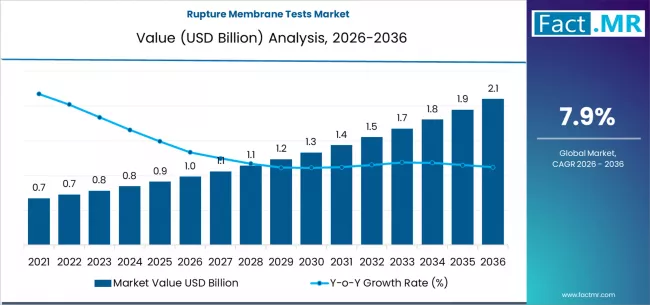
Rupture Membrane Tests Market Market Value Analysis

Geographically, the highest growth is seen in major emerging economies, with India leading at a projected 11.6% CAGR and China following at 11.3%, driven by initiatives to improve maternal and neonatal health outcomes. The USA shows strong growth at 10.3%, while Germany and France grow at 8.4% and 8.3% respectively.

The market evolution is marked by a shift from traditional, less reliable methods to advanced, point-of-care diagnostic tools that enable timely clinical intervention, reducing the risks of infection and preterm delivery associated with delayed diagnosis.

Metric

Metric Value
Market Value (2026) USD 0.98 Billion
Market Forecast Value (2036) USD 2.10 Billion
Forecast CAGR 2026 to 2036 7.9%

Category

Category Segments
Test Immunoassay-based Tests, Rapid Strip Tests, Multiplex Tests
Application Preterm PROM, Term PROM
End User Hospitals, Maternity Clinics, Labs
Region North America, Latin America, Western Europe, Eastern Europe, East Asia, South Asia & Pacific, MEA

Segmental Analysis

By Test, Which Technology Offers the Highest Diagnostic Accuracy?
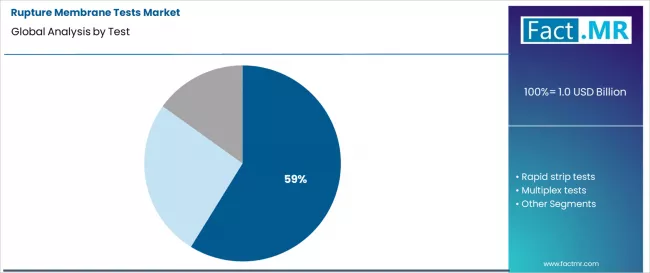
Rupture Membrane Tests Market Analysis By Test

Immunoassay-based tests command a dominant 58.8 % share. This segment's leadership is attributed to its superior clinical accuracy in detecting specific amniotic fluid proteins, such as placental alpha microglobulin-1, which minimizes false-positive results compared to traditional pH or fern tests. Their high sensitivity and specificity are critical for confident diagnosis, especially in equivocal cases, guiding urgent and appropriate clinical management.

By Application, Which Condition Presents the Greatest Clinical Urgency?
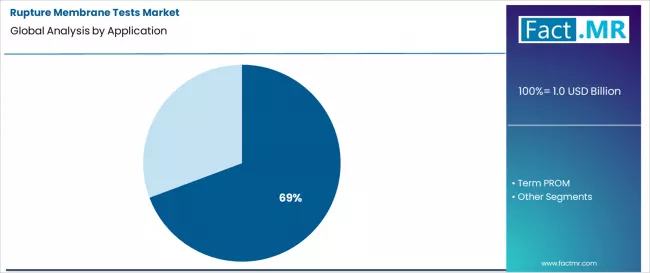
Rupture Membrane Tests Market Analysis By Application

Preterm prelabor rupture of membranes represents the leading application with a 69.3 % share. Diagnosis of PROM before 37 weeks gestation is a high-stakes obstetric emergency, requiring swift intervention to mitigate risks of chorioamnionitis, placental abruption, and preterm birth. The severe consequences of misdiagnosis or delay create a non-discretionary demand for the most reliable testing methods available.

By End User, Where is the Initial Triage for High-Risk Pregnancies?
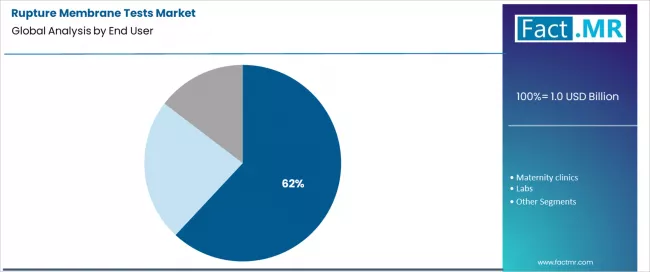
Rupture Membrane Tests Market Analysis By End User

Hospitals constitute the primary end-user segment at 62.0 %. As the frontline for managing obstetric emergencies and high-risk pregnancies, hospital labor and delivery units and emergency departments perform the vast majority of initial ROM assessments. The need for rapid, in-house results to guide immediate care decisions centralizes test utilization and procurement within these acute care settings.

What are the Principal Drivers, Constraints, and Evolving Dynamics of this Market?

Attribute Analysis
Global Focus on Reducing Preterm Birth Complications This driver creates mandated demand for accurate diagnostic tools within prenatal care guidelines, as accurate PROM diagnosis is a critical step in preventing neonatal sepsis and mortality.
High Cost of Advanced Immunoassay Tests This restraint limits widespread adoption in low-resource settings and smaller clinics, where cost considerations may lead to reliance on less accurate traditional methods.
Development of Integrated, Point-of-Care Multiplex Panels This opportunity involves creating single tests that simultaneously diagnose ROM, assess infection markers, and determine fetal lung maturity, streamlining clinical decision-making.
Expansion of Testing into Outpatient and Community Clinics The trend is the decentralization of care, driving demand for simple, rapid, and foolproof strip tests that can be used accurately by midwives and nurses in non-hospital settings.

Analysis of the Rupture Membranes Tests Market by Key Countries
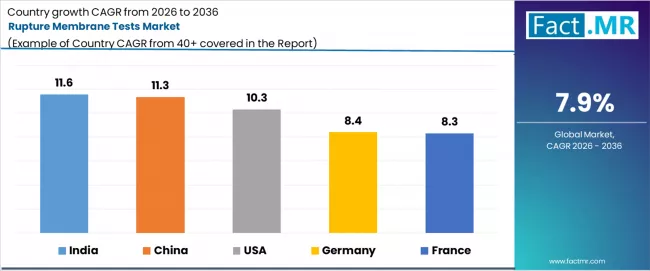
Rupture Membrane Tests Market Cagr Analysis By Country

Country CAGR 2026 to 2036
India 11.6%
China 11.3%
USA 10.3%
Germany 8.4%
France 8.3%

What Drives the USA's Protocol-Driven and Medico-Legal Market?

A highly protocol-driven obstetric environment and a strong medico-legal landscape that mandates definitive diagnostic standards fuel the USA’s 10.3% CAGR. Growth is driven by the adoption of high-sensitivity immunoassays as the standard of care in hospital labor and delivery units to avoid litigation risks associated with missed diagnoses. Reimbursement stability for these tests and a high volume of obstetric visits further sustain market growth.

How is China's Maternal Health Quality Improvement Campaign Influencing Adoption?

China's 11.3% CAGR is propelled by national public health campaigns aimed at improving maternal and infant health metrics, which include standardizing and upgrading diagnostic protocols in obstetric care.

As tier-one and tier-two hospitals modernize, they are replacing outdated methods with advanced, quantitative immunoassays. This shift is supported by growing domestic manufacturing of diagnostic reagents, aiming to increase access and reduce costs across the healthcare system.

How does India's Focus on Reducing Neonatal Mortality Shape Market Growth?

India's leading 11.6% CAGR is driven by intense national and state-level focus on reducing neonatal mortality, where infection following undiagnosed PROM is a significant factor. Growth is characterized by two tracks, the adoption of advanced tests in private hospital chains offering high-risk pregnancy care, and government-led initiatives to introduce reliable, low-cost rapid tests in public health centers and community clinics to improve triage and referral.

What Characterizes Germany's Evidence-Based and Quality-Focused Market?

Germany's 8.4% growth reflects a market governed by strict evidence-based medicine and a strong emphasis on diagnostic quality. Adoption is guided by clinical guidelines from professional gynecological societies that recommend specific, high-accuracy biomarkers.

Hospital procurement decisions are heavily influenced by clinical performance data and total cost-of-care analysis, favoring tests that prevent costly neonatal intensive care unit admissions due to complications from undiagnosed PROM.

What Defines France's Centralized Health System's Approach to Adoption?

France's 8.3% CAGR is shaped by its centralized healthcare system, where adoption of new medical diagnostics is influenced by assessments from the Haute Autorité de Santé. Market growth is steady, driven by the integration of approved, high-performance tests into standardized national obstetric care pathways.

The focus is on cost-effective innovations that demonstrably improve patient outcomes within the framework of the public health insurance system, with procurement often managed at the regional hospital group level.

Competitive Landscape of the Rupture Membranes Tests Market
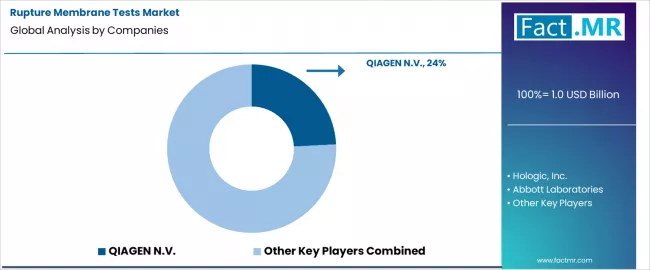
Rupture Membrane Tests Market Analysis By Company

The competitive landscape features global diagnostics giants competing with specialized companies focused on women's health. Competition centers on assay performance characteristics, particularly sensitivity, specificity, and time-to-result-as well as ease of use for nursing staff.

Success is determined by securing endorsements in major international obstetric guidelines, demonstrating cost-effectiveness in health economic studies, and building strong distribution networks that reach both large hospital laboratories and outpatient maternity clinics. The market is also seeing competition from emerging manufacturers offering cost-competitive rapid tests for decentralized settings.

Key Players in the Rupture Membranes Tests Market

Company Core Focus in ROM Testing
QIAGEN N.V. Offers the flagship AmniSure® test, a widely adopted POC immunoassay for placental alpha microglobulin-1 (PAMG-1).
Hologic, Inc. Provides diagnostic solutions in women's health, including ROM tests integrated into broader diagnostic platforms.
Abbott Laboratories Leverages its extensive diagnostics portfolio and global reach to market ROM testing products.
F. Hoffmann-La Roche Ltd. Develops high-throughput immunoassays for central laboratory use in obstetric diagnostics.
Artron Laboratories Inc. Focuses on rapid test development, including immuno-chromatographic strip tests for cost-sensitive markets.
Others Includes various diagnostic companies offering alternative technologies and regional market solutions.

Scope of Report

Items Values
Quantitative Units USD Billion
Test Immunoassay-based Tests, Rapid Strip Tests, Multiplex Tests
Application Preterm PROM, Term PROM
End User Hospitals, Maternity Clinics, Labs
Key Countries India, China, USA, Germany, France
Key Companies QIAGEN N.V., Hologic, Inc., Abbott Laboratories, F. Hoffmann-La Roche Ltd., Artron Laboratories Inc., Others
Additional Analysis Comparative analysis of false-positive and false-negative rates across technologies; study of time-to-decision impact on maternal and neonatal outcomes; cost-benefit analysis of advanced testing versus traditional methods; impact on antibiotic stewardship and infection rates; assessment of usability and training requirements in different care settings.

Market by Segments

  • Test :

    • Immunoassay-based Tests
    • Rapid Strip Tests
    • Multiplex Tests
  • Application :

    • Preterm PROM
    • Term PROM
  • End User :

    • Hospitals
    • Maternity Clinics
    • Labs
  • Region :

    • North America
      • USA
      • Canada
    • Latin America
      • Brazil
      • Mexico
      • Argentina
      • Rest of Latin America
    • Western Europe
      • Germany
      • France
      • Italy
      • Spain
      • UK
      • BENELUX
      • Rest of Western Europe
    • Eastern Europe
      • Russia
      • Poland
      • Czech Republic
      • Rest of Eastern Europe
    • East Asia
      • China
      • Japan
      • South Korea
      • Rest of East Asia
    • South Asia & Pacific
      • India
      • ASEAN
      • Australia
      • Rest of South Asia & Pacific
    • MEA
      • GCC Countries
      • South Africa
      • Turkiye
      • Rest of MEA

Bibliography

  • American College of Obstetricians and Gynecologists. (2025). Practice Bulletin No. 234: Prelabor Rupture of Membranes. Obstetrics & Gynecology.
  • International Federation of Gynecology and Obstetrics. (2024). Guidelines for the Management of Preterm Prelabor Rupture of Membranes. FIGO.
  • Mozurkewich, E. L., & Wolf, F. M. (2024). Biomarkers for the diagnosis of rupture of membranes: a systematic review. American Journal of Perinatology, 41(7), 801-812.
  • World Health Organization. (2025). WHO Recommendations for the Prevention and Management of Preterm Birth. WHO.
  • Zhang, Y., & Caughey, A. B. (2024). Economic evaluation of diagnostic strategies for rupture of membranes in preterm pregnancies. Journal of Maternal-Fetal & Neonatal Medicine, 37(4), 645-652.

Table of Content

  1. Executive Summary
    • Global Market Outlook
    • Demand to side Trends
    • Supply to side Trends
    • Technology Roadmap Analysis
    • Analysis and Recommendations
  2. Market Overview
    • Market Coverage / Taxonomy
    • Market Definition / Scope / Limitations
  3. Market Background
    • Market Dynamics
      • Drivers
      • Restraints
      • Opportunity
      • Trends
    • Scenario Forecast
      • Demand in Optimistic Scenario
      • Demand in Likely Scenario
      • Demand in Conservative Scenario
    • Opportunity Map Analysis
    • Product Life Cycle Analysis
    • Supply Chain Analysis
    • Investment Feasibility Matrix
    • Value Chain Analysis
    • PESTLE and Porter’s Analysis
    • Regulatory Landscape
    • Regional Parent Market Outlook
    • Production and Consumption Statistics
    • Import and Export Statistics
  4. Global Market Analysis 2021 to 2025 and Forecast, 2026 to 2036
    • Historical Market Size Value (USD Million) Analysis, 2021 to 2025
    • Current and Future Market Size Value (USD Million) Projections, 2026 to 2036
      • Y to o to Y Growth Trend Analysis
      • Absolute $ Opportunity Analysis
  5. Global Market Pricing Analysis 2021 to 2025 and Forecast 2026 to 2036
  6. Global Market Analysis 2021 to 2025 and Forecast 2026 to 2036, By Test
    • Introduction / Key Findings
    • Historical Market Size Value (USD Million) Analysis By Test, 2021 to 2025
    • Current and Future Market Size Value (USD Million) Analysis and Forecast By Test, 2026 to 2036
      • Immunoassay-based tests
      • Rapid strip tests
      • Multiplex tests
    • Y to o to Y Growth Trend Analysis By Test, 2021 to 2025
    • Absolute $ Opportunity Analysis By Test, 2026 to 2036
  7. Global Market Analysis 2021 to 2025 and Forecast 2026 to 2036, By Application
    • Introduction / Key Findings
    • Historical Market Size Value (USD Million) Analysis By Application, 2021 to 2025
    • Current and Future Market Size Value (USD Million) Analysis and Forecast By Application, 2026 to 2036
      • Preterm PROM
      • Term PROM
    • Y to o to Y Growth Trend Analysis By Application, 2021 to 2025
    • Absolute $ Opportunity Analysis By Application, 2026 to 2036
  8. Global Market Analysis 2021 to 2025 and Forecast 2026 to 2036, By End User
    • Introduction / Key Findings
    • Historical Market Size Value (USD Million) Analysis By End User, 2021 to 2025
    • Current and Future Market Size Value (USD Million) Analysis and Forecast By End User, 2026 to 2036
      • Hospitals
      • Maternity clinics
      • Labs
    • Y to o to Y Growth Trend Analysis By End User, 2021 to 2025
    • Absolute $ Opportunity Analysis By End User, 2026 to 2036
  9. Global Market Analysis 2021 to 2025 and Forecast 2026 to 2036, By Region
    • Introduction
    • Historical Market Size Value (USD Million) Analysis By Region, 2021 to 2025
    • Current Market Size Value (USD Million) Analysis and Forecast By Region, 2026 to 2036
      • North America
      • Latin America
      • Western Europe
      • Eastern Europe
      • East Asia
      • South Asia and Pacific
      • Middle East & Africa
    • Market Attractiveness Analysis By Region
  10. North America Market Analysis 2021 to 2025 and Forecast 2026 to 2036, By Country
    • Historical Market Size Value (USD Million) Trend Analysis By Market Taxonomy, 2021 to 2025
    • Market Size Value (USD Million) Forecast By Market Taxonomy, 2026 to 2036
      • By Country
        • USA
        • Canada
        • Mexico
      • By Test
      • By Application
      • By End User
    • Market Attractiveness Analysis
      • By Country
      • By Test
      • By Application
      • By End User
    • Key Takeaways
  11. Latin America Market Analysis 2021 to 2025 and Forecast 2026 to 2036, By Country
    • Historical Market Size Value (USD Million) Trend Analysis By Market Taxonomy, 2021 to 2025
    • Market Size Value (USD Million) Forecast By Market Taxonomy, 2026 to 2036
      • By Country
        • Brazil
        • Chile
        • Rest of Latin America
      • By Test
      • By Application
      • By End User
    • Market Attractiveness Analysis
      • By Country
      • By Test
      • By Application
      • By End User
    • Key Takeaways
  12. Western Europe Market Analysis 2021 to 2025 and Forecast 2026 to 2036, By Country
    • Historical Market Size Value (USD Million) Trend Analysis By Market Taxonomy, 2021 to 2025
    • Market Size Value (USD Million) Forecast By Market Taxonomy, 2026 to 2036
      • By Country
        • Germany
        • UK
        • Italy
        • Spain
        • France
        • Nordic
        • BENELUX
        • Rest of Western Europe
      • By Test
      • By Application
      • By End User
    • Market Attractiveness Analysis
      • By Country
      • By Test
      • By Application
      • By End User
    • Key Takeaways
  13. Eastern Europe Market Analysis 2021 to 2025 and Forecast 2026 to 2036, By Country
    • Historical Market Size Value (USD Million) Trend Analysis By Market Taxonomy, 2021 to 2025
    • Market Size Value (USD Million) Forecast By Market Taxonomy, 2026 to 2036
      • By Country
        • Russia
        • Poland
        • Hungary
        • Balkan & Baltic
        • Rest of Eastern Europe
      • By Test
      • By Application
      • By End User
    • Market Attractiveness Analysis
      • By Country
      • By Test
      • By Application
      • By End User
    • Key Takeaways
  14. East Asia Market Analysis 2021 to 2025 and Forecast 2026 to 2036, By Country
    • Historical Market Size Value (USD Million) Trend Analysis By Market Taxonomy, 2021 to 2025
    • Market Size Value (USD Million) Forecast By Market Taxonomy, 2026 to 2036
      • By Country
        • China
        • Japan
        • South Korea
      • By Test
      • By Application
      • By End User
    • Market Attractiveness Analysis
      • By Country
      • By Test
      • By Application
      • By End User
    • Key Takeaways
  15. South Asia and Pacific Market Analysis 2021 to 2025 and Forecast 2026 to 2036, By Country
    • Historical Market Size Value (USD Million) Trend Analysis By Market Taxonomy, 2021 to 2025
    • Market Size Value (USD Million) Forecast By Market Taxonomy, 2026 to 2036
      • By Country
        • India
        • ASEAN
        • Australia & New Zealand
        • Rest of South Asia and Pacific
      • By Test
      • By Application
      • By End User
    • Market Attractiveness Analysis
      • By Country
      • By Test
      • By Application
      • By End User
    • Key Takeaways
  16. Middle East & Africa Market Analysis 2021 to 2025 and Forecast 2026 to 2036, By Country
    • Historical Market Size Value (USD Million) Trend Analysis By Market Taxonomy, 2021 to 2025
    • Market Size Value (USD Million) Forecast By Market Taxonomy, 2026 to 2036
      • By Country
        • Kingdom of Saudi Arabia
        • Other GCC Countries
        • Turkiye
        • South Africa
        • Other African Union
        • Rest of Middle East & Africa
      • By Test
      • By Application
      • By End User
    • Market Attractiveness Analysis
      • By Country
      • By Test
      • By Application
      • By End User
    • Key Takeaways
  17. Key Countries Market Analysis
    • USA
      • Pricing Analysis
      • Market Share Analysis, 2025
        • By Test
        • By Application
        • By End User
    • Canada
      • Pricing Analysis
      • Market Share Analysis, 2025
        • By Test
        • By Application
        • By End User
    • Mexico
      • Pricing Analysis
      • Market Share Analysis, 2025
        • By Test
        • By Application
        • By End User
    • Brazil
      • Pricing Analysis
      • Market Share Analysis, 2025
        • By Test
        • By Application
        • By End User
    • Chile
      • Pricing Analysis
      • Market Share Analysis, 2025
        • By Test
        • By Application
        • By End User
    • Germany
      • Pricing Analysis
      • Market Share Analysis, 2025
        • By Test
        • By Application
        • By End User
    • UK
      • Pricing Analysis
      • Market Share Analysis, 2025
        • By Test
        • By Application
        • By End User
    • Italy
      • Pricing Analysis
      • Market Share Analysis, 2025
        • By Test
        • By Application
        • By End User
    • Spain
      • Pricing Analysis
      • Market Share Analysis, 2025
        • By Test
        • By Application
        • By End User
    • France
      • Pricing Analysis
      • Market Share Analysis, 2025
        • By Test
        • By Application
        • By End User
    • India
      • Pricing Analysis
      • Market Share Analysis, 2025
        • By Test
        • By Application
        • By End User
    • ASEAN
      • Pricing Analysis
      • Market Share Analysis, 2025
        • By Test
        • By Application
        • By End User
    • Australia & New Zealand
      • Pricing Analysis
      • Market Share Analysis, 2025
        • By Test
        • By Application
        • By End User
    • China
      • Pricing Analysis
      • Market Share Analysis, 2025
        • By Test
        • By Application
        • By End User
    • Japan
      • Pricing Analysis
      • Market Share Analysis, 2025
        • By Test
        • By Application
        • By End User
    • South Korea
      • Pricing Analysis
      • Market Share Analysis, 2025
        • By Test
        • By Application
        • By End User
    • Russia
      • Pricing Analysis
      • Market Share Analysis, 2025
        • By Test
        • By Application
        • By End User
    • Poland
      • Pricing Analysis
      • Market Share Analysis, 2025
        • By Test
        • By Application
        • By End User
    • Hungary
      • Pricing Analysis
      • Market Share Analysis, 2025
        • By Test
        • By Application
        • By End User
    • Kingdom of Saudi Arabia
      • Pricing Analysis
      • Market Share Analysis, 2025
        • By Test
        • By Application
        • By End User
    • Turkiye
      • Pricing Analysis
      • Market Share Analysis, 2025
        • By Test
        • By Application
        • By End User
    • South Africa
      • Pricing Analysis
      • Market Share Analysis, 2025
        • By Test
        • By Application
        • By End User
  18. Market Structure Analysis
    • Competition Dashboard
    • Competition Benchmarking
    • Market Share Analysis of Top Players
      • By Regional
      • By Test
      • By Application
      • By End User
  19. Competition Analysis
    • Competition Deep Dive
      • QIAGEN N.V.
        • Overview
        • Product Portfolio
        • Profitability by Market Segments (Product/Age /Sales Channel/Region)
        • Sales Footprint
        • Strategy Overview
          • Marketing Strategy
          • Product Strategy
          • Channel Strategy
      • Hologic, Inc.
      • Abbott Laboratories
      • F. Hoffmann-La Roche Ltd.
      • Artron Laboratories Inc.
      • Others
  20. Assumptions & Acronyms Used
  21. Research Methodology

List Of Table

  • Table 1: Global Market Value (USD Million) Forecast by Region, 2021 to 2036
  • Table 2: Global Market Value (USD Million) Forecast by Test, 2021 to 2036
  • Table 3: Global Market Value (USD Million) Forecast by Application, 2021 to 2036
  • Table 4: Global Market Value (USD Million) Forecast by End User, 2021 to 2036
  • Table 5: North America Market Value (USD Million) Forecast by Country, 2021 to 2036
  • Table 6: North America Market Value (USD Million) Forecast by Test, 2021 to 2036
  • Table 7: North America Market Value (USD Million) Forecast by Application, 2021 to 2036
  • Table 8: North America Market Value (USD Million) Forecast by End User, 2021 to 2036
  • Table 9: Latin America Market Value (USD Million) Forecast by Country, 2021 to 2036
  • Table 10: Latin America Market Value (USD Million) Forecast by Test, 2021 to 2036
  • Table 11: Latin America Market Value (USD Million) Forecast by Application, 2021 to 2036
  • Table 12: Latin America Market Value (USD Million) Forecast by End User, 2021 to 2036
  • Table 13: Western Europe Market Value (USD Million) Forecast by Country, 2021 to 2036
  • Table 14: Western Europe Market Value (USD Million) Forecast by Test, 2021 to 2036
  • Table 15: Western Europe Market Value (USD Million) Forecast by Application, 2021 to 2036
  • Table 16: Western Europe Market Value (USD Million) Forecast by End User, 2021 to 2036
  • Table 17: Eastern Europe Market Value (USD Million) Forecast by Country, 2021 to 2036
  • Table 18: Eastern Europe Market Value (USD Million) Forecast by Test, 2021 to 2036
  • Table 19: Eastern Europe Market Value (USD Million) Forecast by Application, 2021 to 2036
  • Table 20: Eastern Europe Market Value (USD Million) Forecast by End User, 2021 to 2036
  • Table 21: East Asia Market Value (USD Million) Forecast by Country, 2021 to 2036
  • Table 22: East Asia Market Value (USD Million) Forecast by Test, 2021 to 2036
  • Table 23: East Asia Market Value (USD Million) Forecast by Application, 2021 to 2036
  • Table 24: East Asia Market Value (USD Million) Forecast by End User, 2021 to 2036
  • Table 25: South Asia and Pacific Market Value (USD Million) Forecast by Country, 2021 to 2036
  • Table 26: South Asia and Pacific Market Value (USD Million) Forecast by Test, 2021 to 2036
  • Table 27: South Asia and Pacific Market Value (USD Million) Forecast by Application, 2021 to 2036
  • Table 28: South Asia and Pacific Market Value (USD Million) Forecast by End User, 2021 to 2036
  • Table 29: Middle East & Africa Market Value (USD Million) Forecast by Country, 2021 to 2036
  • Table 30: Middle East & Africa Market Value (USD Million) Forecast by Test, 2021 to 2036
  • Table 31: Middle East & Africa Market Value (USD Million) Forecast by Application, 2021 to 2036
  • Table 32: Middle East & Africa Market Value (USD Million) Forecast by End User, 2021 to 2036

List Of Figures

  • Figure 1: Global Market Pricing Analysis
  • Figure 2: Global Market Value (USD Million) Forecast 2021 to 2036
  • Figure 3: Global Market Value Share and BPS Analysis by Test, 2026 and 2036
  • Figure 4: Global Market Y to o to Y Growth Comparison by Test, 2026 to 2036
  • Figure 5: Global Market Attractiveness Analysis by Test
  • Figure 6: Global Market Value Share and BPS Analysis by Application, 2026 and 2036
  • Figure 7: Global Market Y to o to Y Growth Comparison by Application, 2026 to 2036
  • Figure 8: Global Market Attractiveness Analysis by Application
  • Figure 9: Global Market Value Share and BPS Analysis by End User, 2026 and 2036
  • Figure 10: Global Market Y to o to Y Growth Comparison by End User, 2026 to 2036
  • Figure 11: Global Market Attractiveness Analysis by End User
  • Figure 12: Global Market Value (USD Million) Share and BPS Analysis by Region, 2026 and 2036
  • Figure 13: Global Market Y to o to Y Growth Comparison by Region, 2026 to 2036
  • Figure 14: Global Market Attractiveness Analysis by Region
  • Figure 15: North America Market Incremental Dollar Opportunity, 2026 to 2036
  • Figure 16: Latin America Market Incremental Dollar Opportunity, 2026 to 2036
  • Figure 17: Western Europe Market Incremental Dollar Opportunity, 2026 to 2036
  • Figure 18: Eastern Europe Market Incremental Dollar Opportunity, 2026 to 2036
  • Figure 19: East Asia Market Incremental Dollar Opportunity, 2026 to 2036
  • Figure 20: South Asia and Pacific Market Incremental Dollar Opportunity, 2026 to 2036
  • Figure 21: Middle East & Africa Market Incremental Dollar Opportunity, 2026 to 2036
  • Figure 22: North America Market Value Share and BPS Analysis by Country, 2026 and 2036
  • Figure 23: North America Market Value Share and BPS Analysis by Test, 2026 and 2036
  • Figure 24: North America Market Y to o to Y Growth Comparison by Test, 2026 to 2036
  • Figure 25: North America Market Attractiveness Analysis by Test
  • Figure 26: North America Market Value Share and BPS Analysis by Application, 2026 and 2036
  • Figure 27: North America Market Y to o to Y Growth Comparison by Application, 2026 to 2036
  • Figure 28: North America Market Attractiveness Analysis by Application
  • Figure 29: North America Market Value Share and BPS Analysis by End User, 2026 and 2036
  • Figure 30: North America Market Y to o to Y Growth Comparison by End User, 2026 to 2036
  • Figure 31: North America Market Attractiveness Analysis by End User
  • Figure 32: Latin America Market Value Share and BPS Analysis by Country, 2026 and 2036
  • Figure 33: Latin America Market Value Share and BPS Analysis by Test, 2026 and 2036
  • Figure 34: Latin America Market Y to o to Y Growth Comparison by Test, 2026 to 2036
  • Figure 35: Latin America Market Attractiveness Analysis by Test
  • Figure 36: Latin America Market Value Share and BPS Analysis by Application, 2026 and 2036
  • Figure 37: Latin America Market Y to o to Y Growth Comparison by Application, 2026 to 2036
  • Figure 38: Latin America Market Attractiveness Analysis by Application
  • Figure 39: Latin America Market Value Share and BPS Analysis by End User, 2026 and 2036
  • Figure 40: Latin America Market Y to o to Y Growth Comparison by End User, 2026 to 2036
  • Figure 41: Latin America Market Attractiveness Analysis by End User
  • Figure 42: Western Europe Market Value Share and BPS Analysis by Country, 2026 and 2036
  • Figure 43: Western Europe Market Value Share and BPS Analysis by Test, 2026 and 2036
  • Figure 44: Western Europe Market Y to o to Y Growth Comparison by Test, 2026 to 2036
  • Figure 45: Western Europe Market Attractiveness Analysis by Test
  • Figure 46: Western Europe Market Value Share and BPS Analysis by Application, 2026 and 2036
  • Figure 47: Western Europe Market Y to o to Y Growth Comparison by Application, 2026 to 2036
  • Figure 48: Western Europe Market Attractiveness Analysis by Application
  • Figure 49: Western Europe Market Value Share and BPS Analysis by End User, 2026 and 2036
  • Figure 50: Western Europe Market Y to o to Y Growth Comparison by End User, 2026 to 2036
  • Figure 51: Western Europe Market Attractiveness Analysis by End User
  • Figure 52: Eastern Europe Market Value Share and BPS Analysis by Country, 2026 and 2036
  • Figure 53: Eastern Europe Market Value Share and BPS Analysis by Test, 2026 and 2036
  • Figure 54: Eastern Europe Market Y to o to Y Growth Comparison by Test, 2026 to 2036
  • Figure 55: Eastern Europe Market Attractiveness Analysis by Test
  • Figure 56: Eastern Europe Market Value Share and BPS Analysis by Application, 2026 and 2036
  • Figure 57: Eastern Europe Market Y to o to Y Growth Comparison by Application, 2026 to 2036
  • Figure 58: Eastern Europe Market Attractiveness Analysis by Application
  • Figure 59: Eastern Europe Market Value Share and BPS Analysis by End User, 2026 and 2036
  • Figure 60: Eastern Europe Market Y to o to Y Growth Comparison by End User, 2026 to 2036
  • Figure 61: Eastern Europe Market Attractiveness Analysis by End User
  • Figure 62: East Asia Market Value Share and BPS Analysis by Country, 2026 and 2036
  • Figure 63: East Asia Market Value Share and BPS Analysis by Test, 2026 and 2036
  • Figure 64: East Asia Market Y to o to Y Growth Comparison by Test, 2026 to 2036
  • Figure 65: East Asia Market Attractiveness Analysis by Test
  • Figure 66: East Asia Market Value Share and BPS Analysis by Application, 2026 and 2036
  • Figure 67: East Asia Market Y to o to Y Growth Comparison by Application, 2026 to 2036
  • Figure 68: East Asia Market Attractiveness Analysis by Application
  • Figure 69: East Asia Market Value Share and BPS Analysis by End User, 2026 and 2036
  • Figure 70: East Asia Market Y to o to Y Growth Comparison by End User, 2026 to 2036
  • Figure 71: East Asia Market Attractiveness Analysis by End User
  • Figure 72: South Asia and Pacific Market Value Share and BPS Analysis by Country, 2026 and 2036
  • Figure 73: South Asia and Pacific Market Value Share and BPS Analysis by Test, 2026 and 2036
  • Figure 74: South Asia and Pacific Market Y to o to Y Growth Comparison by Test, 2026 to 2036
  • Figure 75: South Asia and Pacific Market Attractiveness Analysis by Test
  • Figure 76: South Asia and Pacific Market Value Share and BPS Analysis by Application, 2026 and 2036
  • Figure 77: South Asia and Pacific Market Y to o to Y Growth Comparison by Application, 2026 to 2036
  • Figure 78: South Asia and Pacific Market Attractiveness Analysis by Application
  • Figure 79: South Asia and Pacific Market Value Share and BPS Analysis by End User, 2026 and 2036
  • Figure 80: South Asia and Pacific Market Y to o to Y Growth Comparison by End User, 2026 to 2036
  • Figure 81: South Asia and Pacific Market Attractiveness Analysis by End User
  • Figure 82: Middle East & Africa Market Value Share and BPS Analysis by Country, 2026 and 2036
  • Figure 83: Middle East & Africa Market Value Share and BPS Analysis by Test, 2026 and 2036
  • Figure 84: Middle East & Africa Market Y to o to Y Growth Comparison by Test, 2026 to 2036
  • Figure 85: Middle East & Africa Market Attractiveness Analysis by Test
  • Figure 86: Middle East & Africa Market Value Share and BPS Analysis by Application, 2026 and 2036
  • Figure 87: Middle East & Africa Market Y to o to Y Growth Comparison by Application, 2026 to 2036
  • Figure 88: Middle East & Africa Market Attractiveness Analysis by Application
  • Figure 89: Middle East & Africa Market Value Share and BPS Analysis by End User, 2026 and 2036
  • Figure 90: Middle East & Africa Market Y to o to Y Growth Comparison by End User, 2026 to 2036
  • Figure 91: Middle East & Africa Market Attractiveness Analysis by End User
  • Figure 92: Global Market - Tier Structure Analysis
  • Figure 93: Global Market - Company Share Analysis

- FAQs -

How big is the rupture membrane tests market in 2026?

The global rupture membrane tests market is estimated to be valued at USD 1.0 billion in 2026.

What will be the size of rupture membrane tests market in 2036?

The market size for the rupture membrane tests market is projected to reach USD 2.1 billion by 2036.

How much will be the rupture membrane tests market growth between 2026 and 2036?

The rupture membrane tests market is expected to grow at a 7.9% CAGR between 2026 and 2036.

What are the key product types in the rupture membrane tests market?

The key product types in rupture membrane tests market are immunoassay-based tests, rapid strip tests and multiplex tests.

Which application segment to contribute significant share in the rupture membrane tests market in 2026?

In terms of application, preterm prom segment to command 69.3% share in the rupture membrane tests market in 2026.

Rupture Membrane Tests Market