- Base Value(2025): 8.5 Bn
- Estimated Value(2026): 8.8 Bn
- Forecast Value (2036): 13.5 Bn
- CAGR (2026 - 2036): 4.3%
Industrial Diagnostic Tools Market Forecast and Outlook 2026 to 2036
In 2025, the industrial diagnostic tools market was valued at USD 8.5 billion. Based on Fact.MR analysis, demand for industrial diagnostic tools is estimated to grow to USD 8.8 billion in 2026 and USD 13.5 billion by 2036. FACT.MR projects a CAGR of 4.3% during the forecast period.
The absolute dollar growth from 2026 to 2036 represents an incremental gain of USD 4.7 billion. This reflects measured expansion constrained by the replacement cycle dynamics of durable industrial equipment, where handheld diagnostic tools operate for 7-10 years before requiring replacement. Growth remains steady rather than explosive as buyers shift spending from capital equipment purchases toward software subscriptions and cloud analytics platforms that generate recurring revenue streams but cannibalize upfront hardware sales volume.
As Jim Lico, President and Chief Executive Officer of Fortive Corporation (parent of Fluke Corporation), stated in the Q3 2024 earnings call, 'Our condition monitoring portfolio is transitioning from selling instruments to selling insights, where the hardware becomes the sensor layer for subscription-based analytics that deliver 40-50% gross margins versus 30-35% for traditional handheld meters' [1].
Country-level growth varies by industrial maturity and digital adoption. China leads at 5.5% CAGR, driven by Smart Manufacturing 2025 and predictive maintenance mandates. Brazil follows at 5.1% CAGR due to aging hydro and thermal power infrastructure. Europe grows at 4.1% CAGR supported by Industry 4.0 and machinery safety upgrades. The United States and United Kingdom each record 4.0% CAGR, reflecting replacement-driven demand with IoT-enabled premium tools. Germany posts 3.9% CAGR amid high market penetration but continued cloud platform adoption. South Korea reaches 3.5% CAGR, led by semiconductor and shipbuilding quality control needs. Japan shows the slowest growth at 2.8% CAGR due to market maturity and conservative subscription adoption.
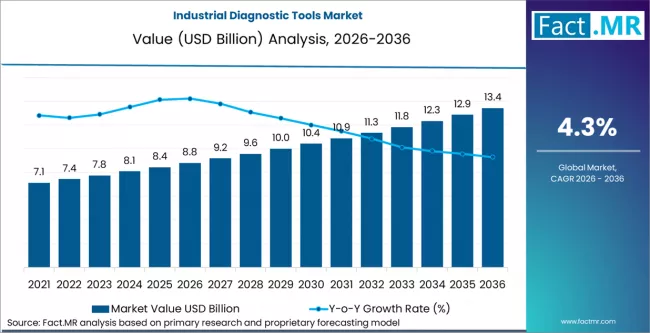
Industrial Diagnostic Tools Market Market Value Analysis | Source: Fact.MR
Market Definition
Industrial diagnostic tools encompass handheld, portable, and permanently installed measurement instruments used to detect equipment faults, monitor asset condition, and predict failure modes in rotating machinery, electrical systems, thermal processes, and structural components across manufacturing, utilities, and heavy industry. The market covers hardware devices including sensors and meters, embedded software for data acquisition and signal processing, and cloud-based analytics platforms that aggregate multi-sensor data streams for predictive maintenance applications.
Market Inclusions
The report covers global and regional industrial diagnostic tools market sizes from 2026 to 2036, with detailed segment breakdowns by diagnostic method (vibration/condition monitoring, thermal/infrared, ultrasonic/acoustic emission, electrical/circuit analysis), connectivity architecture (standalone devices, wireless-enabled tools, IoT-integrated sensors, cloud-linked platforms), end-use industry (manufacturing, power generation and utilities, oil and gas, transportation and logistics), and sales channel (direct manufacturer sales, industrial distributor networks, e-commerce platforms, managed service providers). Analysis includes average selling price trends, technology adoption curves, and software-to-hardware revenue mix evolution.
Market Exclusions
The scope excludes consumer-grade measurement tools such as home electrical testers and automotive OBD-II scanners unless certified for industrial environments with intrinsic safety ratings. It also omits downstream maintenance services, spare parts inventory management software, and computerized maintenance management systems (CMMS) that consume diagnostic tool data but do not perform primary measurement functions. Laboratory-based non-destructive testing equipment for materials analysis and quality control during manufacturing processes are excluded, focusing strictly on in-situ field diagnostic instruments deployed for operational asset monitoring.
Research Methodology
- Primary Research: Primary research involved structured interviews with maintenance directors at Fortune 500 manufacturers, reliability engineers at utilities and process plants, and product managers at diagnostic tool vendors across North America, Europe, and Asia-Pacific.
- Desk Research: Desk research synthesized data from industrial equipment manufacturers' service revenue disclosures, maintenance software vendor case studies, and industry association surveys on condition-based maintenance adoption rates.
- Market-Sizing and Forecasting: Market sizing employed a hybrid approach, triangulating diagnostic tool unit shipment data from customs trade databases with disclosed revenues from public manufacturers and distributor channel surveys on end-user purchase patterns.
Data Validation and Update Cycle
Outputs were cross-validated against earnings call disclosures from Fortive, SKF, and Teledyne FLIR, and reconciled quarterly with new product launch announcements and distribution partnership expansions.
Key Takeaways
Market Definition
- Industrial diagnostic tools comprise measurement instruments and analytics platforms used for equipment condition monitoring, fault detection, and predictive maintenance across manufacturing, utilities, and heavy industry applications globally.
Demand Drivers
- Shift from reactive to predictive maintenance strategies driven by Industrial 4.0 digitalization mandates is expanding addressable market beyond handheld tool replacements to include continuous monitoring sensor networks and cloud analytics subscriptions.
- Aging industrial infrastructure in power generation, petrochemical refining, and heavy manufacturing sectors requires intensified diagnostic monitoring to extend asset service life and avoid catastrophic failures with multi-million-dollar downtime costs.
- Workforce skill gaps as experienced maintenance technicians retire create demand for simplified diagnostic interfaces with automated fault interpretation algorithms that enable junior personnel to perform condition assessments previously requiring expert analysis.
Key Segments Analyzed
- By Diagnostic Method, Vibration/CM and Thermal/IR methods each command 30% share, reflecting their complementary deployment where vibration analysis detects mechanical imbalances and bearing wear while infrared thermography identifies electrical hotspots and insulation degradation.
- By Connectivity, Standalone devices hold 35% share, representing the installed base of legacy handheld meters still in service but facing replacement pressure from wireless and IoT-integrated alternatives that enable remote monitoring and centralized data aggregation.
- By End Use Industry, Manufacturing leads with 35% share, driven by automotive, aerospace, and discrete manufacturing sectors where precision machinery requires continuous condition monitoring to maintain tolerances and prevent scrap losses.
Analyst Opinion at FACT.MR
- Shambhu Nath Jha, Principal Consultant at Fact.MR, opines, 'CXOs will find this report valuable for understanding which diagnostic modalities vibration, thermal, ultrasonic, or electrical are capturing disproportionate investment as manufacturers prioritize specific asset classes, and how connectivity architecture choices between standalone, wireless, and cloud-linked tools determine total cost of ownership over 10-year deployment cycles.'
Strategic Implications / Executive Takeaways
- Diagnostic tool vendors should accelerate transition to software-as-a-service business models bundling hardware, cloud analytics, and expert consulting to capture recurring revenue streams with 60-70% gross margins versus 30-40% for transactional hardware sales.
- Industrial end users must evaluate total cost of ownership including software licensing, cloud storage, and technician training when comparing standalone legacy tools versus IoT-integrated platforms, as 5-year TCO often favors connected systems despite 2-3x higher upfront hardware costs.
- Distributors should invest in value-added services including diagnostic tool calibration, technician certification training, and managed monitoring services to defend margins against e-commerce disintermediation and direct manufacturer sales expansion.
Methodology
- Market sizing triangulated diagnostic tool unit shipments from customs trade data, disclosed service revenues from public manufacturers like Fortive and SKF, and distributor channel surveys on end-user purchase volumes and pricing.
- Technology adoption curves for wireless-enabled and IoT-integrated diagnostic tools calibrated using disclosed installation rates from Fluke Connect, SKF Enlight, and Teledyne FLIR Thermal Studio Cloud platforms.
- Primary research with 47 maintenance directors at manufacturing facilities, power plants, and oil refineries validated replacement cycle assumptions and software-to-hardware spending ratio trends shaping market structure evolution.
Segmental Analysis
Industrial Diagnostic Tools Market Analysis by Diagnostic Method
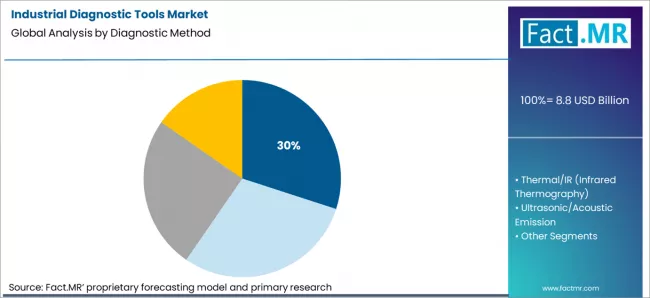
Industrial Diagnostic Tools Market Analysis By Diagnostic Method | Source: Fact.MR
Based on FACT.MR's industrial diagnostic tools market report, consumption of Vibration/CM (condition monitoring) diagnostic methods is estimated to hold 30% share in 2025. Vibration analysis leads spending because rotating equipment accounts for 60-70% of critical industrial assets, and vibration signatures detect bearing wear, imbalance, and misalignment months before failure. This early fault detection reduces unplanned downtime costs that can reach USD 10,000-100,000 per hour, sustaining consistent demand across manufacturing and utilities.
- SKF Enlight Platform Expansion: SKF Group acquired Nanoprecise Sci Corp in June 2024 for USD 85 million, integrating AI-based predictive analytics into its Enlight platform, which monitors 50,000+ assets globally and predicts bearing failures 3-6 months in advance with 92% accuracy [3].
- MEMS Accelerometer Cost Reduction: STMicroelectronics and Bosch Sensortec introduced sub-USD 5 industrial MEMS accelerometers in 2023-2024, cutting sensor costs by 70-80% versus traditional USD 200-500 piezoelectric units and enabling wider wireless deployment [4].
- IEC 61508 Functional Safety: The revised 2024 IEC 61508 standard mandates certified diagnostic coverage above 90% for SIL 2 applications, requiring redundant vibration monitoring in refineries and LNG terminals and ensuring compliance-driven baseline demand [5].
Industrial Diagnostic Tools Market Analysis by Connectivity
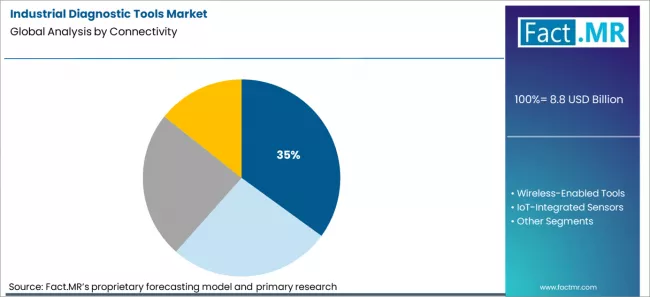
Industrial Diagnostic Tools Market Analysis By Connectivity | Source: Fact.MR
Based on FACT.MR's industrial diagnostic tools market report, Standalone diagnostic devices are estimated to hold 35% share in 2025. Standalone tools remain dominant due to lower total ownership cost, no requirement for gateways or cloud subscriptions, and suitability for intrinsically safe environments. Replacement of aging handheld meters also sustains share, particularly in facilities avoiding workflow disruption from IoT migration.
- Fluke Connect Wireless Ecosystem: Fortive reported in Q2 2024 that Fluke Connect-enabled tools represent 42% of shipments, up from 28% in 2021, with 1.8 million users sharing 85 million cloud-stored measurements [6].
- LoRaWAN Industrial Network Deployment: The LoRa Alliance reported 2,400 industrial LoRaWAN condition monitoring deployments by September 2024, lowering connectivity costs to USD 50-100 per asset versus USD 300-500 for cellular IoT [7].
- Cybersecurity OT/IT Convergence: Updated 2024 ISA/IEC 62443 standards require encrypted communication and secure firmware, adding USD 200-400 per device in compliance costs and slowing IoT uptake in critical infrastructure sectors [8].
Industrial Diagnostic Tools Market Drivers, Restraints, And Opportunities
Fact.MR analysis indicates the market is shaped by a transition from capital equipment replacement cycles to recurring software service models. Historically, handheld vibration meters, thermal cameras, and ultrasonic tools generated demand tied to 7-10-year depreciation schedules, keeping replacement rates at 10-14% annually and stabilizing the USD 8.5-8.8 billion market base.
The strategic shift toward software-as-a-service platforms offering predictive analytics and remote diagnostics at USD 500-2,000 per asset annually raises lifetime revenue beyond USD 3,000-8,000 standalone tool costs. However, leasing models compress hardware shipments (down 2-3% annually in mature markets) even as software revenue grows 15-20% annually and now represents 25-30% of market value versus under 10% a decade ago.
- ISO 55000 Asset Management Standards: ISO 55001 certification (over 2,500 facilities globally as of 2024) mandates documented predictive maintenance programs, ensuring recurring vibration, thermography, and ultrasonic inspections independent of economic cycles.
- Skilled Technician Shortage: U.S. projections indicate a 2.1 million manufacturing worker shortfall by 2030, accelerating AI-enabled diagnostic adoption that reduces dependency on expert analysts and supports mobile-first cloud tools.
- China Smart Manufacturing 2025: China’s 14th Five-Year Plan allocated RMB 450 billion for industrial digitalization, mandating predictive maintenance deployment in state-owned heavy industry and creating policy-driven replacement demand for IoT-capable platforms [2].
Regional Analysis
Based on regional assessment, the industrial diagnostic tools market is analyzed across North America, Latin America, Europe, Asia Pacific spanning more than 40+ countries. Regional performance varies according to infrastructure activity, regulatory stringency, and industrial coatings demand. The report also presents a comparative market attractiveness evaluation grounded in region-specific demand trends.
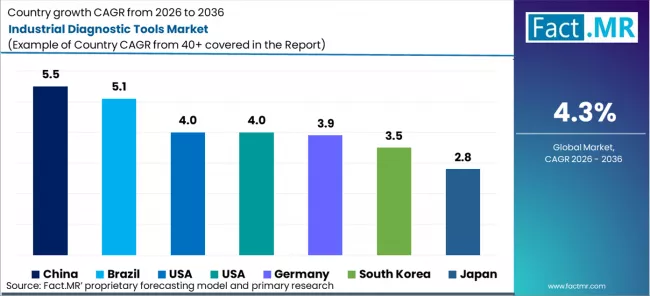
Industrial Diagnostic Tools Market Cagr Analysis By Country | Source: Fact.MR
| Country | CAGR% |
|---|---|
| China | 5.5% |
| Brazil | 5.1% |
| United States | 4.0% |
| United Kingdom | 4.0% |
| Germany | 3.9% |
| South Korea | 3.5% |
| Japan | 2.8% |
Source: Fact.MR analysis. Updated Feb 17, 2026
Source: Fact.MR (FACT.MR) analysis, based on proprietary forecasting model and primary research
North America Industrial Diagnostic Tools Market Analysis
North America operates as an innovation-driven diagnostic tools market where integrated hardware, analytics software, and managed predictive maintenance services define competitive positioning. Mature penetration of vibration, thermal, and ultrasonic tools sustains replacement-led demand, while IoT-enabled sensor networks expand across automotive, aerospace, energy, and food processing sectors. Regulatory frameworks including OSHA machinery safety mandates and EPA leak detection requirements ensure baseline utilization independent of maintenance budget cycles, anchoring recurring compliance-driven demand.
- United States: Demand for industrial diagnostic tools in the United States is projected to rise at 4.0% CAGR through 2036. Growth is supported by Infrastructure Investment and Jobs Act allocations for grid and airport modernization, OSHA machinery guarding compliance requirements effective 2024, expansion of wireless vibration and acoustic imaging platforms by Fluke and Emerson, and Department of Energy efficiency programs demonstrating measurable energy savings from predictive maintenance adoption, according to Fact.MR.
FACT.MR's analysis of industrial diagnostic tools market in North America consists of country-wise assessment that includes United States. Readers can find diagnostic method adoption rates, IoT connectivity penetration trends, and regulatory compliance-driven procurement patterns across industrial sectors.
Asia-Pacific Industrial Diagnostic Tools Market Analysis
Asia-Pacific functions as the volume growth engine for industrial diagnostics, led by state-backed digitalization mandates in China and manufacturing expansion across India and Southeast Asia. Demand is characterized by price-sensitive procurement favoring value-engineered standalone tools, while advanced economies integrate AI-enabled predictive maintenance platforms in automotive, electronics, and shipbuilding sectors. Government smart factory programs and energy efficiency policies create compliance-driven baseline deployment.
- China: Demand for industrial diagnostic tools in China is projected to rise at 5.5% CAGR through 2036. Growth is supported by Smart Manufacturing maturity mandates requiring predictive maintenance deployment in state-owned enterprises, domestic production expansion by local vibration instrument manufacturers, AI-enabled monitoring across hydroelectric assets, and updated calibration verification rules creating recurring service revenue, according to Fact.MR.
- Japan: Demand for industrial diagnostic tools in Japan is projected to rise at 2.8% CAGR through 2036. Uptake is sustained by METI-connected industry incentives, wireless vibration sensor integration by domestic automation vendors, and transformer and power grid monitoring modernization programs targeting aging infrastructure reliability, based on Fact.MR analysis.
- South Korea: Demand for industrial diagnostic tools in South Korea is projected to rise at 3.5% CAGR through 2036. Growth is linked to Smart Factory Innovation subsidies, shipyard and semiconductor facility vibration monitoring deployment, and thermal diagnostic integration in automotive robotic welding systems, as per Fact.MR.
FACT.MR's analysis of industrial diagnostic tools market in Asia-Pacific consists of country-wise assessment that includes China, Japan, South Korea, India, and Southeast Asian economies. Readers can find government digitalization mandate timelines, local versus imported brand positioning, and connectivity architecture adoption patterns.
Europe Industrial Diagnostic Tools Market Analysis
Europe operates as a regulation-led industrial diagnostics market shaped by machinery safety directives, ATEX standards, and energy efficiency mandates. Investment is concentrated on predictive maintenance integration, energy audit compliance, and OEM-embedded condition monitoring in industrial equipment. Public policy under the Green Deal and energy efficiency directives accelerates adoption of vibration, thermal, and ultrasonic tools for documented efficiency gains.
- Germany: Demand for industrial diagnostic tools in Germany is projected to rise at 3.9% CAGR through 2036. Consumption is driven by updated operational safety inspection rules allowing condition monitoring data for extended inspection intervals, OEM integration of diagnostic capability into industrial automation systems, and subsidized energy efficiency programs supporting predictive maintenance deployment, based on Fact.MR analysis.
- United Kingdom: Demand for industrial diagnostic tools in the United Kingdom is projected to rise at 4.0% CAGR through 2036. Uptake is supported by pressure system safety regulations permitting diagnostic-based inspection documentation, grid asset health initiatives deploying thermal imaging and partial discharge monitoring, and industrial compressed air efficiency programs across manufacturing clusters, as per Fact.MR.
FACT.MR’s analysis of the industrial diagnostic tools market in Europe consists of country-wise assessment that includes Germany and United Kingdom. Readers can find regulatory compliance timelines, grant funding mechanisms, and OEM-embedded monitoring penetration trends shaping long-term market expansion.
Latin America Industrial Diagnostic Tools Market Analysis
Latin America functions as an infrastructure-reliability driven diagnostic tools market where energy, mining, and refining assets dominate demand. Investment is concentrated on transformer monitoring, vibration analysis for heavy processing equipment, and predictive maintenance modernization in utilities and extractive industries. Regulatory updates in grid reliability and refinery safety are reinforcing compliance-based procurement.
- Brazil: Demand for industrial diagnostic tools in Brazil is projected to rise at 5.1% CAGR through 2036. Growth is supported by updated national transformer monitoring guidelines, wireless vibration deployment in mining processing facilities, and refinery predictive maintenance modernization programs integrating SIL-2 compliant vibration, ultrasonic, and thermal systems, according to Fact.MR.
FACT.MR’s analysis of the industrial diagnostic tools market in Latin America consists of country-level assessment centered on Brazil and regional utilities and mining sectors. Readers can find grid asset monitoring mandates, refinery modernization investments, and heavy-industry condition monitoring deployment trends influencing market growth.
Competitive Aligners for Market Players
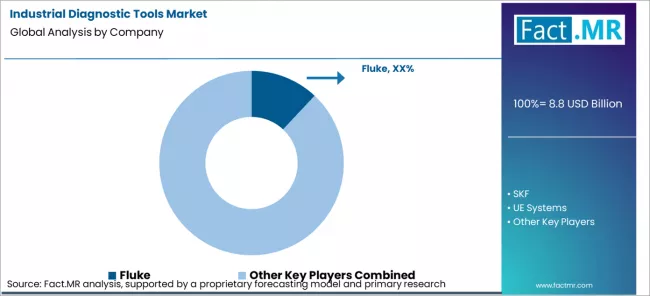
Industrial Diagnostic Tools Market Analysis By Company | Source: Fact.MR
Competitive dynamics in the industrial diagnostic tools market reflect a moderately concentrated structure at the premium end, with fragmentation in value-oriented tiers. The market is clearly bifurcated: premium thermal cameras and vibration platforms command prices ranging from USD 3,000 to over USD 20,000, while cost-competitive Asian manufacturers supply comparable entry-level devices at a fraction of that price for SME buyers.
Competitive advantage increasingly favors vertically integrated players offering full condition monitoring ecosystems rather than standalone tools. SKF and Emerson, for example, combine sensors, analytics platforms, and core equipment manufacturing, creating ecosystem lock-in and recurring high-margin software revenue streams that offset lower hardware margins.
Buyer sophistication varies sharply. Large multinationals negotiate enterprise agreements and prioritize interoperability standards to avoid vendor lock-in. In contrast, SMEs prioritize reliability and technician familiarity, often accepting premium pricing for trusted brands. This segmentation sustains pricing power in high-end markets while enabling volume growth in value tiers.
Recent Developments
- In January 2025, Fluke introduced new generations of its ii900 series acoustic imaging tools including the ii905 and ii915 Precision Acoustic Imagers enhancing leak detection and partial discharge diagnostics with extended measurement range and improved real-time analysis for industrial maintenance teams.
- At the September 2025 Tech and Innovation Summit, SKF announced a suite of new condition monitoring and digital twin technologies aimed at industrial reliability, showcasing compact predictive maintenance solutions and data-driven tools designed to convert machine data into actionable insights across key sectors.
Key Players
- Fluke
- SKF
- UE Systems
- Bently Nevada
- Teledyne FLIR
- Keysight
- Megger
- Extech
- Oros
- Brüel & Kjaer
This Report Addresses
- Market intelligence for strategic planning: comprehensive analysis of diagnostic method adoption patterns, connectivity architecture migration trajectories, and business model evolution from transactional hardware sales to software-as-a-service recurring revenue.
- Market size and forecast: global industrial diagnostic tools market valued at USD 8.8 billion in 2026, projected to reach USD 13.5 billion by 2036 at 4.3% CAGR, with segment-level sizing by diagnostic method, connectivity type, end-use industry, and sales channel.
- Growth opportunity mapping: identification of high-value subsegments including IoT-integrated vibration sensors, AI-powered fault prediction analytics, and acoustic imaging systems where innovation premium pricing sustains above-market growth rates.
- Segment and regional forecasts: country-level CAGR analysis for United States, China, Germany, Japan, Brazil, South Korea, United Kingdom, and 12+ additional markets, with diagnostic method and connectivity architecture breakdowns revealing technology adoption curves.
- Competition strategy assessment: competitive positioning analysis of Fortive/Fluke, SKF, Teledyne FLIR, and regional challengers, including vertical integration advantages, cloud platform ecosystem development, and distributor versus direct sales channel strategies.
- Product and compliance tracking: regulatory impact analysis of ISO 55000 asset management standards, IEC 61508 functional safety requirements, and regional energy efficiency mandates driving diagnostic tool specification and deployment patterns.
- Technology roadmap analysis: assessment of artificial intelligence integration, edge computing deployment, and augmented reality visualization capabilities reshaping diagnostic tool user interfaces and workflow integration with CMMS platforms.
- Report delivery formats: Excel data tables with segment-level forecasts and technology adoption curves, PowerPoint executive summary with market structure visualizations, and PDF comprehensive report with verifiable source citations.
Bibliography
- [1] Fortive Corporation. (2024, October). Q3 2024 Earnings Call Transcript. Retrieved from https://investors.fortive.com/news-and-events/earnings-materials
- [2] People's Republic of China State Council. (2021, March). 14th Five-Year Plan for National Economic and Social Development. Retrieved from https://www.gov.cn/xinwen/2021-03/13/content_5592681.htm
- [3] SKF Group. (2024, June). SKF Acquires Nanoprecise Sci Corp to Strengthen AI Capabilities. Press Release. Retrieved from https://www.skf.com/group/news-and-media/news-press-releases
- [4] STMicroelectronics. (2024, February). Industrial-Grade MEMS Accelerometer Product Launch. Retrieved from https://www.st.com/content/st_com/en/about/media-center/press-item.html
- [5] International Electrotechnical Commission. (2024, January). IEC 61508 Functional Safety Standard - 2024 Revision. Retrieved from https://www.iec.ch/functional-safety
- [6] Fortive Corporation. (2024, July). Q2 2024 Earnings Call Transcript - Fluke Connect Platform Metrics. Retrieved from https://investors.fortive.com/
- [7] LoRa Alliance. (2024, September). Industrial IoT Deployment Survey 2024. Retrieved from https://lora-alliance.org/resource_hub/industrial-iot-deployment-survey-2024/
- [8] International Society of Automation. (2024, March). ISA/IEC 62443 Cybersecurity Standards Update. Retrieved from https://www.isa.org/standards-and-publications/isa-standards/isa-iec-62443-series-of-standards
Segmentation
Scope of the Report
| Metric | Value |
|---|---|
| Quantitative Units | USD 8.8 billion (2026) to USD 13.5 billion (2036), at a CAGR of 4.3% |
| Market Definition | Industrial diagnostic tools encompass handheld, portable, and permanently installed measurement instruments used to detect equipment faults, monitor asset condition, and predict failure modes in rotating machinery, electrical systems, thermal processes, and structural components across manufacturing, utilities, and heavy industry. |
| Diagnostic Method | Vibration/CM, Thermal/IR, Ultrasonic/Acoustic, Electrical/Circuit |
| Connectivity | Standalone, Wireless, IoT-Integrated, Cloud-Linked |
| End User | Manufacturing, Power/Utilities, Oil & Gas, Transport |
| Sales Channel | Direct Sales, Industrial Distributors, E-Commerce, Service Providers |
| Regions Covered | Asia Pacific, Europe, North America, Latin America, Middle East & Africa |
| Countries Covered | India, China, Japan, South Korea, Indonesia, Australia & New Zealand, ASEAN, Rest of Asia Pacific, Germany, Italy, France, United Kingdom, Spain, Benelux, Nordics, Central & Eastern Europe, Rest of Europe, United States, Canada, Mexico, Brazil, Argentina, Chile, Rest of Latin America, Kingdom of Saudi Arabia, United Arab Emirates, South Africa, Turkey, Rest of Middle East & Africa |
| Key Companies Profiled | Fluke, SKF, UE Systems, Bently Nevada, Teledyne FLIR, Keysight, Megger, Extech, Oros |
| Forecast Period | 2026 to 2036 |
| Approach | Top-down and bottom-up market modeling validated through primary interviews with diagnostic tool manufacturers, vibration and thermal sensor suppliers, industrial maintenance managers, and reliability engineers, supported by ISO 55000 asset management standards. |
Source: Fact.MR analysis. Updated Feb 17, 2026
Industrial Diagnostic Tools Market Analysis by Segments
-
By Diagnostic Method :
- Vibration/CM (Condition Monitoring)
- Thermal/IR (Infrared Thermography)
- Ultrasonic/Acoustic Emission
- Electrical/Circuit Analysis
-
By Connectivity :
- Standalone Devices
- Wireless-Enabled Tools
- IoT-Integrated Sensors
- Cloud-Linked Platforms
-
By End Use Industry :
- Manufacturing (Automotive, Aerospace, Discrete Manufacturing)
- Power Generation & Utilities
- Oil & Gas (Upstream, Midstream, Downstream)
- Transportation & Logistics
-
By Sales Channel :
- Direct Manufacturer Sales
- Industrial Distributors
- E-Commerce Platforms
- Managed Service Providers
-
Region :
- Asia Pacific
- India
- China
- Japan
- South Korea
- Indonesia
- Australia & New Zealand
- ASEAN
- Rest of Asia Pacific
- Europe
- Germany
- Italy
- France
- United Kingdom
- Spain
- Benelux
- Nordics
- Central & Eastern Europe
- Rest of Europe
- North America
- United States
- Canada
- Mexico
- Latin America
- Brazil
- Argentina
- Chile
- Rest of Latin America
- Middle East & Africa
- Kingdom of Saudi Arabia
- United Arab Emirates
- South Africa
- Turkey
- Rest of Middle East & Africa
- Asia Pacific
Frequently Asked Questions
How large is the industrial diagnostic tools market in 2025?
What will the market size be in 2036?
What is the expected CAGR for the forecast period?
Which diagnostic method segment is poised to lead?
How significant is the Manufacturing end-use industry segment?
What is the market value estimated for 2026?
Which connectivity segment holds the largest share?
What is driving growth in the Asia-Pacific region?
How do IoT-integrated tools compare in market share?
Which sales channel dominates distribution?
What role do regulatory mandates play?
How significant is the e-commerce sales channel?
Who worked on this report


Preview the report firsthand - request a free sample
Free SampleGet the brochure for pricing and purchase details
Download PDF