- Base Value(2025): 0.7 Bn
- Estimated Value(2026): 0.8 Bn
- Forecast Value (2036): 2.0 Bn
- CAGR (2026 - 2036): 10.2%
Industrial Heat Pump Retrofit Controls Market Forecast and Outlook By FACT.MR
In 2025, the industrial heat pump retrofit controls market was valued at USD 0.7 billion. Based on Fact.MR analysis, demand for industrial heat pump retrofit controls is estimated to grow to USD 0.8 billion in 2026 and USD 2.0 billion by 2036. FACT.MR projects a CAGR of 10.2% during the forecast period.
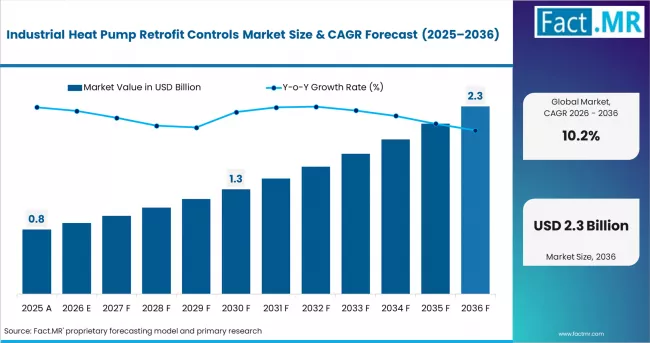
Industrial Heat Pump Retrofit Controls Market Market Value Analysis | Source: Fact.MR
| Metric | Value |
|---|---|
| Estimated Value in 2026 | USD 0.8 billion |
| Forecast Value in 2036 | USD 2.0 billion |
| Forecast CAGR (2026 to 2036) | 10.2% |
Source: Fact.MR analysis. Updated Apr 24, 2026
Summary of the Industrial Heat Pump Retrofit Controls Market
- Market Definition
- Covers AI energy management, predictive maintenance, and SCADA/PLC retrofit control systems supplied for industrial heat pump decarbonisation and process heating efficiency programmes globally.
- Demand Drivers
- EU ETS carbon pricing is increasing industrial heat pump retrofit investment. Driven by industrial facility compliance cost reduction programmes.
- U.S. IRA industrial efficiency tax credits are expanding retrofit control system procurement. Driven by manufacturing sector decarbonisation investment incentives.
- China industrial electrification programmes are scaling heat pump control deployment. Supported by state-backed energy transition and carbon neutrality targets.
- Key Segments Analyzed
- By Control Type: Advanced energy management & optimisation leads at 40% in 2026. Critical for industrial process efficiency and decarbonisation compliance.
- By Application: Industrial process heating leads at 45% in 2026. Largest retrofit control deployment base across manufacturing and chemical sectors.
- By Geography: Germany leads at 11.3% CAGR. Driven by industrial decarbonisation mandates and EU compliance investment.
- Analyst Opinion at FACT.MR
- Shambhu Nath Jha, Principal Consultant at Fact.MR, opines, 'CXOs will find a clear divide between legacy PLC retrofit systems and AI-integrated energy management platforms; the latter captures premium contract value in EU and IRA-linked industrial decarbonisation programmes.'
- Strategic Implications
- Invest in AI-based energy management platform development targeting EU ETS and IRA-compliant industrial heat pump retrofit programmes.
- Build waste heat recovery control system capabilities for chemical and food processing sectors in Germany, France, and Japan.
- Develop modular SCADA/PLC retrofit kits compatible with legacy heat pump installations for emerging market industrial electrification in China and India.
- Methodology
- Based on retrofit control system revenues and industrial heat pump deployment volumes. Validated with 2024–2025 data.
- Supported by EU ETS, IRA programme records, and Siemens, Danfoss, and ABB industry data.
- Forecasts include industrial decarbonisation timelines, control type adoption curves, and expert inputs from energy managers.
Between 2026 and 2036, the market is expected to create USD 1.2 billion in new opportunity. Growth is strong and regulation-supported. Demand is driven by industrial decarbonisation commitments and energy efficiency mandates. Retrofit deployment timelines and system integration complexity constrain faster growth.
Procurement is shifting toward advanced control platforms. Legacy PLC-only systems are losing share. Demand is rising for AI-based energy optimisation and predictive maintenance systems. EU ETS carbon pricing and IRA clean energy tax credits are accelerating procurement. Advanced platforms command 35–55% price premiums. Suppliers without certified energy performance documentation are being excluded from EU Green Deal and IRA-linked programme tenders.
Germany leads with 11.3% CAGR through 2036, driven by industrial decarbonisation targets and EU mandate compliance. China follows at 11.0%, supported by mass industrial electrification and state heat pump deployment programmes. The United States records 10.6%, driven by IRA clean energy and industrial efficiency retrofit incentives. France grows at 10.4%, supported by district heating retrofit investment and industrial decarbonisation programmes. Japan records 10.1%, driven by energy efficiency leadership and manufacturing sector heat pump adoption. India follows at 9.8%, supported by emerging industrial electrification and energy transition policy development.
Segmental Analysis
Industrial Heat Pump Retrofit Controls Market Analysis by Control Type
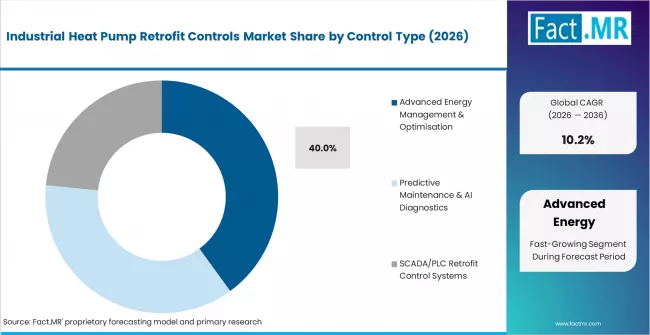
Industrial Heat Pump Retrofit Controls Market Analysis By Control Type | Source: Fact.MR
Advanced energy management systems hold 40% share in 2026. This is the highest-value segment. Demand is linked to decarbonisation reporting. These systems reduce carbon compliance costs. Industrial sectors are adopting them rapidly.
- Siemens Investment: Siemens expanded its control platform portfolio in 2024. Focus is on EU-compliant retrofit systems. It supports long-term service contracts [4].
- Danfoss Development: Danfoss launched an AI-based diagnostic platform in 2025. It integrates with SCADA systems. It provides performance reporting [5].
- Adoption Trend: Predictive control systems grew 19% in 2024. Adoption is strong in chemicals and food sectors [6].
Industrial Heat Pump Retrofit Controls Market Analysis by Application
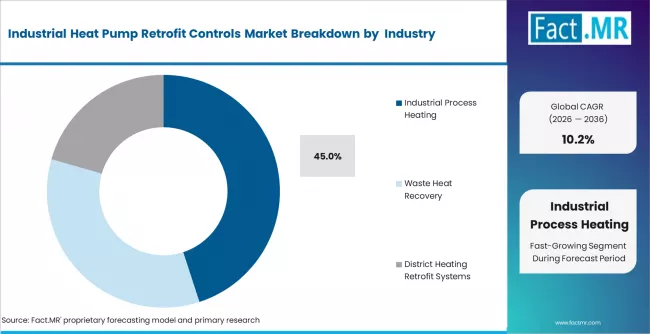
Industrial Heat Pump Retrofit Controls Market Analysis By Application | Source: Fact.MR
Industrial process heating holds 45% share in 2026. This is the largest application. Demand comes from continuous retrofit cycles. Compliance and efficiency drive procurement. Key sectors include chemicals and food processing.
- Johnson Controls Partnership: Johnson Controls expanded retrofit programmes in 2024. Projects cover chemical and pharma facilities. Systems include energy management integration [7].
- ABB Waste Heat System: ABB launched a new control system in 2024. It targets waste heat recovery applications. Focus is on heavy industries.
- District Heating Trend: Retrofit demand grew 23% in 2024. Investment is strong in Europe. France and Germany lead adoption [8].
Drivers, Restraints, and Opportunities
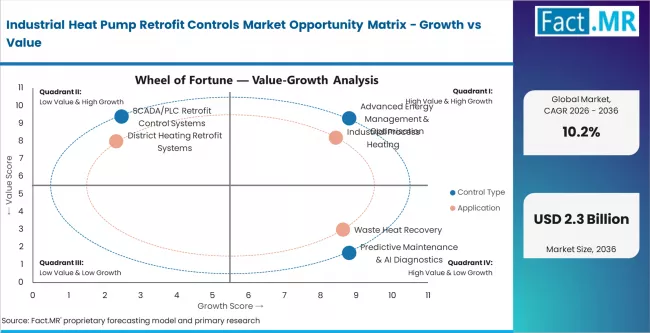
Industrial Heat Pump Retrofit Controls Market Opportunity Matrix Growth Vs Value | Source: Fact.MR
FACT.MR notes that growth is driven by industrial decarbonisation mandates. Energy efficiency compliance is a key factor. EU ETS cost reduction also supports demand. Retrofit controls are required for performance reporting. This creates structured procurement across industries.
Control upgrades are reshaping the market. Legacy PLC and manual systems are declining. AI-based energy management platforms are gaining traction. Predictive maintenance solutions are expanding. Certified performance data commands 35–55% premiums. Suppliers without validation are losing tenders.
- EU Decarbonisation Mandates: EU Energy Efficiency Directive was revised in 2024. Industrial heat efficiency requirements increased. Retrofit control documentation is mandatory. Siemens reported higher demand in 2024 [1].
- U.S. IRA Credits: The U.S. DOE issued tax credits in 2024. These support retrofit control investments. AI-based systems are required for eligibility. Emerson expanded supply in 2025 [2].
- China Scale-Up: China expanded industrial heat pump targets in 2024. State-backed projects are increasing adoption. SCADA-integrated systems are preferred. ABB reported strong demand [3].
Regional Analysis
The industrial heat pump retrofit controls market is assessed across Europe, Asia Pacific, North America, Latin America, and Middle East and Africa, covering 40+ countries with distinct demand profiles shaped by industrial decarbonisation policy intensity, energy efficiency mandate frameworks, heat pump deployment scale, and retrofit programme investment levels. The full report provides market attractiveness analysis by region and country.
.webp "Top Country Growth Comparison Industrial Heat Pump Retrofit Controls Market Cagr (2026 2036)")
Top Country Growth Comparison Industrial Heat Pump Retrofit Controls Market Cagr (2026 2036) | Source: Fact.MR
| Country | CAGR (2026 to 2036) |
|---|---|
| Germany | 11.3% |
| China | 11.0% |
| United States | 10.6% |
| France | 10.4% |
| Japan | 10.1% |
| India | 9.8% |
Source: Fact.MR analysis. Updated Apr 24, 2026
Source: Fact.MR (FACT.MR) analysis, based on proprietary forecasting model and primary research
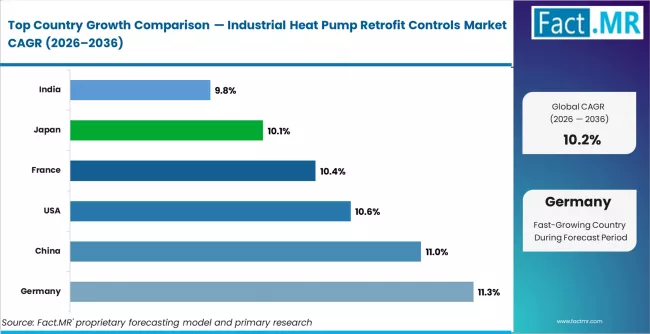
Industrial Heat Pump Retrofit Controls Market Cagr Analysis By Country | Source: Fact.MR
Europe Industrial Heat Pump Retrofit Controls Market Analysis
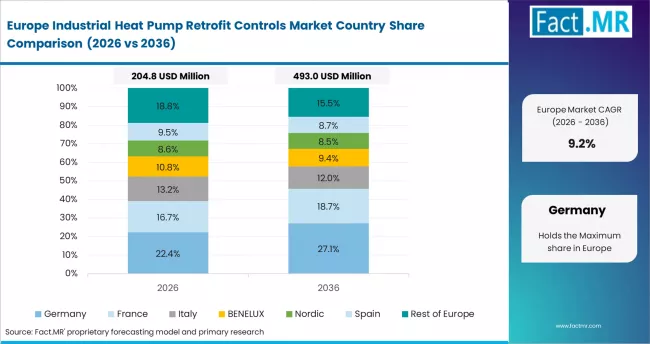
Industrial Heat Pump Retrofit Controls Market Europe Country Market Share Analysis, 2026 & 2036 | Source: Fact.MR
Europe remains the most mature and regulation-driven market. Growth is anchored in EU ETS cost pressure and strict efficiency mandates. Industrial operators are prioritising compliance-ready control systems. Procurement is shifting toward platforms with verified energy savings data and reporting capability.
- Germany: Germany’s demand is strongly tied to industrial decarbonisation funding and compliance pressure. Growth is projected at 11.3% CAGR through 2036. Government programmes expanded in 2024 with targeted grants for retrofit upgrades. Facilities must document process heat efficiency under updated EU rules. This is forcing adoption of advanced control systems. Industrial sectors such as chemicals and paper are leading upgrades. Siemens secured multiple long-term contracts by aligning with compliance requirements.
- France: France is seeing steady expansion through district heating and industrial transition programmes. Growth is estimated at 10.4% CAGR through 2036. National funding in 2024 supported large-scale retrofit deployment. Eligibility requires integration of advanced control platforms. Updated technical guidelines mandate AI diagnostics and performance tracking. Municipal and industrial operators are investing in compliant systems. Schneider Electric strengthened its presence through district heating projects.
Fact.MR covers Germany, France, the UK, Italy, Spain, and Rest of Europe. It includes regulatory frameworks, funding flows, and procurement patterns.
Asia Pacific Industrial Heat Pump Retrofit Controls Market Analysis
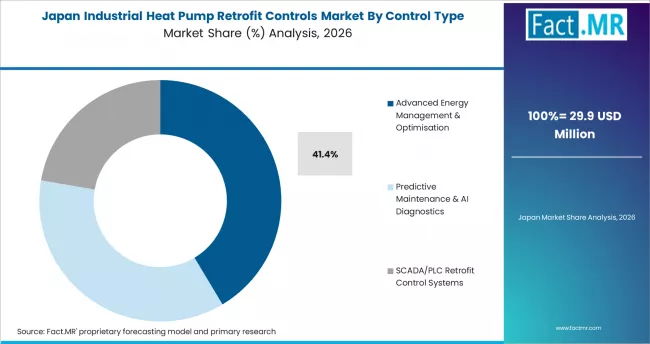
Industrial Heat Pump Retrofit Controls Market Japan Market Share Analysis By Control Type | Source: Fact.MR
Asia Pacific shows the fastest expansion, driven by policy-led electrification and industrial growth. Demand patterns differ across countries. Government mandates and efficiency programmes are shaping procurement behaviour.
- China: China’s growth is driven by large-scale industrial electrification targets. Growth is projected at 11.0% CAGR through 2036. Policies introduced in 2024 require advanced control systems in high-energy facilities. Demonstration projects are accelerating adoption. State-owned industries are leading deployment. ABB reported strong demand for integrated control systems. Local suppliers are scaling to meet government procurement requirements.
- Japan: Japan’s market is driven by strict efficiency standards and advanced technology adoption. Growth is estimated at 10.1% CAGR through 2036. Updated regulations require detailed performance tracking. Industrial operators must meet efficiency benchmarks. Government-backed projects are validating AI-based control systems. Adoption is strongest in high-precision industries.
- India: India is developing as a high-potential market supported by policy incentives. Growth is expected at 9.8% CAGR through 2036. Energy efficiency schemes are encouraging retrofit adoption. Industrial sectors are beginning to upgrade control systems. Pilot projects are demonstrating cost savings and compliance benefits. Schneider Electric is expanding offerings to target these opportunities.
Fact.MR covers China, Japan, India, South Korea, ASEAN, and ANZ. It includes electrification trends, policy support, and procurement behaviour.
North America Industrial Heat Pump Retrofit Controls Market Analysis
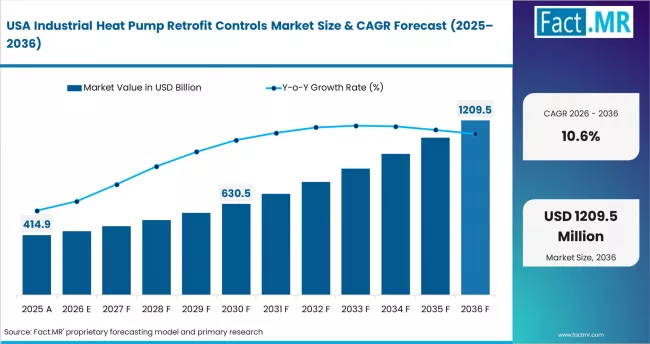
Industrial Heat Pump Retrofit Controls Market Country Value Analysis | Source: Fact.MR
North America is progressing through incentive-led adoption and structured funding programmes. Growth is tied to government support and industrial decarbonisation goals.
- United States: The U.S. market is driven by IRA funding and federal efficiency initiatives. Growth is projected at 10.6% CAGR through 2036. Large-scale grants in 2024 accelerated retrofit activity. Facilities must install advanced control systems to qualify. Updated performance benchmarks require AI-based optimisation. Emerson expanded its portfolio to meet these requirements. Adoption is strongest in energy-intensive industries such as chemicals and food processing.
Fact.MR covers the United States, Canada, and Mexico. It includes funding mechanisms, compliance requirements, and industrial adoption trends.
Competitive Aligners for Market Players
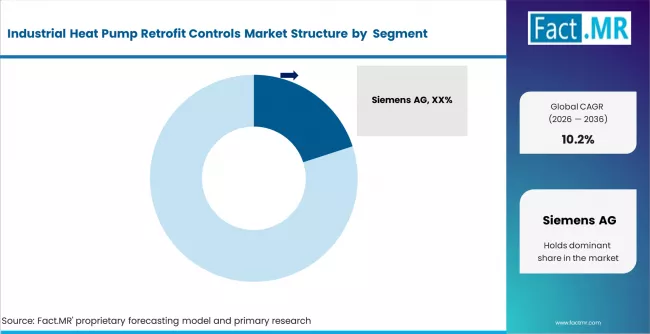
Industrial Heat Pump Retrofit Controls Market Analysis By Company | Source: Fact.MR
Competition in the industrial heat pump retrofit controls market is not really about who has the biggest hardware footprint. It is more about who can prove energy savings, integrate smoothly into industrial systems, and meet strict compliance requirements. Buyers are no longer choosing based on price alone. They want systems that can clearly demonstrate performance and help them qualify for EU ETS reporting or IRA incentives. This has created a market where only a few certified vendors win most of the high-value contracts.
Companies like Siemens AG and Schneider Electric SE sit at the top. They offer advanced AI-based energy platforms and have strong relationships with industrial operators and equipment manufacturers. Their biggest strength is the ability to provide validated energy optimisation data, which helps customers secure funding and long-term service agreements.
Danfoss A/S and ABB Ltd. take a slightly different approach. They focus on upgrading existing systems rather than replacing them. Their solutions work well with current SCADA and control setups. This makes them attractive for facilities looking for faster and lower-cost upgrades while still meeting compliance requirements. Meanwhile, Emerson Electric Co. and Johnson Controls International focus on specific industries like chemicals, food processing, and district heating. They bring strong application knowledge and proven performance data. Regional players in Asia are also growing. They benefit from local policy support and cost advantages, especially in China and India. Overall, success depends on certification, integration capability, and trusted industrial relationships.
Key Players
- Siemens AG
- Schneider Electric SE
- ABB Ltd.
- Johnson Controls International
- Danfoss A/S
- Emerson Electric Co.
Bibliography
- [1] European Commission. (2024). Energy Efficiency Directive Revision 2024: Updated Industrial Process Heat Documentation and Energy Management System Requirements for EU Emissions Trading Scheme Reporting Facilities. ec.europa.eu/energy/topics/energy-efficiency
- [2] U.S. Department of Energy. (2024). Industrial Efficiency and Decarbonisation Office IRA Programme Update: USD 500 Million in Industrial Heat Pump Retrofit Grants with Advanced Control System Deployment Eligibility Requirements. energy.gov/eere/iedo
- [3] ABB Ltd. (Q4 2024). Regional Market Update: Strong China Order Growth for Industrial Energy Management and Heat Recovery Control Systems Under State Carbon Neutrality Action Plan Industrial Facility Mandates. abb.com/investor-relations
- [4] Siemens AG. (Q3 2024). Portfolio Expansion Announcement: Industrial Heat Pump Energy Management Control Platform Expansion Targeting EU ETS-Compliant Chemical and Food Processing Sector Retrofit Programmes in Germany and Europe. siemens.com/press
- [5] Danfoss A/S. (Early 2025). Product Launch: AI-Based Predictive Maintenance Diagnostic Platform for Industrial Heat Pump Retrofits with SCADA Integration and EU Programme Compliance Energy Performance Reporting. danfoss.com/news
- [6] International Energy Agency. (2024). Heat Pumps Technology Report 2024: Industrial Heat Pump Deployment Growth Including Retrofit Control System Adoption Data and AI Diagnostics Procurement Trends in Chemical and Food Processing Sectors. iea.org/reports/heat-pumps
- [7] Johnson Controls International. (2024). Programme Announcement: Industrial Process Heating Heat Pump Retrofit Control Programme Expansion at Chemical and Pharmaceutical Manufacturing Facilities in Germany and the United States. johnsoncontrols.com/news
- [8] Eurostat. (2024). Industrial Energy Consumption Statistics 2024: District Heating Heat Pump Retrofit Control System Investment Growth in France and Germany Under National Decarbonisation Programme Funding. ec.europa.eu/eurostat/statistics-explained/energy
This Report Addresses
- Strategic intelligence on industrial heat pump retrofit controls demand across AI energy management, predictive diagnostics, and SCADA/PLC retrofit systems for process heating and decarbonisation applications globally.
- Market forecast from USD 0.8 billion in 2026 to USD 2.0 billion by 2036, at a CAGR of 10.2%.
- Growth opportunity mapping across Germany EU mandate-driven investment, China state electrification scale-up, U.S. IRA incentive deployment, France district heating retrofit, Japan efficiency programme adoption, and India emerging electrification.
- Segment analysis by control type (energy management, AI diagnostics, SCADA/PLC) and application (process heating, waste heat recovery, district heating retrofit) across global and regional markets.
- Regional outlook covering Europe regulation-led compliance demand, Asia Pacific policy-driven volume growth, and North America incentive-structured retrofit adoption.
- Competitive analysis of Siemens, Schneider Electric, ABB, Danfoss, Johnson Controls, and Emerson. Focus on performance certification, programme eligibility, and industrial sector integration depth.
- Regulatory analysis covering EU Energy Efficiency Directive, EU ETS compliance requirements, U.S. IRA industrial efficiency credits, China MIIT industrial heat pump mandates, Japan Act on Rational Use of Energy, and India PAT scheme.
- Report delivered in PDF, Excel, and presentation formats. Supported by interviews, energy programme data, certification records, and supplier revenues.
Industrial Heat Pump Retrofit Controls Market Definition
The market includes advanced energy management systems, AI diagnostic platforms, and SCADA/PLC control systems retrofitted to industrial heat pumps. These controls optimise heat pump performance, enable predictive maintenance, and automate industrial process heating and waste heat recovery for decarbonisation programme compliance.
Industrial Heat Pump Retrofit Controls Market Inclusions
Covers global forecasts (2026–2036) by control type and application. Includes energy management, AI diagnostics, and SCADA/PLC retrofit systems. Covers industrial process heating, waste heat recovery, and district heating retrofit procurement via industrial and utility supply channels.
Industrial Heat Pump Retrofit Controls Market Exclusions
Excludes heat pump equipment hardware and refrigerant systems. Omits building management systems not specific to industrial heat pump retrofit applications. Also excludes new-build heat pump control systems. Focus remains on retrofit control platform software and hardware supplied for existing industrial heat pump installations.
Industrial Heat Pump Retrofit Controls Market Research Methodology
- Primary Research: Interviews with retrofit control system suppliers, industrial energy managers, and facility decarbonisation programme coordinators across key markets.
- Desk Research: Uses Siemens, Danfoss, and ABB disclosure data. Includes EU ETS compliance data, IRA programme investment records, and industrial heat pump deployment statistics from 2024–2025.
- Market-Sizing and Forecasting: Hybrid model using control system revenues and application-level deployment volumes by control type. Covers all major regions and industrial applications.
- Data Validation and Update Cycle: Validated with energy programme data, retrofit installation volumes, and supplier revenues. Cross-checked with expert interviews. Updated annually.
Segmentation
Scope of Report
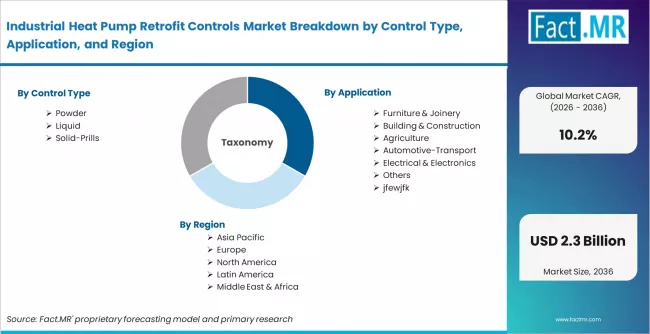
Industrial Heat Pump Retrofit Controls Market Breakdown By Control Type, Application, And Region | Source: Fact.MR
| Attribute | Details |
|---|---|
| Quantitative Units | USD 0.8 billion (2026) to USD 2.0 billion (2036), at a CAGR of 10.2% |
| Market Definition | Advanced energy management systems, AI predictive diagnostics, and SCADA/PLC retrofit control platforms supplied for industrial heat pump decarbonisation, process heating efficiency, and waste heat recovery applications globally. |
| Control Type Segmentation | Advanced Energy Management & Optimisation, Predictive Maintenance & AI Diagnostics, SCADA/PLC Retrofit Control Systems |
| Application Segmentation | Industrial Process Heating, Waste Heat Recovery, District Heating Retrofit Systems |
| Application Coverage | Industrial process heat decarbonisation control, waste heat recovery automation, district heating retrofit system integration, and AI-driven energy optimisation for ETS and IRA compliance documentation. |
| Regions Covered | North America, Europe, Asia Pacific, Latin America, Middle East and Africa |
| Countries Covered | USA, Canada, Mexico, Germany, UK, France, Italy, Spain, Nordic, BENELUX, China, Japan, South Korea, India, ASEAN, Australia and New Zealand, Brazil, Argentina, Chile, Saudi Arabia, GCC, Turkey, South Africa, Rest of MEA |
| Key Companies Profiled | Siemens AG, Schneider Electric SE, ABB Ltd., Johnson Controls International, Danfoss A/S, Emerson Electric Co. |
| Forecast Period | 2026 to 2036 |
| Approach | Hybrid top-down and bottom-up model using retrofit control system revenues, industrial heat pump deployment volumes by application, average selling prices by control type and specification grade, energy programme procurement benchmarks, and primary interviews with industrial energy managers and decarbonisation programme coordinators. |
Source: Fact.MR analysis. Updated Apr 24, 2026
Industrial Heat Pump Retrofit Controls Market by Segments
-
By Control Type:
- Advanced Energy Management & Optimisation
- Predictive Maintenance & AI Diagnostics
- SCADA/PLC Retrofit Control Systems
-
By Application:
- Industrial Process Heating
- Waste Heat Recovery
- District Heating Retrofit Systems
-
By Region:
-
North America
- United States
- Canada
- Mexico
-
Latin America
- Brazil
- Mexico
- Argentina
- Chile
- Rest of Latin America
-
Western Europe
- Germany
- United Kingdom
- France
- Italy
- Spain
- Nordic Countries
- BENELUX
- Rest of Western Europe
-
Eastern Europe
- Russia
- Poland
- Hungary
- Balkan and Baltic
- Rest of Eastern Europe
-
East Asia
- China
- Japan
- South Korea
-
South Asia and Pacific
- India
- ASEAN
- Australia and New Zealand
- Rest of South Asia and Pacific
-
Middle East and Africa
- Kingdom of Saudi Arabia
- Other GCC Countries
- Turkey
- South Africa
- Rest of Middle East and Africa
-
Frequently Asked Questions
How large is the industrial heat pump retrofit controls market in 2025?
What will the market size be by 2036?
What is the expected CAGR for the market from 2026 to 2036?
Which control type segment is poised to lead the market?
Which application segment is expected to dominate?
Which country shows the fastest growth?
What is driving demand for industrial heat pump retrofit controls?
What are the major restraints?
Which material or technology segment leads?
What is the main challenge in this market?
Who worked on this report


Preview the report firsthand - request a free sample
Free SampleGet the brochure for pricing and purchase details
Download PDF