- Market Value (2025): USD 954.6 Mn
- Estimated Value (2026): USD 1050.0 Mn
- Forecast Value (2036): USD 2723.0 Mn
- CAGR (2026-2036): 10.0%
What is the Industrial Lactase Enzymes Market forecast to be worth by 2036?
USD 1,050.0 million in 2026 to USD 2,723.0 million by 2036, implying a 10.0% CAGR.
- The Industrial Lactase Enzymes Market was valued at USD 954.6 million in 2025.
- Demand is projected to increase from USD 1,050.0 million in 2026 to USD 2,723.0 million by 2036.
- The market is forecast to record 10.0% CAGR from 2026 to 2036 as dairy processors, food ingredient manufacturers and nutraceutical formulators specify lactase for lactose control and cleaner sweetness profiles.
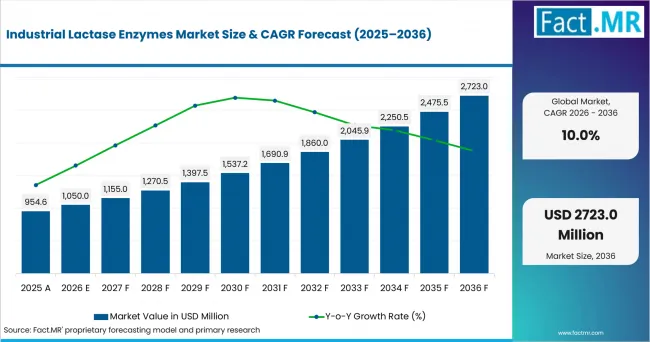
Industrial Lactase Enzymes Market Value Analysis | Source: Fact.MR
What are the defining numbers behind Industrial Lactase Enzymes Market growth?
An absolute opportunity of USD 1,673.0 million is expected between 2026 and 2036.
- Demand Drivers in the Market
- Dairy processors need reliable lactose hydrolysis so finished milk, yogurt and cream products meet lactose-free label targets without off-taste.
- USDA ERS reported on June 11, 2026 that total U.S. food spending reached USD 2.51 trillion in 2025.
- Food ingredient manufacturers use lactase to modify sweetness and solids behavior in selected milk streams for finished applications.
- Nutraceutical brands need stable enzyme inputs where activity, dosage form and documentation shape supplier selection.
- EFSA published a safety assessment on June 9, 2026 covering beta-galactosidase from Bacillus licheniformis strain NZYM-BT for three food-manufacturing processes after the applicant requested an extension to two additional processes.
- Key Segments Analyzed
- By Source: Microbial is expected to hold 44.0% share in 2026 because fermentation routes support consistency, scalable activity and supplier documentation.
- By Form: Liquid is projected to account for 41.0% share in 2026 as dairy processors need pumpable dosing for tanks, lines and aseptic systems.
- By Function: Hydrolysis is anticipated to capture 38.0% share in 2026 since lactose conversion remains the main operational reason for buying lactase.
- By Application: Dairy processing is estimated to represent 42.0% share in 2026 owing to lactose-free milk, yogurt and UHT product demand.
- Analyst Opinion at Fact.MR
- Shambhu Nath Jha, Principal Consultant at Fact.MR, states, "The commercial test for industrial lactase is no longer limited to whether it breaks lactose. Dairy processors are expected to compare residual lactose, dosing flexibility, process time and sweetness outcomes before switching suppliers. Providers that combine enzyme activity with application support and regulatory files are better placed in plants that run lactose-free products at scale."
- Strategic Implications
- Enzyme vendors should document residual lactose performance under real dairy processing conditions and laboratory conversion trials.
- Dairy processors should align enzyme selection with product format, heat treatment and shelf-life targets before scale-up.
- Ingredient formulators should test how lactase changes sweetness balance, solids handling and label claims in reduced-sugar dairy foods.
- Sourcing teams should qualify backup supply for liquid and powder forms because enzyme activity and cold-chain handling affect plant reliability.
The USA is projected to record 11.0% CAGR through 2036, supported by dairy processing scale and reduced-sugar formulation work. Germany is anticipated to advance at 10.5% as EU dairy output and enzyme regulation shape supplier qualification. Japan is forecast to post 9.8% as processors manage lactose-free dairy in a mature milk market. France is estimated to reach 9.4% through fresh dairy processing and ingredient reformulation. Brazil is expected to hold 9.0% as formal milk collection expands and dairy processors scale value-added products.
How does the Industrial Lactase Enzymes Market break down by segment?
Microbial leads Source at 44.0% share; Dairy processing leads Application at 42.0% share.
Which Source dominates?
Microbial is expected to hold 44.0% share in 2026.
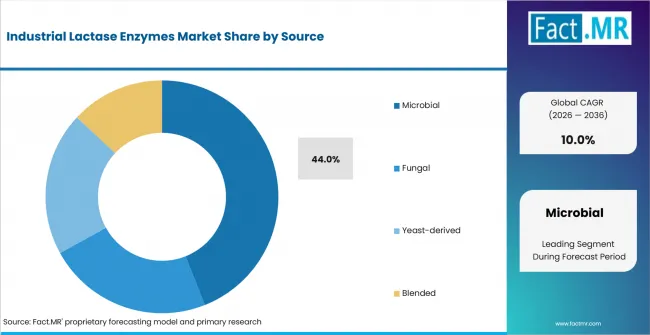
Industrial Lactase Enzymes Market Analysis By Source | Source: Fact.MR
Microbial lactase leads because industrial fermentation gives producers tighter control over enzyme consistency and batch activity. The pattern aligns with broader industrial enzyme use where food and beverage applications remain an operational base.
Novonesis positions Saphera® as a bacterial lactase for lactose-free milk and yogurt. Its product information states that Saphera® can achieve less than 0.01% residual lactose, demonstrating the commercial use of bacterial lactase in lactose-free dairy processing.
What leads the Form segment?
Liquid is projected to account for 41.0% share in 2026.
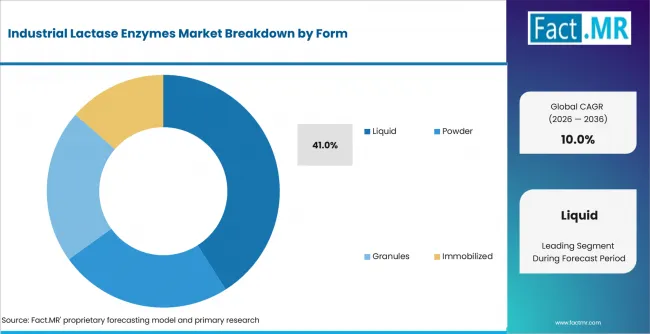
Industrial Lactase Enzymes Market Analysis By Form | Source: Fact.MR
Liquid lactase leads because dairy processors dose it into tanks or process lines with less handling than dry formats. The form also suits in-line aseptic dosing where enzyme dispersion and activity control affect throughput.
Novonesis lists Saphera in liquid format and identifies in-line aseptic dosing among supported processes. That fit is expected to keep liquid lactase aligned with industrial dairy plants that run repeatable recipes.
How does Function shape demand?
Hydrolysis is anticipated to capture 38.0% share in 2026.
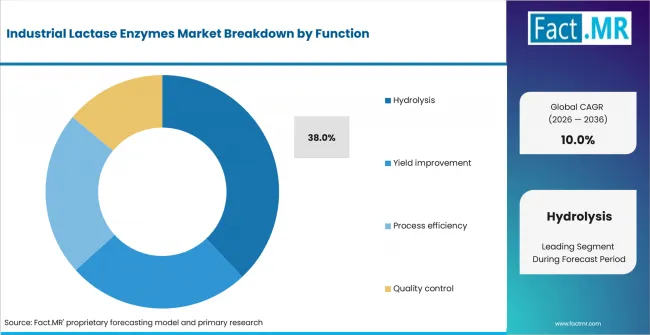
Industrial Lactase Enzymes Market Analysis By Function | Source: Fact.MR
Hydrolysis leads because the direct job of lactase is to split lactose into glucose and galactose. The change supports lactose-free positioning and improves perceived sweetness without adding more sugar.
EFSA described β-galactosidase as EC 3.2.1.23 in June 2026 and stated that the enzyme catalyses the hydrolysis of lactose, releasing galactose and glucose. This hydrolytic activity supports its use in lactose-reduced dairy processing.
What supports Dairy processing within Application?
Dairy processing is estimated to represent 42.0% share in 2026.
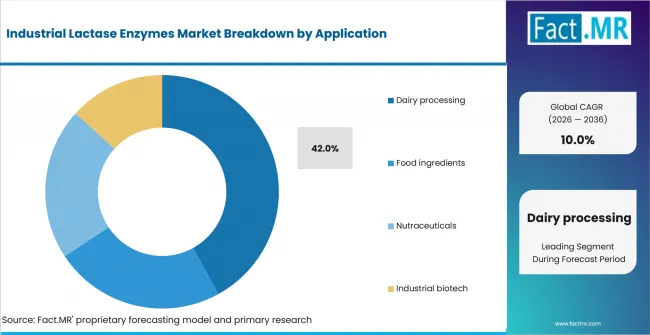
Industrial Lactase Enzymes Market Analysis By Application | Source: Fact.MR
Dairy processing leads because lactase is directly tied to milk, yogurt, cream, whey and related dairy streams. It also fits food processing ingredients where lactose content affects sweetness and solids behavior.
IFF identifies BONLACTA™ as a high-purity lactase for faster lactose hydrolysis under refrigeration and high-temperature conditions. IFF highlights minimized reaction times, improved filterability in sterile dosing and clean taste as benefits for lactose-free dairy processing.
What is accelerating Industrial Lactase Enzymes Market adoption, and what is holding it back?
Demand is expected to rise through lactose-free dairy, sugar-reduction work and scalable microbial fermentation. Growth is constrained by enzyme approval files, process validation and price pressure in dairy supply chains.
Drivers Impact Analysis
| DRIVER | (~) % IMPACT ON CAGR | GEOGRAPHIC RELEVANCE | IMPACT TIMELINE |
|---|---|---|---|
| Lactose-free dairy line expansion | +1.6% | North America, Europe, East Asia | Short term (<= 2 years) |
| Reduced-sugar formulation in milk and yogurt | +1.2% | USA, Germany, France, Japan | Medium term (2-4 years) |
| Microbial fermentation consistency | +0.9% | Global | Medium term (2-4 years) |
| Industrial enzyme documentation and process support | +0.7% | Europe, North America | Long term (>= 4 years) |
Source: Fact.MR analysis. Updated Aug 31, 2026
- Lactose-free dairy line expansion: Processors use lactase when lactose-free milk and fermented products move from niche batches into routine production planning.
- Reduced-sugar formulation in milk and yogurt: Enzyme-led lactose conversion supports sweetness management where brands want fewer added-sugar claims.
- Microbial fermentation consistency: Fermentation-based supply gives enzyme makers a route to repeatable activity in plants that validate residual lactose levels.
- Industrial enzyme documentation and process support: Food enzyme systems are expected to raise the value of technical files, application testing and supplier quality systems.
Opportunity Impact Analysis
| OPPORTUNITY | (~) % IMPACT ON CAGR | GEOGRAPHIC RELEVANCE | IMPACT TIMELINE |
|---|---|---|---|
| Low-lactose and lactose-free UHT dairy | +1.1% | USA, Germany, Brazil | Short term (<= 2 years) |
| GOS and fiber-linked lactase applications | +0.8% | North America, Europe, East Asia | Medium term (2-4 years) |
| Immobilized enzymes for controlled processing | +0.5% | Europe, Japan | Long term (>= 4 years) |
Source: Fact.MR analysis. Updated Aug 31, 2026
- Low-lactose and lactose-free UHT dairy: Extended shelf-life dairy formats create demand for lactase performance that fits industrial processing requirements while maintaining clean taste, product stability and consistent lactose reduction.
- GOS and fiber-linked lactase applications: Lactase is expected to gain relevance in applications where enzymatic conversion supports galacto-oligosaccharide production and broader functional dairy or nutrition formulations.
- Immobilized enzymes for controlled processing: Immobilized enzyme systems support reuse, tighter process control and more consistent processing where manufacturers can justify the additional setup and equipment requirements.
Restraints Impact Analysis
| RESTRAINT | (~) % IMPACT ON CAGR | GEOGRAPHIC RELEVANCE | IMPACT TIMELINE |
|---|---|---|---|
| Food enzyme safety approvals | -0.5% | Europe, Japan, USA | Short term (<= 2 years) |
| Residual lactose validation cost | -0.4% | Global | Medium term (2-4 years) |
| Dairy price and margin pressure | -0.3% | Brazil, Germany, France | Medium term (2-4 years) |
Source: Fact.MR analysis. Updated Aug 31, 2026
- Food enzyme regulation: Food enzyme approval requirements shape market access across European dairy applications. Suppliers need clear safety documentation and regulatory alignment before enzymes move into commercial food-processing programs.
- Residual lactose validation cost: Each product format requires testing because enzyme dose, temperature, processing time and matrix composition influence the final lactose level and product consistency.
- Dairy price and margin pressure: Processors facing milk-price and margin pressure may extend enzyme-upgrade decisions when lactose-free product economics remain tight, increasing the importance of cost-efficient dosing and measurable processing benefits.
Which countries are scaling the Industrial Lactase Enzymes Market through 2036?
- The country comparison spans 2.0 percentage points and forms three practical growth bands across the forecast period.
- The USA remains 0.5 percentage point above Germany due to food spending, dairy processing scale and reduced-sugar reformulation pressure.
- Germany remains 0.7 percentage point above Japan as EU dairy processing and food-enzyme controls shape supplier qualification.
- Japan remains 0.4 percentage point above France through lactose-free processing in a mature dairy market.
- France remains 0.4 percentage point above Brazil as fresh dairy and ingredient reformulation support enzyme use.
- Brazil closes the displayed range through formal milk collection growth and expanding industrial dairy output.
Comparable CAGRs create different entry conditions due to dairy scale, milk collection, approval timing and plant validation practices. Full report coverage includes North America, Latin America, Western Europe, Eastern Europe, East Asia, South Asia & Pacific, Middle East & Africa.
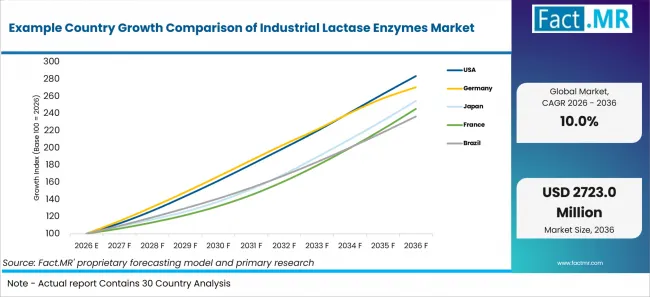
Example Country Growth Comparison Of Industrial Lactase Enzymes Market | Source: Fact.MR
| Country | CAGR (2026-2036) |
|---|---|
| USA | 11.0% |
| Germany | 10.5% |
| Japan | 9.8% |
| France | 9.4% |
| Brazil | 9.0% |
Source: Fact.MR analysis. Updated Aug 31, 2026
What supports USA adoption?
11.0% CAGR, supported by dairy processing scale and reduced-sugar dairy reformulation.
USA dairy plants work at a scale that makes repeatable lactase performance relevant when lactose-free lines move into routine production. USDA NASS reported in April 2026 that U.S. milk production increased 2.6% in 2025 to 232 billion pounds. Liquid dosing and validation support are expected to keep the USA ahead of the displayed country range.
What is supporting Germany's adoption?
10.5% CAGR, supported by EU dairy processing and food-enzyme qualification.
Germany benefits from a large dairy base and a strict food-enzyme approval setting. Eurostat reported in November 2025 that Germany accounted for 18.8% of EU drinking milk production in 2024. Suppliers that combine microbial source control with regulatory files are expected to gain attention from German processors.
How does Japan perform?
9.8% CAGR, led by lactose-free dairy processing and mature milk production.
Japan is a mature dairy market where processors pay close attention to taste, residual lactose and stable performance in smaller production runs. MAFF reported for December 2025 that raw milk production was 616,047 tonnes. Yeast-derived and fungal lactase options are expected to support trials across yogurt and milk drinks.
What supports France adoption?
9.4% CAGR, supported by fresh dairy output and reformulation work.
France links lactase adoption to fresh dairy, ingredient reformulation and quality control in lactose-free products. Agreste reported in June 2026 that cow milk collection increased 1.2% year over year in April 2026. Application support is expected to matter for processors that validate lactose conversion before launch.
What supports Brazil adoption?
9.0% CAGR, supported by formal milk collection and value-added dairy processing.
Brazil gives lactase suppliers a widening processing base as more milk moves through inspected channels. IBGE reported in March 2026 that raw milk acquisition reached 27.51 billion liters in 2025. Industrial lactase use is expected to expand where UHT milk, yogurt and dairy ingredients carry higher value positioning.
Who leads the Industrial Lactase Enzymes Market?
Novonesis is an active provider through Saphera and related lactase biosolutions for lactose-free milk and yogurt. The company positions Saphera as a bacterial lactase in liquid format with in-line aseptic dosing support.
dsm-firmenich competes through Maxilact enzymes, while IFF participates through BONLACTA and NURICA lactase systems for lactose-free, low-sugar and fiber-linked dairy products. Kerry Group plc adds scale through its Carrigaline enzyme hub.
Which companies are the key providers?
Key companies include Novonesis; dsm-firmenich; IFF; Amano Enzyme Inc.; Kerry Group plc; and Advanced Enzyme Technologies Limited.
- Novonesis
- dsm-firmenich
- IFF
- Amano Enzyme Inc.
- Kerry Group plc
- Advanced Enzyme Technologies Limited
Bibliography
- Zeballos, E., & Sinclair, W. (2026, June 11). Total U.S. food spending reached $2.51 trillion in 2025. U.S. Department of Agriculture, Economic Research Service.
- U.S. Department of Agriculture, National Agricultural Statistics Service. (2026, April 30). Milk Production, Disposition, and Income 2025 Summary.
- Eurostat. (2025, November 20). Milk production reached 161.8 million tonnes in 2024.
- Touati-Houari, N. (2026, June 12). Lait. Avril 2026 : la collecte de lait toujours en hausse sur un an. Agreste.
- Brazilian Institute of Geography and Statistics. (2026, March 18). In 2025, Brazil registers the highest production of milk, leather and eggs in history; slaughter of cattle, chickens and pigs also hits record. IBGE News Agency.
- EFSA FEZ Panel (EFSA Panel on Food Enzymes), Zorn, H., Barat Baviera, J. M., Bolognesi, C., Catania, F., Gadermaier, G., Greiner, R., Mayo, B., Mortensen, A., Roos, Y. H., Solano, M. L. M., Van Loveren, H., Vernis, L., Cavanna, D., Liu, Y., & Tokić, V. (2026). Safety evaluation of an extension of use of the food enzyme β-galactosidase from the genetically modified Bacillus licheniformis strain NZYM-BT. EFSA Journal, 24(6), e10137.
- Kerry. (2026, April 20). Kerry opens expanded biotechnology manufacturing hub in Ireland to meet growing global demand for lactase enzymes.
This Report Answers
- The report explains where industrial lactase enzymes are used across source, form, function and application within the wider specialty enzymes category.
- Segment analysis identifies the leading subsegments and the operating reasons processors prioritize them.
- Country analysis examines the listed markets and the dairy, regulatory or plant-level factors that support adoption.
- Competitive analysis reviews current providers across lactase biosolutions, enzyme manufacturing and dairy application support.
- Application analysis assesses how lactose hydrolysis, sweetness management and residual-lactose validation shape purchase decisions.
What does the Industrial Lactase Enzymes Market cover?
The Industrial Lactase Enzymes Market covers beta-galactosidase preparations used by dairy processors and ingredient producers to hydrolyze lactose. The boundary aligns with coverage of lactase enzyme use where dairy applications need residual-lactose control.
The assessment covers source, form, function and application across dairy processing, food ingredients, nutraceuticals and industrial biotech. It also connects with dairy enzymes where lactase is evaluated alongside other process aids used in milk, cheese and yogurt plants.
What is included in the scope?
The scope includes industrial lactase enzyme sales for lactose hydrolysis in milk, yogurt, whey, cream and dairy-derived ingredients. It also includes lactase used for reduced-sugar dairy work and selected functional dairy formats linked to free-from ingredients.
Commercial preparations are included where provider portfolios address dairy processing, food ingredient or nutraceutical lactase applications. Adjacent capacity links to precision fermentation services where enzyme development and scale-up capabilities overlap.
What is excluded from the scope?
The scope excludes laboratory-only beta-galactosidase research products, consumer digestive tablets and generic enzyme blends where lactase activity is unclear.
Finished lactose-free milk, yogurt and nutraceutical products are excluded unless value relates to industrial enzyme inputs. Broader dairy products are covered only when they explain the end-use setting for lactase.
How Was the Analysis Built?
The analysis draws on 120+ sources, 35+ company portfolios, 25+ countries, and more than 20 industry interviews.
- Primary Research: Primary research includes discussions with manufacturers, service providers, technology developers, distributors, end users, and subject-matter experts. These conversations examine purchasing priorities, product adoption, operational challenges, approval requirements, competitive positioning, and the factors that influence wider market acceptance.
- Desk Research: Desk research covers government statistics, regulatory publications, company filings, trade data, technical studies, industry associations, standards, public policy, and other authoritative sources. Every source used in the analysis is documented in the bibliography.
- Market Sizing and Forecasting: Market estimates combine historical performance, demand indicators, pricing and volume trends, segment shares, company participation, country-level growth, adoption patterns, investment activity, and barriers to market expansion.
- Data Validation and Update Cycle: Findings are validated by comparing primary interviews with public data, company activity, regulatory changes, trade patterns, and industry developments. Regular updates review new product launches, capacity changes, partnerships, approvals, and shifts in commercial adoption.
Segmentation
What is the report’s scope and coverage?
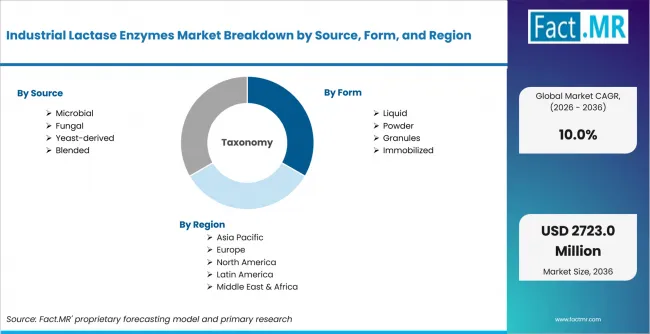
Industrial Lactase Enzymes Market Breakdown By Source, Form, And Region | Source: Fact.MR
| Attribute | Details |
|---|---|
| Quantitative Units | USD million |
| Market Definition | Industrial lactase enzymes are beta-galactosidase enzyme preparations used to hydrolyze lactose in dairy, food ingredients, nutraceuticals and industrial biotech processes. |
| Source | Microbial; Fungal; Yeast-derived; Blended |
| Form | Liquid; Powder; Granules; Immobilized |
| Function | Hydrolysis; Yield improvement; Process efficiency; Quality control |
| Application | Dairy processing; Food ingredients; Nutraceuticals; Industrial biotech |
| Regions Covered | North America; Latin America; Western Europe; Eastern Europe; East Asia; South Asia & Pacific; Middle East & Africa |
| Countries Covered | USA; Germany; Japan; France; Brazil |
| Key Companies Profiled | Novonesis; dsm-firmenich; IFF; Amano Enzyme Inc.; Kerry Group plc; Advanced Enzyme Technologies Limited |
| Forecast Period | 2026 to 2036 |
| Approach | Hybrid top-down and bottom-up approach using dairy processing demand, enzyme form mix, source qualification, application intensity, country adoption and provider portfolio review. |
Source: Fact.MR analysis. Updated Aug 31, 2026
How is the market segmented?
-
By Source:
- Microbial
- Fungal
- Yeast-derived
- Blended
-
By Form:
- Liquid
- Powder
- Granules
- Immobilized
-
By Function:
- Hydrolysis
- Yield improvement
- Process efficiency
- Quality control
-
By Application:
- Dairy processing
- Food ingredients
- Nutraceuticals
- Industrial biotech
-
By Region:
- North America
- Latin America
- Western Europe
- Eastern Europe
- East Asia
- South Asia & Pacific
- Middle East & Africa
Frequently Asked Questions
How big is the industrial lactase enzymes market in 2026?
What is the CAGR of the industrial lactase enzymes market from 2026 to 2036?
Which source leads the industrial lactase enzymes market?
Which form leads the industrial lactase enzymes market?
Who are the leading companies in the industrial lactase enzymes market?
Who worked on this report


Preview the report firsthand - request a free sample
Free SampleGet the brochure for pricing and purchase details
Download PDF