- Market Value (2025): USD 293.1 Mn
- Estimated Value (2026): USD 308.9 Mn
- Forecast Value (2036): USD 521.1 Mn
- CAGR (2026-2036): 5.4%
What is the Inert Ceramic Balls Market forecast to be worth by 2036?
USD 308.9 million in 2026 to USD 521.1 million by 2036, at a 5.4% CAGR.
- The inert ceramic balls market reached USD 293.1 million in 2025.
- According to Fact.MR analysis, demand will increase from USD 308.9 million in 2026 to USD 521.1 million by 2036.
- The market is expected to grow at a 5.4% CAGR between 2026 and 2036, reflecting new vessel orders and planned catalyst-change schedules.
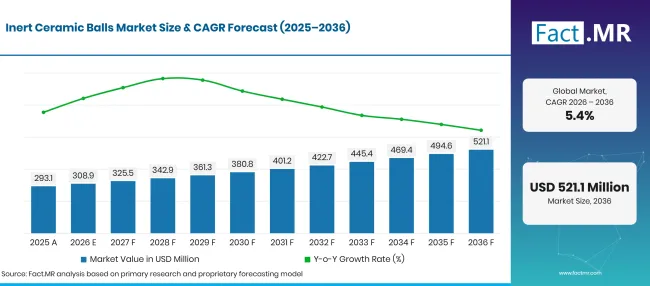
Factmr Inert Ceramic Balls Market Forecast Global | Source: Fact.MR
| Year | Basis | Market Value (USD million) |
|---|---|---|
| 2025 | Actual | 293.1 |
| 2026 | Estimate | 308.9 |
| 2036 | Forecast | 521.1 |
| CAGR 2026 to 2036 | Forecast period | 5.4% |
Source: Fact.MR analysis. Updated Oct 19, 2026
What are the defining numbers behind Inert Ceramic Balls Market growth?
USD 212.2 million additional market value between 2026 and 2036, led by alumina materials and petrochemical applications.
- Demand Drivers in the Market
- Process engineers use inert ceramic balls to hold catalyst layers in place without changing the reaction inside the vessel. Before loading begins, they check ball diameter and crushing strength against the bed design.
- Refinery teams often replace support balls when they open a reactor for scheduled catalyst work.
- Petrochemical plant operators need stable flow through packed vessels as temperatures change during operating cycles. High-alumina ceramic balls are selected where resistance to heat and mechanical stress matters.
- Key Segments Analyzed
- By Material Type: Alumina holds 42.3% share in 2026 as catalyst-bed designers use ceramic media with tested heat resistance.
- By Application: Petrochemical represents 42.3% share in 2026, reflecting support-media purchases for chemical process vessels.
- By End-Use Industry: Oil & Gas represents 53.6% share in 2026 because refinery units use packed catalyst and adsorbent beds.
- Analyst Opinion at Fact.MR
- Shambhu Nath Jha, Principal Consultant at Fact.MR, states, “Purchasing decision for inert ceramic balls begins with the vessel drawing and catalyst loading plan. A low-priced ball offers limited value if it fractures or blocks the support screen. Suppliers that document crush strength and chemical composition alongside size tolerance are better placed to meet repeat qualification needs.”
- Strategic Implications
- Ceramic manufacturers should provide clear size distributions and documented crushing tests so refinery engineers can approve a ball grade against vessel specifications.
- Catalyst loading contractors benefit from keeping the required sizes in stock before a planned shutdown, since late delivery delays the entire bed-replacement task.
- Process licensors must align support-ball grading with screens and the catalyst loading plan to manage flow and stop small particles passing into lower layers.
- Plant owners should compare usable service life and replacement labor alongside the purchase price because vessel access is costly during a scheduled turnaround.
Germany is expected to grow at a 6.4% CAGR as chemical plants focus on reliable reactor bed performance. Brazil follows at 5.9%, supported by refining and gas-processing uses. The United States records 5.3% as plants replace and maintain reactor media. The United Kingdom stands at 4.8%, while Japan reaches 4.2% as replacement spending grows at a slower pace. These scheduled media changes also support wider industrial catalyst operations.
How does the Inert Ceramic Balls Market break down by segment?
Alumina holds 42.3%; Petrochemical accounts for 42.3% share in 2026.
Which Material Type dominates?
Alumina holds 42.3% share in 2026.
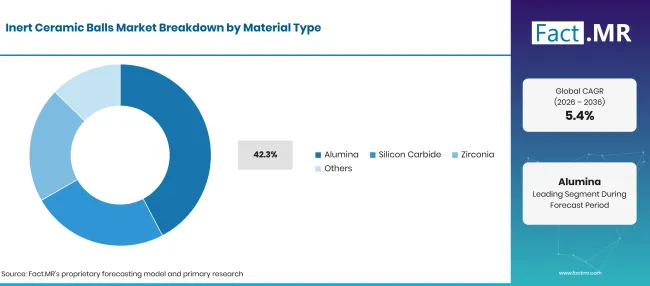
Factmr Inert Ceramic Balls Market Breakdown Material Type | Source: Fact.MR
| Material Type dominates | Share (2026) |
|---|---|
| Alumina (Leading segment) | 42.3% |
| Other segments combined | 57.7% |
| Total | 100.0% |
Source: Fact.MR analysis. Updated Oct 19, 2026
Alumina ceramic balls are specified where operating temperature and contact with process materials place demands on the support layer. Their role is mechanical support rather than active catalysis. Silicon carbide enters selected demanding environments where its properties meet the equipment design. Zirconia covers specialist applications that justify a different ceramic composition. Saint-Gobain NorPro describes its Denstone family as engineered to resist breakage and limit unwanted pressure loss [7].
What leads the Application segment?
Petrochemical accounts for 42.3% share in 2026.
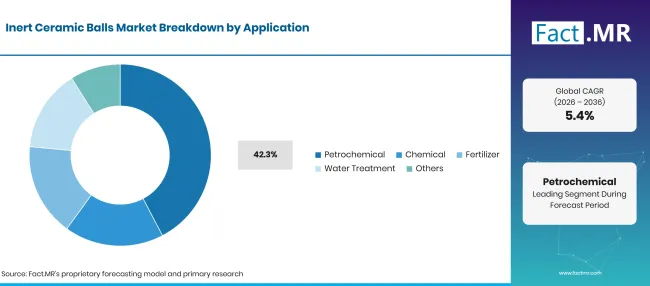
Factmr Inert Ceramic Balls Market Breakdown Application | Source: Fact.MR
| What leads the Application segment | Share (2026) |
|---|---|
| Petrochemical (Leading segment) | 42.3% |
| Other segments combined | 57.7% |
| Total | 100.0% |
Source: Fact.MR analysis. Updated Oct 19, 2026
Petrochemical reactors often contain catalysts or adsorbents supported by graded inert balls. Operators look closely at size changes between layers because poorly matched media can pass through a support grid or trap unwanted solids. Chemical applications include other packed process vessels where the support material must remain stable. Fertilizer units create a separate set of high-temperature and chemical compatibility requirements.
How does End-Use Industry purchasing shape sales?
Oil & Gas leads with 53.6% share in 2026.
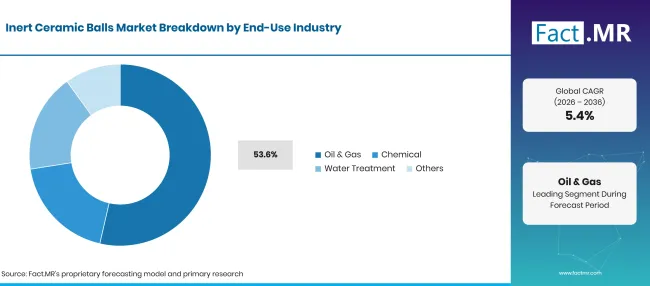
Factmr Inert Ceramic Balls Market Breakdown End Use Industry | Source: Fact.MR
| How does End-Use Industry purchasing shape sales | Share (2026) |
|---|---|
| Oil & Gas (Leading segment) | 53.6% |
| Other segments combined | 46.4% |
| Total | 100.0% |
Source: Fact.MR analysis. Updated Oct 19, 2026
Oil and gas operators use inert ceramic balls across refinery catalyst systems and selected gas-treatment beds. The purchasing pattern is closely tied to turnaround planning and replacement schedules. Chemical manufacturers choose support media against reactor design and the materials handled in the vessel. Water treatment operators consider flow distribution and compatibility with the treatment media. Christy Catalytics lists refinery and hydroprocessing uses for its ceramic support balls [8].
What is accelerating Inert Ceramic Balls Market adoption, and what is holding it back?
Catalyst-bed replacement supports orders, while material qualification and plant shutdown costs restrict faster switching.
Drivers Impact Analysis
| DRIVER | (~) % IMPACT ON CAGR | GEOGRAPHIC RELEVANCE | IMPACT TIMELINE |
|---|---|---|---|
| Refinery maintenance | +1.0% | Global | Medium term (2–4 years) |
| Petrochemical bed support | +0.8% | Europe, Americas | Medium term (2–4 years) |
| Thermal performance | +0.7% | Global | Long term (>= 4 years) |
| Repeat orders | +0.5% | Global | Short term (<= 2 years) |
| Quality documentation | +0.4% | Global | Medium term (2–4 years) |
Source: Fact.MR analysis. Updated Oct 19, 2026
Opportunity Impact Analysis
| OPPORTUNITY | (~) % IMPACT ON CAGR | GEOGRAPHIC RELEVANCE | IMPACT TIMELINE |
|---|---|---|---|
| Bed redesign projects | +0.8% | Global | Medium term (2–4 years) |
| Higher alumina grades | +0.6% | Global | Long term (>= 4 years) |
| Turnaround supply planning | +0.5% | Americas, Europe | Short term (<= 2 years) |
| Technical support packages | +0.4% | Global | Medium term (2–4 years) |
Source: Fact.MR analysis. Updated Oct 19, 2026
Restraints Impact Analysis
| RESTRAINT | (~) % IMPACT ON CAGR | GEOGRAPHIC RELEVANCE | IMPACT TIMELINE |
|---|---|---|---|
| Ceramic quality variation | -0.8% | Global | Short term (<= 2 years) |
| Shutdown costs | -0.6% | Global | Medium term (2–4 years) |
| Energy-intensive production | -0.5% | Europe, Asia | Medium term (2–4 years) |
| Alternative support shapes | -0.4% | Global | Long term (>= 4 years) |
Source: Fact.MR analysis. Updated Oct 19, 2026
Which countries are scaling the Inert Ceramic Balls Market through 2036?
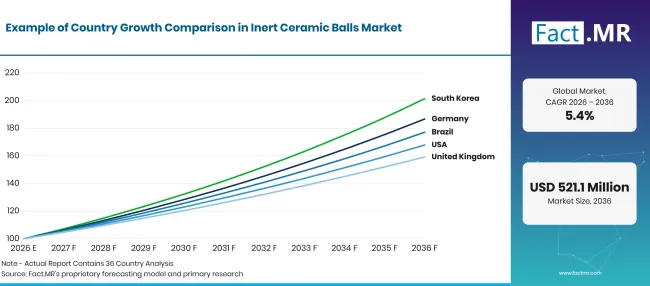
Factmr Inert Ceramic Balls Market Growth Index | Source: Fact.MR
| Country | CAGR (2026–2036) |
|---|---|
| Germany | 6.4% |
| Brazil | 5.9% |
| United States | 5.3% |
| United Kingdom | 4.8% |
| Japan | 4.2% |
Source: Fact.MR analysis. Updated Oct 19, 2026
Why is Germany expanding its inert ceramic balls market?
6.4% CAGR, linked to process equipment maintenance and media qualification.
Chemical plant operators can choose heat-resistant alumina media for equipment where the bed must remain stable across production cycles. According to Destatis, production in Germany’s energy-intensive industrial branches declined by 0.8% in January 2026 compared with December 2025 [2]. Changing industrial activity encourages chemical plant operators to review reactor operating costs and the reliability in support media.
How is Brazil supporting purchases of inert ceramic balls?
5.9% CAGR, shaped by refinery maintenance and regional ceramic supply.
Growth drivers: Brazil's ANP listed refining capacity at about 2.3 million barrels per day for 2025 in its June 2026 statistical yearbook [3]. The installed base creates recurring catalyst-support maintenance needs. ANP listed the Paulínia refinery nominal capacity at 433,996 barrels per day in its 2026 data release [4]. Large installations require careful shutdown coordination.
What shapes the United States outlook?
5.3% CAGR, linked to refinery loading schedules and engineering approvals.
Growth drivers: The U.S. Energy Information Administration reported in June 2026 that 130 petroleum refineries were operable on January 1, 2026 [1]. Their catalyst units form a recurring support-media service market. EIA recorded refinery utilization of 92.0% for 2025 [5]. Sustained plant use makes careful turnaround scheduling valuable for reactor components.
How does the United Kingdom source inert support media?
4.8% CAGR, shaped by specialist chemical processing and scheduled equipment service.
The Department for Energy Security and Net Zero recorded 2025 UK energy production of 94.0 million tonnes of oil equivalent [6]. Oil handling remains relevant to industrial maintenance planning. The same official report recorded a 2.5% rise in UK oil production during 2025. Qualification steps can limit switching between ceramic suppliers during a short refinery maintenance window.
What supports Japan's market outlook?
4.2% CAGR, linked to consistent ceramic grades for established process plants.
Refinery operators can use well-characterized support balls when catalyst beds are reloaded after scheduled maintenance. Chemical plants may prefer uniform sphere dimensions to keep a packed support layer level and protect equipment screens. Specialist engineering contractors can request crushing-strength data when comparing high-alumina and alternative grades.
Who leads the Inert Ceramic Balls Market?
Saint-Gobain NorPro and Christy Catalytics offer documented ceramic catalyst-bed support products.
Saint-Gobain NorPro markets Denstone support media, focusing on controlled chemistry and protection of catalyst beds. Christy Catalytics supplies PROX-SVERS ceramic support balls for refinery and petrochemical uses. Both explain product selection in terms of support performance, so customers can compare engineering specifications before placing an order. These direct product families provide clearer evidence of participation than broad descriptions of technical ceramics. Competition centers on qualified grades and delivery support instead of a single universal ball specification.
Which companies are the key providers?
Key companies include Pingxiang Funeng Chemical Industry; Saint-Gobain NorPro; Christy Catalytics LLC; Interra Global; SorbiTech.
- Pingxiang Funeng Chemical Industry
- Saint-Gobain NorPro
- Christy Catalytics LLC
- Interra Global
- SorbiTech
Bibliography
- [1] U.S. Energy Information Administration. (2026, June 29). U.S. refining capacity decreased during 2025.
- [2] Statistisches Bundesamt (Destatis). (2026, March 9). Production in January 2026: -0.5% on the previous month.
- [3] Agência Nacional do Petróleo, Gás Natural e Biocombustíveis. (2026, June 26). Anuário Estatístico Brasileiro do Petróleo, Gás Natural e Biocombustíveis 2026.
- [4] Agência Nacional do Petróleo, Gás Natural e Biocombustíveis. (2026, August 17). Refining capacity on December 31, 2025 [CSV data file].
- [5] U.S. Energy Information Administration. (2026, September 30). U.S. refinery utilization and capacity.
- [6] Department for Energy Security and Net Zero. (2026, July 16). DESNZ annual report 2025 to 2026: Performance report. GOV.UK.
- [7] Saint-Gobain NorPro. (n.d.). Denstone® Support Media Product Family.
- [8] Christy Catalytics. (n.d.). Ceramic Balls.
This Report Answers
- The report examines how plant operators choose inert support media for catalyst beds and adsorbent columns.
- Material analysis compares alumina with silicon carbide and zirconia according to specific service conditions.
- Application analysis explains the role of support spheres in petrochemical, chemical and fertilizer operations.
- Country analysis contrasts replacement purchasing and industrial activity in five selected national markets.
- Supplier discussion separates finished support-ball products from adjacent catalyst-bed technologies and alumina materials.
What does the Inert Ceramic Balls Market cover?
The scope covers ceramic balls used to support, hold down or separate layers of catalyst and adsorbent media inside industrial vessels. Balls are assessed for size, chemical compatibility and resistance to crushing. Related equipment and active catalysts fall outside the material sale itself. Related work on next-generation catalysts considers changes in active catalyst systems alongside support media.
What is included in the scope?
Included products are ceramic spheres delivered for inert support or hold-down duty in packed industrial vessels.
The analysis covers finished support media sold to refinery operators, chemical plants and water-treatment users. It includes replacement purchases when an existing bed is opened and first loading when a vessel is commissioned. Material selection is considered in relation to the actual work the sphere performs inside the bed.
What is excluded from the scope?
The figures exclude active catalyst beads sold primarily for their catalytic function and loose alumina powder before it becomes finished balls.
Ceramic bearings and general grinding media are also outside the boundary. Loading labor and vessel inspection services do not count as support-ball sales. When a product has more than one possible use, its placement depends on its principal commercial application.
How Was the Analysis Built?
The analysis draws on 120+ sources, 35+ company portfolios, 25+ countries, and more than 20 industry interviews.
- Primary Research: Primary research includes discussions with manufacturers, service providers, technology developers, distributors, end users, and subject-matter experts. These conversations examine purchasing priorities, product adoption, operational challenges, approval requirements, competitive positioning, and the factors that influence wider market acceptance.
- Desk Research: Desk research covers government statistics, regulatory publications, company filings, trade data, technical studies, industry associations, standards, public policy, and other authoritative sources. Every source used in the analysis is documented in the bibliography.
- Market Sizing and Forecasting: Market estimates combine historical performance, demand indicators, pricing and volume trends, segment shares, company participation, country-level growth, adoption patterns, investment activity, and barriers to market expansion.
- Data Validation and Update Cycle: Findings are validated by comparing primary interviews with public data, company activity, regulatory changes, trade patterns, and industry developments. Regular updates review new product launches, capacity changes, partnerships, approvals, and shifts in commercial adoption.
Segmentation
What is the report’s scope and coverage?
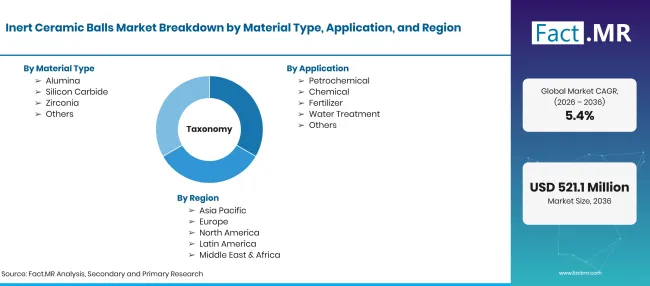
Factmr Inert Ceramic Balls Market Taxonomy | Source: Fact.MR
| Attribute | Details |
|---|---|
| Quantitative Units | USD million in 2026 to USD million by 2036, at CAGR |
| Market Definition | Inert ceramic spheres supplied as support or hold-down media in industrial packed beds. |
| Material Type | Alumina; Silicon Carbide; Zirconia; Others |
| Application | Petrochemical; Chemical; Fertilizer; Water Treatment; Others |
| End-Use Industry | Oil & Gas; Chemical; Water Treatment; Others |
| Regions Covered | North America; Latin America; Western Europe; Eastern Europe; East Asia; South Asia & Pacific; Middle East & Africa |
| Countries Covered | Germany; Brazil; United States; United Kingdom; Japan |
| Companies Profiled | Pingxiang Funeng Chemical Industry; Saint-Gobain NorPro; Christy Catalytics LLC; Interra Global; SorbiTech. |
| Forecast Period | 2026 to 2036 |
| Approach | Vessel service conditions, verified product specifications, public energy statistics and stated market forecasts |
Source: Fact.MR analysis. Updated Oct 19, 2026
How is the market segmented?
-
By Material Type
- Alumina
- Silicon Carbide
- Zirconia
- Others
-
By Application
- Petrochemical
- Chemical
- Fertilizer
- Water Treatment
- Others
-
By End-Use Industry
- Oil & Gas
- Chemical
- Water Treatment
- Others
-
By Region
- North America
- Latin America
- Western Europe
- Eastern Europe
- East Asia
- South Asia & Pacific
- Middle East & Africa
Frequently Asked Questions
How big is the Inert Ceramic Balls Market in 2026?
What is the CAGR of the Inert Ceramic Balls Market from 2026 to 2036?
Which material type leads the Inert Ceramic Balls Market?
Which application leads the Inert Ceramic Balls Market?
Who are the leading companies in the Inert Ceramic Balls Market?
Who worked on this report


Preview the report firsthand - request a free sample
Free SampleGet the brochure for pricing and purchase details
Download PDF