- Base Value(2026): 312.7 Bn
- Estimated Value(2026): 312.7 Bn
- Forecast Value (2036): 510.8 Bn
- CAGR (2026 - 2036): 5.0%
Injection Molding Market Forecast and Outlook 2026 to 2036
The global injection molding market is projected to grow from USD 312.66 billion in 2026 to approximately USD 510.8 billion by 2036, expanding at a CAGR of 5.0% between 2026 and 2036. The market will likely expand 1.6X, supported by exponential demand for precision manufacturing solutions, rising adoption of advanced molding technologies, and growing emphasis on production efficiency innovation and material optimization.
Quick Stats on Injection Molding Market
- Injection Molding Market Value (2026): USD 312.66 billion
- Injection Molding Market Forecast Value (2036): USD 510.8 billion
- Injection Molding Market Forecast CAGR (2026 to 2036): 5.0%
- Leading Material in Injection Molding Market: Plastics (98.0%)
- Leading Application in Injection Molding Market: Packaging (32.2%)
- Key Growth Regions in Injection Molding Market: Asia Pacific, North America, and Europe
- Key Players in Injection Molding Market: C&J Industries, All-Plastics, Biomerics, HTI Plastics, The Rodon Group, EVCO Plastics, Majors Plastics INC, Proto Labs, Tessy Plastics, Currier Plastics Inc.
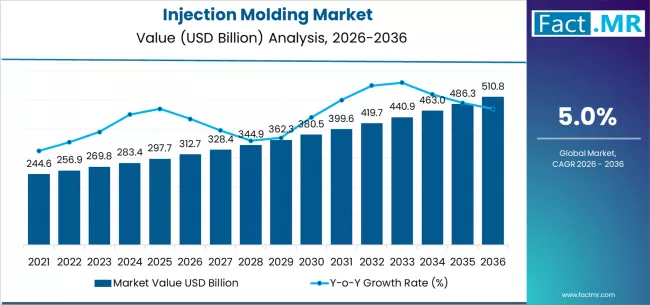
Injection Molding Market Market Value Analysis | Source: Fact.MR
The injection molding market is positioned for substantial expansion, driven by increasing recognition of injection molding efficiency importance, growing demand for complex part manufacturing with enhanced quality standards, and rising adoption of advanced automation technologies across packaging, automotive, and consumer goods production operations globally.
Growth relies on technological innovations in injection molding systems, particularly advanced multi-material molding technologies and intelligent process control system integration, which offer enhanced production flexibility, improved part quality, and superior compatibility with comprehensive automation protocols prevalent in contemporary manufacturing practices.
Manufacturing operators increasingly prioritize injection molding solutions that deliver optimal balance between production speed, dimensional accuracy, and cost-effectiveness while adhering to increasingly stringent quality standards and environmental requirements across global industrial markets.
The injection molding landscape is experiencing transformative changes as manufacturers adopt sophisticated technologies including electric injection molding machines, advanced real-time monitoring systems, and intelligent mold temperature control platforms that enable predictive quality management and optimized cycle time reduction.
Injection Molding Market Key Takeaways
| Metric | Value |
|---|---|
| Estimated Value (2026E) | USD 312.66 billion |
| Forecast Value (2036F) | USD 510.8 billion |
| Forecast CAGR (2026 to 2036) | 5.0% |
Source: Fact.MR analysis. Updated Dec 22, 2025
Category
| Category | Segments |
|---|---|
| Material | Plastics; Metal; Others |
| Application | Packaging; Consumables and Electronics; Automotive and Transportation; Building and Construction; Medical; Others |
| Region | Asia Pacific; North America; Europe; Latin America; Middle East & Africa |
Source: Fact.MR analysis. Updated Dec 22, 2025
Segmental Analysis
Why is Plastic the Preferred Material for Injection Molding?
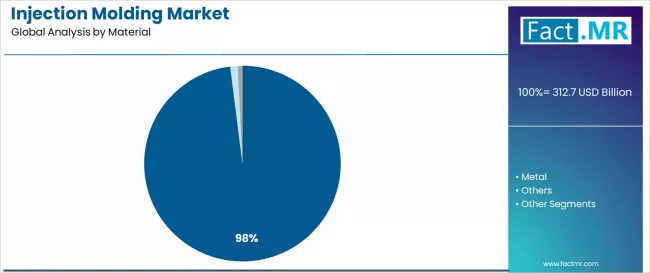
Injection Molding Market Analysis By Material | Source: Fact.MR
Plastic injection molding is projected to account for 98.0% of the injection molding market in 2026. Manufacturing operators increasingly recognize the optimal balance of processing versatility and cost-effectiveness offered by plastic materials for injection molding applications, particularly in high-volume production operations and complex component manufacturing environments.
This material category addresses both production efficiency requirements and design flexibility demands while providing reliable processing outcomes across diverse manufacturing applications.
Why do Packaging Applications Command the Majority Market Share?
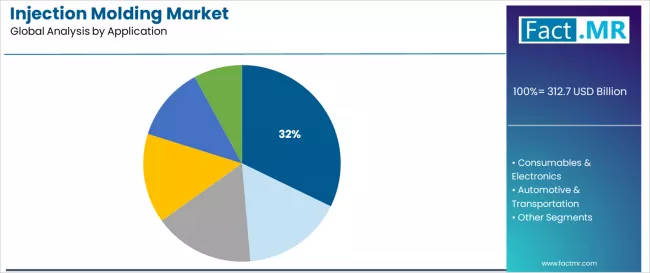
Injection Molding Market Analysis By Application | Source: Fact.MR
Packaging applications will likely represent 32.2% of injection molding demand in 2026, underscoring its role as the primary application category driving market volume and production throughput.
Injection molding utilized in packaging applications offers enhanced production efficiency and cost competitiveness essential for serving consumer goods and food and beverage packaging requirements.
What are the Drivers, Restraints, and Key Trends of the Injection Molding Market?
The injection molding market is driven by growing demand for high-volume, cost-efficient manufacturing across automotive, packaging, consumer goods, and electronics industries. Manufacturers are increasingly prioritizing production efficiency, dimensional accuracy, and cycle time reduction to remain competitive. Continued industrial automation and demand for consistent large-scale output are reinforcing adoption across global manufacturing operations.
Market restraints include high upfront capital investment for advanced molding equipment, which can delay adoption among small and mid-scale manufacturers. Volatility in polymer raw material prices affects production economics and margin stability. In addition, technical complexity associated with processing recycled and bio-based polymers creates operational challenges and requires process optimization expertise.
Key trends include accelerated adoption of all electric and hybrid injection molding machines that deliver higher energy efficiency, precision control, and lower operating costs. Integration of Industry 4.0 technologies, including real-time process monitoring, predictive analytics, and AI-driven optimization, is also gaining traction. These digital capabilities improve quality consistency, reduce scrap rates, and enhance overall equipment effectiveness across modern molding operations.
Analysis of the Injection Molding Market by Key Countries
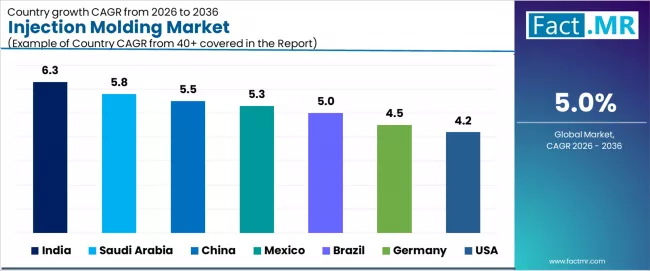
Injection Molding Market Cagr Analysis By Country | Source: Fact.MR
| Country | CAGR (2026-2036) |
|---|---|
| India | 6.3% |
| China | 5.5% |
| Saudi Arabia | 5.8% |
| Mexico | 5.3% |
| Brazil | 5.0% |
| Germany | 4.5% |
| USA | 4.2% |
Source: Fact.MR analysis. Updated Dec 22, 2025
How is India’s Automotive Upswing Reshaping Injection Molding Demand?
India’s injection molding market is expanding steadily as automotive production, packaging demand, and consumer goods manufacturing scale up together. Growth is most visible in industrial clusters across Maharashtra, Gujarat, and Tamil Nadu, where suppliers are upgrading molding capacity to meet volume, cost, and export quality requirements. Policy support through Make in India, combined with competitive manufacturing costs and a growing technical workforce, continues to encourage investment in electric and automated molding systems.
Why does China Continue to Anchor Global Injection Molding Volumes?
China’s dominance in injection molding is rooted in its unmatched manufacturing scale and deep automation integration. Producers across coastal industrial corridors are increasingly deploying precision and energy-efficient machines to support high-volume consumer electronics and automotive component production. As manufacturers shift toward higher-value output and tighter quality control, demand remains strong for advanced molding systems that can sustain throughput while improving consistency.
How is Construction-led Industrialisation Driving Saudi Arabia’s Market?
Saudi Arabia’s injection molding demand is closely tied to construction growth and industrial diversification under Vision 2030. Expanding infrastructure programs are increasing the need for molded building components and industrial parts, encouraging manufacturers to invest in reliable, scalable molding equipment. The focus remains on production capacity and operational stability rather than customization, reflecting the market’s early-stage manufacturing maturity.
What sustains Mexico’s Role as a North American Molding Hub?
Mexico’s injection molding market benefits from its integration into automotive and export manufacturing supply chains. Facilities in key industrial regions are expanding molding capacity to serve OEMs and Tier-1 suppliers, balancing cost efficiency with rising quality expectations. Proximity to US markets and trade agreement advantages continue to underpin steady equipment investment across automotive and consumer goods production.
How is Domestic Consumption Supporting Brazil’s Injection Molding Expansion?
Brazil’s market growth is shaped by rising domestic demand for packaged goods and consumer products. Manufacturers are modernising molding operations to improve efficiency and reduce production costs, particularly in packaging and household goods. While capital spending remains selective, industrial expansion and market scale continue to support gradual adoption of newer molding technologies.
Why does Germany Remain a Benchmark for Precision Molding?
Germany’s injection molding market reflects its broader engineering culture, where precision, documentation, and long-term performance guide equipment decisions. Automotive suppliers and medical device manufacturers invest in high-specification machines that integrate tightly with automated production lines. Growth is moderate but consistent, anchored in quality-driven applications rather than volume expansion.
What Keeps the USA Focused on High-Precision Injection Molding?
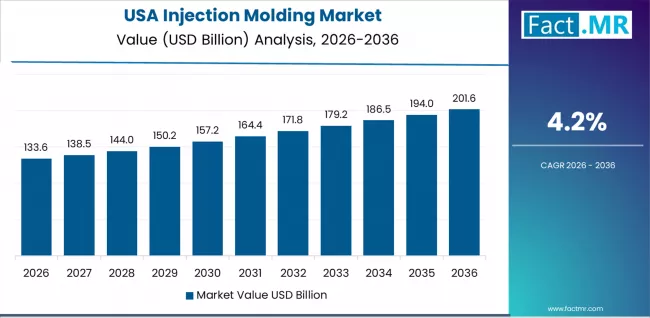
Injection Molding Market Country Value Analysis | Source: Fact.MR
In the USA, injection molding growth is concentrated in medical devices, electronics, and specialised components rather than mass production. Manufacturers prioritise machines capable of meeting strict regulatory standards, cleanroom compatibility, and repeatable precision. Investment decisions are driven less by scale and more by compliance, reliability, and advanced process control.
Competitive Landscape of the Injection Molding Market
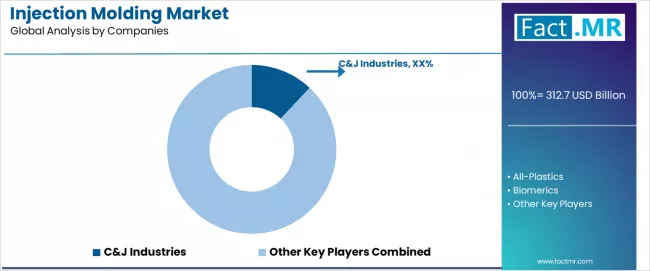
Injection Molding Market Analysis By Company | Source: Fact.MR
The injection molding market is highly competitive, with participation from contract manufacturers, specialized molding service providers, and integrated manufacturing organizations. Competition is driven by process reliability, automation adoption, material expertise, and the ability to meet stringent quality and sustainability requirements across end-use industries rather than price alone.
C&J Industries holds a leading position, supported by precision molding capabilities, advanced production infrastructure, and strong relationships across industrial and medical applications. Other established players such as All-Plastics and Biomerics compete through custom manufacturing expertise, project management capabilities, and compliance with regulated industry standards. HTI Plastics and The Rodon Group emphasize automotive, industrial, and high-volume consumer goods production, leveraging scale and operational efficiency.
Companies including EVCO Plastics, Majors Plastics Inc., Tessy Plastics, and Currier Plastics strengthen competition through engineering support, sustainable material processing, and long-term customer partnerships. Proto Labs differentiates through rapid and on-demand manufacturing models that support prototyping and short production runs. This competitiveness favors manufacturers combining automation, material innovation, and consistent quality delivery with flexible production and strong customer collaboration.
Key Players in the Injection Molding Market
- C&J Industries
- All-Plastics
- Biomerics
- HTI Plastics
- The Rodon Group
- EVCO Plastics
- Majors Plastics INC
- Proto Labs
- Tessy Plastics
- Currier Plastics Inc.
Segmentation
Scope of the Report
| Items | Values |
|---|---|
| Quantitative Units (2026) | USD 312.66 Billion |
| Material | Plastics, Metal, Others |
| Application | Packaging, Consumables & Electronics, Automotive & Transportation, Building & Construction, Medical, Others |
| Regions Covered | Asia Pacific, North America, Europe, Latin America, MEA |
| Countries Covered | USA, Germany, India, China, Mexico, Brazil, Saudi Arabia and 40+ countries |
| Key Companies Profiled | C&J Industries, All-Plastics, Biomerics, HTI Plastics, The Rodon Group, EVCO Plastics, Majors Plastics INC, Proto Labs, Tessy Plastics, Currier Plastics Inc. |
| Additional Attributes | Dollar sales by material, application, regional demand trends, competitive landscape, manufacturer preferences for specific injection molding solutions, integration with comprehensive automation systems, innovations in electric machine development, sustainable material processing advancement, and production efficiency optimization capabilities |
Source: Fact.MR analysis. Updated Dec 22, 2025
Injection Molding Market by Segments
-
Material :
- Plastics
- Metal
- Others
-
Application :
- Packaging
- Consumables & Electronics
- Automotive & Transportation
- Building & Construction
- Medical
- Others
-
Region :
-
Asia Pacific
- China
- India
- Japan
- South Korea
- ASEAN
- Australia & New Zealand
- Rest of Asia Pacific
-
North America
- USA
- Canada
- Mexico
-
Europe
- Germany
- France
- UK
- Italy
- Spain
- Nordic
- BENELUX
- Rest of Europe
-
Latin America
- Brazil
- Argentina
- Chile
- Rest of Latin America
-
MEA
- Saudi Arabia
- Other GCC Countries
- Turkey
- South Africa
- Other African Countries
- Rest of MEA
-
Frequently Asked Questions
How big is the injection molding market in 2026?
What will be the size of injection molding market in 2036?
How much will be the injection molding market growth between 2026 and 2036?
What are the key product types in the injection molding market?
Which application segment to contribute significant share in the injection molding market in 2026?
Who worked on this report


Preview the report firsthand - request a free sample
Free SampleGet the brochure for pricing and purchase details
Download PDF