The Intraoperative Margin Assessment Device Market is analyzed across its key product, application and end-use segments, with the study covering market dynamics, regional trends and demand outlook, forecast 2026 to 2036.
By Fact.MR Healthcare DeskLead analyst:
S.N. JhaPublished :
Updated :
10 min read
Fact-checked under the Fact.MR editorial process
Intraoperative Margin Assessment Device Market Forecast and Outlook 2026 to 2036
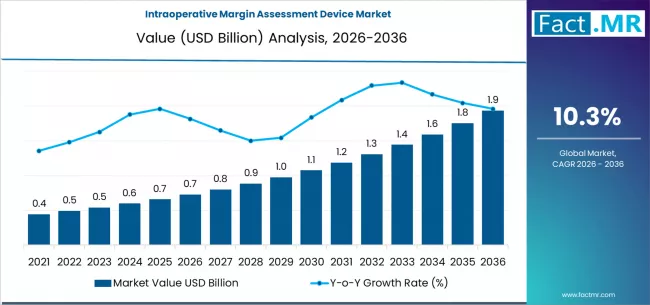
The global intraoperative margin assessment devices market is projected to total USD 0.73 billion in 2026, advancing to USD 1.93 billion by 2036, progressing at a 10.3% CAGR. This expansion is driven by the paradigm shift in surgical oncology from postoperative pathology to real-time, in-situ tissue analysis during cancer resection procedures.
Summary of Intraoperative Margin Assessment Device Market
Market Snapshot
Global intraoperative margin assessment device market revenue stood at USD 0.73 billion in 2026 and is forecast to reach USD 1.93 billion by 2036.
At a 10.3%CAGRfrom 2026 to 2036, this market is set to expand ~2.6x in value, adding USD 1.20 billion in absolute opportunity.
This marketrepresentsa high-growth intraoperative imaging and surgical decision-support segment, focused on enabling real-time cancer margin detection duringtumorresection procedures.
Intraoperative margin assessment devices are evolving into real-time tissue characterization platforms, allowing surgeons to assess cancerous margins during surgery and reduce the need for repeat operations.
Demand and Growth Drivers
Increasing emphasis on real-time intraoperative decision-making in surgical oncology is the primary growth driver.
Rising need to reduce re-operation rates in cancer surgeries, particularly in breast-conserving procedures, is accelerating adoption.
Shift from postoperative pathology to intraoperative diagnostics is improving surgical efficiency and patient outcomes.
Growth in oncology surgical volumes globally is supporting demand for precision tools.
Advancements in optical spectroscopy, fluorescence imaging, andRF-based systems are enhancing diagnostic accuracy and workflow integration.
Product and Segment View
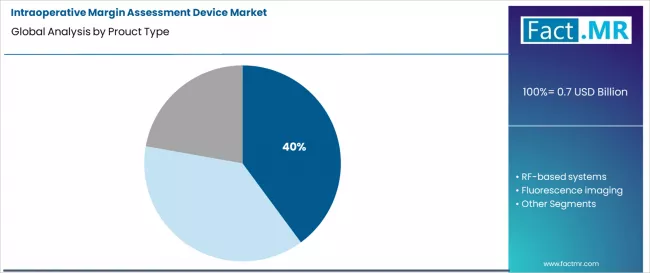
Optical spectroscopy systems hold 39.9% of product type share in 2026,emergingas the dominant segment due to real-time, label-free tissue analysis capability.
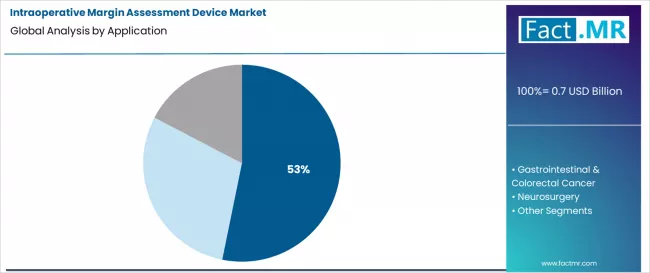
Breast cancer accounts for 53.2% of application share in 2026, positioning it as the leading segment due to high volume of lumpectomy procedures and need for margin precision.
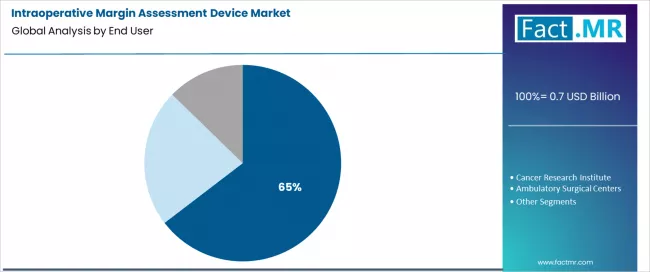
Hospitals account for 64.6% of end-user share in 2026, reflecting concentration of advanced surgical infrastructure.
Key product categories include:
Optical spectroscopy systems
RF-based systems
Fluorescence imaging systems
Core functionalities include:
Real-time margin detection during surgery
Reduction in repeat surgical procedures
Improvedtumorexcision accuracy
Geography and Competitive Outlook
Growth is supported across North America, Europe, and Asia Pacific, driven by oncology infrastructure and surgical innovation.
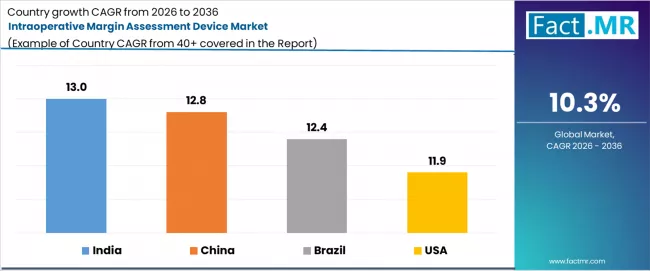
India (13.0%CAGR), China (12.8%), Brazil (12.4%), and United States (11.9%) are key growth markets.
Market expansion is closely tied to:
Growth in cancer incidence and surgical procedures
Adoption of precision medicine approaches
Investment in advanced surgical technologies
Key companies active in this market includeHologic, Dune Medical Devices,Lumicell, Stryker, and KarlStorz.
Intraoperative Margin Assessment Device Market — At a Glance
Attribute
Details
Market Value 2026
USD 0.73 billion
Market Value 2036
USD 1.93 billion
Absolute Dollar Opportunity 2026-2036
USD 1.20 billion
Total Growth 2026-2036
164.4%
CAGR2026-2036
10.3%
Growth Multiple
~2.6x
Key Demand Theme
Adoption of real-time intraoperative margin assessment to improve surgical accuracy and reduce re-operations
Leading Segment by Product Type (2026)
Optical Spectroscopy Systems
Segment Share (2026)
39.9%
Leading Segment by Application (2026)
Breast Cancer
Segment Share (2026)
53.2%
Leading Segment by End User (2026)
Hospitals
Segment Share (2026)
64.6%
Key Growth Regions
North America, Europe, Asia Pacific
CountryCAGRs
India 13.0%, China 12.8%, Brazil 12.4%, USA 11.9%
Top Companies
Hologic, Dune Medical Devices,Lumicell, Stryker, KarlStorz
North America, Latin America, Western Europe, Eastern Europe, East Asia, South Asia & Pacific, Middle East & Africa
Source: Fact.MR analysis. Updated Apr 30, 2026
The critical challenge in tumor removal is ensuring complete excision while preserving healthy tissue, a balance historically determined after surgery, often leading to unnecessary second operations. Real-time margin assessment technologies have become indispensable, providing surgeons with immediate feedback on the presence of cancerous cells at the resection edge. These devices are critical for reducing re-excision rates, improving patient outcomes, lowering overall healthcare costs, and minimizing surgical trauma. The market's growth is a direct product of the rising global cancer burden, the strong clinical and economic value proposition of these tools, and their integration into value-based surgical care pathways. This landscape, encompassing breast conservation, gastrointestinal, and neurosurgical oncology, makes intraoperative margin technology a transformative standard of care in the operating room.
Breast Cancer, Gastrointestinal & Colorectal Cancer, Neurosurgery
End User
Hospitals, Cancer Research Institutes, Ambulatory Surgical Centers
Region
North America, Latin America, Western Europe, Eastern Europe, East Asia, South Asia & Pacific, MEA
Source: Fact.MR analysis. Updated Apr 30, 2026
Segmental Analysis
By Product Type, Which Technology Offers Broad Utility and Clinical Data?
Intraoperative Margin Assessment Device Market Analysis By Prouct Type | Source: Fact.MR
Optical spectroscopy systems command a leading 39.9% share. This segment's dominance is attributed to its ability to provide real-time, label-free biochemical analysis of tissue without the need for exogenous dyes.
Technologies like Raman or diffuse reflectance spectroscopy can differentiate between malignant and benign tissue based on intrinsic optical properties, offering versatility across multiple cancer types. Their non-destructive nature and growing body of clinical validation support their adoption as a first-line intraoperative tool.
By Application, Which Surgical Oncology Field is the Primary Adoption Driver?
Breast cancer surgery is the dominant application with a 53.2% share. This is due to the high volume of breast-conserving surgeries, or lumpectomies, where clear margins are critical, and the clinical and economic cost of re-operation is well-documented.
The standardized surgical approach and strong patient advocacy have made breast oncology the primary clinical and commercial focus for device developers, generating the most robust evidence for improving outcomes and driving widespread procedural integration.
By End User, Where is the Highest Concentration of Complex Cancer Surgery?
Intraoperative Margin Assessment Device Market Analysis By End User | Source: Fact.MR
Hospitals constitute the overwhelming end-user segment, holding 64.6% of the market. Academic medical centers and large community hospitals perform the vast majority of complex cancer resections.
These institutions have the surgical volume, multidisciplinary tumor boards, and capital budgets necessary to invest in advanced surgical technologies. They are also the primary sites for clinical trials and training, solidifying their role as the central adopters and influencers for this technology.
What are the Principal Drivers, Constraints, and Evolving Dynamics of this Market?
Attribute
Expected Impact
Shift from Postoperative to Intraoperative Decision-Making
Drives direct demand by offering a clear value proposition, which is, reducing re-excision rates, improving patient outcomes, and lowering overall cost of care, thereby accelerating hospital adoption.
High Capital Cost and Unclear Reimbursement Pathways
Restrains market penetration, particularly in cost-sensitive settings and smaller surgical centers, by creating significant budgetary barriers and financial uncertainty for hospitals.
Integration with AI for Predictive Analytics and Robotic Surgery Platforms
Presents a major opportunity to enhance device accuracy, provide surgical guidance, and embed margin assessment into next-generation digital operating rooms, creating premium product tiers.
Market Consolidation via Partnerships and Acquisitions
Defines the competitive trend, as large medtech giants acquire innovative startups to secure technology, while startups partner with OEMs for global distribution and clinical validation.
Source: Fact.MR analysis. Updated Apr 30, 2026
Analysis of the Intraoperative Margin Assessment Device Market by Key Countries
Intraoperative Margin Assessment Device Market Cagr Analysis By Country | Source: Fact.MR
Country
CAGR 2026 to 2036
India
13.0%
China
12.8%
Brazil
12.4%
USA
11.9%
Source: Fact.MR analysis. Updated Apr 30, 2026
How does India's Growing Surgical Volume and Healthcare Modernization drive Growth?
A vast and growing patient population, increasing cancer incidence, and a major push to modernize healthcare infrastructure propel India’s leading growth rate of 13.0% CAGR. Growth is driven by the expansion of private hospital chains offering advanced oncology care and a growing emphasis on surgical outcomes.
The cost-effectiveness of preventing revision surgeries presents a strong value argument in India's price-sensitive market, fostering adoption of these technologies in leading urban surgical centers as a differentiator for quality care.
What Factors underpin China's Rapid Adoption of Advanced Medical Technology?
China's robust growth at 12.8% CAGR is fueled by substantial government investment in healthcare, rising healthcare expenditure, and a national focus on improving cancer care standards. The large volume of cancer surgeries provides a significant base for technology adoption.
The market in China is characterized by both the procurement of international devices and a parallel, state-supported drive to develop domestic alternatives, creating a dynamic and fast-evolving competitive landscape within the country's major tertiary hospitals.
Why is Brazil a High-Growth Market despite Regional Economic Variability?
Brazil's significant growth at 12.4% CAGR is driven by a high burden of breast cancer, a well-developed network of private oncology clinics and hospitals, and increasing patient awareness demanding higher-quality surgical outcomes.
Adoption is concentrated in large urban centers within the private healthcare system, which serves a significant portion of the population and competes on technological sophistication. Regulatory efforts to streamline approvals for innovative medical devices also support market entry and growth.
How does the USA's Mature Healthcare and Reimbursement Landscape Shape Adoption?
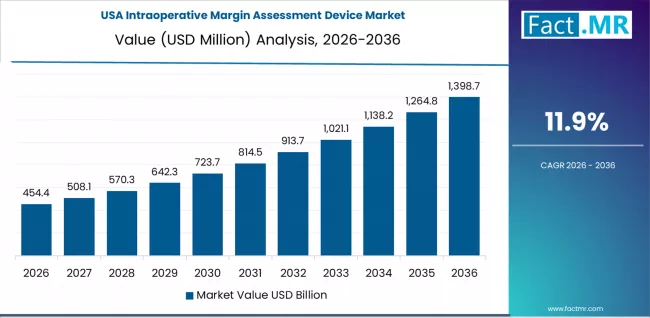
Intraoperative Margin Assessment Device Market Country Value Analysis | Source: Fact.MR
The USA's strong growth at 11.9% CAGR operates within a mature framework of clinical evidence, value-based care incentives, and complex reimbursement. Adoption is driven by leading comprehensive cancer centers that set national standards of care.
Growth is closely tied to generating robust clinical data for payor coverage, integrating devices into surgical workflows, and demonstrating a return on investment through reduced hospital costs associated with reoperations, making it a evidence-led, but steadily expanding, market.
Competitive Landscape of the Intraoperative Margin Assessment Device Market
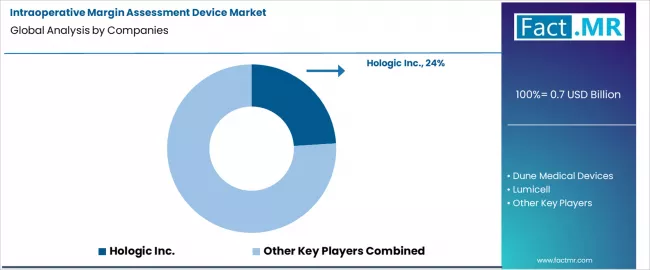
Intraoperative Margin Assessment Device Market Analysis By Company | Source: Fact.MR
The market is characterized by a high-stakes race between specialized pioneers and strategic giants. Pure-play innovators like Dune Medical and Lumicell compete on the strength and specificity of their proprietary technology and their success in securing pivotal clinical trial data.
Their path often involves seeking FDA clearances for specific indications and demonstrating superior clinical utility. In parallel, established surgical powerhouses like Stryker and Hologic are leveraging their deep commercial relationships, global distribution networks, and integrated operating room ecosystems.
Their strategy frequently involves partnerships, licensing, or outright acquisition of promising technologies to quickly populate their surgical portfolios. The competitive frontier is thus dual: pioneers must prove clinical supremacy and navigate commercialization, while incumbents must identify and successfully integrate the winning technologies before standards of care solidify.
Key Players in the Intraoperative Margin Assessment Device Market
Hologic Inc.
Dune Medical Devices
Lumicell
Stryker Corporation
Karl Storz SE & Co. KG
Others
References
American Society of Clinical Oncology. (2025). Standards for Surgical Margins in Solid Tumor Oncology. Journal of Clinical Oncology.
National Comprehensive Cancer Network. (2024). NCCN Clinical Practice Guidelines in Oncology: Breast Cancer. NCCN.
Pleskow, D. K., & Wallace, M. B. (2024). Advanced imaging and tissue analysis in interventional endoscopy and surgery. Springer.
Surgical Oncology Society of India. (2025). White Paper on Adoption of Intraoperative Technologies in Indian Cancer Surgery. SOSI.
World Health Organization. (2025). Global Cancer Observatory: Cancer Today. International Agency for Research on Cancer.
Breast Cancer, Gastrointestinal & Colorectal Cancer, Neurosurgery
End User
Hospitals, Cancer Research Institutes, Ambulatory Surgical Centers
Key Countries
India, China, Brazil, USA
Key Companies
Hologic Inc., Dune Medical Devices, Lumicell, Stryker Corporation, Karl Storz SE & Co. KG, Others
Additional Analysis
Comparative analysis of sensitivity and specificity rates across different technologies; study of workflow integration time and impact on surgical duration; health-economic analysis of cost savings from reduced re-excisions; impact on surgeon training and learning curves; assessment of regulatory pathway differences across key geographies.
Source: Fact.MR analysis. Updated Apr 30, 2026
Market by Segments
Product Type :
Optical Spectroscopy Systems
RF-based Systems
Fluorescence Imaging
Application :
Breast Cancer
Gastrointestinal & Colorectal Cancer
Neurosurgery
End User :
Hospitals
Cancer Research Institutes
Ambulatory Surgical Centers
Region :
North America
USA
Canada
Latin America
Brazil
Mexico
Argentina
Rest of Latin America
Western Europe
Germany
France
Italy
Spain
UK
BENELUX
Rest of Western Europe
Eastern Europe
Russia
Poland
Czech Republic
Rest of Eastern Europe
East Asia
China
Japan
South Korea
Rest of East Asia
South Asia & Pacific
India
ASEAN
Australia
Rest of South Asia & Pacific
MEA
GCC Countries
South Africa
Turkiye
Rest of MEA
Questions Answered
Frequently Asked Questions
How big is the intraoperative margin assessment device market in 2026?
The global intraoperative margin assessment device market is estimated to be valued at USD 0.7 billion in 2026.
What will be the size of intraoperative margin assessment device market in 2036?
The market size for the intraoperative margin assessment device market is projected to reach USD 1.9 billion by 2036.
How much will be the intraoperative margin assessment device market growth between 2026 and 2036?
The intraoperative margin assessment device market is expected to grow at a 10.3% CAGR between 2026 and 2036.
What are the key product types in the intraoperative margin assessment device market?
The key product types in intraoperative margin assessment device market are optical spectroscopy systems, rf-based systems and fluorescence imaging.
Which application segment to contribute significant share in the intraoperative margin assessment device market in 2026?
In terms of application, breast cancer segment to command 53.2% share in the intraoperative margin assessment device market in 2026.