- Market Value (2025): USD 851.9 Mn
- Estimated Value (2026): USD 920.0 Mn
- Forecast Value (2036): USD 1986.2 Mn
- CAGR (2026-2036): 8.0%
What is the Label-Friendly Bulking Agents Market forecast to be worth by 2036?
USD 920.0 million in 2026 to USD 1,986.2 million by 2036 at an 8.0% CAGR.
- The Label-Friendly Bulking Agents Market reached USD 851.9 million in 2025.
- Demand is projected to increase from USD 920.0 million in 2026 to USD 1,986.2 million by 2036.
- The market is forecast to record an 8.0% CAGR from 2026 to 2036 as food brands redesign bulk, sweetness and texture around recognizable ingredients.
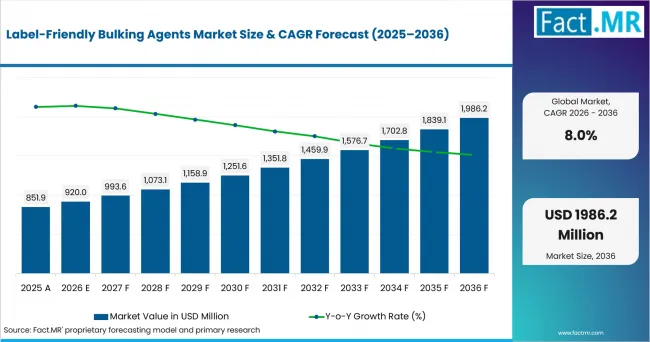
Label Friendly Bulking Agents Market Value Analysis | Source: Fact.MR
What are the defining numbers behind Label-Friendly Bulking Agents Market growth?
An absolute opportunity of USD 1,066.2 million is expected between 2026 and 2036.
- Demand Drivers in the Market
- Packaged-food reformulation is expected to raise demand for bulking systems that preserve bite after sugar or calorie reduction.
- Sugar reduction requires physical volume replacement, since sweeteners alone leave gaps in chew and mouthfeel. Soluble fibers and native flours help formulators maintain structure in bars, bakery mixes and dairy alternatives.
- Fiber enrichment is anticipated to widen use beyond diet products. Brands can use the same ingredient family for digestive positioning and texture management, which simplifies recipe design across snack, beverage and prepared-food platforms.
- Clean and recognizable ingredient claims are expected to favor citrus fibers, oat fibers and plant cell-wall fibers. These materials combine a plant-source story with water binding and body control.
- Cost and sensory work remain central to adoption. Specialty fibers need hydration control and supplier guidance before they replace lower-cost starch or syrup solids.
- Key Segments Analyzed
- By Ingredient Platform: Soluble fibers are expected to hold 33.00% share in 2026 owing to their dual role in fiber enrichment and sugar-reduction reformulation.
- By Nutrition Positioning: Fiber enrichment is projected to account for 36.00% share in 2026 since brands can pair bulk replacement with a clear nutrition benefit.
- By Food Application: Bakery & bars are anticipated to capture 29.00% share in 2026 as crumb, chew and moisture control are central to reduced-sugar products.
- By Label Claim: Clean and recognizable ingredient claims are estimated to represent 39.00% share in 2026 due to retailer preference for familiar source names.
- Analyst Opinion at Fact.MR
- Shambhu Nath Jha, Principal Consultant at Fact.MR, states, “This market is shaped by the gap between nutrition targets and eating quality. Brands want less sugar and cleaner labels, yet consumers expect softness, body and sweetness balance. Suppliers are expected to gain when they combine fiber chemistry, recipe support and label-ready documents.”
- Strategic Implications
- Ingredient suppliers should package fiber systems with clear hydration guidance, since application teams need repeatable texture outcomes across bakery and beverage formats.
- Food brands should screen bulking agents early in sugar-reduction projects so texture repair stays aligned with launch timing.
- Tate & Lyle PLC set a new fibre-fortification target in August 2026 to provide 35 billion “daily fibre gap equivalent” servings of 15 g of fibre by 31 March 2030, strengthening its focus on fibre fortification in food and beverage formulations.
- Retailer-facing teams should connect clean ingredient language with sensory proof, since recognizable names need support from repeat purchase.
USA is projected to post 9.0% CAGR through packaged-food reformulation and front-label nutrition pressure. The UK is expected to record 7.9% CAGR supported by HFSS advertising rules. Germany is forecast to advance at 7.6% CAGR with bakery and prepared-food reformulation. Japan is anticipated to reach 7.2% CAGR through premium packaged foods. France is estimated to post 6.3% CAGR as Nutri-Score revisions sharpen attention on sugar and nutrition balance.
How does the Label-Friendly Bulking Agents Market break down by segment?
Soluble fibers lead Ingredient Platform at 33.00%; clean and recognizable ingredient claims lead Label Claim at 39.00%.
Which Ingredient Platform dominates?
Soluble fibers hold 33.0% share in 2026.
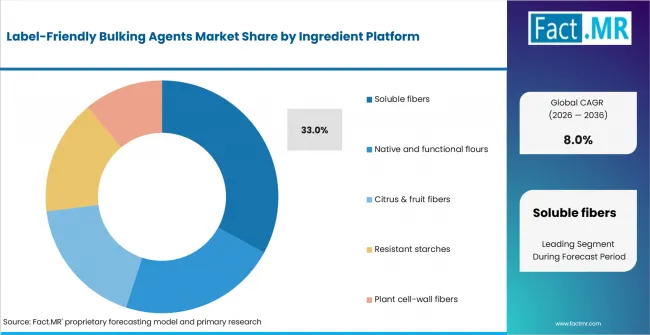
Label Friendly Bulking Agents Market Analysis By Ingredient Platform | Source: Fact.MR
Soluble fibers are expected to lead the ingredient platform segment because they address fiber enrichment and bulk replacement in one step. They disperse across bars, beverages and dairy alternatives when suppliers control viscosity and taste. Native and functional flours remain useful where grain-based identity matters. Citrus and fruit fibers gain share in sauces and bakery fillings where water binding is central to texture.
What leads Nutrition Positioning?
Fiber enrichment leads with 36.0% share in 2026.
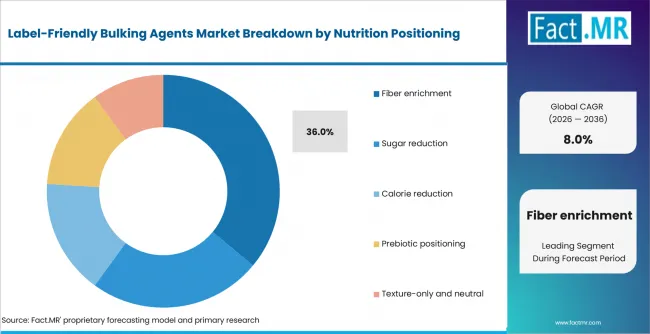
Label Friendly Bulking Agents Market Analysis By Nutrition Positioning | Source: Fact.MR
Fiber enrichment is projected to lead nutrition positioning because it lets brands add a positive claim while replacing lost sugar bulk. The positioning works across snack bars, cereal clusters and dairy alternatives. Sugar reduction follows closely as front-label pressure puts added sugars under review. Prebiotic positioning is expected to expand when brands support claim language with documented ingredient function.
How does Food Application shape demand?
Bakery & bars lead with 29.0% share in 2026.
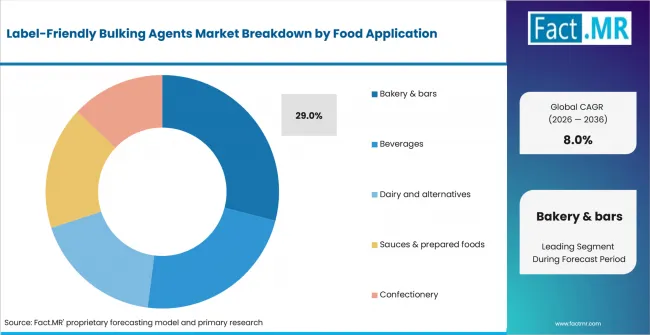
Label Friendly Bulking Agents Market Analysis By Food Application | Source: Fact.MR
Bakery & bars are anticipated to lead food application demand because sugar reduction quickly changes chew, volume and moisture behavior. The U.S. Bureau of Labor Statistics Table 2 for July 2026 showed cereals and bakery products rose 2.7% over 12 months. Beverages use soluble fibers where clarity and mouthfeel remain stable. Dairy alternatives need bulking agents for body and spoonable texture.
What supports Label Claim selection?
Clean and recognizable ingredient claims hold 39.0% share in 2026.
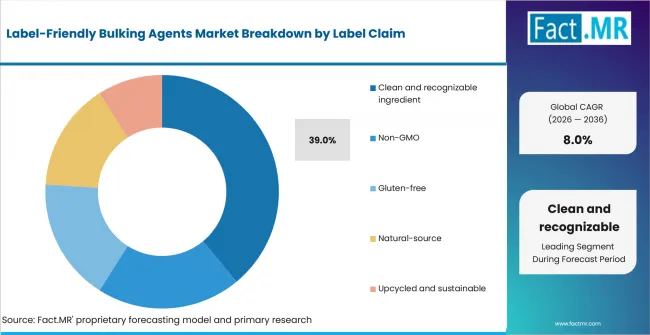
Label Friendly Bulking Agents Market Analysis By Label Claim | Source: Fact.MR
Clean and recognizable ingredient claims are estimated to hold the largest share because ingredient names have become part of retailer and shopper screening. Oat fiber, citrus fiber and resistant starch are easier to explain than synthetic-sounding systems. Non-GMO claims matter where corn or starch origin is assessed. Upcycled and traceable claims add value when fruit-derived streams support a clearer source story.
What is accelerating Label-Friendly Bulking Agents Market adoption, and what is holding it back?
Sugar reduction drives it; cost and sensory validation restrain it.
Drivers Impact Analysis
| DRIVER | (~) % IMPACT ON CAGR | GEOGRAPHIC RELEVANCE | IMPACT TIMELINE |
|---|---|---|---|
| Added-sugar label pressure | +1.8% | North America, Europe | Short term (<= 2 years) |
| Fiber enrichment across everyday foods | +1.4% | Global | Medium term (2-4 years) |
| Texture repair after calorie reduction | +1.1% | North America, Europe, East Asia | Short term (<= 2 years) |
| Plant-source and recognizable ingredient claims | +0.8% | Global | Medium term (2-4 years) |
| Prepared-food reformulation | +0.6% | Europe, North America | Long term (>= 4 years) |
- Added-sugar label pressure: Front-label nutrition work is expected to keep sugar reduction close to consumer choice. Bulking agents replace the volume lost when sugar is reduced. Formulators need fibers and starches that rebuild mouthfeel while keeping labels simple.
- Fiber enrichment across everyday foods: Brands are projected to use fiber systems in bars, breakfast foods and beverages. The same ingredient can support bulk and nutrition positioning.
- Texture repair after calorie reduction: Low-calorie recipes often lose chew, creaminess or moisture retention. Soluble fibers and functional flours can restore body when dosage fits the food matrix.
- Plant-source and recognizable ingredient claims: Plant cell-wall fibers and fruit-derived materials give brands a source story that shoppers can understand. Clean naming can help products pass retailer review. Adoption is strongest where taste remains neutral.
- Prepared-food reformulation: Sauces, fillings and ready meals need bulk control when starches or sugars are reduced. Citrus and fruit fibers help manage water movement.
Opportunity Impact Analysis
| OPPORTUNITY | (~) % IMPACT ON CAGR | GEOGRAPHIC RELEVANCE | IMPACT TIMELINE |
|---|---|---|---|
| Fiber-forward snack and bar platforms | +1.2% | North America, Europe | Short term (<= 2 years) |
| Beverage-friendly soluble fibers | +0.9% | USA, Japan, UK | Medium term (2-4 years) |
| Upcycled citrus and fruit fiber systems | +0.7% | Europe, North America | Medium term (2-4 years) |
| Private-label reformulation packs | +0.5% | UK, Germany, France | Long term (>= 4 years) |
- Fiber-forward snack and bar platforms: Snack brands are expected to expand fiber-enriched claims while managing sweetness. Bulking agents help developers protect chew and launch related formats faster.
- Beverage-friendly soluble fibers: Clear or low-viscosity fibers create entry points in flavored waters, dairy alternatives and nutrition drinks. Stability at the target dose remains central.
- Upcycled citrus and fruit fiber systems: Fruit-derived fibers are anticipated to gain where source stories support label claims. The opportunity depends on consistent color, taste and particle size.
- Private-label reformulation packs: Retail-owned brands need repeatable ingredient systems across multiple suppliers and formats. Pre-tested bulking blends can help them move faster. Documentation and application support are expected to carry weight in supplier choice.
Restraints Impact Analysis
| RESTRAINT | (~) % IMPACT ON CAGR | GEOGRAPHIC RELEVANCE | IMPACT TIMELINE |
|---|---|---|---|
| Sensory drift at higher fiber dose | -0.6% | Global | Short term (<= 2 years) |
| Premium ingredient cost | -0.5% | Europe, North America | Medium term (2-4 years) |
| Beverage clarity and viscosity barriers | -0.4% | Japan, USA, UK | Medium term (2-4 years) |
| Claim and labeling variation | -0.3% | Europe, East Asia | Long term (>= 4 years) |
- Sensory drift at higher fiber dose: High inclusion can change mouthfeel, sweetness perception and moisture release. Brands need bench trials before scaling a reformulated recipe. Wider use is expected where suppliers provide matrix-specific dosage ranges.
- Premium ingredient cost: Specialty fibers cost more than basic fillers or common starches. Manufacturers may reserve them for products where label value offsets recipe cost.
- Beverage clarity and viscosity barriers: Soluble fibers can affect clarity or drinking texture when dosage rises. Beverage developers need grades that disperse cleanly and maintain a stable mouthfeel. This restrains faster movement into clear drinks.
- Claim and labeling variation: Fiber definitions and nutrition-claim rules differ across markets. Global brands need local reviews before using the same package language.
Which countries are scaling the Label-Friendly Bulking Agents Market through 2036?
- The country comparison spans 2.75 percentage points and forms three practical growth bands across the forecast period.
- USA remains 1.12 percentage points above the UK through packaged-food reformulation and front-label nutrition pressure.
- The UK remains 0.32 percentage point above Germany as HFSS advertising rules sharpen sugar and calorie reformulation.
- Germany remains 0.40 percentage point above Japan through bakery reformulation and ingredient processing depth.
- Japan remains 0.91 percentage point above France as premium packaged foods use soluble fibers for cleaner texture control.
- France closes the displayed range through Nutri-Score revision and natural-source ingredient selection.
Comparable CAGRs can create different entry conditions due to retail nutrition rules, bakery usage, beverage clarity needs and supplier application support. Full report coverage includes North America, Latin America, Western Europe, Eastern Europe, East Asia, South Asia & Pacific, Middle East & Africa.
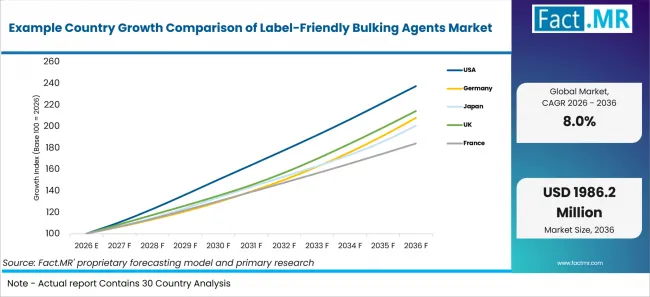
Example Country Growth Comparison Of Label Friendly Bulking Agents Market | Source: Fact.MR
| Country | CAGR (2026-2036) |
|---|---|
| USA | 9.0% |
| UK | 7.9% |
| Germany | 7.6% |
| Japan | 7.2% |
| France | 6.3% |
What supports USA adoption?
9.0% CAGR, supported by packaged-food reformulation and front-label nutrition pressure.
USDA ERS reported in June 2026 that inflation-adjusted U.S. food spending reached USD 2.51 trillion in 2025. This large packaged-food and foodservice base supports reformulation activity, while front-label nutrition pressure encourages manufacturers to review ingredients, improve nutrition profiles, and adopt alternative fat systems across established product lines.
What is powering UK reformulation?
7.9% CAGR, driven by HFSS advertising rules and retail recipe work.
GOV.UK states that advertising restrictions for less healthy food and drink came into force across the UK on 5 January 2026. The rules increase reformulation pressure across packaged foods, encouraging manufacturers and retailers to reassess fat systems, recipe composition, and nutrition profiles while maintaining familiar taste and product performance.
How is Germany scaling demand?
7.6% CAGR, backed by bakery reformulation and ingredient processing depth.
Destatis reported in August 2026 that food prices were 0.4% higher in July 2026 than a year earlier. Germany’s established bakery and food-processing base supports continued reformulation, while manufacturers focus on ingredient performance, cost control, and reliable functionality when adjusting fat systems across packaged food applications.
What supports Japan adoption?
7.2% CAGR, supported by premium packaged food and clean mouthfeel needs.
The Statistics Bureau of Japan reported in February 2026 that average monthly consumption expenditure for two-or-more-person households was 314,001 yen in 2025. This is broad household-spending context rather than a direct measure of bulking-agent demand.
What underpins France demand?
6.3% CAGR, shaped by Nutri-Score revision and natural-source ingredient selection.
Santé publique France reported in March 2025 that between 30% and 40% of products would see their Nutri-Score change under the updated calculation method. The revised method rates salty and sugary products more strictly and better distinguishes whole-grain starchy foods from refined starchy foods.
Who leads the Label-Friendly Bulking Agents Market?
Ingredion Incorporated holds an established position through starch, fibre, texturizing and sugar-reduction capabilities. Its July 2026 IFT FIRST showcase highlighted clean label, texture, fibre fortification and sugar reduction as interconnected formulation priorities.
Tate & Lyle PLC competes through soluble fibres, sweetener solutions and reformulation expertise across beverages, dairy and dairy alternatives, snacks and bakery products. BENEO GMBH is active through its Orafti® inulin and oligofructose platforms.
J. Rettenmaier & Söhne GmbH + Co KG (JRS) supports plant fiber use where texture, water binding and process stability need tuning. Nexira brings acacia fiber and botanical ingredient depth. Fiberstar, Inc. participates through citrus-fiber technology for water binding and clean ingredient positioning.
Competition is expected to center on application proof, supply reliability and claim-ready documentation. Suppliers that help brands balance sweetness, bulk and mouthfeel are better placed than companies offering commodity filler material alone.
Which companies are the key providers?
Key companies include Ingredion Incorporated; Tate & Lyle PLC; BENEO GMBH; J. Rettenmaier & Söhne GmbH + Co KG (JRS); Nexira; and Fiberstar, Inc.
- Ingredion Incorporated
- Tate & Lyle PLC
- BENEO GMBH
- J. Rettenmaier & Söhne GmbH + Co KG (JRS)
- Nexira
- Fiberstar, Inc.
Bibliography
- U.S. Bureau of Labor Statistics. (2026, August 12). Table 2. Consumer Price Index for All Urban Consumers (CPI-U): U.S. city average, by detailed expenditure category.
- Department of Health and Social Care, & Department for Culture, Media and Sport. (2026, March 25). Less healthy food or drink: Advertising and promotions restrictions.
- Federal Statistical Office (Destatis). (2026, August 12). Inflation rate at +2.8% in July 2026.
- Ingredion Incorporated. (2026, July 6). Ingredion to spotlight next-generation solutions for texture, clean labels and positive nutrition at IFT FIRST 2026.
- Santé publique France. (2025, March 17). Signing of the Nutri-Score decree: Another step toward better nutritional information for consumers.
- Statistics Bureau of Japan. (2026, February 6). 2025 yearly average [Family Income and Expenditure Survey].
- Tate & Lyle. (2026, August 26). Tate & Lyle adds new purpose target to improve everyday consumer health through fibre fortification.
- Zeballos, E., & Sinclair, W. (2026, June 11). Total U.S. food spending reached $2.51 trillion in 2025. U.S. Department of Agriculture, Economic Research Service.
- U.S. Food and Drug Administration. (2025, January 14). FDA proposes requiring at-a-glance nutrition information on the front of packaged foods.
This Report Answers
- The report explains how label-friendly bulking agents are used across ingredient platforms, nutrition positioning and food applications. It also connects the market to adjacent dietary fiber ingredients and clean-label reformulation needs.
- Segment analysis identifies why soluble fibers, citrus fiber systems and resistant starches support sugar reduction while protecting texture.
- Country analysis examines the USA, UK, Germany, Japan and France through nutrition-label pressure, HFSS rules, bakery reformulation and resistant starch and slowly digestible carbohydrates use cases.
- Competitive analysis reviews providers across soluble fibers, native flours, fruit-derived fibers and low-fermentability dietary fibers used in sensitive food formats.
- Application analysis assesses how bakery, beverages, dairy alternatives and sauces use bulking systems. It also considers adjacent citrus fiber fat mimetics where fiber helps rebuild mouthfeel after fat reduction.
What does the Label-Friendly Bulking Agents Market cover?
The Label-Friendly Bulking Agents Market covers food-grade ingredients that restore bulk, body and texture when sugar, calories or fat are reduced. It includes soluble fibers, functional flours, citrus fibers, resistant starches and plant cell-wall fibers.
The assessment covers ingredient platform, nutrition positioning, food application and label claim. Demand is assessed across bakery & bars, beverages, dairy alternatives, sauces & prepared foods and confectionery applications.
What is included in the scope?
The scope includes branded and private-label food applications where a bulking ingredient provides texture, volume, mouthfeel or fiber value. It includes single ingredients and formulation systems sold to manufacturers for clean-label reformulation.
It covers soluble fibers, native and functional flours, citrus and fruit fibers, resistant starches and plant cell-wall fibers used by food brands, ingredient blenders and contract manufacturers.
What is excluded from the scope?
Outside scope are sweeteners sold only for sweetness, commodity flour used without label-driven reformulation intent, standard starch thickeners sold only as basic process aids and dietary supplements sold as finished consumer products.
General emulsifiers, preservatives and flavor systems are outside scope unless the ingredient system is sold primarily to restore bulk or mouthfeel during sugar, calorie or nutrition-label reformulation.
How Was the Analysis Built?
The analysis draws on 120+ sources, 35+ company portfolios, 25+ countries, and more than 20 industry interviews.
- Primary Research: Primary research includes discussions with manufacturers, service providers, technology developers, distributors, end users, and subject-matter experts. These conversations examine purchasing priorities, product adoption, operational challenges, approval requirements, competitive positioning, and the factors that influence wider market acceptance.
- Desk Research: Desk research covers government statistics, regulatory publications, company filings, trade data, technical studies, industry associations, standards, public policy, and other authoritative sources. Every source used in the analysis is documented in the bibliography.
- Market Sizing and Forecasting: Market estimates combine historical performance, demand indicators, pricing and volume trends, segment shares, company participation, country-level growth, adoption patterns, investment activity, and barriers to market expansion.
- Data Validation and Update Cycle: Findings are validated by comparing primary interviews with public data, company activity, regulatory changes, trade patterns, and industry developments. Regular updates review new product launches, capacity changes, partnerships, approvals, and shifts in commercial adoption.
What is the report’s scope and coverage?
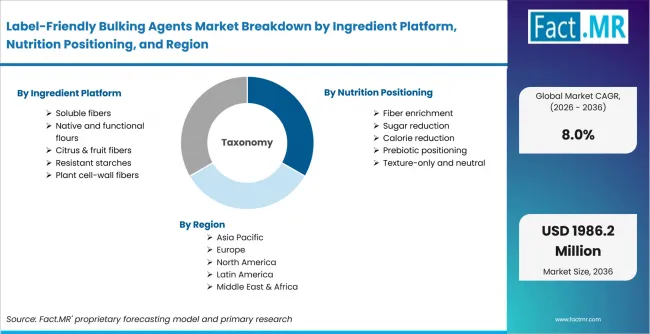
Label Friendly Bulking Agents Market Breakdown By Ingredient Platform, Nutrition Positioning, And Region | Source: Fact.MR
| Attribute | Details |
|---|---|
| Quantitative Units | USD million |
| Market Definition | Bulking agents used by food and beverage manufacturers to replace volume, texture or mouthfeel during sugar reduction, calorie reduction, fiber enrichment or clean-label reformulation. |
| Ingredient Platform | Soluble fibers; Native and functional flours; Citrus and fruit fibers; Resistant starches; Plant cell-wall fibers |
| Nutrition Positioning | Fiber enrichment; Sugar reduction; Calorie reduction; Prebiotic positioning; Texture-only and neutral |
| Food Application | Bakery & bars; Beverages; Dairy and alternatives; Sauces & prepared foods; Confectionery |
| Label Claim | Clean and recognizable ingredient; Non-GMO; Gluten-free; Natural-source; Upcycled and traceable |
| Regions Covered | North America; Latin America; Western Europe; Eastern Europe; East Asia; South Asia & Pacific; Middle East & Africa |
| Countries Covered | USA; UK; Germany; Japan; France |
| Key Companies Profiled | Ingredion Incorporated; Tate & Lyle PLC; BENEO GMBH; J. Rettenmaier & Söhne GmbH + Co KG (JRS); Nexira; Fiberstar, Inc. |
| Forecast Period | 2026 to 2036 |
| Approach | Hybrid top-down and bottom-up approach using food formulation demand, ingredient platform mix, application usage, label-claim intensity, country adoption and provider portfolio review. |
How is the market segmented?
-
By Ingredient Platform:
- Soluble fibers
- Native and functional flours
- Citrus and fruit fibers
- Resistant starches
- Plant cell-wall fibers
-
By Nutrition Positioning:
- Fiber enrichment
- Sugar reduction
- Calorie reduction
- Prebiotic positioning
- Texture-only and neutral
-
By Food Application:
- Bakery & bars
- Beverages
- Dairy and alternatives
- Sauces & prepared foods
- Confectionery
-
By Label Claim:
- Clean and recognizable ingredient
- Non-GMO
- Gluten-free
- Natural-source
- Upcycled and traceable
-
By Region:
- North America
- Latin America
- Western Europe
- Eastern Europe
- East Asia
- South Asia & Pacific
- Middle East & Africa