- Base Value(2025): 450.0 Mn
- Estimated Value(2026): 475.0 Mn
- Forecast Value (2036): 825.0 Mn
- CAGR (2026 - 2036): 5.7%
Citrus Fiber Fat Mimetics Market Forecast and Outlook By Fact.MR
In 2025, the citrus fiber fat mimetics market was valued at USD 450.0 million. Based on Fact MR analysis, demand for citrus fiber fat mimetic ingredients is estimated to grow to USD 475.0 million in 2026 and USD 825.0 million by 2036. FMR projects a CAGR of 5.7% during the forecast period.
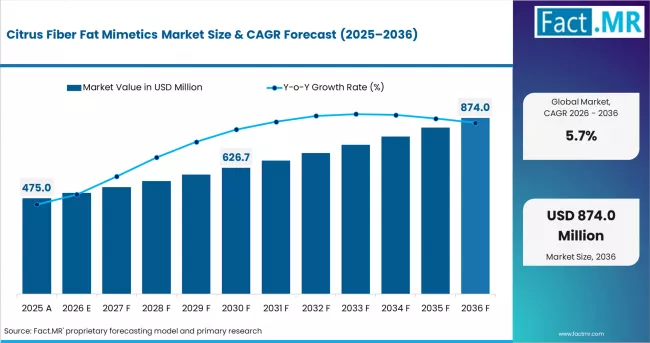
Citrus Fiber Fat Mimetics Market Market Value Analysis | Source: Fact.MR
Citrus Fiber Fat Mimetics Market
| Metric | Details |
|---|---|
| Industry Size (2026E) | USD 475.0 million |
| Industry Value (2036F) | USD 825.0 million |
| CAGR (2026 to 2036) | 5.7% |
Source: Fact.MR analysis. Updated Apr 22, 2026
Summary of the Citrus Fiber Fat Mimetics Market
- Market Definition
- The market includes plant-derived functional fiber ingredients obtained from citrus peel and pulp that replicate fat-like sensory and structural properties in formulated foods. These ingredients provide viscosity control, water binding, emulsification stability, and texture enhancement across reduced-fat bakery, dairy alternative, sauce, and processed food applications.
- Demand Drivers
- Increasing reformulation of processed foods requiring fat reduction while maintaining texture stability and mouthfeel consistency.
- Growing use of citrus-derived fiber systems enabling water retention and viscosity development across emulsified food matrices.
- Rising incorporation of plant-based texture modifiers supporting reduced-fat product positioning across bakery and dairy alternative formulations.
- Expanding demand for hydrocolloid ingredients compatible with recognizable labeling requirements across packaged food manufacturing.
- Stable utilization of citrus peel by-products enabling functional ingredient supply across clean-label formulation systems.
- Increasing reliance on fiber-based emulsification systems supporting dispersion stability across reduced lipid food applications.
- Key Segments Analyzed
- Type: Powder fiber accounts for 39% share supported by compatibility with dry blending and hydration-driven viscosity formation.
- Function: Fat replacement holds 36% share supported by ability of hydrated citrus fiber matrices to simulate lubrication characteristics.
- Application Role: Bakery products, sauces, dressings, and dairy alternatives utilize citrus fiber to maintain structural consistency in reduced-fat formulations.
- Functional Role: Citrus fiber polysaccharide composition supports oil binding, gel formation, and moisture retention across processed food matrices.
- Geography: Asia Pacific, Europe, and North America demonstrate steady adoption linked to demand for plant-derived fat replacement ingredients.
- Analyst Opinion at Fact MR
- Shambhu Nath Jha, Principal Consultant, Fact MR, opines, 'In this updated edition of the Citrus Fiber Fat Mimetics Market report, citrus-derived hydrocolloid systems support texture stabilization and fat reduction strategies across processed food formulation environments through 2036.'
- Strategic Implications or Executive Takeaways
- Improve particle size control enabling consistent hydration kinetics across powdered citrus fiber ingredient systems.
- Strengthen emulsification stability performance supporting uniform dispersion across reduced-fat food formulations.
- Enhance water-binding capacity supporting structural integrity across bakery fillings and processed food matrices.
- Expand formulation compatibility supporting integration across dairy alternatives and plant-based product applications.
- Maintain raw material supply consistency supported by citrus processing by-product recovery systems.
- Improve rheological performance enabling simulation of fat-like mouthfeel across low-lipid product development workflows.
- Methodology
- Primary interviews conducted with hydrocolloid ingredient manufacturers, food formulation specialists, and texture solution developers.
- Benchmarked against processed food reformulation indicators influencing adoption of plant-derived fat replacement ingredients.
- Evaluated citrus fiber extraction processes supporting preservation of polysaccharide functionality across ingredient systems.
- Hybrid modeling applied combining top-down functional ingredient demand assessment with bottom-up formulation adoption benchmarking.
- Validation conducted using supplier-level production indicators across citrus-derived fiber ingredient manufacturing environments.
Peer review applied using Fact MR analytical frameworks linking clean-label formulation trends with hydrocolloid fat mimetic adoption patterns.
A CAGR of 5.7% indicates incremental expansion supported by use of citrus fiber as a fat replacer in reduced-fat bakery and dairy formulations. Variability remains moderate due to citrus peel supply fluctuations, while constraints persist from formulation performance trade-offs and substitution competition from starch and hydrocolloid systems.
China leads with a projected CAGR of 6.9%, supported by increasing incorporation of citrus-derived texturizing ingredients across processed food formulation systems. India follows with a CAGR of 6.6%, driven by expanding use of plant-based fat replacement components across packaged food production environments. The United Kingdom records a CAGR of 6.3%, reflecting steady utilization of citrus fiber fat mimetics across reduced-fat food product development applications. Germany shows a CAGR of 6.1%, supported by consistent demand for plant-derived texture modifiers across industrial food manufacturing systems. The United States records the slowest growth at 5.7%, reflecting a mature market tied to replacement demand within established functional ingredient supply chains.
Segmental Analysis
Citrus Fiber Fat Mimetics Market Analysis by Type
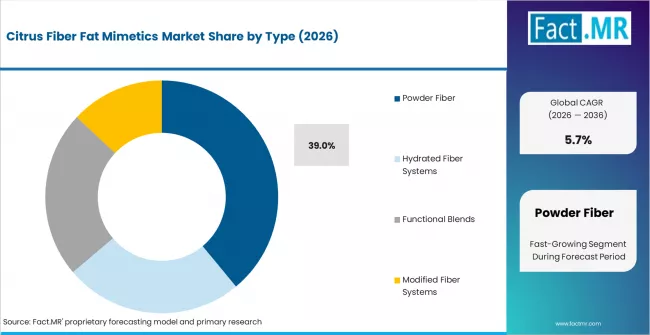
Citrus Fiber Fat Mimetics Market Analysis By Type | Source: Fact.MR
- Market Overview: Based on Fact MR assessment, powder fiber is projected to account for 39% share of the citrus fiber fat mimetics market in 2026. Dried citrus fiber derived from peel residues is processed into fine powder enabling incorporation across formulated food products requiring water binding and texture stabilization characteristics. Powder fiber structure supports interaction with aqueous phases enabling development of viscosity and structural integrity across emulsified systems. Ingredient functionality supports compatibility with bakery fillings, dairy alternatives, sauces, and processed meat formulations requiring controlled moisture retention and mouthfeel performance across industrial food formulation workflows.
- Demand Drivers:
- Water Binding Requirements: Powder citrus fiber supports hydration behavior enabling viscosity development across food formulation matrices.
- Texture Stabilization Parameters: Fiber structure supports maintenance of structural consistency across processed food applications requiring controlled rheological performance.
- Processing Compatibility Needs: Powder format supports uniform blending across dry mix systems enabling efficient incorporation across industrial formulation operations.
Citrus Fiber Fat Mimetics Market Analysis by Function
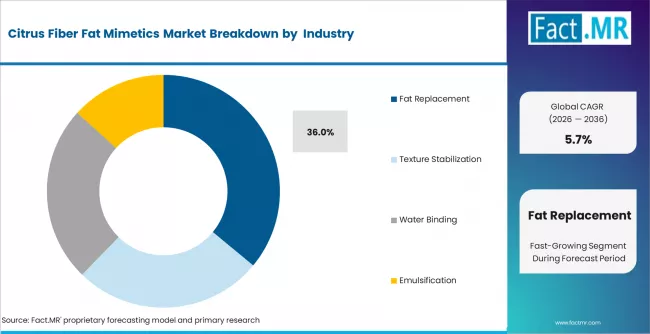
Citrus Fiber Fat Mimetics Market Analysis By Function | Source: Fact.MR
- Market Overview: Fat replacement functionality is estimated to hold 36% share of the citrus fiber fat mimetics market in 2026, supported by ability of hydrated fiber matrices to simulate lubrication and creaminess characteristics typically provided by lipid components. Fiber gel structure supports modification of mouthfeel enabling maintenance of product texture across reduced fat formulations requiring controlled viscosity performance. Functional behavior supports incorporation across bakery fillings, dressings, dairy alternatives, and processed foods requiring balanced sensory properties across fat reduced product development workflows.
- Demand Drivers:
- Texture Modification Requirements: Citrus fiber supports development of viscosity characteristics enabling simulation of fat like mouthfeel across formulated food products.
- Formulation Stability Parameters: Hydrated fiber structure supports emulsification stability enabling consistent distribution of ingredients across reduced fat systems.
- Processing Performance Needs: Fiber based fat mimetics support compatibility with mixing and homogenization workflows requiring controlled rheological behavior.
Key Dynamics
Citrus Fiber Fat Mimetics Market Drivers, Restraints, and Opportunities
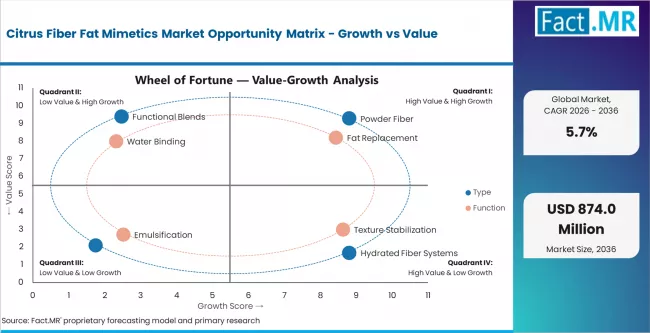
Citrus Fiber Fat Mimetics Market Opportunity Matrix Growth Vs Value | Source: Fact.MR
FMR analysts observe that historical fat reduction in processed foods relied on starches and modified carbohydrates that often compromised mouthfeel and emulsion stability in low-fat formulations. The current market size reflects a transition toward citrus fiber-based fat mimetics derived from juice processing by-products, which provide water-binding, viscosity enhancement, and emulsion stabilization functions that replicate lubrication and texture associated with fats. Structural reality indicates an emerging growth ingredient market because citrus fiber contains pectin and insoluble polysaccharides capable of forming gel networks that simulate fat-like mouthfeel while enabling calorie reduction in bakery, dairy, sauces, and plant-based formulations. Citrus fiber demonstrates strong water-holding and oil-binding capacity, enabling reduced-fat formulations without major reformulation complexity.
The present structural shift reflects declining reliance on modified starch and synthetic emulsifiers as clean-label positioning drives adoption of recognizable fruit-derived fibers with multifunctional stabilizing properties. Citrus fiber ingredients carry higher processing cost due to purification and particle size control requirements, yet improved texture stability and label transparency support premium pricing in reformulated reduced-fat food systems. Value growth remains linked to reformulation of processed foods where manufacturers must maintain sensory performance while lowering fat content to align with nutritional guidelines and product positioning strategies.
- Clean Label Reformulation: Citrus fiber provides thickening, stabilizing, and fat-mimicking functionality compatible with recognizable ingredient labeling requirements in processed foods.
- Hydrocolloid Functionality: Pectin-rich citrus fiber forms gel networks and stable emulsions that replicate fat lubrication and viscosity in reduced-fat formulations.
- Europe Ingredient Supply: Spain, Italy, and Germany support raw material availability due to large citrus processing industries generating peel-derived fiber feedstock.
Regional Analysis
The Citrus Fiber Fat Mimetics Market is assessed across North America, Europe, and Asia Pacific, segmented by country-level demand in clean-label fat replacers, texture-modifying food ingredients, plant-derived stabilizers, and low-fat formulation solutions. Regional demand reflects reformulation of processed foods and incorporation of citrus-derived fiber ingredients in bakery, dairy, and sauce applications. The full report offers market attractiveness analysis.
.webp "Top Country Growth Comparison Citrus Fiber Fat Mimetics Market Cagr (2026 2036)")
Top Country Growth Comparison Citrus Fiber Fat Mimetics Market Cagr (2026 2036) | Source: Fact.MR
CAGR Table
| Country | CAGR (2026–2036) |
|---|---|
| China | 6.9% |
| India | 6.6% |
| United Kingdom | 6.3% |
| Germany | 6.1% |
| United States | 5.7% |
Source: Fact.MR analysis. Updated Apr 22, 2026
Source: Fact MR analysis, based on proprietary forecasting model and primary research
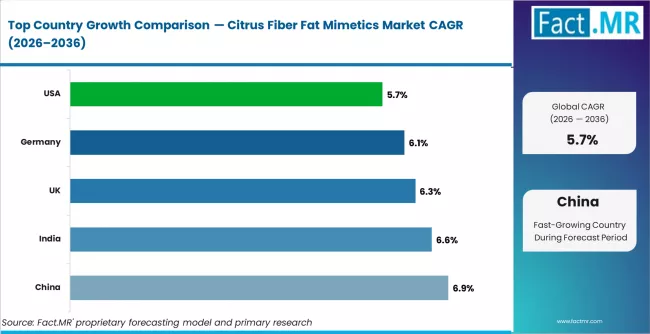
Citrus Fiber Fat Mimetics Market Cagr Analysis By Country | Source: Fact.MR
Asia Pacific
Asia Pacific functions as the citrus by-product ingredient processing hub, supported by expansion of fruit processing operations and increasing use of fiber-based fat replacement ingredients in reformulated food products. CP Kelco strengthens citrus fiber ingredient engineering capability. Fiberstar Inc. expands plant-based texture modifier solutions. JRS Group supports citrus-derived functional ingredient development.
- China: China is projected to record 6.9% CAGR in citrus fiber fat mimetics through 2036. Food ingredient reformulation guideline update (National Health Commission, March 2024) supports clean-label fat replacement ingredient adoption. CP Kelco expanded citrus fiber ingredient processing capability (June 2023).
- India: Adoption of citrus fiber fat mimetics in India is forecast to grow at 6.6% CAGR through 2036. Food Safety and Standards Authority reformulation advisory update (January 2024) supports plant fiber-based fat replacer ingredient usage. JRS Group expanded citrus fiber ingredient supply capability (May 2023).
Europe
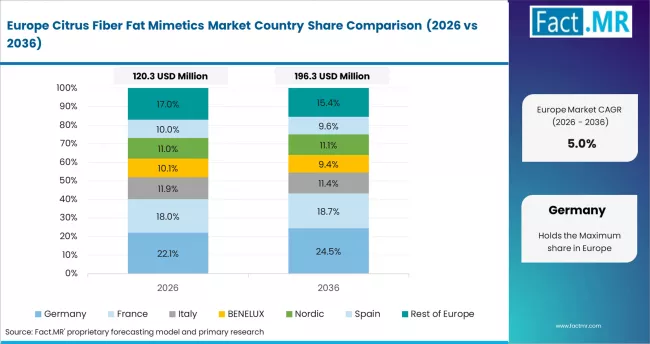
Citrus Fiber Fat Mimetics Market Europe Country Market Share Analysis, 2026 & 2036 | Source: Fact.MR
Europe operates as the clean-label ingredient formulation center, supported by structured food additive regulations and increasing demand for plant-derived texture modification solutions. Fiberstar Inc. strengthens citrus fiber application development capability. Herbafood Ingredients GmbH expands fruit fiber ingredient portfolio. JRS Group supports plant-based fat replacement ingredient innovation.
- United Kingdom: Demand expansion for citrus fiber fat mimetics in United Kingdom is expected at 6.3% CAGR through 2036. UK nutrition reformulation strategy update (Department of Health and Social Care, February 2024) supports low-fat ingredient adoption. Fiberstar Inc. expanded citrus fiber application engineering capability (July 2023).
- Germany: Germany is anticipated to observe 6.1% CAGR in citrus fiber fat mimetics through 2036. EU food additive regulatory alignment update (European Food Safety Authority, October 2023) supports plant-derived texture modifier commercialization. Herbafood Ingredients GmbH expanded citrus fiber ingredient production capability (April 2023).
North America
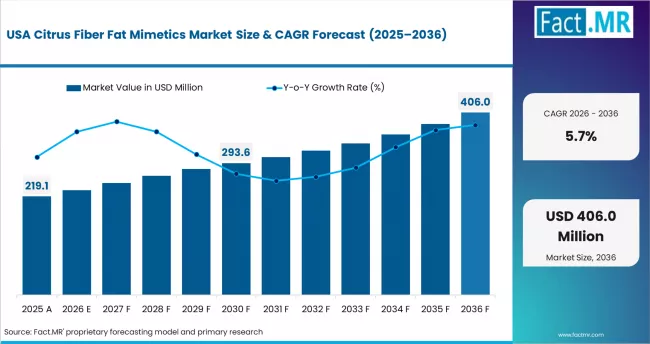
Citrus Fiber Fat Mimetics Market Country Value Analysis | Source: Fact.MR
North America represents the clean-label texture ingredient commercialization environment, supported by expansion of reduced-fat food formulations and increasing adoption of plant fiber-based fat mimetics across processed food categories. Fiberstar Inc. strengthens citrus fiber functionality capability. Cargill Incorporated expands texture modification ingredient portfolio. Ingredion Incorporated supports plant-based formulation technologies.
- United States: The United States is forecast to witness 5.7% CAGR in citrus fiber fat mimetics through 2036. FDA nutrition reformulation guidance update (April 2024) supports reduced-fat ingredient substitution strategies. Ingredion Incorporated expanded citrus fiber formulation capability (August 2023).
Fact MR's analysis of citrus fiber fat mimetics market in global regions consists of country-wise assessment that includes China, India, United Kingdom, Germany, and United States. Readers can find clean-label ingredient trends, citrus fiber formulation developments, regulatory signals, and competitive positioning across key markets.
Competitive Landscape
Competitive Structure and Buyer Dynamics in the Citrus Fiber Fat Mimetics Market
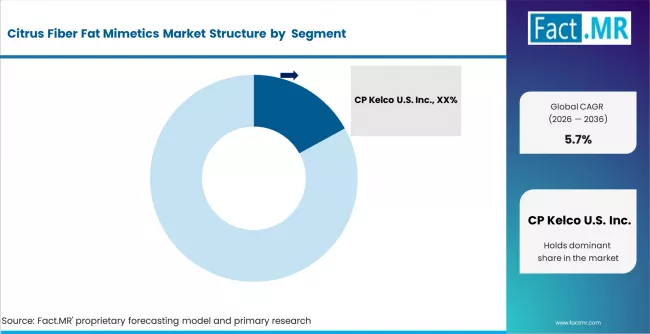
Citrus Fiber Fat Mimetics Market Analysis By Company | Source: Fact.MR
The competitive structure of the Citrus Fiber Fat Mimetics Market is moderately fragmented, with hydrocolloid manufacturers and functional ingredient companies participating across fat replacement applications in processed foods. Companies such as CP Kelco U.S. Inc., Cargill Incorporated, Ingredion Incorporated, Fiberstar Inc., Herbstreith and Fox GmbH, CEAMSA, Naturex SA, Lucid Colloids Ltd., Golden Health Co. Ltd., and Cifal Herbal Pvt. Ltd. maintain positions through citrus fiber processing capabilities and global ingredient distribution networks. Competition is primarily influenced by water binding capacity, texture replication performance, formulation stability, and compatibility with reduced fat food applications including bakery, dairy, sauces, and processed meat products.
Several companies maintain structural advantages through access to citrus processing byproducts used as feedstock for functional fiber extraction. Firms such as CP Kelco U.S. Inc., Cargill Incorporated, and Ingredion Incorporated benefit from integrated hydrocolloid processing infrastructure supporting consistent material functionality. Fiberstar Inc. and CEAMSA maintain advantages through specialized expertise in citrus fiber modification technologies designed for fat replacement applications. Food manufacturers typically adopt multi supplier sourcing strategies to reduce dependence on a single ingredient supplier and maintain formulation flexibility across product development pipelines. Procurement decisions evaluate suppliers based on functional consistency, processing compatibility, and long term ingredient availability, moderating supplier pricing leverage across fat mimetic ingredient supply chains.
Key Players of the Citrus Fiber Fat Mimetics Market
- CP Kelco U.S. Inc.
- Cargill Incorporated
- Ingredion Incorporated
- Fiberstar Inc.
- Herbstreith and Fox GmbH
- CEAMSA
- Lucid Colloids Ltd.
- Naturex SA (Givaudan)
- Golden Health Co. Ltd.
- Cifal Herbal Pvt. Ltd.
Bibliographies
- [1] European Food Safety Authority. (2023, October). EU food additive regulatory alignment update. European Food Safety Authority.
- [2] Ministry of Food Processing Industries. (2024, January). Food processing waste utilization initiative update. Government of India.
- [3] National Health Commission. (2024, March). Food ingredient reformulation guideline update. Government of China.
- [4] U.S. Food and Drug Administration. (2024, April). Nutrition reformulation guidance update. U.S. Department of Health and Human Services.
- [5] Department of Health and Social Care. (2024, February). UK nutrition reformulation strategy update. UK Government.
- [6] CP Kelco U.S. Inc. (2023, June). Citrus fiber ingredient processing capability expansion. CP Kelco U.S. Inc.
- [7] Fiberstar Inc. (2023, July). Citrus fiber application engineering capability expansion. Fiberstar Inc.
- [8] Herbafood Ingredients GmbH. (2023, April). Citrus fiber ingredient production capability expansion. Herbafood Ingredients GmbH.
- [9] Ingredion Incorporated. (2023, August). Citrus fiber formulation capability expansion. Ingredion Incorporated.
- [10] JRS Group. (2023, May). Citrus fiber ingredient supply capability expansion. JRS Group.
This Report Addresses
- Market size forecasts for 2026 to 2036 based on incorporation of citrus-derived fiber ingredients in reduced-fat food formulations.
- Opportunity mapping across powder fiber, hydrated fiber systems, functional blends, and modified citrus fiber ingredient formats.
- Segment and regional forecasts covering bakery products, dairy alternatives, sauces and dressings, processed foods, and meat alternative applications.
- Competition benchmarking based on water binding capacity, emulsification stability, texture replication performance, and formulation compatibility.
- Regulatory review covering clean-label ingredient acceptance and fat reduction compliance requirements influencing citrus fiber utilization.
- Report delivery in PDF, Excel, PPT, and dashboard formats supporting ingredient suppliers, food processors, and formulation specialists.
Supply risk evaluation covering citrus peel raw material availability variability, processing yield consistency, and substitution competition from starch and hydrocolloid fat replacers.
Citrus Fiber Fat Mimetics Market Definition
The Citrus Fiber Fat Mimetics Market includes functional food ingredients derived from citrus peel and pulp fibers that replicate the texture, mouthfeel, emulsification, and viscosity properties of fats, enabling reduction or replacement of oils and lipids in bakery, dairy alternatives, sauces, dressings, meat substitutes, and functional food formulations.
Citrus Fiber Fat Mimetics Market Inclusions
The report includes global and regional market size estimates, forecast analysis, and segmentation by ingredient form such as powder or hydrated systems, fiber composition, application area, end use industry, pricing structure, and supply chain distribution patterns across fat replacement and texture modification ingredient markets.
Citrus Fiber Fat Mimetics Market Exclusions
The scope excludes synthetic fat substitutes such as olestra, whole citrus fruit ingredients, pectin sold primarily as gelling agents without fat mimetic functionality, finished packaged foods where ingredient composition cannot be isolated, and fat replacers derived from non citrus sources such as starch or protein systems.
Citrus Fiber Fat Mimetics Market Research Methodology
- Primary Research: Interviews were conducted with functional ingredient manufacturers, food formulators, texture solution developers, distributors, and nutrition specialists.
- Desk Research: Public sources included food hydrocolloid studies, company technical documentation, patent literature, and research publications on citrus fiber functionality in fat reduction systems.
- Market-Sizing and Forecasting: A hybrid model combining top-down functional ingredient demand evaluation and bottom-up analysis of citrus fiber fat mimetic adoption across food applications was applied.
- Data Validation and Update Cycle: Outputs were validated through cross comparison of supplier data, expert consultation, and periodic monitoring of clean label ingredient innovation trends.
Segmentation
Report Scope
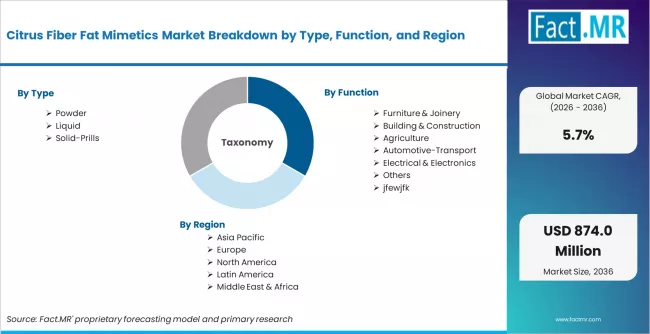
Citrus Fiber Fat Mimetics Market Breakdown By Type, Function, And Region | Source: Fact.MR
| Metric | Value |
|---|---|
| Quantitative Units | USD 475.0 million (2026) to USD 825.0 million (2036), at a CAGR of 5.7% |
| Market Definition | The citrus fiber fat mimetics market includes plant-derived functional fiber ingredients obtained from citrus peel used to replicate fat functionality, improve mouthfeel, enhance water retention, and stabilize emulsions across reduced-fat and clean label food formulations. |
| Type Segmentation | Powder fiber, Hydrated fiber systems, Functional blends, Modified fiber systems |
| Application Segmentation | Bakery products, Dairy alternatives, Sauces and dressings, Processed foods, Meat alternatives |
| Function Segmentation | Fat replacement, Texture stabilization, Water binding, Emulsification |
| Regions Covered | North America, Latin America, Europe, East Asia, South Asia, Oceania, Middle East and Africa |
| Countries Covered | United States, Canada, Germany, France, United Kingdom, Italy, Spain, Netherlands, China, Japan, South Korea, India, Thailand, Indonesia, Brazil, Mexico, United Arab Emirates, South Africa, and 40+ countries |
| Key Companies Profiled | CP Kelco U.S. Inc., Cargill Incorporated, Ingredion Incorporated, Fiberstar Inc., Herbstreith and Fox GmbH, CEAMSA, Lucid Colloids Ltd., Naturex SA, Golden Health Co. Ltd., Cifal Herbal Pvt. Ltd. |
| Forecast Period | 2026 to 2036 |
| Approach | Hybrid top-down and bottom-up market estimation based on clean label ingredient demand benchmarking, fat replacement formulation trends, plant fiber ingredient consumption analysis, processed food texture optimization requirements, and validation through primary interviews with ingredient manufacturers, food formulators, and product development specialists. |
Source: Fact.MR analysis. Updated Apr 22, 2026
Citrus Fiber Fat Mimetics Market Key Segments
-
Type:
- Powder Fiber
- Hydrated Fiber Systems
- Functional Blends
- Modified Fiber Systems
-
Application:
- Bakery Products
- Dairy Alternatives
- Sauces and Dressings
- Processed Foods
- Meat Alternatives
-
Function:
- Fat Replacement
- Texture Stabilization
- Water Binding
- Emulsification
-
Region:
- North America
- USA
- Canada
- Mexico
- Europe
- Germany
- UK
- France
- Italy
- Spain
- Nordic Countries
- BENELUX
- Rest of Europe
- Asia Pacific
- China
- Japan
- South Korea
- India
- Australia
- Rest of Asia Pacific
- Latin America
- Brazil
- Argentina
- Rest of Latin America
- Middle East and Africa
- Kingdom of Saudi Arabia
- United Arab Emirates
- South Africa
- Rest of Middle East and Africa
- Other Regions
- Oceania
- Central Asia
- Other Markets
- North America
Frequently Asked Questions
How large is the demand for Citrus Fiber Fat Mimetics in the global market in 2026?
What will be the market size of Citrus Fiber Fat Mimetics in the global market by 2036?
What is the expected demand growth for Citrus Fiber Fat Mimetics in the global market between 2026 and 2036?
Which company is identified as a leading manufacturer in the Citrus Fiber Fat Mimetics market?
Which type segment is projected to dominate citrus fiber fat mimetic demand by 2026?
Why are citrus fiber fat mimetics widely used in food formulation applications?
What is driving demand for citrus fiber fat mimetics in China?
What is the growth outlook for the Citrus Fiber Fat Mimetics market in China?
Why is India an important market for citrus-derived fiber ingredients?
What is the growth outlook for the Citrus Fiber Fat Mimetics market in India?
How is demand for citrus fiber fat mimetics evolving in the United Kingdom?
What is the growth outlook for the Citrus Fiber Fat Mimetics market in the United Kingdom?
What is the growth outlook for the Citrus Fiber Fat Mimetics market in Germany?
How is the United States positioned in the Citrus Fiber Fat Mimetics market?
What is the growth outlook for the Citrus Fiber Fat Mimetics market in the United States?
What are citrus fiber fat mimetics and what are they mainly used for?
What does the Citrus Fiber Fat Mimetics market include in this report?
What applications are included in the scope of the Citrus Fiber Fat Mimetics market?
What is excluded from the scope of the Citrus Fiber Fat Mimetics market report?
What does market forecast mean in the Citrus Fiber Fat Mimetics market report?
How is the Citrus Fiber Fat Mimetics market forecast developed in this report?
What does primary validation indicate in the Citrus Fiber Fat Mimetics market analysis?
Who worked on this report


Preview the report firsthand - request a free sample
Free SampleGet the brochure for pricing and purchase details
Download PDF