Resistant Starch and Slowly Digestible Carbohydrates Market

Resistant Starch and Slowly Digestible Carbohydrates Market Size and Share Forecast Outlook 2026 to 2036

Resistant starch and slowly digestible carbohydrates market is projected to grow from USD 14.3 billion in 2026 to USD 27.4 billion by 2036, at a CAGR of 6.7%. Resistant Starch (RS1–RS5) will dominate with a 58.0% market share, while bakery and cereals will lead the application segment with a 32.0% share.

Resistant Starch and Slowly Digestible Carbohydrates Market Commercial Reality Summary Forecast Outlook 2026 to 2036

The resistant starch and slowly digestible carbohydrates market is expected to reach USD 14.3 billion in 2026 and grow to USD 27.4 billion by 2036, with a CAGR of 6.7%. Commercial performance in this market is shaped by a combination of pricing discipline and buyer leverage.

Key Takeaways from Resistant Starch and Slowly Digestible Carbohydrates Market

  • Resistant Starch and Slowly Digestible Carbohydrates Market Value (2026): USD 14.3 billion
  • Resistant Starch and Slowly Digestible Carbohydrates Market Forecast Value (2036): USD 27.4 billion
  • Resistant Starch and Slowly Digestible Carbohydrates Market Forecast CAGR (2026 to 2036): 6.7%
  • Key Growth Region in Resistant Starch and Slowly Digestible Carbohydrates Market: India (7.5%)
  • Key Players in Resistant Starch and Slowly Digestible Carbohydrates Market: Ingredion Incorporated, Tate & Lyle plc, Cargill, Inc., Roquette Frères, ADM, Emsland Group, MGP Ingredients, MSP Starch Products, SunOpta Inc., AGRANA Beteiligungs AG
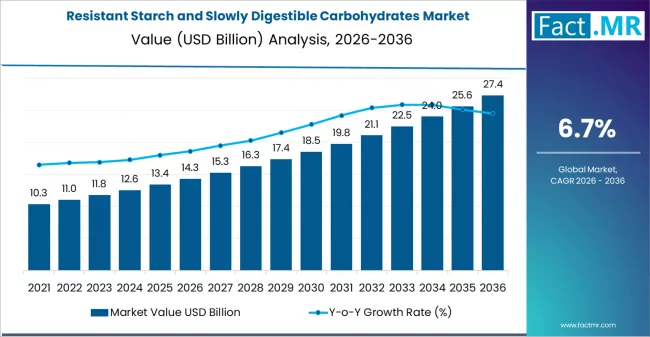
Resistant Starch And Slowly Digestible Carbohydrates Market Market Value Analysis

Manufacturers are under pressure to balance cost control with consumer demand for healthier, functional ingredients. Pricing power is often limited by competitive pressure, particularly from large buyers seeking to negotiate favorable terms. Volume predictability remains a challenge due to fluctuations in demand tied to changing dietary trends and shifting consumer preferences. Companies must navigate these dynamics carefully to maintain margins while adapting to evolving market conditions. Moreover, innovation and regulatory compliance add complexity to the supply chain, influencing both product offerings and the cost structures of suppliers. These realities require careful strategic alignment to sustain profitability over the forecast period.

Resistant Starch and Slowly Digestible Carbohydrates Market

Metric Value
Estimated Value in (2026E) USD 14.3 billion
Forecast Value in (2036F) USD 27.4 billion
Forecast CAGR (2026 to 2036) 6.7%

Category

Category Segments
Compound Type Resistant Starch (RS1–RS5); Slowly Digestible Starch (SDS); Modified or Novel Carbohydrate Blends; Other Low-Glycemic Carbohydrates
Application Bakery and Cereals; Dairy and Nutrition Bars; Beverages and Functional Drinks; Clinical and Medical Nutrition; Sports and Performance Nutrition; Other Foods & Supplements
Ingredient Source High-Amylose Maize or Corn; Potato & Tuber Sources; Green Bananas and Tropical Sources; Legumes and Pulses; Other (Rice or Wheat or Novel Sources)
Region North America; Europe; Asia Pacific; Latin America; Middle East & Africa

Segmental Analysis

What Is the Impact of Compound Type on the Resistant Starch and Slowly Digestible Carbohydrates Market?
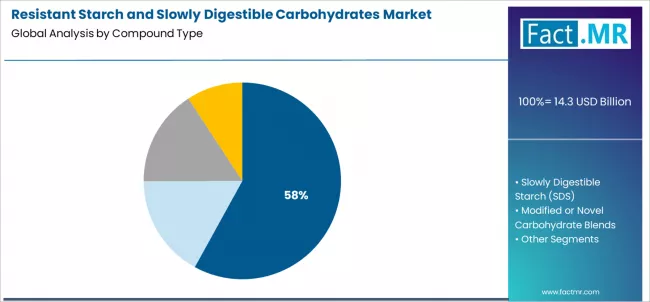
Resistant Starch And Slowly Digestible Carbohydrates Market Analysis By Compound Type

In the resistant starch and slowly digestible carbohydrates market, compound type plays a significant role in determining the functionality and benefits of these ingredients. Resistant starch (RS1–RS5) leads the market with a 58% share, as it offers a wide range of health benefits, including improved gut health and blood sugar regulation. Resistant starch is used in various applications such as bakery products, snacks, and dietary supplements. As consumers continue to seek healthier alternatives for managing blood sugar and supporting digestion, the demand for resistant starch will remain strong, driving the market's growth.

How Does Ingredient Source Influence the Resistant Starch and Slowly Digestible Carbohydrates Market?
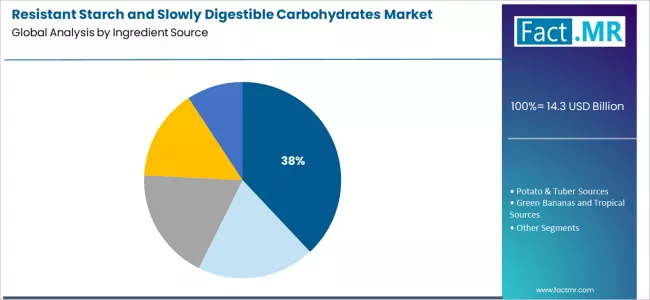
Resistant Starch And Slowly Digestible Carbohydrates Market Analysis By Ingredient Source

Ingredient source is a key factor influencing the market for resistant starch and slowly digestible carbohydrates, with high-amylose maize or corn holding a 38% share. This source is rich in resistant starch, making it an ideal ingredient for food products targeting digestive health and low-glycemic diets. High-amylose maize or corn is widely used in processed foods, including baked goods and snacks. As the demand for functional foods and low-glycemic products rises, ingredient sources like high-amylose maize will continue to play a dominant role in the market, providing consumers with health-focused carbohydrate alternatives.

What are the Drivers, Restraints, and Key Trends of the Resistant Starch and Slowly Digestible Carbohydrates Market?

  • Drivers: Demand for resistant starch and slowly digestible carbohydrates is shaped by research linking these ingredients to moderated post prandial glucose responses and improved digestive health. Food manufacturers incorporate these carbohydrate types into bakery, cereal, and snack formulations to support nutrition related product positioning and to meet emerging dietary guidelines that emphasize glycemic management. Scientific and clinical studies published in peer reviewed journals influence formulation choices and ingredient adoption.
  • Restraints: Variability in functional performance across food matrices affects formulators’ ability to achieve desired texture and sensory outcomes without compromising stability. Some processors adjust production methods because resistant starch can interact differently with water and heat compared with conventional starches. Regulatory frameworks in some regions impose labeling restrictions or require substantiation of physiological claims, which can slow introduction of new products that reference specific health effects.
  • Trend 1: Expansion of ingredient portfolios that include novel resistant starch types derived from botanical modifications to broaden application in diverse food formats.
  • Trend 2: Greater use of analytical methods that quantify digestibility kinetics and support formulation decisions intended to balance nutritional function with consumer acceptable taste and texture.

Analysis of the Resistant Starch and Slowly Digestible Carbohydrates Market by Key Country
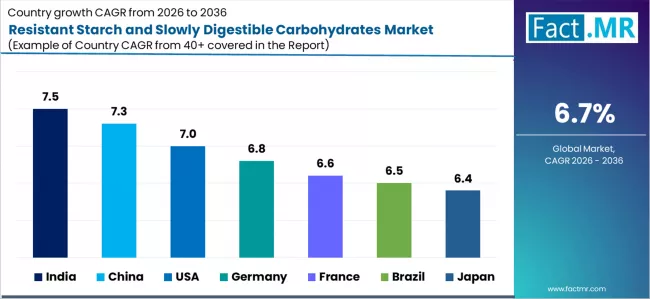
Resistant Starch And Slowly Digestible Carbohydrates Market Cagr Analysis By Country

Country CAGR (2026–2036)
USA 7%
China 7.3%
Germany 6.8%
India 7.5%
Brazil 6.5%

The report covers an in-depth analysis of 40+ countries; top-performing countries are highlighted below.

What is the Growth Outlook for Resistant Starch and Slowly Digestible Carbohydrates Market in the USA?

The USA’s resistant starch and slowly digestible carbohydrates market is projected to grow at a CAGR of 7% from 2026 to 2036. With the increasing awareness of the health benefits associated with these ingredients, particularly in weight management, blood sugar control, and digestive health, the demand for resistant starch and slowly digestible carbohydrates is rising. As the American food and beverage industry continues to prioritize healthier and functional food options, this market is set to grow steadily. The rise of health-conscious consumers, coupled with the demand for natural and plant-based products, will drive continued adoption in various food applications, supporting the growth of this market.

How is the Resistant Starch and Slowly Digestible Carbohydrates Market Performing in China?

China’s resistant starch and slowly digestible carbohydrates market is expected to grow at a CAGR of 7.3% from 2026 to 2036. As China’s consumers become increasingly health-conscious, the demand for functional foods containing resistant starch and slowly digestible carbohydrates is on the rise. These ingredients are used in a variety of products, including low-glycemic foods, fiber-rich snacks, and dietary supplements. China’s large and growing middle class, along with its focus on improving the health and wellness of its population, will continue to drive the market’s growth. Additionally, the government’s push for healthier food choices and reforms in the food and beverage sector will support the increasing adoption of these ingredients.

What is the Market Outlook for Resistant Starch and Slowly Digestible Carbohydrates Market in Germany?

Germany’s resistant starch and slowly digestible carbohydrates market is projected to grow at a CAGR of 6.8% from 2026 to 2036. Germany, known for its robust food and beverage industry, is seeing a rising demand for functional foods that offer health benefits. The increasing preference for low-glycemic, high-fiber foods is driving the adoption of resistant starch and slowly digestible carbohydrates. With a focus on healthier eating habits and rising consumer awareness of the benefits of these ingredients for digestive health and blood sugar management, Germany’s market for these ingredients will continue to expand steadily over the forecast period.

What is the Growth Potential for Resistant Starch and Slowly Digestible Carbohydrates Market in India?

India’s resistant starch and slowly digestible carbohydrates market is forecast to grow at a CAGR of 7.5% from 2026 to 2036. As India’s population grows and the demand for health-focused foods rises, the market for resistant starch and slowly digestible carbohydrates is experiencing rapid growth. These ingredients are seen as beneficial for weight management, heart health, and improving overall digestion. India’s growing middle class, rising health concerns, and increasing disposable income are all factors driving the demand for functional and healthy foods. With these trends, the market for resistant starch and slowly digestible carbohydrates in India is expected to grow steadily, driven by both domestic and international demand for nutritious food products.

What is the Demand for Resistant Starch and Slowly Digestible Carbohydrates Market in Brazil?

Brazil’s resistant starch and slowly digestible carbohydrates market is set to grow at a CAGR of 6.5% from 2026 to 2036. With Brazil’s increasing focus on health and wellness, the demand for functional foods that support digestive health and weight management is rising. Resistant starch and slowly digestible carbohydrates are key ingredients in low-glycemic foods, which are becoming more popular in Brazil. The growing interest in plant-based, high-fiber foods and the increasing awareness of their health benefits will continue to drive market growth. As Brazil’s consumer base becomes more health-conscious, the market for these ingredients will expand, supporting both the food and dietary supplement sectors.

How is Competition Structured in the Resistant Starch and Slowly Digestible Carbohydrates Market?

Competition in the resistant starch and slowly digestible carbohydrates market is shaped by product functionality, source versatility, and regulatory compliance. Ingredion and Tate & Lyle compete with broad portfolios of starch derivatives engineered for digestive and glycemic response applications. Cargill, ADM, and Roquette Frères emphasize scalable production and diverse feedstock integration to meet varied formulation needs. Emsland Group and MGP Ingredients focus on specialty starch fractions tailored to health oriented food products.

MSP Starch Products and SunOpta Inc. position offerings with natural and plant based credentials designed for clean label trends. AGRANA Beteiligungs AG competes by linking carbohydrate ingredients with upstream agricultural supply chains to ensure consistency of raw materials. Differentiation arises from documented physiological effects, ease of incorporation into food matrices, and alignment with dietary guidelines. Buyers assess suppliers based on technical support, compositional data, and the ability to maintain consistent performance across manufacturing scales.

Key Players in the Resistant Starch and Slowly Digestible Carbohydrates Market?

  • Ingredion Incorporated
  • Tate & Lyle plc
  • Cargill, Inc.
  • Roquette Frères
  • ADM
  • Emsland Group
  • MGP Ingredients
  • MSP Starch Products
  • SunOpta Inc.
  • AGRANA BeteiligungsAG

Scope of the Report

Items Values
Quantitative Units (2026) USD Billion
Compound Type Resistant Starch (RS1–RS5), Slowly Digestible Starch (SDS), Modified or Novel Carbohydrate Blends, Other Low-Glycemic Carbohydrates
Application Bakery and Cereals, Dairy and Nutrition Bars, Beverages and Functional Drinks, Clinical and Medical Nutrition, Sports and Performance Nutrition, Other Foods & Supplements
Ingredient Source High-Amylose Maize or Corn, Potato & Tuber Sources, Green Bananas and Tropical Sources, Legumes and Pulses, Other (Rice or Wheat or Novel Sources)
Regions Covered North America, Europe, Asia Pacific, Latin America, Middle East & Africa
Countries Covered United States, Canada, Mexico, Brazil, Germany, United Kingdom, France, Italy, Spain, China, Japan, South Korea, India, Australia & New Zealand
Key Companies Profiled Ingredion Incorporated, Tate & Lyle plc, Cargill, Inc., Roquette Frères, ADM, Emsland Group, MGP Ingredients, MSP Starch Products, SunOpta Inc., AGRANA Beteiligungs-AG
Additional Attributes Dollar revenue by compound type, application, and ingredient source; regional demand trends, competitive landscape, formulation advancements in low-glycemic carbohydrates, functional nutrition positioning, regulatory alignment for health claims, and product innovation strategies in resistant and slowly digestible starches

Resistant Starch and Slowly Digestible Carbohydrates Market Key Segments

  • Compound Type :

    • Resistant Starch (RS1–RS5)
    • Slowly Digestible Starch (SDS)
    • Modified or Novel Carbohydrate Blends
    • Other Low-Glycemic Carbohydrates
  • Application :

    • Bakery and Cereals
    • Dairy and Nutrition Bars
    • Beverages and Functional Drinks
    • Clinical and Medical Nutrition
    • Sports and Performance Nutrition
    • Other Foods & Supplements
    • Other
  • Ingredient Source :

    • High-Amylose Maize or Corn
    • Potato & Tuber Sources
    • Green Bananas and Tropical Sources
    • Legumes and Pulses
    • Other (Rice or Wheat or Novel Sources)
  • Region :

    • North America

      • USA
      • Canada
      • Mexico
    • Europe

      • Germany
      • UK
      • France
      • Italy
      • Spain
      • Nordic Countries
      • BENELUX
      • Rest of Europe
    • Asia Pacific

      • China
      • Japan
      • South Korea
      • India
      • Australia
      • Rest of Asia Pacific
    • Latin America

      • Brazil
      • Argentina
      • Rest of Latin America
    • Middle East and Africa

      • Kingdom of Saudi Arabia
      • United Arab Emirates
      • South Africa
      • Rest of Middle East and Africa
    • Other Regions

      • Oceania
      • Central Asia
      • Other Markets

Bibliographies

  • Food and Agriculture Organization of the United Nations. (2023). Dietary carbohydrates: Classification, physiological effects, and functional properties. FAO Nutrition Division.
  • World Health Organization. (2023). Carbohydrates in human nutrition: Resistant starch and glycemic response. WHO Press.
  • European Food Safety Authority. (2024). Scientific opinion on dietary fiber, resistant starch, and health claims related to glycaemic response. EFSA Journal.
  • U.S. Food and Drug Administration. (2024). Dietary fiber guidance for resistant starch and slowly digestible carbohydrates under nutrition labeling regulations. FDA.

Table of Content

  1. Executive Summary
    • Global Market Outlook
    • Demand to side Trends
    • Supply to side Trends
    • Technology Roadmap Analysis
    • Analysis and Recommendations
  2. Market Overview
    • Market Coverage / Taxonomy
    • Market Definition / Scope / Limitations
  3. Market Background
    • Market Dynamics
      • Drivers
      • Restraints
      • Opportunity
      • Trends
    • Scenario Forecast
      • Demand in Optimistic Scenario
      • Demand in Likely Scenario
      • Demand in Conservative Scenario
    • Opportunity Map Analysis
    • Product Life Cycle Analysis
    • Supply Chain Analysis
    • Investment Feasibility Matrix
    • Value Chain Analysis
    • PESTLE and Porter’s Analysis
    • Regulatory Landscape
    • Regional Parent Market Outlook
    • Production and Consumption Statistics
    • Import and Export Statistics
  4. Global Market Analysis 2021 to 2025 and Forecast, 2026 to 2036
    • Historical Market Size Value (USD Million) Analysis, 2021 to 2025
    • Current and Future Market Size Value (USD Million) Projections, 2026 to 2036
      • Y to o to Y Growth Trend Analysis
      • Absolute $ Opportunity Analysis
  5. Global Market Pricing Analysis 2021 to 2025 and Forecast 2026 to 2036
  6. Global Market Analysis 2021 to 2025 and Forecast 2026 to 2036, By Compound Type
    • Introduction / Key Findings
    • Historical Market Size Value (USD Million) Analysis By Compound Type, 2021 to 2025
    • Current and Future Market Size Value (USD Million) Analysis and Forecast By Compound Type, 2026 to 2036
      • Resistant Starch (RS1–RS5)
      • Slowly Digestible Starch (SDS)
      • Modified or Novel Carbohydrate Blends
      • Other Low‑Glycemic Carbohydrates
    • Y to o to Y Growth Trend Analysis By Compound Type, 2021 to 2025
    • Absolute $ Opportunity Analysis By Compound Type, 2026 to 2036
  7. Global Market Analysis 2021 to 2025 and Forecast 2026 to 2036, By Application
    • Introduction / Key Findings
    • Historical Market Size Value (USD Million) Analysis By Application, 2021 to 2025
    • Current and Future Market Size Value (USD Million) Analysis and Forecast By Application, 2026 to 2036
      • Bakery and Cereals
      • Dairy and Nutrition Bars
      • Beverages and Functional Drinks
      • Clinical and Medical Nutrition
      • Sports and Performance Nutrition
      • Other Foods & Supplements
    • Y to o to Y Growth Trend Analysis By Application, 2021 to 2025
    • Absolute $ Opportunity Analysis By Application, 2026 to 2036
  8. Global Market Analysis 2021 to 2025 and Forecast 2026 to 2036, By Ingredient Source
    • Introduction / Key Findings
    • Historical Market Size Value (USD Million) Analysis By Ingredient Source, 2021 to 2025
    • Current and Future Market Size Value (USD Million) Analysis and Forecast By Ingredient Source, 2026 to 2036
      • High‑Amylose Maize or Corn
      • Potato & Tuber Sources
      • Green Bananas and Tropical Sources
      • Legumes and Pulses
      • Other (Rice or Wheat or Novel Sources)
    • Y to o to Y Growth Trend Analysis By Ingredient Source, 2021 to 2025
    • Absolute $ Opportunity Analysis By Ingredient Source, 2026 to 2036
  9. Global Market Analysis 2021 to 2025 and Forecast 2026 to 2036, By Region
    • Introduction
    • Historical Market Size Value (USD Million) Analysis By Region, 2021 to 2025
    • Current Market Size Value (USD Million) Analysis and Forecast By Region, 2026 to 2036
      • North America
      • Latin America
      • Western Europe
      • Eastern Europe
      • East Asia
      • South Asia and Pacific
      • Middle East & Africa
    • Market Attractiveness Analysis By Region
  10. North America Market Analysis 2021 to 2025 and Forecast 2026 to 2036, By Country
    • Historical Market Size Value (USD Million) Trend Analysis By Market Taxonomy, 2021 to 2025
    • Market Size Value (USD Million) Forecast By Market Taxonomy, 2026 to 2036
      • By Country
        • USA
        • Canada
        • Mexico
      • By Compound Type
      • By Application
      • By Ingredient Source
    • Market Attractiveness Analysis
      • By Country
      • By Compound Type
      • By Application
      • By Ingredient Source
    • Key Takeaways
  11. Latin America Market Analysis 2021 to 2025 and Forecast 2026 to 2036, By Country
    • Historical Market Size Value (USD Million) Trend Analysis By Market Taxonomy, 2021 to 2025
    • Market Size Value (USD Million) Forecast By Market Taxonomy, 2026 to 2036
      • By Country
        • Brazil
        • Chile
        • Rest of Latin America
      • By Compound Type
      • By Application
      • By Ingredient Source
    • Market Attractiveness Analysis
      • By Country
      • By Compound Type
      • By Application
      • By Ingredient Source
    • Key Takeaways
  12. Western Europe Market Analysis 2021 to 2025 and Forecast 2026 to 2036, By Country
    • Historical Market Size Value (USD Million) Trend Analysis By Market Taxonomy, 2021 to 2025
    • Market Size Value (USD Million) Forecast By Market Taxonomy, 2026 to 2036
      • By Country
        • Germany
        • UK
        • Italy
        • Spain
        • France
        • Nordic
        • BENELUX
        • Rest of Western Europe
      • By Compound Type
      • By Application
      • By Ingredient Source
    • Market Attractiveness Analysis
      • By Country
      • By Compound Type
      • By Application
      • By Ingredient Source
    • Key Takeaways
  13. Eastern Europe Market Analysis 2021 to 2025 and Forecast 2026 to 2036, By Country
    • Historical Market Size Value (USD Million) Trend Analysis By Market Taxonomy, 2021 to 2025
    • Market Size Value (USD Million) Forecast By Market Taxonomy, 2026 to 2036
      • By Country
        • Russia
        • Poland
        • Hungary
        • Balkan & Baltic
        • Rest of Eastern Europe
      • By Compound Type
      • By Application
      • By Ingredient Source
    • Market Attractiveness Analysis
      • By Country
      • By Compound Type
      • By Application
      • By Ingredient Source
    • Key Takeaways
  14. East Asia Market Analysis 2021 to 2025 and Forecast 2026 to 2036, By Country
    • Historical Market Size Value (USD Million) Trend Analysis By Market Taxonomy, 2021 to 2025
    • Market Size Value (USD Million) Forecast By Market Taxonomy, 2026 to 2036
      • By Country
        • China
        • Japan
        • South Korea
      • By Compound Type
      • By Application
      • By Ingredient Source
    • Market Attractiveness Analysis
      • By Country
      • By Compound Type
      • By Application
      • By Ingredient Source
    • Key Takeaways
  15. South Asia and Pacific Market Analysis 2021 to 2025 and Forecast 2026 to 2036, By Country
    • Historical Market Size Value (USD Million) Trend Analysis By Market Taxonomy, 2021 to 2025
    • Market Size Value (USD Million) Forecast By Market Taxonomy, 2026 to 2036
      • By Country
        • India
        • ASEAN
        • Australia & New Zealand
        • Rest of South Asia and Pacific
      • By Compound Type
      • By Application
      • By Ingredient Source
    • Market Attractiveness Analysis
      • By Country
      • By Compound Type
      • By Application
      • By Ingredient Source
    • Key Takeaways
  16. Middle East & Africa Market Analysis 2021 to 2025 and Forecast 2026 to 2036, By Country
    • Historical Market Size Value (USD Million) Trend Analysis By Market Taxonomy, 2021 to 2025
    • Market Size Value (USD Million) Forecast By Market Taxonomy, 2026 to 2036
      • By Country
        • Kingdom of Saudi Arabia
        • Other GCC Countries
        • Turkiye
        • South Africa
        • Other African Union
        • Rest of Middle East & Africa
      • By Compound Type
      • By Application
      • By Ingredient Source
    • Market Attractiveness Analysis
      • By Country
      • By Compound Type
      • By Application
      • By Ingredient Source
    • Key Takeaways
  17. Key Countries Market Analysis
    • USA
      • Pricing Analysis
      • Market Share Analysis, 2025
        • By Compound Type
        • By Application
        • By Ingredient Source
    • Canada
      • Pricing Analysis
      • Market Share Analysis, 2025
        • By Compound Type
        • By Application
        • By Ingredient Source
    • Mexico
      • Pricing Analysis
      • Market Share Analysis, 2025
        • By Compound Type
        • By Application
        • By Ingredient Source
    • Brazil
      • Pricing Analysis
      • Market Share Analysis, 2025
        • By Compound Type
        • By Application
        • By Ingredient Source
    • Chile
      • Pricing Analysis
      • Market Share Analysis, 2025
        • By Compound Type
        • By Application
        • By Ingredient Source
    • Germany
      • Pricing Analysis
      • Market Share Analysis, 2025
        • By Compound Type
        • By Application
        • By Ingredient Source
    • UK
      • Pricing Analysis
      • Market Share Analysis, 2025
        • By Compound Type
        • By Application
        • By Ingredient Source
    • Italy
      • Pricing Analysis
      • Market Share Analysis, 2025
        • By Compound Type
        • By Application
        • By Ingredient Source
    • Spain
      • Pricing Analysis
      • Market Share Analysis, 2025
        • By Compound Type
        • By Application
        • By Ingredient Source
    • France
      • Pricing Analysis
      • Market Share Analysis, 2025
        • By Compound Type
        • By Application
        • By Ingredient Source
    • India
      • Pricing Analysis
      • Market Share Analysis, 2025
        • By Compound Type
        • By Application
        • By Ingredient Source
    • ASEAN
      • Pricing Analysis
      • Market Share Analysis, 2025
        • By Compound Type
        • By Application
        • By Ingredient Source
    • Australia & New Zealand
      • Pricing Analysis
      • Market Share Analysis, 2025
        • By Compound Type
        • By Application
        • By Ingredient Source
    • China
      • Pricing Analysis
      • Market Share Analysis, 2025
        • By Compound Type
        • By Application
        • By Ingredient Source
    • Japan
      • Pricing Analysis
      • Market Share Analysis, 2025
        • By Compound Type
        • By Application
        • By Ingredient Source
    • South Korea
      • Pricing Analysis
      • Market Share Analysis, 2025
        • By Compound Type
        • By Application
        • By Ingredient Source
    • Russia
      • Pricing Analysis
      • Market Share Analysis, 2025
        • By Compound Type
        • By Application
        • By Ingredient Source
    • Poland
      • Pricing Analysis
      • Market Share Analysis, 2025
        • By Compound Type
        • By Application
        • By Ingredient Source
    • Hungary
      • Pricing Analysis
      • Market Share Analysis, 2025
        • By Compound Type
        • By Application
        • By Ingredient Source
    • Kingdom of Saudi Arabia
      • Pricing Analysis
      • Market Share Analysis, 2025
        • By Compound Type
        • By Application
        • By Ingredient Source
    • Turkiye
      • Pricing Analysis
      • Market Share Analysis, 2025
        • By Compound Type
        • By Application
        • By Ingredient Source
    • South Africa
      • Pricing Analysis
      • Market Share Analysis, 2025
        • By Compound Type
        • By Application
        • By Ingredient Source
  18. Market Structure Analysis
    • Competition Dashboard
    • Competition Benchmarking
    • Market Share Analysis of Top Players
      • By Regional
      • By Compound Type
      • By Application
      • By Ingredient Source
  19. Competition Analysis
    • Competition Deep Dive
      • Ingredion Incorporated
        • Overview
        • Product Portfolio
        • Profitability by Market Segments (Product/Age /Sales Channel/Region)
        • Sales Footprint
        • Strategy Overview
          • Marketing Strategy
          • Product Strategy
          • Channel Strategy
      • Tate & Lyle plc
      • Cargill, Inc.
      • Roquette Frères
      • ADM
      • Emsland Group
      • MGP Ingredients
      • MSP Starch Products
      • SunOpta Inc.
      • AGRANA Beteiligungs‑AG
  20. Assumptions & Acronyms Used
  21. Research Methodology

List Of Table

  • Table 1: Global Market Value (USD Million) Forecast by Region, 2021 to 2036
  • Table 2: Global Market Value (USD Million) Forecast by Compound Type, 2021 to 2036
  • Table 3: Global Market Value (USD Million) Forecast by Application, 2021 to 2036
  • Table 4: Global Market Value (USD Million) Forecast by Ingredient Source, 2021 to 2036
  • Table 5: North America Market Value (USD Million) Forecast by Country, 2021 to 2036
  • Table 6: North America Market Value (USD Million) Forecast by Compound Type, 2021 to 2036
  • Table 7: North America Market Value (USD Million) Forecast by Application, 2021 to 2036
  • Table 8: North America Market Value (USD Million) Forecast by Ingredient Source, 2021 to 2036
  • Table 9: Latin America Market Value (USD Million) Forecast by Country, 2021 to 2036
  • Table 10: Latin America Market Value (USD Million) Forecast by Compound Type, 2021 to 2036
  • Table 11: Latin America Market Value (USD Million) Forecast by Application, 2021 to 2036
  • Table 12: Latin America Market Value (USD Million) Forecast by Ingredient Source, 2021 to 2036
  • Table 13: Western Europe Market Value (USD Million) Forecast by Country, 2021 to 2036
  • Table 14: Western Europe Market Value (USD Million) Forecast by Compound Type, 2021 to 2036
  • Table 15: Western Europe Market Value (USD Million) Forecast by Application, 2021 to 2036
  • Table 16: Western Europe Market Value (USD Million) Forecast by Ingredient Source, 2021 to 2036
  • Table 17: Eastern Europe Market Value (USD Million) Forecast by Country, 2021 to 2036
  • Table 18: Eastern Europe Market Value (USD Million) Forecast by Compound Type, 2021 to 2036
  • Table 19: Eastern Europe Market Value (USD Million) Forecast by Application, 2021 to 2036
  • Table 20: Eastern Europe Market Value (USD Million) Forecast by Ingredient Source, 2021 to 2036
  • Table 21: East Asia Market Value (USD Million) Forecast by Country, 2021 to 2036
  • Table 22: East Asia Market Value (USD Million) Forecast by Compound Type, 2021 to 2036
  • Table 23: East Asia Market Value (USD Million) Forecast by Application, 2021 to 2036
  • Table 24: East Asia Market Value (USD Million) Forecast by Ingredient Source, 2021 to 2036
  • Table 25: South Asia and Pacific Market Value (USD Million) Forecast by Country, 2021 to 2036
  • Table 26: South Asia and Pacific Market Value (USD Million) Forecast by Compound Type, 2021 to 2036
  • Table 27: South Asia and Pacific Market Value (USD Million) Forecast by Application, 2021 to 2036
  • Table 28: South Asia and Pacific Market Value (USD Million) Forecast by Ingredient Source, 2021 to 2036
  • Table 29: Middle East & Africa Market Value (USD Million) Forecast by Country, 2021 to 2036
  • Table 30: Middle East & Africa Market Value (USD Million) Forecast by Compound Type, 2021 to 2036
  • Table 31: Middle East & Africa Market Value (USD Million) Forecast by Application, 2021 to 2036
  • Table 32: Middle East & Africa Market Value (USD Million) Forecast by Ingredient Source, 2021 to 2036

List Of Figures

  • Figure 1: Global Market Pricing Analysis
  • Figure 2: Global Market Value (USD Million) Forecast 2021 to 2036
  • Figure 3: Global Market Value Share and BPS Analysis by Compound Type, 2026 and 2036
  • Figure 4: Global Market Y to o to Y Growth Comparison by Compound Type, 2026 to 2036
  • Figure 5: Global Market Attractiveness Analysis by Compound Type
  • Figure 6: Global Market Value Share and BPS Analysis by Application, 2026 and 2036
  • Figure 7: Global Market Y to o to Y Growth Comparison by Application, 2026 to 2036
  • Figure 8: Global Market Attractiveness Analysis by Application
  • Figure 9: Global Market Value Share and BPS Analysis by Ingredient Source, 2026 and 2036
  • Figure 10: Global Market Y to o to Y Growth Comparison by Ingredient Source, 2026 to 2036
  • Figure 11: Global Market Attractiveness Analysis by Ingredient Source
  • Figure 12: Global Market Value (USD Million) Share and BPS Analysis by Region, 2026 and 2036
  • Figure 13: Global Market Y to o to Y Growth Comparison by Region, 2026 to 2036
  • Figure 14: Global Market Attractiveness Analysis by Region
  • Figure 15: North America Market Incremental Dollar Opportunity, 2026 to 2036
  • Figure 16: Latin America Market Incremental Dollar Opportunity, 2026 to 2036
  • Figure 17: Western Europe Market Incremental Dollar Opportunity, 2026 to 2036
  • Figure 18: Eastern Europe Market Incremental Dollar Opportunity, 2026 to 2036
  • Figure 19: East Asia Market Incremental Dollar Opportunity, 2026 to 2036
  • Figure 20: South Asia and Pacific Market Incremental Dollar Opportunity, 2026 to 2036
  • Figure 21: Middle East & Africa Market Incremental Dollar Opportunity, 2026 to 2036
  • Figure 22: North America Market Value Share and BPS Analysis by Country, 2026 and 2036
  • Figure 23: North America Market Value Share and BPS Analysis by Compound Type, 2026 and 2036
  • Figure 24: North America Market Y to o to Y Growth Comparison by Compound Type, 2026 to 2036
  • Figure 25: North America Market Attractiveness Analysis by Compound Type
  • Figure 26: North America Market Value Share and BPS Analysis by Application, 2026 and 2036
  • Figure 27: North America Market Y to o to Y Growth Comparison by Application, 2026 to 2036
  • Figure 28: North America Market Attractiveness Analysis by Application
  • Figure 29: North America Market Value Share and BPS Analysis by Ingredient Source, 2026 and 2036
  • Figure 30: North America Market Y to o to Y Growth Comparison by Ingredient Source, 2026 to 2036
  • Figure 31: North America Market Attractiveness Analysis by Ingredient Source
  • Figure 32: Latin America Market Value Share and BPS Analysis by Country, 2026 and 2036
  • Figure 33: Latin America Market Value Share and BPS Analysis by Compound Type, 2026 and 2036
  • Figure 34: Latin America Market Y to o to Y Growth Comparison by Compound Type, 2026 to 2036
  • Figure 35: Latin America Market Attractiveness Analysis by Compound Type
  • Figure 36: Latin America Market Value Share and BPS Analysis by Application, 2026 and 2036
  • Figure 37: Latin America Market Y to o to Y Growth Comparison by Application, 2026 to 2036
  • Figure 38: Latin America Market Attractiveness Analysis by Application
  • Figure 39: Latin America Market Value Share and BPS Analysis by Ingredient Source, 2026 and 2036
  • Figure 40: Latin America Market Y to o to Y Growth Comparison by Ingredient Source, 2026 to 2036
  • Figure 41: Latin America Market Attractiveness Analysis by Ingredient Source
  • Figure 42: Western Europe Market Value Share and BPS Analysis by Country, 2026 and 2036
  • Figure 43: Western Europe Market Value Share and BPS Analysis by Compound Type, 2026 and 2036
  • Figure 44: Western Europe Market Y to o to Y Growth Comparison by Compound Type, 2026 to 2036
  • Figure 45: Western Europe Market Attractiveness Analysis by Compound Type
  • Figure 46: Western Europe Market Value Share and BPS Analysis by Application, 2026 and 2036
  • Figure 47: Western Europe Market Y to o to Y Growth Comparison by Application, 2026 to 2036
  • Figure 48: Western Europe Market Attractiveness Analysis by Application
  • Figure 49: Western Europe Market Value Share and BPS Analysis by Ingredient Source, 2026 and 2036
  • Figure 50: Western Europe Market Y to o to Y Growth Comparison by Ingredient Source, 2026 to 2036
  • Figure 51: Western Europe Market Attractiveness Analysis by Ingredient Source
  • Figure 52: Eastern Europe Market Value Share and BPS Analysis by Country, 2026 and 2036
  • Figure 53: Eastern Europe Market Value Share and BPS Analysis by Compound Type, 2026 and 2036
  • Figure 54: Eastern Europe Market Y to o to Y Growth Comparison by Compound Type, 2026 to 2036
  • Figure 55: Eastern Europe Market Attractiveness Analysis by Compound Type
  • Figure 56: Eastern Europe Market Value Share and BPS Analysis by Application, 2026 and 2036
  • Figure 57: Eastern Europe Market Y to o to Y Growth Comparison by Application, 2026 to 2036
  • Figure 58: Eastern Europe Market Attractiveness Analysis by Application
  • Figure 59: Eastern Europe Market Value Share and BPS Analysis by Ingredient Source, 2026 and 2036
  • Figure 60: Eastern Europe Market Y to o to Y Growth Comparison by Ingredient Source, 2026 to 2036
  • Figure 61: Eastern Europe Market Attractiveness Analysis by Ingredient Source
  • Figure 62: East Asia Market Value Share and BPS Analysis by Country, 2026 and 2036
  • Figure 63: East Asia Market Value Share and BPS Analysis by Compound Type, 2026 and 2036
  • Figure 64: East Asia Market Y to o to Y Growth Comparison by Compound Type, 2026 to 2036
  • Figure 65: East Asia Market Attractiveness Analysis by Compound Type
  • Figure 66: East Asia Market Value Share and BPS Analysis by Application, 2026 and 2036
  • Figure 67: East Asia Market Y to o to Y Growth Comparison by Application, 2026 to 2036
  • Figure 68: East Asia Market Attractiveness Analysis by Application
  • Figure 69: East Asia Market Value Share and BPS Analysis by Ingredient Source, 2026 and 2036
  • Figure 70: East Asia Market Y to o to Y Growth Comparison by Ingredient Source, 2026 to 2036
  • Figure 71: East Asia Market Attractiveness Analysis by Ingredient Source
  • Figure 72: South Asia and Pacific Market Value Share and BPS Analysis by Country, 2026 and 2036
  • Figure 73: South Asia and Pacific Market Value Share and BPS Analysis by Compound Type, 2026 and 2036
  • Figure 74: South Asia and Pacific Market Y to o to Y Growth Comparison by Compound Type, 2026 to 2036
  • Figure 75: South Asia and Pacific Market Attractiveness Analysis by Compound Type
  • Figure 76: South Asia and Pacific Market Value Share and BPS Analysis by Application, 2026 and 2036
  • Figure 77: South Asia and Pacific Market Y to o to Y Growth Comparison by Application, 2026 to 2036
  • Figure 78: South Asia and Pacific Market Attractiveness Analysis by Application
  • Figure 79: South Asia and Pacific Market Value Share and BPS Analysis by Ingredient Source, 2026 and 2036
  • Figure 80: South Asia and Pacific Market Y to o to Y Growth Comparison by Ingredient Source, 2026 to 2036
  • Figure 81: South Asia and Pacific Market Attractiveness Analysis by Ingredient Source
  • Figure 82: Middle East & Africa Market Value Share and BPS Analysis by Country, 2026 and 2036
  • Figure 83: Middle East & Africa Market Value Share and BPS Analysis by Compound Type, 2026 and 2036
  • Figure 84: Middle East & Africa Market Y to o to Y Growth Comparison by Compound Type, 2026 to 2036
  • Figure 85: Middle East & Africa Market Attractiveness Analysis by Compound Type
  • Figure 86: Middle East & Africa Market Value Share and BPS Analysis by Application, 2026 and 2036
  • Figure 87: Middle East & Africa Market Y to o to Y Growth Comparison by Application, 2026 to 2036
  • Figure 88: Middle East & Africa Market Attractiveness Analysis by Application
  • Figure 89: Middle East & Africa Market Value Share and BPS Analysis by Ingredient Source, 2026 and 2036
  • Figure 90: Middle East & Africa Market Y to o to Y Growth Comparison by Ingredient Source, 2026 to 2036
  • Figure 91: Middle East & Africa Market Attractiveness Analysis by Ingredient Source
  • Figure 92: Global Market - Tier Structure Analysis
  • Figure 93: Global Market - Company Share Analysis

- FAQs -

How big is the resistant starch and slowly digestible carbohydrates market in 2026?

The global resistant starch and slowly digestible carbohydrates market is estimated to be valued at USD 14.3 billion in 2026.

What will be the size of resistant starch and slowly digestible carbohydrates market in 2036?

The market size for the resistant starch and slowly digestible carbohydrates market is projected to reach USD 27.4 billion by 2036.

How much will be the resistant starch and slowly digestible carbohydrates market growth between 2026 and 2036?

The resistant starch and slowly digestible carbohydrates market is expected to grow at a 6.7% CAGR between 2026 and 2036.

What are the key product types in the resistant starch and slowly digestible carbohydrates market?

The key product types in resistant starch and slowly digestible carbohydrates market are resistant starch (rs1–rs5), slowly digestible starch (sds), modified or novel carbohydrate blends and other low‑glycemic carbohydrates.

Which application segment to contribute significant share in the resistant starch and slowly digestible carbohydrates market in 2026?

In terms of application, bakery and cereals segment to command 32.0% share in the resistant starch and slowly digestible carbohydrates market in 2026.

Resistant Starch and Slowly Digestible Carbohydrates Market