Antifoaming Agents Market Size, Share, Growth and Forecast (2026 - 2036)
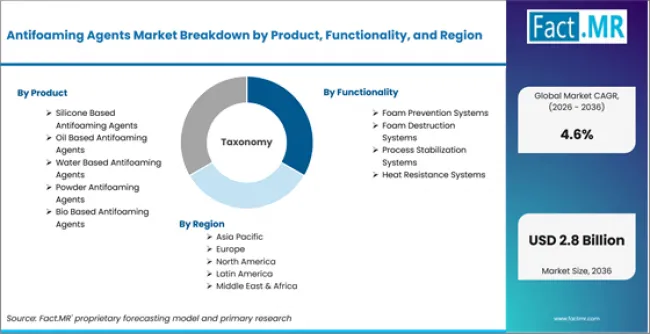
Antifoaming Agents Market is segmented by Product (Silicone Based Antifoaming Agents, Oil Based Antifoaming Agents, Water Based Antifoaming Agents, Powder Antifoaming Agents, Bio Based Antifoaming Agents), Functionality (Foam Prevention Systems, Foam Destruction Systems, Process Stabilization Systems, Heat Resistance Systems), Application (Food And Beverage Industry, Chemical Industry, Water Treatment Industry, Pharmaceutical Industry), and Region. Forecast for 2026 to 2036.
Antifoaming Agents Market Analysis and Forecast by Fact.MR
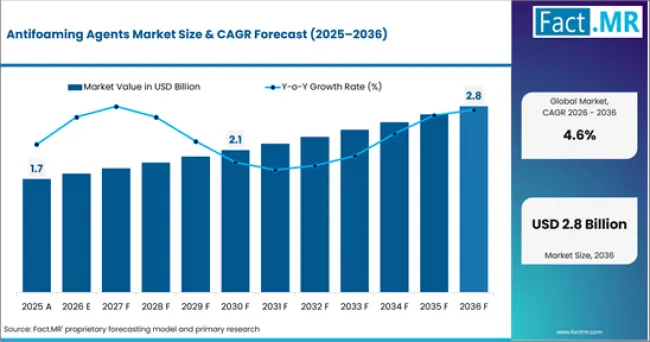
- The Antifoaming Agents Market is expected to grow from USD 1.8 billion in 2026 to USD 2.8 billion by 2036, at a 4.6% CAGR.
- Driven by expanding food and beverage production requiring foam control across fermentation, cooking, and packaging operations, growing industrial process demand in wastewater treatment, pulp and paper, and textile manufacturing, and rising adoption of food-grade silicone and non-silicone defoamers meeting clean-label and regulatory compliance requirements.
- Silicone-based agents accounting for 48.3% share and food and beverage applications contributing 29.6% share as process operators prioritize foam prevention, additive safety, and dosing efficiency.
Summary of the Antifoaming Agents Market
- Market Snapshot
- In 2025, the global Antifoaming Agents Market was valued at approximately USD 1.7 billion.
- The market is estimated to reach USD 1.8 billion in 2026 and is projected to attain USD 2.8 billion by 2036.
- The market is likely to expand at a CAGR of 4.6% during the forecast period.
- The market is anticipated to create an absolute dollar opportunity of USD 1.0 billion between 2026 and 2036.
- Silicone-based antifoaming agents account for 48.3% of product segment share in 2026.
- China (5.8%) and India (5.5%) are the key growth markets during the forecast period.
- Demand and Growth Drivers
- Food and beverage manufacturing requires foam control across fermentation (brewing, bioethanol), cooking (sugar processing, soup production), bottling, and CIP cleaning operations where uncontrolled foam reduces yield and throughput.
- Aeration and biological treatment stages of wastewater treatment processes generate foam and the continuous dosing of antifoaming agents is required to maintain the treatment efficiency and prevent foam overflow.
- Antifoaming agents are used in pulp and paper manufacturing for pulp washing, stock preparation and paper machine wet-end operations where foam entrains air that degrades sheet quality.
- In textile dyeing and finishing processes, defoaming agents are needed. Dye baths that contain surfactants often cause foam to form, which may result in uneven penetration of the dye and defects in the fabric.
- Oil and gas production uses antifoaming agents in drilling mud, gas-liquid separation, and crude oil processing where foam formation reduces equipment efficiency and increases safety risk.
- Geography and Competitive Outlook
- China at 5.8% reflects strong market fundamentals and expanding demand.
- India at 5.5% reflects strong market fundamentals and expanding demand.
- Brazil at 4.9% reflects strong market fundamentals and expanding demand.
- Key players include Dow Inc., Wacker Chemie AG, Shin-Etsu Chemical Co. Ltd., BASF SE, Evonik Industries AG, Momentive Performance Materials.
- Analyst Opinion
- Shambhu Nath Jha, Principal Consultant at Fact.MR, says "The antifoaming agents market is a process chemical category where demand is distributed across multiple industrial sectors, with no single application exceeding 30% of total consumption. This diversification provides demand resilience because weakness in one sector is offset by stability in others. Silicone-based defoamers dominate because they offer the broadest operating temperature range and lowest effective dosage, but food-grade and non-silicone alternatives are gaining share as formulators respond to clean-label preferences and regulatory specifications. Dow, Wacker Chemie, Shin-Etsu, BASF, Evonik, and Momentive compete through silicone chemistry, application support, and process-specific formulations. China and India represent the fastest growth because their food processing, wastewater treatment, and industrial manufacturing sectors are expanding at rates above global averages."
Key Growth Drivers, Constraints, and Opportunities
Key Factors Driving Growth
- Growth of primary demand is due to structural trends in industrial consumption leading to stable procurement needs.
- Technological advancement that extends product capability and scope of application across end-use categories.
- Regulatory frameworks creating compliance driven demand and quality specification requirements.
Key Market Constraints
- Supply concentration or volatility in feedstock costs creates procurement risk for downstream consumers.
- Operating costs for manufacturers serving multiple jurisdictions are increased by regulatory compliance complexity.
- Commodity segments are limited in pricing power by competitive pressure from alternative materials or processes.
Key Opportunity Areas
- Specialty and high-performance grades command pricing premiums that create margin differentiation.
- Emerging market industrial expansion represents large untapped demand as manufacturing capacity develops.
- Sustainability and clean-label requirements create differentiated product positioning.
Segment-wise Analysis of the Antifoaming Agents Market
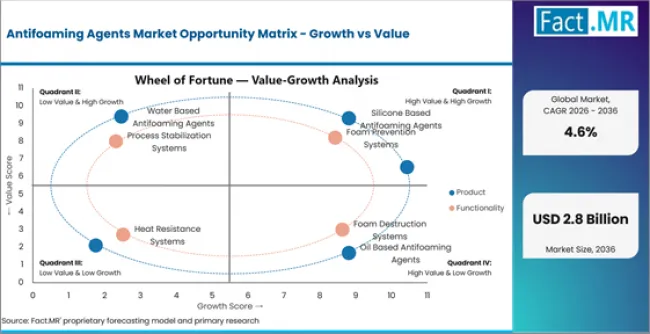
- Silicone-based antifoaming agents hold 48.3% of the product segment in 2026.
The antifoaming agents market is segmented by product, functionality, application, composition, form, and region.
Which Product Segment Dominates the Antifoaming Agents Market?

Silicone-based antifoaming agents account for 48.3% of the product segment in 2026. Their leadership is based on mature industrial usage patterns, wide application compatibility and meeting key end-use needs.
Complementary product categories satisfy specialised needs. The leading segment is expected to retain dominance through 2036.
Which Application Segment Dominates the Antifoaming Agents Market?
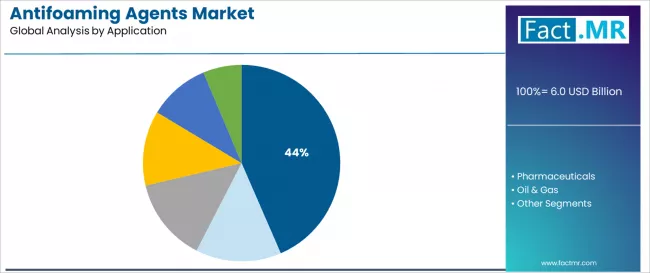
Demand drivers are anchored by the leading application, which feeds on structural consumption from primary industrial end-use categories, supported by trends in production volume and regulatory specifications.
Secondary applications contribute growing demand from expanding use cases. The leading application maintains its core demand position.
Which Trend is Shaping the Next Phase of Growth in the Antifoaming Agents Market?
Bio-based and food-processing-compatible antifoaming agents derived from vegetable oils and plant-derived surfactants represent the most significant product development trend. Traditional silicone defoamers are effective, but are facing increasing scrutiny in food processing applications due to the presence of silicone residue on product surfaces, which is a concern for consumers and regulators. The vegetable oil and lecithin defoamers are food-grade, silicone-free, and eligible for organic and clean-label processing certifications.
The commercial impact is that non-silicone, bio-based defoamers command pricing premiums in food processing applications where organic certification or silicone-free processing claims carry consumer value. The market is bifurcating between high-performance silicone systems for industrial applications and bio-based alternatives for food-contact and environmentally sensitive applications. Suppliers that develop effective non-silicone formulations are capturing share in the food processing segment where regulatory and consumer pressures favor natural-origin process aids.
Regional Outlook Across Key Markets
- China at 5.8% reflects expanding demand driven by regional fundamentals.
- India at 5.5% reflects expanding demand driven by regional fundamentals.
- Brazil at 4.9% reflects expanding demand driven by regional fundamentals.
- Germany at 4.7% reflects expanding demand driven by regional fundamentals.
.webp)
| Country | CAGR (%) |
|---|---|
| China | 5.8% |
| India | 5.5% |
| Brazil | 4.9% |
| Germany | 4.7% |
| USA | 4.3% |
Source: Fact.MR analysis, based on proprietary forecasting model and primary research.

Antifoaming Agents Market Growth Assessment in China
The China antifoaming agents market is expected to grow at a CAGR of 5.8% by 2036, driven by demand factors influencing primary application categories. End-use consumption patterns and regional regulatory frameworks shape product specifications and procurement requirements.
- Primary demand channels in China are expanding through structural industrial growth and application diversification.
- Regional competitive dynamics reflect the balance between domestic production capacity and imported specialty grade supply.
Antifoaming Agents Market Demand Trends in India
The India antifoaming agents market is projected to expand at a CAGR of 5.5% through 2036, mirroring scale factors shaping demand across key application categories. Regional regulatory frameworks and end-use consumption patterns also impact product specification and procurement requirements.
- Primary demand channels in India are expanding through structural industrial growth and application diversification.
- Regional competitive dynamics reflect the balance between domestic production capacity and imported specialty grade supply.
Antifoaming Agents Market Opportunity in Brazil
The Brazil antifoaming agents market is projected to grow at a CAGR of 4.9% through 2036, reflecting infrastructure factors shaping demand across primary application categories. Regional regulatory frameworks and end-use consumption patterns influence product specification and procurement requirements.
- Primary demand channels in Brazil are expanding through structural industrial growth and application diversification.
- Regional competitive dynamics reflect the balance between domestic production capacity and imported specialty grade supply.
Antifoaming Agents Market Analysis in Germany
The Germany antifoaming agents market is projected to grow at a CAGR of 4.7% through 2036, reflecting regulation factors shaping demand across primary application categories. Regional regulatory frameworks and end-use consumption patterns influence product specification and procurement requirements.
- Primary demand channels in Germany are expanding through structural industrial growth and application diversification.
- Regional competitive dynamics reflect the balance between domestic production capacity and imported specialty grade supply.
Antifoaming Agents Market Outlook in USA

The USA antifoaming agents market is projected to grow at a CAGR of 4.3% through 2036, reflecting maturity factors shaping demand across primary application categories. Regional regulatory frameworks and end-use consumption patterns influence product specification and procurement requirements.
- Primary demand channels in USA are expanding through structural industrial growth and application diversification.
- Regional competitive dynamics reflect the balance between domestic production capacity and imported specialty grade supply.
Competitive Benchmarking and Company Positioning

Antifoaming Agents Market Analysis By Company
- Dow Inc., Wacker Chemie AG, Shin-Etsu Chemical Co. Ltd. hold leading positions through established production scale and market presence.
- BASF SE, Evonik Industries AG, Momentive Performance Materials compete across specific grades, regional markets, and application niches.
- Production capability, application development expertise, and customer technical service create primary competitive differentiators.
The competitive landscape features Dow Inc. and Wacker Chemie AG leading through scale and expertise, while regional competitors serve specialized requirements.
Competition is intensifying as technology advancement and market expansion create new product requirements.
Key Companies in the Antifoaming Agents Market
- Dow Inc., Wacker Chemie AG, Shin-Etsu Chemical Co. Ltd., BASF SE, Evonik Industries AG are among the leading players.
- Momentive Performance Materials, Elkem Silicones, Ashland, MÜNZING Chemie GmbH, Kemira Oyj compete across specific segments.
Recent Industry Developments
January 2025 | WACKER Chemie AG | Capacity Expansion: Specialty Silicones in Asia
Wacker expanded specialty silicone production capacity in Japan and South Korea in January 2025, with the new plants aimed at meeting rising demand in Asia.
July 2025 | BASF SE | Product Development: FoamStar® ED 2524 Defoamer
BASF listed FoamStar® ED 2524 as a high-efficiency defoamer in emulsion form for aqueous coating applications. The product is an aqueous emulsion of organo-modified silicones, making it a relevant additional development for the antifoaming agents market.
March 2025 | Evonik Industries AG | Product Launch: TEGO® Foamex 8420
Evonik launched TEGO® Foamex 8420, a siloxane-based defoamer concentrate for waterborne overprint varnishes and inks. The product supports demanding defoaming challenges in waterborne formulations, with long-term effectiveness and broad food-contact compliance.
Leading Companies Shaping the Antifoaming Agents Market
- Dow Inc.
- Wacker Chemie AG.
- Shin-Etsu Chemical Co. Ltd.
- BASF SE.
- Evonik Industries AG.
- Momentive Performance Materials.
- Elkem Silicones.
- Ashland.
- MÜNZING Chemie GmbH
- Kemira Oyj
Sources and Research References
- BASF SE. (2025, July). FoamStar® ED 2524 technical data sheet. BASF SE.
- Dow Inc. (2026). DOWSIL™ 8024 Food Contact Release Emulsion. Dow Inc.
- Evonik Industries AG. (2025, March 10). Evonik launches TEGO® Foamex 8420 for utmost defoaming challenges in waterborne overprint varnishes and inks. Evonik Industries AG.
- WACKER Chemie AG. (2025, January 23). WACKER expands production capacity for specialty silicones in Asia. WACKER Chemie AG.
This bibliography is provided for reader reference and is not exhaustive. The full report contains the complete reference list and detailed citations.
Key Questions This Report Addresses
- What is the current and future size of the Antifoaming Agents Market?
- How fast is the Antifoaming Agents Market expected to grow between 2026 and 2036?
- Which product type is likely to lead the market by 2026?
- Which application segment is expected to account for the highest demand?
- What factors are driving demand globally?
- How is technology evolution reshaping competitive dynamics?
- Why are China and India the fastest-growing markets?
- Which countries are projected to show the fastest growth through 2036?
- Who are the key companies active in the Antifoaming Agents Market?
- How does Fact.MR estimate and validate the market forecast?
Antifoaming Agents Market Definition
The antifoaming agents market covers the core products, materials, and formulations within the defined scope across global and regional markets.
Antifoaming Agents Market Inclusions
- The scope covers global and regional market size and forecasts for 2026 to 2036 across product type, application, end use, technology, formulation, distribution channel, and region.
- It includes regional demand analysis based on primary demand drivers, regulatory frameworks, and end-use consumption patterns.
- The report covers pricing analysis across major product grades and delivery configurations.
Antifoaming Agents Market Exclusions
- The scope excludes adjacent categories and general-purpose materials not specifically designed for the defined market application.
- It excludes consulting and financial services not directly linked to market-specific procurement.
Antifoaming Agents Market Research Methodology
- The methodology combines secondary research, primary interviews, and forecast modelling.
- It draws on 100+ secondary sources and benchmarks 40+ company portfolios.
- Market sizing covers 25+ countries through a demand-side model with top-down validation.
- Primary validation includes 20+ interviews across manufacturers, providers, end users, and partners.
- Final estimates go through cross-validation, procurement-cycle analysis, and sensitivity testing.
Scope of Analysis

| Parameter | Details |
|---|---|
| Quantitative Units | USD 1.8 billion to USD 2.8 billion, at a CAGR of 4.6% |
| Market Definition | The Antifoaming Agents Market covers the primary products and materials within the defined scope. |
| Regions Covered | North America, Latin America, Europe, East Asia, South Asia and Pacific, Middle East and Africa |
| Countries Covered | China, India, Brazil, Germany, USA, 25 plus countries |
| Key Companies | Dow Inc., Wacker Chemie AG, Shin-Etsu Chemical Co. Ltd., BASF SE, Evonik Industries AG, Momentive Performance Materials, Elkem Silicones, Ashland, MÜNZING Chemie GmbH, Kemira Oyj |
| Forecast Period | 2026 to 2036 |
| Approach | Hybrid demand-side and top-down methodology with primary interviews and cross-validation |
Antifoaming Agents Market Segmentation
-
Antifoaming Agents Market Segmented by Product:
- Silicone Based Antifoaming Agents
- Polydimethylsiloxane Antifoaming Systems
- Food Processing Applications
- Industrial Processing Systems
- Silicone Emulsion Antifoaming Agents
- Wastewater Treatment Applications
- Chemical Manufacturing Products
- Polydimethylsiloxane Antifoaming Systems
- Oil Based Antifoaming Agents
- Mineral Oil Antifoaming Systems
- Fermentation Applications
- Industrial Fluid Systems
- Vegetable Oil Antifoaming Agents
- Food Grade Applications
- Clean Label Processing Products
- Mineral Oil Antifoaming Systems
- Water Based Antifoaming Agents
- Aqueous Antifoaming Emulsions
- Pulp Processing Applications
- Paper Manufacturing Systems
- Dispersed Water Based Antifoaming Systems
- Textile Applications
- Industrial Treatment Products
- Aqueous Antifoaming Emulsions
- Powder Antifoaming Agents
- Silica Based Powder Antifoaming Systems
- Detergent Applications
- Dry Mix Products
- Powdered Food Grade Antifoaming Agents
- Instant Beverage Applications
- Processed Food Systems
- Silica Based Powder Antifoaming Systems
- Bio Based Antifoaming Agents
- Plant Derived Antifoaming Systems
- Sustainable Manufacturing Applications
- Eco Friendly Processing Products
- Fermentation Derived Antifoaming Agents
- Biotechnology Applications
- Natural Processing Systems
- Plant Derived Antifoaming Systems
- Silicone Based Antifoaming Agents
-
Antifoaming Agents Market Segmented by Functionality:
- Foam Prevention Systems
- Surface Tension Reduction Systems
- Chemical Processing Applications
- Industrial Fluid Products
- Air Entrapment Prevention Systems
- Food Manufacturing Applications
- Process Efficiency Systems
- Surface Tension Reduction Systems
- Foam Destruction Systems
- Rapid Bubble Collapse Systems
- Fermentation Applications
- Industrial Processing Products
- Continuous Foam Suppression Systems
- Wastewater Applications
- Treatment Plant Systems
- Rapid Bubble Collapse Systems
- Process Stabilization Systems
- Viscosity Control Antifoaming Systems
- Paint Applications
- Coating Products
- Process Flow Optimization Systems
- Pulp Applications
- Paper Manufacturing Systems
- Viscosity Control Antifoaming Systems
- Heat Resistance Systems
- High Temperature Antifoaming Agents
- Boiler Applications
- Thermal Processing Products
- Steam Stable Antifoaming Systems
- Industrial Heating Applications
- Continuous Production Systems
- High Temperature Antifoaming Agents
- Foam Prevention Systems
-
Antifoaming Agents Market Segmented by Application:
- Food And Beverage Industry
- Beverage Processing Applications
- Carbonated Drink Systems
- Dairy Processing Products
- Food Manufacturing Applications
- Sauce Processing Systems
- Confectionery Products
- Beverage Processing Applications
- Chemical Industry
- Petrochemical Applications
- Refinery Processing Systems
- Industrial Chemical Products
- Polymer Manufacturing Applications
- Resin Processing Systems
- Specialty Chemical Products
- Petrochemical Applications
- Water Treatment Industry
- Wastewater Treatment Applications
- Municipal Processing Systems
- Industrial Treatment Products
- Water Purification Applications
- Filtration Systems
- Utility Treatment Products
- Wastewater Treatment Applications
- Pharmaceutical Industry
- Fermentation Applications
- Biotechnology Systems
- Clinical Manufacturing Products
- Drug Formulation Applications
- Liquid Processing Systems
- Healthcare Production Products
- Fermentation Applications
- Food And Beverage Industry
-
Antifoaming Agents Market Segmented by Composition:
- Silicone Compound Systems
- Pure Silicone Antifoaming Agents
- High Performance Applications
- Industrial Processing Products
- Modified Silicone Systems
- Specialty Applications
- Advanced Treatment Systems
- Pure Silicone Antifoaming Agents
- Hydrocarbon Compound Systems
- Paraffin Based Systems
- Chemical Applications
- Industrial Fluid Products
- Mineral Oil Compound Systems
- General Manufacturing Applications
- Processing Systems
- Paraffin Based Systems
- Organic Compound Systems
- Fatty Acid Ester Systems
- Food Applications
- Natural Processing Products
- Alcohol Based Antifoaming Systems
- Fermentation Applications
- Biotechnology Systems
- Fatty Acid Ester Systems
- Hybrid Compound Systems
- Silicone Oil Hybrid Systems
- Multi Industry Applications
- Performance Processing Products
- Bio Hybrid Antifoaming Systems
- Sustainable Applications
- Green Manufacturing Systems
- Silicone Oil Hybrid Systems
- Silicone Compound Systems
-
Antifoaming Agents Market Segmented by Form:
- Liquid Form
- Emulsion Antifoaming Liquids
- Industrial Applications
- Processing Systems
- Concentrated Liquid Antifoaming Agents
- Chemical Applications
- Continuous Production Products
- Emulsion Antifoaming Liquids
- Powder Form
- Dry Powder Antifoaming Agents
- Detergent Applications
- Powder Blend Systems
- Granulated Antifoaming Systems
- Food Applications
- Instant Mix Products
- Dry Powder Antifoaming Agents
- Paste Form
- Viscous Antifoaming Pastes
- Coating Applications
- Industrial Treatment Systems
- Heavy Duty Paste Systems
- High Foam Applications
- Manufacturing Products
- Viscous Antifoaming Pastes
- Dispersion Form
- Water Dispersible Systems
- Paper Applications
- Pulp Processing Products
- Oil Dispersible Antifoaming Agents
- Chemical Applications
- Fluid Processing Systems
- Water Dispersible Systems
- Liquid Form
-
Antifoaming Agents Market by Region:
- North America
- USA
- Canada
- Mexico
- Latin America
- Brazil
- Chile
- Rest of Latin America
- Western Europe
- Germany
- UK
- Italy
- Spain
- France
- Nordic
- BENELUX
- Rest of Western Europe
- Eastern Europe
- Russia
- Poland
- Hungary
- Balkan & Baltic
- Rest of Eastern Europe
- East Asia
- China
- Japan
- South Korea
- South Asia and Pacific
- India
- ASEAN
- Australia & New Zealand
- Rest of South Asia and Pacific
- Middle East & Africa
- Kingdom of Saudi Arabia
- Other GCC Countries
- Turkiye
- South Africa
- Other African Union
- Rest of Middle East & Africa
- North America
- Frequently Asked Questions -
How big is the antifoaming agents market in 2026?
The global antifoaming agents market is estimated to be valued at USD 1.8 billion in 2026.
What will be the size of antifoaming agents market in 2036?
The market size for the antifoaming agents market is projected to reach USD 2.8 billion by 2036.
How much will be the antifoaming agents market growth between 2026 and 2036?
The antifoaming agents market is expected to grow at a 4.6% CAGR between 2026 and 2036.
What are the key product in the antifoaming agents market?
The key product in antifoaming agents market are Silicone Based Antifoaming Agents, Oil Based Antifoaming Agents, Water Based Antifoaming Agents, Powder Antifoaming Agents and Bio Based Antifoaming Agents.
Which functionality segment is expected to contribute significant share in the antifoaming agents market in 2026?
In terms of functionality, foam prevention systems segment is expected to command 37.1% share in the antifoaming agents market in 2026.
Table of Content
- Key Takeaways
- Market Size and CAGR
- Top Growth Driver
- Fastest Growing Segment
- Leading Region
- Key Companies
- Emerging Opportunities
- Executive Summary
- Global Market Outlook
- Demand-side Trends
- Supply-side Trends
- Technology Roadmap Analysis
- Analysis and Recommendations
- Analyst Perspective (What is happening? Why now? What should investors know?)
- Key Questions Answered
- How large is the market?
- What is the CAGR?
- What are key trends?
- Which region dominates?
- Who are the leaders?
- Market Overview
- Market Coverage / Taxonomy
- Market Definition / Scope / Limitations
- Research Methodology
- Chapter Orientation
- Analytical Lens and Working Hypotheses
- Market Structure, Signals, and Trend Drivers
- Benchmarking and Cross-market Comparability
- Market Sizing, Forecasting, and Opportunity Mapping
- Research Design and Evidence Framework
- Desk Research Programme (Secondary Evidence)
- Expert Input and Fieldwork (Primary Evidence)
- Tooling, Models, and Reference Databases
- Data Engineering and Model Build
- Quality Assurance and Audit Trail
- Market Background
- Market Dynamics (Drivers, Restraints, Opportunity, Trends)
- Scenario Forecast (Optimistic, Likely, Conservative)
- Impact Analysis
- AI Impact
- Sustainability Impact
- Regulatory Impact
- Technology Impact
- Consumer / Buyer Analysis
- Purchase Drivers
- Adoption Barriers
- Buyer Journey
- Opportunity Map Analysis
- Product Life Cycle Analysis
- Supply Chain Analysis
- Investment Feasibility Matrix
- Value Chain Analysis
- PESTLE and Porter's Analysis
- Regulatory Landscape
- Regional Parent Market Outlook
- Production and Consumption Statistics
- Import and Export Statistics
- Global Market Analysis and Forecast, 2021 to 2036
- Historical Market Size Value (USD Million) Analysis, 2021 to 2025
- Current and Future Market Size Value (USD Million) Projections, 2026 to 2036
- Y-o-Y Growth Trend Analysis
- Absolute $ Opportunity Analysis
- Global Market Pricing Analysis, 2021 to 2036
- Global Market Analysis and Forecast, By Product, 2021 to 2036
- Introduction / Key Findings
- Historical Market Size Value (USD Million) Analysis By Product, 2021 to 2025
- Current and Future Market Size Value (USD Million) Analysis and Forecast By Product, 2026 to 2036
- Silicone Based Antifoaming Agents
- Polydimethylsiloxane Antifoaming Systems
- Silicone Emulsion Antifoaming Agents
- Oil Based Antifoaming Agents
- Mineral Oil Antifoaming Systems
- Vegetable Oil Antifoaming Agents
- Water Based Antifoaming Agents
- Aqueous Antifoaming Emulsions
- Dispersed Water Based Antifoaming Systems
- Powder Antifoaming Agents
- Silica Based Powder Antifoaming Systems
- Powdered Food Grade Antifoaming Agents
- Bio Based Antifoaming Agents
- Plant Derived Antifoaming Systems
- Fermentation Derived Antifoaming Agents
- Silicone Based Antifoaming Agents
- Y-o-Y Growth Trend Analysis By Product, 2021 to 2025
- Absolute $ Opportunity Analysis By Product, 2026 to 2036
- Global Market Analysis and Forecast, By Functionality, 2021 to 2036
- Introduction / Key Findings
- Historical Market Size Value (USD Million) Analysis By Functionality, 2021 to 2025
- Current and Future Market Size Value (USD Million) Analysis and Forecast By Functionality, 2026 to 2036
- Foam Prevention Systems
- Surface Tension Reduction Systems
- Air Entrapment Prevention Systems
- Foam Destruction Systems
- Rapid Bubble Collapse Systems
- Continuous Foam Suppression Systems
- Process Stabilization Systems
- Viscosity Control Antifoaming Systems
- Process Flow Optimization Systems
- Heat Resistance Systems
- High Temperature Antifoaming Agents
- Steam Stable Antifoaming Systems
- Foam Prevention Systems
- Y-o-Y Growth Trend Analysis By Functionality, 2021 to 2025
- Absolute $ Opportunity Analysis By Functionality, 2026 to 2036
- Global Market Analysis and Forecast, By Application, 2021 to 2036
- Introduction / Key Findings
- Historical Market Size Value (USD Million) Analysis By Application, 2021 to 2025
- Current and Future Market Size Value (USD Million) Analysis and Forecast By Application, 2026 to 2036
- Food And Beverage Industry
- Beverage Processing Applications
- Food Manufacturing Applications
- Chemical Industry
- Petrochemical Applications
- Polymer Manufacturing Applications
- Water Treatment Industry
- Wastewater Treatment Applications
- Water Purification Applications
- Pharmaceutical Industry
- Fermentation Applications
- Drug Formulation Applications
- Food And Beverage Industry
- Y-o-Y Growth Trend Analysis By Application, 2021 to 2025
- Absolute $ Opportunity Analysis By Application, 2026 to 2036
- Global Market Analysis and Forecast, By Composition, 2021 to 2036
- Introduction / Key Findings
- Historical Market Size Value (USD Million) Analysis By Composition, 2021 to 2025
- Current and Future Market Size Value (USD Million) Analysis and Forecast By Composition, 2026 to 2036
- Silicone Compound Systems
- Pure Silicone Antifoaming Agents
- Modified Silicone Systems
- Hydrocarbon Compound Systems
- Paraffin Based Systems
- Mineral Oil Compound Systems
- Organic Compound Systems
- Fatty Acid Ester Systems
- Alcohol Based Antifoaming Systems
- Hybrid Compound Systems
- Silicone Oil Hybrid Systems
- Bio Hybrid Antifoaming Systems
- Silicone Compound Systems
- Y-o-Y Growth Trend Analysis By Composition, 2021 to 2025
- Absolute $ Opportunity Analysis By Composition, 2026 to 2036
- Global Market Analysis and Forecast, By Form, 2021 to 2036
- Introduction / Key Findings
- Historical Market Size Value (USD Million) Analysis By Form, 2021 to 2025
- Current and Future Market Size Value (USD Million) Analysis and Forecast By Form, 2026 to 2036
- Liquid Form
- Emulsion Antifoaming Liquids
- Concentrated Liquid Antifoaming Agents
- Powder Form
- Dry Powder Antifoaming Agents
- Granulated Antifoaming Systems
- Paste Form
- Viscous Antifoaming Pastes
- Heavy Duty Paste Systems
- Dispersion Form
- Water Dispersible Systems
- Oil Dispersible Antifoaming Agents
- Liquid Form
- Y-o-Y Growth Trend Analysis By Form, 2021 to 2025
- Absolute $ Opportunity Analysis By Form, 2026 to 2036
- Global Market Analysis and Forecast, By Region, 2021 to 2036
- Introduction
- Historical Market Size Value (USD Million) Analysis By Region, 2021 to 2025
- Current Market Size Value (USD Million) Analysis and Forecast By Region, 2026 to 2036
- North America
- Latin America
- Western Europe
- Eastern Europe
- East Asia
- South Asia and Pacific
- Middle East & Africa
- Market Attractiveness Analysis By Region
- North America Market Analysis and Forecast, By Country, 2021 to 2036
- Historical Market Size Value (USD Million) Trend Analysis By Market Taxonomy, 2021 to 2025
- Market Size Value (USD Million) Forecast By Market Taxonomy, 2026 to 2036
- By Country
- USA
- Canada
- Mexico
- By Product
- By Functionality
- By Application
- By Composition
- By Form
- By Country
- Market Attractiveness Analysis
- By Country
- By Product
- By Functionality
- By Application
- By Composition
- By Form
- Key Takeaways
- Latin America Market Analysis and Forecast, By Country
- Historical Market Size Value (USD Million) Trend Analysis By Market Taxonomy, 2021 to 2025
- Market Size Value (USD Million) Forecast By Market Taxonomy, 2026 to 2036
- By Country
- Brazil
- Chile
- Rest of Latin America
- By Product
- By Functionality
- By Application
- By Composition
- By Form
- By Country
- Market Attractiveness Analysis
- By Country
- By Product
- By Functionality
- By Application
- By Composition
- By Form
- Key Takeaways
- Western Europe Market Analysis and Forecast, By Country
- Historical Market Size Value (USD Million) Trend Analysis By Market Taxonomy, 2021 to 2025
- Market Size Value (USD Million) Forecast By Market Taxonomy, 2026 to 2036
- By Country
- Germany
- UK
- Italy
- Spain
- France
- Nordic
- BENELUX
- Rest of Western Europe
- By Product
- By Functionality
- By Application
- By Composition
- By Form
- By Country
- Market Attractiveness Analysis
- By Country
- By Product
- By Functionality
- By Application
- By Composition
- By Form
- Key Takeaways
- Eastern Europe Market Analysis and Forecast, By Country
- Historical Market Size Value (USD Million) Trend Analysis By Market Taxonomy, 2021 to 2025
- Market Size Value (USD Million) Forecast By Market Taxonomy, 2026 to 2036
- By Country
- Russia
- Poland
- Hungary
- Balkan & Baltic
- Rest of Eastern Europe
- By Product
- By Functionality
- By Application
- By Composition
- By Form
- By Country
- Market Attractiveness Analysis
- By Country
- By Product
- By Functionality
- By Application
- By Composition
- By Form
- Key Takeaways
- East Asia Market Analysis and Forecast, By Country
- Historical Market Size Value (USD Million) Trend Analysis By Market Taxonomy, 2021 to 2025
- Market Size Value (USD Million) Forecast By Market Taxonomy, 2026 to 2036
- By Country
- China
- Japan
- South Korea
- By Product
- By Functionality
- By Application
- By Composition
- By Form
- By Country
- Market Attractiveness Analysis
- By Country
- By Product
- By Functionality
- By Application
- By Composition
- By Form
- Key Takeaways
- South Asia and Pacific Market Analysis and Forecast, By Country
- Historical Market Size Value (USD Million) Trend Analysis By Market Taxonomy, 2021 to 2025
- Market Size Value (USD Million) Forecast By Market Taxonomy, 2026 to 2036
- By Country
- India
- ASEAN
- Australia & New Zealand
- Rest of South Asia and Pacific
- By Product
- By Functionality
- By Application
- By Composition
- By Form
- By Country
- Market Attractiveness Analysis
- By Country
- By Product
- By Functionality
- By Application
- By Composition
- By Form
- Key Takeaways
- Middle East & Africa Market Analysis and Forecast, By Country
- Historical Market Size Value (USD Million) Trend Analysis By Market Taxonomy, 2021 to 2025
- Market Size Value (USD Million) Forecast By Market Taxonomy, 2026 to 2036
- By Country
- Kingdom of Saudi Arabia
- Other GCC Countries
- Turkiye
- South Africa
- Other African Union
- Rest of Middle East & Africa
- By Product
- By Functionality
- By Application
- By Composition
- By Form
- By Country
- Market Attractiveness Analysis
- By Country
- By Product
- By Functionality
- By Application
- By Composition
- By Form
- Key Takeaways
- Key Countries Market Analysis
- USA
- Pricing Analysis
- Market Share Analysis, 2025
- By Product
- By Functionality
- By Application
- By Composition
- By Form
- Canada
- Pricing Analysis
- Market Share Analysis, 2025
- By Product
- By Functionality
- By Application
- By Composition
- By Form
- Mexico
- Pricing Analysis
- Market Share Analysis, 2025
- By Product
- By Functionality
- By Application
- By Composition
- By Form
- Brazil
- Pricing Analysis
- Market Share Analysis, 2025
- By Product
- By Functionality
- By Application
- By Composition
- By Form
- Chile
- Pricing Analysis
- Market Share Analysis, 2025
- By Product
- By Functionality
- By Application
- By Composition
- By Form
- Germany
- Pricing Analysis
- Market Share Analysis, 2025
- By Product
- By Functionality
- By Application
- By Composition
- By Form
- UK
- Pricing Analysis
- Market Share Analysis, 2025
- By Product
- By Functionality
- By Application
- By Composition
- By Form
- Italy
- Pricing Analysis
- Market Share Analysis, 2025
- By Product
- By Functionality
- By Application
- By Composition
- By Form
- Spain
- Pricing Analysis
- Market Share Analysis, 2025
- By Product
- By Functionality
- By Application
- By Composition
- By Form
- France
- Pricing Analysis
- Market Share Analysis, 2025
- By Product
- By Functionality
- By Application
- By Composition
- By Form
- India
- Pricing Analysis
- Market Share Analysis, 2025
- By Product
- By Functionality
- By Application
- By Composition
- By Form
- ASEAN
- Pricing Analysis
- Market Share Analysis, 2025
- By Product
- By Functionality
- By Application
- By Composition
- By Form
- Australia & New Zealand
- Pricing Analysis
- Market Share Analysis, 2025
- By Product
- By Functionality
- By Application
- By Composition
- By Form
- China
- Pricing Analysis
- Market Share Analysis, 2025
- By Product
- By Functionality
- By Application
- By Composition
- By Form
- Japan
- Pricing Analysis
- Market Share Analysis, 2025
- By Product
- By Functionality
- By Application
- By Composition
- By Form
- South Korea
- Pricing Analysis
- Market Share Analysis, 2025
- By Product
- By Functionality
- By Application
- By Composition
- By Form
- Russia
- Pricing Analysis
- Market Share Analysis, 2025
- By Product
- By Functionality
- By Application
- By Composition
- By Form
- Poland
- Pricing Analysis
- Market Share Analysis, 2025
- By Product
- By Functionality
- By Application
- By Composition
- By Form
- Hungary
- Pricing Analysis
- Market Share Analysis, 2025
- By Product
- By Functionality
- By Application
- By Composition
- By Form
- Kingdom of Saudi Arabia
- Pricing Analysis
- Market Share Analysis, 2025
- By Product
- By Functionality
- By Application
- By Composition
- By Form
- Turkiye
- Pricing Analysis
- Market Share Analysis, 2025
- By Product
- By Functionality
- By Application
- By Composition
- By Form
- South Africa
- Pricing Analysis
- Market Share Analysis, 2025
- By Product
- By Functionality
- By Application
- By Composition
- By Form
- USA
- Market Structure Analysis
- Competition Dashboard
- Competition Benchmarking
- Market Share Analysis of Top Players
- By Regional
- By Product
- By Functionality
- By Application
- By Composition
- By Form
- Emerging Startups
- Innovation Benchmarking
- Competition Analysis
- Competition Deep Dive
- Dow Inc. (including Dow Corning)
- Overview
- Product Portfolio
- Profitability by Market Segments (Product/Age /Sales Channel/Region)
- Sales Footprint
- Strategy Overview
- Marketing Strategy
- Product Strategy
- Channel Strategy
- Wacker Chemie AG
- Shin-Etsu Chemical Co., Ltd.
- BASF SE
- Evonik Industries AG
- Clariant AG
- Ashland Global Holdings Inc.
- Kemira Oyj
- Momentive Performance Materials
- Elementis plc
- Solvay S.A.
- Air Products and Chemicals, Inc.
- Dow Inc. (including Dow Corning)
- Competition Deep Dive
- Case Studies
- Success Stories
- Recent Developments
- Assumptions & Acronyms Used
List Of Table
- Table 1: Global Market Value (USD Million) Forecast by Region, 2021 to 2036
- Table 2: Global Market Value (USD Million) Forecast by Product, 2021 to 2036
- Table 3: Global Market Value (USD Million) Forecast by Functionality, 2021 to 2036
- Table 4: Global Market Value (USD Million) Forecast by Application, 2021 to 2036
- Table 5: Global Market Value (USD Million) Forecast by Composition, 2021 to 2036
- Table 6: Global Market Value (USD Million) Forecast by Form, 2021 to 2036
- Table 7: Global Market rma_anu Forecast by rma_anu, 2021 to 2036
- Table 8: North America Market Value (USD Million) Forecast by Country, 2021 to 2036
- Table 9: North America Market Value (USD Million) Forecast by Product, 2021 to 2036
- Table 10: North America Market Value (USD Million) Forecast by Functionality, 2021 to 2036
- Table 11: North America Market Value (USD Million) Forecast by Application, 2021 to 2036
- Table 12: North America Market Value (USD Million) Forecast by Composition, 2021 to 2036
- Table 13: North America Market Value (USD Million) Forecast by Form, 2021 to 2036
- Table 14: Latin America Market Value (USD Million) Forecast by Country, 2021 to 2036
- Table 15: Latin America Market Value (USD Million) Forecast by Product, 2021 to 2036
- Table 16: Latin America Market Value (USD Million) Forecast by Functionality, 2021 to 2036
- Table 17: Latin America Market Value (USD Million) Forecast by Application, 2021 to 2036
- Table 18: Latin America Market Value (USD Million) Forecast by Composition, 2021 to 2036
- Table 19: Latin America Market Value (USD Million) Forecast by Form, 2021 to 2036
- Table 20: Western Europe Market Value (USD Million) Forecast by Country, 2021 to 2036
- Table 21: Western Europe Market Value (USD Million) Forecast by Product, 2021 to 2036
- Table 22: Western Europe Market Value (USD Million) Forecast by Functionality, 2021 to 2036
- Table 23: Western Europe Market Value (USD Million) Forecast by Application, 2021 to 2036
- Table 24: Western Europe Market Value (USD Million) Forecast by Composition, 2021 to 2036
- Table 25: Western Europe Market Value (USD Million) Forecast by Form, 2021 to 2036
- Table 26: Eastern Europe Market Value (USD Million) Forecast by Country, 2021 to 2036
- Table 27: Eastern Europe Market Value (USD Million) Forecast by Product, 2021 to 2036
- Table 28: Eastern Europe Market Value (USD Million) Forecast by Functionality, 2021 to 2036
- Table 29: Eastern Europe Market Value (USD Million) Forecast by Application, 2021 to 2036
- Table 30: Eastern Europe Market Value (USD Million) Forecast by Composition, 2021 to 2036
- Table 31: Eastern Europe Market Value (USD Million) Forecast by Form, 2021 to 2036
- Table 32: East Asia Market Value (USD Million) Forecast by Country, 2021 to 2036
- Table 33: East Asia Market Value (USD Million) Forecast by Product, 2021 to 2036
- Table 34: East Asia Market Value (USD Million) Forecast by Functionality, 2021 to 2036
- Table 35: East Asia Market Value (USD Million) Forecast by Application, 2021 to 2036
- Table 36: East Asia Market Value (USD Million) Forecast by Composition, 2021 to 2036
- Table 37: East Asia Market Value (USD Million) Forecast by Form, 2021 to 2036
- Table 38: South Asia and Pacific Market Value (USD Million) Forecast by Country, 2021 to 2036
- Table 39: South Asia and Pacific Market Value (USD Million) Forecast by Product, 2021 to 2036
- Table 40: South Asia and Pacific Market Value (USD Million) Forecast by Functionality, 2021 to 2036
- Table 41: South Asia and Pacific Market Value (USD Million) Forecast by Application, 2021 to 2036
- Table 42: South Asia and Pacific Market Value (USD Million) Forecast by Composition, 2021 to 2036
- Table 43: South Asia and Pacific Market Value (USD Million) Forecast by Form, 2021 to 2036
- Table 44: Middle East & Africa Market Value (USD Million) Forecast by Country, 2021 to 2036
- Table 45: Middle East & Africa Market Value (USD Million) Forecast by Product, 2021 to 2036
- Table 46: Middle East & Africa Market Value (USD Million) Forecast by Functionality, 2021 to 2036
- Table 47: Middle East & Africa Market Value (USD Million) Forecast by Application, 2021 to 2036
- Table 48: Middle East & Africa Market Value (USD Million) Forecast by Composition, 2021 to 2036
- Table 49: Middle East & Africa Market Value (USD Million) Forecast by Form, 2021 to 2036
List Of Figures
- Figure 1: Global Market Pricing Analysis
- Figure 2: Global Market Value (USD Million) Forecast 2021 to 2036
- Figure 3: Global Market Value Share and BPS Analysis by Product, 2026 and 2036
- Figure 4: Global Market Y-o-Y Growth Comparison by Product, 2026 to 2036
- Figure 5: Global Market Attractiveness Analysis by Product
- Figure 6: Global Market Value Share and BPS Analysis by Functionality, 2026 and 2036
- Figure 7: Global Market Y-o-Y Growth Comparison by Functionality, 2026 to 2036
- Figure 8: Global Market Attractiveness Analysis by Functionality
- Figure 9: Global Market Value Share and BPS Analysis by Application, 2026 and 2036
- Figure 10: Global Market Y-o-Y Growth Comparison by Application, 2026 to 2036
- Figure 11: Global Market Attractiveness Analysis by Application
- Figure 12: Global Market Value Share and BPS Analysis by Composition, 2026 and 2036
- Figure 13: Global Market Y-o-Y Growth Comparison by Composition, 2026 to 2036
- Figure 14: Global Market Attractiveness Analysis by Composition
- Figure 15: Global Market Value Share and BPS Analysis by Form, 2026 and 2036
- Figure 16: Global Market Y-o-Y Growth Comparison by Form, 2026 to 2036
- Figure 17: Global Market Attractiveness Analysis by Form
- Figure 18: Global Market Value (USD Million) Share and BPS Analysis by Region, 2026 and 2036
- Figure 19: Global Market Y-o-Y Growth Comparison by Region, 2026 to 2036
- Figure 20: Global Market Attractiveness Analysis by Region
- Figure 21: North America Market Incremental Dollar Opportunity, 2026 to 2036
- Figure 22: Latin America Market Incremental Dollar Opportunity, 2026 to 2036
- Figure 23: Western Europe Market Incremental Dollar Opportunity, 2026 to 2036
- Figure 24: Eastern Europe Market Incremental Dollar Opportunity, 2026 to 2036
- Figure 25: East Asia Market Incremental Dollar Opportunity, 2026 to 2036
- Figure 26: South Asia and Pacific Market Incremental Dollar Opportunity, 2026 to 2036
- Figure 27: Middle East & Africa Market Incremental Dollar Opportunity, 2026 to 2036
- Figure 28: North America Market Value Share and BPS Analysis by Country, 2026 and 2036
- Figure 29: North America Market Value Share and BPS Analysis by Product, 2026 and 2036
- Figure 30: North America Market Y-o-Y Growth Comparison by Product, 2026 to 2036
- Figure 31: North America Market Attractiveness Analysis by Product
- Figure 32: North America Market Value Share and BPS Analysis by Functionality, 2026 and 2036
- Figure 33: North America Market Y-o-Y Growth Comparison by Functionality, 2026 to 2036
- Figure 34: North America Market Attractiveness Analysis by Functionality
- Figure 35: North America Market Value Share and BPS Analysis by Application, 2026 and 2036
- Figure 36: North America Market Y-o-Y Growth Comparison by Application, 2026 to 2036
- Figure 37: North America Market Attractiveness Analysis by Application
- Figure 38: North America Market Value Share and BPS Analysis by Composition, 2026 and 2036
- Figure 39: North America Market Y-o-Y Growth Comparison by Composition, 2026 to 2036
- Figure 40: North America Market Attractiveness Analysis by Composition
- Figure 41: North America Market Value Share and BPS Analysis by Form, 2026 and 2036
- Figure 42: North America Market Y-o-Y Growth Comparison by Form, 2026 to 2036
- Figure 43: North America Market Attractiveness Analysis by Form
- Figure 44: Latin America Market Value Share and BPS Analysis by Country, 2026 and 2036
- Figure 45: Latin America Market Value Share and BPS Analysis by Product, 2026 and 2036
- Figure 46: Latin America Market Y-o-Y Growth Comparison by Product, 2026 to 2036
- Figure 47: Latin America Market Attractiveness Analysis by Product
- Figure 48: Latin America Market Value Share and BPS Analysis by Functionality, 2026 and 2036
- Figure 49: Latin America Market Y-o-Y Growth Comparison by Functionality, 2026 to 2036
- Figure 50: Latin America Market Attractiveness Analysis by Functionality
- Figure 51: Latin America Market Value Share and BPS Analysis by Application, 2026 and 2036
- Figure 52: Latin America Market Y-o-Y Growth Comparison by Application, 2026 to 2036
- Figure 53: Latin America Market Attractiveness Analysis by Application
- Figure 54: Latin America Market Value Share and BPS Analysis by Composition, 2026 and 2036
- Figure 55: Latin America Market Y-o-Y Growth Comparison by Composition, 2026 to 2036
- Figure 56: Latin America Market Attractiveness Analysis by Composition
- Figure 57: Latin America Market Value Share and BPS Analysis by Form, 2026 and 2036
- Figure 58: Latin America Market Y-o-Y Growth Comparison by Form, 2026 to 2036
- Figure 59: Latin America Market Attractiveness Analysis by Form
- Figure 60: Western Europe Market Value Share and BPS Analysis by Country, 2026 and 2036
- Figure 61: Western Europe Market Value Share and BPS Analysis by Product, 2026 and 2036
- Figure 62: Western Europe Market Y-o-Y Growth Comparison by Product, 2026 to 2036
- Figure 63: Western Europe Market Attractiveness Analysis by Product
- Figure 64: Western Europe Market Value Share and BPS Analysis by Functionality, 2026 and 2036
- Figure 65: Western Europe Market Y-o-Y Growth Comparison by Functionality, 2026 to 2036
- Figure 66: Western Europe Market Attractiveness Analysis by Functionality
- Figure 67: Western Europe Market Value Share and BPS Analysis by Application, 2026 and 2036
- Figure 68: Western Europe Market Y-o-Y Growth Comparison by Application, 2026 to 2036
- Figure 69: Western Europe Market Attractiveness Analysis by Application
- Figure 70: Western Europe Market Value Share and BPS Analysis by Composition, 2026 and 2036
- Figure 71: Western Europe Market Y-o-Y Growth Comparison by Composition, 2026 to 2036
- Figure 72: Western Europe Market Attractiveness Analysis by Composition
- Figure 73: Western Europe Market Value Share and BPS Analysis by Form, 2026 and 2036
- Figure 74: Western Europe Market Y-o-Y Growth Comparison by Form, 2026 to 2036
- Figure 75: Western Europe Market Attractiveness Analysis by Form
- Figure 76: Eastern Europe Market Value Share and BPS Analysis by Country, 2026 and 2036
- Figure 77: Eastern Europe Market Value Share and BPS Analysis by Product, 2026 and 2036
- Figure 78: Eastern Europe Market Y-o-Y Growth Comparison by Product, 2026 to 2036
- Figure 79: Eastern Europe Market Attractiveness Analysis by Product
- Figure 80: Eastern Europe Market Value Share and BPS Analysis by Functionality, 2026 and 2036
- Figure 81: Eastern Europe Market Y-o-Y Growth Comparison by Functionality, 2026 to 2036
- Figure 82: Eastern Europe Market Attractiveness Analysis by Functionality
- Figure 83: Eastern Europe Market Value Share and BPS Analysis by Application, 2026 and 2036
- Figure 84: Eastern Europe Market Y-o-Y Growth Comparison by Application, 2026 to 2036
- Figure 85: Eastern Europe Market Attractiveness Analysis by Application
- Figure 86: Eastern Europe Market Value Share and BPS Analysis by Composition, 2026 and 2036
- Figure 87: Eastern Europe Market Y-o-Y Growth Comparison by Composition, 2026 to 2036
- Figure 88: Eastern Europe Market Attractiveness Analysis by Composition
- Figure 89: Eastern Europe Market Value Share and BPS Analysis by Form, 2026 and 2036
- Figure 90: Eastern Europe Market Y-o-Y Growth Comparison by Form, 2026 to 2036
- Figure 91: Eastern Europe Market Attractiveness Analysis by Form
- Figure 92: East Asia Market Value Share and BPS Analysis by Country, 2026 and 2036
- Figure 93: East Asia Market Value Share and BPS Analysis by Product, 2026 and 2036
- Figure 94: East Asia Market Y-o-Y Growth Comparison by Product, 2026 to 2036
- Figure 95: East Asia Market Attractiveness Analysis by Product
- Figure 96: East Asia Market Value Share and BPS Analysis by Functionality, 2026 and 2036
- Figure 97: East Asia Market Y-o-Y Growth Comparison by Functionality, 2026 to 2036
- Figure 98: East Asia Market Attractiveness Analysis by Functionality
- Figure 99: East Asia Market Value Share and BPS Analysis by Application, 2026 and 2036
- Figure 100: East Asia Market Y-o-Y Growth Comparison by Application, 2026 to 2036
- Figure 101: East Asia Market Attractiveness Analysis by Application
- Figure 102: East Asia Market Value Share and BPS Analysis by Composition, 2026 and 2036
- Figure 103: East Asia Market Y-o-Y Growth Comparison by Composition, 2026 to 2036
- Figure 104: East Asia Market Attractiveness Analysis by Composition
- Figure 105: East Asia Market Value Share and BPS Analysis by Form, 2026 and 2036
- Figure 106: East Asia Market Y-o-Y Growth Comparison by Form, 2026 to 2036
- Figure 107: East Asia Market Attractiveness Analysis by Form
- Figure 108: South Asia and Pacific Market Value Share and BPS Analysis by Country, 2026 and 2036
- Figure 109: South Asia and Pacific Market Value Share and BPS Analysis by Product, 2026 and 2036
- Figure 110: South Asia and Pacific Market Y-o-Y Growth Comparison by Product, 2026 to 2036
- Figure 111: South Asia and Pacific Market Attractiveness Analysis by Product
- Figure 112: South Asia and Pacific Market Value Share and BPS Analysis by Functionality, 2026 and 2036
- Figure 113: South Asia and Pacific Market Y-o-Y Growth Comparison by Functionality, 2026 to 2036
- Figure 114: South Asia and Pacific Market Attractiveness Analysis by Functionality
- Figure 115: South Asia and Pacific Market Value Share and BPS Analysis by Application, 2026 and 2036
- Figure 116: South Asia and Pacific Market Y-o-Y Growth Comparison by Application, 2026 to 2036
- Figure 117: South Asia and Pacific Market Attractiveness Analysis by Application
- Figure 118: South Asia and Pacific Market Value Share and BPS Analysis by Composition, 2026 and 2036
- Figure 119: South Asia and Pacific Market Y-o-Y Growth Comparison by Composition, 2026 to 2036
- Figure 120: South Asia and Pacific Market Attractiveness Analysis by Composition
- Figure 121: South Asia and Pacific Market Value Share and BPS Analysis by Form, 2026 and 2036
- Figure 122: South Asia and Pacific Market Y-o-Y Growth Comparison by Form, 2026 to 2036
- Figure 123: South Asia and Pacific Market Attractiveness Analysis by Form
- Figure 124: Middle East & Africa Market Value Share and BPS Analysis by Country, 2026 and 2036
- Figure 125: Middle East & Africa Market Value Share and BPS Analysis by Product, 2026 and 2036
- Figure 126: Middle East & Africa Market Y-o-Y Growth Comparison by Product, 2026 to 2036
- Figure 127: Middle East & Africa Market Attractiveness Analysis by Product
- Figure 128: Middle East & Africa Market Value Share and BPS Analysis by Functionality, 2026 and 2036
- Figure 129: Middle East & Africa Market Y-o-Y Growth Comparison by Functionality, 2026 to 2036
- Figure 130: Middle East & Africa Market Attractiveness Analysis by Functionality
- Figure 131: Middle East & Africa Market Value Share and BPS Analysis by Application, 2026 and 2036
- Figure 132: Middle East & Africa Market Y-o-Y Growth Comparison by Application, 2026 to 2036
- Figure 133: Middle East & Africa Market Attractiveness Analysis by Application
- Figure 134: Middle East & Africa Market Value Share and BPS Analysis by Composition, 2026 and 2036
- Figure 135: Middle East & Africa Market Y-o-Y Growth Comparison by Composition, 2026 to 2036
- Figure 136: Middle East & Africa Market Attractiveness Analysis by Composition
- Figure 137: Middle East & Africa Market Value Share and BPS Analysis by Form, 2026 and 2036
- Figure 138: Middle East & Africa Market Y-o-Y Growth Comparison by Form, 2026 to 2036
- Figure 139: Middle East & Africa Market Attractiveness Analysis by Form
- Figure 140: Global Market - Tier Structure Analysis
- Figure 141: Global Market - Company Share Analysis