- Market Value (2025):USD 420 million
- Estimated Value (2026):USD 455 million
- Forecast Value (2036): USD 920 million
- CAGR (2026-2036):7.3%
What is the laparoscopic specimen bags market forecast to be worth by 2036?
USD 455 million in 2026 to USD 920 million by 2036, at 7.3% CAGR.
- The laparoscopic specimen bags market crossed a valuation of USD 420 million in 2025. Demand is expected to increase from USD 455 million in 2026 to USD 920 million by 2036.
- The market is forecast to record 7.3% CAGR from 2026 to 2036 as minimally invasive surgery creates repeat demand for controlled specimen containment.
- Laparoscopic specimen bags are recurring consumables used after tissue dissection. The category connects with laparoscopic devices because retrieval bags are used through trocar access during minimally invasive surgery.
- The strongest adoption case comes from procedures where the specimen must be contained before removal through a small incision.
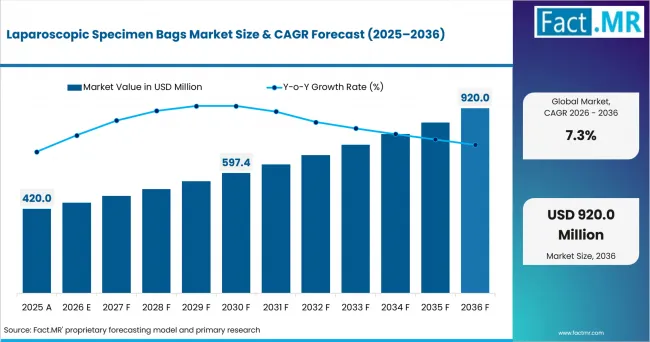
Laparoscopic Specimen Bags Market Market Value Analysis | Source: Fact.MR
What are the defining numbers behind laparoscopic specimen bags market growth?
USD 465 million absolute opportunity by 2036, led by procedure-linked consumable use.
- Demand Drivers in the Market
- Laparoscopic surgeons need retrieval bags that contain tissue before extraction through small incisions.
- Operating room managers need procedure-ready products that reduce specimen handling variation.
- ASC administrators need compact consumable formats that support scheduled minimally invasive procedures.
- Hospital supply chain teams need standardized bag sizes across recurring laparoscopic case types.
- Key Segments Analyzed
- By Bag Type: Deployment bags are expected to hold 38.0% share in 2026 because surgeons favor controlled insertion and opening during laparoscopic retrieval.
- By Size: Medium bags lead because they suit frequent gallbladder, appendix and gynecology cases. The segment is projected to capture 36.0% share in 2026.
- By Procedure: Cholecystectomy is likely to account for 32.0% share in 2026 because gallbladder removal remains a common retrieval-bag use case.
- By End User: Hospitals lead because high-acuity surgical departments manage the broadest procedure mix. The segment is expected to hold 56.0% share in 2026.
- By Geography: The United States is projected to record 8.0% CAGR through 2036 as hospitals and ASCs expand laparoscopic consumable use.
- Analyst Opinion at Fact.MR
- Shambhu Nath Jha, Senior Analyst at Fact.MR, states, “Laparoscopic specimen bags are not purchased only as low-cost pouches. We see hospitals evaluating whether the bag opens predictably, contains tissue securely and removes specimens without disrupting port-site workflow. Suppliers that combine dependable containment with simple deployment will be better positioned in recurring surgical consumable contracts.”
- Strategic Implications
- Retrieval bag suppliers should design products around procedure fit instead of only pouch volume.
- Hospitals should standardize bag formats across common laparoscopic procedures to reduce stocking complexity.
- ASC operators can improve case readiness by aligning bag sizes with scheduled procedure mix.
- Distributors should bundle retrieval bags with access products where surgical teams prefer procedure-specific kits.
FDA clearance for EzCatch Tissue Retrieval Bag in 2024 describes the device as a retrieval bag used for safe and convenient removal of tissue specimens through appropriately sized trocar sleeves. [1] This supports the scope of laparoscopic specimen bags as a containment product, not just a generic surgical accessory.
The United States is projected to record 8.0% CAGR through 2036 as hospitals and ASCs use retrieval bags across cholecystectomy, gynecology and bariatric procedures. Germany is expected to post 7.6% CAGR through 2036 as surgical centers standardize containment products. Japan is likely to record 7.3% CAGR as precision laparoscopic programs favor reliable retrieval systems. China is forecast to advance at 7.1% CAGR as private hospitals expand minimally invasive procedure access. India is set to record 6.9% CAGR as procedure volume grows in urban surgical centers.
How does the laparoscopic specimen bags market break down by segment?
Deployment bags lead at 38.0%; medium bags lead at 36.0%.
Which bag type dominates?
Deployment bags hold 38.0% share in 2026.
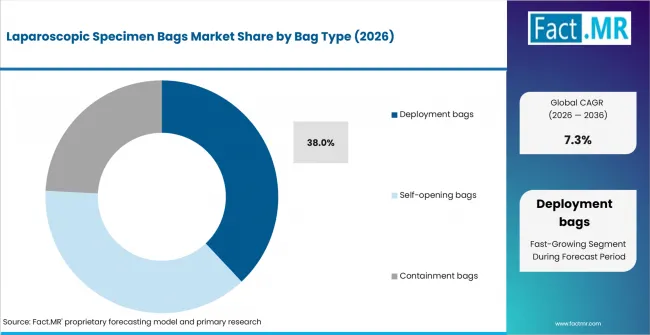
Laparoscopic Specimen Bags Market Analysis By Bag Type | Source: Fact.MR
Deployment bags are expected to hold 38.0% share in 2026 because surgeons need controlled insertion through laparoscopic access ports. These bags support predictable opening and easier specimen capture inside the body cavity. Manual retrieval bags remain useful where cost control is important, but deployment systems reduce handling effort during busy procedures. Self-opening bags gain attention where fast capture matters. Reinforced bags serve cases where specimen edges or tissue weight increase tear concern. The segment connects with endoscopy operative products because retrieval bags are used within therapeutic endoscopic and laparoscopic workflows.
Which size dominates?
Medium bags capture 36.0%, laparoscopic specimen retrieval.
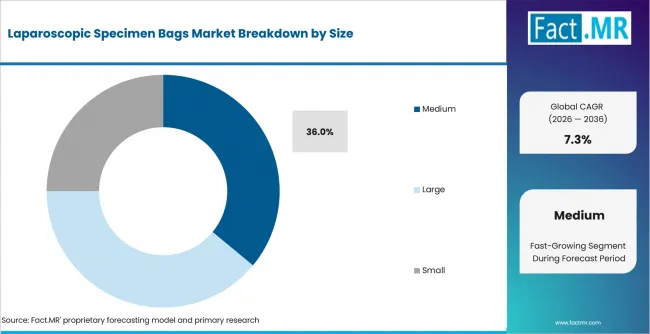
Laparoscopic Specimen Bags Market Analysis By Size | Source: Fact.MR
Medium bags lead because they fit a wide range of common laparoscopic procedures without forcing surgeons into oversized formats. The segment is projected to capture 36.0% share in 2026 as gallbladder and gynecology specimens often fall into mid-volume retrieval needs. Small bags suit limited tissue removal, while large and extra-large bags support bariatric and colorectal cases. Custom procedure kits are growing where hospitals prefer predictable setups. Size selection is important because an undersized bag can slow specimen loading, while an oversized bag can complicate extraction through limited access.
Which procedure dominates?
Cholecystectomy holds 32.0% share in 2026.
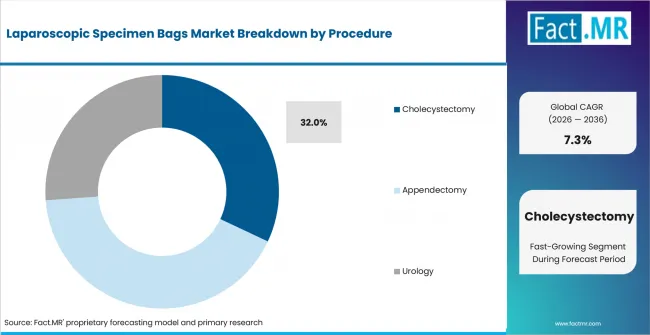
Laparoscopic Specimen Bags Market Analysis By Procedure | Source: Fact.MR
Cholecystectomy leads because gallbladder removal is a frequent laparoscopic procedure and often requires contained extraction. The procedure segment is likely to account for 32.0% share in 2026 as retrieval bags help surgeons manage gallbladder tissue, stones and fluid exposure during removal. FDA clearance for ENDOCOLLECT Specimen Retrieval Bag in 2024 lists 8 mm, 12 mm and 15 mm versions, showing why bag size flexibility matters across procedure settings. [2] Appendectomy, gynecology, urology, bariatric and colorectal procedures add recurring demand where tissue containment is clinically useful.
Which end user dominates?
Hospitals account for 56.0% due to laparoscopic specimen bag purchasing.
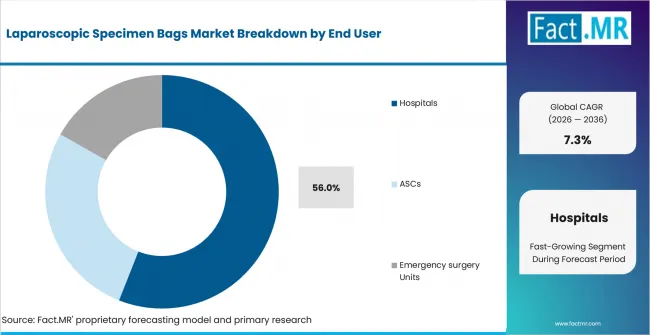
Laparoscopic Specimen Bags Market Analysis By End User | Source: Fact.MR
Hospitals lead because they manage the widest laparoscopic procedure mix and maintain deeper surgical inventory. These institutions buy retrieval bags for emergency surgery, planned general surgery and specialty departments. The hospital segment is expected to hold 56.0% share in 2026 because large facilities require multiple bag sizes and product formats. ASCs are growing as selected laparoscopic procedures shift into scheduled outpatient settings. Specialty surgical centers prefer products that match procedure focus. Teaching hospitals need reliable options because trainees require predictable deployment during supervised cases. Retrieval bags also connect with surgical kits when products are stocked as procedure-ready consumables.
What is accelerating laparoscopic specimen bag adoption, and what is holding it back?
Minimally invasive surgery growth and contained tissue retrieval needs drive it, while single-use price pressure and basic retrieval bag commoditization restrain it.
Drivers Impact Analysis
| DRIVER | (~) % IMPACT ON CAGR | GEOGRAPHIC RELEVANCE | IMPACT TIMELINE |
|---|---|---|---|
| Wider use of minimally invasive surgery creating repeat retrieval bag demand | +0.8% | Global, strongest in North America and Europe | Medium term (2–4 years) |
| Procedure-linked need for contained tissue removal | +0.7% | Global, strongest in hospitals and ASCs | Short term (≤ 2 years) |
| Shift toward deployment and self-opening designs | +0.5% | North America, Europe, Japan | Medium term (2–4 years) |
| ASC adoption of procedure-ready consumables | +0.4% | United States, India, Gulf countries | Medium term (2–4 years) |
| Hospital standardization of bag sizes across common cases | +0.3% | Global, strongest in large hospital networks | Long term (≥ 4 years) |
Minimally invasive procedure use
Minimally invasive surgery is the main demand base because retrieval bags are used after tissue dissection and before specimen extraction. Surgeons need a pouch that can pass through the trocar route and help remove tissue without uncontrolled contact. The driver is strongest where laparoscopic cholecystectomy and colorectal procedures are common. This makes specimen bags a recurring consumable rather than a capital-equipment purchase.
Contained tissue removal
Contained retrieval is important because the specimen may include tissue or fluid-bearing material. If the specimen is not secured before removal, the team can face spillage or handling difficulty. A laparoscopic single-use specimen retrieval system cleared by FDA in 2025 describes use as a receptacle for collection and extraction of tissue, organs and calculi during general and laparoscopic surgery. [3] This supports the clinical logic behind containment-focused bag demand.
Deployment and self-opening designs
Deployment and self-opening designs reduce the handwork needed to place a bag inside the body cavity. Surgeons value products that open reliably and stay ready for specimen loading. These designs matter during crowded procedures where the surgeon has limited working space. The driver favors suppliers with strong introducer design and pouch-control features.
ASC procedure readiness
ASCs need consumables that match scheduled procedure lists and reduce setup variation. Specimen bags fit this need because they are small and procedure-linked. ASC demand is strongest where laparoscopic cases are predictable and lower-acuity. Suppliers can win by offering simple size ranges and consistent availability.
Hospital bag standardization
Hospitals are standardizing bag formats to reduce stocking complexity. A consistent product set helps operating room teams avoid confusion during procedures. Standardization also supports supply chain planning because retrieval bags are used repeatedly across departments. This driver favors brands with broad bag size coverage and dependable distribution.
Opportunity Impact Analysis
| OPPORTUNITY | (~) % IMPACT ON CAGR | GEOGRAPHIC RELEVANCE | IMPACT TIMELINE |
|---|---|---|---|
| Reinforced containment bags for bariatric and colorectal procedures | +0.5% | North America, Europe, East Asia | Medium term (2–4 years) |
| Custom procedure kits for hospitals and ASCs | +0.4% | United States, Germany, Japan | Medium term (2–4 years) |
| Transparent pouch designs for easier specimen visualization | +0.3% | Global, strongest in teaching hospitals | Short term (≤ 2 years) |
| Distributor-led bundling with trocar and access products | +0.3% | Global, strongest in fragmented hospital channels | Long term (≥ 4 years) |
Reinforced containment bags
Reinforced bags create opportunity in procedures where specimen weight or extraction force can stress the pouch. Bariatric and colorectal cases may require stronger materials and more dependable closure. Suppliers that can show tear resistance and smooth removal can move beyond commodity pouch pricing. The opportunity is strongest where surgeons want confidence during difficult specimen extraction.
Custom procedure kits
Custom procedure kits help hospitals and ASCs reduce case preparation work. A kit can pair the retrieval bag with access products or other disposable items used in the same procedure. This supports procedure consistency and can simplify purchasing. The opportunity connects with surgical procedures because recurring case types create predictable kit demand.
Transparent pouch designs
Transparent pouch designs help surgeons see the specimen after capture. This matters when the team needs visual confirmation before closure and removal. Teaching hospitals may value this feature because it supports supervised learning and safer workflow demonstration. Suppliers can use visualization as a practical differentiator without overcomplicating the device.
Distributor-led bundling
Distributors can bundle specimen bags with trocars and laparoscopic consumables. This helps smaller hospitals avoid separate purchasing steps. It also gives manufacturers a path into accounts where surgeons prefer familiar product groupings. Bundling will be strongest where hospitals do not purchase directly from every device maker.
Restraints Impact Analysis
| RESTRAINT | (~) % IMPACT ON CAGR | GEOGRAPHIC RELEVANCE | IMPACT TIMELINE |
|---|---|---|---|
| Price pressure on single-use surgical consumables | -0.5% | Global, strongest in public hospitals | Medium term (2–4 years) |
| Product commoditization across basic retrieval bags | -0.4% | Global | Short term (≤ 2 years) |
| Size mismatch and deployment failure risk | -0.3% | Hospitals and ASCs globally | Medium term (2–4 years) |
| Waste scrutiny around disposable surgical products | -0.2% | Europe, Japan, large hospital networks | Long term (≥ 4 years) |
Single-use price pressure
Price pressure is a major restraint because specimen bags are used repeatedly and many hospitals treat them as routine consumables. Purchasing teams often compare basic bag formats on unit price. This can limit premium uptake unless suppliers can prove smoother deployment or better procedure fit. The restraint is strongest in public systems and price-sensitive private hospitals.
Product commoditization
Basic retrieval bags can look similar to hospital buyers. When the difference is not visible during purchasing, suppliers face margin pressure. Commoditization is especially challenging for manual bags and standard-size pouches. Stronger suppliers need to differentiate through deployment mechanism and closure reliability before broad safety claims.
Size mismatch and deployment risk
A bag that is too small can make specimen loading difficult. A bag that is too large can complicate extraction through a limited incision. Deployment failure also disrupts procedure flow because the surgeon may need to switch products mid-case. This restraint supports demand for clear labeling and procedure-specific sizing guidance.
Disposable waste scrutiny
Disposable retrieval bags support sterile workflow, but they add to operating room waste. Waste scrutiny is becoming more relevant in hospitals that track sustainability across surgical departments. This does not remove demand, but it can push purchasing teams to question unnecessary oversizing or excess packaging.
Which countries are scaling laparoscopic specimen bags fastest?
United States 8.0%; Germany 7.6%; Japan 7.3%; China 7.1%; India 6.9%.
Based on regional analysis, the laparoscopic specimen bags market is segmented into North America, Europe, East Asia, South Asia, Latin America, and Middle East and Africa.
| Country | CAGR |
|---|---|
| United States | 8.0% |
| Germany | 7.6% |
| Japan | 7.3% |
| China | 7.1% |
| India | 6.9% |
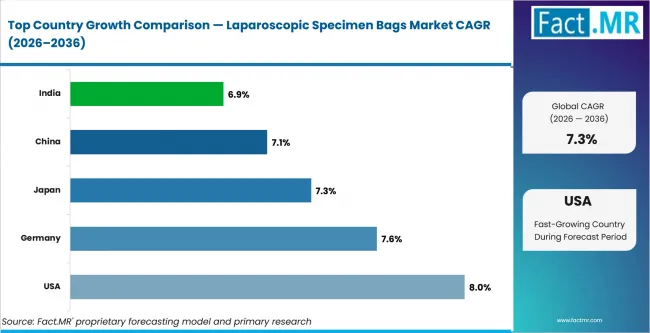
Laparoscopic Specimen Bags Market Cagr Analysis By Country | Source: Fact.MR
What is powering the United States lead?
8.0% CAGR, driven by Medtronic and high ASC laparoscopic procedure flow.
The United States is projected to record 8.0% CAGR from 2026 to 2036 as hospitals and ASCs use retrieval bags across common minimally invasive procedures. Medtronic’s Endo Bag system is designed for insertion through standard 10 mm, 11 mm or 12 mm trocar cannulas, supporting fit with routine laparoscopic access. [4] Growth will favor products that combine availability with simple operating room use.
How is Germany scaling laparoscopic specimen bag demand?
Germany is expected to post 7.6% CAGR through 2036, supported by structured surgical procurement and standardized laparoscopic workflows.
Hospitals need retrieval bags that fit procedure protocols without complicating sterile setup. Germany is expected to post 7.6% CAGR by 2036 as surgical departments standardize containment products across cholecystectomy, gynecology and colorectal procedures. Growth will favor suppliers that support documentation, consistent packaging and reliable size availability.
What supports Japan’s outlook?
7.3% CAGR, driven by precision laparoscopic programs and controlled specimen handling.
Japan is likely to record 7.3% CAGR over the forecast period as advanced hospitals use specimen bags for careful tissue extraction. Surgical teams value predictable opening, smooth closure and compact extraction. Demand will favor medium and reinforced bags that support reliable handling in smaller operating spaces.
What underpins China’s growth?
China is forecast to record 7.1% CAGR through 2036 as private hospitals and urban surgical centers scale laparoscopic surgery.
Specimen bag demand will grow as procedure volume increases across general surgery and gynecology. China is forecast to advance at 7.1% CAGR through 2036 as hospitals build recurring consumable use around minimally invasive operating rooms. Cost-effective deployment bags with local distributor support will have stronger traction.
How is India scaling laparoscopic specimen bag adoption?
6.9% CAGR, driven by private hospital networks and outpatient surgical expansion.
India is set to record 6.9% CAGR through 2036 as urban hospitals and specialty surgical centers increase laparoscopic procedure access. Demand will benefit from cholecystectomy, appendectomy and gynecology cases. Suppliers with affordable product ranges and strong distributor coverage will be better placed.
Who leads the laparoscopic specimen bags market?
Medtronic and Johnson & Johnson / Ethicon lead through established laparoscopic access portfolios.
Laparoscopic specimen bags are supplied by access-device manufacturers, surgical consumable firms and specialty laparoscopic product companies. Medtronic competes through Endo Bag and related specimen retrieval systems. Johnson & Johnson / Ethicon competes through ENDOPOUCH RETRIEVER, which is designed to capture specimens during laparoscopic procedures and uses support arms to facilitate bag opening and tissue capture. [5]
Applied Medical, CONMED and B. Braun add depth through access and retrieval bag portfolios. CooperSurgical is relevant in gynecology-driven specimen retrieval. Genicon and Purple Surgical compete through specialized endobag and tissue retrieval pouch formats. CONMED’s Anchor Tissue Retrieval System offers multiple bag volume options and is positioned for laparoscopic and robotic cases. [6]
Competition through 2036 will depend on deployment reliability, pouch strength, size range and distributor reach. Suppliers that compete only on basic pouch availability will face price pressure. Suppliers that connect bag design with procedure flow can defend stronger value. The product is small, but the purchase logic sits inside a high-frequency laparoscopic gynecological and general surgery workflow.
Which companies are the key providers?
Medtronic and Johnson & Johnson / Ethicon are key providers. Applied Medical and CONMED are also profiled. CooperSurgical, B. Braun, Genicon and Purple Surgical complete the company set.
- Medtronic
- Johnson & Johnson / Ethicon
- Applied Medical
- CONMED
- CooperSurgical
- B. Braun
- Genicon
- Purple Surgical
Bibliography
- U.S. Food and Drug Administration. (2024, April 15). 510(k) summary: EzCatch Tissue Retrieval Bag, K240205. FDA.
- U.S. Food and Drug Administration. (2024, April 1). 510(k) premarket notification: ENDOCOLLECT Specimen Retrieval Bag, K240635. FDA.
- U.S. Food and Drug Administration. (2025, March 12). 510(k) summary: DANNIK® Laparoscopic Single-Use Poly Specimen Retrieval System, K250411. FDA.
- Medtronic. (2026). Endo Bag™ specimen retrieval system. Medtronic.
- Johnson & Johnson MedTech. (2026). ENDOPOUCH RETRIEVER™ Specimen Bag. Johnson & Johnson MedTech.
- CONMED Corporation. (2026). Anchor Tissue Retrieval System. CONMED.
This Report Addresses
- Strategic intelligence on laparoscopic specimen bags across bag type and size.
- Segment analysis covering Deployment Bags and Medium Bags.
- Regional outlook covering the United States, Germany, Japan, China, and India.
- Competitive analysis of Medtronic, Johnson & Johnson / Ethicon, Applied Medical, CONMED, CooperSurgical, B. Braun, Genicon and Purple Surgical.
- Technology assessment covering deployment control, pouch strength, closure reliability and specimen containment.
- Use case assessment covering cholecystectomy, appendectomy, gynecology, urology, bariatric and colorectal procedures.
- Primary interviews, provider checks and official source review support the forecast.
What does the laparoscopic specimen bags market cover?
Sterile retrieval bags used to contain and extract tissue during laparoscopic procedures.
The laparoscopic specimen bags market covers manual retrieval bags and containment bags used during minimally invasive surgery. These products help surgeons collect resected tissue inside the body cavity and remove it through a small access route.
The market differs from broad minimally invasive surgery because it focuses only on the retrieval and containment consumable used after dissection. It excludes energy devices, cameras, and general surgical instruments when they do not provide specimen containment.
What is included in the scope?
Retrieval bags and tissue containment systems used across laparoscopic procedures.
The scope includes manual retrieval bags and containment bags. It also includes small and custom procedure kit formats. Procedure coverage includes cholecystectomy and colorectal surgery.
The scope includes bags supplied to hospitals and emergency surgery units. It includes sterile single-use retrieval systems and pouch formats sold within broader laparoscopic access kits. The category also connects with disposable trocars because retrieval bags are commonly inserted through trocar access.
What is excluded from the scope?
General surgical instruments without specimen containment function are outside the scope.
The scope excludes trocars and energy devices when they do not provide specimen containment. It also excludes general sterile packaging used only for product shipment. Broad surgical equipment is outside scope unless the product directly captures and removes tissue from the body cavity.
How was the analysis built?
100+ sources, 40+ company portfolios, 25+ countries, 20+ interviews.
- Primary Research: Primary research includes interviews with laparoscopic surgeons and operating room managers. It includes input from hospital supply chain teams and ASC procurement heads.
- Desk Research: Desk research reviews FDA retrieval bag clearances and official company product portfolios. It covers specimen retrieval bags, tissue containment systems, endobags and laparoscopic access consumables.
- Market-Sizing and Forecasting: Forecasting uses minimally invasive procedure adoption, retrieval bag attachment rates, end-user purchasing cycles and procedure-specific kit adoption.
- Data Validation and Update Cycle: Forecasts are validated through provider checks and procurement feedback. Product listing reviews and surgical consumable portfolio checks help confirm market direction.
Segmentation
What is the report’s scope and coverage?
| Attribute | Details |
|---|---|
| Quantitative Units | USD Million in 2026 to USD Million by 2036 at CAGR |
| Market Definition | Sterile bags used to contain and extract tissue specimens during laparoscopic procedures |
| Bag Type | Manual retrieval bags; deployment bags; self-opening bags; reinforced bags; containment bags |
| Size | Small; medium; large; extra-large; custom procedure kits |
| Procedure | Cholecystectomy; appendectomy; gynecology; urology; bariatric; colorectal |
| End User | Hospitals; ASCs; specialty surgical centers; teaching hospitals; emergency surgery units |
| Regions Covered | North America; Europe; East Asia; South Asia; Latin America; Middle East and Africa |
| Countries Covered | United States; Germany; Japan; China; India |
| Key Companies Profiled | Medtronic; Johnson & Johnson / Ethicon; Applied Medical; CONMED; CooperSurgical; B. Braun; Genicon; Purple Surgical |
| Forecast Period | 2026 to 2036 |
| Approach | Hybrid top-down and bottom-up approach using laparoscopic procedure adoption, retrieval bag attachment rates, product type mix and provider validation |
How is the market segmented?
-
By Bag Type:
- Manual retrieval bags
- Deployment bags
- Self-opening bags
- Reinforced bags
- Containment bags
-
By Size:
- Small
- Medium
- Large
- Extra-large
- Custom procedure kits
-
By Procedure:
- Cholecystectomy
- Appendectomy
- Gynecology
- Urology
- Bariatric
- Colorectal
-
By End User:
- Hospitals
- ASCs
- Specialty surgical centers
- Teaching hospitals
- Emergency surgery units
-
Region:
- North America
- United States
- Canada
- Europe
- Germany
- United Kingdom
- France
- Italy
- Netherlands
- East Asia
- Japan
- China
- South Korea
- South Asia
- India
- Thailand
- Singapore
- Latin America
- Brazil
- Mexico
- Chile
- Middle East & Africa
- UAE
- Saudi Arabia
- South Africa
- Israel
- North America
Frequently Asked Questions
Which bag type leads the Laparoscopic Specimen Bags Market?
Which size leads the Laparoscopic Specimen Bags Market?
Which procedure leads the Laparoscopic Specimen Bags Market?
Which end user leads the Laparoscopic Specimen Bags Market?
Which region leads the Laparoscopic Specimen Bags Market?
Which country expands fastest in the Laparoscopic Specimen Bags Market?
How does Germany perform in the Laparoscopic Specimen Bags Market?
How does Japan perform in the Laparoscopic Specimen Bags Market?
How does China perform in the Laparoscopic Specimen Bags Market?
How does India perform in the Laparoscopic Specimen Bags Market?
What is the primary driver in the Laparoscopic Specimen Bags Market?
What is the main restraint in the Laparoscopic Specimen Bags Market?
Why are deployment bags important in this market?
Why are medium bags important for demand?
Who worked on this report


Preview the report firsthand - request a free sample
Free SampleGet the brochure for pricing and purchase details
Download PDF