- Base Value(2025): 2.4 Bn
- Estimated Value(2026): 2.5 Bn
- Forecast Value (2036): 4.5 Bn
- CAGR (2026 - 2036): 5.7%
Law Enforcement and Military Clothing Market Forecast and Outlook By Fact.MR
In 2025, the law enforcement and military clothing market was valued at USD 2.4 billion. Based on Fact.MR analysis, demand for law enforcement and military clothing is estimated to grow to USD 2.5 billion in 2026 and USD 4.5 billion by 2036. FACT.MR projects a CAGR of 5.7% during the forecast period.
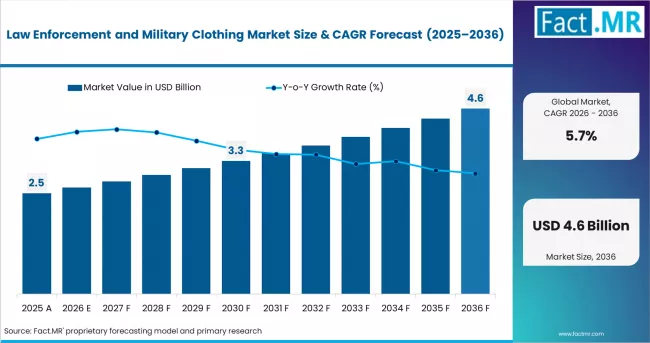
Law Enforcement And Military Clothing Market Market Value Analysis | Source: Fact.MR
| Metric | Value |
|---|---|
| Estimated Value in 2026 | USD 2.5 billion |
| Forecast Value in 2036 | USD 4.5 |
Source: Fact.MR analysis. Updated Apr 14, 2026
Summary of Law Enforcement and Military Clothing Market
- Market Definition
- Covers uniforms, body armor, outerwear, footwear, and accessories in aramid and flame-resistant materials for military and law enforcement procurement globally.
- Demand Drivers
- India’s defence textile procurement is expanding under Make in India.
- U.S. DoD programmes are increasing demand for flame-resistant and ballistic clothing.
- EU and NATO modernisation programmes are driving technical uniform upgrades.
- Key Segments Analyzed
- By Product Type: Outerwear leads 45% in 2026. Largest volume in uniforms and jackets.
- By Material: Aramid fibers dominate in 2026. Widely used in body armor and protective gear.
- By End Use: Military leads 60% in 2026. Largest procurement base globally.
- By Geography: India leads at 7.7% CAGR. Driven by defence spending and localization.
- Analyst Opinion at FACT.MR
- Shambhu Nath Jha notes a clear divide between standard uniforms and high-specification gear. Certification and aramid integration are critical for premium tenders.
- Strategic Implications
- Invest in aramid integration and NATO-compliant testing.
- Build local manufacturing in India for defence programmes.
- Develop advanced flame-resistant and IR-reduction fabrics.
- Methodology
- Based on defense procurement budgets and product-level demand.
- Supported by DoD, NATO, and MoD data and industry reports.
- Forecasts include budget trends, workforce expansion, and specification upgrades.
Between 2026 and 2036, the market is expected to create USD 1.8 billion in new opportunity. Growth is steady and structurally supported. Demand is driven by defence spending and law enforcement modernisation. Replacement of ageing gear is increasing procurement. Growth is constrained by long tender cycles and raw material cost volatility.
Procurement is shifting toward high-performance gear. Standard uniforms are losing share. Demand is rising for body armor and flame-resistant clothing. NATO and Indo-Pacific forces are upgrading specifications. Advanced features include ballistic protection and IR-signature reduction. Premium products command 30–50% price premiums. Suppliers without certified testing are being excluded.
India leads with 7.7% CAGR through 2036. Growth is driven by defence spending and Make in India initiatives. China follows at 7.3%, supported by military modernisation and domestic production. The United States records 6.0%, driven by law enforcement and defence upgrades. The United Kingdom grows at 5.8%, supported by counterterrorism procurement. Germany records 5.5%, driven by military modernisation under EU initiatives. Mature markets face constraints from long procurement cycles and pricing pressure.
Segmental Analysis
Law Enforcement and Military Clothing Market Analysis by Product Type
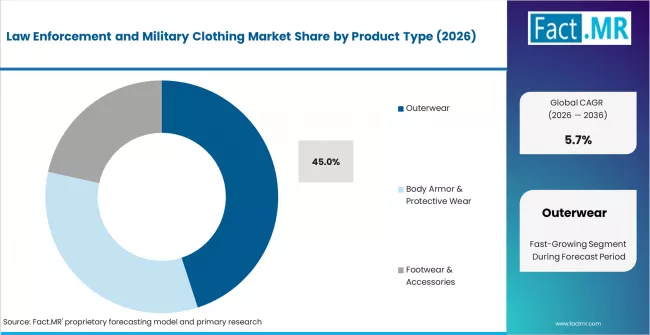
Law Enforcement And Military Clothing Market Analysis By Product Type | Source: Fact.MR
Outerwear holds 45% share in 2026. It is the highest-volume category. Demand is driven by recurring uniform replacement. Procurement is linked to force headcount. This creates stable volume demand.
- Propper International Investment: Propper secured a U.S. Army contract in 2024. Production of Army Combat Uniforms increased. Compliance with updated specifications was ensured. This strengthens its DoD supply position. [1]
- 5.11 Tactical Development: 5.11 Tactical launched updated STRYKE™ pants in 2025. New fabric improves flexibility and durability. Target customers include law enforcement agencies. [2]
- Outerwear Procurement Trend: U.S. government reported 14% growth in 2024. Demand increased across federal agencies. Replacement cycles and backlog clearance supported growth. [3]
Law Enforcement and Military Clothing Market Analysis by End Use
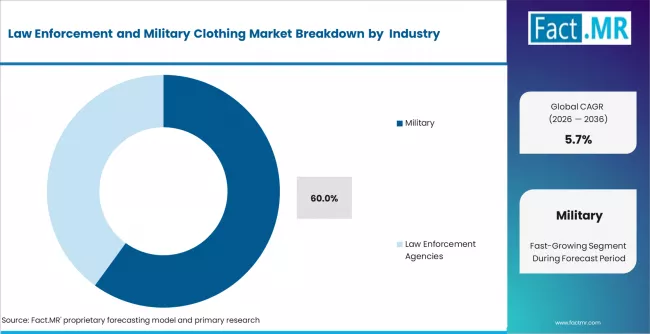
Law Enforcement And Military Clothing Market Analysis By End Use | Source: Fact.MR
Military holds 60% share in 2026. It is the largest procurement segment. Demand is driven by large force size. Technical garments have higher unit value. Multi-year contracts ensure stable demand.
- Point Blank Investment: Point Blank Enterprises expanded production in 2024. Facility upgrade supports military armor supply. Secured large U.S. Army order. [4]
- Blauer Manufacturing Development: Blauer Manufacturing launched new patrol jacket in 2024. Features include armor compatibility and flame resistance. Targets police procurement. [6]
- Law Enforcement Demand Trend: U.S. agencies increased budgets by 9% in 2024. Funding supported clothing upgrades. Federal grants supported procurement.
Drivers, Restraints, and Opportunities
FACT.MR notes growth is linked to defence budgets. Law enforcement modernisation also drives demand. Equipment replacement is mandatory. This ensures stable baseline demand.
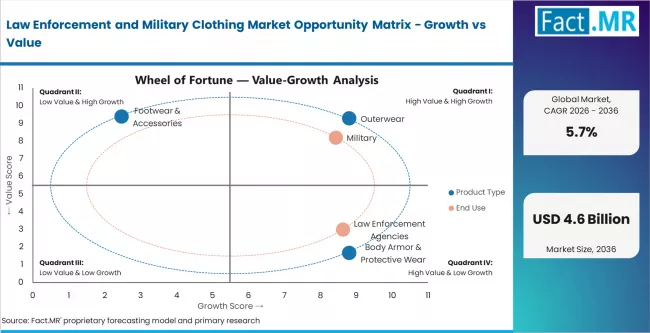
Law Enforcement And Military Clothing Market Opportunity Matrix Growth Vs Value | Source: Fact.MR
Specification upgrades are reshaping the market. Commodity uniforms are losing share. High-performance garments are gaining demand. Certified products command 30–50% price premiums. Suppliers without certification are losing tenders.
- NATO Standardisation Drive: NATO updated standards in 2024. Thermal and ballistic requirements increased. European countries began replacement cycles. This supports long-term demand. [5]
- India Make in India Defence: India expanded localisation rules in 2024. Imports of defence textiles were restricted. Domestic production is increasing. Procurement is shifting locally.
- U.S. Body Armor Grant Expansion: U.S. government allocated USD 31 million in 2024. Funds supported body armor procurement. Demand increased at state and local agencies. [3]
Regional Analysis
The law enforcement and military clothing market is assessed across Asia Pacific, North America, Europe, Latin America, and Middle East and Africa, covering 40+ countries with distinct demand profiles shaped by defense budget scale, law enforcement modernisation investment, technical specification requirements, and government procurement policy frameworks. The full report provides market attractiveness analysis by region and country.
.webp "Top Country Growth Comparison Law Enforcement And Military Clothing Market Cagr (2026 2036)")
Top Country Growth Comparison Law Enforcement And Military Clothing Market Cagr (2026 2036) | Source: Fact.MR
| Country | CAGR (2026 to 2036) |
|---|---|
| India | 7.7% |
| China | 7.3% |
| United States | 6.0% |
| United Kingdom | 5.8% |
| Germany | 5.5% |
Source: Fact.MR analysis. Updated Apr 14, 2026
Source: Fact.MR (FACT.MR) analysis, based on proprietary forecasting model and primary research
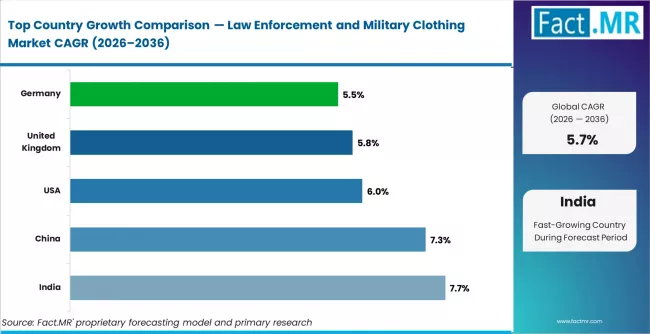
Law Enforcement And Military Clothing Market Cagr Analysis By Country | Source: Fact.MR
Asia Pacific Law Enforcement and Military Clothing Market Analysis
Asia Pacific remains the most dynamic region. Growth is driven by defence modernisation and localisation mandates. India and China dominate demand expansion. Procurement is shifting toward certified protective gear. Point Blank Enterprises and Tata Advanced Systems are strengthening regional supply positions.
-
India: Indigenisation policy drives 7.7% CAGR through 2036. Import restrictions expanded in 2024 under defence textile lists. Domestic suppliers are gaining priority in tenders. Tata Advanced Systems secured new production contracts. Paramilitary force expansion is increasing demand. Procurement is competitive but locally mandated. Growth is driven by policy and force expansion.
- China: Central planning supports 7.3% CAGR through 2036. Military modernisation programmes are increasing funding. Advanced combat clothing demand is rising across PLA units. Xinxing Jihua Group expanded technical fabric capacity. Procurement is state-controlled and volume-secured. Growth is driven by scale and strategic allocation.
FACT.MR covers India, China, Japan, South Korea, ASEAN, and ANZ. Includes defence budgets, localisation trends, and procurement frameworks.
North America Law Enforcement and Military Clothing Market Analysis
Law Enforcement And Military Clothing Market Country Value Analysis | Source: Fact.MR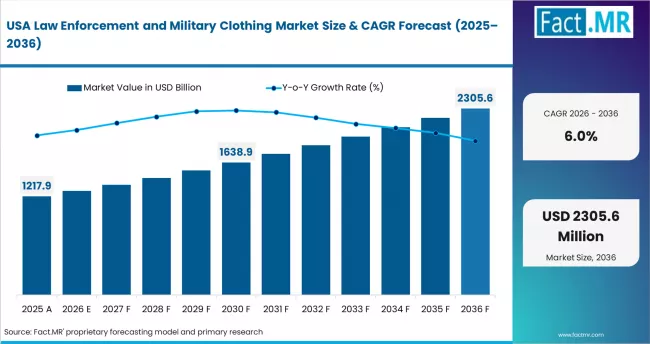
North America leads in value and specification standards. Demand is anchored in defence programmes and law enforcement upgrades. Safariland, Point Blank Enterprises, and Propper dominate supply. Certification and compliance remain key entry barriers.
- United States: Federal programme expansion supports 6.0% CAGR through 2036. Military clothing systems are being upgraded under long-term programmes. Protective gear demand is increasing across units. Law enforcement funding continues through federal grants. Suppliers must meet NIJ and DoD standards. Growth is driven by specification upgrades and structured procurement.
FACT.MR covers the United States, Canada, and Mexico. Includes DoD programmes and law enforcement funding trends.
Europe Law Enforcement and Military Clothing Market Analysis
Law Enforcement And Military Clothing Market Europe Country Market Share Analysis, 2026 & 2036 | Source: Fact.MR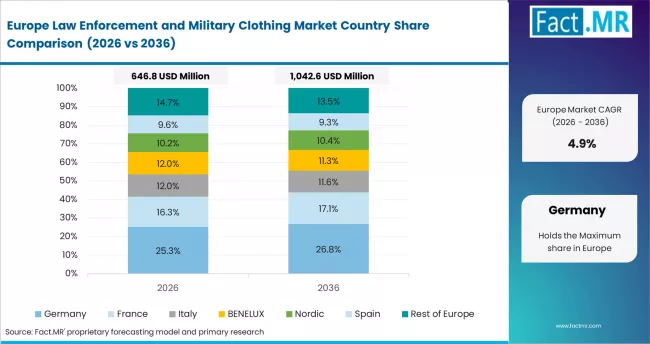
Europe is a compliance-led and specification-intensive market. Demand is shaped by NATO standards and EU defence funding. Suppliers must meet strict testing and certification requirements.
- United Kingdom: Parallel procurement channels support 5.8% CAGR through 2036. Defence programmes are upgrading combat clothing systems. Police forces are increasing tactical gear budgets. Counterterrorism units are driving high-specification demand. Growth is balanced across military and law enforcement procurement.
- Germany: Centralised procurement drives 5.5% CAGR through 2036. Bundeswehr modernisation programmes are increasing equipment demand. BAAINBw tightened compliance standards in 2024. Environmental and safety certifications are mandatory. Growth is driven by regulation and defence upgrades.
FACT.MR covers Germany, France, the UK, Italy, Spain, and Rest of Europe. Includes NATO compliance, procurement cycles, and demand forecasts.
Competitive Aligners for Market Players
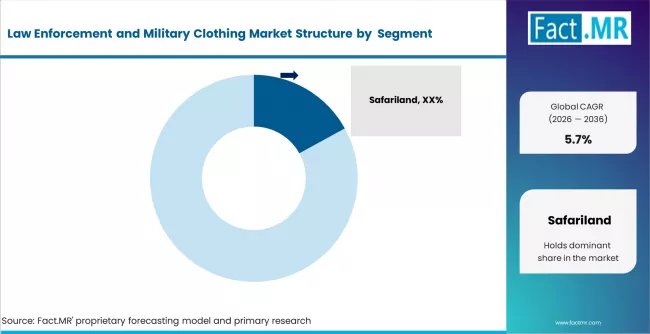
Law Enforcement And Military Clothing Market Analysis By Company | Source: Fact.MR
Competition in the law enforcement and military clothing market is defined less by scale and more by certification depth, contract access, and performance credibility. Suppliers operate within tightly controlled procurement ecosystems where qualification under NIJ, NATO STANAG, and national defence standards determines eligibility rather than price alone. This creates a layered market where a small group of certified vendors capture the majority of high-value tenders.
Point Blank Enterprises and Safariland are positioned at the top tier. Their advantage lies in ballistic protection expertise, vertically integrated production, and long-standing relationships with U.S. DoD and law enforcement agencies. They compete through proven field performance and compliance documentation, enabling repeat contract awards under multi-year procurement programmes.
Propper and 5.11 Tactical focus on outerwear and uniform systems. Their strength lies in high-volume production and adaptability to evolving tactical requirements. These players align closely with agency-level procurement needs, offering modular designs and rapid product iteration, particularly in law enforcement segments.
European suppliers such as Seyntex operate within NATO-aligned procurement frameworks. Their competitive edge is compliance with EU standards and participation in multinational defence tenders. They benefit from proximity to European military buyers and established certification infrastructure. Domestic manufacturers in India and China are gaining share through localisation mandates. Tata Advanced Systems and Xinxing Jihua Group are expanding under government-backed procurement policies, securing captive demand through domestic sourcing requirements. The competitive boundary is therefore defined by certification, contract positioning, and integration into defence procurement systems. Suppliers with validated performance, compliant materials, and established government relationships capture premium margins, while non-certified players remain limited to low-value uniform supply segments.
Key Players
- Safariland
- Point Blank Enterprises
- Propper International
- 5.11 Tactical
- Blauer Manufacturing
- Seyntex
Bibliography
- [1] Propper International. (Q2 2024). Contract Award: Multi-Year U.S. Army Uniform Supply Contract for Army Combat Uniform Sets Manufactured to Army Regulation 670-1 Updated Specifications Under DoD Clothing and Textile Supply Programme. Q2 2024. propper.com/newsroom
- [2] 5.11 Tactical. (2025). Product Launch: Updated STRYKE™ Law Enforcement Tactical Pant Line with Flex-Tac® Mechanical Stretch Fabric Targeting U.S. Municipal and County Police Department Patrol and Tactical Unit Procurement. January 2025. 511tactical.com/newsroom
- [3] U.S. Government Accountability Office. (2024). Federal Law Enforcement Equipment Procurement Report 2024: 14% Increase in Law Enforcement Uniform and Outerwear Procurement Spending Across Federal Agencies Including DHS, CBP, and FBI Under Post-Pandemic Equipment Backlog Clearance Programmes. 2024. gao.gov
- [4] Point Blank Enterprises. (2024). Contract Award: U.S. Army Modular Scalable Vest Programme Delivery Order Exceeding USD 100 Million for Military-Grade Soft Body Armor Systems Produced at Pompano Beach Florida Manufacturing Facility. 2024. pointblankenterprises.com
- [5] Seyntex NV. (Early 2025). Product Launch: Updated Flame-Resistant Combat Shirt Fabric System Meeting NATO STANAG 2895 Thermal Hazard Protection Standards for European Military Procurement Agency Combat Clothing Upgrade Programmes. January 2025. seyntex.com/news
- [6] Blauer Manufacturing. (Q4 2024). Product Launch: Updated Law Enforcement Patrol Jacket with Integrated Body Armor Carrier Compatibility and Moisture-Wicking Flame-Resistant Lining for Northeast U.S. Police Department Municipal Equipment Modernisation Procurement. Q4 2024. blauer.com/newsroom
This Report Addresses
- Strategic intelligence on demand across body armor, tactical outerwear, uniform replacement, and flame-resistant clothing for military and law enforcement globally.
- Market forecast from USD 2.5 billion in 2026 to USD 4.5 billion by 2036 at a CAGR of 5.7%.
- Growth opportunities across India Make in India defence procurement, China PLA modernisation, U.S. DoD body armor demand, UK MoD upgrades, and Germany Bundeswehr procurement.
- Segment analysis by product (outerwear, body armor, footwear & accessories), material (aramid, nylon, flame-resistant), and end use (military, law enforcement).
- Regional outlook covering Asia Pacific defence-led demand, North America certification-driven supply, and Europe NATO-standard upgrade cycles.
- Competitive analysis of Safariland, Point Blank Enterprises, Propper, 5.11 Tactical, Blauer Manufacturing, and Seyntex. Focus on certification, materials, and contracts.
- Regulatory analysis covering NATO STANAG standards, U.S. NIJ certification, India indigenisation policy, UK MoD specifications, and German compliance frameworks.
- Report delivered in PDF, Excel, and presentation formats. Supported by interviews, tender data, certification records, and manufacturer revenues.
Law Enforcement and Military Clothing Market Definition
The market includes uniforms, tactical outerwear, body armor, footwear, and accessories. Products use aramid fibers, nylon blends, and flame-resistant fabrics. Used by military, police, and paramilitary agencies globally.
Law Enforcement and Military Clothing Market Inclusions
Covers global forecasts (2026–2036) by product, material, and end use. Includes outerwear, body armor, and footwear. Covers military and law enforcement procurement via government tenders.
Law Enforcement and Military Clothing Market Exclusions
Excludes civilian tactical apparel and private security uniforms. Omits standalone ballistic plates and sub-assembly components. Focus remains on integrated textile-based systems.
Law Enforcement and Military Clothing Market Research Methodology
- Primary Research: Interviews with procurement officers, manufacturers, and contract specialists across key countries.
- Desk Research: Uses NATO standards, U.S. DoD data, India MoD records, and Bundeswehr reports. Includes company data from Safariland, Point Blank Enterprises, and Propper.
- Market-Sizing and Forecasting: Hybrid model using defense budgets and unit demand by product type. Covers all major regions and applications.
- Data Validation and Update Cycle: Validated with tender data, budgets, and company revenues. Cross-checked with expert interviews. Updated annually.
Segmentation
Scope of Report
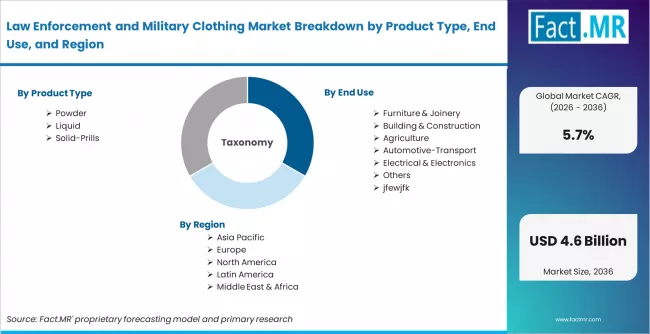
Law Enforcement And Military Clothing Market Breakdown By Product Type, End Use, And Region | Source: Fact.MR
| Attribute | Details |
|---|---|
| Quantitative Units | USD 2.5 billion (2026) to USD 4.5 billion (2036), at a CAGR of 5.7% |
| Market Definition | Uniforms, body armor, tactical outerwear, footwear, and accessories in aramid fiber, nylon blend, and flame-resistant fabric grades procured by military forces and law enforcement agencies through government tender and direct supply programmes globally. |
| Product Type Segmentation | Outerwear, Body Armor & Protective Wear, Footwear & Accessories |
| Material Segmentation | Aramid Fibers, Nylon Blends, Flame-Resistant Fabrics |
| End Use Segmentation | Military, Law Enforcement Agencies |
| Application Coverage | Military combat clothing procurement, law enforcement uniform supply, body armor and protective wear tendering, tactical outerwear for counterterrorism units, and flame-resistant clothing for military vehicle crew and aviation personnel. |
| Regions Covered | North America, Europe, Asia Pacific, Latin America, Middle East and Africa |
| Countries Covered | USA, Canada, Mexico, Germany, UK, France, Italy, Spain, Nordic, BENELUX, China, Japan, South Korea, India, ASEAN, Australia and New Zealand, Brazil, Argentina, Chile, Saudi Arabia, GCC, Turkey, South Africa, Rest of MEA |
| Key Companies Profiled | Safariland, Point Blank Enterprises, Propper International, 5.11 Tactical, Blauer Manufacturing, Seyntex |
| Forecast Period | 2026 to 2036 |
| Approach | Hybrid top-down and bottom-up model using government defense textile procurement budget estimates, unit volume forecasts by product type and end-use segment, average contract unit prices by specification grade, and primary interviews with military procurement officers and defense textile manufacturers. |
Source: Fact.MR analysis. Updated Apr 14, 2026
Law Enforcement and Military Clothing Market by Segments
-
By Product Type:
- Outerwear
- Body Armor & Protective Wear
- Footwear & Accessories
-
By Material:
- Aramid Fibers
- Nylon Blends
- Flame-Resistant Fabrics
-
By End Use:
- Military
- Law Enforcement Agencies
-
By Region:
- North America
- United States
- Canada
- Mexico
- Latin America
- Brazil
- Mexico
- Argentina
- Chile
- Rest of Latin America
- Western Europe
- Germany
- United Kingdom
- France
- Italy
- Spain
- Nordic Countries
- BENELUX
- Rest of Western Europe
- Eastern Europe
- Russia
- Poland
- Hungary
- Balkan and Baltic
- Rest of Eastern Europe
- East Asia
- China
- Japan
- South Korea
- South Asia and Pacific
- India
- ASEAN
- Australia and New Zealand
- Rest of South Asia and Pacific
- Middle East and Africa
- Kingdom of Saudi Arabia
- Other GCC Countries
- Turkey
- South Africa
- Rest of Middle East and Africa
- North America
Frequently Asked Questions
How large is the law enforcement and military clothing market in 2025?
What will the market size be by 2036?
What is the expected CAGR for the market from 2026 to 2036?
Which product type segment is poised to lead the market?
Which end-use segment is expected to dominate?
Which country shows the fastest growth?
What is driving demand for law enforcement and military clothing?
What are the major restraints?
Which material segment leads the market?
What applications dominate usage?
What is the main challenge in this market?
Who worked on this report


Preview the report firsthand - request a free sample
Free SampleGet the brochure for pricing and purchase details
Download PDF