Lecithin Market Size, Share, Growth and Forecast (2026 - 2036)
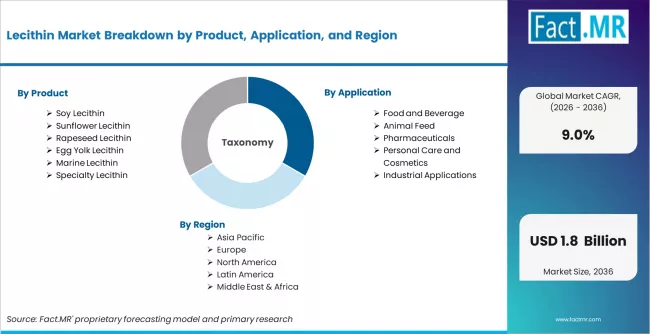
Lecithin Market is segmented by Product (Soy Lecithin, Sunflower Lecithin, Rapeseed Lecithin, Egg Yolk Lecithin, Marine Lecithin, Specialty Lecithin), Application (Food and Beverage, Animal Feed, Pharmaceuticals, Personal Care and Cosmetics, Industrial Applications), End Use (Food Manufacturers, Animal Feed Industry, Pharmaceutical Companies, Cosmetic Manufacturers, Industrial Manufacturers), and Region, with forecasts covering the period from 2026 to 2036.
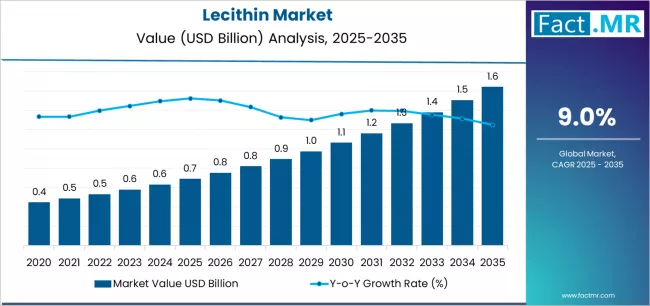
According to Fact.MR estimates, the global lecithin market market was valued at USD 0.7 billion in 2025. The market is projected to reach USD 0.8 billion in 2026 and is expected to grow to USD 1.8 billion by 2036, expanding at a CAGR of 9.0%. Soy Lecithin is anticipated to account for 42.8% of the product segment in 2026, while Food and Beverage is expected to remain the leading application with around 38.5% share.
Lecithin Market Analysis and Forecast by Fact.MR
The lecithin market, valued at USD 0.69 billion in 2025, is expanding at a 9.0% CAGR to reach USD 1.78 billion by 2036. Lecithin is a naturally occurring phospholipid complex extracted from soybeans, sunflower seeds, rapeseed, egg yolks, and marine sources, functioning as an emulsifier, dispersant, stabiliser, and release agent across food, feed, pharmaceutical, cosmetic, and industrial applications. Growth is shaped by clean-label emulsifier demand replacing synthetic alternatives, sunflower lecithin adoption driven by non-GMO and allergen-free positioning, pharmaceutical liposome delivery technology, and expanding animal feed applications.
Summary of Lecithin Market
- Market Snapshot
- The lecithin market is valued at USD 0.69 billion in 2025.
- Estimated market value for 2026 is USD 0.752 billion, projected to reach USD 1.78 billion by 2036.
- A CAGR of 9.0% is forecast for the 2026 to 2036 assessment period.
- Incremental opportunity of USD 1.028 billion between 2026 and 2036.
- Soy lecithin holds 42.8% of the product segment, with liquid lecithin at 47.3% of form demand.
- India and China are the fastest-growing markets for lecithin consumption.
- Demand and Growth Drivers
- Clean-label reformulation in the food industry is driving lecithin adoption as a natural emulsifier replacing synthetic alternatives (mono and diglycerides, polysorbates, PGPR). Lecithin's INCI classification as a natural ingredient and consumer recognition as a food-derived component support its clean-label positioning.
- Sunflower lecithin demand is growing at 15 to 20% annually as food manufacturers seek non-GMO and soy-allergen-free emulsifier alternatives. Sunflower lecithin avoids both the GMO concerns associated with soy lecithin and the allergen declaration requirements under EU and US food labelling regulations.
- Pharmaceutical liposome technology is creating high-value lecithin demand. Liposomal drug delivery systems using phosphatidylcholine-enriched lecithin fractions are used in vaccine formulations, cancer therapeutics, and nutraceutical bioavailability enhancement.
- Animal feed applications for lecithin as a fat dispersant, palatability enhancer, and energy source are expanding, particularly in aquaculture and poultry feed where lecithin improves fat utilisation and feed conversion efficiency.
- Product and Segment View
- Soy lecithin holds 42.8% of the product segment, reflecting the established position of soybean-derived lecithin as the lowest-cost and highest-volume commercial lecithin source.
- Food and beverage captures 38.5% of application demand, driven by emulsification requirements in chocolate, bakery, margarine, and instant food manufacturing.
- Direct sales account for 61.8% of distribution channel demand, reflecting the B2B nature of lecithin ingredient trade.
- Key segmentation includes:
- Product: Soy Lecithin, Sunflower Lecithin, Rapeseed Lecithin, Egg Yolk Lecithin, Marine Lecithin, Specialty Lecithin
- Application: Food and Beverage, Animal Feed, Pharmaceuticals, Personal Care and Cosmetics, Industrial Applications
- Form: Liquid Lecithin, Powder Lecithin, Granular Lecithin, Modified Lecithin
- Source: Soybean, Sunflower Seed, Rapeseed, Egg Yolk, Marine Sources
- Geography and Competitive Outlook
- North America accounts for significant revenue, with the USA generating USD 0.265 billion in 2025.
- East Asia is expanding, with Japan contributing USD 0.037 billion and South Korea contributing USD 0.021 billion in 2025.
- Cargill, Inc. holds approximately 17.0% of global market share through integrated soybean processing and lecithin production.
- ADM, Bunge, and Lipoid GmbH compete on production scale, source diversification, and pharmaceutical-grade capabilities.
- Analyst Opinion
- The lecithin market is transitioning from a commodity soybean processing by-product to a precision-formulated functional ingredient. The 9.0% CAGR reflects structural demand shifts: clean-label food reformulation, sunflower lecithin premiumisation, and pharmaceutical liposome applications are all pulling lecithin into higher-value segments. Companies that can offer source-specific, function-specific lecithin grades with standardised phospholipid profiles will capture margin premiums over commodity liquid lecithin suppliers.
Key Growth Drivers, Constraints, and Opportunities
Key Factors Driving Growth
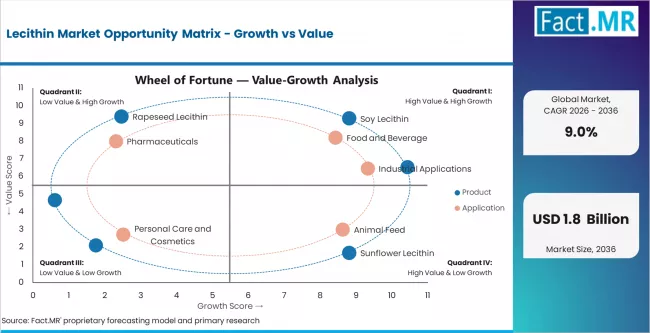
- Chocolate manufacturing consumes the largest single-application volume of lecithin globally. Lecithin reduces chocolate viscosity by 30 to 50%, enabling thinner coatings and reducing cocoa butter usage by 5 to 8% per batch. With global chocolate production exceeding 7.5 million tonnes annually, per ICCO data, lecithin demand from chocolate manufacturing alone provides a structural demand floor.
- Sunflower lecithin is capturing share from soy lecithin at an accelerating rate. EU and US allergen labelling requirements mandate soy declaration on food products containing soy lecithin, creating a reformulation incentive for manufacturers of products not otherwise containing soy. Sunflower lecithin avoids this labelling burden while offering comparable emulsification performance in most food applications.
- Liposomal supplement formulations are growing at 20 to 25% annually in the nutraceutical sector. Liposomal vitamin C, curcumin, glutathione, and CoQ10 products use high-purity lecithin to form phospholipid vesicles that improve oral bioavailability 3 to 5-fold compared to standard supplement forms.
Key Market Constraints
- Soybean price volatility directly impacts lecithin production economics. Lecithin is extracted during soybean oil degumming, and crude lecithin prices correlate with soybean commodity markets. Price fluctuations of 20 to 40% between crop years create margin instability for lecithin manufacturers.
- GMO concerns limit soy lecithin acceptance in organic and non-GMO certified food products. Over 90% of US soybeans and 80%+ of Brazilian soybeans are GMO varieties, and identity-preserved non-GMO soy lecithin commands 30 to 50% price premiums, creating cost barriers for food manufacturers seeking non-GMO compliance.
- Sunflower lecithin production capacity remains limited relative to soy lecithin, creating supply constraints and price premiums of 2 to 3 times above soy lecithin. Sunflower seeds yield less lecithin per tonne of processed seed than soybeans, and dedicated sunflower lecithin extraction facilities are concentrated in a small number of European processors.
Key Opportunity Areas
- Pharmaceutical-grade lecithin for liposomal drug delivery is a high-margin growth segment. Pharmaceutical lecithin (phosphatidylcholine purity above 90%) commands prices of USD 50 to USD 200 per kilogram versus USD 1 to USD 3 per kilogram for food-grade liquid lecithin. The growing pipeline of liposomal pharmaceutical products is creating sustained demand for high-purity lecithin fractions.
- Organic lecithin is a premium niche growing at 12 to 15% annually, driven by organic food manufacturing requirements. Organic soy and sunflower lecithin command 40 to 80% premiums over conventional equivalents, and supply is constrained by limited organic oilseed processing capacity.
- Infant formula applications for lecithin as an emulsifier and phospholipid source are expanding. Lecithin's phospholipid profile supports brain development in infants, and regulatory frameworks (Codex Alimentarius, EU infant formula directive) permit lecithin use in infant formula, creating a high-value, specification-intensive application.
Segment-wise Analysis of the Lecithin Market
- Soy lecithin holds 42.8% of the product segment, reflecting its position as the lowest-cost commercial lecithin source.
- Food and beverage captures 38.5% of application demand, driven by emulsification in chocolate, bakery, and processed food manufacturing.
- Liquid lecithin accounts for 47.3% of form demand, reflecting its direct use in food manufacturing without further processing.
Which product type dominates the Lecithin Market?
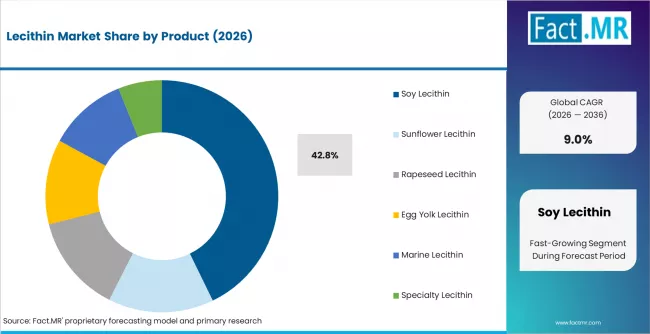
Soy lecithin controls 42.8% of the product segment. Soy lecithin is the most cost-effective commercial lecithin, produced as a co-product of soybean oil degumming at soybean crushing facilities operated by Cargill, ADM, Bunge, and regional processors. Global soybean processing capacity exceeds 350 million tonnes annually, providing abundant raw material for lecithin extraction.
Sunflower lecithin holds the second-largest share and is the fastest-growing product type. Rapeseed lecithin serves European markets where rapeseed processing is concentrated. Egg yolk lecithin serves pharmaceutical applications requiring high phosphatidylcholine purity. Marine lecithin serves niche nutraceutical applications.
Which application drives demand in the Lecithin Market?
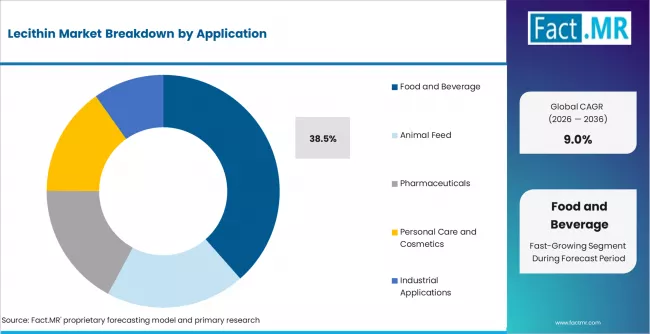
Food and beverage accounts for 38.5% of application demand. Chocolate manufacturing, bakery products, margarine and spreads, instant beverages, and dairy products are the primary food applications. Lecithin functions as an emulsifier (enabling oil-water mixing), wetting agent (improving powder dispersibility), release agent (preventing sticking), and crystallisation modifier (controlling fat bloom in chocolate).
Animal feed holds the second-largest application share, with lecithin used as a fat dispersant and energy source in poultry, swine, and aquaculture feed. Pharmaceutical applications are the fastest-growing segment, driven by liposome technology.
Which form captures the largest share in the Lecithin Market?
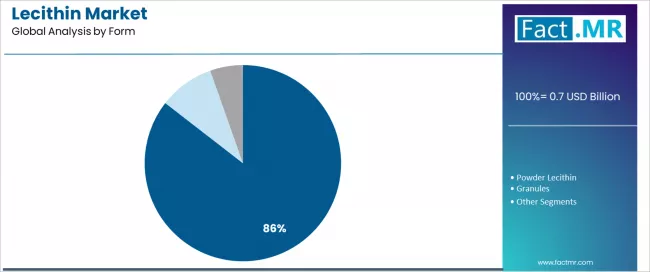
Liquid lecithin accounts for 47.3% of form demand. Crude and de-oiled liquid lecithin is the primary commercial form, used directly in food manufacturing without further processing. Liquid lecithin is cost-effective, easy to dose, and compatible with standard food production equipment.
Powder lecithin holds the second-largest share, serving applications requiring dry ingredient incorporation (bakery premixes, infant formula, dietary supplements). Granular lecithin serves retail consumer applications. Modified lecithin (enzymatically or chemically treated) serves specialty emulsification requirements.
Which Product Trend is Shaping the Next Phase of Growth in the Lecithin Market?
The fastest-growing product trend in the lecithin market is the development of phospholipid-enriched lecithin fractions with standardised compositions for pharmaceutical and nutraceutical applications. Traditional food-grade lecithin contains 15 to 30% phosphatidylcholine (PC), 10 to 20% phosphatidylethanolamine (PE), and various minor phospholipids in variable ratios. Pharmaceutical applications require PC-enriched fractions with 40 to 95% PC content, produced through solvent fractionation, chromatographic separation, or enzymatic modification.
The commercial significance is transformative. PC-enriched lecithin fractions command prices 10 to 100 times above crude food-grade lecithin, converting a commodity by-product into a precision pharmaceutical ingredient. Lipoid GmbH, American Lecithin Company, and specialty fractionators are investing in purification technology that produces cGMP-compliant pharmaceutical lecithin. The growing pipeline of liposomal drug products (Doxil, AmBisome, and new candidates) and liposomal supplements is creating sustained demand growth for high-purity lecithin fractions.
Regional Outlook Across Key Markets
.webp)
- North America is a major market, with the USA contributing USD 0.265 billion in 2025 revenue.
- East Asia is expanding, with Japan at USD 0.037 billion and South Korea at USD 0.021 billion.
- South Asia and Pacific is the fastest-growing region, driven by India's food processing expansion.
- Europe is a major market with strong sunflower lecithin production and pharmaceutical-grade demand.
CAGR Table
| Country | CAGR (%) |
|---|---|
| India | 10.8% |
| China | 10.4% |
| Brazil | 9.8% |
| Germany | 9.1% |
| USA | 8.6% |
| UK | 8.3% |
| Japan | 7.9% |
Source: Fact.MR analysis, based on proprietary forecasting model and primary research.
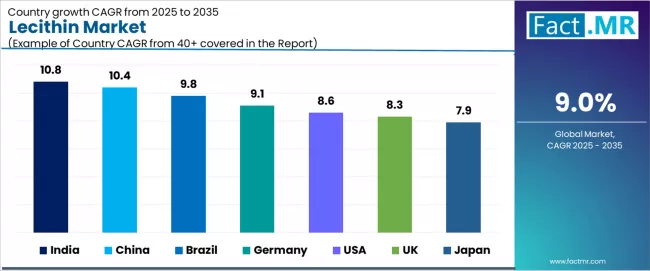
India: food processing growth and oilseed processing expansion drive leadership
India leads global growth. India's food processing sector is expanding at 12 to 15% annually, creating demand for lecithin as a food-grade emulsifier. India's soybean processing industry, concentrated in Madhya Pradesh and Maharashtra, provides raw material for domestic lecithin production. Indian lecithin demand is growing as packaged food manufacturing scales.
- India's soybean processing capacity exceeded 15 million tonnes in 2024, per Soybean Processors Association of India data, with lecithin as a growing value-added co-product.
China: food manufacturing scale and pharmaceutical industry expansion accelerate adoption
China records the second-highest growth rate. Chinese lecithin demand is driven by the country's massive food manufacturing sector, pharmaceutical industry growth, and expanding animal feed production. Chinese soybean processing capacity exceeds 100 million tonnes annually, providing abundant lecithin supply.
- China's food manufacturing sector exceeded USD 1.5 trillion in 2024, per National Bureau of Statistics data, with emulsifier ingredients growing alongside processed food production expansion.
Brazil: soybean processing leadership and domestic food industry drive growth
Brazil's growth reflects its position as the world's largest soybean producer and processor. Brazilian soybean crushing facilities produce lecithin as a co-product of soybean oil refining, and domestic lecithin demand is growing alongside Brazil's expanding processed food manufacturing sector and animal feed industry.
- Brazil's soybean crush exceeded 55 million tonnes in 2024, per ABIOVE data, with lecithin extraction rates increasing as processors invest in degumming optimisation.
Germany: sunflower lecithin production and pharmaceutical demand define the market
Germany's growth is driven by its position as Europe's leading sunflower lecithin producer and the pharmaceutical industry's demand for high-purity lecithin fractions. Lipoid GmbH, based in Ludwigshafen, is the world's leading pharmaceutical-grade lecithin manufacturer. German food manufacturers favour sunflower lecithin for allergen-free positioning.
- Germany's sunflower lecithin production capacity grew 15% in 2024, per BLE data, driven by non-GMO food ingredient demand.
USA: clean-label food trend and pharmaceutical applications sustain demand
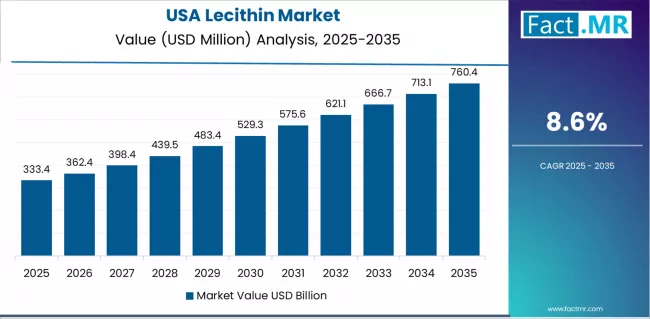
The USA generates USD 0.265 billion in 2025 revenue. Growth is driven by clean-label food reformulation replacing synthetic emulsifiers with lecithin, sunflower lecithin adoption for non-GMO product positioning, and pharmaceutical liposome applications. US soybean processing provides a large domestic lecithin supply base.
- US soybean crush exceeded 62 million tonnes in 2024, per USDA NASS data, with lecithin production benefiting from processing expansion.
UK: clean-label reformulation and pharmaceutical ingredients drive growth
UK growth is driven by clean-label food reformulation trends and pharmaceutical ingredient demand. UK food manufacturers are transitioning from synthetic emulsifiers to lecithin-based alternatives. The UK pharmaceutical sector sources high-purity lecithin for liposomal formulations.
- UK clean-label food product launches grew 15% in 2024, per Mintel GNPD data, with lecithin as a leading emulsifier replacement for synthetic alternatives.
Japan: pharmaceutical liposome technology and food quality standards sustain demand
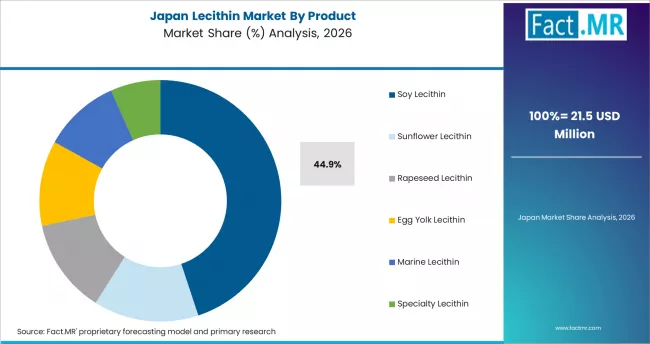
Japan contributes USD 0.037 billion in 2025. Japanese lecithin demand reflects the country's advanced pharmaceutical industry and stringent food ingredient quality standards. Japanese pharmaceutical companies are leaders in liposomal drug delivery technology, creating sustained demand for high-purity lecithin fractions.
- Japan's pharmaceutical excipient market grew 6% in 2024, per PMDA data, with phospholipid-based ingredients gaining formulation share.
Competitive Benchmarking and Company Positioning
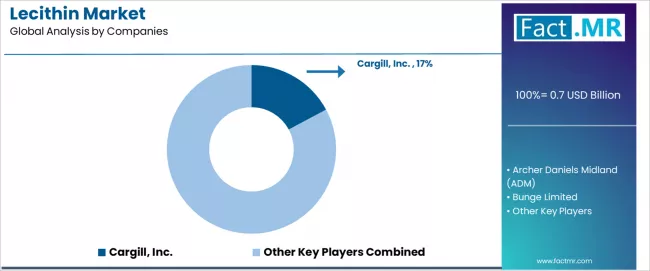
Lecithin Market Analysis By Company
- Cargill, Inc. holds approximately 17.0% of global revenue through integrated soybean processing and lecithin production at its global network of oilseed crushing facilities.
- ADM and Bunge compete on soybean processing scale, lecithin product portfolio breadth, and global distribution reach.
- Lipoid GmbH dominates the pharmaceutical-grade lecithin segment through proprietary fractionation technology and cGMP-compliant production facilities.
The competitive structure is moderately concentrated, with Cargill holding the largest share at 17.0%. Cargill's position is built on its global soybean crushing network that produces lecithin as a co-product of soybean oil refining. The company's scale advantage enables competitive pricing for food-grade liquid lecithin while investing in de-oiled and fractionated specialty grades.
Competition is stratified by product grade. In commodity food-grade lecithin, Cargill, ADM, and Bunge compete on price and supply reliability. In sunflower lecithin, European processors (Bunge Europe, Sternchemie) compete on non-GMO certification and allergen-free positioning. In pharmaceutical-grade lecithin, Lipoid GmbH and American Lecithin Company compete on phospholipid purity, regulatory documentation, and cGMP compliance.
Key Companies in the Lecithin Market
The lecithin competitive field includes Cargill Inc., Archer Daniels Midland (ADM), Bunge Limited, Lipoid GmbH, DuPont de Nemours Inc., American Lecithin Company, Stern-Wywiol Gruppe GmbH and Co. KG, NOW Foods, Global River Food Ingredients, and Haneil Soyatech Pvt. Ltd.
Recent Industry Developments
- Cargill: sunflower lecithin product range expansion (2025)
- Cargill expanded its sunflower lecithin product portfolio with new de-oiled powder and granular formats targeting clean-label bakery and confectionery manufacturers.
- Lipoid GmbH: pharmaceutical lecithin capacity expansion (2025)
- Lipoid expanded pharmaceutical-grade lecithin production capacity at its Ludwigshafen facility, adding purification lines for 95%+ PC-enriched fractions to serve growing liposomal drug delivery demand.
- ADM: organic lecithin supply chain development (2026)
- ADM established an organic soy lecithin supply chain using identity-preserved organic soybeans from certified US and Brazilian farms, targeting the organic food manufacturing segment.
- Stern-Wywiol: modified lecithin platform launch (2025)
- Stern-Wywiol Gruppe launched an enzymatically modified lecithin product platform delivering improved emulsification performance in low-fat food applications, targeting reformulation programmes.
Leading Companies Shaping the Lecithin Market
-
Global Players
- Cargill, Inc.
- Archer Daniels Midland (ADM)
- Bunge Limited
- DuPont de Nemours, Inc.
-
Regional Players
- Lipoid GmbH
- American Lecithin Company
- Stern-Wywiol Gruppe GmbH and Co. KG
- NOW Foods
-
Emerging / Start-up Players
- Global River Food Ingredients
- Haneil Soyatech Pvt. Ltd.
- Sternchemie GmbH
Sources and Research References
- Company annual reports from Cargill, ADM, Bunge, and Lipoid GmbH.
- ICCO (International Cocoa Organization) chocolate production statistics.
- Soybean Processors Association of India processing data.
- USDA NASS soybean crush and oilseed processing statistics.
- BLE (Federal Office for Agriculture and Food) German lecithin production data.
- Mintel GNPD clean-label food product launch data.
All cited sources are first-party company filings, government databases, industry associations, or commodity organisations. No syndicated market research reports were used.
Key Questions This Report Addresses
- What is the projected market value for lecithin by 2036?
- Which product type holds the largest share?
- What CAGR is forecast from 2026 to 2036?
- How is sunflower lecithin capturing share from soy lecithin?
- Which countries are growing fastest?
- What is the competitive structure?
- How are pharmaceutical applications creating premium lecithin demand?
- What role does clean-label reformulation play in lecithin growth?
- How does GMO status affect lecithin source selection?
Lecithin Market Definition
The lecithin market encompasses the extraction, processing, and sale of phospholipid-based emulsifier products derived from soybeans, sunflower seeds, rapeseed, egg yolks, and marine sources. Products include liquid, powder, granular, and modified lecithin forms serving food, feed, pharmaceutical, cosmetic, and industrial applications.
Lecithin Market Inclusions
- Soy, sunflower, rapeseed, egg yolk, and marine lecithin in all commercial forms.
- Modified and fractionated lecithin products with standardised phospholipid compositions.
- Pharmaceutical-grade lecithin for liposome and drug delivery applications.
- Lecithin used as a feed additive in animal nutrition.
Lecithin Market Exclusions
- Synthetic emulsifiers and surfactants not derived from natural lecithin sources.
- Phospholipid supplements sold as consumer health products (e.g., phosphatidylserine supplements).
- Soybean oil and other vegetable oils from which lecithin is separated during degumming.
- Lecithin-containing finished food products (chocolate, margarine) sold at retail.
Lecithin Market Research Methodology
- Primary research with lecithin manufacturers, oilseed processors, food ingredient distributors, and pharmaceutical formulators across 12 countries.
- Revenue modelling based on lecithin production volumes, oilseed processing statistics, and manufacturer-reported sales.
- Pricing analysis using B2B ingredient price lists, commodity trading data, and pharmaceutical ingredient procurement records.
- Competitive share estimation through company annual reports, oilseed processing industry data, and trade flow analysis.
- Demand validation through food emulsifier consumption data, pharmaceutical excipient market analysis, and feed additive usage statistics.
Scope of Analysis

| Parameter | Details |
|---|---|
| Report Currency | USD Billion |
| Market Value (2025) | USD 0.69 Billion |
| Forecast Value (2036) | USD 1.78 Billion |
| CAGR (2026 to 2036) | 9.0% |
| Product | Soy Lecithin, Sunflower Lecithin, Rapeseed Lecithin, Egg Yolk Lecithin, Marine Lecithin, Specialty Lecithin |
| Application | Food and Beverage, Animal Feed, Pharmaceuticals, Personal Care and Cosmetics, Industrial Applications |
| Form | Liquid Lecithin, Powder Lecithin, Granular Lecithin, Modified Lecithin |
| Source | Soybean, Sunflower Seed, Rapeseed, Egg Yolk, Marine Sources |
| Regions | North America, Latin America, Europe, East Asia, South Asia and Pacific, Middle East and Africa |
| Countries | India, China, Brazil, Germany, USA, UK, Japan, and 40+ countries |
| Companies | Cargill Inc., ADM, Bunge Limited, Lipoid GmbH, DuPont, American Lecithin Company, Stern-Wywiol Gruppe, NOW Foods, Global River Food Ingredients, Haneil Soyatech |
| Forecast Period | 2026 to 2036 |
| Approach | Top-down and bottom-up with primary and secondary research |
Market Segmentation Analysis
-
Lecithin Market Market Segmented by Product:
- Soy Lecithin
- Liquid Soy Lecithin
- Powder Soy Lecithin
- Refined Soy Lecithin
- Sunflower Lecithin
- Liquid Sunflower Lecithin
- Powder Sunflower Lecithin
- Non GMO Sunflower Lecithin
- Rapeseed Lecithin
- Canola Lecithin Extract
- Crude Rapeseed Lecithin
- Egg Yolk Lecithin
- Natural Egg Lecithin
- Phospholipid Rich Extracts
- Marine Lecithin
- Fish Derived Lecithin
- Algae Based Lecithin
- Specialty Lecithin
- Degummed Lecithin
- Hydrolyzed Lecithin
- Modified Lecithin
- Soy Lecithin
-
Lecithin Market Market Segmented by Application:
- Food and Beverage
- Chocolate and Confectionery
- Bakery Products
- Instant Foods
- Animal Feed
- Poultry Feed
- Swine Feed
- Aquaculture Feed
- Pharmaceuticals
- Drug Delivery Systems
- Emulsifier for Capsules
- Personal Care and Cosmetics
- Skincare Formulations
- Haircare Products
- Industrial Applications
- Paint and Coatings
- Plastics and Lubricants
- Adhesives and Ink Production
- Food and Beverage
-
Lecithin Market Market Segmented by End Use:
- Food Manufacturers
- Confectionery Producers
- Bakery Manufacturers
- Beverage Companies
- Animal Feed Industry
- Feed Manufacturers
- Aqua Feed Producers
- Pharmaceutical Companies
- Drug Formulation Companies
- Cosmetic Manufacturers
- Personal Care Brands
- Industrial Manufacturers
- Chemical Processing Companies
- Polymer Producers
- Food Manufacturers
-
Lecithin Market Market Segmented by Distribution Channel:
- Direct Sales
- Bulk Ingredient Supply Contracts
- Manufacturer Agreements
- Distributors
- Food Ingredient Distributors
- Chemical Distributors
- Online B2B Platforms
- Industrial Marketplaces
- Ingredient E Commerce Platforms
- Retail Channels
- Health Food Stores
- Supplement Retailers
- Export Channels
- Global Bulk Trade
- Contract Manufacturing Supply Chains
- Direct Sales
-
Lecithin Market Market Segmented by Form:
- Liquid Lecithin
- Viscous Liquid Form
- Refined Oil Based Lecithin
- Powder Lecithin
- Spray Dried Lecithin
- Granulated Lecithin
- Granular Lecithin
- Soy Granules
- Sunflower Granules
- Modified Lecithin
- Hydrolyzed Lecithin
- Enzymatically Modified Lecithin
- Liquid Lecithin
-
Lecithin Market Market Segmented by Source:
- Soybean
- Non GMO Soybean Sources
- Conventional Soy Sources
- Sunflower Seed
- Organic Sunflower Seeds
- High Oleic Sunflower Seeds
- Rapeseed
- Canola Oil Byproduct Sources
- Egg Yolk
- Animal Derived Lecithin Sources
- Marine Sources
- Fish and Algae Derived Lecithin
- Soybean
-
Lecithin Market Market by Region:
- North America
- USA
- Canada
- Mexico
- Latin America
- Brazil
- Chile
- Rest of Latin America
- Western Europe
- Germany
- UK
- Italy
- Spain
- France
- Nordic
- BENELUX
- Rest of Western Europe
- Eastern Europe
- Russia
- Poland
- Hungary
- Balkan & Baltic
- Rest of Eastern Europe
- East Asia
- China
- Japan
- South Korea
- South Asia and Pacific
- India
- ASEAN
- Australia & New Zealand
- Rest of South Asia and Pacific
- Middle East & Africa
- Kingdom of Saudi Arabia
- Other GCC Countries
- Turkiye
- South Africa
- Other African Union
- Rest of Middle East & Africa
- North America
- Frequently Asked Questions -
What is the current market size?
The market is valued at USD 0.69 billion in 2025.
What growth rate is expected?
A 9.0% CAGR from 2026 to 2036.
Which product type leads?
Soy lecithin holds 42.8% of the product segment.
Which application is largest?
Food and beverage captures 38.5% of application demand.
Which country is growing fastest?
India leads at 10.8% CAGR.
What is the incremental opportunity?
USD 1.028 billion between 2026 and 2036.
Which company holds the largest share?
Cargill Inc. holds approximately 17.0%.
Table of Content
- Executive Summary
- Global Market Outlook
- Demand to side Trends
- Supply to side Trends
- Technology Roadmap Analysis
- Analysis and Recommendations
- Market Overview
- Market Coverage / Taxonomy
- Market Definition / Scope / Limitations
- Research Methodology
- Chapter Orientation
- Analytical Lens and Working Hypotheses
- Market Structure, Signals, and Trend Drivers
- Benchmarking and Cross-market Comparability
- Market Sizing, Forecasting, and Opportunity Mapping
- Research Design and Evidence Framework
- Desk Research Programme (Secondary Evidence)
- Company Annual and Sustainability Reports
- Peer-reviewed Journals and Academic Literature
- Corporate Websites, Product Literature, and Technical Notes
- Earnings Decks and Investor Briefings
- Statutory Filings and Regulatory Disclosures
- Technical White Papers and Standards Notes
- Trade Journals, Industry Magazines, and Analyst Briefs
- Conference Proceedings, Webinars, and Seminar Materials
- Government Statistics Portals and Public Data Releases
- Press Releases and Reputable Media Coverage
- Specialist Newsletters and Curated Briefings
- Sector Databases and Reference Repositories
- Fact.MR Internal Proprietary Databases and Historical Market Datasets
- Subscription Datasets and Paid Sources
- Social Channels, Communities, and Digital Listening Inputs
- Additional Desk Sources
- Expert Input and Fieldwork (Primary Evidence)
- Primary Modes
- Qualitative Interviews and Expert Elicitation
- Quantitative Surveys and Structured Data Capture
- Blended Approach
- Why Primary Evidence is Used
- Field Techniques
- Interviews
- Surveys
- Focus Groups
- Observational and In-context Research
- Social and Community Interactions
- Stakeholder Universe Engaged
- C-suite Leaders
- Board Members
- Presidents and Vice Presidents
- R&D and Innovation Heads
- Technical Specialists
- Domain Subject-matter Experts
- Scientists
- Physicians and Other Healthcare Professionals
- Governance, Ethics, and Data Stewardship
- Research Ethics
- Data Integrity and Handling
- Primary Modes
- Tooling, Models, and Reference Databases
- Desk Research Programme (Secondary Evidence)
- Data Engineering and Model Build
- Data Acquisition and Ingestion
- Cleaning, Normalisation, and Verification
- Synthesis, Triangulation, and Analysis
- Quality Assurance and Audit Trail
- Market Background
- Market Dynamics
- Drivers
- Restraints
- Opportunity
- Trends
- Scenario Forecast
- Demand in Optimistic Scenario
- Demand in Likely Scenario
- Demand in Conservative Scenario
- Opportunity Map Analysis
- Product Life Cycle Analysis
- Supply Chain Analysis
- Investment Feasibility Matrix
- Value Chain Analysis
- PESTLE and Porter’s Analysis
- Regulatory Landscape
- Regional Parent Market Outlook
- Production and Consumption Statistics
- Import and Export Statistics
- Market Dynamics
- Global Market Analysis 2021 to 2025 and Forecast, 2026 to 2036
- Historical Market Size Value (USD Million) Analysis, 2021 to 2025
- Current and Future Market Size Value (USD Million) Projections, 2026 to 2036
- Y to o to Y Growth Trend Analysis
- Absolute $ Opportunity Analysis
- Global Market Pricing Analysis 2021 to 2025 and Forecast 2026 to 2036
- Global Market Analysis 2021 to 2025 and Forecast 2026 to 2036, By Product
- Introduction / Key Findings
- Historical Market Size Value (USD Million) Analysis By Product , 2021 to 2025
- Current and Future Market Size Value (USD Million) Analysis and Forecast By Product , 2026 to 2036
- Soy Lecithin
- Liquid Soy Lecithin
- Powder Soy Lecithin
- Refined Soy Lecithin
- Sunflower Lecithin
- Liquid Sunflower Lecithin
- Powder Sunflower Lecithin
- Non GMO Sunflower Lecithin
- Rapeseed Lecithin
- Canola Lecithin Extract
- Crude Rapeseed Lecithin
- Egg Yolk Lecithin
- Natural Egg Lecithin
- Phospholipid Rich Extracts
- Marine Lecithin
- Fish Derived Lecithin
- Algae Based Lecithin
- Specialty Lecithin
- Degummed Lecithin
- Hydrolyzed Lecithin
- Modified Lecithin
- Soy Lecithin
- Y to o to Y Growth Trend Analysis By Product , 2021 to 2025
- Absolute $ Opportunity Analysis By Product , 2026 to 2036
- Global Market Analysis 2021 to 2025 and Forecast 2026 to 2036, By Application
- Introduction / Key Findings
- Historical Market Size Value (USD Million) Analysis By Application, 2021 to 2025
- Current and Future Market Size Value (USD Million) Analysis and Forecast By Application, 2026 to 2036
- Food and Beverage
- Chocolate and Confectionery
- Bakery Products
- Instant Foods
- Animal Feed
- Poultry Feed
- Swine Feed
- Aquaculture Feed
- Pharmaceuticals
- Drug Delivery Systems
- Emulsifier for Capsules
- Personal Care and Cosmetics
- Skincare Formulations
- Haircare Products
- Industrial Applications
- Paint and Coatings
- Plastics and Lubricants
- Adhesives and Ink Production
- Food and Beverage
- Y to o to Y Growth Trend Analysis By Application, 2021 to 2025
- Absolute $ Opportunity Analysis By Application, 2026 to 2036
- Global Market Analysis 2021 to 2025 and Forecast 2026 to 2036, By End Use
- Introduction / Key Findings
- Historical Market Size Value (USD Million) Analysis By End Use, 2021 to 2025
- Current and Future Market Size Value (USD Million) Analysis and Forecast By End Use, 2026 to 2036
- Food Manufacturers
- Confectionery Producers
- Bakery Manufacturers
- Beverage Companies
- Animal Feed Industry
- Feed Manufacturers
- Aqua Feed Producers
- Pharmaceutical Companies
- Drug Formulation Companies
- Cosmetic Manufacturers
- Personal Care Brands
- Industrial Manufacturers
- Chemical Processing Companies
- Polymer Producers
- Food Manufacturers
- Y to o to Y Growth Trend Analysis By End Use, 2021 to 2025
- Absolute $ Opportunity Analysis By End Use, 2026 to 2036
- Global Market Analysis 2021 to 2025 and Forecast 2026 to 2036, By Distribution Channel
- Introduction / Key Findings
- Historical Market Size Value (USD Million) Analysis By Distribution Channel, 2021 to 2025
- Current and Future Market Size Value (USD Million) Analysis and Forecast By Distribution Channel, 2026 to 2036
- Direct Sales
- Bulk Ingredient Supply Contracts
- Manufacturer Agreements
- Distributors
- Food Ingredient Distributors
- Chemical Distributors
- Online B2B Platforms
- Industrial Marketplaces
- Ingredient E Commerce Platforms
- Retail Channels
- Health Food Stores
- Supplement Retailers
- Export Channels
- Global Bulk Trade
- Contract Manufacturing Supply Chains
- Direct Sales
- Y to o to Y Growth Trend Analysis By Distribution Channel, 2021 to 2025
- Absolute $ Opportunity Analysis By Distribution Channel, 2026 to 2036
- Global Market Analysis 2021 to 2025 and Forecast 2026 to 2036, By Form
- Introduction / Key Findings
- Historical Market Size Value (USD Million) Analysis By Form, 2021 to 2025
- Current and Future Market Size Value (USD Million) Analysis and Forecast By Form, 2026 to 2036
- Liquid Lecithin
- Viscous Liquid Form
- Refined Oil Based Lecithin
- Powder Lecithin
- Spray Dried Lecithin
- Granulated Lecithin
- Granular Lecithin
- Soy Granules
- Sunflower Granules
- Modified Lecithin
- Hydrolyzed Lecithin
- Enzymatically Modified Lecithin
- Liquid Lecithin
- Y to o to Y Growth Trend Analysis By Form, 2021 to 2025
- Absolute $ Opportunity Analysis By Form, 2026 to 2036
- Global Market Analysis 2021 to 2025 and Forecast 2026 to 2036, By Source
- Introduction / Key Findings
- Historical Market Size Value (USD Million) Analysis By Source, 2021 to 2025
- Current and Future Market Size Value (USD Million) Analysis and Forecast By Source, 2026 to 2036
- Soybean
- Non GMO Soybean Sources
- Conventional Soy Sources
- Sunflower Seed
- Organic Sunflower Seeds
- High Oleic Sunflower Seeds
- Rapeseed
- Canola Oil Byproduct Sources
- Egg Yolk
- Animal Derived Lecithin Sources
- Marine Sources
- Fish and Algae Derived Lecithin
- Soybean
- Y to o to Y Growth Trend Analysis By Source, 2021 to 2025
- Absolute $ Opportunity Analysis By Source, 2026 to 2036
- Global Market Analysis 2021 to 2025 and Forecast 2026 to 2036, By Region
- Introduction
- Historical Market Size Value (USD Million) Analysis By Region, 2021 to 2025
- Current Market Size Value (USD Million) Analysis and Forecast By Region, 2026 to 2036
- North America
- Latin America
- Western Europe
- Eastern Europe
- East Asia
- South Asia and Pacific
- Middle East & Africa
- Market Attractiveness Analysis By Region
- North America Market Analysis 2021 to 2025 and Forecast 2026 to 2036, By Country
- Historical Market Size Value (USD Million) Trend Analysis By Market Taxonomy, 2021 to 2025
- Market Size Value (USD Million) Forecast By Market Taxonomy, 2026 to 2036
- By Country
- USA
- Canada
- Mexico
- By Product
- By Application
- By End Use
- By Distribution Channel
- By Form
- By Source
- By Country
- Market Attractiveness Analysis
- By Country
- By Product
- By Application
- By End Use
- By Distribution Channel
- By Form
- By Source
- Key Takeaways
- Latin America Market Analysis 2021 to 2025 and Forecast 2026 to 2036, By Country
- Historical Market Size Value (USD Million) Trend Analysis By Market Taxonomy, 2021 to 2025
- Market Size Value (USD Million) Forecast By Market Taxonomy, 2026 to 2036
- By Country
- Brazil
- Chile
- Rest of Latin America
- By Product
- By Application
- By End Use
- By Distribution Channel
- By Form
- By Source
- By Country
- Market Attractiveness Analysis
- By Country
- By Product
- By Application
- By End Use
- By Distribution Channel
- By Form
- By Source
- Key Takeaways
- Western Europe Market Analysis 2021 to 2025 and Forecast 2026 to 2036, By Country
- Historical Market Size Value (USD Million) Trend Analysis By Market Taxonomy, 2021 to 2025
- Market Size Value (USD Million) Forecast By Market Taxonomy, 2026 to 2036
- By Country
- Germany
- UK
- Italy
- Spain
- France
- Nordic
- BENELUX
- Rest of Western Europe
- By Product
- By Application
- By End Use
- By Distribution Channel
- By Form
- By Source
- By Country
- Market Attractiveness Analysis
- By Country
- By Product
- By Application
- By End Use
- By Distribution Channel
- By Form
- By Source
- Key Takeaways
- Eastern Europe Market Analysis 2021 to 2025 and Forecast 2026 to 2036, By Country
- Historical Market Size Value (USD Million) Trend Analysis By Market Taxonomy, 2021 to 2025
- Market Size Value (USD Million) Forecast By Market Taxonomy, 2026 to 2036
- By Country
- Russia
- Poland
- Hungary
- Balkan & Baltic
- Rest of Eastern Europe
- By Product
- By Application
- By End Use
- By Distribution Channel
- By Form
- By Source
- By Country
- Market Attractiveness Analysis
- By Country
- By Product
- By Application
- By End Use
- By Distribution Channel
- By Form
- By Source
- Key Takeaways
- East Asia Market Analysis 2021 to 2025 and Forecast 2026 to 2036, By Country
- Historical Market Size Value (USD Million) Trend Analysis By Market Taxonomy, 2021 to 2025
- Market Size Value (USD Million) Forecast By Market Taxonomy, 2026 to 2036
- By Country
- China
- Japan
- South Korea
- By Product
- By Application
- By End Use
- By Distribution Channel
- By Form
- By Source
- By Country
- Market Attractiveness Analysis
- By Country
- By Product
- By Application
- By End Use
- By Distribution Channel
- By Form
- By Source
- Key Takeaways
- South Asia and Pacific Market Analysis 2021 to 2025 and Forecast 2026 to 2036, By Country
- Historical Market Size Value (USD Million) Trend Analysis By Market Taxonomy, 2021 to 2025
- Market Size Value (USD Million) Forecast By Market Taxonomy, 2026 to 2036
- By Country
- India
- ASEAN
- Australia & New Zealand
- Rest of South Asia and Pacific
- By Product
- By Application
- By End Use
- By Distribution Channel
- By Form
- By Source
- By Country
- Market Attractiveness Analysis
- By Country
- By Product
- By Application
- By End Use
- By Distribution Channel
- By Form
- By Source
- Key Takeaways
- Middle East & Africa Market Analysis 2021 to 2025 and Forecast 2026 to 2036, By Country
- Historical Market Size Value (USD Million) Trend Analysis By Market Taxonomy, 2021 to 2025
- Market Size Value (USD Million) Forecast By Market Taxonomy, 2026 to 2036
- By Country
- Kingdom of Saudi Arabia
- Other GCC Countries
- Turkiye
- South Africa
- Other African Union
- Rest of Middle East & Africa
- By Product
- By Application
- By End Use
- By Distribution Channel
- By Form
- By Source
- By Country
- Market Attractiveness Analysis
- By Country
- By Product
- By Application
- By End Use
- By Distribution Channel
- By Form
- By Source
- Key Takeaways
- Key Countries Market Analysis
- USA
- Pricing Analysis
- Market Share Analysis, 2025
- By Product
- By Application
- By End Use
- By Distribution Channel
- By Form
- By Source
- Canada
- Pricing Analysis
- Market Share Analysis, 2025
- By Product
- By Application
- By End Use
- By Distribution Channel
- By Form
- By Source
- Mexico
- Pricing Analysis
- Market Share Analysis, 2025
- By Product
- By Application
- By End Use
- By Distribution Channel
- By Form
- By Source
- Brazil
- Pricing Analysis
- Market Share Analysis, 2025
- By Product
- By Application
- By End Use
- By Distribution Channel
- By Form
- By Source
- Chile
- Pricing Analysis
- Market Share Analysis, 2025
- By Product
- By Application
- By End Use
- By Distribution Channel
- By Form
- By Source
- Germany
- Pricing Analysis
- Market Share Analysis, 2025
- By Product
- By Application
- By End Use
- By Distribution Channel
- By Form
- By Source
- UK
- Pricing Analysis
- Market Share Analysis, 2025
- By Product
- By Application
- By End Use
- By Distribution Channel
- By Form
- By Source
- Italy
- Pricing Analysis
- Market Share Analysis, 2025
- By Product
- By Application
- By End Use
- By Distribution Channel
- By Form
- By Source
- Spain
- Pricing Analysis
- Market Share Analysis, 2025
- By Product
- By Application
- By End Use
- By Distribution Channel
- By Form
- By Source
- France
- Pricing Analysis
- Market Share Analysis, 2025
- By Product
- By Application
- By End Use
- By Distribution Channel
- By Form
- By Source
- India
- Pricing Analysis
- Market Share Analysis, 2025
- By Product
- By Application
- By End Use
- By Distribution Channel
- By Form
- By Source
- ASEAN
- Pricing Analysis
- Market Share Analysis, 2025
- By Product
- By Application
- By End Use
- By Distribution Channel
- By Form
- By Source
- Australia & New Zealand
- Pricing Analysis
- Market Share Analysis, 2025
- By Product
- By Application
- By End Use
- By Distribution Channel
- By Form
- By Source
- China
- Pricing Analysis
- Market Share Analysis, 2025
- By Product
- By Application
- By End Use
- By Distribution Channel
- By Form
- By Source
- Japan
- Pricing Analysis
- Market Share Analysis, 2025
- By Product
- By Application
- By End Use
- By Distribution Channel
- By Form
- By Source
- South Korea
- Pricing Analysis
- Market Share Analysis, 2025
- By Product
- By Application
- By End Use
- By Distribution Channel
- By Form
- By Source
- Russia
- Pricing Analysis
- Market Share Analysis, 2025
- By Product
- By Application
- By End Use
- By Distribution Channel
- By Form
- By Source
- Poland
- Pricing Analysis
- Market Share Analysis, 2025
- By Product
- By Application
- By End Use
- By Distribution Channel
- By Form
- By Source
- Hungary
- Pricing Analysis
- Market Share Analysis, 2025
- By Product
- By Application
- By End Use
- By Distribution Channel
- By Form
- By Source
- Kingdom of Saudi Arabia
- Pricing Analysis
- Market Share Analysis, 2025
- By Product
- By Application
- By End Use
- By Distribution Channel
- By Form
- By Source
- Turkiye
- Pricing Analysis
- Market Share Analysis, 2025
- By Product
- By Application
- By End Use
- By Distribution Channel
- By Form
- By Source
- South Africa
- Pricing Analysis
- Market Share Analysis, 2025
- By Product
- By Application
- By End Use
- By Distribution Channel
- By Form
- By Source
- USA
- Market Structure Analysis
- Competition Dashboard
- Competition Benchmarking
- Market Share Analysis of Top Players
- By Regional
- By Product
- By Application
- By End Use
- By Distribution Channel
- By Form
- By Source
- Competition Analysis
- Competition Deep Dive
- Cargill, Inc.
- Overview
- Product Portfolio
- Profitability by Market Segments (Product/Age /Sales Channel/Region)
- Sales Footprint
- Strategy Overview
- Marketing Strategy
- Product Strategy
- Channel Strategy
- Archer Daniels Midland (ADM)
- Bunge Limited
- Lipoid GmbH
- DuPont de Nemours, Inc.
- American Lecithin Company
- Stern-Wywiol Gruppe GmbH & Co. KG
- NOW Foods
- Global River Food Ingredients
- Haneil Soyatech Pvt. Ltd.
- Cargill, Inc.
- Competition Deep Dive
- Assumptions & Acronyms Used
List Of Table
- Table 1: Global Market Value (USD Million) Forecast by Region, 2021 to 2036
- Table 2: Global Market Value (USD Million) Forecast by Product , 2021 to 2036
- Table 3: Global Market Value (USD Million) Forecast by Application, 2021 to 2036
- Table 4: Global Market Value (USD Million) Forecast by End Use, 2021 to 2036
- Table 5: Global Market Value (USD Million) Forecast by Distribution Channel, 2021 to 2036
- Table 6: Global Market Value (USD Million) Forecast by Form, 2021 to 2036
- Table 7: Global Market Value (USD Million) Forecast by Source, 2021 to 2036
- Table 8: North America Market Value (USD Million) Forecast by Country, 2021 to 2036
- Table 9: North America Market Value (USD Million) Forecast by Product , 2021 to 2036
- Table 10: North America Market Value (USD Million) Forecast by Application, 2021 to 2036
- Table 11: North America Market Value (USD Million) Forecast by End Use, 2021 to 2036
- Table 12: North America Market Value (USD Million) Forecast by Distribution Channel, 2021 to 2036
- Table 13: North America Market Value (USD Million) Forecast by Form, 2021 to 2036
- Table 14: North America Market Value (USD Million) Forecast by Source, 2021 to 2036
- Table 15: Latin America Market Value (USD Million) Forecast by Country, 2021 to 2036
- Table 16: Latin America Market Value (USD Million) Forecast by Product , 2021 to 2036
- Table 17: Latin America Market Value (USD Million) Forecast by Application, 2021 to 2036
- Table 18: Latin America Market Value (USD Million) Forecast by End Use, 2021 to 2036
- Table 19: Latin America Market Value (USD Million) Forecast by Distribution Channel, 2021 to 2036
- Table 20: Latin America Market Value (USD Million) Forecast by Form, 2021 to 2036
- Table 21: Latin America Market Value (USD Million) Forecast by Source, 2021 to 2036
- Table 22: Western Europe Market Value (USD Million) Forecast by Country, 2021 to 2036
- Table 23: Western Europe Market Value (USD Million) Forecast by Product , 2021 to 2036
- Table 24: Western Europe Market Value (USD Million) Forecast by Application, 2021 to 2036
- Table 25: Western Europe Market Value (USD Million) Forecast by End Use, 2021 to 2036
- Table 26: Western Europe Market Value (USD Million) Forecast by Distribution Channel, 2021 to 2036
- Table 27: Western Europe Market Value (USD Million) Forecast by Form, 2021 to 2036
- Table 28: Western Europe Market Value (USD Million) Forecast by Source, 2021 to 2036
- Table 29: Eastern Europe Market Value (USD Million) Forecast by Country, 2021 to 2036
- Table 30: Eastern Europe Market Value (USD Million) Forecast by Product , 2021 to 2036
- Table 31: Eastern Europe Market Value (USD Million) Forecast by Application, 2021 to 2036
- Table 32: Eastern Europe Market Value (USD Million) Forecast by End Use, 2021 to 2036
- Table 33: Eastern Europe Market Value (USD Million) Forecast by Distribution Channel, 2021 to 2036
- Table 34: Eastern Europe Market Value (USD Million) Forecast by Form, 2021 to 2036
- Table 35: Eastern Europe Market Value (USD Million) Forecast by Source, 2021 to 2036
- Table 36: East Asia Market Value (USD Million) Forecast by Country, 2021 to 2036
- Table 37: East Asia Market Value (USD Million) Forecast by Product , 2021 to 2036
- Table 38: East Asia Market Value (USD Million) Forecast by Application, 2021 to 2036
- Table 39: East Asia Market Value (USD Million) Forecast by End Use, 2021 to 2036
- Table 40: East Asia Market Value (USD Million) Forecast by Distribution Channel, 2021 to 2036
- Table 41: East Asia Market Value (USD Million) Forecast by Form, 2021 to 2036
- Table 42: East Asia Market Value (USD Million) Forecast by Source, 2021 to 2036
- Table 43: South Asia and Pacific Market Value (USD Million) Forecast by Country, 2021 to 2036
- Table 44: South Asia and Pacific Market Value (USD Million) Forecast by Product , 2021 to 2036
- Table 45: South Asia and Pacific Market Value (USD Million) Forecast by Application, 2021 to 2036
- Table 46: South Asia and Pacific Market Value (USD Million) Forecast by End Use, 2021 to 2036
- Table 47: South Asia and Pacific Market Value (USD Million) Forecast by Distribution Channel, 2021 to 2036
- Table 48: South Asia and Pacific Market Value (USD Million) Forecast by Form, 2021 to 2036
- Table 49: South Asia and Pacific Market Value (USD Million) Forecast by Source, 2021 to 2036
- Table 50: Middle East & Africa Market Value (USD Million) Forecast by Country, 2021 to 2036
- Table 51: Middle East & Africa Market Value (USD Million) Forecast by Product , 2021 to 2036
- Table 52: Middle East & Africa Market Value (USD Million) Forecast by Application, 2021 to 2036
- Table 53: Middle East & Africa Market Value (USD Million) Forecast by End Use, 2021 to 2036
- Table 54: Middle East & Africa Market Value (USD Million) Forecast by Distribution Channel, 2021 to 2036
- Table 55: Middle East & Africa Market Value (USD Million) Forecast by Form, 2021 to 2036
- Table 56: Middle East & Africa Market Value (USD Million) Forecast by Source, 2021 to 2036
List Of Figures
- Figure 1: Global Market Pricing Analysis
- Figure 2: Global Market Value (USD Million) Forecast 2021-2036
- Figure 3: Global Market Value Share and BPS Analysis by Product, 2026 and 2036
- Figure 4: Global Market Y-o-Y Growth Comparison by Product,2026 to 2036
- Figure 5: Global Market Attractiveness Analysis by Product
- Figure 6: Global Market Value Share and BPS Analysis by Application, 2026 and 2036
- Figure 7: Global Market Y-o-Y Growth Comparison by Application,2026 to 2036
- Figure 8: Global Market Attractiveness Analysis by Application
- Figure 9: Global Market Value Share and BPS Analysis by End Use, 2026 and 2036
- Figure 10: Global Market Y-o-Y Growth Comparison by End Use,2026 to 2036
- Figure 11: Global Market Attractiveness Analysis by End Use
- Figure 12: Global Market Value Share and BPS Analysis by Distribution Channel, 2026 and 2036
- Figure 13: Global Market Y-o-Y Growth Comparison by Distribution Channel,2026 to 2036
- Figure 14: Global Market Attractiveness Analysis by Distribution Channel
- Figure 15: Global Market Value Share and BPS Analysis by Form, 2026 and 2036
- Figure 16: Global Market Y-o-Y Growth Comparison by Form,2026 to 2036
- Figure 17: Global Market Attractiveness Analysis by Form
- Figure 18: Global Market Value Share and BPS Analysis by Source, 2026 and 2036
- Figure 19: Global Market Y-o-Y Growth Comparison by Source,2026 to 2036
- Figure 20: Global Market Attractiveness Analysis by Source
- Figure 21: Global Market Value (USD Million) Share and BPS Analysis by Region, 2026 and 2036
- Figure 22: Global Market Y-o-Y Growth Comparison by Region,2026 to 2036
- Figure 23: Global Market Attractiveness Analysis by Region
- Figure 24: North America Market Incremental Dollar Opportunity,2026 to 2036
- Figure 25: Latin America Market Incremental Dollar Opportunity,2026 to 2036
- Figure 26: Western Europe Market Incremental Dollar Opportunity,2026 to 2036
- Figure 27: Eastern Europe Market Incremental Dollar Opportunity,2026 to 2036
- Figure 28: East Asia Market Incremental Dollar Opportunity,2026 to 2036
- Figure 29: South Asia and Pacific Market Incremental Dollar Opportunity,2026 to 2036
- Figure 30: Middle East & Africa Market Incremental Dollar Opportunity,2026 to 2036
- Figure 31: North America Market Value Share and BPS Analysis by Country, 2026 and 2036
- Figure 32: North America Market Value Share and BPS Analysis by Product, 2026 and 2036
- Figure 33: North America Market Y-o-Y Growth Comparison by Product,2026 to 2036
- Figure 34: North America Market Attractiveness Analysis by Product
- Figure 35: North America Market Value Share and BPS Analysis by Application, 2026 and 2036
- Figure 36: North America Market Y-o-Y Growth Comparison by Application,2026 to 2036
- Figure 37: North America Market Attractiveness Analysis by Application
- Figure 38: North America Market Value Share and BPS Analysis by End Use, 2026 and 2036
- Figure 39: North America Market Y-o-Y Growth Comparison by End Use,2026 to 2036
- Figure 40: North America Market Attractiveness Analysis by End Use
- Figure 41: North America Market Value Share and BPS Analysis by Distribution Channel, 2026 and 2036
- Figure 42: North America Market Y-o-Y Growth Comparison by Distribution Channel,2026 to 2036
- Figure 43: North America Market Attractiveness Analysis by Distribution Channel
- Figure 44: North America Market Value Share and BPS Analysis by Form, 2026 and 2036
- Figure 45: North America Market Y-o-Y Growth Comparison by Form,2026 to 2036
- Figure 46: North America Market Attractiveness Analysis by Form
- Figure 47: North America Market Value Share and BPS Analysis by Source, 2026 and 2036
- Figure 48: North America Market Y-o-Y Growth Comparison by Source,2026 to 2036
- Figure 49: North America Market Attractiveness Analysis by Source
- Figure 50: Latin America Market Value Share and BPS Analysis by Country, 2026 and 2036
- Figure 51: Latin America Market Value Share and BPS Analysis by Product, 2026 and 2036
- Figure 52: Latin America Market Y-o-Y Growth Comparison by Product,2026 to 2036
- Figure 53: Latin America Market Attractiveness Analysis by Product
- Figure 54: Latin America Market Value Share and BPS Analysis by Application, 2026 and 2036
- Figure 55: Latin America Market Y-o-Y Growth Comparison by Application,2026 to 2036
- Figure 56: Latin America Market Attractiveness Analysis by Application
- Figure 57: Latin America Market Value Share and BPS Analysis by End Use, 2026 and 2036
- Figure 58: Latin America Market Y-o-Y Growth Comparison by End Use,2026 to 2036
- Figure 59: Latin America Market Attractiveness Analysis by End Use
- Figure 60: Latin America Market Value Share and BPS Analysis by Distribution Channel, 2026 and 2036
- Figure 61: Latin America Market Y-o-Y Growth Comparison by Distribution Channel,2026 to 2036
- Figure 62: Latin America Market Attractiveness Analysis by Distribution Channel
- Figure 63: Latin America Market Value Share and BPS Analysis by Form, 2026 and 2036
- Figure 64: Latin America Market Y-o-Y Growth Comparison by Form,2026 to 2036
- Figure 65: Latin America Market Attractiveness Analysis by Form
- Figure 66: Latin America Market Value Share and BPS Analysis by Source, 2026 and 2036
- Figure 67: Latin America Market Y-o-Y Growth Comparison by Source,2026 to 2036
- Figure 68: Latin America Market Attractiveness Analysis by Source
- Figure 69: Western Europe Market Value Share and BPS Analysis by Country, 2026 and 2036
- Figure 70: Western Europe Market Value Share and BPS Analysis by Product, 2026 and 2036
- Figure 71: Western Europe Market Y-o-Y Growth Comparison by Product,2026 to 2036
- Figure 72: Western Europe Market Attractiveness Analysis by Product
- Figure 73: Western Europe Market Value Share and BPS Analysis by Application, 2026 and 2036
- Figure 74: Western Europe Market Y-o-Y Growth Comparison by Application,2026 to 2036
- Figure 75: Western Europe Market Attractiveness Analysis by Application
- Figure 76: Western Europe Market Value Share and BPS Analysis by End Use, 2026 and 2036
- Figure 77: Western Europe Market Y-o-Y Growth Comparison by End Use,2026 to 2036
- Figure 78: Western Europe Market Attractiveness Analysis by End Use
- Figure 79: Western Europe Market Value Share and BPS Analysis by Distribution Channel, 2026 and 2036
- Figure 80: Western Europe Market Y-o-Y Growth Comparison by Distribution Channel,2026 to 2036
- Figure 81: Western Europe Market Attractiveness Analysis by Distribution Channel
- Figure 82: Western Europe Market Value Share and BPS Analysis by Form, 2026 and 2036
- Figure 83: Western Europe Market Y-o-Y Growth Comparison by Form,2026 to 2036
- Figure 84: Western Europe Market Attractiveness Analysis by Form
- Figure 85: Western Europe Market Value Share and BPS Analysis by Source, 2026 and 2036
- Figure 86: Western Europe Market Y-o-Y Growth Comparison by Source,2026 to 2036
- Figure 87: Western Europe Market Attractiveness Analysis by Source
- Figure 88: Eastern Europe Market Value Share and BPS Analysis by Country, 2026 and 2036
- Figure 89: Eastern Europe Market Value Share and BPS Analysis by Product, 2026 and 2036
- Figure 90: Eastern Europe Market Y-o-Y Growth Comparison by Product,2026 to 2036
- Figure 91: Eastern Europe Market Attractiveness Analysis by Product
- Figure 92: Eastern Europe Market Value Share and BPS Analysis by Application, 2026 and 2036
- Figure 93: Eastern Europe Market Y-o-Y Growth Comparison by Application,2026 to 2036
- Figure 94: Eastern Europe Market Attractiveness Analysis by Application
- Figure 95: Eastern Europe Market Value Share and BPS Analysis by End Use, 2026 and 2036
- Figure 96: Eastern Europe Market Y-o-Y Growth Comparison by End Use,2026 to 2036
- Figure 97: Eastern Europe Market Attractiveness Analysis by End Use
- Figure 98: Eastern Europe Market Value Share and BPS Analysis by Distribution Channel, 2026 and 2036
- Figure 99: Eastern Europe Market Y-o-Y Growth Comparison by Distribution Channel,2026 to 2036
- Figure 100: Eastern Europe Market Attractiveness Analysis by Distribution Channel
- Figure 101: Eastern Europe Market Value Share and BPS Analysis by Form, 2026 and 2036
- Figure 102: Eastern Europe Market Y-o-Y Growth Comparison by Form,2026 to 2036
- Figure 103: Eastern Europe Market Attractiveness Analysis by Form
- Figure 104: Eastern Europe Market Value Share and BPS Analysis by Source, 2026 and 2036
- Figure 105: Eastern Europe Market Y-o-Y Growth Comparison by Source,2026 to 2036
- Figure 106: Eastern Europe Market Attractiveness Analysis by Source
- Figure 107: East Asia Market Value Share and BPS Analysis by Country, 2026 and 2036
- Figure 108: East Asia Market Value Share and BPS Analysis by Product, 2026 and 2036
- Figure 109: East Asia Market Y-o-Y Growth Comparison by Product,2026 to 2036
- Figure 110: East Asia Market Attractiveness Analysis by Product
- Figure 111: East Asia Market Value Share and BPS Analysis by Application, 2026 and 2036
- Figure 112: East Asia Market Y-o-Y Growth Comparison by Application,2026 to 2036
- Figure 113: East Asia Market Attractiveness Analysis by Application
- Figure 114: East Asia Market Value Share and BPS Analysis by End Use, 2026 and 2036
- Figure 115: East Asia Market Y-o-Y Growth Comparison by End Use,2026 to 2036
- Figure 116: East Asia Market Attractiveness Analysis by End Use
- Figure 117: East Asia Market Value Share and BPS Analysis by Distribution Channel, 2026 and 2036
- Figure 118: East Asia Market Y-o-Y Growth Comparison by Distribution Channel,2026 to 2036
- Figure 119: East Asia Market Attractiveness Analysis by Distribution Channel
- Figure 120: East Asia Market Value Share and BPS Analysis by Form, 2026 and 2036
- Figure 121: East Asia Market Y-o-Y Growth Comparison by Form,2026 to 2036
- Figure 122: East Asia Market Attractiveness Analysis by Form
- Figure 123: East Asia Market Value Share and BPS Analysis by Source, 2026 and 2036
- Figure 124: East Asia Market Y-o-Y Growth Comparison by Source,2026 to 2036
- Figure 125: East Asia Market Attractiveness Analysis by Source
- Figure 126: South Asia and Pacific Market Value Share and BPS Analysis by Country, 2026 and 2036
- Figure 127: South Asia and Pacific Market Value Share and BPS Analysis by Product, 2026 and 2036
- Figure 128: South Asia and Pacific Market Y-o-Y Growth Comparison by Product,2026 to 2036
- Figure 129: South Asia and Pacific Market Attractiveness Analysis by Product
- Figure 130: South Asia and Pacific Market Value Share and BPS Analysis by Application, 2026 and 2036
- Figure 131: South Asia and Pacific Market Y-o-Y Growth Comparison by Application,2026 to 2036
- Figure 132: South Asia and Pacific Market Attractiveness Analysis by Application
- Figure 133: South Asia and Pacific Market Value Share and BPS Analysis by End Use, 2026 and 2036
- Figure 134: South Asia and Pacific Market Y-o-Y Growth Comparison by End Use,2026 to 2036
- Figure 135: South Asia and Pacific Market Attractiveness Analysis by End Use
- Figure 136: South Asia and Pacific Market Value Share and BPS Analysis by Distribution Channel, 2026 and 2036
- Figure 137: South Asia and Pacific Market Y-o-Y Growth Comparison by Distribution Channel,2026 to 2036
- Figure 138: South Asia and Pacific Market Attractiveness Analysis by Distribution Channel
- Figure 139: South Asia and Pacific Market Value Share and BPS Analysis by Form, 2026 and 2036
- Figure 140: South Asia and Pacific Market Y-o-Y Growth Comparison by Form,2026 to 2036
- Figure 141: South Asia and Pacific Market Attractiveness Analysis by Form
- Figure 142: South Asia and Pacific Market Value Share and BPS Analysis by Source, 2026 and 2036
- Figure 143: South Asia and Pacific Market Y-o-Y Growth Comparison by Source,2026 to 2036
- Figure 144: South Asia and Pacific Market Attractiveness Analysis by Source
- Figure 145: Middle East & Africa Market Value Share and BPS Analysis by Country, 2026 and 2036
- Figure 146: Middle East & Africa Market Value Share and BPS Analysis by Product, 2026 and 2036
- Figure 147: Middle East & Africa Market Y-o-Y Growth Comparison by Product,2026 to 2036
- Figure 148: Middle East & Africa Market Attractiveness Analysis by Product
- Figure 149: Middle East & Africa Market Value Share and BPS Analysis by Application, 2026 and 2036
- Figure 150: Middle East & Africa Market Y-o-Y Growth Comparison by Application,2026 to 2036
- Figure 151: Middle East & Africa Market Attractiveness Analysis by Application
- Figure 152: Middle East & Africa Market Value Share and BPS Analysis by End Use, 2026 and 2036
- Figure 153: Middle East & Africa Market Y-o-Y Growth Comparison by End Use,2026 to 2036
- Figure 154: Middle East & Africa Market Attractiveness Analysis by End Use
- Figure 155: Middle East & Africa Market Value Share and BPS Analysis by Distribution Channel, 2026 and 2036
- Figure 156: Middle East & Africa Market Y-o-Y Growth Comparison by Distribution Channel,2026 to 2036
- Figure 157: Middle East & Africa Market Attractiveness Analysis by Distribution Channel
- Figure 158: Middle East & Africa Market Value Share and BPS Analysis by Form, 2026 and 2036
- Figure 159: Middle East & Africa Market Y-o-Y Growth Comparison by Form,2026 to 2036
- Figure 160: Middle East & Africa Market Attractiveness Analysis by Form
- Figure 161: Middle East & Africa Market Value Share and BPS Analysis by Source, 2026 and 2036
- Figure 162: Middle East & Africa Market Y-o-Y Growth Comparison by Source,2026 to 2036
- Figure 163: Middle East & Africa Market Attractiveness Analysis by Source
- Figure 164: Global Market - Tier Structure Analysis
- Figure 165: Global Market - Company Share Analysis