- Base Value(2025): 1.3 Bn
- Estimated Value(2026): 1.4 Bn
- Forecast Value (2036): 3.5 Bn
- CAGR (2026 - 2036): 9.2%
Lifting Columns Market Forecast 2026 to 2036
In 2025, the lifting columns market was valued at USD 1.3 billion. Based on Fact MR analysis, demand for lifting columns is estimated to grow to USD 1.4 billion in 2026 and USD 3.5 billion by 2036. FMR projects a CAGR of 9.2% during the forecast period.
The absolute dollar growth from 2026 to 2036 is USD 2.1 billion. This growth is driven by the increasing adoption of lifting columns in industries such as healthcare (especially in adjustable beds and medical devices), automotive, and furniture sectors. Lifting columns provide ergonomic solutions and contribute to automation, which is boosting their use in various applications. However, challenges such as high initial costs and competition from alternative lifting solutions may impact growth in some regions.
China leads with a CAGR of 12.4%, driven by strong demand for automated solutions and growth in manufacturing sectors. India follows with 11.5%, supported by increasing industrialization and demand for ergonomic solutions. Germany grows at 10.6%, benefiting from high demand for adjustable lifting systems in healthcare and industrial applications. Brazil shows growth at 9.7%, fueled by expanding healthcare and industrial sectors. The USA grows at 8.7%, driven by steady demand for lifting column technologies in various applications.
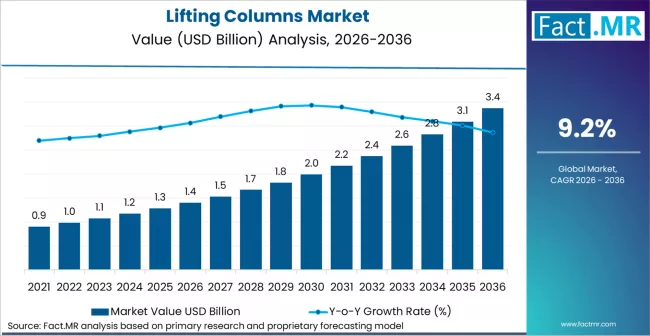
Lifting Columns Market Market Value Analysis | Source: Fact.MR
Lifting Columns Market
| Metric | Value |
|---|---|
| Estimated Value in (2026E) | USD 1.4 billion |
| Forecast Value in (2036F) | USD 3.5 billion |
| Forecast CAGR (2026 to 2036) | 9.2% |
Source: Fact.MR analysis. Updated Mar 6, 2026
Lifting Columns Market Definition
The Lifting Columns Market involves the manufacture and sale of vertical support and actuating systems that raise, lower, or position loads smoothly and precisely in industrial, commercial, and medical environments.
Market Inclusions
This report covers global and regional market sizes for lifting columns over a defined forecast period, including product types (single‑, twin‑, multi‑stage), applications (medical tables, workstations, robotics, industrial equipment), and end‑use industries.
Market Exclusions
The scope excludes unrelated lifting equipment such as cranes, hoists, and manual lifts not classified as lifting columns, and complete systems where lifting column data is not separately quantified.
Research Methodology
- Primary Research: Interviews were conducted with design engineers, OEM specialists, and end‑users.
- Desk Research: Data was sourced from industry reports, equipment publications, and trade statistics.
- Market‑Sizing and Forecasting: A hybrid approach combining top‑down demand forecasts with bottom‑up shipment and revenue data was used.
- Data Validation and Update Cycle: Findings were validated through expert review and aligned with recent production and trade data.
Summary of the Lifting Columns Market
- Market Definition
- The Lifting Columns Market encompasses the development and sale of vertical support and actuating systems used to raise, lower, or position loads in various industrial, commercial, and medical environments. These systems are essential for providing adjustable height capabilities in furniture, medical devices, workstations, and other industrial applications.
- Demand Drivers
- Growing Adoption of Ergonomic Solutions: Increasing demand for adjustable furniture, especially in offices and healthcare settings, is driving the need for reliable lifting columns that provide smooth and precise height adjustments.
- Industrial Automation Trends: Lifting columns are integral to modern industrial machinery, robotic applications, and automation, where height adjustments are crucial for equipment functionality.
- Rising Healthcare Needs: The demand for adjustable medical equipment, such as hospital beds and diagnostic tools, is increasing, spurring the adoption of lifting columns in the healthcare sector.
- Energy Efficiency and Precision: Electric lifting columns, known for their precision and energy efficiency, are seeing greater adoption due to their reliability and low maintenance in various industries.
- Key Segments Analyzed
- Mode of Operation: Electric, Manual, Hydraulic
- Screw Type: Ball Screws, Telescopic Lead Screws, Trapezoidal Screws
- Loading Capacity: 2,500 N - 5,000 N, Up to 2,500 N, Above 5,000 N
- Application: Furniture, Medical & Healthcare, Workstations, Industrial
- Stage: 2 Stage, 1 Stage, 3 Stage
- Geography: China, India, Germany, Brazil, USA
- Analyst Opinion at FMR
- Shambhu Nath Jha, Principal Consultant at Fact MR, comments, “The lifting columns market is witnessing robust growth driven by the increasing demand for ergonomic and automated solutions across industries. As healthcare and industrial sectors continue to prioritize flexibility and automation, the market for lifting columns will continue to expand. Electric lifting columns, particularly, are becoming the preferred choice due to their energy efficiency and precision, positioning them as the future of height-adjustable systems in various applications.”
- Strategic Implications/Executive Takeaways
- Focus on Precision and Energy Efficiency: Manufacturers should prioritize the development of electric lifting columns that offer greater precision and energy efficiency for use in healthcare, industrial, and ergonomic furniture applications.
- Expand Production in High-Growth Regions: Strengthen production and distribution in fast-growing markets like China and India, where industrial growth and demand for ergonomic solutions are high.
- Invest in Automation Integration: Partner with industrial automation companies to integrate advanced lifting column systems into automated manufacturing and robotics applications.
- Methodology
- Primary research conducted through interviews with engineers, OEM specialists, and end users.
- Desk research using industry reports, equipment publications, and trade statistics.
- Market sizing and forecasting using a hybrid approach combining top-down and bottom-up models validated with production and trade data.
Segmental Analysis
Lifting Columns Market Analysis by Mode of Operation
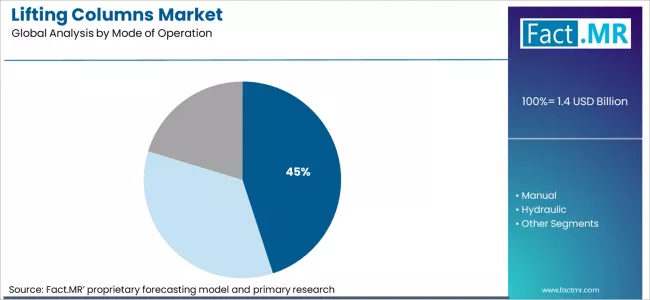
Lifting Columns Market Analysis By Mode Of Operation | Source: Fact.MR
- Market Overview: Electric lifting columns are expected to capture 45% of the market share by 2026. Electric lifting columns are favored for their precision, ease of use, and ability to provide smooth vertical movement in a variety of applications, from adjustable desks to medical equipment and industrial lifting systems.
- Demand Drivers:
- Increased Adoption in Ergonomic Furniture: The growing trend towards ergonomic furniture, especially adjustable desks, is a major driver for electric lifting columns, which offer easy height adjustments for user comfort.
- Ease of Use and Precision: Electric actuators provide precise control and smooth movement, making them ideal for applications requiring frequent adjustments, such as office furniture, medical equipment, and industrial machinery.
- Energy Efficiency and Reliability: Electric lifting columns are energy-efficient, offering reliable performance with minimal maintenance, contributing to their widespread adoption in various sectors.
Lifting Columns Market Analysis by Screw Type
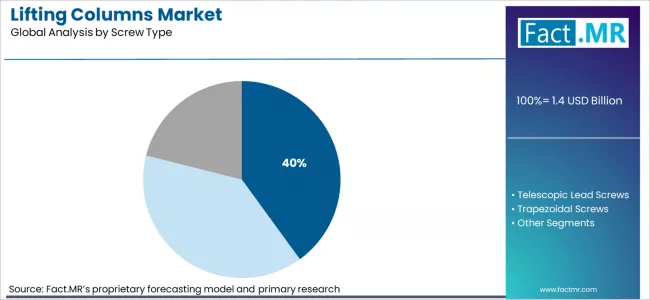
Lifting Columns Market Analysis By Screw Type | Source: Fact.MR
- Market Overview: Ball screws are projected to hold 40% of the market share by 2026. Ball screws are widely used in lifting columns due to their ability to provide high efficiency, precision, and smooth motion, which are crucial for applications like adjustable tables, workstations, and lifting equipment.
- Demand Drivers:
- High Precision and Load-Bearing Capacity: Ball screws offer high precision and load-bearing capacity, making them ideal for lifting columns that require accurate vertical movement and the ability to support varying loads.
- Energy Efficiency and Low Friction: Ball screws offer lower friction compared to other screw types, leading to reduced energy consumption and longer service life, which drives their demand in lifting column applications.
- Wide Range of Applications: The versatility of ball screws in applications ranging from industrial machinery to ergonomic office furniture increases their demand in the lifting column market, particularly for those requiring smooth and efficient operation.
Lifting Columns Market Drivers, Restraints, and Opportunities
FMR analysts observe that the lifting columns market is a growth‑aligned, application‑driven segment supported by rising demand for ergonomic, height‑adjustable systems in industrial automation, healthcare, and office/furnishing sectors. Historically, fixed‑height supports and simple mechanical lifts were standard; as users prioritized worker comfort, automation, and adaptable workspaces, structural demand emerged for electrically driven lifting columns that offer precise motion, load capacity, and integration with control systems. The 2026 valuation reflects this shift, with adoption tied to workplace ergonomic standards and automation upgrades rather than basic manual lifts.
While basic mechanical lifting solutions remain significant in cost‑sensitive segments, advanced electric lifting columns with higher load ratings, synchronized motion, and smart control are gaining share. These higher‑value systems command premium pricing, contributing to net market value growth even as unit volumes grow in line with industrial modernization and ergonomic adoption. The market exists because adjustable height and controlled motion increasingly matter for safety, productivity, and user comfort across diverse end uses.
- Ergonomics & Workplace Productivity Demand: Adoption of lifting columns in workstations, sit‑stand desks, and medical equipment replaces fixed supports to improve comfort and reduce injury risk.
- Automation & Integration Trends: Industrial automation and robotics integration drive demand for synchronized, electronically controlled lifting columns over simpler mechanisms.
- Regional Adoption Dynamics: In North America and Europe, strong ergonomic and automation standards accelerate uptake, while Asia‑Pacific shows rapid growth with expanding industrial and office infrastructure.
Regional Analysis
The market analysis covers key global regions, including East Asia, South Asia, Western Europe, North America, and Latin America. It is segmented geographically, with specific market dynamics for each region. The full report provides a detailed market attractiveness analysis.
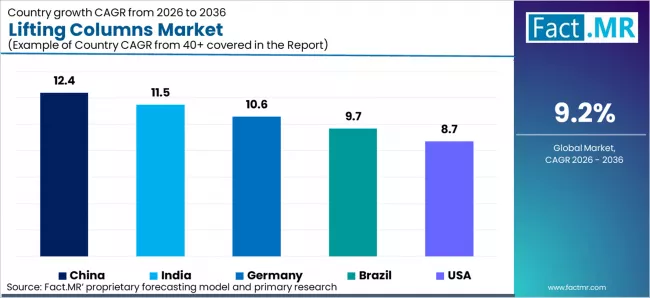
Lifting Columns Market Cagr Analysis By Country | Source: Fact.MR
| Country | CAGR (2026-2036) |
|---|---|
| China | 12.4% |
| India | 11.5% |
| Germany | 10.6% |
| Brazil | 9.7% |
| USA | 8.7% |
Source: Fact.MR analysis. Updated Mar 6, 2026
Source: Fact MR (FMR) analysis, based on proprietary forecasting model and primary research.
East Asia:
In East Asia, China leads the demand for lifting columns, driven by rapid industrial growth, increasing automation, and rising demand for advanced lifting equipment in sectors like manufacturing, logistics, and healthcare.
- China: Demand for lifting columns in China is projected to rise at 12.4% CAGR through 2036. China’s industrial expansion, growing demand for automation in manufacturing and logistics, and rising adoption of lifting equipment in healthcare and other sectors continue to drive market growth.
South Asia:
In South Asia, India is a significant market for lifting columns, supported by the country's growing industrialization, expanding automation trends, and rising demand for advanced lifting systems in sectors like manufacturing, healthcare, and logistics.
- India: Demand for lifting columns in India is projected to rise at 11.5% CAGR through 2036. India’s industrial and logistics sectors, growing adoption of automation in manufacturing, and increasing demand for ergonomic lifting solutions contribute to steady market growth.
Western Europe:
In Western Europe, Germany is a prominent market for lifting columns, driven by its strong manufacturing base, increasing industrial automation, and growing demand for advanced lifting solutions across various sectors, including automotive and healthcare.
- Germany: Demand for lifting columns in Germany is projected to rise at 10.6% CAGR through 2036. Germany’s advanced manufacturing and automotive sectors, growing demand for automation and robotic systems, and rising adoption of lifting columns in healthcare applications continue to fuel market growth.
North America:
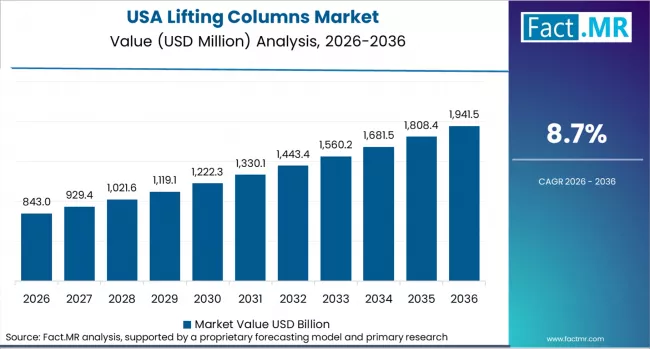
Lifting Columns Market Country Value Analysis | Source: Fact.MR
In North America, the USA remains a significant market for lifting columns, driven by the growing demand for advanced lifting equipment in manufacturing, healthcare, and logistics sectors, and increasing adoption of automation technologies.
- USA: Demand for lifting columns in the U.S. is projected to rise at 8.7% CAGR through 2036. The USA’s increasing demand for automation solutions, rising adoption of ergonomic lifting solutions in healthcare and logistics, and growing investments in manufacturing automation continue to support market growth.
Latin America:
In Latin America, Brazil is the largest market for lifting columns, driven by the country’s growing industrial sector, increasing demand for automation in manufacturing and logistics, and rising adoption of lifting equipment for healthcare and ergonomic applications.
- Brazil: Demand for lifting columns in Brazil is projected to rise at 9.7% CAGR through 2036. Brazil’s expanding industrial and logistics sectors, increasing automation in manufacturing, and rising adoption of lifting systems in healthcare continue to contribute to market expansion.
Fact MR's analysis of the Lifting Columns Market in East Asia, South Asia, Western Europe, North America, and Latin America consists of country-wise assessments that include China, India, Germany, Brazil, and the USA. Readers can find detailed trends, regulatory updates, and company-specific investments shaping the market’s growth in these countries.
What is the Competitive Structure and Buyer Behavior in the Lifting Columns Market?
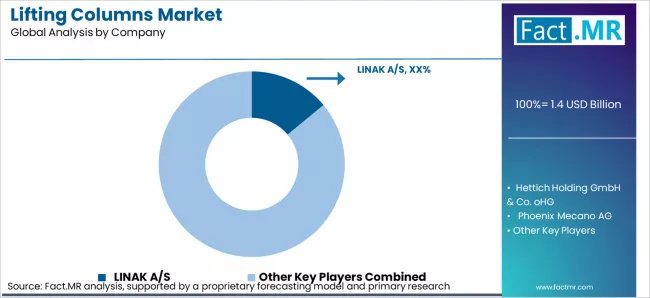
Lifting Columns Market Analysis By Company | Source: Fact.MR
The lifting columns market is moderately concentrated, with several established mechanical and mechatronics suppliers such as LINAK A/S, Phoenix Mecano AG, Thomson Industries, Inc., and TiMotion Group holding significant share alongside other competitors including Hettich Holding GmbH & Co. oHG, DewertOkin GmbH, Hoerbiger Holding AG, Ketterer Präzision GmbH, A&F Roemheld GmbH, SUSPA GmbH, and X2 Technology Ltd. The primary competitive variables are load capacity, precision control, reliability, integration ease with end‑use systems, and after‑sales support, which drive buyer preference across industrial, furniture, medical, and automation applications. Companies with strong engineering expertise, diversified product portfolios, and global distribution networks have structural advantages, enabling them to serve diverse sector requirements, ensure consistent quality, and provide responsive technical support. Large original equipment manufacturers and industrial integrators wield notable buyer leverage by qualifying multiple suppliers, negotiating supply terms, and standardizing specifications to manage performance risk and component compatibility. To manage supplier dependency, these buyers often maintain diversified vendor lists and emphasize long‑term service agreements, which limits individual suppliers’ pricing power. As a result, competition focuses on delivering robust performance, consistent supply assurance, and comprehensive technical support rather than on price alone.
Recent Industry Developments
- Sustainable High-Performance Launch: In early 2026, LINAK completed the global rollout of its DL11 EXPERIENCE™ generation, establishing a new industry benchmark by delivering a fast 80 mm/s speed and 800 N load capacity in a system that is entirely PVC-free and PFAS-free to meet 2026 environmental mandates.
- Medical Application Dominance: The healthcare sector has become the primary driver of equipment demand in 2026, with high-torque columns like the DewertOkin DC20 (2000 N pushing force) being widely adopted for "intelligent" nursing beds that require precise, low-noise height adjustment for patient safety.
- Advanced "E-Drive" Industrial Integration: Thomson Industries expanded its LC3000 series in early 2026, introducing a high-moment load capacity version specifically for self-guided AGVs (Automated Guided Vehicles) in warehouses, allowing for telescopic vertical movement without the need for additional external guiding.
Key Players of the Lifting Columns Market
- LINAK A/S
- Hettich Holding GmbH & Co. oHG
- Phoenix Mecano AG
- Thomson Industries, Inc.
- TiMotion Group
- DewertOkin GmbH
- Hoerbiger Holding AG
- Ketterer Präzision GmbH
- A&F Roemheld GmbH (Roemheld Group)
- SUSPA GmbH
- X2 Technology Ltd
Report Scope
| Metric | Value |
|---|---|
| Quantitative Units | USD 1.4 billion (2026) to USD 3.5 billion (2036), at a CAGR of 9.2% |
| Market Definition | The Lifting Columns Market encompasses lifting mechanisms, including electric, manual, hydraulic, and screw-based columns, applied in various industries like furniture, medical, healthcare, and industrial sectors. |
| By Mode of Operation | Electric, Manual, Hydraulic |
| By Screw Type | Ball Screws, Telescopic Lead Screws, Trapezoidal Screws |
| By Loading Capacity | 2,500 N - 5,000 N, Up To 2,500 N, Above 5,000 N |
| By Application | Furniture, Medical & Healthcare, Workstations, Industrial, Stage |
| By Stage | 2 Stage, 1 Stage, 3 Stage |
| Regions Covered | North America, Latin America, Europe, East Asia, South Asia, Oceania, Middle East and Africa |
| Countries Covered | United States, Canada, Mexico, Brazil, Argentina, Germany, France, United Kingdom, Italy, Spain, China, India, Japan, South Korea, Indonesia, Australia, and 40+ countries |
| Key Companies Profiled | LINAK A/S, Hettich Holding GmbH & Co. oHG, Phoenix Mecano AG, Thomson Industries, Inc., TiMotion Group, DewertOkin GmbH, Hoerbiger Holding AG, Ketterer Präzision GmbH, A&F Roemheld GmbH (Roemheld Group), SUSPA GmbH, X2 Technology Ltd |
| Forecast Period | 2026 to 2036 |
| Approach | Hybrid top-down and bottom-up market modeling validated through primary interviews with manufacturers and supported by trade data benchmarking and market research. |
Source: Fact.MR analysis. Updated Mar 6, 2026
Bibliographies
- LINAK A/S. (2023). Electric lifting columns: Innovation and precision for healthcare and industrial applications.
- Phoenix Mecano AG. (2023). Lifting columns for ergonomic workstations and industrial applications: Market trends and growth prospects.
- DewertOkin GmbH. (2023). Advances in lifting column technologies for the medical and ergonomic furniture sectors.
- TiMotion Group. (2023). The role of lifting columns in modern industrial automation and healthcare solutions.
- LINAK. (2026). Sustainable high-performance launch: DL11 EXPERIENCE: Next level in lifting columns. LINAK.
- DewertOkin. (2026). Medical application dominance: DC20: Powerful drive solution for nursing beds. DewertOkin.
- Thomson Industries. (2026). Advanced "E-Drive" industrial integration: Lifting columns for medical and industrial applications. Thomson Industries.
This report addresses
- Market intelligence enabling comprehensive assessment of leading countries and product segments across the Lifting Columns Market globally.
- Market volume (sales units) estimates and 10-year revenue forecasts from 2026 to 2036, validated through manufacturer shipment data, channel partner surveys, and country-level demand modeling.
- Growth opportunity mapping across mode of operation (Electric, Manual, Hydraulic), screw types (Ball Screws, Telescopic Lead Screws, Trapezoidal Screws), loading capacity (2,500 N - 5,000 N, Up To 2,500 N, Above 5,000 N), and applications (Furniture, Medical & Healthcare, Workstations, Industrial).
- Segment and regional revenue forecasts by mode of operation, screw type, loading capacity, application, and geography across 40+ countries.
- Competition strategy analysis covering dealer network structure, recent developments, product portfolio, USPs, and market share analysis.
- Product and regulatory compliance tracking aligned with ergonomics standards, workplace safety regulations, and industry certification requirements.
- Regulatory impact analysis addressing automation standards, electronic control systems, and ergonomic mandates across key markets.
- Report delivery in PDF, Excel, PowerPoint, and interactive dashboard formats for executive, procurement, and operational planning use.
Segmentation
Lifting Columns Market Key Segments
-
Mode of Operation
- Electric
- Manual
- Hydraulic
-
Screw Type
- Ball Screws
- Telescopic Lead Screws
- Trapezoidal Screws
-
Loading Capacity
- 2,500 N - 5,000 N
- Up to 2,500 N
- Above 5,000 N
-
Application
- Furniture
- Medical & Healthcare
- Workstations
- Industrial
- Stage
-
Stage
- 2 Stage
- 1 Stage
- 3 Stage
-
Region
- North America
- USA
- Canada
- Mexico
- Europe
- Germany
- UK
- France
- Italy
- Spain
- Nordic Countries
- BENELUX
- Rest of Europe
- Asia Pacific
- China
- Japan
- South Korea
- India
- Australia
- Rest of Asia Pacific
- Latin America
- Brazil
- Argentina
- Rest of Latin America
- Middle East and Africa
- Kingdom of Saudi Arabia
- United Arab Emirates
- South Africa
- Rest of Middle East and Africa
- Other Regions
- Oceania
- Central Asia
- Other Markets
- North America
Frequently Asked Questions
How large is the demand for Lifting Columns in the global market in 2026?
What will be the market size of Lifting Columns in the global market by 2036?
What is the expected demand growth for Lifting Columns in the global market between 2026 and 2036?
Which mode of operation is expected to dominate the market?
Which region is expected to show the highest growth rate for Lifting Columns?
How significant is the growth outlook for India in this market?
What is the growth outlook for Germany in the Lifting Columns market?
What is the growth forecast for Brazil in the Lifting Columns market?
What is the growth forecast for the United States in the Lifting Columns market?
Which company is identified as a leading player in the Lifting Columns market?
What are Lifting Columns used for?
What does the Lifting Columns market include in this report?
How is the market forecast developed in this report?
What is meant by the Lifting Columns market in this report?
Who worked on this report


Preview the report firsthand - request a free sample
Free SampleGet the brochure for pricing and purchase details
Download PDF