Linerless Labels Market
Linerless Labels Market Size and Share Forecast Outlook 2026 to 2036
Linerless labels market is projected to grow from USD 2.1 billion in 2026 to USD 3.2 billion by 2036, at a CAGR of 4.3%. Primary Product Labels will dominate with a 53.7% market share, while food and beverage will lead the end-use industry segment with a 28.3% share.
Linerless Labels Market Forecast and Outlook 2026 to 2036
The global linerless labels market is valued at USD 2.1 billion in 2026 and is set to reach USD 3.2 billion by 2036, recording a compound annual growth rate (CAGR) of 4.3% between 2026 and 2036. In 2026, the primary product labels segment is projected to hold a 53.7% share, while food & beverage applications account for 28.3% of the total demand.
Key Takeaways from the Linerless Labels Market Report
- Market Value (2026): USD 2.1 Billion
- Market Forecast Value (2036): USD 3.2 Billion
- Forecast CAGR (2026-2036): 4.3%
- Leading Product Segment: Primary Product Labels (53.7%)
- Leading Application Segment: Food & Beverage (28.3%)
- Key Growth Regions: Asia Pacific, North America, Europe
- Key Players: Avery Dennison Corporation, Coveris Holdings S.A., 3M Company, CCL Industries Inc., R.R. Donnelley & Sons Company
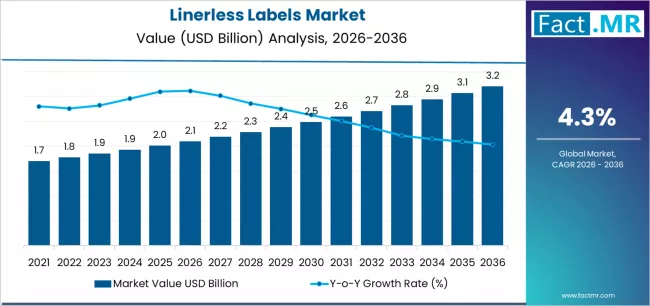
Market expansion is fundamentally driven by the global shift towards sustainable packaging and operational efficiency. The elimination of the release liner reduces material consumption and waste by approximately 30-40%, directly addressing Extended Producer Responsibility (EPR) cost pressures and corporate sustainability goals. This waste reduction, combined with operational advantages like more labels per roll and reduced changeover times on automated lines, creates a compelling economic and environmental value proposition for high-volume packaging operations.
Advanced adhesive chemistry and digital printing integration will define growth over the forecast period. Innovations in release coating systems and polymer formulations enable reliable performance across diverse climates and applications, from frozen food logistics to retail shelf labeling. The integration of variable data printing and smart labeling capabilities with linerless technology allows for enhanced traceability, customization, and supply chain efficiency, transforming labels from static identifiers into dynamic data carriers.
Linerless Labels Market
| Metric | Value |
|---|---|
| Estimated Value in (2026E) | USD 2.1 billion |
| Forecast Value in (2036F) | USD 3.2 billion |
| Forecast CAGR (2026 to 2036) | 4.3% |
Category
| Category | Segments |
|---|---|
| Product Type | Primary Product Labels, Variable Information Print Labels, Functional Labels, Other Configurations |
| Printing Technology | Flexographic, Digital, Thermal Transfer, Other Methods |
| Adhesion Type | Permanent, Repositionable, Removable |
| End-Use Industry | Food & Beverage, Retail, Logistics & Transportation, Pharmaceuticals, Others |
| Region | North America, Europe, Asia Pacific, Latin America, MEA |
Segmental Analysis
Why do Primary Product Labels Dominate the Market?
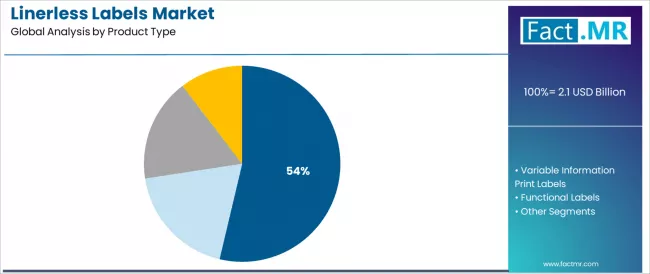
The primary product labels segment commands a 53.7% market share in 2026, as it serves as the frontline solution for brand identification, regulatory information, and consumer communication. The elimination of the liner is particularly impactful here, where high-volume runs translate the material savings and operational efficiencies directly into significant cost reduction. This segment benefits from superior print quality and durability, meeting the high visual and functional standards required for consumer-facing packaging while aligning with waste-reduction mandates.
- The direct correlation between linerless adoption and reduced EPR fee liability due to less packaging waste is a key financial driver for brand owners.
- Compatibility with high-speed automated application systems makes primary linerless labels integral to modern, efficient packaging lines in food, beverage, and fast-moving consumer goods.
Why are Food & Beverage Applications a Critical Driver for the Linerless Labels Market?
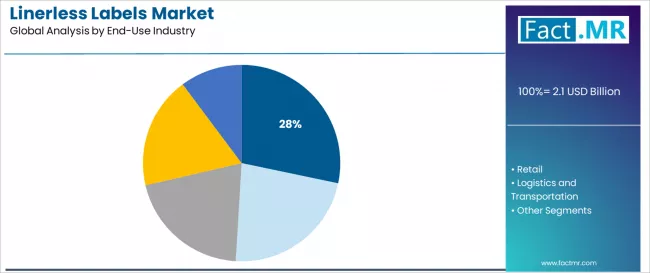
Food and beverage applications are projected to hold a 28.3% share in 2026. This sector faces stringent regulatory labeling requirements and demands labels that perform under challenging conditions like refrigeration, freezing, and moisture exposure. Linerless labels, with advanced adhesive and substrate technologies, meet these performance needs while eliminating the liner waste associated with billions of packaged food items. The sector's high-volume, cost-sensitive nature makes the efficiency gains from linerless technology especially valuable.
- The need for labels that withstand condensation and low temperatures without compromising adhesion or print integrity is a key technical driver for frozen and chilled food segments.
- Retailer and consumer pressure for reduced packaging waste is pushing major food brands to adopt linerless solutions as part of broader sustainability pledges.
What are the Drivers, Restraints, and Trends in the Linerless Labels Market?
The market is primarily driven by stringent sustainability regulations and EPR schemes that penalize packaging waste, making liner elimination financially attractive. Secondary drivers include the demand for operational efficiency in automated packaging lines and the growth of e-commerce logistics, requiring durable, scan-able labels. Key restraints include higher initial adhesive and coating costs compared to traditional labels and the need for specialized application equipment.
The market is trending towards integration with Industry 4.0 and smart packaging, where linerless labels become platforms for RFID, NFC, or QR codes for track-and-trace. Another key trend is the development of new adhesive technologies for challenging substrates and environments, expanding application scope.
Analysis of the Linerless Labels Market by Key Country
| Country | CAGR (2026-2036) |
|---|---|
| India | 4.4% |
| China | 4.3% |
| USA | 3.9% |
| Brazil | 3.7% |
| Germany | 3.5% |
| UK | 3.4% |
| South Korea | 3.2% |
What is Propelling India’s Leadership in Labeling Efficiency?
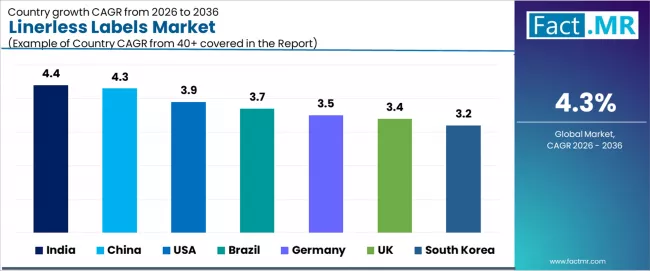
Revenue from linerless label consumption in India is projected to exhibit exceptional growth with a CAGR of 4.4% through 2035. This is driven by the country's rapidly expanding retail packaging sector, favorable government policies toward industrial modernization, and initiatives promoting advanced packaging technologies across major manufacturing regions. India's position as a growing consumer goods hub and increasing focus on operational efficiency are creating substantial demand.
How is China Leveraging its Manufacturing Scale for Adoption?
The linerless label products market in China is expanding at a CAGR of 4.3%, supported by rising manufacturing investment, growing packaging consciousness, and expanding technology distributor capabilities. The country's developing industrial infrastructure and increasing investment in automated packaging technologies are driving demand across both traditional and modern manufacturing applications.
What Underpins Steady Demand in the Technologically Advanced USA Market?
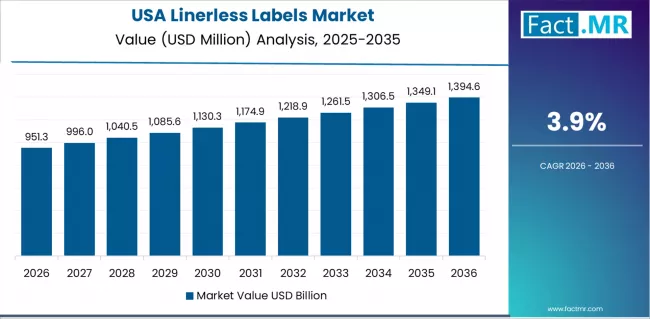
The linerless label products market in the USA is projected to grow at a CAGR of 3.9% through 2035, supported by the country's emphasis on packaging technology advancement, operational efficiency optimization, and advanced labeling system integration. American industrial users prioritize performance reliability and operational precision, making specialized linerless labels essential components for packaging applications.
How is Brazil Emerging as a Regional Hub for Sustainable Labeling?
The linerless label products market in Brazil is projected to grow at a CAGR of 3.7% through 2035, driven by the country's emphasis on industrial development, retail modernization growth, and growing packaging distributor capabilities. Brazilian industrial users and retail facilities consistently seek efficiency-focused labels that enhance operational performance and support modernization excellence.
Why does German Engineering Precision Define its Market Approach?
The linerless label products market in Germany is projected to grow at a CAGR of 3.5% through 2035, supported by the country's mature industrial packaging standards, established manufacturing regulations, and leadership in precision labeling technology. Germany's sophisticated packaging standards and strong support for advanced labeling systems are creating steady demand.
What Supports the UK’s Steady Shift Towards Efficient Labeling?
The linerless label products market in the UK is projected to grow at a CAGR of 3.4% through 2035, supported by established packaging standards, mature industrial markets, and emphasis on operational efficiency across manufacturing and retail sectors. British industrial users and packaging professionals prioritize quality performance and operational consistency, creating steady demand.
How is South Korea’s Advanced Tech Sector Influencing Adoption?
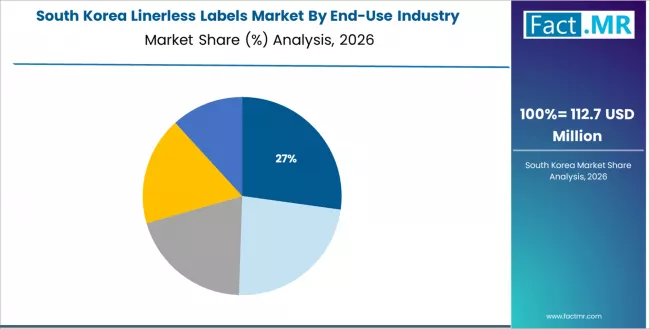
The linerless label products market in South Korea is projected to grow at a CAGR of 3.2% through 2035, supported by the country's emphasis on precision manufacturing, operational excellence, and advanced technology integration requiring efficient labeling solutions. South Korean industrial users prioritize technical performance and manufacturing precision, making specialized linerless labels essential.
Competitive Landscape of the Linerless Labels Market
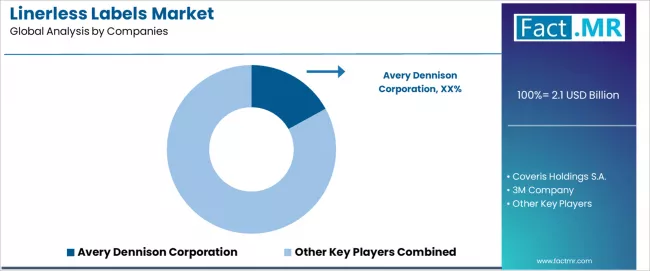
The competitive landscape features established material science giants and specialized label converters. Competition centers on proprietary adhesive and release coating technologies, expertise in integrating with digital printing and automated application systems, and the ability to provide global supply chain support.
Leading players are investing in R&D to expand the performance boundaries of linerless labels into more demanding environments and to integrate smart features like RFID. Success depends on transitioning from a label supplier to a strategic partner for packaging line optimization and sustainability goal achievement.
Key Players in the Linerless Labels Market
- Avery Dennison Corporation
- Coveris Holdings S.A.
- 3M Company
- CCL Industries Inc.
- R.R. Donnelley & Sons Company
- Hub Labels Inc.
- Reflex Labels Ltd.
- Skanem AS
- UPM-Kymmene Corporation
- Constantia Flexibles Group GmbH
- NAStar Inc.
- General Data Company Inc.
- SATO Holdings Corporation
- Zebra Technologies Corp.
Scope of the Report
| Items | Values |
|---|---|
| Quantitative Units (2026) | USD 2.1 Billion |
| Product Type | Primary Product Labels, Variable Information Print Labels, Functional Labels, Other Label Configurations |
| Printing Technology | Flexographic, Digital, Thermal Transfer, Other Printing Methods |
| Adhesion Type | Permanent, Repositionable, Removable |
| End-Use Industry | Food and Beverage, Retail, Logistics and Transportation, Pharmaceuticals, Others |
| Regions Covered | North America, Europe, Asia Pacific, Latin America, MEA, Other Regions |
| Countries Covered | China, India, Germany, Brazil, USA, UK, South Korea, and 40+ countries |
| Key Companies Profiled | Avery Dennison Corporation, Coveris Holdings S.A., 3M Company, CCL Industries Inc., R.R. Donnelley & Sons Company, and other leading linerless label companies |
| Additional Attributes | Dollar sales by product type, printing technology, adhesion type, end-use industry, and region; regional demand trends, competitive landscape, technological advancements in labeling engineering, packaging optimization |
Linerless Labels Market by Segments
-
Product Type :
- Primary Product Labels
- Variable Information Print Labels
- Functional Labels
- Other Label Configurations
-
Printing Technology :
- Flexographic
- Digital
- Thermal Transfer
- Other Printing Methods
-
Adhesion Type :
- Permanent
- Repositionable
- Removable
-
End-Use Industry :
- Food and Beverage
- Retail
- Logistics and Transportation
- Pharmaceuticals
- Others
-
Region :
-
North America
- USA
- Canada
- Mexico
-
Europe
- Germany
- UK
- France
- Italy
- Spain
- Nordic Countries
- BENELUX
- Rest of Europe
-
Asia Pacific
- China
- India
- Japan
- South Korea
- Australia
- Rest of Asia Pacific
-
Latin America
- Brazil
- Argentina
- Rest of Latin America
-
MEA
- Saudi Arabia
- UAE
- South Africa
- Rest of MEA
-
Table of Content
- Executive Summary
- Global Market Outlook
- Demand to side Trends
- Supply to side Trends
- Technology Roadmap Analysis
- Analysis and Recommendations
- Market Overview
- Market Coverage / Taxonomy
- Market Definition / Scope / Limitations
- Market Background
- Market Dynamics
- Drivers
- Restraints
- Opportunity
- Trends
- Scenario Forecast
- Demand in Optimistic Scenario
- Demand in Likely Scenario
- Demand in Conservative Scenario
- Opportunity Map Analysis
- Product Life Cycle Analysis
- Supply Chain Analysis
- Investment Feasibility Matrix
- Value Chain Analysis
- PESTLE and Porter’s Analysis
- Regulatory Landscape
- Regional Parent Market Outlook
- Production and Consumption Statistics
- Import and Export Statistics
- Market Dynamics
- Global Market Analysis 2021 to 2025 and Forecast, 2026 to 2036
- Historical Market Size Value (USD Million) Analysis, 2021 to 2025
- Current and Future Market Size Value (USD Million) Projections, 2026 to 2036
- Y to o to Y Growth Trend Analysis
- Absolute $ Opportunity Analysis
- Global Market Pricing Analysis 2021 to 2025 and Forecast 2026 to 2036
- Global Market Analysis 2021 to 2025 and Forecast 2026 to 2036, By Product Type
- Introduction / Key Findings
- Historical Market Size Value (USD Million) Analysis By Product Type, 2021 to 2025
- Current and Future Market Size Value (USD Million) Analysis and Forecast By Product Type, 2026 to 2036
- Primary Product Labels
- Variable Information Print Labels
- Functional Labels
- Other Label Configurations
- Y to o to Y Growth Trend Analysis By Product Type, 2021 to 2025
- Absolute $ Opportunity Analysis By Product Type, 2026 to 2036
- Global Market Analysis 2021 to 2025 and Forecast 2026 to 2036, By End-Use Industry
- Introduction / Key Findings
- Historical Market Size Value (USD Million) Analysis By End-Use Industry, 2021 to 2025
- Current and Future Market Size Value (USD Million) Analysis and Forecast By End-Use Industry, 2026 to 2036
- Food and Beverage
- Retail
- Logistics and Transportation
- Pharmaceuticals
- Others
- Y to o to Y Growth Trend Analysis By End-Use Industry, 2021 to 2025
- Absolute $ Opportunity Analysis By End-Use Industry, 2026 to 2036
- Global Market Analysis 2021 to 2025 and Forecast 2026 to 2036, By Region
- Introduction
- Historical Market Size Value (USD Million) Analysis By Region, 2021 to 2025
- Current Market Size Value (USD Million) Analysis and Forecast By Region, 2026 to 2036
- North America
- Latin America
- Western Europe
- Eastern Europe
- East Asia
- South Asia and Pacific
- Middle East & Africa
- Market Attractiveness Analysis By Region
- North America Market Analysis 2021 to 2025 and Forecast 2026 to 2036, By Country
- Historical Market Size Value (USD Million) Trend Analysis By Market Taxonomy, 2021 to 2025
- Market Size Value (USD Million) Forecast By Market Taxonomy, 2026 to 2036
- By Country
- USA
- Canada
- Mexico
- By Product Type
- By End-Use Industry
- By Country
- Market Attractiveness Analysis
- By Country
- By Product Type
- By End-Use Industry
- Key Takeaways
- Latin America Market Analysis 2021 to 2025 and Forecast 2026 to 2036, By Country
- Historical Market Size Value (USD Million) Trend Analysis By Market Taxonomy, 2021 to 2025
- Market Size Value (USD Million) Forecast By Market Taxonomy, 2026 to 2036
- By Country
- Brazil
- Chile
- Rest of Latin America
- By Product Type
- By End-Use Industry
- By Country
- Market Attractiveness Analysis
- By Country
- By Product Type
- By End-Use Industry
- Key Takeaways
- Western Europe Market Analysis 2021 to 2025 and Forecast 2026 to 2036, By Country
- Historical Market Size Value (USD Million) Trend Analysis By Market Taxonomy, 2021 to 2025
- Market Size Value (USD Million) Forecast By Market Taxonomy, 2026 to 2036
- By Country
- Germany
- UK
- Italy
- Spain
- France
- Nordic
- BENELUX
- Rest of Western Europe
- By Product Type
- By End-Use Industry
- By Country
- Market Attractiveness Analysis
- By Country
- By Product Type
- By End-Use Industry
- Key Takeaways
- Eastern Europe Market Analysis 2021 to 2025 and Forecast 2026 to 2036, By Country
- Historical Market Size Value (USD Million) Trend Analysis By Market Taxonomy, 2021 to 2025
- Market Size Value (USD Million) Forecast By Market Taxonomy, 2026 to 2036
- By Country
- Russia
- Poland
- Hungary
- Balkan & Baltic
- Rest of Eastern Europe
- By Product Type
- By End-Use Industry
- By Country
- Market Attractiveness Analysis
- By Country
- By Product Type
- By End-Use Industry
- Key Takeaways
- East Asia Market Analysis 2021 to 2025 and Forecast 2026 to 2036, By Country
- Historical Market Size Value (USD Million) Trend Analysis By Market Taxonomy, 2021 to 2025
- Market Size Value (USD Million) Forecast By Market Taxonomy, 2026 to 2036
- By Country
- China
- Japan
- South Korea
- By Product Type
- By End-Use Industry
- By Country
- Market Attractiveness Analysis
- By Country
- By Product Type
- By End-Use Industry
- Key Takeaways
- South Asia and Pacific Market Analysis 2021 to 2025 and Forecast 2026 to 2036, By Country
- Historical Market Size Value (USD Million) Trend Analysis By Market Taxonomy, 2021 to 2025
- Market Size Value (USD Million) Forecast By Market Taxonomy, 2026 to 2036
- By Country
- India
- ASEAN
- Australia & New Zealand
- Rest of South Asia and Pacific
- By Product Type
- By End-Use Industry
- By Country
- Market Attractiveness Analysis
- By Country
- By Product Type
- By End-Use Industry
- Key Takeaways
- Middle East & Africa Market Analysis 2021 to 2025 and Forecast 2026 to 2036, By Country
- Historical Market Size Value (USD Million) Trend Analysis By Market Taxonomy, 2021 to 2025
- Market Size Value (USD Million) Forecast By Market Taxonomy, 2026 to 2036
- By Country
- Kingdom of Saudi Arabia
- Other GCC Countries
- Turkiye
- South Africa
- Other African Union
- Rest of Middle East & Africa
- By Product Type
- By End-Use Industry
- By Country
- Market Attractiveness Analysis
- By Country
- By Product Type
- By End-Use Industry
- Key Takeaways
- Key Countries Market Analysis
- USA
- Pricing Analysis
- Market Share Analysis, 2025
- By Product Type
- By End-Use Industry
- Canada
- Pricing Analysis
- Market Share Analysis, 2025
- By Product Type
- By End-Use Industry
- Mexico
- Pricing Analysis
- Market Share Analysis, 2025
- By Product Type
- By End-Use Industry
- Brazil
- Pricing Analysis
- Market Share Analysis, 2025
- By Product Type
- By End-Use Industry
- Chile
- Pricing Analysis
- Market Share Analysis, 2025
- By Product Type
- By End-Use Industry
- Germany
- Pricing Analysis
- Market Share Analysis, 2025
- By Product Type
- By End-Use Industry
- UK
- Pricing Analysis
- Market Share Analysis, 2025
- By Product Type
- By End-Use Industry
- Italy
- Pricing Analysis
- Market Share Analysis, 2025
- By Product Type
- By End-Use Industry
- Spain
- Pricing Analysis
- Market Share Analysis, 2025
- By Product Type
- By End-Use Industry
- France
- Pricing Analysis
- Market Share Analysis, 2025
- By Product Type
- By End-Use Industry
- India
- Pricing Analysis
- Market Share Analysis, 2025
- By Product Type
- By End-Use Industry
- ASEAN
- Pricing Analysis
- Market Share Analysis, 2025
- By Product Type
- By End-Use Industry
- Australia & New Zealand
- Pricing Analysis
- Market Share Analysis, 2025
- By Product Type
- By End-Use Industry
- China
- Pricing Analysis
- Market Share Analysis, 2025
- By Product Type
- By End-Use Industry
- Japan
- Pricing Analysis
- Market Share Analysis, 2025
- By Product Type
- By End-Use Industry
- South Korea
- Pricing Analysis
- Market Share Analysis, 2025
- By Product Type
- By End-Use Industry
- Russia
- Pricing Analysis
- Market Share Analysis, 2025
- By Product Type
- By End-Use Industry
- Poland
- Pricing Analysis
- Market Share Analysis, 2025
- By Product Type
- By End-Use Industry
- Hungary
- Pricing Analysis
- Market Share Analysis, 2025
- By Product Type
- By End-Use Industry
- Kingdom of Saudi Arabia
- Pricing Analysis
- Market Share Analysis, 2025
- By Product Type
- By End-Use Industry
- Turkiye
- Pricing Analysis
- Market Share Analysis, 2025
- By Product Type
- By End-Use Industry
- South Africa
- Pricing Analysis
- Market Share Analysis, 2025
- By Product Type
- By End-Use Industry
- USA
- Market Structure Analysis
- Competition Dashboard
- Competition Benchmarking
- Market Share Analysis of Top Players
- By Regional
- By Product Type
- By End-Use Industry
- Competition Analysis
- Competition Deep Dive
- Avery Dennison Corporation
- Overview
- Product Portfolio
- Profitability by Market Segments (Product/Age /Sales Channel/Region)
- Sales Footprint
- Strategy Overview
- Marketing Strategy
- Product Strategy
- Channel Strategy
- Coveris Holdings S.A.
- 3M Company
- CCL Industries Inc.
- R.R. Donnelley & Sons Company
- Hub Labels Inc.
- Reflex Labels Ltd.
- Skanem AS
- UPM-Kymmene Corporation
- Constantia Flexibles Group GmbH
- NAStar Inc.
- General Data Company Inc.
- SATO Holdings Corporation
- Zebra Technologies Corp.
- Avery Dennison Corporation
- Competition Deep Dive
- Assumptions & Acronyms Used
- Research Methodology
List Of Table
- Table 1: Global Market Value (USD Million) Forecast by Region, 2021 to 2036
- Table 2: Global Market Value (USD Million) Forecast by Product Type, 2021 to 2036
- Table 3: Global Market Value (USD Million) Forecast by End-Use Industry, 2021 to 2036
- Table 4: North America Market Value (USD Million) Forecast by Country, 2021 to 2036
- Table 5: North America Market Value (USD Million) Forecast by Product Type, 2021 to 2036
- Table 6: North America Market Value (USD Million) Forecast by End-Use Industry, 2021 to 2036
- Table 7: Latin America Market Value (USD Million) Forecast by Country, 2021 to 2036
- Table 8: Latin America Market Value (USD Million) Forecast by Product Type, 2021 to 2036
- Table 9: Latin America Market Value (USD Million) Forecast by End-Use Industry, 2021 to 2036
- Table 10: Western Europe Market Value (USD Million) Forecast by Country, 2021 to 2036
- Table 11: Western Europe Market Value (USD Million) Forecast by Product Type, 2021 to 2036
- Table 12: Western Europe Market Value (USD Million) Forecast by End-Use Industry, 2021 to 2036
- Table 13: Eastern Europe Market Value (USD Million) Forecast by Country, 2021 to 2036
- Table 14: Eastern Europe Market Value (USD Million) Forecast by Product Type, 2021 to 2036
- Table 15: Eastern Europe Market Value (USD Million) Forecast by End-Use Industry, 2021 to 2036
- Table 16: East Asia Market Value (USD Million) Forecast by Country, 2021 to 2036
- Table 17: East Asia Market Value (USD Million) Forecast by Product Type, 2021 to 2036
- Table 18: East Asia Market Value (USD Million) Forecast by End-Use Industry, 2021 to 2036
- Table 19: South Asia and Pacific Market Value (USD Million) Forecast by Country, 2021 to 2036
- Table 20: South Asia and Pacific Market Value (USD Million) Forecast by Product Type, 2021 to 2036
- Table 21: South Asia and Pacific Market Value (USD Million) Forecast by End-Use Industry, 2021 to 2036
- Table 22: Middle East & Africa Market Value (USD Million) Forecast by Country, 2021 to 2036
- Table 23: Middle East & Africa Market Value (USD Million) Forecast by Product Type, 2021 to 2036
- Table 24: Middle East & Africa Market Value (USD Million) Forecast by End-Use Industry, 2021 to 2036
List Of Figures
- Figure 1: Global Market Pricing Analysis
- Figure 2: Global Market Value (USD Million) Forecast 2021 to 2036
- Figure 3: Global Market Value Share and BPS Analysis by Product Type, 2026 and 2036
- Figure 4: Global Market Y to o to Y Growth Comparison by Product Type, 2026 to 2036
- Figure 5: Global Market Attractiveness Analysis by Product Type
- Figure 6: Global Market Value Share and BPS Analysis by End-Use Industry, 2026 and 2036
- Figure 7: Global Market Y to o to Y Growth Comparison by End-Use Industry, 2026 to 2036
- Figure 8: Global Market Attractiveness Analysis by End-Use Industry
- Figure 9: Global Market Value (USD Million) Share and BPS Analysis by Region, 2026 and 2036
- Figure 10: Global Market Y to o to Y Growth Comparison by Region, 2026 to 2036
- Figure 11: Global Market Attractiveness Analysis by Region
- Figure 12: North America Market Incremental Dollar Opportunity, 2026 to 2036
- Figure 13: Latin America Market Incremental Dollar Opportunity, 2026 to 2036
- Figure 14: Western Europe Market Incremental Dollar Opportunity, 2026 to 2036
- Figure 15: Eastern Europe Market Incremental Dollar Opportunity, 2026 to 2036
- Figure 16: East Asia Market Incremental Dollar Opportunity, 2026 to 2036
- Figure 17: South Asia and Pacific Market Incremental Dollar Opportunity, 2026 to 2036
- Figure 18: Middle East & Africa Market Incremental Dollar Opportunity, 2026 to 2036
- Figure 19: North America Market Value Share and BPS Analysis by Country, 2026 and 2036
- Figure 20: North America Market Value Share and BPS Analysis by Product Type, 2026 and 2036
- Figure 21: North America Market Y to o to Y Growth Comparison by Product Type, 2026 to 2036
- Figure 22: North America Market Attractiveness Analysis by Product Type
- Figure 23: North America Market Value Share and BPS Analysis by End-Use Industry, 2026 and 2036
- Figure 24: North America Market Y to o to Y Growth Comparison by End-Use Industry, 2026 to 2036
- Figure 25: North America Market Attractiveness Analysis by End-Use Industry
- Figure 26: Latin America Market Value Share and BPS Analysis by Country, 2026 and 2036
- Figure 27: Latin America Market Value Share and BPS Analysis by Product Type, 2026 and 2036
- Figure 28: Latin America Market Y to o to Y Growth Comparison by Product Type, 2026 to 2036
- Figure 29: Latin America Market Attractiveness Analysis by Product Type
- Figure 30: Latin America Market Value Share and BPS Analysis by End-Use Industry, 2026 and 2036
- Figure 31: Latin America Market Y to o to Y Growth Comparison by End-Use Industry, 2026 to 2036
- Figure 32: Latin America Market Attractiveness Analysis by End-Use Industry
- Figure 33: Western Europe Market Value Share and BPS Analysis by Country, 2026 and 2036
- Figure 34: Western Europe Market Value Share and BPS Analysis by Product Type, 2026 and 2036
- Figure 35: Western Europe Market Y to o to Y Growth Comparison by Product Type, 2026 to 2036
- Figure 36: Western Europe Market Attractiveness Analysis by Product Type
- Figure 37: Western Europe Market Value Share and BPS Analysis by End-Use Industry, 2026 and 2036
- Figure 38: Western Europe Market Y to o to Y Growth Comparison by End-Use Industry, 2026 to 2036
- Figure 39: Western Europe Market Attractiveness Analysis by End-Use Industry
- Figure 40: Eastern Europe Market Value Share and BPS Analysis by Country, 2026 and 2036
- Figure 41: Eastern Europe Market Value Share and BPS Analysis by Product Type, 2026 and 2036
- Figure 42: Eastern Europe Market Y to o to Y Growth Comparison by Product Type, 2026 to 2036
- Figure 43: Eastern Europe Market Attractiveness Analysis by Product Type
- Figure 44: Eastern Europe Market Value Share and BPS Analysis by End-Use Industry, 2026 and 2036
- Figure 45: Eastern Europe Market Y to o to Y Growth Comparison by End-Use Industry, 2026 to 2036
- Figure 46: Eastern Europe Market Attractiveness Analysis by End-Use Industry
- Figure 47: East Asia Market Value Share and BPS Analysis by Country, 2026 and 2036
- Figure 48: East Asia Market Value Share and BPS Analysis by Product Type, 2026 and 2036
- Figure 49: East Asia Market Y to o to Y Growth Comparison by Product Type, 2026 to 2036
- Figure 50: East Asia Market Attractiveness Analysis by Product Type
- Figure 51: East Asia Market Value Share and BPS Analysis by End-Use Industry, 2026 and 2036
- Figure 52: East Asia Market Y to o to Y Growth Comparison by End-Use Industry, 2026 to 2036
- Figure 53: East Asia Market Attractiveness Analysis by End-Use Industry
- Figure 54: South Asia and Pacific Market Value Share and BPS Analysis by Country, 2026 and 2036
- Figure 55: South Asia and Pacific Market Value Share and BPS Analysis by Product Type, 2026 and 2036
- Figure 56: South Asia and Pacific Market Y to o to Y Growth Comparison by Product Type, 2026 to 2036
- Figure 57: South Asia and Pacific Market Attractiveness Analysis by Product Type
- Figure 58: South Asia and Pacific Market Value Share and BPS Analysis by End-Use Industry, 2026 and 2036
- Figure 59: South Asia and Pacific Market Y to o to Y Growth Comparison by End-Use Industry, 2026 to 2036
- Figure 60: South Asia and Pacific Market Attractiveness Analysis by End-Use Industry
- Figure 61: Middle East & Africa Market Value Share and BPS Analysis by Country, 2026 and 2036
- Figure 62: Middle East & Africa Market Value Share and BPS Analysis by Product Type, 2026 and 2036
- Figure 63: Middle East & Africa Market Y to o to Y Growth Comparison by Product Type, 2026 to 2036
- Figure 64: Middle East & Africa Market Attractiveness Analysis by Product Type
- Figure 65: Middle East & Africa Market Value Share and BPS Analysis by End-Use Industry, 2026 and 2036
- Figure 66: Middle East & Africa Market Y to o to Y Growth Comparison by End-Use Industry, 2026 to 2036
- Figure 67: Middle East & Africa Market Attractiveness Analysis by End-Use Industry
- Figure 68: Global Market - Tier Structure Analysis
- Figure 69: Global Market - Company Share Analysis
- FAQs -
How big is the linerless labels market in 2026?
The global linerless labels market is estimated to be valued at USD 2.1 billion in 2026.
What will be the size of linerless labels market in 2036?
The market size for the linerless labels market is projected to reach USD 3.2 billion by 2036.
How much will be the linerless labels market growth between 2026 and 2036?
The linerless labels market is expected to grow at a 4.3% CAGR between 2026 and 2036.
What are the key product types in the linerless labels market?
The key product types in linerless labels market are primary product labels, variable information print labels, functional labels and other label configurations.
Which end-use industry segment to contribute significant share in the linerless labels market in 2026?
In terms of end-use industry, food and beverage segment to command 28.3% share in the linerless labels market in 2026.