- Market Value (2025): USD 4.3 Bn
- Estimated Value (2026): USD 4.6 Bn
- Forecast Value (2036): USD 9.8 Bn
- CAGR (2026-2036): 7.9%
What is the Holographic Scratch-off Labels Market forecast to be worth by 2036?
USD 4.6 billion in 2026 to USD 9.8 billion by 2036 at a 7.9% CAGR.
- The holographic scratch-off labels market was valued at USD 4.3 billion in 2025.
- Demand is projected to increase from USD 4.6 billion in 2026 to USD 9.8 billion by 2036.
- The market is forecast to record a 7.9% CAGR from 2026 to 2036 as authentication moves into volume packs.
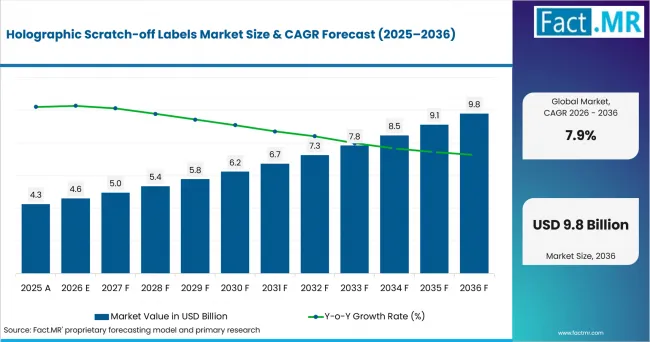
Holographic Scratch Off Labels Market Value Analysis | Source: Fact.MR
What are the defining numbers behind Holographic Scratch-off Labels Market growth?
An absolute opportunity of USD 5.2 billion is expected by 2036.
- Demand Drivers in the Market
- Consumer goods manufacturers need security labels that show an optical security feature while hiding codes under scratch coating.
- Pharmaceutical companies use pack-level authentication where a visible seal must match serialized records and distributor checks.
- Lottery and gaming organizations need durable scratch areas that conceal outcomes until purchase and resist early viewing or surface manipulation.
- Industrial enterprises use warranty labels to connect equipment registration and service entitlement.
- OECD and EUIPO reported in May 2025 that counterfeit and pirated goods represented an estimated USD 467 billion of global trade in 2021, equal to 2.3% of global imports. This report uses the finding as context for anti-counterfeit packaging.
- Key Segments Analyzed
- By Product: Security Holographic Scratch-off Labels are expected to hold 43.80% share in 2026 since tamper evidence and visible authentication can be combined on the same label face.
- By Application: Product Authentication Applications are projected to account for 77.20% share in 2026 because brand owners need concealed codes and overt holograms to work together.
- By End Use: Consumer Goods Manufacturers are anticipated to hold 58.60% share in 2026 as high-volume packs need visible checks before checkout.
- By Technology: Holographic Imaging Technology is estimated to hold 35.40% share in 2026 owing to optical effects that support fast visual inspection.
- By Formulation: UV Curable Label Formulations are forecast to account for 69.70% share in 2026 owing to fast curing on coated label stock.
- By Distribution Channel: Direct Manufacturer Sales are expected to hold 52.10% share in 2026 where enterprise buyers prefer controlled artwork transfer and production records.
- Analyst Opinion at Fact.MR
- Shambhu Nath Jha, Principal Consultant at Fact.MR, states, “Buyers test clean scratch opening, hologram alignment and code concealment. Suppliers are expected to combine controlled mastering, coating consistency and secure data handling as brand audits tighten.”
- Strategic Implications
- Label converters should document artwork custody before entering security programs that require audit-ready production evidence.
- Brand-protection teams should align holograms with consumer verification after DPMA reported in December 2025 that EU authorities seized 112 million counterfeit products in 2024.
- Procurement teams should test rub resistance and code coverage on actual packaging substrates before a national rollout.
- Distributors should separate decorative labels from security labels that require controlled production evidence and serial handling.
Germany is projected to post a 9.9% CAGR through 2036. Brazil is anticipated at 9.0%. The USA is forecast at 8.2%. The UK is expected at 7.3%. Japan is estimated at 6.5%.
How does the Holographic Scratch-off Labels Market break down by segment?
Product Authentication Applications leads at 77.20%; UV Curable Label Formulations leads at 69.70%.
Which Product dominates?
Security Holographic Scratch-off Labels are expected to hold 43.80% share in 2026.
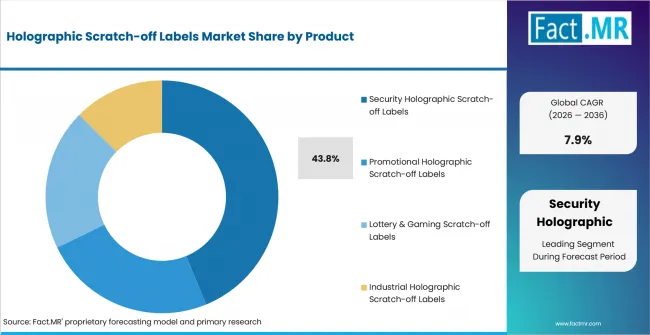
Holographic Scratch Off Labels Market Analysis By Product | Source: Fact.MR
Security holographic scratch-off labels combine a visible authenticity cue with concealed PINs, warranty numbers or verification codes. Tamper evident labels use first-opening evidence without the same scratch-reveal function. Promotional labels serve reward campaigns. Lottery labels require strong opacity. Industrial labels focus on registration.
What leads the Application segment?
Product Authentication Applications are projected to account for 77.20% share in 2026.
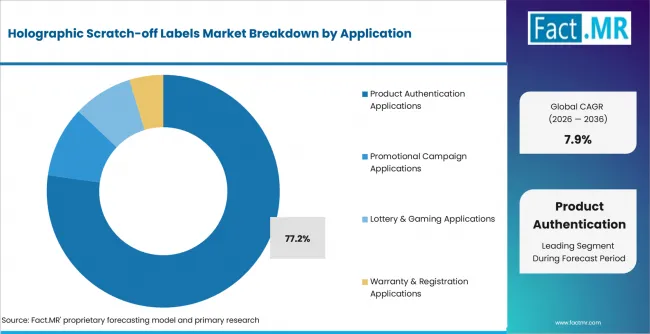
Holographic Scratch Off Labels Market Analysis By Application | Source: Fact.MR
Product authentication applications lead because the label must prove origin before a package changes hands. Consumer goods use holography and hidden codes. Pharmaceutical authentication needs tighter records where RFID pharma labels or serialization systems operate beside physical labels. The U.S. Census Bureau reported in May 2026 that Q1 2026 retail e-commerce sales reached USD 326.7 billion.
How does End Use shape demand?
Consumer Goods Manufacturers are anticipated to represent 58.60% share in 2026.
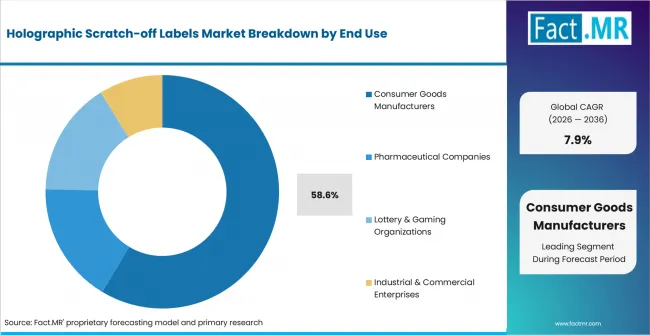
Holographic Scratch Off Labels Market Analysis By End Use | Source: Fact.MR
Consumer goods manufacturers lead because packs move across retail, online and distributor channels. Electronics and luxury goods use holographic authentication to protect brand value. Pharmaceutical companies need stronger custody controls. Lottery and gaming organizations require scratch fields that reveal cleanly after sale.
What supports Holographic Imaging Technology?
Holographic Imaging Technology is estimated to hold 35.40% share in 2026.
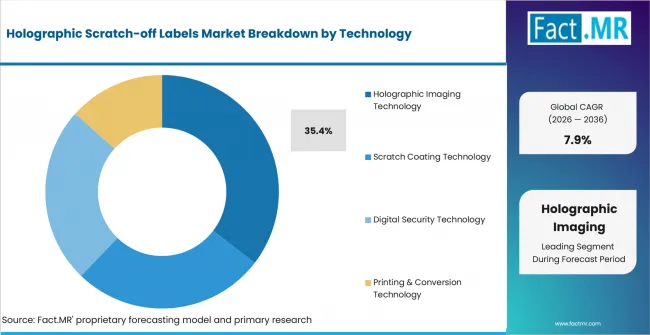
Holographic Scratch Off Labels Market Analysis By Technology | Source: Fact.MR
Holographic imaging technology leads because it gives inspectors a visual signal that ordinary printing cannot easily copy. Two-dimensional systems suit lower-cost packs. Converters qualify holographic film effects when shine and security cues must survive handling. Digital security adds serialization.
What supports UV Curable Label Formulations?
UV Curable Label Formulations are forecast to hold 69.70% share in 2026.
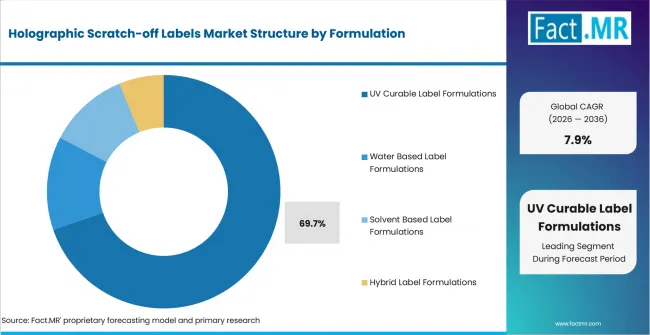
Holographic Scratch Off Labels Market Analysis By Formulation | Source: Fact.MR
UV curable formulations lead because fast curing helps converters run repeatable scratch coatings over holographic substrates. Durable grades support abrasion exposure. Deinkable label adhesives show why adhesive behavior remains part of packaging approval.
What leads Distribution Channel demand?
Direct Manufacturer Sales are expected to account for 52.10% share in 2026.
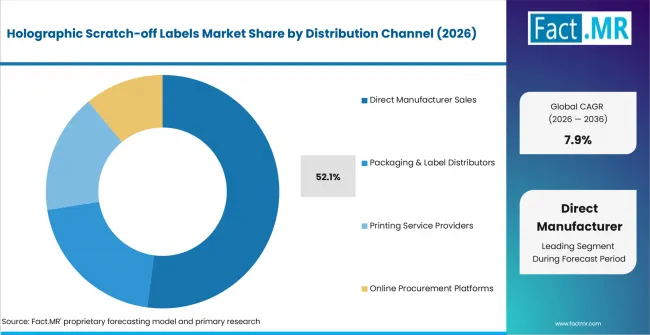
Holographic Scratch Off Labels Market Analysis By Distribution Channel | Source: Fact.MR
Direct manufacturer sales lead because enterprise programs require secure artwork, serialized codes and controlled records. Distributors serve regional accounts. Printing service providers support lottery and campaign work where coding and marking systems pair hidden codes with visible identifiers.
What is accelerating Holographic Scratch-off Labels Market adoption, and what is holding it back?
Authentication risk drives it; material cost and verification complexity restrain it.
Drivers Impact Analysis
| DRIVER | (~) % IMPACT ON CAGR | GEOGRAPHIC RELEVANCE | IMPACT TIMELINE |
|---|---|---|---|
| Product authentication across consumer goods | +1.8% | Global | Short term (<= 2 years) |
| Pharmaceutical pack-level verification | +1.4% | North America, Europe, Japan | Medium term (2-4 years) |
| Lottery, gaming and promotional programs | +1.0% | Global | Short term (<= 2 years) |
| E-commerce counterfeit exposure | +0.8% | USA, UK, Japan | Medium term (2-4 years) |
Source: Fact.MR analysis. Updated Aug 20, 2026
- Product authentication across consumer goods: Brands choose holographic scratch-off labels when packs need visible proof and hidden verification. The format fits electronics and cosmetics where buyers expect a quick check.
- Lottery, gaming and promotional programs: Scratch-off fields remain useful where value is revealed after sale. Holographic layers add a visible barrier against early tampering.
- E-commerce counterfeit exposure: Parcel-based retail creates more handoffs outside controlled stores. CBP reported in August 2025 that it processed 1.36 billion de minimis shipments in fiscal year 2024.
Opportunity Impact Analysis
| OPPORTUNITY | (~) % IMPACT ON CAGR | GEOGRAPHIC RELEVANCE | IMPACT TIMELINE |
|---|---|---|---|
| Serialized scratch panels for brand portals | +1.2% | Global | Medium term (2-4 years) |
| Premium consumer-pack authentication | +0.9% | Germany, Japan, UK | Long term (>= 4 years) |
| Regional lottery and gaming programs | +0.7% | Brazil, USA, UK | Short term (<= 2 years) |
Source: Fact.MR analysis. Updated Aug 20, 2026
- Serialized scratch panels for brand portals: Labels that hide QR, PIN or numeric codes can connect physical packs with online verification. The opportunity is concentrated where brands operate warranty or loyalty databases.
- Premium consumer-pack authentication: Luxury, electronics and beauty brands can use holographic effects as decoration and protection. It is expected to overlap with foil labels where finish and authentication are reviewed together.
- Regional lottery and gaming programs: Government and commercial gaming programs need repeatable scratch performance across ticket volumes. Converters that prove opacity and clean removal can compete beyond decorative labels.
Restraints Impact Analysis
| RESTRAINT | (~) % IMPACT ON CAGR | GEOGRAPHIC RELEVANCE | IMPACT TIMELINE |
|---|---|---|---|
| Hologram mastering and artwork custody requirements | -0.6% | Global | Short term (<= 2 years) |
| Substrate and coating cost pressure | -0.5% | USA, Europe | Medium term (2-4 years) |
| Small-batch customization cost | -0.4% | Brazil, Japan | Long term (>= 4 years) |
Source: Fact.MR analysis. Updated Aug 20, 2026
- Hologram mastering and artwork custody requirements: Security buyers require controlled origination, secure files and batch records. These steps slow onboarding and reduce the fit of ordinary label printers.
- Substrate and coating cost pressure: Holographic film, adhesive and scratch coating inputs can change label economics. BLS reported in June 2026 that producer prices for adhesives and sealants were 2.5% higher over the 12 months ending May 2026.
- Small-batch customization cost: Local campaigns and short pharmaceutical runs can require unique masters, variable data and separate approvals. That structure raises unit cost and limits quick substitutions.
Which countries are scaling the Holographic Scratch-off Labels Market through 2036?
- The country comparison spans 3.4 percentage points and forms two practical growth bands across the forecast period.
- Germany remains 0.9 percentage point above Brazil because customs enforcement keeps premium packaging controls visible.
- Brazil remains 0.8 percentage point above the USA as border operations and medicine-authentication cases keep holographic security visible.
- The USA remains 0.9 percentage point above the UK with e-commerce volume exposing brands to counterfeit goods.
- The UK remains 0.8 percentage point above Japan through online retail verification and border product-safety checks.
- Japan closes the displayed range owing to e-commerce expansion and trademark-centered brand protection.
Comparable CAGRs create different entry conditions due to customs intensity and approval cycles. Coverage includes North America, Latin America, Western Europe, Eastern Europe, East Asia, South Asia & Pacific, Middle East & Africa.
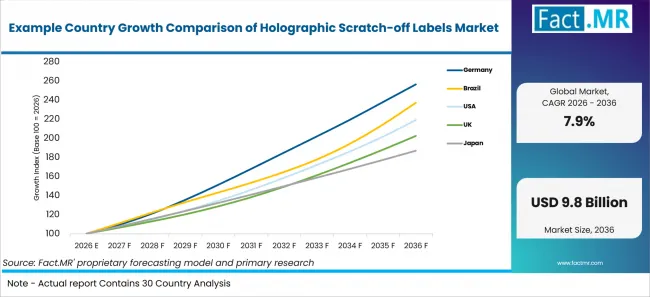
Example Country Growth Comparison Of Holographic Scratch Off Labels Market | Source: Fact.MR
| COUNTRY | CAGR (2026-2036) |
|---|---|
| Germany | 9.9% |
| Brazil | 9.0% |
| USA | 8.2% |
| UK | 7.3% |
| Japan | 6.5% |
Source: Fact.MR analysis. Updated Aug 20, 2026
What supports Germany adoption?
9.9% CAGR through 2036, supported by anti-counterfeit enforcement and premium packaging controls.
Germany’s growth reflects strong enforcement activity and continued demand for secure packaging across consumer goods, pharmaceuticals and premium products. German customs seized €417 million in counterfeit goods during 2024, highlighting the need for visible and difficult-to-copy security features. Holographic panels and direct supply agreements support brand protection, although customized origination, coating validation and country-specific artwork approvals may extend qualification timelines.
How is Brazil scaling demand?
9.0% CAGR through 2036, driven by border enforcement and medicine-authentication pressure.
Brazil’s growth is supported by counterfeit enforcement, retail expansion and increasing attention to pharmaceutical authentication. Receita Federal reported in October 2025 that the multi-agency Operação Fronteira RFB had seized R$78 million in illegal goods, while IBGE reported that Brazil’s retail sales volume increased 1.6% in 2025. Holographic and scratch-off solutions can support medicine security and promotional programs, although smaller production runs, humidity exposure and substrate variation may raise validation costs.
What supports USA adoption?
8.2% CAGR through 2036, backed by e-commerce scale and counterfeit-seizure exposure.
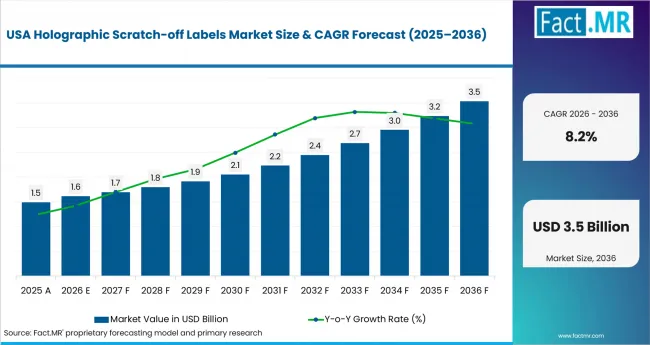
Holographic Scratch Off Labels Market Country Value Analysis | Source: Fact.MR
The USA’s growth reflects broad trademark activity, counterfeit exposure and demand for authentication across pharmaceuticals, promotions and consumer products. CBP stated in its June 2025 IPR Process Modernization Issue Paper that it seized more than 32 million IPR-violative goods in fiscal year 2024. Security labels can connect products with distribution records and promotional programs, although rising plastic-film costs and strict requirements for opacity, rub-off performance and barcode readability may increase qualification complexity.
What supports the UK outlook?
7.3% CAGR through 2036, supported by border enforcement and online retail authentication.
The UK’s growth reflects substantial counterfeit interception and a large online retail channel. Border Force seized counterfeit articles with a retail value exceeding £500 million between 2021 and 2023, while ONS reported in its June 2026 retail-sales bulletin that online sales represented 29.4% of total retail sales. Scratch-off and holographic features support loyalty, warranty and product-verification programs, although short promotional cycles and retailer-specific handling requirements can restrict testing and production flexibility.
How does Japan perform?
6.5% CAGR through 2036, led by trademark enforcement and e-commerce verification needs.
Japan’s growth is supported by intellectual-property enforcement and a large digital commerce market. Customs recorded 31,760 import suspensions involving 763,504 IPR-infringing items in 2025, while domestic B2C e-commerce reached JPY 26.1 trillion in 2024. Electronics, premium goods and promotional programs create demand for holographic and scratch-off features, although precise optical matching, specialty production runs and rising consumer prices may constrain adoption.
Who leads the Holographic Scratch-off Labels Market?
Competition is shaped by security-feature control, coating consistency and secure data handling. Official product sources establish supplier participation rather than market-share leadership.
KURZ offers holographic security and digital brand-protection solutions. Holostik supplies security holograms and labels. UFlex lists holographic scratch and scratch-label solutions. Holographic Security Innovations supplies scratch-off and holographic labels. PB Holotech lists scratch-card labels, scratch holograms and holographic labels. Related procurement can overlap with industrial labels.
Which companies are the key providers?
Companies include LEONHARD KURZ Stiftung & Co. KG; Holostik India Ltd.; UFlex Limited; Holographic Security Innovations Ltd.; and PB Holotech India Pvt. Ltd.
- LEONHARD KURZ Stiftung & Co. KG
- Holostik India Ltd.
- UFlex Limited
- Holographic Security Innovations Ltd.
- PB Holotech India Pvt. Ltd.
Bibliography
- Agência Nacional de Vigilância Sanitária. (2025, August 15). Operação desarticula rede suspeita de falsificar medicamento para câncer no Ceará.
- U.S. Bureau of Labor Statistics. (2026, July 15). Producer Price Indexes—June 2026.
- Statistisches Bundesamt (Destatis). (2026, February 2). Einzelhandelsumsatz im Jahr 2025 real um 2,7 % höher als im Vorjahr [Retail turnover in 2025 up 2.7% in real terms from the previous year].
- German Patent and Trade Mark Office. (2025, July 8). Enjoy your vacation—say no to fakes!
- U.S. Food and Drug Administration. (2025, October 16). Drug Supply Chain Security Act (DSCSA).
- Statistics Bureau of Japan. (2026, January 23). Japan 2025 [Consumer Price Index yearly average].
- Ministry of Economy, Trade and Industry. (2025, August 26). Results of FY2024 E-Commerce Market Survey compiled.
- Office for National Statistics. (2026, July 24). Retail sales, Great Britain: June 2026.
This Report Answers
- The report explains use across product, application, end use, technology, formulation and channel.
- Segment analysis identifies 2026 share leaders and buyer reasons.
- Country analysis examines Germany, Brazil, the USA, the UK and Japan.
- Competitive analysis reviews active holographic scratch-off label providers.
- Application analysis assesses concealed codes and scratch-coating performance.
What does the Holographic Scratch-off Labels Market cover?
The Holographic Scratch-off Labels Market covers paper and film labels that pair holographic imagery with a scratch-off layer. Uses include authentication, promotion, lottery access and warranty registration.
The assessment covers labels sold to consumer goods manufacturers, pharmaceutical companies, lottery and gaming organizations, and industrial enterprises. Coverage includes foil labels for metallic finishes and smart blister lidding for medicine-pack verification.
What is included in the scope?
The scope includes labels used to conceal PINs, QR codes, warranty identifiers, lottery outcomes and rewards.
The scope includes direct sales, distributors, printing-service programs and online procurement for security or promotional labels.
What is excluded from the scope?
The scope excludes plain hologram stickers, ordinary scratch cards without holography and decorative labels that do not conceal or authenticate information.
Broader printed packaging and RFID/NFC labels are excluded unless the product is delivered as a holographic scratch-off label.
How Was the Analysis Built?
The analysis draws on 120+ sources, 35+ company portfolios, 25+ countries, and more than 20 industry interviews.
- Primary Research: Primary research includes discussions with manufacturers, service providers, technology developers, distributors, end users, procurement teams, and subject-matter experts. These conversations examine purchasing priorities, product adoption, operational challenges, approval requirements, competitive positioning, and the factors that influence wider market acceptance.
- Desk Research: Desk research covers government statistics, regulatory publications, company filings, trade data, technical studies, industry associations, standards, public policy, and other authoritative sources. Every source used in the analysis is documented in the bibliography.
- Market Sizing and Forecasting: Market estimates combine historical performance, demand indicators, pricing and volume trends, segment shares, company participation, country-level growth, adoption patterns, investment activity, and barriers to market expansion.
- Data Validation and Update Cycle: Findings are validated by comparing primary interviews with public data, company activity, regulatory changes, trade patterns, and industry developments. Regular updates review new product launches, capacity changes, partnerships, approvals, procurement trends, and shifts in commercial adoption.
Segmentation
What is the report’s scope and coverage?
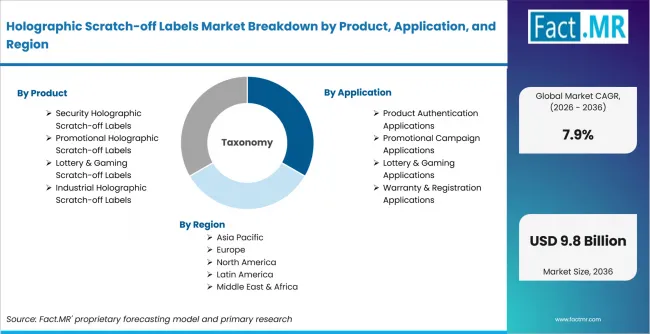
Holographic Scratch Off Labels Market Breakdown By Product, Application, And Region | Source: Fact.MR
| ATTRIBUTE | DETAILS |
|---|---|
| Quantitative Units | USD billion |
| Market Definition | Labels that combine a holographic security feature with a removable scratch-off coating used to conceal PINs, codes, warranty data, lottery results, promotional rewards or authentication details. |
| Product | Security Holographic Scratch-off Labels; Promotional Holographic Scratch-off Labels; Lottery & Gaming Scratch-off Labels; Industrial Holographic Scratch-off Labels |
| Application | Product Authentication Applications; Promotional Campaign Applications; Lottery & Gaming Applications; Warranty & Registration Applications |
| End Use | Consumer Goods Manufacturers; Pharmaceutical Companies; Lottery & Gaming Organizations; Industrial & Commercial Enterprises |
| Technology | Holographic Imaging Technology; Scratch Coating Technology; Digital Security Technology; Printing & Conversion Technology |
| Formulation | UV Curable Label Formulations; Water Based Label Formulations; Solvent Based Label Formulations; Hybrid Label Formulations |
| Distribution Channel | Direct Manufacturer Sales; Packaging & Label Distributors; Printing Service Providers; Online Procurement Platforms |
| Regions Covered | North America; Latin America; Western Europe; Eastern Europe; East Asia; South Asia & Pacific; Middle East & Africa |
| Countries Covered | Germany; Brazil; USA; UK; Japan |
| Key Companies Profiled | LEONHARD KURZ Stiftung & Co. KG; Holostik India Ltd.; UFlex Limited; Holographic Security Innovations Ltd.; PB Holotech India Pvt. Ltd. |
| Forecast Period | 2026 to 2036 |
| Approach | Hybrid top-down and bottom-up approach using label demand by application; converter participation; authentication use cases; country enforcement signals; segment shares; and provider portfolio review. |
Source: Fact.MR analysis. Updated Aug 20, 2026
How is the market segmented?
-
By Product
- Security Holographic Scratch-off Labels
- Tamper Evident Holographic Labels
- Authentication Holographic Labels
- Promotional Holographic Scratch-off Labels
- Consumer Campaign Labels
- Brand Engagement Labels
- Lottery & Gaming Scratch-off Labels
- Lottery Ticket Labels
- Gaming Access Labels
- Industrial Holographic Scratch-off Labels
- Asset Identification Labels
- Warranty Protection Labels
- Security Holographic Scratch-off Labels
-
By Application
- Product Authentication Applications
- Consumer Goods Authentication
- Pharmaceutical Authentication
- Promotional Campaign Applications
- Retail Promotions
- Digital Engagement Promotions
- Lottery & Gaming Applications
- Government Lottery Programs
- Commercial Gaming Programs
- Warranty & Registration Applications
- Consumer Electronics Registration
- Industrial Equipment Registration
- Product Authentication Applications
-
By End Use
- Consumer Goods Manufacturers
- Electronics Manufacturers
- Luxury Goods Manufacturers
- Pharmaceutical Companies
- Branded Drug Manufacturers
- Healthcare Product Manufacturers
- Lottery & Gaming Organizations
- Government Lottery Authorities
- Commercial Gaming Operators
- Industrial & Commercial Enterprises
- Equipment Manufacturers
- Commercial Product Suppliers
- Consumer Goods Manufacturers
-
By Technology
- Holographic Imaging Technology
- 2D Holographic Systems
- 3D Holographic Systems
- Scratch Coating Technology
- Latex Based Scratch Coatings
- UV Curable Scratch Coatings
- Digital Security Technology
- Serialized Security Systems
- Track & Trace Systems
- Printing & Conversion Technology
- Digital Printing Systems
- Conventional Printing Systems
- Holographic Imaging Technology
-
By Formulation
- UV Curable Label Formulations
- High Durability Formulations
- Fast Cure Formulations
- Water Based Label Formulations
- Eco Friendly Formulations
- Flexible Application Formulations
- Solvent Based Label Formulations
- High Adhesion Formulations
- Specialty Surface Formulations
- Hybrid Label Formulations
- Multi Layer Formulations
- Advanced Functional Formulations
- UV Curable Label Formulations
-
By Distribution Channel
- Direct Manufacturer Sales
- Enterprise Supply Agreements
- Custom Label Programs
- Packaging & Label Distributors
- Regional Distributors
- Specialty Security Distributors
- Printing Service Providers
- Commercial Printing Companies
- Security Printing Companies
- Online Procurement Platforms
- B2B Procurement Platforms
- Manufacturer Portals
- Direct Manufacturer Sales
-
By Region
- North America
- Latin America
- Western Europe
- Eastern Europe
- East Asia
- South Asia & Pacific
- Middle East & Africa
Frequently Asked Questions
How big is the holographic scratch-off labels market in 2026?
What is the CAGR of the holographic scratch-off labels market from 2026 to 2036?
Which product leads the holographic scratch-off labels market?
Which application leads the holographic scratch-off labels market?
Who are the leading companies in the holographic scratch-off labels market?
Who worked on this report


Preview the report firsthand - request a free sample
Free SampleGet the brochure for pricing and purchase details
Download PDF