- Market Value (2025): USD 1.1 Bn
- Estimated Value (2026): USD 1.2 Bn
- Forecast Value (2036): USD 4.4 Bn
- CAGR (2026-2036): 13.9%
What is the Liposomal Nutrient Carriers Market forecast to be worth by 2036?
USD 1.2 billion in 2026 to USD 4.4 billion by 2036 at a 13.9% CAGR.
- The Liposomal Nutrient Carriers Market was valued at USD 1.1 billion in 2025.
- Demand is projected to increase from USD 1.2 billion in 2026 to USD 4.4 billion by 2036.
- The market is forecast to record 13.9% CAGR from 2026 to 2036 as supplement brands use lipid carriers for vitamin and botanical payloads.
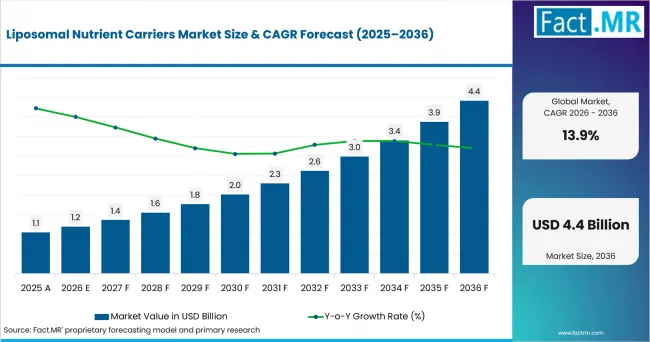
Liposomal Nutrient Carriers Market Value Analysis | Source: Fact.MR
What are the defining numbers behind Liposomal Nutrient Carriers Market growth?
USD 3.2 billion absolute opportunity by 2036, led by phosphatidylcholine liposomes, vitamins and USA demand.
- Demand Drivers in the Market
- Supplement brands need clearer delivery claims where a standard tablet offers limited differentiation. Liposomal concentrates allow product teams to position products around bioavailability, taste control and active protection, while these performance claims require formulation- and payload-specific evidence.
- Vitamin formulators need carriers that protect sensitive actives during storage. Premium products need a clear reason for shoppers to choose liposomal drops or capsules over standard supplement forms.
- Botanical product teams need better safety documentation as blends become more complex. FDA amended MOU 225-19-032 effective August 1, 2025 to support safety assessment for complex botanical mixtures in foods and dietary supplements.
- German supplement use supports format work beyond tablets. Drugstore and pharmacy channels reward clear dosage, stable composition and carrier explanations that retail staff understand.
- Key Segments Analyzed
- By Carrier Architecture: Phosphatidylcholine liposomes are expected to hold 43.00% share in 2026 owing to their familiar membrane structure and broad use in nutrient delivery.
- By Payload: Vitamins to account for 34.00% share in 2026. Liposomal and other lipid-based formulations can alter dispersion and pharmacokinetics.
- By Delivery Format: Liquid concentrate is anticipated to capture 32.00% share in 2026 supported by easier blending into drops, shots and beverage premixes.
- By Performance Claim: Bioavailability enhancement is forecast to represent 42.00% share in 2026 due to buyer focus on absorption-led positioning.
- Analyst Opinion at Fact.MR
- Shambhu Nath Jha, Principal Consultant at Fact.MR, states, “The commercial test for liposomal nutrients is shifting toward proof of carrier quality. Brands are expected to ask for particle stability, phospholipid origin and claim language before they approve a formula. Suppliers that combine clean-label lipids, payload compatibility and practical scale-up support are better placed for repeat programs.”
- Strategic Implications
- Formulators should match carrier architecture to payload sensitivity before choosing a format, since vitamin C drops and omega capsules place different stress on lipid vesicles.
- Brand owners should keep claim wording close to measurable performance, especially where bioavailability and protection are used on front labels or sales pages.
- Ingredient suppliers should document phospholipid source, allergen position and particle behavior so technical files support claims across premium supplement channels.
- Channel partners should use official guidance and finished-product testing when selling liquid concentrates online.
USA is projected to record 15.7% CAGR through 2036 driven by high supplement use and premium vitamin formats. Germany is expected to post 14.9% CAGR owing to online supplement purchasing and pharmacy-channel scrutiny. Switzerland is anticipated to reach 13.2% CAGR supported by disciplined maximum-level rules and pharmacy trust. Japan is estimated to advance at 12.5% CAGR due to functional-claim evidence discipline. UK is forecast to hold 10.3% CAGR reinforced by dose-form clarity and retail surveillance.
How does the Liposomal Nutrient Carriers Market break down by segment?
Phosphatidylcholine liposomes lead at 43.00%; bioavailability enhancement leads at 42.00%.
Which Carrier Architecture dominates?
Phosphatidylcholine liposomes hold 43.0% share in 2026.
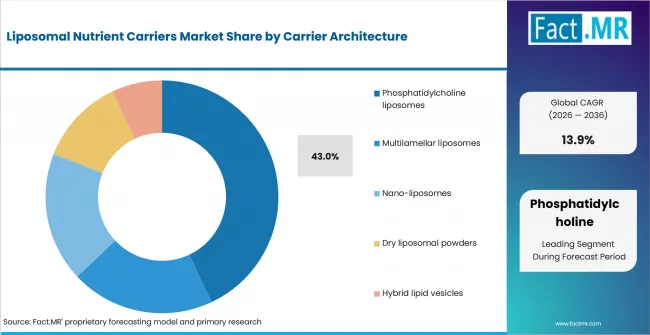
Liposomal Nutrient Carriers Market Analysis By Carrier Architecture | Source: Fact.MR
Phosphatidylcholine liposomes are expected to lead Carrier Architecture because their lipid bilayer structure is familiar to formulators. Multilamellar liposomes serve products needing payload protection. Nano-liposomes support liquids where dispersion quality affects mouthfeel. Dry powders support shipping stability for sachets and sticks.
What leads the Payload segment?
Vitamins account for 34.0% share in 2026.
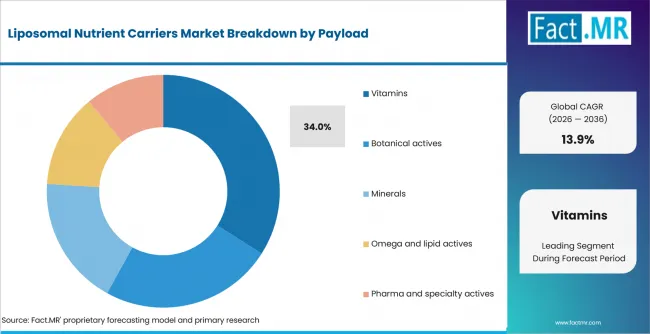
Liposomal Nutrient Carriers Market Analysis By Payload | Source: Fact.MR
Vitamins are projected to account for 34.00% share in 2026 because they appear across daily supplement lines and premium nutrition formats. Botanical actives follow where ingredients need taste masking or solubility help. Vitamin-led carrier evaluation therefore depends on stability proof and clean taste.
How does Delivery Format shape demand?
Liquid concentrate holds 32.0% share in 2026.
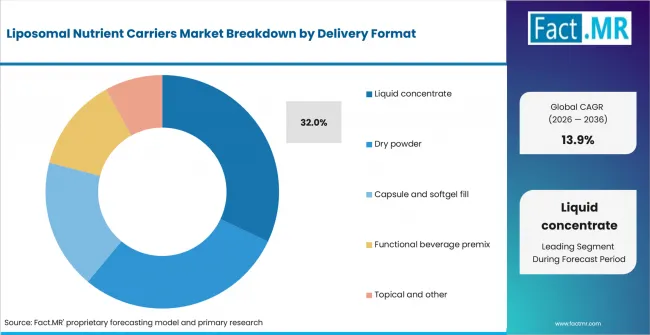
Liposomal Nutrient Carriers Market Analysis By Delivery Format | Source: Fact.MR
Liquid concentrate is anticipated to hold 32.00% share in 2026 supported by direct use in drops, shots and beverage premixes. Dry powder supports sachets and stick packs where moisture control is central. Capsule and softgel fill serves brands that need measured dosing and familiar supplement presentation. GOV.UK guidance published in June 2026 lists five forms for food supplements. Those forms are tablets, capsules, gummies, powders and liquids.
What supports Bioavailability Enhancement within Performance Claim?
Bioavailability enhancement leads with 42.0% share in 2026.
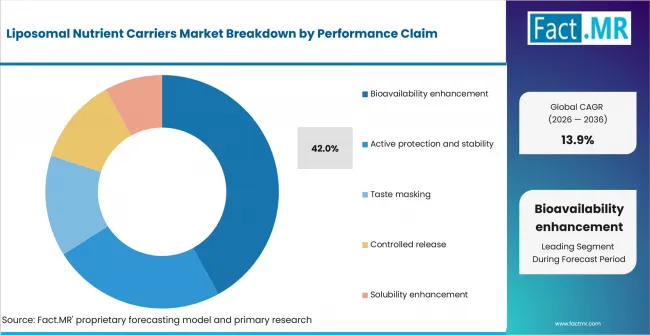
Liposomal Nutrient Carriers Market Analysis By Performance Claim | Source: Fact.MR
Bioavailability enhancement is forecast to lead Performance Claim because it gives brands a direct reason to choose liposomal delivery over simple blending. Active protection and stability claims suit sensitive vitamins and botanicals. Taste masking is relevant for bitter plant extracts and mineral blends. Controlled release stays closer to specialist formulation projects.
What is accelerating Liposomal Nutrient Carriers Market adoption, and what is holding it back?
Premium supplement differentiation drives it; claim and stability proof restrain it.
Drivers Impact Analysis
| DRIVER | (~) % IMPACT ON CAGR | GEOGRAPHIC RELEVANCE | IMPACT TIMELINE |
|---|---|---|---|
| Bioavailability-led premium positioning | +2.0% | North America, Europe, East Asia | Short term (<= 2 years) |
| Clean-label phospholipid sourcing | +1.4% | USA, Germany, Switzerland | Medium term (2-4 years) |
| Liquid concentrate and beverage formats | +1.1% | USA, UK, Japan | Medium term (2-4 years) |
| Botanical stability and taste masking | +0.8% | Germany, Japan, UK | Long term (>= 4 years) |
- Bioavailability-led premium positioning: Supplement brands are expected to use liposomal carriers when a formula needs a clearer value claim than a standard capsule. Brands therefore have a clear route for premium product trials in adult daily-nutrition lines.
- Clean-label phospholipid sourcing: Sunflower and non-GMO phospholipid systems are projected to gain space as brands simplify allergen and origin statements. The same reasoning favors suppliers that document lipid origin and batch consistency.
- Liquid concentrate and beverage formats: Liquid concentrates are anticipated to improve trial speed because brands blend them into drops, shots and premixes with fewer processing steps. Clear dose-form language supports liquid products when labels explain serving size and use conditions.
- Botanical stability and taste masking: Botanical payloads are forecast to need tighter carrier work as blends become more complex. Liposomal carriers help manage stability and taste when plant actives carry strong flavor notes.
Opportunity Impact Analysis
| OPPORTUNITY | (~) % IMPACT ON CAGR | GEOGRAPHIC RELEVANCE | IMPACT TIMELINE |
|---|---|---|---|
| Ready-to-blend liposomal concentrates | +1.3% | Global | Short term (<= 2 years) |
| Botanical actives in premium supplements | +1.0% | Germany, Japan, UK | Medium term (2-4 years) |
| Capsule and softgel fill systems | +0.7% | USA, Switzerland, UK | Medium term (2-4 years) |
| Functional beverage premixes | +0.6% | USA, Japan | Long term (>= 4 years) |
- Ready-to-blend liposomal concentrates: Pre-formulated concentrates are expected to lower the formulation burden for smaller brands. This route suits brands that need faster trial work before scale-up.
- Botanical actives in premium supplements: Botanical payloads are anticipated to create room for carriers that improve taste and stability. Suppliers that pair encapsulation with documentation are better placed in this area.
- Capsule and softgel fill systems: Capsule and softgel fill are projected to remain useful where consumers expect measured daily dosing. Capsule innovation remains useful for sensitive payload positioning where brand owners need daily dose familiarity.
- Functional beverage premixes: Beverage premixes are forecast to widen use where brands need visible dispersion and cleaner mouthfeel. Successful adoption depends on flavor testing and shelf-life proof.
Restraints Impact Analysis
| RESTRAINT | (~) % IMPACT ON CAGR | GEOGRAPHIC RELEVANCE | IMPACT TIMELINE |
|---|---|---|---|
| Claim substantiation and label review | -0.8% | USA, UK, Japan | Short term (<= 2 years) |
| Phospholipid input cost | -0.6% | Global | Medium term (2-4 years) |
| Payload compatibility limits | -0.5% | Global | Medium term (2-4 years) |
| Online-channel quality variation | -0.4% | Europe, UK | Long term (>= 4 years) |
- Claim substantiation and label review: Bioavailability and protection claims are expected to require clear test support before wider launch. Brands need evidence files before using technical delivery claims in regulated health-positioned products.
- Phospholipid input cost: High-purity phospholipids are projected to keep liposomal products above basic supplement formats. Brands need enough price room to absorb carrier cost and maintain margin.
- Payload compatibility limits: Every active behaves differently inside a lipid vesicle, so formula transfer across payloads is limited. Vitamins and botanicals require separate checks for stability and dispersion. This raises lab workload before scale-up.
- Online-channel quality variation: Online supplement sales are anticipated to face closer review because product claims reach consumers quickly across borders. Online-channel review encourages stronger files for premium liposomal labels.
Which countries are scaling the Liposomal Nutrient Carriers Market through 2036?
- The country comparison spans 5.45 percentage points and forms three practical growth bands across the forecast period.
- USA remains 0.84 percentage point above Germany through broad supplement use and premium vitamin formats.
- Germany remains 1.66 percentage points above Switzerland as online supplement purchasing meets stricter formulation review.
- Switzerland remains 0.70 percentage point above Japan through pharmacy trust and maximum-level discipline.
- Japan remains 2.25 percentage points above UK as functional-claim filings reward stronger formulation files.
- UK closes the displayed range through dose-form clarity and active food-supplement surveillance.
Comparable CAGRs create different entry conditions due to supplement use, claim rules, channel mix and carrier documentation. Full report coverage includes North America, Latin America, Western Europe, Eastern Europe, East Asia, South Asia & Pacific, Middle East & Africa.
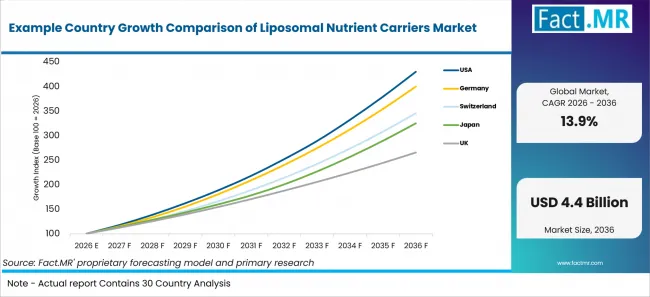
Example Country Growth Comparison Of Liposomal Nutrient Carriers Market | Source: Fact.MR
| Country | CAGR (2026-2036) |
|---|---|
| USA | 15.7% |
| Germany | 14.9% |
| Switzerland | 13.2% |
| Japan | 12.5% |
| UK | 10.3% |
What supports USA adoption?
15.7% CAGR, supported by repeat supplement use and premium vitamin positioning.
The USA is projected to record 15.7% CAGR through 2036 as supplement brands use liposomes to position vitamins above standard tablets. CDC NCHS reported in May 2026 that 60.2% of U.S. adults aged 20 and older used any dietary supplement in the previous 30 days during August 2021-August 2023. This documents broad supplement use rather than specifically measuring demand for liposomal delivery systems.
How is Germany scaling demand?
14.9% CAGR, shaped by online supplement purchasing and formulation review.
Germany is anticipated to post 14.9% CAGR through 2036 as drugstore and pharmacy channels favor products with clear dose and ingredient files. Destatis reported in March 2025 that 21% of people aged 16 to 74 in Germany had purchased medicines or food supplements online during the three months before the 2024 survey, demonstrating an established online purchasing channel for these products.
What supports the Switzerland outlook?
13.2% CAGR, reinforced by supplement use and maximum-level discipline.
Switzerland is estimated to reach 13.2% CAGR through 2036 as formulators use liposomes for concentrated nutrients while following strict dose rules. FSVO reported in March 2026 that nearly one third of survey respondents consumed at least one food supplement, indicating widespread supplement use in Switzerland.
How is Japan developing demand?
12.5% CAGR, supported by health-claim formats and evidence discipline.
Japan is forecast to advance at 12.5% CAGR through 2036 as brands use liposomes to support nutrient-function and convenience claims. The Consumer Affairs Agency stated that, from April 1, 2025, systematic reviews used as scientific evidence for new Foods with Function Claims submissions must comply with PRISMA 2020, strengthening evidence-reporting requirements for applicable submissions.
What underpins UK growth?
10.3% CAGR, driven by dose-form clarity and retail surveillance.
The UK is expected to record 10.3% CAGR through 2036 as brands use liposomal carriers for premium differentiation within food-supplement guidance. The Food Standards Agency’s 2025/26 Retail Surveillance Survey collected 845 food products, of which 800 were assessed for compliance with relevant legislation and guidance and 45 oat-based samples were examined for research purposes. This demonstrates broad food-surveillance activity rather than liposomal-supplement-specific monitoring.
Who leads the Liposomal Nutrient Carriers Market?
Lipoid GmbH stands out as the clearest direct provider in the available material. Its LIPOID Liposome Basic H is positioned as a pre-formulated liposomal system, supporting formulators that need phospholipid-based carriers for nutrient and specialty-active delivery.
PlantaCorp GmbH, Botanic Healthcare, Natural Field Co., Ltd., and Eskag Pharma are also profiled as key companies in the market. Their relevance is assessed across liposomal delivery, lipid-carrier, nutrient, and dosage-form capabilities, although the pasted material does not provide the same level of product-specific evidence for each company.
Competitive positioning is expected to depend on carrier quality, phospholipid origin, payload compatibility, particle stability, and scale-up support. Suppliers that combine clean-label lipid systems with documentation and practical formulation assistance are better placed to secure repeat supplement and functional-nutrition programs.
Which companies are the key providers?
Key companies include Lipoid GmbH, PlantaCorp GmbH, Botanic Healthcare, Natural Field Co., Ltd., and Eskag Pharma.
- Lipoid GmbH
- PlantaCorp GmbH
- Botanic Healthcare
- Natural Field Co., Ltd.
- Eskag Pharma
Bibliography
- Stierman, B., Couch, C. A., Gahche, J. J., & Mishra, S. (2026, May 21). Dietary supplement use: United States, August 2021–August 2023 (NCHS Data Brief No. 561). National Center for Health Statistics.
- U.S. Food and Drug Administration. (2025, August 1). MOU 225-19-032.
- Lipoid GmbH. (2025, March 24). LIPOID Liposome Basic H: Pre-formulated high-quality liposomes.
- Food Standards Agency. (2026, June 25). Food supplements guidance. GOV.UK.
- Federal Statistical Office (Destatis). (2025, March 11). 21 % der 16- bis 74-Jährigen kaufen Arzneimittel oder Nahrungsergänzungsmittel online [21% of 16- to 74-year-olds buy medicines or food supplements online].
- Food Standards Agency, Scarrett, A., Cooke, S., & Bachelor, J. (2026). Retail Surveillance Survey Sampling Programme 2025/26. FSA Research and Evidence.
- Food Standards Agency. (2025, December). Novel formulations of supplement compounds designed to increase oral bioavailability.
This Report Answers
- The report explains how liposomal nutrient carriers are used across carrier architecture and payload groups.
- Segment analysis identifies phosphatidylcholine liposomes and bioavailability enhancement as the leading share positions.
- Country analysis examines USA, Germany, Switzerland, Japan and UK with separate demand mechanisms for each market.
- Competitive analysis reviews the six profiled companies and distinguishes direct liposomal nutrient-carrier evidence from adjacent delivery, lipid, nutrient and dosage-form capabilities.
- Application assessment covers vitamin, botanical, mineral and omega payloads.
- Format assessment covers liquid, powder, capsule and softgel applications.
- The analysis draws on official statistics, regulatory guidance, company developments and provider portfolio checks, with direct and adjacent supplier roles distinguished where the underlying evidence differs.
What does the Liposomal Nutrient Carriers Market cover?
Phosphatidylcholine liposomes, multilamellar systems, nano-liposomes and dry powders used for nutrient delivery.
The Liposomal Nutrient Carriers Market covers lipid vesicles and related phospholipid systems used to carry nutritional actives. These carriers are used in supplements, functional beverage premixes and softgel fills.
The assessment differs from broad nutraceutical coverage because it focuses on carrier architecture and delivery performance. Standard vitamins and minerals fall inside the scope only when sold as part of a liposomal or lipid-carrier system.
What is included in the scope?
Liposomal nutrient systems used in supplement, functional nutrition and selected specialty active formats.
The scope includes liposomes and hybrid lipid vesicles used with vitamins. Related phospholipid grades are included when they function as nutrient carriers. The scope also covers liquid concentrates, dry powders and softgel capsule systems used in daily supplement programs. It also reviews dietary supplement formats where liposomal delivery affects taste, dispersion and active protection.
What is excluded from the scope?
Plain nutrient powders and unrelated pharmaceutical delivery systems are outside the scope.
Plain vitamin powders and ordinary botanical extracts sold without a lipid-carrier claim are outside the scope. Broad food ingredient encapsulation systems are outside the scope unless the technology is marketed as a liposomal nutrient carrier. Pharmaceutical liposomes are covered only where supplier capability supports nutraceutical or specialty active delivery.
How Was the Analysis Built?
The analysis draws on 120+ sources, 35+ company portfolios, 25+ countries, and more than 20 industry interviews.
- Primary Research: Primary research includes discussions with manufacturers, service providers, technology developers, distributors, end users, and subject-matter experts. These conversations examine purchasing priorities, product adoption, operational challenges, approval requirements, competitive positioning, and the factors that influence wider market acceptance.
- Desk Research: Desk research covers government statistics, regulatory publications, company filings, trade data, technical studies, industry associations, standards, public policy, and other authoritative sources. Every source used in the analysis is documented in the bibliography.
- Market Sizing and Forecasting: Market estimates combine historical performance, demand indicators, pricing and volume trends, segment shares, company participation, country-level growth, adoption patterns, investment activity, and barriers to market expansion.
- Data Validation and Update Cycle: Findings are validated by comparing primary interviews with public data, company activity, regulatory changes, trade patterns, and industry developments. Regular updates review new product launches, capacity changes, partnerships, approvals, and shifts in commercial adoption.
What is the report’s scope and coverage?
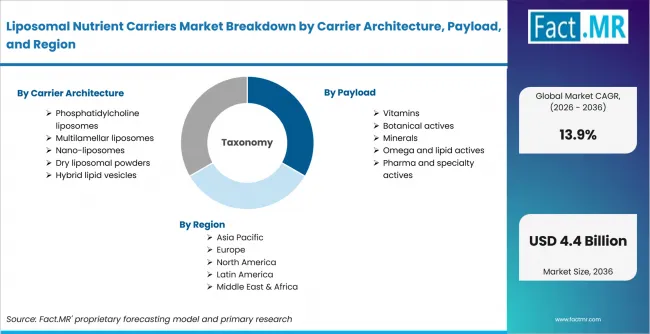
Liposomal Nutrient Carriers Market Breakdown By Carrier Architecture, Payload, And Region | Source: Fact.MR
| Attribute | Details |
|---|---|
| Quantitative Units | USD billion in 2026 to USD billion by 2036 at a CAGR |
| Market Definition | Lipid vesicle and phospholipid carrier systems used to deliver vitamins, botanicals, minerals, omega actives and selected specialty payloads in supplement and functional nutrition formats. |
| Carrier Architecture | Phosphatidylcholine liposomes; Multilamellar liposomes; Nano-liposomes; Dry liposomal powders; Hybrid lipid vesicles |
| Payload | Vitamins; Botanical actives; Minerals; Omega and lipid actives; Pharma and specialty actives |
| Delivery Format | Liquid concentrate; Dry powder; Capsule and softgel fill; Functional beverage premix; Topical and other |
| Performance Claim | Bioavailability enhancement; Active protection and stability; Taste masking; Controlled release; Solubility enhancement |
| Regions Covered | North America; Latin America; Western Europe; Eastern Europe; East Asia; South Asia & Pacific; Middle East & Africa |
| Countries Covered | USA; Germany; Switzerland; Japan; UK |
| Key Companies Profiled | Lipoid GmbH, PlantaCorp GmbH, Botanic Healthcare, Natural Field Co., Ltd., and Eskag Pharma. |
| Forecast Period | 2026 to 2036 |
| Approach | Hybrid top-down and bottom-up approach using supplement-format demand, lipid carrier adoption, payload mapping, country evidence and provider portfolio review. |
How is the market segmented?
-
By Carrier Architecture
- Phosphatidylcholine liposomes
- Multilamellar liposomes
- Nano-liposomes
- Dry liposomal powders
- Hybrid lipid vesicles
-
By Payload
- Vitamins
- Botanical actives
- Minerals
- Omega and lipid actives
- Pharma and specialty actives
-
By Delivery Format
- Liquid concentrate
- Dry powder
- Capsule and softgel fill
- Functional beverage premix
- Topical and other
-
By Performance Claim
- Bioavailability enhancement
- Active protection and stability
- Taste masking
- Controlled release
- Solubility enhancement
-
By Region
- North America
- Latin America
- Western Europe
- Eastern Europe
- East Asia
- South Asia & Pacific
- Middle East & Africa