What is the low-add-on surface sizers market forecast to be worth by 2036?
USD 345.0 million in 2026 to USD 820.0 million by 2036, at 9.0% CAGR.
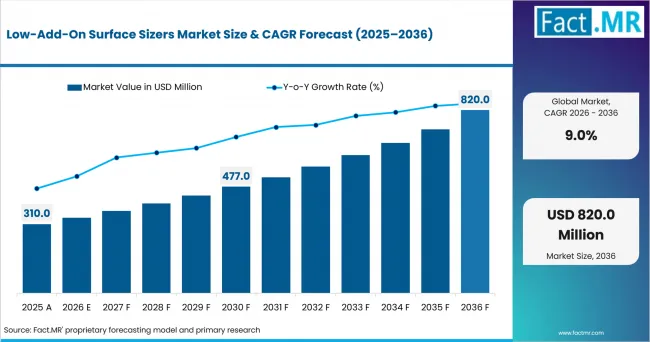
- The low-add-on surface sizers market crossed a valuation of USD 310.0 million in 2025. The market is estimated at USD 345.0 million in 2026. The market is projected to reach USD 820.0 million by 2036.
- The market is forecast to record 9.0% CAGR from 2026 to 2036.
- Food-contact packaging reformulation forms the clearest evidence base for this market. The Food and Drug Administration announced in February 2024 that PFAS grease-proofing substances were no longer sold for food-contact use in the U.S. market.
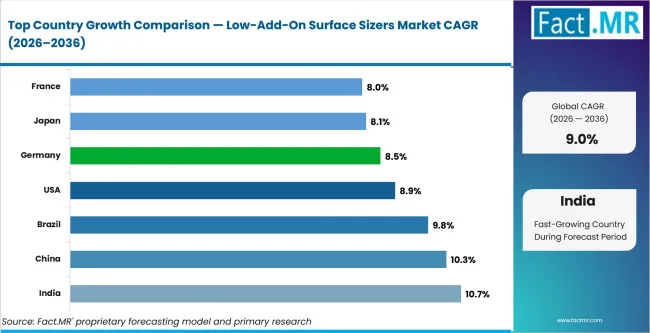
- This supports qualification work for lower-add-on surface programs in foodservice board and packaging paper. India is projected to record 10.7% CAGR through 2036, supported by packaging conversion and recycling obligations.
Low Add On Surface Sizers Market Market Value Analysis | Source: Fact.MR
What are the defining numbers behind low-add-on surface sizers growth?
USD 475.0 million absolute opportunity by 2036, led by East Asia and South Asia.
- Demand Drivers in the Market
- Foodservice board mills are shifting toward fluorine-free oil and grease control after food-contact packaging rules tightened in the United States and Europe.
- Containerboard producers need surface strength and water holdout without adding heavy coating weight to recycled-fiber board.
- Printing paper mills use low-add-on programs to protect print quality while limiting extra drying load on the paper machine.
- Converters prefer sizing systems that can be applied on existing film press or metered size press assets.
- Key Segments Analyzed
- By Chemistry: Alkyl ketene dimer is projected to hold 31.0% share in 2026 due to familiar sizing behavior and water-resistance performance in board grades.
- By Paper Grade: Containerboard is forecast to account for 34.0% share in 2026 supported by liner and medium producers seeking better surface strength.
- By Performance: Water resistance is anticipated to secure 38.0% share in 2026 attributable to Cobb value control in packaging and print grades.
- By Application Method: Metered size press is estimated to represent 36.0% share in 2026 led by controlled pickup and lower chemical waste.
- By Buyer Type: Integrated paper mills are predicted to capture 44.0% share in 2026 because they can qualify chemistry across multiple machines.
- By Geography: East Asia is expected to hold 34.0% share in 2026 supported by large paper and board production clusters.
- Analyst Opinion at Fact.MR
- Shambhu Nath Jha, Principal Analyst at Fact.MR states, "Low-add-on surface sizing is becoming a paper-machine decision rather than a chemistry-only decision. Mills ask whether a sizing program can reduce pickup and protect print results. They also ask whether deposits remain controlled during long production runs. Suppliers that help mills prove the same surface effect with less dry add-on are expected to gain repeat accounts."
- Strategic Implications
- Sizing suppliers should sell performance per tonne of paper rather than price per kilogram of chemistry.
- Paper mills need trial protocols that compare dry pickup and Cobb values. They also review print holdout and machine cleanliness together.
- Converters should qualify PFAS-free surface programs before food-contact customers request full documentation.
- Distributors need technical staff who can support size press settings and not just deliver drums or totes.
China is expected to expand at 10.3% CAGR because paperboard output scale creates large trial volume. Brazil is forecast to grow at 9.8% CAGR, while the United States is expected to advance at 8.9% CAGR through food-contact packaging reformulation. Germany is projected to rise at 8.5% CAGR due to European rule alignment.
How does the low-add-on surface sizers market break down by segment?
Alkyl ketene dimer leads at 31.0%; containerboard leads at 34.0%.
Which chemistry leads?
Alkyl ketene dimer holds 31.0% share in 2026.
Alkyl ketene dimer leads because mills understand its water-resistance response and operating limits. The chemistry is widely used where containerboard and sack grades need better surface holdout. Suppliers still need to manage deposits and emulsion stability during mill trials. Surface programs that use alkyl ketene dimer with starch blends can reduce pickup while keeping water absorption within specification.
Which paper grade leads?
Containerboard accounts for 34.0% share in 2026.
Containerboard leads because liner and medium producers need surface strength for printing and converting. Moisture exposure adds another reason for surface holdout. Recycled-fiber use can create more variation in surface quality. Low-add-on surface sizers help mills stabilize surface response without moving into heavy coating programs. The grade also gives suppliers large trial volumes once one machine program is approved.
Which performance outcome leads?
Water resistance holds 38.0% share in 2026.
Water resistance is the top performance target because packaging buyers measure liquid contact and surface absorption during qualification. Cobb value control gives mills a simple way to judge whether a program works. Printability and strength remain important, but water holdout is the first pass-or-fail test in many board specifications.
Which application method leads?
Metered size press leads with 36.0% share in 2026.
Metered size press leads because it gives better pickup control than older pond systems. Mills can adjust solids and flow more precisely while protecting speed. This method is well suited for low-add-on programs because suppliers must prove performance at a narrow application window. Film press follows closely due to its use in board and printing grades.
Which buyer type leads?
Integrated paper mills hold 44.0% share in 2026.
Integrated paper mills lead because they can qualify a surface program across production and quality control. Converting requirements are checked before rollout. These mills also have technical teams that can test dosage and machine cleanliness at scale. Independent converters remain important for specialty grades, but integrated mills create the largest repeat orders once a program is approved.
Why is the low-add-on surface sizers market growing?
Regulation and machine economics are moving buyers toward lower-dosage surface treatment. Packaging performance adds another adoption reason.
Food-contact packaging reformulation is the clearest commercial driver. Mills now need surface chemistry that supports oil and water control without legacy fluorochemical routes. This strengthens the trial pipeline for lower-add-on systems in foodservice board and paper-based takeaway packaging.
European packaging rules add another reason for converters to qualify surface programs early. Regulation (European Union) 2025/40 on packaging and packaging waste was published in January 2025. The rule strengthens packaging design discipline and supports buyer interest in recyclable fiber formats. Paper packaging materials are therefore becoming a larger surface-chemistry opportunity when converters need print quality and food-contact performance from the same substrate.
Mill economics are the second driver. Low-add-on sizing can reduce excess chemical pickup and drying load if the formulation performs at the intended solids level. Buyers do not approve a product because the chemistry sounds new. They approve it when the paper machine keeps speed and the finished sheet passes water holdout tests.
Recyclability pressure is also changing the performance target. Barrier paper programs need surface chemistry that supports liquid resistance without making the sheet difficult to repulp. This creates demand for sizing systems that sit between simple starch treatment and heavier barrier coating.
What is accelerating demand and what is holding it back?
PFAS-free packaging work accelerates demand. Trial risk and dosage proof hold back faster switching.
The main accelerator is the move away from fluorochemical grease-proofing in food packaging. The product points to a wider buyer requirement for fluorine-free oil and grease control in foodservice and takeaway packaging.
Low-add-on sizing also benefits from chemistry overlap with fluorine-free barrier coatings. Converters often test these systems together because water holdout and printability must work on the same paper surface. Grease resistance is checked in food-contact board. The commercial result is more bundled trial work for suppliers that can support both sizing and barrier claims.
The main restraint is mill approval time. A surface sizer can look effective in a lab drawdown and still fail if deposits build up on the machine. Mills therefore require pilot runs and machine data. Finished sheet testing is required before larger contracts are approved.
Another restraint is cost proof. Lower dosage must translate into a lower cost per tonne of saleable paper. Suppliers that only compare drum price with older products lose ground when procurement teams examine machine yield and rejected rolls.
Where do the biggest low-add-on surface sizing opportunities sit?
Foodservice board and recycled containerboard create the main opportunity areas. Print-sensitive packaging adds another route for low-add-on programs.
Paper coating materials are moving closer to surface sizing decisions as converters ask for strength and printability. Liquid control must also work in one paper grade. This does not make every coating product a surface sizer. It does mean that suppliers need to show where sizing ends and heavier coating begins.
- Foodservice board creates room for fluorine-free water and oil control that can pass customer qualification.
- Recycled containerboard gives sizing suppliers a route to improve surface strength on variable fiber furnishes.
- Label and specialty paper grades reward suppliers that can balance ink holdout with low pickup.
- Sack kraft applications create a fit for low-add-on programs that support strength and moisture resistance.
Oil and grease resistance remains a related requirement in food-contact board. The grease barrier category is therefore relevant for suppliers that can combine sizing and repulpability. Food-contact documentation must also work without older fluorochemical routes.
Which countries are scaling low-add-on surface sizers fastest?
India 10.7%; China 10.3%; Brazil 9.8%; USA 8.9%; Germany 8.5%; Japan 8.1%; France 8.0%.
Based on regional analysis, the low-add-on surface sizers market is segmented into North America; Europe; East Asia; South Asia; Latin America; and Middle East and Africa.
| Country | CAGR |
|---|---|
| India | 10.7% |
| China | 10.3% |
| Brazil | 9.8% |
| United States | 8.9% |
| Germany | 8.5% |
| Japan | 8.1% |
| France | 8.0% |
Low Add On Surface Sizers Market Cagr Analysis By Country | Source: Fact.MR
What is powering India’s lead?
India is projected to record a 10.7% CAGR through 2036, supported by food packaging expansion and recycling obligations.
India combines fast packaging conversion with mills that need low-add-on chemistry for cost control. Indian Brand Equity Foundation reported in February 2026 that the paper packaging market reached INR 1.67 trillion in August 2025. The same source notes that extended producer responsibility rules for paper packaging start phased recycling targets from April 2026. Sizing suppliers that can support repulpable and PFAS-free board programs should gain better access to foodservice and e-commerce packaging accounts.
How is China scaling surface sizing demand?
China is expected to expand at 10.3% CAGR by 2036, led by large paperboard output and packaging conversion scale.
China has the largest paper and board production base among the profiled countries. Foodservice board adds another route for surface sizing. Suppliers with stable emulsions and local technical service are expected to benefit when mills compare lower pickup against runnability risk.
Why does Brazil remain above the global average?
Brazil is forecast to grow at 9.8% CAGR from 2026 to 2036, supported by kraft paper activity and export-linked packaging needs.
Brazil’s surface sizing demand is tied to packaging paper and sack kraft applications. The Confederation of European Paper Industries reported in February 2026 that Brazil’s paper and board production increased by 0.1% in 2025. The volume signal is modest, but supplier opportunity remains in higher-performance grades where moisture resistance and strength matter. Mills are expected to prefer programs that improve board performance without requiring a full coating rebuild.
What supports the USA outlook?
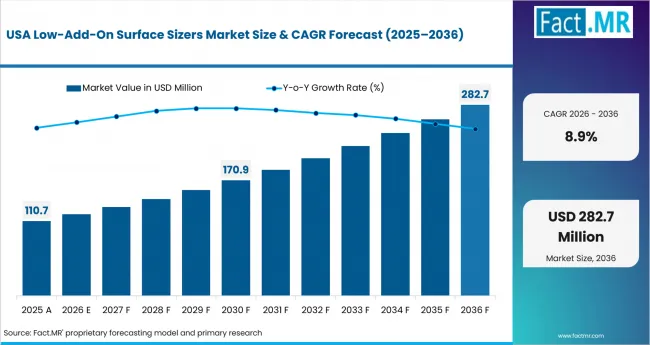
The United States is expected to advance at 8.9% CAGR through 2036, driven by PFAS-free packaging programs and recycled-board output.
Low Add On Surface Sizers Market Country Value Analysis | Source: Fact.MR
United States buyers are moving faster in food-contact surface chemistry due to clearer regulatory direction. The American Forest & Paper Association reported in May 2026 that U.S. paper and paperboard production reached 66.3 million tons in 2025. Containerboard and packaging paper mills therefore remain important testing routes for low-add-on surface sizing programs.
What underpins Germany’s growth?
Germany is projected to rise at 8.5% CAGR by 2036, attributable to packaging quality discipline and European rule alignment.
German buyers have high documentation requirements for packaging and paper chemicals. DIE PAPIERINDUSTRIE reported in its 2025 performance report that German paper sales volume reached 19 million tonnes in 2024. This base supports steady demand for surface programs in board and specialty paper. Converting grades add a further buyer group. Suppliers with European food-contact documentation and field service are expected to be better placed in mill trials.
Why is Japan an important sizing market?
Japan is forecast at 8.1% CAGR through 2036, supported by specialty paper quality needs and foodservice board conversion.
Japan’s paper market is smaller than China’s but quality requirements remain high. The Japan Paper Association reported that paper and paperboard production was 21,604 thousand tonnes in 2024. Specialty paper and label applications create demand for sizing programs that support print holdout at low pickup. Suppliers must prove consistent sheet results because Japanese buyers tend to use conservative qualification cycles.
How does France fit into the European opportunity?
France is expected to post 8.0% CAGR through 2036, driven by food packaging reformulation and European recycling rules.
French converters are exposed to European packaging regulation and food-contact material expectations. European recycling rules matter for low-add-on surface sizers because converters need water resistance without complicating finished-pack recovery. Suppliers that can document repulpability and print performance gain a clearer route into foodservice board accounts.
Who leads the low-add-on surface sizers landscape?
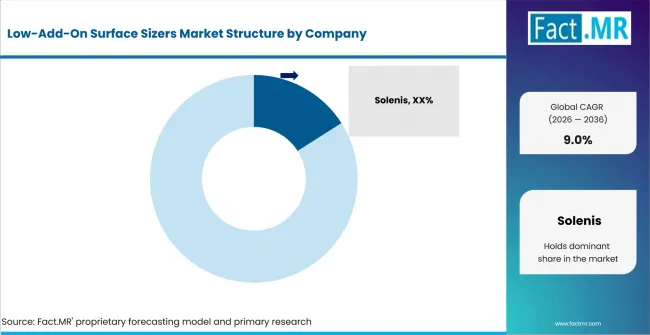
Solenis; Kemira; Harima Chemicals; Nalco Water (Ecolab) and Ingredion Incorporated compete through chemistry portfolios and mill service.
Low Add On Surface Sizers Market Analysis By Company | Source: Fact.MR
Low-add-on surface sizers are sold to mills that want proof of machine stability and finished sheet performance. Solenis lists sizing agents and surface treatments for paper and board applications. Kemira lists FennoSize S surface sizing agents for paper, packaging and board grades.
Emulsion polymers matter where mills need film formation and water resistance at controlled pickup.
Competition depends less on catalog breadth and more on trial support. A supplier must help a mill decide solids and pH. Drying load and application method are checked during the same trial. Suppliers with better account access combine paper chemistry and food-contact documentation. Field service staff must stay through machine trials.
Packaging coating activity also affects the supplier map because converters increasingly test sizing and barrier functions together. This favors companies that can support surface sizing and adjacent paper coating programs without forcing buyers into a heavier treatment than the grade requires. Coating additives influence the same paper-machine purchase discussion when mills buy sizing agents and modifiers from one service team.
Which companies are the key players?
Solenis; Kemira; Harima Chemicals; Nalco Water (Ecolab) and Ingredion Incorporated.
- Solenis
- Kemira
- Harima Chemicals
- Nalco Water (Ecolab)
- Ingredion Incorporated
Bibliography
- U.S. Food and Drug Administration. (2024, February 28). FDA announces PFAS used in grease-proofing agents for food packaging no longer being sold in the U.S. U.S. Food and Drug Administration.
- European Union. (2025, January 22). Regulation (EU) 2025/40 on packaging and packaging waste. EUR-Lex.
- Confederation of European Paper Industries. (2026, February 17). New 2025 pulp and paper manufacturing figures show moderate resilience in a context of rising costs, increased competition, and industrial downturn. Confederation of European Paper Industries.
- American Forest & Paper Association. (2026, May 29). AF&PA releases 66th annual paper industry capacity and fiber consumption survey. American Forest & Paper Association.
- Japan Paper Association. (2025). Paper and paperboard production. Japan Paper Association.
- India Brand Equity Foundation. (2026, February). Paper and packaging industry in India. India Brand Equity Foundation.
- DIE PAPIERINDUSTRIE. (2025). PAPIER 2025: Ein Leistungsbericht. DIE PAPIERINDUSTRIE.
- Solenis LLC. (2026). Sizing agents: Internal and surface applications. Solenis.
- Kemira Oyj. (2026). Surface sizing. Kemira.
This Report Addresses
- Strategic intelligence on low-add-on surface sizers across chemistry, paper grade, and application method.
- Segment analysis covering AKD, containerboard, water resistance, metered size press and integrated paper mills.
- Regional outlook covering India, China, Brazil, the United States, Germany, Japan, and France.
- Competitive analysis of Solenis; Kemira; Harima Chemicals; Nalco Water (Ecolab) and Ingredion Incorporated.
- Application assessment covering film press, metered size press, spray, blade line and pond size press.
- Source review covering packaging regulation, paper production, supplier launches and company portfolio validation.
What does the low-add-on surface sizers market cover?
Surface-applied sizing agents used at lower add-on levels for paper and paperboard.
The low-add-on surface sizers market covers specialty chemicals applied to the surface of paper and paperboard to improve water resistance and print holdout. It also covers surface strength and barrier readiness. It includes alkyl ketene dimer and alkenyl succinic anhydride. It also includes acrylic copolymers plus polyurethane dispersions. Starch hybrids and fluorine-free barrier polymers are included. The market differs from bulk coating because buyers focus on functional effect at lower dry pickup.
What is included in the scope?
Surface sizing chemistry and application support for paper and board mills.
The scope includes low-dosage sizing agents used at film press and metered size press systems. It also covers spray units, blade lines and pond size press systems. It covers products sold to containerboard mills and foodservice board mills. It also covers printing paper mills, specialty paper converters and sack kraft producers. It also includes supplier support for runnability checks and Cobb value control. Printability targets and barrier trials are included.
What is excluded from the scope?
Internal sizing sales without surface application and full coating systems sold outside sizing use.
The scope excludes internal sizing chemistry when it has no surface application role. It excludes raw starch sold without surface sizing positioning. It excludes full paper coating systems where the main purpose is pigment coating or decorative finish. It excludes finished paper and paperboard sales.
How was the analysis built?
100+ sources reviewed. 45+ company portfolios checked. 30+ countries screened. 20+ interviews assessed.
- Primary Research: Primary research covered paper mill procurement managers and chemical distributors. It also covered packaging converters and size press application specialists. Interviews focused on dosage targets and trial approval. They also checked machine deposits and the purchase trade-off between cost per tonne and paper performance.
- Desk Research: Desk research reviewed government packaging rules and paper production statistics. It also reviewed trade association data, company product portfolios and official supplier announcements. The review avoided syndicated market figures and commercial market publisher data.
- Market-Sizing and Forecasting: Forecasting used user-provided value anchors and paper and board output checks. Chemistry mix assumptions and application intensity by paper grade supported the model. Estimates were reconciled against supplier portfolios and packaging regulation signals.
- Data Validation and Update Cycle: Forecasts were validated through source recency checks and company activity from 2024 onward. The update cycle also checked whether older fluorochemical claims were still suitable after food-contact restrictions moved buyers toward fluorine-free surface systems.
What is the report’s scope and coverage?
| Attribute | Details |
|---|---|
| Quantitative Units | USD Million in 2026 to USD Million by 2036 |
| Market Definition | Surface-applied low-add-on sizing agents for paper and paperboard |
| Chemistry | AKD, ASA, acrylic copolymers, polyurethane dispersions, starch hybrids, fluorine-free barrier polymers |
| Paper Grade | Containerboard, foodservice board, printing paper, specialty paper, sack kraft, label paper |
| Performance | Water resistance, printability, strength, lower dosage, runnability, barrier performance |
| Application Method | Film press, metered size press, spray, blade/coating line, pond size press |
| Buyer Type | Integrated paper mills, independent converters, specialty mills, foodservice board mills, label stock producers |
| Regions Covered | North America, Europe, East Asia, South Asia, Latin America, Middle East and Africa |
| Countries Covered | India, China, Brazil, United States, Germany, Japan, France |
| Key Companies Profiled | Solenis, Kemira, Harima Chemicals, Ecolab, Ingredion Incorporated |
| Forecast Period | 2026 to 2036 |
| Approach | Hybrid top-down and bottom-up approach using paper output checks, supplier portfolios, packaging regulation signals and interview validation |
How is the market segmented?
-
By Chemistry:
- AKD
- ASA
- Acrylic Copolymers
- Polyurethane Dispersions
- Starch Hybrids
- Fluorine-Free Barrier Polymers
-
By Paper Grade:
- Containerboard
- Foodservice Board
- Printing Paper
- Specialty Paper
- Sack Kraft
- Label Paper
-
By Performance:
- Water Resistance
- Printability
- Strength
- Lower Dosage
- Runnability
- Barrier Performance
-
By Application Method:
- Film Press
- Metered Size Press
- Spray
- Blade Line
- Pond Size Press
-
By Buyer Type:
- Integrated Mills
- Independent Converters
- Specialty Mills
- Foodservice Board Mills
- Label Stock Producers
-
By Region:
- North America
- Latin America
- Europe
- East Asia
- South Asia
- Middle East & Africa
- North America
- United States
- Canada
- Latin America
- Brazil
- Argentina
- Mexico
- Rest of Latin America
- Europe
- Germany
- United Kingdom
- France
- Italy
- Spain
- Rest of Europe
- East Asia
- China
- Japan
- South Korea
- South Asia
- India
- ASEAN
- Middle East & Africa
- GCC Countries
- South Africa
- UAE
- Rest of Middle East & Africa
- North America