- Market Value (2025): USD 1.0 Bn
- Estimated Value (2026): USD 1.3 Bn
- Forecast Value (2036): USD 11.1 Bn
- CAGR (2026-2036): 24.1%
What is the Low-Altitude Drag-Resistant Platforms Market forecast to be worth by 2036?
USD 1.3 billion in 2026 to USD 11.1 billion by 2036, at a 24.1% CAGR.
- The market is valued at USD 1.0 billion in 2025.
- Demand is projected to increase from USD 1.3 billion in 2026 to USD 11.1 billion by 2036.
- The market is forecast to record a 24.1% CAGR from 2026 to 2036 as Earth observation, defence ISR and communications missions move closer to Earth while propulsion and materials mature for drag-intensive operations.
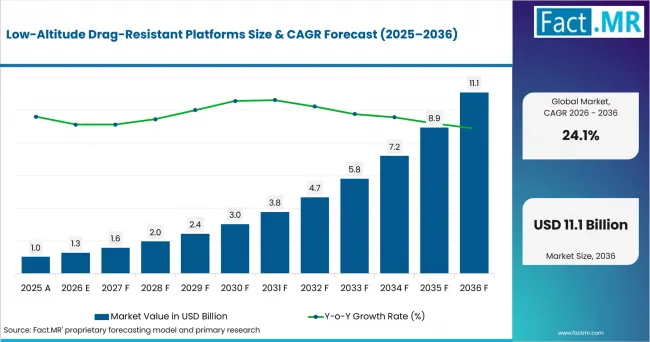
Low Altitude Drag Resistant Platforms Value Analysis | Source: Fact.MR
What are the defining numbers behind Low-Altitude Drag-Resistant Platforms Market growth?
The market is projected to create approximately USD 9.8 billion in absolute dollar opportunity between 2026 and 2036.
- Demand Drivers in the Market
- Operating closer to Earth can improve optical resolution and radio-link performance for a given payload, creating a direct mission incentive for Earth observation, ISR and selected communications architectures.
- Flight heritage from ESA GOCE and JAXA SLATS has shown that aerodynamic spacecraft design and electric propulsion can sustain missions in drag-sensitive low orbits.
- DARPA Otter is advancing air-breathing electric propulsion for 90-450 km operations, creating a path toward longer-duration VLEO missions without carrying all propellant from launch.
- Lower operating altitudes can shorten natural orbital persistence after end of mission, which can support debris-mitigation objectives when safe reentry and mission disposal are designed correctly.
- Key Segments Analyzed
- By Platform Design: Low-drag bus geometry holds 34.0% share in 2026, followed by aerodynamic deployable surfaces at 21.0%.
- By Altitude: 251-350 km accounts for 34.0% share in 2026, ahead of 181-250 km at 31.0%.
- By Propulsion: Electric drag compensation represents 37.0% share in 2026, while air-breathing electric propulsion accounts for 21.0%.
- By Mission: Earth observation leads with 35.0% share in 2026, followed by defence ISR at 23.0%.
- Analyst Opinion at Fact.MR
- Shambhu Nath Jha, Senior Consultant, Fact.MR, notes that low-altitude platforms should be treated as an integrated spacecraft problem rather than a propulsion upgrade. Cross-sectional area, atomic-oxygen exposure, pointing stability, thermal design and thrust margin all interact. The suppliers that can prove stable mission life at the intended altitude, not simply demonstrate a low orbit for a short period, are likely to capture the highest-value programs.
- Strategic Implications
- Platform developers should set altitude and mission life before selecting propulsion because drag rises sharply as orbit altitude falls and varies with solar activity.
- Earth-observation operators should compare resolution gains against propulsion power, duty cycle and constellation replenishment economics rather than using altitude alone as the performance metric.
- Materials and coatings should be qualified for atomic oxygen and sustained ram exposure when operations move below conventional LEO altitudes.
- Defence buyers should evaluate VLEO as a resilient layer within a broader multi-orbit architecture, especially where revisit, signal strength and rapid natural disposal are operational priorities.
Country growth remains exceptionally high across the assessed set. The UK leads at 25.6% CAGR from 2026 to 2036, followed by Japan at 25.2%, the USA at 24.9%, France at 24.4% and Germany at 24.0%.
How does the Low-Altitude Drag-Resistant Platforms Market break down by segment?
The Low-Altitude Drag-Resistant Platforms Market is segmented by Platform Design into Low-drag bus geometry, Aerodynamic deployable surfaces, High-density compact bus, Drag-compensated platform and Adaptive attitude-optimized bus; by Altitude into 120-180 km, 181-250 km, 251-350 km, 351-450 km and >450 km; by Propulsion into Electric drag compensation, Air-breathing EP, Chemical micropropulsion, Cold gas / resistojet and Passive only; and by Mission into Earth observation, Defence ISR, Communications, Atmospheric science and Other.
Why does Low-drag bus geometry lead demand within Platform Design?
Low-drag bus geometry holds 34.0% share in 2026.
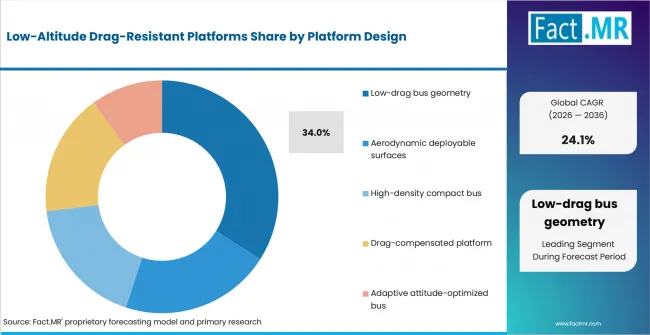
Low Altitude Drag Resistant Platforms Analysis By Platform Design | Source: Fact.MR
Aerodynamic geometry reduces the frontal area and torque disturbances presented to the residual atmosphere. ESA designed GOCE around a slender, highly symmetric structure and winglets because the satellite operated near 250 km, where drag could otherwise overwhelm the precision gravity mission. That design logic remains directly relevant to modern drag-resistant buses.
The sensing demand behind these platforms intersects with the Earth Observation Market, where higher revisit and better spatial performance continue to increase the value of satellite-based observation.
Why does the 251-350 km band lead demand within Altitude?
The 251-350 km band accounts for 19.0% share in 2026.
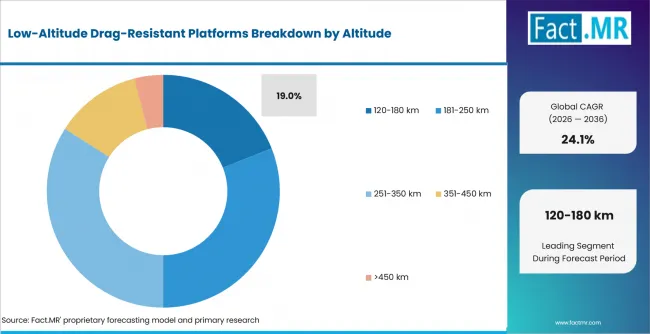
Low Altitude Drag Resistant Platforms Analysis By Altitude | Source: Fact.MR
This altitude band offers a practical compromise between proximity benefits and survivability. DLR describes VLEO as orbits below roughly 300 km and notes that better optical resolution and shorter signal paths come with significant drag and more demanding propulsion. JAXA demonstrated progressively lower operations with SLATS, while ESA GOCE sustained science operations near 250 km using continuous electric drag compensation.
The 181-250 km band follows with 31.0% share. Demand below 180 km remains smaller at 19.0% because propulsion and materials loads rise sharply, while 351-450 km and >450 km represent 12.0% and 4.0% respectively within the defined low-altitude platform market.
Why does Electric drag compensation lead demand within Propulsion?
Electric drag compensation holds 37.0% share in 2026.
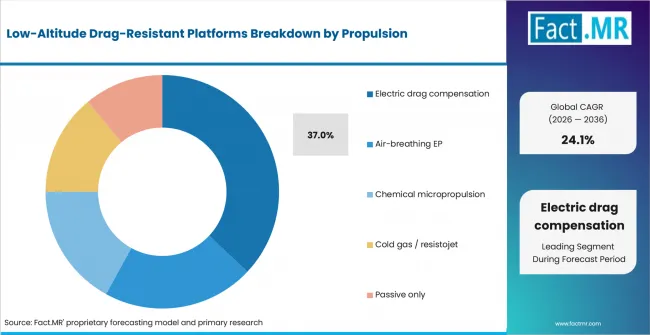
Low Altitude Drag Resistant Platforms Analysis By Propulsion | Source: Fact.MR
Continuous low-thrust electric propulsion matches the operating problem of drag-sensitive orbit maintenance because it can apply small corrective forces over long periods. ESA GOCE used automatically throttled ion propulsion to counter atmospheric drag, and JAXA SLATS used ion propulsion across multiple super-low-altitude operating points.
The qualification burden also creates adjacent demand in the Electric Propulsion Thruster Test Equipment Market, where vacuum testing and life validation support the transition from thruster development to flight service.
Air-breathing electric propulsion represents 21.0% share and is the most disruptive adjacent architecture. DARPA Otter is designed to harvest ambient low-density air and use it as propellant, targeting extended operations across 90-450 km. Chemical micropropulsion accounts for 17.0%, cold gas / resistojet 14.0%, and passive-only designs 11.0%.
Why does Earth observation lead demand within Mission?
Earth observation accounts for 35.0% share in 2026.
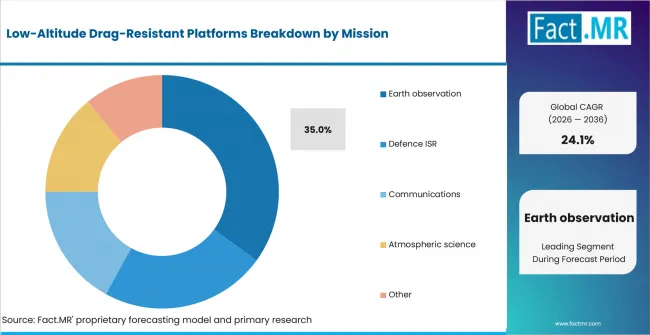
Low Altitude Drag Resistant Platforms Analysis By Mission | Source: Fact.MR
Earth observation benefits directly from proximity because a sensor can achieve finer ground sampling from a lower orbit or reach a given resolution with a smaller optical system. JAXA SLATS demonstrated high-resolution imaging at very low altitude, while DLR identifies improved optical resolution as one of the core advantages of VLEO.
Platform qualification also overlaps with the Small Satellite Environmental Test Systems Market, because low-altitude spacecraft need thermal-vacuum, structural and materials validation before mission-specific flight qualification.
Defence ISR follows at 23.0%, communications at 17.0%, atmospheric science at 14.0% and other missions at 11.0%. Lower altitude can support stronger links and rapid revisit, but each use case must be balanced against drag, power and lifetime constraints.
What is accelerating Low-Altitude Drag-Resistant Platforms Market adoption, and what is holding it back?
Adoption is being accelerated by proximity-driven payload performance, defence interest in responsive sensing, maturing electric propulsion and stronger attention to orbital sustainability. The main constraints are atmospheric drag variability, power demand, atomic-oxygen exposure and limited long-duration flight heritage at the lowest altitudes.
The impact values below are directional analytical estimates used to compare market mechanisms. They are not additive components of the 24.1% market CAGR.
Drivers Impact Analysis
| DRIVER | (~) % IMPACT ON CAGR | GEOGRAPHIC RELEVANCE | IMPACT TIMELINE |
|---|---|---|---|
| Higher resolution and stronger links from lower altitude | +3.4% | USA, Europe, Japan | 2026 to 2036 |
| Electric drag-compensation flight heritage | +2.8% | Europe, Japan, USA | 2026 to 2034 |
| Defence ISR and responsive sensing demand | +2.5% | USA, UK, France | 2026 to 2036 |
| Debris-mitigation value of shorter natural orbital persistence | +1.6% | Global | 2027 to 2036 |
- Proximity benefit: DLR notes that VLEO can improve optical resolution and shorten signal paths. This can reduce payload size for a given mission objective or increase performance without proportionally increasing aperture or transmit power.
- Flight heritage: ESA GOCE sustained operations near 250 km through aerodynamic design and continuous ion propulsion. JAXA SLATS later demonstrated orbit keeping down to 167.4 km, providing practical evidence that drag-sensitive missions can be operated when propulsion and materials are designed around the environment.
- Defence demand: DARPA Otter is specifically developing air-breathing electric propulsion for VLEO. Redwire received a phase 2 contract to manufacture and deliver the Otter spacecraft based on its SabreSat platform, giving the market a current defence-backed demonstration path.
- Sustainability: ESA continues tightening debris-mitigation expectations and its 2026 space-environment reporting shows the pressure created by increasing LEO traffic. Low-altitude missions can benefit from faster post-mission decay, although safe reentry and controlled operations remain necessary.
Opportunity Impact Analysis
| OPPORTUNITY | (~) % IMPACT ON CAGR | GEOGRAPHIC RELEVANCE | IMPACT TIMELINE |
|---|---|---|---|
| VLEO Earth-observation constellations | +3.1% | USA, Japan, Europe | 2026 to 2036 |
| Air-breathing electric propulsion | +2.7% | USA, Europe, Japan | 2028 to 2036 |
| Defence ISR and resilient multi-orbit layers | +2.2% | USA, UK, France | 2026 to 2036 |
| Compact payloads enabled by closer operating distance | +1.8% | Global | 2027 to 2036 |
- Earth observation: Skeyeon is developing a purpose-built VLEO architecture around roughly 250 km and received a U.S. patent in 2026 covering remote sensing from 180-350 km with drag-compensating propulsion. Redwire is separately advancing VLEO platforms for sensing and defence missions.
- The use of electric propulsion to sustain long-duration spacecraft also connects with the All-Electric Satellites Market, where electric propulsion is already established as a core satellite-architecture choice across orbit classes.
- Air-breathing propulsion: DARPA Otter is designed to reduce the finite-propellant constraint by using ambient atmospheric particles as the propellant source. If long-duration performance is demonstrated, the technology could expand viable mission life in the lowest altitude bands.
- Communications opportunity: lower altitude can improve link budgets and latency, but coverage footprints shrink and constellations become larger. This makes VLEO communications most relevant for specialised resilient, direct-to-device or high-capacity layers rather than as an automatic substitute for conventional LEO.
- That communications trade-off can be viewed alongside the broader Satellite Internet Market, where constellation scale, spacecraft manufacturing and network economics determine commercial viability.
Restraints Impact Analysis
| RESTRAINT | (~) % IMPACT ON CAGR | GEOGRAPHIC RELEVANCE | IMPACT TIMELINE |
|---|---|---|---|
| Atmospheric drag and solar-cycle variability | -3.0% | Global | 2026 to 2036 |
| Atomic-oxygen and materials degradation | -2.1% | 120-350 km missions | 2026 to 2036 |
| Power and propellant burden for orbit maintenance | -1.9% | Global | 2026 to 2034 |
| Limited long-duration heritage at the lowest altitudes | -1.3% | Global | 2026 to 2032 |
- Drag variability: NASA notes that atmospheric drag on low-Earth-orbit satellites rises when solar activity heats and expands the upper atmosphere. Designers therefore need thrust margin and orbit-control logic that can tolerate density changes rather than a single nominal drag condition.
- Materials exposure: JAXA reports that atomic-oxygen density at super-low altitudes can be far greater than at conventional Earth-observation altitudes. Surface materials, coatings and exposed mechanisms must therefore be qualified for erosion and contamination risk.
- Power burden: continuous or frequent orbit maintenance consumes electrical power and can drive larger solar arrays, batteries and thermal-control systems. These additions can increase area and drag if they are not integrated into the aerodynamic design.
- Heritage gap: GOCE and SLATS proved key technologies, but the commercial market still has limited multi-year heritage below conventional LEO. Program schedules can therefore depend on demonstration missions, insurance acceptance and customer confidence in predicted lifetime.
Which countries are scaling the Low-Altitude Drag-Resistant Platforms Market through 2036?
The country set grows within a narrow but very high range because VLEO remains an emerging architecture rather than a mature satellite class. The UK leads at 25.6% CAGR, followed by Japan at 25.2%, the USA at 24.9%, France at 24.4% and Germany at 24.0%.
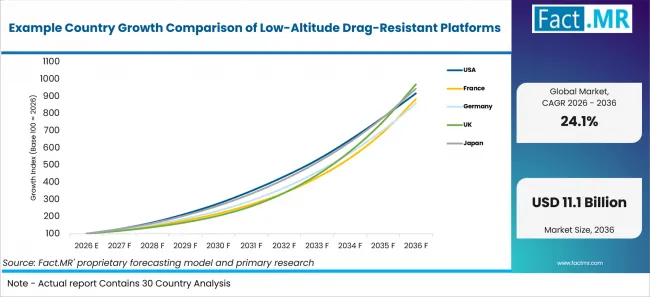
Example Country Growth Comparison Of Low Altitude Drag Resistant Platforms | Source: Fact.MR
| Country | CAGR (2026-2036) |
|---|---|
| USA | 24.9% |
| France | 24.4% |
| Germany | 24.0% |
| UK | 25.6% |
| Japan | 25.2% |
What supports USA growth?
24.9% CAGR through 2036, supported by defence-backed VLEO demonstrations and an active small-satellite manufacturing base.
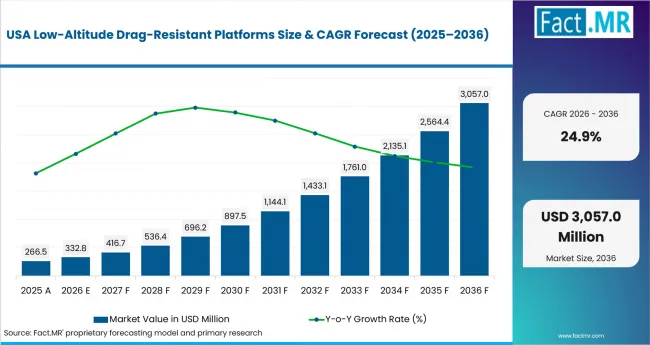
Low Altitude Drag Resistant Platforms Country Value Analysis | Source: Fact.MR
DARPA Otter directly targets operations from 90 km to 450 km using air-breathing electric propulsion. Redwire is under contract to advance the phase 2 spacecraft using its SabreSat VLEO platform. This creates a near-term route from propulsion research to an integrated flight demonstrator, while U.S. Earth-observation and defence customers provide clear demand for higher revisit and high-resolution sensing.
What supports France growth?
24.4% CAGR through 2036, supported by European Earth-observation heritage and VLEO platform development.
CNES participates in the scientific use of ESA GOCE data and documents the role of ion propulsion in maintaining that very low orbit. France also benefits from Thales Alenia Space participation in the ESA-backed Skimsat study, which targets a small multimission spacecraft operating below 300 km. The combination of mission heritage and current platform engineering supports commercialisation through the forecast period.
How is Germany scaling demand?
24.0% CAGR through 2036, with research capability focused on small satellites and the engineering challenges of VLEO.
DLR explicitly identifies very low Earth orbit as a demanding operating environment for small satellites below roughly 300 km. Its public technical guidance highlights both the proximity benefits and the propulsion burden created by atmospheric drag. Germany also has a broad spacecraft, electric-propulsion and materials research base that can support platform qualification and subsystem supply.
What supports UK adoption?
25.6% CAGR through 2036, the fastest growth rate in the assessed country set.
The UK combines a strong small-satellite sector with direct VLEO development activity. Thales Alenia Space and QinetiQ began an ESA-backed Skimsat study in Bristol for a multimission platform below 300 km. The UK Space Agency is also funding wider low-Earth-orbit satellite communications development through the C-LEO programme, strengthening the domestic engineering and supply-chain base relevant to low-altitude constellations.
What supports Japan growth?
25.2% CAGR through 2036, supported by the strongest national flight heritage in super-low-altitude Earth observation among the assessed countries.
JAXA SLATS, or Tsubame, operated at seven altitude levels and achieved a record 167.4 km Earth-observation orbit. JAXA used ion propulsion throughout the programme and added gas-jet thrusters at the lowest altitude because drag was so high. That flight record gives Japan practical experience in propulsion, materials and mission operations directly relevant to commercial low-altitude platforms.
Who leads the Low-Altitude Drag-Resistant Platforms Market?
The competitive landscape is led by a mix of specialised VLEO developers and established spacecraft manufacturers. Redwire has built a strong position in very low Earth orbit through its SabreSat platform and work linked to the DARPA Otter programme. Thales Alenia Space is advancing the Skimsat concept with QinetiQ, while Skeyeon is developing a dedicated VLEO architecture focused on compact sensing, low-drag materials and direct-to-ground data delivery.
Larger aerospace groups add scale, spacecraft-bus expertise and constellation manufacturing capability. Lockheed Martin strengthened its satellite manufacturing position through the acquisition of Terran Orbital in 2024. Airbus and Blue Canyon Technologies also bring broad spacecraft development capabilities that can support low-altitude missions. Competition is therefore shifting toward companies that can combine aerodynamic design, propulsion efficiency, compact payload integration and repeatable satellite production.
Which companies are active in the competitive landscape?
- Redwire
- Airbus Defence and Space
- Thales Alenia Space
- Blue Canyon Technologies, currently part of RTX with an announced sale to MDA Space pending completion
- Skeyeon
- Lockheed Martin, including the Terran Orbital business
Bibliography
- Defense Advanced Research Projects Agency. Otter programme overview, Very Low Earth Orbit air-breathing electric propulsion.
- European Space Agency. GOCE operations, satellite design and drag-free electric propulsion materials.
- European Space Agency Space Debris Office. Space Environment Report, 2026 edition, and current orbital-environment statistics.
- Japan Aerospace Exploration Agency. Super Low Altitude Test Satellite SLATS / Tsubame mission results and 167.4 km altitude record.
- German Aerospace Center. Small satellites and Very Low Earth Orbit technical overview.
- National Aeronautics and Space Administration. Earth satellite orbit guidance and atmospheric-drag effects.
- Centre National d'Etudes Spatiales. GOCE mission overview and French scientific participation.
- UK Space Agency. Connectivity in Low-Earth Orbit programme, updated 2026.
- Redwire Corporation. DARPA Otter phase 2 award and SabreSat platform information.
- Thales Alenia Space. Skimsat VLEO multimission study with QinetiQ.
- Skeyeon. 2026 VLEO remote-sensing patent and platform technology information.
- Lockheed Martin. Completion of Terran Orbital acquisition, October 2024.
- RTX and MDA Space. Blue Canyon Technologies ownership and announced 2026 sale transaction materials.
This Report Answers
- How large is the Low-Altitude Drag-Resistant Platforms Market in 2025, 2026 and 2036?
- Why do low-drag bus geometry, the 251-350 km altitude band, electric drag compensation and Earth observation lead their categories?
- How do atmospheric drag, atomic oxygen and solar activity affect platform design and mission life?
- What commercial opportunity could air-breathing electric propulsion create in VLEO?
- How do the USA, France, Germany, UK and Japan differ in forecast growth through 2036?
- Which current company groups participate in the market, and how do recent acquisitions affect the competitive landscape?
What does the Low-Altitude Drag-Resistant Platforms Market cover?
The market covers complete spacecraft platforms designed for sustained mission operation in low-altitude Earth orbits where residual-atmosphere drag materially affects lifetime, pointing or orbit maintenance. Covered platforms may use low-drag geometry, deployable aerodynamic features, compact high-density buses, active drag compensation or attitude strategies that reduce drag and torque.
Covered missions include Earth observation, defence ISR, communications, atmospheric science and other applications in the defined altitude bands. Propulsion may be electric, air-breathing electric, chemical micropropulsion, cold gas / resistojet or passive-only where the mission profile does not require active long-duration drag compensation.
What is included in the scope?
Included revenue covers spacecraft bus and platform value attributable to the defined low-altitude drag-resistant architectures. Integrated propulsion, power, attitude control, thermal management and structural features are included when delivered as part of the complete platform configuration.
Platforms operating across the listed altitude classes are included when low-altitude drag resistance or drag compensation is a material design feature. The assessment includes commercial, civil and defence platforms sold for Earth observation, ISR, communications, atmospheric science and other covered missions.
What is excluded from the scope?
Conventional LEO satellites without a material drag-resistant or drag-compensation design requirement are outside the core market. Standalone thrusters, propellants, coatings, sensors, payloads, launch vehicles and ground stations are excluded unless supplied as an inseparable part of the platform value.
Short-lived sounding rockets, crewed spacecraft and high-altitude platforms within the atmosphere are excluded. Satellite data services and imagery revenue are also outside the market unless the business model includes the sale of the covered spacecraft platform itself.
How Was the Analysis Built?
- Primary Research: The analysis considers spacecraft platform architecture, low-altitude mission requirements, propulsion duty cycle, materials exposure, payload performance and customer procurement criteria across civil, commercial and defence programs.
- Desk Research: Public evidence includes ESA, JAXA, NASA, DARPA, DLR, CNES and UK Space Agency material, along with current company filings and programme announcements used for company-status validation.
- Market Sizing and Forecasting: The assessment uses the approved 2025, 2026 and 2036 market values, segment shares, supplier shares and country growth rates for the 2026 to 2036 forecast period.
- Data Validation and Update Cycle: Corporate ownership, active programmes and 2026 public evidence are checked before publication so obsolete company status is not presented as current competition.
What is the report's scope and coverage?
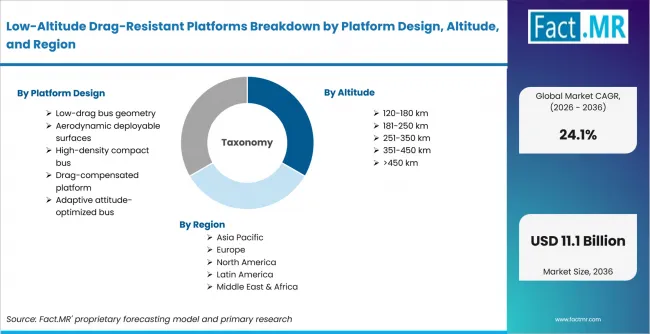
Low Altitude Drag Resistant Platforms Breakdown By Platform Design, Altitude, And Region | Source: Fact.MR
| Attribute | Details |
|---|---|
| Quantitative Units | USD billion; CAGR and revenue shares in percent |
| Market Definition | Spacecraft platforms purpose-built for sustained low-altitude Earth-orbit operations where residual-atmosphere drag materially affects design, lifetime or orbit maintenance. |
| Platform Design | Low-drag bus geometry; Aerodynamic deployable surfaces; High-density compact bus; Drag-compensated platform; Adaptive attitude-optimized bus |
| Altitude | 120-180 km; 181-250 km; 251-350 km; 351-450 km; >450 km |
| Propulsion | Electric drag compensation; Air-breathing EP; Chemical micropropulsion; Cold gas / resistojet; Passive only |
| Mission | Earth observation; Defence ISR; Communications; Atmospheric science; Other |
| Regions Covered | North America; Latin America; Western Europe; Eastern Europe; East Asia; South Asia & Pacific; Middle East & Africa |
| Countries Covered | USA; France; Germany; UK; Japan |
| Competitive Set | Redwire; Airbus Defence and Space; Thales Alenia Space; Blue Canyon Technologies; Skeyeon; Lockheed Martin including Terran Orbital business |
| Forecast Period | 2026 to 2036 |
| Approach | Market sizing, segment and supplier share analysis, country growth assessment, and validation against public space-agency, regulatory and company evidence. |
How is the market segmented?
-
By Platform Design
- Low-drag bus geometry - 34.0%
- Aerodynamic deployable surfaces - 21.0%
- High-density compact bus - 18.0%
- Drag-compensated platform - 17.0%
- Adaptive attitude-optimized bus - 10.0%
-
By Altitude
- 120-180 km - 19.0%
- 181-250 km - 31.0%
- 251-350 km - 34.0%
- 351-450 km - 12.0%
- >450 km - 4.0%
-
By Propulsion
- Electric drag compensation - 37.0%
- Air-breathing EP - 21.0%
- Chemical micropropulsion - 17.0%
- Cold gas / resistojet - 14.0%
- Passive only - 11.0%
-
By Mission
- Earth observation - 35.0%
- Defence ISR - 23.0%
- Communications - 17.0%
- Atmospheric science - 14.0%
- Other - 11.0%
-
By Region
- North America
- Latin America
- Western Europe
- Eastern Europe
- East Asia
- South Asia & Pacific
- Middle East & Africa