- Market Value (2025): USD 5.9 Bn
- Estimated Value (2026): USD 6.4 Bn
- Forecast Value (2036): USD 15.9 Bn
- CAGR (2026-2036): 9.5%
What is the Hardware Integration Platforms Market forecast to be worth by 2036?
USD 6.4 billion in 2026 to USD 15.9 billion by 2036 at a 9.5% CAGR.
- The Hardware Integration Platforms Market reached USD 5.9 billion in 2025.
- Demand is projected to increase from USD 6.4 billion in 2026 to USD 15.9 billion by 2036.
- The market is forecast to record 9.5% CAGR from 2026 to 2036 with plant engineering teams reducing custom board work.
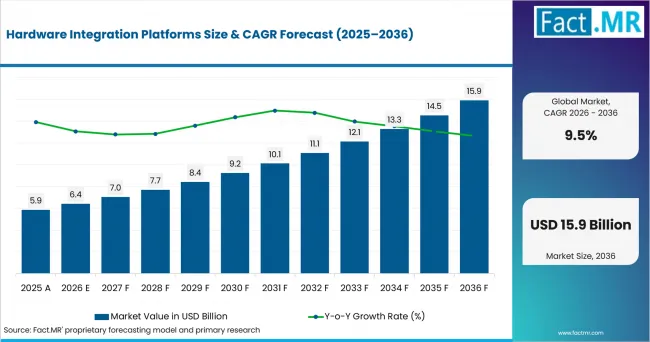
Hardware Integration Platforms Value Analysis | Source: Fact.MR
What are the defining numbers behind Hardware Integration Platforms Market growth?
An absolute opportunity of USD 9.5 billion is expected between 2026 and 2036.
- Demand Drivers in the Market
- Automation programs are moving toward repeatable hardware stacks where control cabinets combine embedded compute, safety I/O and machine vision. Lawrence Berkeley National Laboratory reported in June 2026 that data centers could account for 11.8% of U.S. electricity use by 2030.
- Factory robot deployment is increasing the value of validated compute and sensor connections. The International Federation of Robotics reported in September 2025 that 542,000 industrial robots were installed worldwide in 2024.
- Machine builders need board-level integration that protects software work already completed on x86 and ARM systems. Clear firmware support and carrier-board documentation reduce redesign work when processor generations change.
- Defense and transport programs use rugged modular platforms where chassis fit, thermal paths and backplane interfaces must be validated before field deployment. That requirement shifts spending toward suppliers with full integration packages.
- Key Segments Analyzed
- By Platform Type: Embedded compute integration is expected to hold 29.0% share in 2026 driven by demand for repeatable processor and carrier-board stacks.
- By Architecture: x86 industrial is projected to account for 26.0% share in 2026 supported by software compatibility across industrial PCs and edge systems.
- By Use Case: Industrial automation is anticipated to capture 29.0% share in 2026 owing to machine vision, robotics and motion-control hardware needs.
- By Integration Service: Board-level integration is estimated to represent 31.0% share in 2026 with equipment teams seeking validated power, I/O and thermal paths.
- Analyst Opinion at Fact.MR
- Shambhu Nath Jha, Principal Consultant at Fact.MR, states, “Hardware integration platforms are drawing attention as the bottleneck has moved beyond compute power. Buyers need documentation, firmware support and mechanical fit before a design reaches the field. Suppliers that combine validated boards, lifecycle control and thermal knowledge are expected to gain preference in projects where redesign risk is costly.”
- Strategic Implications
- Platform vendors should publish lifecycle roadmaps for processors, memory and connectors so engineering teams can plan redesign windows early.
- Embedded board suppliers should offer x86 and ARM options with tested I/O expansion, firmware support and migration notes for older systems.
- Rugged-system integrators should standardize thermal and vibration validation packs across repeatable chassis, backplane and module combinations.
- Edge AI platform suppliers should document accelerator support and field-service options before buyers approve systems for production equipment.
Japan is projected to record 12.3% CAGR through 2036 supported by machinery orders and electronics production. The UK is expected to post 10.9% CAGR supported by advanced manufacturing investment in automation hardware. The USA is forecast to advance at 10.3% CAGR with factory orders and edge infrastructure needs. Germany is anticipated to reach 9.7% CAGR through machinery demand. Taiwan is estimated to record 8.3% CAGR with electronics manufacturing scale supporting board-level supply.
How does the Hardware Integration Platforms Market break down by segment?
Board-level integration leads Integration Service at 31.0% share in 2026; embedded compute integration leads Platform Type at 29.0% share.
Which Platform Type dominates?
Embedded compute integration is expected to hold 29.0% share in 2026.
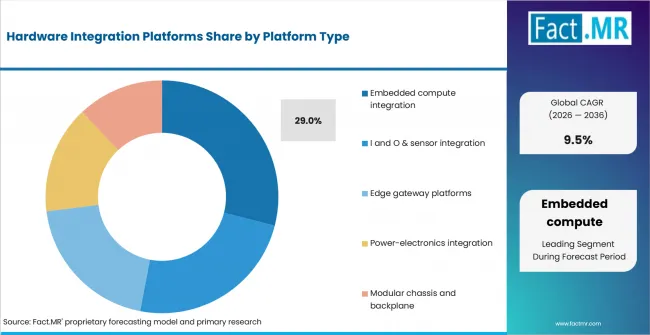
Hardware Integration Platforms Analysis By Platform Type | Source: Fact.MR
Embedded compute integration leads by giving equipment makers a ready path from processor choice to deployed control hardware. It reduces work on carrier boards, BIOS support and peripheral selection. Robot density and machine-vision deployment make this layer more valuable where factories need repeatable compute inside the same cabinet footprint.
Embedded compute suppliers package motherboards, SBCs, computer-on-modules and industrial PCs around common processor families. That portfolio breadth shows the value of integration: one processor shift affects board layout, I/O, firmware and mechanical fit together.
What leads the Architecture segment?
x86 industrial is projected to account for 26.0% share in 2026.
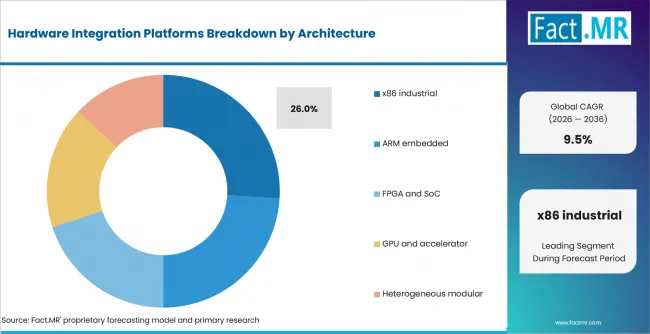
Hardware Integration Platforms Analysis By Architecture | Source: Fact.MR
x86 industrial platforms remain widely selected where engineering teams need Windows, Linux and real-time software support on familiar hardware. The architecture is useful for machine builders that want existing code to move across processor upgrades. GPU and NPU options support edge AI without forcing a full application redesign.
Intel announced new Core Ultra processors for edge computing at CES in January 2025, targeting edge and industrial use cases. The processors add integrated AI acceleration, while Intel continues to emphasize software compatibility and its established x86 software ecosystem.
How does Use Case shape demand?
Industrial automation is anticipated to capture 29.0% share in 2026.
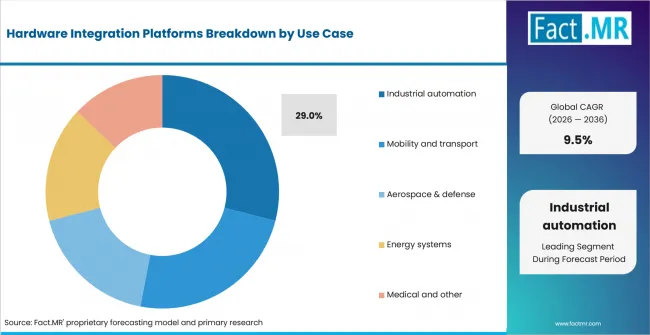
Hardware Integration Platforms Analysis By Use Case | Source: Fact.MR
Industrial automation leads where machine vision, robotics and motion-control equipment need compute, sensing and connectivity inside one cabinet. ADLINK launched its expandable DLAP Edge AI platforms in June 2025 with connectivity options including USB, Ethernet, HDMI, DisplayPort, serial and digital I/O. The platforms provide PCIe and other expansion options for industrial AI deployments, while the DLAP-5200 Series adds a fanless design suited to automation and other demanding industrial environments.
The use case is expected to remain tied to integration depth. A machine builder gains value when the compute board, I/O wiring and enclosure cooling are validated before the equipment reaches installation.
What supports Board-level integration within Integration Service?
Board-level integration is estimated to represent 31.0% share in 2026.
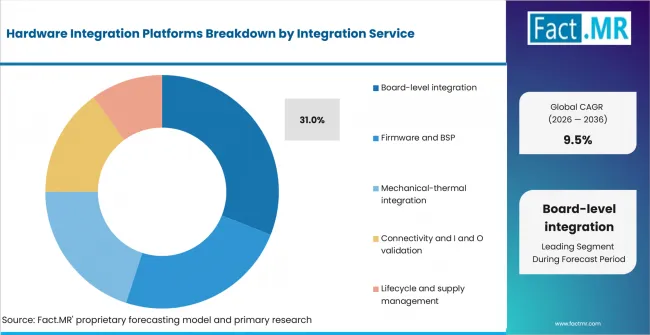
Hardware Integration Platforms Analysis By Integration Service | Source: Fact.MR
Board-level integration leads as the first practical step from processor selection to a working product. Carrier board layout, power rails, I/O routing and thermal interfaces decide whether a platform reaches certification without repeated redesign. These tasks are tied to the customer’s bill of materials and approval timeline.
Kontron and congatec signed an agreement in May 2025 to cooperate in computer-on-module manufacturing, under which Kontron will manufacture congatec COMs. Kontron’s subsidiary JUMPtec and congatec develop COMs for embedded computing formats including COM Express, COM-HPC, SMARC and Q7.
What is accelerating Hardware Integration Platforms Market adoption, and what is holding it back?
Demand is expected to rise through automation refresh, edge AI hardware and lifecycle-managed integration. Growth is constrained by qualification cost, supply continuity and thermal design limits.
Drivers Impact Analysis
| DRIVER | (~) % IMPACT ON CAGR | GEOGRAPHIC RELEVANCE | IMPACT TIMELINE |
|---|---|---|---|
| Industrial automation refresh and edge AI deployment | +1.4% | Global | Short term (<= 2 years) |
| Sensor and I/O expansion in machine platforms | +1.1% | North America, East Asia | Medium term (2-4 years) |
| Lifecycle-managed compute modules for regulated equipment | +0.9% | USA, Europe, Japan | Medium term (2-4 years) |
| Rugged edge hardware for defense and transport | +0.8% | USA, UK, Japan | Long term (>= 4 years) |
Source: Fact.MR analysis. Updated Sep 8, 2026
- Industrial automation refresh: Modernization of industrial automation systems is expected to increase demand for hardware platforms that combine computing, I/O connectivity, and thermal management within a repeatable architecture. Integrated designs can simplify deployment and reduce engineering effort across multiple machine and factory applications.
- Sensor and I/O expansion: Growing use of cameras, sensors, and safety devices is projected to increase demand for gateways and carrier boards with flexible connectivity. Platforms that accommodate changing I/O requirements can reduce redesign cycles and support faster integration across industrial equipment.
- Lifecycle-managed compute modules: Long-lived industrial products require computing modules with predictable availability, controlled upgrade paths, and replacement support. Lifecycle-managed platforms can help manufacturers maintain deployed equipment for extended periods while reducing disruption when processors or modules reach end of life.
Opportunity Impact Analysis
| OPPORTUNITY | (~) % IMPACT ON CAGR | GEOGRAPHIC RELEVANCE | IMPACT TIMELINE |
|---|---|---|---|
| x86 and ARM module upgrades for machine builders | +1.0% | Global | Short term (<= 2 years) |
| Rugged platforms for defense and transport electronics | +0.8% | USA, UK, Japan | Medium term (2-4 years) |
| Mechanical-thermal integration for edge AI systems | +0.7% | East Asia, North America | Long term (>= 4 years) |
Source: Fact.MR analysis. Updated Sep 8, 2026
- x86 and ARM upgrade cycles: Processor-generation changes create opportunities for suppliers to offer migration kits that preserve customer software investments. Platforms that maintain interface compatibility, operating-system support, and predictable upgrade paths can reduce engineering effort when industrial customers refresh compute hardware.
- Rugged platform demand: Defense and transport electronics favor suppliers with experience in rugged chassis, backplanes, environmental validation, and long-life system design. Proven mechanical and electrical integration can improve supplier positioning where reliability under vibration, temperature, and harsh operating conditions is critical.
- Mechanical-thermal integration: Higher-performance edge AI boards can place greater heat loads inside compact industrial enclosures. This creates service opportunities for suppliers that can optimize airflow, heat spreading, enclosure design, and component placement while maintaining reliability and form-factor constraints.
Restraints Impact Analysis
| RESTRAINT | (~) % IMPACT ON CAGR | GEOGRAPHIC RELEVANCE | IMPACT TIMELINE |
|---|---|---|---|
| Qualification and certification workload | -0.6% | Global | Short term (<= 2 years) |
| Component lifecycle and availability risk | -0.5% | North America, East Asia | Medium term (2-4 years) |
| Thermal and power limits in compact systems | -0.4% | Global | Long term (>= 4 years) |
Source: Fact.MR analysis. Updated Sep 8, 2026
- Qualification workload: Hardware changes can trigger repeated electromagnetic compatibility, vibration, safety, and environmental testing. This additional validation can slow design wins and extend deployment timelines, particularly in industrial, transport, and defense applications with strict qualification requirements.
- Component lifecycle risk: Changes in processors, memory, connectors, or other critical components can disrupt platform availability before full deployment. Suppliers therefore need lifecycle planning, alternate-component strategies, and controlled revision management to reduce production delays.
- Thermal and power limits: Compact enclosures can struggle to accommodate higher heat loads and power demand as GPUs, sensors, and high-speed networking are added. These constraints can limit upgrade options and increase the need for careful thermal, power, and enclosure design.
Which countries are scaling the Hardware Integration Platforms Market through 2036?
- The country comparison spans 4.03 percentage points and forms three practical growth bands across the forecast period.
- Japan remains 1.36 percentage points above the UK through machinery-order support and electronics production.
- The UK remains 0.62 percentage point above the USA supported by advanced manufacturing programs for automation hardware.
- The USA remains 0.60 percentage point above Germany through factory-order depth and edge infrastructure needs.
- Germany remains 1.45 percentage points above Taiwan through machinery and electrical equipment demand.
Comparable CAGRs create different entry conditions due to machinery output, electronics capacity, power limits and engineering labor availability. Full report coverage includes North America, Latin America, Western Europe, Eastern Europe, East Asia, South Asia & Pacific, Middle East & Africa.
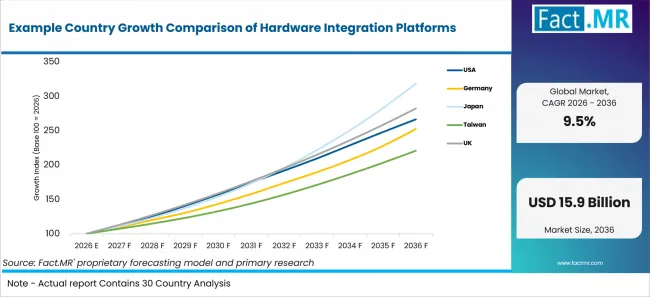
Example Country Growth Comparison Of Hardware Integration Platforms | Source: Fact.MR
| Country | CAGR (2026-2036) |
|---|---|
| Japan | 12.3% |
| United Kingdom | 10.9% |
| United States | 10.3% |
| Germany | 9.7% |
| Taiwan | 8.3% |
Source: Fact.MR analysis. Updated Sep 8, 2026
What supports Japan adoption?
12.3% CAGR, supported by machinery orders and electronics production.
Japan’s machinery builders evaluate platform suppliers on board availability, firmware support and long operating life before approving new embedded systems. The Cabinet Office reported in July 2026 that machinery orders received by 280 manufacturers operating in Japan rose 9.5% in May 2026 from the previous month. That order base supports integration demand in factory automation and transport electronics where hardware qualification must fit existing control architectures.
What supports the United Kingdom’s growth?
10.9% CAGR, backed by advanced manufacturing investment and automation policy.
The United Kingdom is expected to scale through advanced manufacturing programs that connect aerospace, automotive, battery and industrial equipment supply chains. The Office for National Statistics reported in July 2026 that total UK manufacturers’ product sales reached GBP 452.0 billion in 2025. That manufacturing base gives platform vendors room to support board-level integration, rugged compute and validated I/O where redesign budgets are closely controlled.
What supports USA adoption?
10.3% CAGR, driven by factory orders and edge infrastructure pressure.
The USA has a broad buyer base across automation, defense electronics, energy systems and data center support equipment. The U.S. Census Bureau reported in September 2026 that new orders for manufactured goods reached USD 663.6 billion in July 2026. That scale supports demand for hardware integration platforms that shorten design-in work and help engineering teams manage processor refresh, thermal load and I/O validation.
What is supporting Germany’s adoption?
9.7% CAGR, supported by machinery orders and electronics demand.
Germany’s machine builders use integration platforms to protect installed software and control architectures across product generations. Destatis reported that real new orders in manufacturing increased 6.4% in December 2025 compared with November 2025, after seasonal and calendar adjustment. That demand environment supports industrial PCs, fieldbus interfaces and repeatable sensor connections where board-level changes must pass customer validation before shipment.
How does Taiwan perform?
8.3% CAGR, led by electronics manufacturing scale and board-level supply.
Taiwan benefits from proximity to motherboard, industrial PC, semiconductor and electronics manufacturing networks. The Ministry of Economic Affairs reported in May 2026 that Taiwan’s manufacturing production value reached NTD 5.951 trillion in the first quarter of 2026, up 20.58% year over year. That production base supports platform suppliers serving industrial automation and edge AI systems that require board supply, I/O expansion and lifecycle documentation.
Who leads the Hardware Integration Platforms Market?
Advantech is active through industrial motherboards, single-board computers, computer-on-modules, compact IPCs and edge AI systems. Its portfolio combines current processor platforms with industrial board, embedded computing and edge AI solutions. Kontron participates through embedded computing platforms and rugged systems, while its current computer-on-module strategy includes the manufacture of congatec COMs and their integration into Kontron systems.
ADLINK competes through edge AI platforms and industrial computing hardware with extensive I/O and PCIe expansion for manufacturing and industrial automation applications. Curtiss-Wright is active in rugged modular computing systems for aerospace and defense, including the VPX3-730 GPU module introduced in June 2025 with an NVIDIA RTX PRO 5000 Blackwell GPU.
NVIDIA and Intel influence the market through processor, accelerator and edge AI ecosystems. NVIDIA made Jetson Thor generally available in August 2025 for robotics and physical AI applications. Intel provides x86 edge and embedded processors with integrated CPU, GPU and NPU capabilities for industrial and other edge computing applications.
Which companies are the key providers?
Key companies include Advantech, Kontron, ADLINK, Curtiss-Wright, NVIDIA and Intel.
- Advantech
- Kontron
- ADLINK
- Curtiss-Wright
- NVIDIA
- Intel
Bibliography
- ADLINK Technology Inc. (2025, June 26). ADLINK unveils new expandable DLAP Edge AI platforms to power industrial AI at scale.
- Advantech. (2025, January 10). Advantech adopts Intel® Core™ Ultra Processors (Series 2) to accelerate edge AI and edge computing innovations.
- Economic and Social Research Institute, Cabinet Office, Government of Japan. (2026, July 15). Machinery Orders in May, 2026.
- Wranovics, J. (2025, June 23). Curtiss-Wright introduces the industry’s highest performance SOSA aligned 3U VPX GPU module for AI at the edge. Curtiss-Wright Defense Solutions.
- Federal Statistical Office (Destatis). (2026, February 5). New orders in manufacturing in December 2025: +7.8% on the previous month.
- Intel Corporation. (2025, January 6). Intel extends leadership in AI PCs and edge computing at CES 2025.
- International Federation of Robotics. (2025, September 25). World Robotics 2025 report – INDUSTRIAL ROBOTS – released by IFR.
- Kontron AG. (2025, May 14). Kontron and congatec start cooperation relating to the manufacturing of computer-on-modules (COM).
- NVIDIA. (2025, August 25). NVIDIA Blackwell-powered Jetson Thor now available, accelerating the age of general robotics.
- Office for National Statistics. (2026, July 24). UK manufacturers’ sales by product: 2025.
- U.S. Census Bureau. (2026, September 2). Monthly full report on manufacturers’ shipments, inventories, & orders [July 2026 release].
- Smith, S. J., Hubbard, A., Newkirk, A., Ganeshalingam, M., Holecek, B., Sartor, D. A., Mills, M., & Shehabi, A. (2026, June). United States data center energy usage report: 2025 update. Lawrence Berkeley National Laboratory.
This Report Answers
- The report explains where hardware integration platforms are used across platform type, architecture, use case and integration service.
- Segment analysis identifies the leading subsegments and the operational reasons engineering teams prioritize them.
- Country analysis reviews the listed markets and the manufacturing mechanisms supporting hardware integration demand.
- Competitive analysis reviews current providers across embedded boards, rugged systems, edge AI modules and processor platforms.
- Application analysis assesses how lifecycle support, thermal design and I/O validation influence supplier selection.
What does the Hardware Integration Platforms Market cover?
The Hardware Integration Platforms Market covers hardware and service stacks used to move embedded compute from board selection to deployable equipment. It includes systems tied to industrial automation control systems, smart factory technology and edge computing infrastructure where integration work affects field performance.
The assessment covers x86 industrial, ARM embedded, FPGA and SoC, GPU and accelerator, and heterogeneous modular architectures. Coverage extends to edge vision systems, factory floor edge AI industrial PCs and robot control systems when the hardware platform carries the integration value.
What is included in the scope?
The scope includes embedded compute boards, industrial PCs, computer-on-modules, carrier boards, rugged chassis and integration services that connect hardware to a finished equipment design. It includes hardware used with factory robot systems, robotic sensors and 5G edge computing where board-level or system-level integration is sold as part of the platform.
Firmware and BSP work, board bring-up, mechanical-thermal integration, connectivity validation and lifecycle supply management are included when sold as part of platform integration. Edge security is treated as an adjacent requirement when connected gateways need trusted hardware and validated network interfaces.
What is excluded from the scope?
The scope excludes standalone semiconductors, bare connectors, passive components and raw cloud-compute services sold without hardware integration work. General software platforms fall outside the assessment when they lack board, I/O or mechanical integration.
Pure electronic manufacturing services are outside scope when the supplier only builds to a finished customer design. Design consulting is separate when it lacks a repeatable hardware platform or integration package.
How Was the Analysis Built?
The analysis draws on 120+ sources, 35+ company portfolios, 25+ countries, and more than 20 industry interviews.
- Primary Research: Primary research includes discussions with manufacturers, service providers, technology developers, distributors, end users, and subject-matter experts. These conversations examine purchasing priorities, product adoption, operational challenges, approval requirements, competitive positioning, and the factors that influence wider market acceptance.
- Desk Research: Desk research covers government statistics, regulatory publications, company filings, trade data, technical studies, industry associations, standards, public policy, and other authoritative sources. Every source used in the analysis is documented in the bibliography.
- Market Sizing and Forecasting: Market estimates combine historical performance, demand indicators, pricing and volume trends, segment shares, company participation, country-level growth, adoption patterns, investment activity, and barriers to market expansion.
- Data Validation and Update Cycle: Findings are validated by comparing primary interviews with public data, company activity, regulatory changes, trade patterns, and industry developments. Regular updates review new product launches, capacity changes, partnerships, approvals, and shifts in commercial adoption.
Segmentation
What is the report’s scope and coverage?
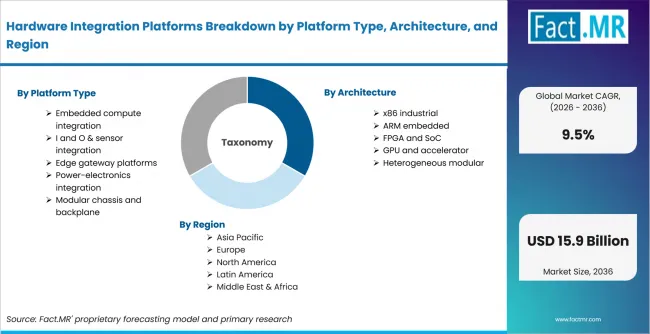
Hardware Integration Platforms Breakdown By Platform Type, Architecture, And Region | Source: Fact.MR
| Attribute | Details |
|---|---|
| Quantitative Units | USD billion in 2026 to USD billion by 2036 at a CAGR |
| Market Definition | Hardware platforms and integration services that combine embedded compute, I/O, sensors, firmware, thermal design, chassis, backplane and lifecycle support for industrial, transport, defense, energy and medical systems. |
| Platform Type | Embedded compute integration; I/O and sensor integration; Edge gateway platforms; Power-electronics integration; Modular chassis and backplane |
| Architecture | x86 industrial; ARM embedded; FPGA and SoC; GPU and accelerator; Heterogeneous modular |
| Use Case | Industrial automation; Mobility and transport; Aerospace and defense; Energy systems; Medical and other |
| Integration Service | Board-level integration; Firmware and BSP; Mechanical-thermal integration; Connectivity and I/O validation; Lifecycle and supply management |
| Regions Covered | North America; Latin America; Western Europe; Eastern Europe; East Asia; South Asia & Pacific; Middle East & Africa |
| Countries Covered | United States; Germany; Japan; Taiwan; United Kingdom |
| Key Companies Profiled | Advantech; Kontron; ADLINK; Curtiss-Wright; NVIDIA; Intel |
| Forecast Period | 2026 to 2036 |
| Approach | Hybrid top-down and bottom-up approach using automation demand, embedded platform portfolios, electronics output, country-level manufacturing indicators, product launches and provider activity review. |
Source: Fact.MR analysis. Updated Sep 8, 2026
How is the market segmented?
-
By Platform Type
- Embedded compute integration
- I/O and sensor integration
- Edge gateway platforms
- Power-electronics integration
- Modular chassis and backplane
-
By Architecture
- x86 industrial
- ARM embedded
- FPGA and SoC
- GPU and accelerator
- Heterogeneous modular
-
By Use Case
- Industrial automation
- Mobility and transport
- Aerospace and defense
- Energy systems
- Medical and other
-
By Integration Service
- Board-level integration
- Firmware and BSP
- Mechanical-thermal integration
- Connectivity and I/O validation
- Lifecycle and supply management
-
By Region
- North America
- Latin America
- Western Europe
- Eastern Europe
- East Asia
- South Asia & Pacific
- Middle East & Africa
Frequently Asked Questions
How big is the hardware integration platforms market in 2026?
What is the CAGR of the hardware integration platforms market from 2026 to 2036?
Which platform type leads the hardware integration platforms market?
Which integration service leads the hardware integration platforms market?
Which companies are profiled in the hardware integration platforms market?
Who worked on this report


Preview the report firsthand - request a free sample
Free SampleGet the brochure for pricing and purchase details
Download PDF