- Forecast Value (2035): 4.3 Bn
- CAGR (2035): 12.3%
Low-Calorie Coconut Milk Market Outlook 2025 to 2035
The Low-Calorie Coconut Milk Market is expected to surge from USD 1.3 Billion in 2025 to USD 4.3 Billion by 2035, at an impressive CAGR of 12.3%. Driven by the dairy-free movement and Asian cuisine influence, this market is thriving among vegan, lactose-intolerant, and fitness-focused consumers. Liquid forms dominate due to cooking convenience, while powdered variants are favored for long shelf life.
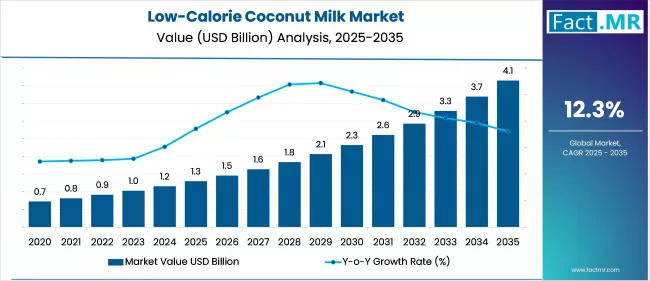
Low Calorie Coconut Milk Market Value Analysis | Source: Fact.MR
| Metric | Value |
|---|---|
| Low-Calorie Coconut Milk Market Estimated Value in (2025 E) | USD 1.3 billion |
| Low-Calorie Coconut Milk Market Forecast Value in (2035 F) | USD 4.1 billion |
| Forecast CAGR (2025 to 2035) | 12.3% |
Source: Fact.MR analysis. Updated Aug 20, 2025
According to latest research by FACT.MR, Low-calorie Coconut Milk market is set to witness steady growth with a 12% CAGR during 2021-2031. The demand is attributed to the rising awareness about the health benefits of low-calorie coconut milk and the rising demand for plant-based food products.
| Countries | CAGR |
|---|---|
| U.S. | 11.2% |
| Germany | 10.3% |
| China | 13.5% |
| India | 14.0% |
Source: Fact.MR analysis. Updated Aug 20, 2025
Rise in Lactose Intolerance to be a Key Demanding Factor for Low-Calorie Coconut Milk
Lactose intolerance is a condition in which the body is unable to digest lactose, a form of natural sugar. Lactose can be found in a variety of dairy products, including milk and yoghurt.
As a result, the rise in lactose intolerance among global consumers is propelling the growth of low-calorie coconut milk market. Rising knowledge of low-calorie coconut milk's health advantages is also contributing to the rising demand for low-calorie coconut milk.
Multifunctional Benefits Provided by the Low-Calorie Coconut Milk to Propel the Growth
Growing consumer awareness of health and wellness is hastening the adoption of a healthy lifestyle, increasing demand for low-calorie coconut milk. The demand for low-calorie coconut milk is being fueled by an increase in the adoption of healthy habits such as yoga, going to the gym, and eating nutritious foods.
In addition, consuming low-calorie coconut milk is an excellent way to speed up weight loss by controlling overall weight management. Low-calorie coconut milk is not only low in calories, but it's also high in protein and fibre, all of which help you feel full and reduce hunger. Low-calorie coconut milk is also a rich source of various vitamins and minerals that promote the overall health of the individual.
Europe Demand Outlook for Low-Calorie Coconut Milk Market
During the forecast period, the low-calorie coconut milk market in Europe will grow at a significant rate. The popularity of low-calorie coconut milk is being fueled by a greater understanding of its advantages over dairy alternatives.
Growing health consciousness is also increasing demand, as low-calorie coconut milk can not only be used as a dairy substitute due to its short- and medium-chain triglyceride content but also it is high in vitamins C and E, which can help to prevent tumour growth and age-related diseases.
Furthermore, the benefits of low-calorie coconut milk, as well as the expansion of well-being, are driving the growth of the low-calorie coconut milk market in Europe.
Low-Calorie Coconut Milk market: key players
Some key manufacturers operating the business in the Low-calorie Coconut Milk market globally includes
- Goya Foods Inc.
- McCormick & Company Inc.
- Dabur India Ltd,
- hai Agri Foods Public Co. Ltd
- Ducoco
- Celebes Coconut Corp.
- Vita Coco
- Theppadungporn Coconut Co. Ltd
- \Danone SA
- ThaiCoconut Public Company
The report is a compilation of first-hand information, qualitative and quantitative assessment by industry analysts, inputs from industry experts and industry participants across the value chain.
The report provides an in-depth analysis of parent market trends, macro-economic indicators and governing factors along with market attractiveness as per segments. The report also maps the qualitative impact of various market factors on market segments and geographies.
Low-Calorie Coconut Milk Market Report Highlights
- Detailed overview of the parent market
- Changing market dynamics in the industry
- In-depth market segmentation
- Historical, current and projected market size in terms of volume and value
- Recent industry trends and developments
- Competitive landscape
- Strategies of key players and products offered
- Potential and niche segments, geographical regions exhibiting promising growth
- A neutral perspective on market performance
- Must-have information for market players to sustain and enhance their market footprint
Segmentation
Low-Calorie Coconut Milk: Market Segmentation
-
Based on nature, the global low-calorie coconut milk market can be segmented as:
- Organic
- Conventional
-
Based on form, the global low-calorie coconut milk market can be segmented as:
- Powder
- Liquid
-
Based on product type, the global low-calorie coconut milk market can be segmented as:
- Low-calorie Coconut Milk Powder
- Low-calorie Coconut Milk Cream
-
Based on Packaging, the global low-calorie coconut milk market can be segmented as:
- Bottle
- Cans
- Sachets
- Jar
- others
-
Based on end use, the global low-calorie coconut milk market can be segmented as:
- Food and Beverage Industry
- Personal Care and Cosmetics Industry
- Functional Food & Dietary Supplements
- Household
- HoReCa
-
Based on the Distribution Channel, the global low-calorie coconut milk market can be segmented as:
- B2B (Direct Sales)
- B2C (Indirect Sales)
- Store-based Retailing
- Supermarket/Hypermarket
- Convenience Stores
- Groceries
- Speciality Stores
- Other Retailing Formats
- Online Retailing
- Store-based Retailing
-
Based on the Region, the global Low-calorie Coconut Milk market can be segmented as:
- North America
- U.S. and Canada
- Latin America
- Mexico, Brazil, Peru, Chile, and others
- Western Europe
- Germany, U.K., France, Spain, Italy, Nordic countries, Belgium, Netherlands, and Luxembourg
- Eastern Europe
- Poland and Russia
- Asia Pacific
- China, India, Japan, ASEAN, Australia, and New Zealand
- The Middle East and Africa
- GCC, Southern Africa, and North Africa
- North America
NOTE - Although care has been taken to maintain the highest levels of accuracy in Fact.MR’s reports, recent market/vendor-specific changes may take time to reflect in the analysis.
Who worked on this report


Preview the report firsthand - request a free sample
Free SampleGet the brochure for pricing and purchase details
Download PDF