- Market Value (2025): USD 257.10 Mn
- Estimated Value (2026): USD 281.4 Mn
- Forecast Value (2036): USD 694.2 Mn
- CAGR (2026-2036): 9.4%
Shelf-Stable Probiotic Carriers Market Forecast and Outlook 2026 to 2036
As per the Fact.MR analysis, the shelf-stable probiotic carriers market was valued at USD 257.10 million in 2025 and is projected to grow from USD 281.4 million in 2026 to USD 694.2 million by 2036. Demand for shelf-stable probiotic carriers is likely to grow at a CAGR of 9.4% over the forecast period.
Demand for shelf-stable probiotic carriers is rising as brands and retailers want probiotic products that hold their labeled counts without refrigeration. Manufacturers of probiotic carriers are building freeze-dried protectant systems, microencapsulated beads, lipid microcapsules and spore-compatible matrices for room-temperature supply chains. For example, in September 2026, a study published in Frontiers in Nutrition found that storage temperature was the primary determinant of viability in commercial probiotic supplements, with the greatest losses under ambient conditions. Similar evidence is projected to drive sales of shelf-stable probiotic carriers as brands reformulate for ambient retail.
Key Takeaways from the Shelf-Stable Probiotic Carriers Market
- Shelf-Stable Probiotic Carriers Market Value (2025): USD 257.10 million
- Shelf-Stable Probiotic Carriers Market Value (2026): USD 281.4 million
- Shelf-Stable Probiotic Carriers Market Forecast Value (2036): USD 694.2 million
- Shelf-Stable Probiotic Carriers Market Forecast CAGR (2026-2036): 9.4%
- Leading Carrier Matrix: Freeze-dried protectant (31.6%)
- Key Market Participants: DSM-Firmenich, Lonza, Balchem, Kerry Group, Glanbia Nutritionals, IFF
- Key Growth Regions: India, China, United Kingdom, United States, Germany
In September 2026, Kerry and Cosun took their biotic ranges to Fi Asia 2026 as Indonesia's 'Live Culture' claim and halal certification rules came into force. Demand for shelf-stable probiotic carriers is growing in tropical markets where cold chains are limited and products sit at high temperatures in traditional retail. Manufacturers of probiotic carriers are pairing robust strains with carriers that meet local claim and certification rules. Similar regulatory clarity is projected to drive sales of shelf-stable probiotic carriers across Southeast Asia, South Asia and Latin America.
Shelf-Stable Probiotic Carriers Market
| Metric | Value |
|---|---|
| Estimated Value in (2026) | USD 281.4 million |
| Forecast Value in (2036) | USD 694.2 million |
| Forecast CAGR (2026 to 2036) | 9.4% |
Source: Fact.MR analysis. Updated Nov 20, 2026
Source: Fact.MR analysis.
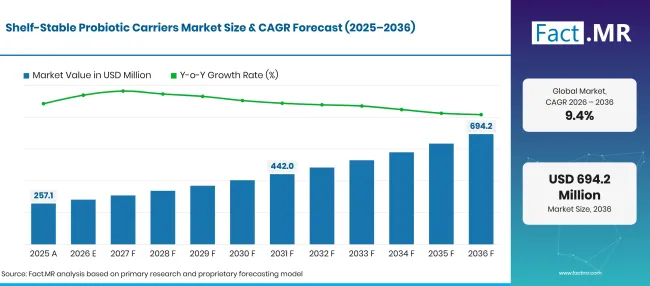
Shelf Stable Probiotic Carriers Forecast Global | Source: Fact.MR
Category
| Category | Segments |
|---|---|
| Carrier Matrix | Freeze-dried protectant, Microencapsulated bead, Lipid microcapsule, Spore-compatible carrier, Synbiotic matrix |
| Delivery Form | Powder, Capsule / tablet, Liquid / emulsion, Microencapsulated bead, Ready-to-drink / food |
| Health Application | General nutrition, Cognitive health, Gut / microbiome, Bone / joint, Clinical nutrition |
| Customer Channel | Medical nutrition OEM, Supplement brand, Ingredient manufacturer, Pharmacy, Direct-to-consumer |
| Region | India; China; United Kingdom; United States; Germany |
Source: Fact.MR analysis. Updated Nov 20, 2026
Segmental Analysis
Why do freeze-dried protectant systems lead carrier matrix demand in the Shelf-Stable Probiotic Carriers Market?
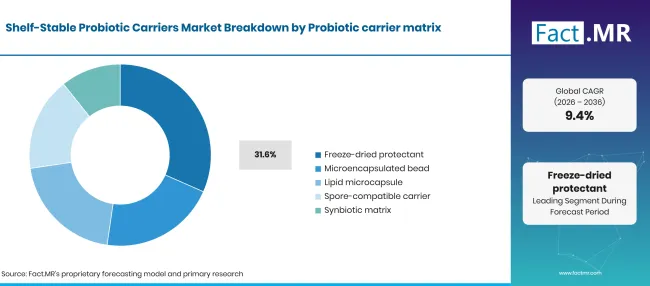
Shelf Stable Probiotic Carriers Breakdown Probiotic Carrier Matrix | Source: Fact.MR
Demand for Freeze-dried protectant systems account for 31.6% of the shelf-stable probiotic carriers market in 2026, about USD 88.9 million, because lyophilization with cryoprotectants such as trehalose, skim-milk solids and maltodextrin remains the standard way to make cultures storage-stable. Protectants form a glassy matrix that limits cell damage during drying and slows decline at room temperature. Manufacturers of probiotic carriers are refining protectant blends for each strain, an area also covered in the particle-engineered probiotic stabilizers market. Trehalose, maltodextrin and other protective ingredients help reduce cellular damage during freeze-drying. Supporting the broader supplement opportunity, the U.S. CDC reported in May 2026 that 60.2% of adults aged 20 and older used dietary supplements, while 38.7% used two or more. Growing supplement consumption is encouraging manufacturers to invest in improved probiotic stabilization systems.
How are powders leading delivery form demand in the Shelf-Stable Probiotic Carriers Market?
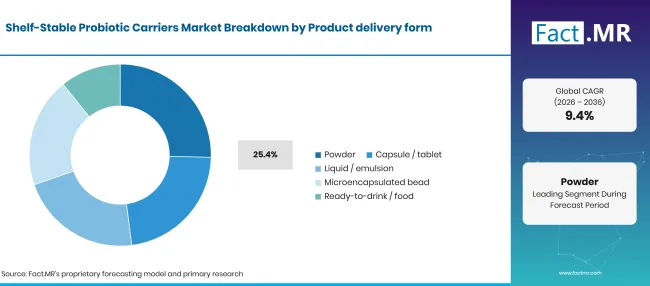
Shelf Stable Probiotic Carriers Breakdown Product Delivery Form | Source: Fact.MR
Sales of Powders represent 25.4% of shelf-stable probiotic carriers revenue in 2026, about USD 71.5 million, as sachets, stick packs, infant formula and medical nutrition powders offer low water activity that suits dried cultures. Powders also let manufacturers blend probiotics with vitamins and fibers in one dose. Manufacturers of probiotic carriers are controlling particle size and moisture pick-up to keep blends uniform and stable, drawing on methods used across the microencapsulated food ingredients market. Their low moisture content also supports storage stability when properly formulated. China's State Administration for Market Regulation reported more than 14,000 effective health food registration certificates and 26,000 filing certificates by June 2026, indicating a substantial regulated product ecosystem for supplement manufacturers. These developments support opportunities for powder-based probiotic carrier suppliers.
Why does general nutrition lead health application demand in the Shelf-Stable Probiotic Carriers Market?
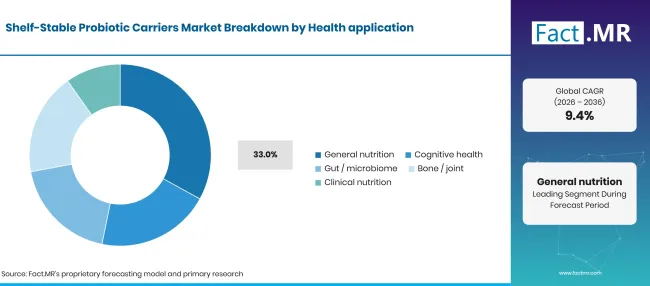
Shelf Stable Probiotic Carriers Breakdown Health Application | Source: Fact.MR
General nutrition to capture 33.0% of shelf-stable probiotic carriers revenue in 2026, about USD 92.9 million, as mainstream foods and daily supplements add probiotics for broad wellness. Kerry's push to bring its BC30 spore probiotic into everyday Indonesian bakery and snack products shows how carriers that survive baking and ambient storage open mass-market categories. Manufacturers of probiotic carriers are offering spore-compatible and encapsulated systems for these foods. Similar mainstream adoption is projected to keep general nutrition the leading application. Germany's Federal Statistical Office reported in November 2026 that supplement production reached 241,000 tonnes in 2025, increasing 1.6% year over year, while production value rose 12.6% to approximately EUR 2.08 billion. Expanding supplement manufacturing is supporting demand for specialized probiotic ingredients and carriers.
How are medical nutrition manufacturers shaping customer demand in the Shelf-Stable Probiotic Carriers Market?
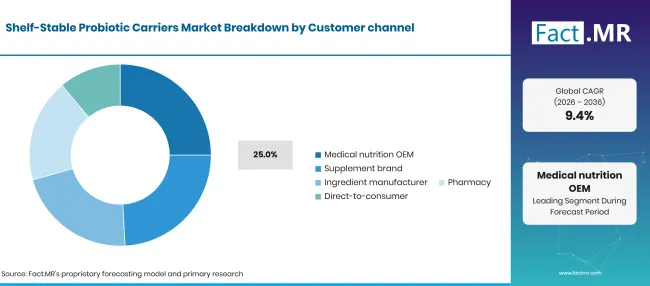
Shelf Stable Probiotic Carriers Breakdown Customer Channel | Source: Fact.MR
Demand from medical nutrition OEMs leads with 25.0% of shelf-stable probiotic carriers revenue in 2026, about USD 70.4 million, as enteral, infant and clinical formulas require guaranteed counts across long shelf lives and strict quality systems. These buyers demand documented stability, low contamination risk and consistent particle properties. Manufacturers of probiotic carriers are providing pharmaceutical-grade documentation and formulation support similar to services in the probiotic formulation support services market. The WHO's August 2026 nutrition update reported that 150 million children under five were affected by stunting and 43 million by wasting in 2024.
Shelf-Stable Probiotic Carriers Market-Drivers, Restraints & Trends
Drivers
Demand for shelf-stable probiotic carriers is rising as nutrition companies position gut health within healthy ageing and longevity. For example, in June 2026, dsm-firmenich said at Vitafoods Europe that it targets four hallmarks of ageing, including gut microbiome composition. Manufacturers of probiotic carriers are designing ambient-stable formats for older consumers who buy supplements through pharmacy and online channels. Similar ageing-focused innovation is projected to drive sales of shelf-stable probiotic carriers through the forecast period.
Restraints
Demand for shelf-stable probiotic carriers is constrained because many commercial products still lose viability at room temperature, which undermines label claims and consumer trust. The September 2026 Frontiers in Nutrition study found the largest viability losses under ambient storage. Similar evidence is projected to increase testing and documentation costs for brands using shelf-stable probiotic carriers. Manufacturers of probiotic carriers must prove real-time stability for each strain and matrix rather than relying on overages.
Opportunity
Spore Probiotics in Everyday Foods In September 2026, Kerry said it was using approval of a Live Culture claim for BC30 in Indonesia to expand probiotics into everyday bakery and snack products. Demand for spore-forming probiotics is rising because Bacillus spores tolerate heat, pressure and low moisture far better than vegetative cells. Similar approvals are projected to drive sales of spore-compatible shelf-stable probiotic carriers in baked goods, cereals and beverages. Manufacturers of probiotic carriers are designing matrices that keep spores dormant until consumption.
Trend
Postbiotics as a Stability Alternative Demand for postbiotic ingredients is rising as companies seek gut-health benefits without the need to keep cells alive. Manufacturers of probiotic carriers are adding inactivated and postbiotic options to their portfolios alongside live cultures. For example, in February 2026, dsm-firmenich said it was running two clinical trials in adults aged 55 and over on its postbiotic HMPB, with results expected in the second half of 2026. Similar research is projected to shape demand for shelf-stable probiotic carriers by setting stability benchmarks for live products.
Shelf-Stable Probiotic Carriers Market by Analysis by Key Country
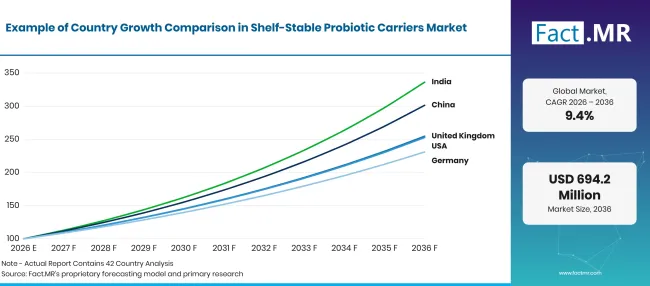
Shelf Stable Probiotic Carriers Growth Index | Source: Fact.MR
| Country | CAGR (2026-2036) |
|---|---|
| India | 12.9% |
| China | 11.7% |
| United Kingdom | 9.8% |
| United States | 9.7% |
| Germany | 8.7% |
Source: Fact.MR analysis. Updated Nov 20, 2026
Source: Fact.MR analysis.
What is driving shelf-stable probiotic carriers demand in India?
In January 2026, the Food Safety and Standards Authority of India's list of approved non-specified food products included a probiotic food based on a Bacillus clausii spore suspension.
Demand for shelf-stable probiotic carriers in India is projected to grow at a 12.9% CAGR, the fastest among the five key countries, as spore and encapsulated formats suit hot, humid distribution. Manufacturers of probiotic carriers are supporting Indian nutraceutical makers through product approval and stability testing. Similar approvals are projected to drive sales of shelf-stable probiotic carriers in India. Ambient-stable probiotic powders and spore-compatible formulations offer opportunities across distribution networks where refrigeration is not consistently available. In July 2026, India's Department of Pharmaceuticals reported that 20,149 Jan Aushadhi Kendras were operational, with a product portfolio covering 2,110 medicines and 315 surgical products, medical consumables and devices, including nutraceuticals. Expanding affordable healthcare distribution is creating additional opportunities for supplement suppliers.
How is market growth supporting shelf-stable probiotic carriers sales in China?
Sales of shelf-stable probiotic carriers in China are estimated to record an 11.7% CAGR as probiotic powders and sachets sell through e-commerce at ambient temperature.
For example, in June 2026, IFF Health Sciences described China's probiotics market as seeing fast and consistent growth. Manufacturers of probiotic carriers are supplying freeze-dried and encapsulated cultures to Chinese brands and cross-border sellers. Similar consumer demand is projected to drive sales of shelf-stable probiotic carriers in China. Regulatory attention to strain identification, product quality and probiotic viability is increasing the importance of reliable carrier technologies. In August 2026, China's State Administration for Market Regulation reported more than 14,000 effective health food registration certificates and 26,000 filing certificates as of June. Its proposed regulatory framework for probiotic-containing health foods also emphasizes strain-level identification and quality control, supporting demand for documented stabilization technologies.
Why is the United Kingdom an important market for shelf-stable probiotic carriers?
Demand for shelf-stable probiotic carriers in the United Kingdom is projected to increase at a 9.8% CAGR as gut-health supplements move into mainstream grocery and drugstore channels.
In August 2026, IndexBox estimated that probiotics account for about 45% to 55% of UK gut health supplement value. Manufacturers of probiotic carriers are offering ambient-stable capsules and powders for UK own-label ranges that are not stored chilled. In January 2026, the UK Government reported that the probiotic product market reached GBP 1.07 billion in 2024, representing 19% value growth and 41% volume growth between 2019 and 2024. The expansion of probiotic dairy products, particularly kefir, is creating opportunities for suppliers of specialized probiotic ingredients and delivery systems.
What is shaping shelf-stable probiotic carriers demand in the United States?
Sales of shelf-stable probiotic carriers in the United States are estimated to hold a 9.7% CAGR as brands link gut health with healthy ageing and broader wellness.
For example, dsm-firmenich used SupplySide Global 2026 in Las Vegas to present its 'Gut Effect' longevity program, and IFF launched a metabolic-health probiotic in October 2026. Manufacturers of probiotic carriers are adapting ambient-stable formats for gummies, powders and capsules sold through U.S. retail and e-commerce. Similar product development is projected to drive sales in the United States. Manufacturers are prioritizing freeze-dried powders, capsules and microencapsulated cultures that can maintain viable counts throughout distribution. The U.S. CDC's May 2026 report found that 60.2% of adults used dietary supplements during August 2021–August 2023, compared with 53.8% in 2013–2014. This increase in supplement participation supports opportunities for ingredient suppliers developing stable probiotic delivery systems.
How is supplement manufacturing supporting shelf-stable probiotic carriers demand in Germany?
Demand for shelf-stable probiotic carriers in Germany is projected to grow at an 8.7% CAGR, the slowest among the five countries, as a large supplement market grows more slowly than emerging Asia.
In June 2026, Tagesspiegel reported that about 415 million packs of food supplements were sold in Germany in 2025, almost twice as many as in 2022, and German supplement production reached a record level in 2026. Manufacturers of probiotic carriers are serving German contract manufacturers with documented, ambient-stable cultures. According to Germany's Federal Statistical Office, supplement production reached 241,000 tonnes in 2025, while the number of producing companies increased to 72 from 64 in 2024. The expansion of domestic manufacturing capacity is creating opportunities for suppliers of freeze-dried and microencapsulated probiotic ingredients.
Competitive Landscape for Shelf-Stable Probiotic Carriers Market
Competition in the shelf-stable probiotic carriers market is led by culture and nutrition ingredient companies that control both strains and stabilization technology. dsm-firmenich, IFF and Kerry Group compete on robust strains, spore probiotics and freeze-drying expertise, while Lonza competes through acid-resistant capsule formats and Balchem and Glanbia Nutritionals through encapsulation and premix capabilities. Buyers select suppliers on guaranteed counts at end of shelf life, heat and moisture tolerance, documentation for regulated categories and cost.
From 2025 onward, competition shifted toward ambient food applications and evidence-backed stability. Kerry expanded spore probiotics into Indonesian bakery and snacks in September 2026, dsm-firmenich advanced postbiotic trials and longevity positioning, and an independent study highlighted ambient viability losses in commercial products. Manufacturers with real-time stability data and strain-specific carrier systems are best placed to win medical and mainstream nutrition contracts.
Recent Developments
- In October 2026, Yakult said India could become one of its top 10 global markets under growth plans running to 2030.
- In September 2026, Kerry said it would use Indonesia's Live Culture claim approval for BC30 to expand into everyday bakery and snacks.
- In June 2026, IFF Health Sciences said China's probiotics market was seeing fast and consistent growth.
- In February 2026, dsm-firmenich said it was running two clinical trials of its postbiotic HMPB in adults aged 55 and over.
Key Players in Shelf-Stable Probiotic Carriers Market
Key companies profiled include DSM-Firmenich; Lonza; Balchem; Kerry Group; Glanbia Nutritionals; and IFF.
- DSM-Firmenich
- Lonza
- Balchem
- Kerry Group
- Glanbia Nutritionals
- IFF
Bibliography
- Federal Statistical Office of Germany (Destatis). (2026). Dietary supplement production increased by 48.4% since 2019.
- Food Safety and Standards Authority of India. (2026). List of product and ingredient applications approved under the non-specified food regulations.
- Frontiers in Nutrition. (2026). Storage temperature as a determinant of probiotic long-term stability in commercial dietary supplements. Frontiers Media.
- Government of India, Press Information Bureau. (2026). Pradhan Mantri Bhartiya Janaushadhi Pariyojana.
- IndexBox. (2026). Gut health supplements market in the United Kingdom.
- NutraIngredients. (2026a). China's probiotics market sees fast, consistent growth, says IFF. William Reed.
- NutraIngredients. (2026b). DSM-Firmenich explores postbiotic role in gut-mediated muscle performance. William Reed.
- State Administration for Market Regulation. (2026). Response on health food registration and filing management. Government of China.
- Tagesspiegel. (2026). Milliardenmarkt der Selbstoptimierer.
- U.S. Centers for Disease Control and Prevention, National Center for Health Statistics. (2026). Dietary supplement use: United States, August 2021–August 2023.
- UK Parliament. (2026). Written answer on the size and growth of the UK probiotics market.
- World Health Organization. (2026). Infant and young child feeding.
Segmentation
Scope of Report
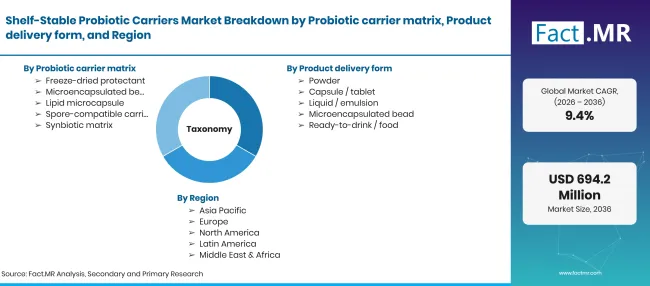
Shelf Stable Probiotic Carriers Taxonomy | Source: Fact.MR
| Items | Values |
|---|---|
| Quantitative Units (2026) | USD 281.4 Million |
| Carrier Matrix | Freeze-dried protectant, Microencapsulated bead, Lipid microcapsule, Spore-compatible carrier, Synbiotic matrix |
| Delivery Form | Powder, Capsule / tablet, Liquid / emulsion, Microencapsulated bead, Ready-to-drink / food |
| Health Application | General nutrition, Cognitive health, Gut / microbiome, Bone / joint, Clinical nutrition |
| Customer Channel | Medical nutrition OEM, Supplement brand, Ingredient manufacturer, Pharmacy, Direct-to-consumer |
| Regions Covered | North America, Latin America, Europe, East Asia, South Asia and Pacific, Middle East & Africa |
| Countries Covered | India, China, United Kingdom, United States, Germany, and other countries |
| Key Companies Profiled | DSM-Firmenich, Lonza, Balchem, Kerry Group, Glanbia Nutritionals, IFF |
| Additional Attributes | Dollar revenue in the Shelf-Stable Probiotic Carriers Market is segmented by carrier matrix (freeze-dried protectant, microencapsulated bead, lipid microcapsule, spore-compatible carrier, synbiotic matrix), delivery form, health application, customer channel and region. |
Source: Fact.MR analysis. Updated Nov 20, 2026
Shelf-Stable Probiotic Carriers Market by Segments
-
Carrier Matrix
- Freeze-dried protectant
- Microencapsulated bead
- Lipid microcapsule
- Spore-compatible carrier
- Synbiotic matrix
-
Delivery Form
- Powder
- Capsule / tablet
- Liquid / emulsion
- Microencapsulated bead
- Ready-to-drink / food
-
Health Application
- General nutrition
- Cognitive health
- Gut / microbiome
- Bone / joint
- Clinical nutrition
-
Customer Channel
- Medical nutrition OEM
- Supplement brand
- Ingredient manufacturer
- Pharmacy
- Direct-to-consumer
-
Region:
- North America
- United States
- Canada
- Mexico
- Europe
- Germany
- United Kingdom
- France
- Italy
- Spain
- Rest of Europe
- Asia Pacific
- China
- India
- Japan
- South Korea
- Australia
- Rest of Asia Pacific
- Latin America
- Brazil
- Mexico
- Argentina
- Rest of Latin America
- Middle East & Africa
- GCC Countries
- South Africa
- Rest of Middle East & Africa
- North America
Who worked on this report


Preview the report firsthand - request a free sample
Free SampleGet the brochure for pricing and purchase details
Download PDF