- Market Value (2025): USD 1.6 Bn
- Estimated Value (2026): USD 1.8 Bn
- Forecast Value (2036): USD 4.3 Bn
- CAGR (2026-2036): 9.1%
What is the Low-Fat Protein Emulsifiers Market forecast to be worth by 2036?
USD 1.8 billion in 2026 to USD 4.3 billion by 2036, at 9.1% CAGR.
- The Low-Fat Protein Emulsifiers Market crossed a valuation of USD 1.6 billion in 2025.
- Demand is projected to increase from USD 1.8 billion in 2026 to USD 4.3 billion by 2036.
- The market is forecast to record a 9.1% CAGR from 2026 to 2036 as beverage, dairy, and sauce formulators use protein functionality to manage reduced-fat texture and stability.
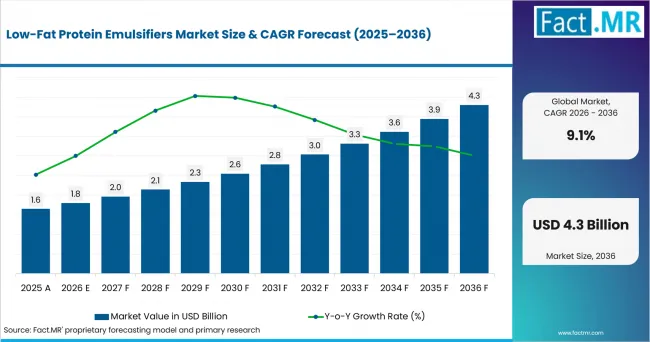
Low Fat Protein Emulsifiers Market Value Analysis | Source: Fact.MR
What are the defining numbers behind Low-Fat Protein Emulsifiers Market growth?
USD 2.5 billion absolute opportunity by 2036, led by whey, oil-in-water systems, fat-free applications and beverages.
- Demand Drivers in the Market
- Beverage formulators need proteins that keep oil mixed properly and help low-fat drinks stay smooth. In June 2026, the USDA Economic Research Service reported that the United States spent USD 2.51 trillion on food in 2025.
- Dairy companies use whey and other proteins to keep low-fat products smooth and stable.
- Sauce manufacturers utilize proteins to decrease separation and produce pourable sauces.
- Key Segments Analyzed
- By Protein Source: In 2026, Whey holds 35.0% share because dairy proteins combine nutritional value.
- By Emulsion System: The oil-in-water segment is expected to have a 31.0% share in 2026, as beverages and dairy products usually disperse fat in a continuous water phase.
- By Fat Level Application: Fat free is expected to hold 36.0% share in 2026 owing to the formulation requirement to rebuild body post fat removal.
- By End Product: Beverages are estimated to represent 34.0% share in 2026 owing to the need for stable protein systems in liquid nutrition and reduced-fat drink formats.
- Analyst Opinion at Fact.MR
- S.N. Jha, Principal Consultant at Fact.MR, states, “Food manufacturers need proteins that still work well after the fat level is reduced. Suppliers that offer reliable mixing and good taste may increase the demand.”
- Strategic Implications
- Beverage brands need to test whether the protein stays stable after mixing before finalizing a low-fat recipe.
- Dairy product makers should check both stability and texture. The product may stay well mixed but can still feel thin when the fat is reduced. The Office for National Statistics reported in July 2026 that food made up 22.9% of UK manufacturers’ product sales in 2025.
- Product developers need to check nutrition claims and product performance separately. This keeps each test focused on what the recipe needs.
Food companies are reformulating recipes for beverages and prepared foods, with the UK predicted to grow fastest at 10.1% CAGR through to 2036 Next is Japan at 9.7% as the large food processing industry demands more health-oriented foods. The USA is anticipated to lead with 9.4% CAGR, driven by high food spending and a strong supply of whey. Germany’s 9.1% is supported by increased production of dairy and prepared foods to meet demand, and France’s 8.8% is supported by its dairy and food manufacturing industries.
How does the Low-Fat Protein Emulsifiers Market break down by segment?
Whey leads Protein Source at 35.0%; Fat-free leads Fat Level Application at 36.0%.
Which Protein Source dominates?
Whey holds 35.0% share in 2026.
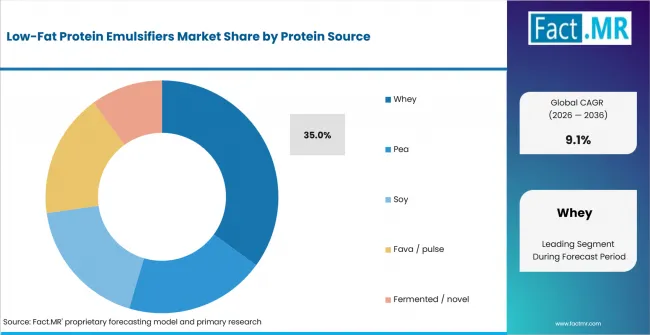
Low Fat Protein Emulsifiers Market Analysis By Protein Source | Source: Fact.MR
Whey is used widely to add protein and keep food products mixed and smooth. Pea and soy proteins keep oil and water mixed, which is increasing demand for plant-based foods. Fava and other pulse proteins provide manufacturers with more ingredient options. In April 2026, USDA National Agricultural Statistics Service reported that U.S. whey protein isolate production reached 213.524 million pounds in 2025.
What leads the Emulsion System segment?
Oil-in-water leads with 31.0% share in 2026.
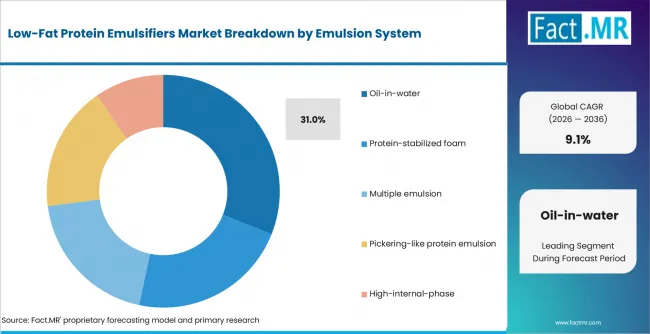
Low Fat Protein Emulsifiers Market Analysis By Emulsion System | Source: Fact.MR
Oil-in-water systems dominate this segment and are widely used in drinks and dairy products. Protein foams stabilize bubbles. Multiple emulsions allow food makers to control products that have more than one liquid layer. Pickering-like protein emulsions rely on protein particles in order to keep ingredients mixed. High-internal-phase systems are mainly used in thick products with a high amount of mixed-in material.
How does Fat Level Application shape demand?
Fat-free applications lead with 36.0% share in 2026.
Fat-free applications are anticipated to own a 36.0% share in 2026 as fat removal can impact thickness and stability. Proteins help to restore these characteristics when the fat is removed. Even products that contain less than 3% fat or 3–10% fat still contain some fat, so proteins are primarily used to keep them stable and to provide the right texture. The 11–20% range includes products with a medium amount of fat, while the above 20% category covers products which contain more fat.
What supports Beverages within End Product?
Beverages represent 34.0% share in 2026.
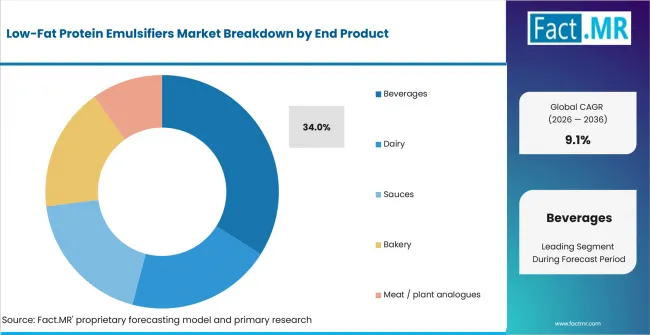
Low Fat Protein Emulsifiers Market Analysis By End Product | Source: Fact.MR
In dairy foods, proteins help the product handle heat and remain stable during storage. For sauces, they keep oil and water mixed during processing and filling. Their role in bakery foods includes mixing and foaming, while maintaining the texture. Meat and plant-based foods depend on the binding and stability. Roquette launched NUTRALYS® Pea 850F in February 2026.
What is accelerating Low-Fat Protein Emulsifiers Market adoption, and what is holding it back?
Demand is growing as more food manufacturers reduce fat in their products, while taste and production issues can limit the use.
Drivers Impact Analysis
| DRIVER | (~) % IMPACT ON CAGR | GEOGRAPHIC RELEVANCE | IMPACT TIMELINE |
|---|---|---|---|
| Reduced-fat reformulation across beverages and dairy | +1.5% | Global | Short term (<= 2 years) |
| Protein enrichment combined with functional texture needs | +1.2% | North America, Europe, East Asia | Medium term (2-4 years) |
| Plant-protein use in dairy and meat alternatives | +1.0% | Europe, North America | Medium term (2-4 years) |
| Prepared-food and convenience processing | +0.8% | Europe, North America, Japan | Short term (<= 2 years) |
| Supplier application support for heat and shear stability | +0.6% | Global | Long term (>= 4 years) |
Opportunity Impact Analysis
| OPPORTUNITY | (~) % IMPACT ON CAGR | GEOGRAPHIC RELEVANCE | IMPACT TIMELINE |
|---|---|---|---|
| Low-fat high-protein beverages | +1.2% | Global | Short term (<= 2 years) |
| Hybrid dairy and plant formulations | +0.9% | Europe, North America | Medium term (2-4 years) |
| Pulse proteins with improved flavor | +0.7% | Europe, North America, Japan | Medium term (2-4 years) |
| Multifunctional protein systems for sauces and prepared foods | +0.6% | Global | Long term (>= 4 years) |
Restraints Impact Analysis
| RESTRAINT | (~) % IMPACT ON CAGR | GEOGRAPHIC RELEVANCE | IMPACT TIMELINE |
|---|---|---|---|
| Flavor and mouthfeel trade-offs at high protein load | -0.7% | Global | Short term (<= 2 years) |
| Heat, pH and shear sensitivity | -0.6% | Global | Short term (<= 2 years) |
| Price pressure in food and beverage categories | -0.5% | USA, UK, Germany, Japan, France | Medium term (2-4 years) |
| Source-specific allergen and labeling constraints | -0.3% | Global | Long term (>= 4 years) |
Which countries are scaling Low-Fat Protein Emulsifiers Market through 2036?
- The country comparison spans 1.3 percentage points from the UK to France across the forecast period.
- The UK is projected to remain 0.4 percentage point above Japan as food manufacturing and reduced-fat reformulation support ingredient use.
- Japan is expected to remain 0.3 percentage point above the USA as beverage and health-food formulation expands.
- The USA is estimated to remain 0.3 percentage point above Germany through a broad dairy protein supply base and food manufacturing activity.
- Germany is forecast to remain 0.3 percentage point above France as prepared foods and dairy processing support formulation work.
- France closes the listed range through dairy availability and broad food consumption.
Comparable CAGRs can create different entry conditions because dairy supply and food-processing scale vary by country. Full report coverage includes North America and Latin America. It also includes Western Europe and Eastern Europe. East Asia and South Asia & Pacific are covered alongside Middle East & Africa.
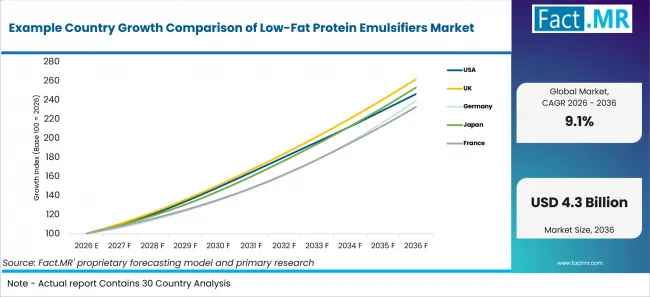
Example Country Growth Comparison Of Low Fat Protein Emulsifiers Market | Source: Fact.MR
| Country | CAGR (2026-2036) |
|---|---|
| UK | 10.1% |
| Japan | 9.7% |
| USA | 9.4% |
| Germany | 9.1% |
| France | 8.8% |
What supports the UK outlook?
10.1% CAGR, supported by food manufacturing depth and reduced-fat formulation.
UK food companies use proteins in many beverages and prepared foods. In April 2026, the Department for Environment, Food & Rural Affairs state that UK exports of dairy products and birds’ eggs reached £2.505 billion in 2025. Demand for protein emulsifiers is expected to grow as brands reduce fat while keeping the right texture and stability.
How is Japan scaling demand?
Japan anticipated to lead 9.7% CAGR.
Japan has a large processed-food industry and strong demand for foods focused on nutrition. The USDA Foreign Agricultural Service reported in April 2026 that Japan’s food processing sector was valued at USD 174 billion in 2025. Demand for protein emulsifiers is expected to grow in beverages and dairy-style products where fat is reduced but a stable texture is still needed.
What is powering USA demand?
USA is projected to grow at 9.4% CAGR up to 2036.
The U.S. food companies have a large food-processing industry and a strong supply of dairy proteins. This supports lower-fat dairy foods and drinks using whey protein for nutrition and stability. Plant proteins provide more choices for dairy alternatives and products that combine dairy and plant ingredients.
What underpins Germany’s growth?
9.1% CAGR, supported by prepared-food production and dairy processing.
Germany has a large processed-food industry which creating demand for protein emulsifiers in dairy products and meals. Destatis reported in January 2026 that Germany produced 1.7 million tonnes of prepared meals in 2024. Demand is expected to grow as lower-fat recipes need proteins that keep ingredients mixed during big-scale production.
How does France perform?
France is anticipated to lead 8.8% CAGR.
French dairy industry is well developed and the French spend a lot of money on food. According to INSEE in June 2026, household expenditure on food and nonalcoholic beverages totalled EUR 192.8 billion in 2025. Adoption of protein emulsifiers is expected to grow in dairy products and beverages because reducing fat can change their texture and feel.
Who leads the Low-Fat Protein Emulsifiers Market?
Kerry Group and Arla Foods Ingredients cover dairy protein functionality, while Ingredion, Cargill, IFF and Roquette strengthen plant-protein and formulation capabilities.
Kerry Group supplies protein ingredients and emulsifiers for beverages and dairy products, while Arla Foods Ingredients offers whey-based ingredients for added protein and better texture. In March 2025, Arla Foods Ingredients signed an agreement with Valley Queen to make Nutrilac® ProteinBoost. Production at the South Dakota plant was planned to start in winter 2025/2026 after new equipment was installed.
Ingredion and Cargill supply plant-based proteins for food products. IFF offers protein ingredients that also help with texture and keep ingredients mixed, while Roquette supplies pea protein for beverages and dairy alternatives. Suppliers are expected to compete on taste, how easily the protein mixes, and how well it works during heating. Its ability to keep ingredients mixed in lower-fat foods will also affect which protein buyers choose.
Which companies are the key providers?
Kerry Group and Arla Foods Ingredients are key providers. Ingredion, Cargill, IFF and Roquette are also profiled.
- Kerry Group
- Ingredion
- Cargill
- IFF
- Roquette
- Arla Foods Ingredients
Bibliography
- Arla Foods Ingredients. (2025, March 3). Arla Foods Ingredients strengthens US foothold with Valley Queen agreement.
- Department for Environment, Food & Rural Affairs. (2026, April 30). UK trade in Food, Feed and Drink, 2025 provisional.
- Beretti, P.-A., & Pereira, É. (2026, June 16). La consommation des ménages en 2025 : La consommation des ménages ralentit en dépit d’une forte décélération des prix. Institut national de la statistique et des études économiques.
- Office for National Statistics. (2026, July 24). UK manufacturers’ sales by product: 2025.
- Roquette. (2026, February 23). Launch of breakthrough clean-tasting pea protein isolate.
- Zeballos, E., & Sinclair, W. (2026, June 11). Total U.S. food spending reached $2.51 trillion in 2025. U.S. Department of Agriculture, Economic Research Service.
- U.S. Department of Agriculture, Foreign Agricultural Service. (2026, April 1). Food processing ingredients annual (Report No. JA2026-0012).
- U.S. Department of Agriculture, National Agricultural Statistics Service. (2026, April 24). Dairy products 2025 summary.
- Statistisches Bundesamt (Destatis). (2026, January 14). Produktion von Fertiggerichten binnen fünf Jahren mengenmäßig um 25,6 % gestiegen [Production of ready meals increased by 25.6% in volume within five years].
This Report Answers
- The report explains how Protein Source and Emulsion System choices affect reduced-fat food formulation.
- Segment analysis identifies Whey, Oil-in-water, Fat-free and Beverages as the 2026 share leaders.
- Country analysis examines the UK, Japan, USA, Germany and France and the mechanisms supporting their forecast growth.
- Competitive analysis reviews Kerry Group, Ingredion, Cargill, IFF, Roquette and Arla Foods Ingredients across dairy and plant-protein formulation.
What does the Low-Fat Protein Emulsifiers Market cover?
Whey, pea, soy, pulse and novel proteins used to stabilize reduced-fat food and beverage systems.
The Low-Fat Protein Emulsifiers Market covers protein ingredients used for interfacial stabilization, foaming, binding or texture support in formulations where fat content is reduced. Coverage includes dairy and plant proteins used in oil-in-water systems, protein-stabilized foams, multiple emulsions, Pickering-like protein emulsions and high-internal-phase structures.
The boundary is narrower than the broader food emulsifier category because the functional material must be protein-based or depend directly on protein emulsification. Conventional lecithins, mono- and diglycerides and other non-protein emulsifiers are outside the core scope when sold without a protein-based functional system.
What is included in the scope?
Protein emulsifier systems used in beverages, dairy, sauces, bakery and meat or plant analogues across reduced-fat applications.
Coverage includes whey and plant proteins across the listed emulsion systems and fat-level applications. Related formulation areas include food emulsifier systems, emulsifiers and co-emulsifiers, clean-label emulsifiers, high-protein beverage emulsifiers, protein ingredients, plant protein ingredients, whey protein concentrate, milk protein concentrate, acid-stable pea protein beverages, and functional food texture systems.
What is excluded from the scope?
Standalone non-protein emulsifiers and protein ingredients sold only for nutrition are outside the scope.
The scope excludes lecithin, mono- and diglycerides, polysorbates and other conventional emulsifiers when the functional emulsifying component comes from another ingredient class. It also excludes protein powders used only to raise protein content when the product has no relevant emulsification, foaming, binding or reduced-fat texture function.
How Was the Analysis Built?
The analysis draws on 120+ sources, 35+ company portfolios, 25+ countries, and more than 20 industry interviews.
- Primary Research: Primary research includes discussions with manufacturers, service providers, technology developers, distributors, end users, and subject-matter experts. These conversations examine purchasing priorities, product adoption, operational challenges, approval requirements, competitive positioning, and the factors that influence wider market acceptance.
- Desk Research: Desk research covers government statistics, regulatory publications, company filings, trade data, technical studies, industry associations, standards, public policy, and other authoritative sources. Every source used in the analysis is documented in the bibliography.
- Market Sizing and Forecasting: Market estimates combine historical performance, demand indicators, pricing and volume trends, segment shares, company participation, country-level growth, adoption patterns, investment activity, and barriers to market expansion.
- Data Validation and Update Cycle: Findings are validated by comparing primary interviews with public data, company activity, regulatory changes, trade patterns, and industry developments. Regular updates review new product launches, capacity changes, partnerships, approvals, and shifts in commercial adoption.
What is the report’s scope and coverage?
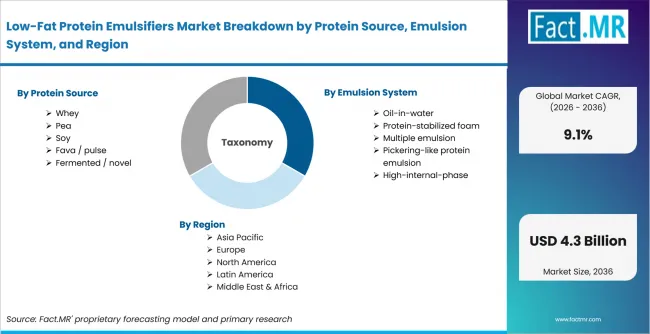
Low Fat Protein Emulsifiers Market Breakdown By Protein Source, Emulsion System, And Region | Source: Fact.MR
| Attribute | Details |
|---|---|
| Quantitative Units | USD billion in 2026 to USD billion by 2036 at a CAGR |
| Market Definition | Protein ingredients used to stabilize emulsions, foams or texture in reduced-fat food and beverage formulations. |
| Protein Source | Whey; Pea; Soy; Fava / pulse; Fermented / novel |
| Emulsion System | Oil-in-water; Protein-stabilized foam; Multiple emulsion; Pickering-like protein emulsion; High-internal-phase |
| Fat Level Application | Fat-free; <3% fat; 3-10%; 11-20%; >20% reduced-fat system |
| End Product | Beverages; Dairy; Sauces; Bakery; Meat / plant analogues |
| Regions Covered | North America; Latin America; Western Europe; Eastern Europe; East Asia; South Asia & Pacific; Middle East & Africa |
| Countries Covered | USA; UK; Germany; Japan; France |
| Key Companies Profiled | Kerry Group; Ingredion; Cargill; IFF; Roquette; Arla Foods Ingredients |
| Forecast Period | 2026 to 2036 |
| Approach | Hybrid demand-side and supplier-side assessment using application fit, protein functionality, country food-processing indicators and provider portfolio review. |
How is the market segmented?
-
By Protein Source
- Whey
- Pea
- Soy
- Fava / pulse
- Fermented / novel
-
By Emulsion System
- Oil-in-water
- Protein-stabilized foam
- Multiple emulsion
- Pickering-like protein emulsion
- High-internal-phase
-
By Fat Level Application
- Fat-free
- <3% fat
- 3-10%
- 11-20%
- >20% reduced-fat system
-
By End Product
- Beverages
- Dairy
- Sauces
- Bakery
- Meat / plant analogues
-
By Region
- North America
- Latin America
- Western Europe
- Eastern Europe
- East Asia
- South Asia & Pacific
- Middle East & Africa