- Base Value(2025): 0.8 Bn
- Estimated Value(2026): 0.9 Bn
- Forecast Value (2036): 1.8 Bn
- CAGR (2026 - 2036): 8.1%
Acid-Stable Pea Protein Beverages Market Forecast and Outlook By Fact.MR
In 2025, the acid-stable pea protein beverages market was valued at USD 0.8 billion. Based on Fact.MR analysis, demand for acid-stable pea protein beverages is estimated to grow to USD 0.9 billion in 2026 and USD 1.8 billion by 2036. FACT.MR projects a CAGR of 8.1% during the forecast period.
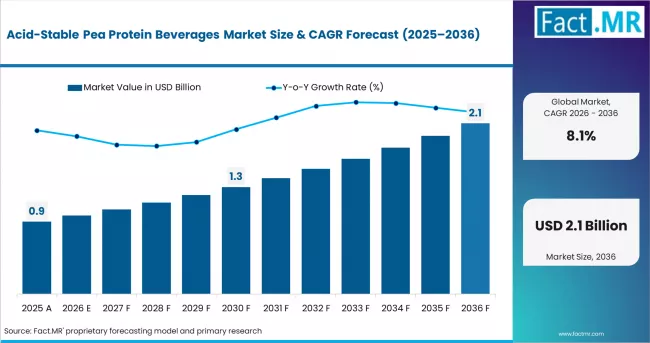
Acid Stable Pea Protein Beverages Market Market Value Analysis | Source: Fact.MR
| Metric | Value |
|---|---|
| Estimated Value in 2026 | USD 0.9 billion |
| Forecast Value in 2036 | USD 1.8 billion |
| Forecast CAGR (2026 to 2036) | 8.1% |
Source: Fact.MR analysis. Updated Apr 22, 2026
Summary of the Acid-Stable Pea Protein Beverages Market
- Market Definition
- Market covers acid-stable pea protein ingredients used in functional beverages globally.
- Demand Drivers
- RTD beverage growth is increasing demand for stable plant proteins.
- Clean-label and vegan trends are driving plant-based formulations.
- Sports nutrition expansion is supporting protein beverage demand.
- Key Segments Analyzed
- By Product Type: Isolates lead 55% in 2026 due to stability and clarity.
- By Beverage Type: RTD beverages lead 50% in 2026 due to convenience demand.
- By Application: Functional nutrition leads 46% in 2026 driven by health trends.
- Analyst Opinion at FACT.MR
- Shambhu Nath Jha, Principal Consultant at Fact.MR opines, ‘CXOs will find that acid stability and sensory performance define competitive advantage. Suppliers with validated beverage compatibility and cost-efficient modification processes will lead.’
- Strategic Implications
- Invest in acid-stable protein modification technology.
- Build partnerships with RTD beverage manufacturers.
- Focus on taste masking and clarity improvement.
- Methodology
- Uses ingredient demand and beverage volume data.
- Includes company disclosures and formulation benchmarks.
- Forecasts consider plant-based demand trends.
The market is projected to generate USD 0.9 billion in absolute opportunity. Growth is steady and driven by plant-based protein demand and RTD beverage expansion. Clean-label reformulation supports adoption. Growth is constrained by taste masking challenges and higher processing costs for acid-stable modification.
Pricing dynamics are shifting toward premium formulations. Beverage brands are willing to pay for stability and clarity. Ingredient suppliers with functional validation command higher margins.
India leads with 9.8% CAGR, driven by fitness and affordability demand. China follows at 9.5% due to RTD beverage expansion. Germany records 8.7% with clean-label adoption. The UK shows 8.5% supported by premium drink innovation. The United States grows at 8.3% with plant-based beverage scale. Mature markets show replacement demand, constrained by formulation cost sensitivity.
Segmental Analysis
Acid-Stable Pea Protein Beverages Market Analysis by Product Type
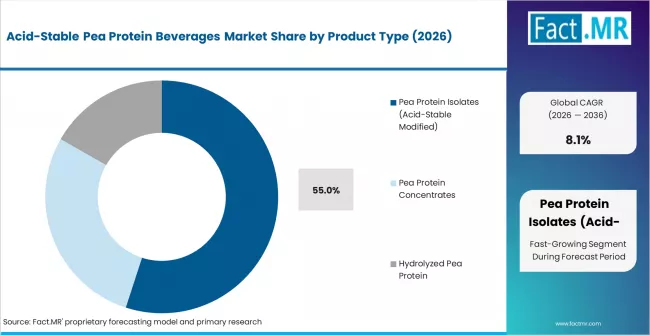
Acid Stable Pea Protein Beverages Market Analysis By Product Type | Source: Fact.MR
Based on FACT.MR’s acid-stable pea protein beverages market report, consumption of pea protein isolates is estimated to hold approximately 55% share in 2026. This segment leads due to superior solubility, neutral taste profile, and ability to remain stable in low pH beverage systems. Isolates enable clear, smooth-texture beverages, which are critical for consumer acceptance in RTD and juice-based formats.
- Roquette Innovation: Roquette Frères expanded its pea protein isolate portfolio in 2024, focusing on beverage-grade solutions with improved solubility and acid stability. This supports RTD beverage manufacturers targeting clean-label formulations. [1]
- Ingredion Development: Ingredion Incorporated launched advanced plant protein solutions in 2025 designed for acidic beverage applications. These products improve dispersion and reduce sedimentation in low pH systems. [2]
- Industry Adoption Trend: Beverage manufacturers are increasingly shifting toward isolates to achieve better clarity, mouthfeel, and shelf stability. This trend is particularly visible in premium functional and sports beverage segments. [3]
Acid-Stable Pea Protein Beverages Market Analysis by Beverage Type
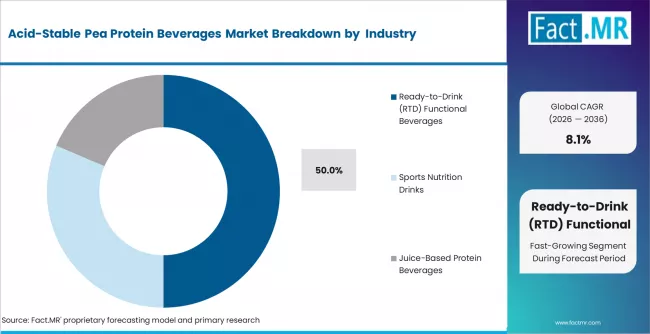
Acid Stable Pea Protein Beverages Market Analysis By Beverage Type | Source: Fact.MR
Based on FACT.MR’s report, ready-to-drink (RTD) beverages are estimated to hold approximately 50% share in 2026. This segment leads due to strong consumer demand for convenience, on-the-go nutrition, and functional beverage formats. RTD beverages provide an ideal platform for protein fortification, especially in urban markets where lifestyle-driven consumption is rising.
- ADM RTD Expansion: ADM expanded its plant-based beverage solutions portfolio in 2024, targeting RTD protein drinks with improved stability and taste profiles. This supports large-scale beverage brand adoption. [4]
- Cargill Beverage Innovation: Cargill introduced new formulation systems in 2025 for protein-enriched beverages, focusing on low pH compatibility and clean-label positioning. This strengthens RTD beverage development pipelines. [5]
- Convenience Consumption Trend: Consumers are increasingly choosing RTD formats due to busy lifestyles and demand for functional nutrition. This is driving beverage companies to prioritise stable protein ingredients that integrate seamlessly into ready-to-consumer products. [6]
Drivers, Restraints, and Opportunities
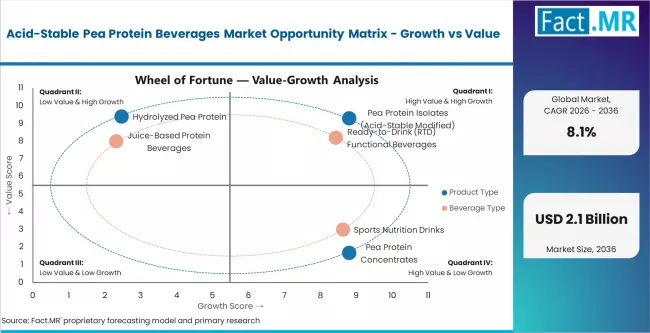
Acid Stable Pea Protein Beverages Market Opportunity Matrix Growth Vs Value | Source: Fact.MR
FACT.MR analysts observe that the market is evolving as a specialised segment within plant-based beverages. Demand is anchored in functional beverage expansion and protein fortification trends across RTD, sports, and clinical nutrition formats. The market exists at its current scale because traditional plant proteins fail in acidic environments, creating a clear functional gap that acid-stable pea proteins address.
The market is undergoing a formulation shift toward high-performance proteins. Standard pea and soy proteins are losing relevance in low pH beverages due to precipitation and texture issues. Acid-stable isolates are replacing them. These products carry higher costs but unlock wider beverage applications including juice-based and flavored RTD formats. Revenue growth is driven by formulation value rather than volume expansion.
- RTD Beverage Expansion: Growth in ready-to-drink beverages is accelerating globally. Beverage brands require proteins that remain stable in acidic formulations such as flavored waters and juices. This is increasing demand for modified pea protein isolates that maintain clarity and shelf stability.
- Clean Label Demand: Consumers are shifting toward plant-based and allergen-free proteins. Pea protein is preferred due to its non-GMO and dairy-free positioning. This supports adoption across premium functional beverage categories in North America and Europe.
- Technology Barrier: Acid-stable modification requires advanced processing and formulation expertise. This creates high entry barriers. Established ingredient manufacturers dominate due to proprietary technologies and scale advantages.
Regional Analysis
The acid-stable pea protein beverages market is assessed across Asia Pacific, North America, Europe, Latin America, and Middle East and Africa. The market covers 40+ countries with demand shaped by functional beverage adoption, plant-based protein trends, clean-label preferences, and RTD consumption growth. The full report provides market attractiveness analysis by region and country.
.webp "Top Country Growth Comparison Acid Stable Pea Protein Beverages Market Cagr (2026 2036)")
Top Country Growth Comparison Acid Stable Pea Protein Beverages Market Cagr (2026 2036) | Source: Fact.MR
| Country | CAGR (2026 to 2036) |
|---|---|
| India | 9.8% |
| China | 9.5% |
| Germany | 8.7% |
| United States | 8.5% |
| United Kingdom | 8.3% |
Source: Fact.MR analysis. Updated Apr 22, 2026
Source: Fact.MR (FACT.MR) analysis, based on proprietary forecasting model and primary research
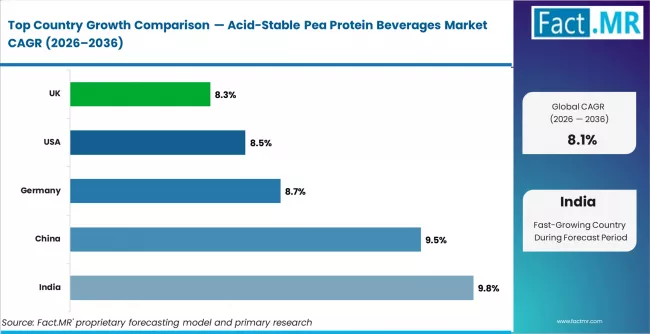
Acid Stable Pea Protein Beverages Market Cagr Analysis By Country | Source: Fact.MR
Asia Pacific Acid-Stable Pea Protein Beverages Market Analysis
Asia Pacific is the fastest-growing region and a high-volume consumption hub. Growth is driven by expanding middle-class consumption, rising fitness awareness, and rapid adoption of RTD functional beverages. Ingredient suppliers such as ADM and Roquette Frères are strengthening regional distribution networks. The region is shifting from imported formulations to localized production and cost-efficient supply chains.
- India: India leads with a projected CAGR of 9.8% through 2036. Urban consumers are increasingly adopting protein-enriched beverages as part of fitness and lifestyle routines. Government-led nutrition awareness and expansion of modern retail are supporting demand. Domestic beverage brands are launching affordable RTD protein drinks targeting mass-market consumers. The market is price-sensitive, favoring cost-efficient formulations. Growth is volume-driven and supported by a large young population and expanding distribution reach.
- China: China is projected to grow at 9.5% CAGR through 2036. The RTD beverage segment is expanding rapidly across urban and semi-urban markets. Local beverage manufacturers are incorporating plant proteins into juice-based and flavored drinks to cater to health-conscious consumers. Strong domestic manufacturing capabilities support scale and cost competitiveness. Growth is driven by convenience, product innovation, and high consumer acceptance of functional beverages.
Fact.MR’s analysis covers China, India, Japan, South Korea, ASEAN, and ANZ. It includes beverage consumption trends, plant protein adoption, and regional demand forecasts.
North America Acid-Stable Pea Protein Beverages Market Analysis
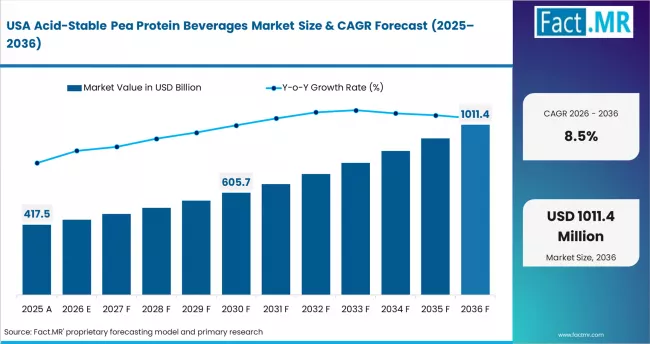
Acid Stable Pea Protein Beverages Market Country Value Analysis | Source: Fact.MR
North America is the largest and most mature market. It leads in product innovation, formulation technology, and premium functional beverage adoption. Companies such as Cargill and Ingredion Incorporated are key suppliers supporting beverage manufacturers. The region benefits from advanced retail infrastructure and strong consumer awareness of plant-based nutrition.
- United States: The United States grows at 8.3% CAGR through 2036. It is the largest market for functional and plant-based beverages globally. Demand is driven by health-conscious consumers seeking high-protein, clean-label drinks. Beverage brands are investing in RTD product innovation with improved taste and functionality. Established supply chains and strong distribution networks enable rapid product rollout. Growth is steady and supported by premiumisation trends rather than volume expansion alone.
Fact.MR’s analysis covers the United States, Canada, and Mexico. It includes plant-based trends, RTD adoption, and innovation benchmarks.
Europe Acid-Stable Pea Protein Beverages Market Analysis
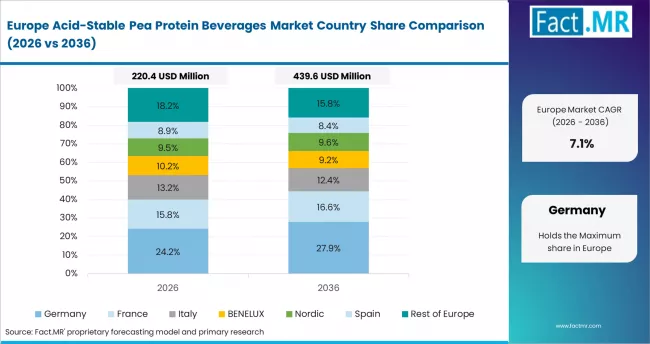
Acid Stable Pea Protein Beverages Market Europe Country Market Share Analysis, 2026 & 2036 | Source: Fact.MR
Europe is a clean-label and sustainability-driven market with strong regulatory alignment. Consumers prioritize natural, allergen-free, and plant-based ingredients. Ingredient suppliers such as Cosucra Groupe Warcoing and Roquette Frères are expanding beverage-focused protein solutions. Growth is driven by premium product innovation and regulatory support for plant-based foods.
- Germany: Germany grows at 8.7% CAGR through 2036. It is a leading market for clean-label and plant-based beverages in Europe. Consumers show high acceptance of protein-enriched functional drinks. Beverage manufacturers are investing in innovative RTD formulations with improved taste and stability. Growth is driven by strong retail penetration and consumer preference for sustainable products.
- United Kingdom: The United Kingdom grows at 8.5% CAGR through 2036. The market is driven by premium functional drink innovation and strong demand for convenient nutrition. Retail chains and beverage startups are introducing protein-enriched RTD products targeting health-conscious consumers. Growth is supported by a well-developed retail ecosystem and increasing focus on wellness-driven consumption.
Fact.MR’s analysis covers Germany, France, the UK, Italy, Spain, and Rest of Europe. It includes clean-label trends, regulatory alignment, and regional demand forecasts.
Competitive Aligners for Market Players
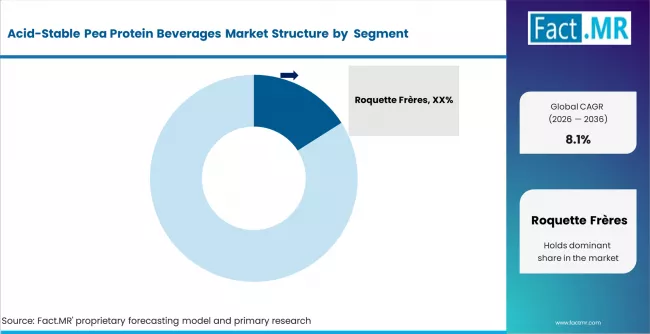
Acid Stable Pea Protein Beverages Market Analysis By Company | Source: Fact.MR
The competitive landscape of the acid-stable pea protein beverages market is moderately concentrated, with a small group of global ingredient manufacturers controlling a significant share of supply. Competition is defined by formulation performance, acid stability, and beverage compatibility rather than price alone. Large players such as Roquette Frères, ADM, Ingredion Incorporated, and Cargill dominate through scale, processing expertise, and established relationships with beverage manufacturers. These companies benefit from vertically integrated supply chains and continuous investment in plant protein innovation, strengthening their market position. A second tier of players, including Cosucra Groupe Warcoing and other regional suppliers, competes through niche formulation capabilities and cost-efficient production. However, their market access is often limited by the technical complexity of acid-stable modification and the need for consistent functional performance in low pH beverages. This creates a structural barrier that favors established multinational suppliers with proprietary processing technologies.
Strategic advantage in this market is increasingly tied to application-specific innovation. Companies that can deliver proteins with improved solubility, neutral taste, and stability in acidic environments are securing long-term supply agreements with beverage brands. As functional beverage demand grows, ingredient suppliers are positioning themselves as formulation partners rather than commodity vendors.
Buyer behavior further reinforces supplier concentration. Large beverage manufacturers prefer long-term contracts with trusted suppliers that offer technical support, regulatory compliance, and consistent quality. This reduces switching flexibility and increases dependency on integrated players. As a result, companies with strong R&D capabilities and beverage-focused solutions are able to command premium pricing, while smaller suppliers remain confined to price-sensitive or regional segments.
Key Players
- Roquette Frères
- Ingredion Incorporated
- Cargill Incorporated
- Archer Daniels Midland Company (ADM)
- Cosucra Groupe Warcoing
- PURIS Proteins LLC
- Burcon NutraScience Corporation
- Kerry Group plc
- Emsland Group
Bibliography
- [1] Roquette Frères, Annual Report 2024, Roquette Frères, 2024.
- [2] Ingredion Incorporated, Product Innovation and Ingredient Solutions Update, Ingredion Incorporated, 2025.
- [3] Food and Beverage Industry Association, Global Functional Beverage Trends Report, 2024.
- [4] ADM, Annual Report and Nutrition Segment Update, ADM, 2024.
- [5] Cargill, Product Development and Beverage Solutions Update, Cargill, 2025.
- [6] International Food Information Council, Food and Health Survey Report, 2024.
This Report Addresses
- Strategic insights on demand across India, China, Germany, United States, and United Kingdom. Covers plant-based beverage adoption, RTD expansion, clean-label demand, and protein fortification trends.
- Market forecast from USD 0.9 billion in 2026 to USD 1.8 billion by 2036, at 8.1% CAGR.
- Opportunity mapping across RTD beverage innovation, sports nutrition expansion, clean-label formulation demand, and low-pH protein stability technologies.
- Segment analysis by product type, beverage type, and application. Covers acid-stable isolates, concentrates, hydrolyzed proteins, and key beverage formats.
- Regional outlook covering Asia Pacific consumption growth, North America innovation leadership, and Europe clean-label regulatory-driven demand.
- Competitive analysis of Roquette Frères, Ingredion Incorporated, Cargill, ADM, and Cosucra Groupe Warcoing.
- Technology tracking on acid-stable protein modification, solubility enhancement, taste masking, and beverage formulation compatibility.
- Report delivery in PDF, Excel, and presentation formats with validated data and industry inputs.
Acid-Stable Pea Protein Beverages Market Definition
The acid-stable pea protein beverages market includes beverages formulated using modified pea protein capable of maintaining solubility and stability in low pH environments such as juices and flavored drinks. These proteins are primarily used in ready-to-drink beverages, sports nutrition drinks, and functional beverages.
Acid-Stable Pea Protein Beverages Market Inclusions
Covers global and regional forecasts from 2026 to 2036 by product type, beverage type, and application. Includes acid-stable isolates, concentrates, and hydrolyzed proteins used in RTD beverages and nutrition drinks. Covers formulation stability, protein solubility, and beverage compatibility analysis.
Acid-Stable Pea Protein Beverages Market Exclusions
Excludes standard pea protein powders used in neutral pH applications. Dairy proteins, soy proteins, and whey-based beverages are not included. Finished branded beverages are excluded. Focus remains on acid-stable protein ingredient use in beverage formulations.
Acid-Stable Pea Protein Beverages Market Research Methodology
- Primary Research: Interviews with ingredient manufacturers, beverage formulators, and functional drink brands.
- Desk Research: Uses data from ADM, Roquette, Ingredion, and Cargill annual reports and 2024–2025 beverage innovation data.
- Market-Sizing and Forecasting: Hybrid model using ingredient demand, beverage volumes, and pricing benchmarks.
- Data Validation and Update Cycle: Validated using company disclosures and beverage formulation benchmarks.
Segmentation
Scope of Report
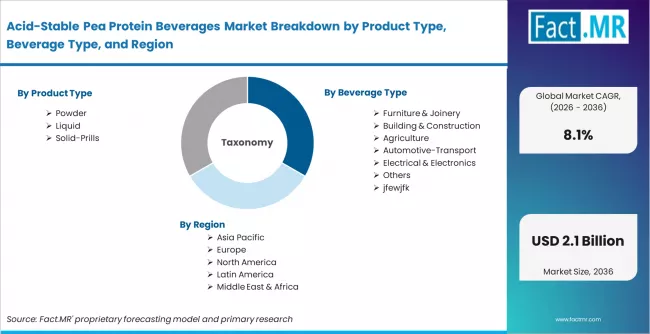
Acid Stable Pea Protein Beverages Market Breakdown By Product Type, Beverage Type, And Region | Source: Fact.MR
| Attribute | Details |
|---|---|
| Quantitative Units | USD 0.9 billion (2026) to USD 1.8 billion (2036), at a CAGR of 8.1% |
| Market Definition | Acid-stable pea protein ingredients designed for low-pH beverage formulations, including isolates, concentrates, and hydrolyzed proteins that provide solubility, clarity, and stability in functional beverages such as RTD drinks, sports nutrition beverages, and juice-based protein drinks globally. |
| Product Type Segmentation | Pea Protein Isolates (Acid-Stable Modified), Pea Protein Concentrates, Hydrolyzed Pea Protein |
| Beverage Type Segmentation | Ready-to-Drink (RTD) Functional Beverages, Sports Nutrition Drinks, Juice-Based Protein Beverages |
| Application Segmentation | Functional Nutrition Beverages, Sports & Fitness Nutrition, Clinical Nutrition |
| Application Coverage | Protein-fortified RTD beverages, juice-based protein drinks, sports recovery beverages, clinical nutrition drinks, and clean-label plant-based beverage formulations requiring low-pH protein stability. |
| Regions Covered | North America, Europe, Asia Pacific, Latin America, Middle East and Africa |
| Countries Covered | USA, Canada, Mexico, Germany, UK, France, Italy, Spain, China, Japan, South Korea, India, ASEAN, Australia and New Zealand, Brazil, Argentina, Saudi Arabia, GCC, South Africa, Rest of MEA |
| Key Companies Profiled | Roquette Frères, Ingredion Incorporated, Cargill Incorporated, Archer Daniels Midland Company (ADM), Cosucra Groupe Warcoing, PURIS Proteins LLC, Burcon NutraScience Corporation, Kerry Group plc, Emsland Group, The Scoular Company |
| Forecast Period | 2026 to 2036 |
Source: Fact.MR analysis. Updated Apr 22, 2026
Acid-Stable Pea Protein Beverages Market by Segments
-
By Product Type:
- Pea Protein Isolates (Acid-Stable Modified)
- Pea Protein Concentrates
- Hydrolyzed Pea Protein
-
By Beverage Type:
- Ready-to-Drink (RTD) Functional Beverages
- Sports Nutrition Drinks
- Juice-Based Protein Beverages
-
By Application:
- Functional Nutrition Beverages
- Sports & Fitness Nutrition
- Clinical Nutrition
-
By Region:
- North America
- United States
- Canada
- Mexico
- Latin America
- Brazil
- Mexico
- Argentina
- Chile
- Rest of Latin America
- Western Europe
- Germany
- United Kingdom
- France
- Italy
- Spain
- Nordic Countries
- BENELUX
- Rest of Western Europe
- Eastern Europe
- Russia
- Poland
- Hungary
- Balkan and Baltic
- Rest of Eastern Europe
- East Asia
- China
- Japan
- South Korea
- South Asia and Pacific
- India
- ASEAN
- Australia and New Zealand
- Rest of South Asia and Pacific
- Middle East and Africa
- Kingdom of Saudi Arabia
- Other GCC Countries
- Turkey
- South Africa
- Rest of Middle East and Africa
- North America
Frequently Asked Questions
How large is the acid-stable pea protein beverages market in 2025?
What will be the market size in 2026?
What is the projected market value by 2036?
What is the expected CAGR for the market?
Which product type segment leads the market?
Which beverage type dominates the market?
Which region is growing the fastest in this market?
What is driving demand for acid-stable pea protein beverages?
What is the key challenge in this market?
Who are the major players in the market?
Which application segment holds the largest share?
Why are acid-stable proteins important in beverages?
Who worked on this report


Preview the report firsthand - request a free sample
Free SampleGet the brochure for pricing and purchase details
Download PDF