- Market Value (2025): USD 1.3 Bn
- Estimated Value (2026): USD 1.5 Bn
- Forecast Value (2036): USD 4.4 Bn
- CAGR (2026-2036): 11.6%
What is the High-Speed Precision Dosers Market forecast to be worth by 2036?
USD 1.5 billion in 2026 to USD 4.4 billion by 2036, at 11.6% CAGR.
- The High-Speed Precision Dosers Market reached USD 1.3 billion in 2025.
- Demand is set to increase from USD 1.5 billion in 2026 to USD 4.4 billion by 2036.
- The market is forecast to record 11.6% CAGR from 2026 to 2036 as process plants place tighter control around fast feed addition and steady recipe execution.
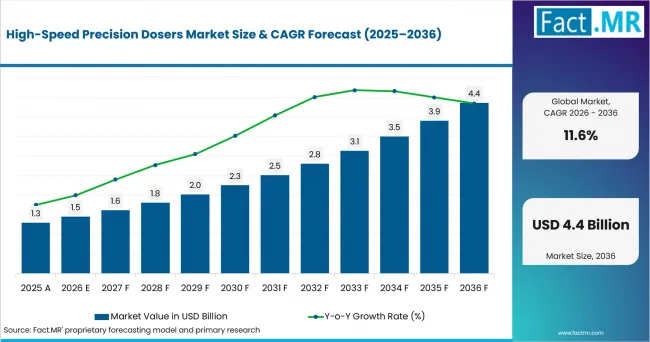
High Speed Precision Dosers Market Value Analysis | Source: Fact.MR
What are the defining numbers behind High-Speed Precision Dosers Market growth?
USD 2.9 billion absolute opportunity by 2036, led by servo auger dosing, the <30 doses/min class, and food applications.
- Demand Drivers in the Market
- Drug line teams require controlled micro-addition where a small dosing error can affect blend uniformity and batch records. Lab weighing workstations show the same emphasis on documented weighing steps before feed enters the full line.
- Battery process engineers need stable gravimetric feed for dry powders as electrode plant moves toward steady process routes. Ingredient dosing systems illustrate how closed-loop weighing can keep recipe additions aligned with target mass.
- Plastics compounders need exact feeder response during recipe changes so fillers and additives stay synchronized with extrusion throughput. The operating link between feeding and extrusion is also visible in devolatilization side feeders.
- Key Segments Analyzed
- By Dosing Mechanism: Servo auger is anticipated to hold 35.0% share in 2026 owing to controlled screw speed and quick correction when powder flow changes.
- By Cycle Rate: <30 doses/min is projected to account for 31.0% share in 2026 because many high-value recipes prioritize steady charge size and clean changeovers over the highest possible cycle count.
- By Accuracy Class: ±0.1% is forecast to capture 35.0% share in 2026 as high-value inputs and tightly controlled formulations place a premium on low dosing deviation.
- By sector: Food is expected to represent 31.0% share in 2026 supported by broad use of controlled input addition across bakery, confectionery, dairy, prepared foods, and ice cream lines.
- Analyst Opinion at Fact.MR
- Shambhu Nath Jha, Principal Consultant at Fact.MR, states, “The commercial test for an exact doser is whether it holds the intended feed rate when feed behavior and line speed change. Demand is set to favor systems that pair responsive drive control with reliable weighing feedback. Suppliers should treat cleaning access and recipe changeover as core performance measures alongside dosing accuracy.”
- Strategic Implications
- System makers should document accuracy under defined feeds and refill conditions so engineering teams can compare steady control on a common basis. Precise ingredient dosers show why the dosing principle and feed class should be evaluated together.
- Food and drug plants should check cleanability together with dosing accuracy. This is because fast recipe changes lose value when product-contact parts require lengthy access or inspection. Easy access can save time between recipes and reduce the work needed for checks.
- Battery line integrators should test gravimetric feeders with the actual powder blend before scale-up. In September 2025, Coperion announced its Loss-in-Weight Roller Feeder for dry electrode coating, designed to continuously and consistently feed powder blends directly into the calender gap.
Japan is set to post 12.3% CAGR through 2036 as battery spending and factory controls help demand for controlled powder feeding. The USA is set to record 12.0% CAGR as food, drug. Industrial plants add tighter feed control to production lines. Germany is set to advance at 11.7% CAGR backed by battery and process-sector spending. France is forecast to reach 11.4% CAGR as food and drug plants sustain demand for precise dosing. The UK is set to record 10.1% CAGR as advanced manufacturing and life-sciences spending help plant automation.
How does the High-Speed Precision Dosers Market break down by segment?
Servo auger leads Dosing Mechanism at 35.0%; ±0.1% leads Accuracy Class at 35.0%.
Which Dosing Mechanism dominates?
Servo auger is projected to hold 35.0% share in 2026.
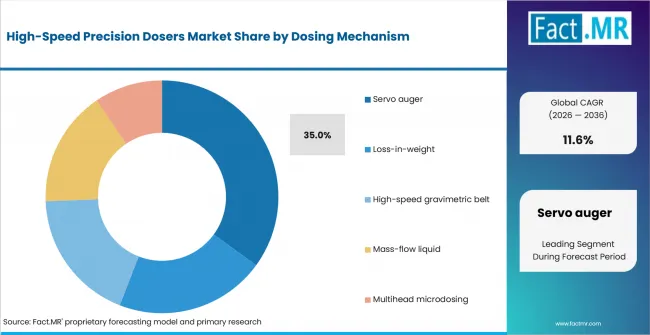
High Speed Precision Dosers Market Analysis By Dosing Mechanism | Source: Fact.MR
Servo auger is set to lead because servo control changes screw speed quickly and repeats a defined motion profile. Loss-in-weight systems add mass feedback for steady runs, while gravimetric belts suit free-flowing feed. Mass-flow liquid and multihead systems serve fluids and several micro-inputs. Precise ingredient dosers use the same distinction between gravimetric control and other dosing principles. Servo drive speed can change in small steps and can hold a set rate over long runs. This helps when a powder needs slow and steady feed.
What leads the Cycle Rate segment?
<30 doses/min is anticipated to account for 31.0% share in 2026.
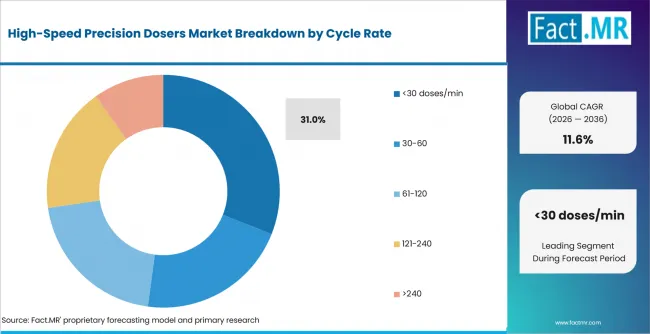
High Speed Precision Dosers Market Analysis By Cycle Rate | Source: Fact.MR
The <30 doses/min class is expected to lead because charge size, validation, refill behavior, and cleaning can limit practical repetition even in fast systems. Higher-rate classes serve smaller additions and tightly synchronized lines. Automatic checkweighers show how high-speed production lines pair throughput with steady weight checks.
How does Accuracy Class shape demand?
±0.1% is forecast to capture 35.0% share in 2026.
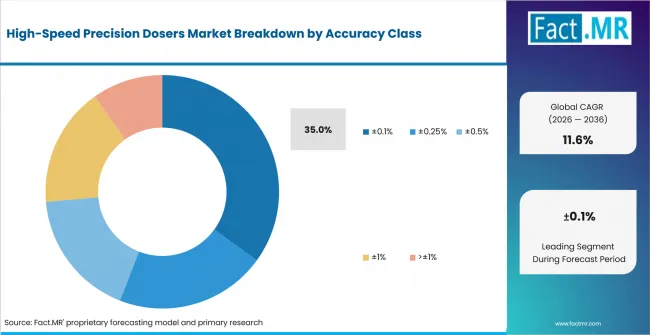
High Speed Precision Dosers Market Analysis By Accuracy Class | Source: Fact.MR
The ±0.1% class is forecast to lead where input value or formulation control justifies tighter performance. Wider tolerance bands remain practical when feed flow varies more than the nominal feeder specification. Accuracy still depends on feed behavior and refill events, so plant trials remain important before acceptance.
What supports Food within Industry?
Food is estimated to represent 31.0% share in 2026.
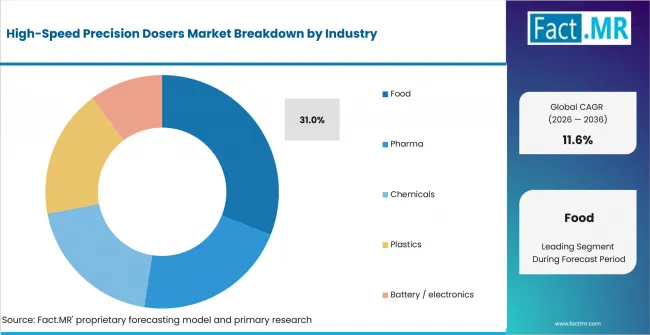
High Speed Precision Dosers Market Analysis By Industry | Source: Fact.MR
Food is expected to lead because recipes combine bulk inputs with smaller powders, liquids, flavors, and inclusions. Drug dosing emphasizes validated steady control, while chemicals, plastics, and batteries rely on controlled feeding. Tetra Pak introduced its Ingredient Doser 4000 A3 in March 2025 and reported a 67% reduction in start-up waste.
What is accelerating High-Speed Precision Dosers Market adoption, and what is holding it back?
Closed-loop precision and automated recipe control help adoption; material variability and integration complexity restrain it.
Drivers Impact Analysis
| Driver | (~) % Impact on CAGR | Geographic Relevance | Impact Timeline |
|---|---|---|---|
| Closed-loop recipe control | +2.3% | Global | Short term (<= 2 years) |
| Faster automated production lines | +1.8% | North America, Europe, East Asia | Medium term (2-4 years) |
| High-value material loss reduction | +1.4% | Global | Short term (<= 2 years) |
| Battery dry-process scale-up | +1.1% | USA, Germany, Japan, UK | Medium term (2-4 years) |
Source: Fact.MR analysis. Updated Sep 25, 2026
Opportunity Impact Analysis
| Opportunity | (~) % Impact on CAGR | Geographic Relevance | Impact Timeline |
|---|---|---|---|
| Recipe-linked digital feeder control | +1.2% | Global | Medium term (2-4 years) |
| Modular hygienic changeover designs | +0.9% | USA, UK, France, Germany | Short term (<= 2 years) |
| Multi-material microdosing cells | +0.7% | Global | Long term (>= 4 years) |
Source: Fact.MR analysis. Updated Sep 25, 2026
Restraints Impact Analysis
| Restraint | (~) % Impact on CAGR | Geographic Relevance | Impact Timeline |
|---|---|---|---|
| Material flow variability | -0.9% | Global | Short term (<= 2 years) |
| Integration and validation burden | -0.6% | Pharma, food, battery hubs | Medium term (2-4 years) |
| High precision-system cost | -0.4% | Global | Medium term (2-4 years) |
Source: Fact.MR analysis. Updated Sep 25, 2026
Which countries are scaling the High-Speed Precision Dosers Market through 2036?
- The country CAGR range spans 2.2 points, from Japan at 12.3% to the UK at 10.1%.
- Japan stands 0.3 point above the USA as battery plant and capital spending help exact feeder demand.
- The USA remains 0.3 point above Germany across food, drug, and advanced plant uses.
- Germany stays 0.3 point above France as battery and industrial transformation projects expand process-systems needs.
- France remains 1.3 points above the UK, backed by food, drug, and systems plant work.
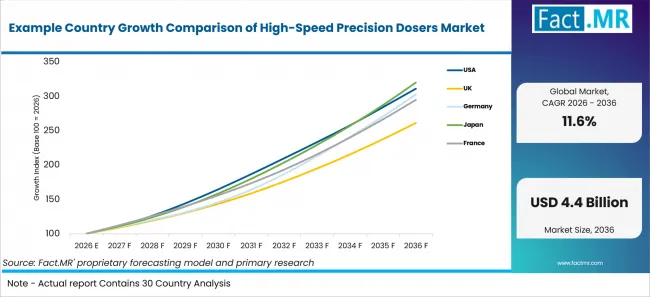
Example Country Growth Comparison Of High Speed Precision Dosers Market | Source: Fact.MR
| Country | CAGR (2026-2036) |
|---|---|
| Japan | 12.3% |
| United States | 12.0% |
| Germany | 11.7% |
| France | 11.4% |
| United Kingdom | 10.1% |
Source: Fact.MR analysis. Updated Sep 25, 2026
How does Japan perform?
12.3% CAGR, led by manufacturing investment and battery-production expansion.
Japan’s factory base gives precision feeders a clear role in lines that need tight process control. The Bank of Japan said in July 2026 that fixed investment by large manufacturers increased 10.6% in fiscal 2025. Higher capital spending is set to help feeder upgrades for dry powders and other controlled feeds.
What supports USA adoption?
12.0% CAGR, backed by manufacturing investment and high-value process industries.
U.S. plants use precision dosing across food, chemicals, plastics, pharmaceuticals, and battery production. The Bureau of Economic Analysis reported in July 2026 that the foreign direct investment position in the United States increased by USD 266.0 billion during 2025, with manufacturing recording the largest industry increase. Plant spending is expected to support feeder upgrades that combine precise material delivery with line control.
What is supporting Germany’s adoption?
11.7% CAGR, shaped by equipment investment and process-industry automation.
Germany’s machinery base helps precision dosing across chemicals, plastics, food processing, and battery applications. The Federal Statistical Office reported in May 2026 that, at current prices, machinery and equipment capital formation increased 4.2% year on year in the fourth quarter of 2025. Continued spending is set to favor feeders that give stable weighing feedback and flexible integration with established production lines.
What supports France adoption?
11.4% CAGR, supported by food manufacturing and controlled process production.
France has a large food manufacturing base that uses measured additions across powders, liquids, and inclusions. Insee said in July 2026 that food, beverage, and tobacco manufacturing generated EUR 207 billion in production value during 2025. That scale is set to sustain demand for dosing systems that combine hygienic access with steady recipe control.
How is the United Kingdom developing demand?
10.1% CAGR, driven by food manufacturing and automated processing requirements.
UK food manufacturing gives a broad use base for ingredient and inclusion dosing. The Office for National Statistics said in July 2026 that food manufacturing made up 22.9% of total UK manufacturers’ product sales in 2025. Its share of manufacturing activity is set to help precision dosing where processors need reliable recipe control and efficient changeovers.
Who leads the High-Speed Precision Dosers Market?
Bühler, Coperion, GEA, AZO, Qlar (formerly Schenck Process), and Tetra Pak are active in precision feeding, weighing, ingredient dosing, and process-line integration.
Suppliers focus on stable material feed, dosing accuracy, responsive controls, cleanability, and integration with production lines. IBC dosing units combine controlled chemical feed with PLC, recipe-based, and connected controls, including mobile dosing configurations.
In July 2025, Qlar announced that it would present the SIMPLEX FB loss-in-weight feeder at K 2025, held in Düsseldorf from October 8 to 15, 2025. The gravimetric feeder is designed for reliable and continuous dosing of bulk materials. The provider set collectively covers applications across food, plastics, chemicals, and battery manufacturing.
Which companies are the key providers?
Key companies include Bühler; Coperion; GEA; AZO; Qlar (formerly Schenck Process); and Tetra Pak.
- Bühler
- Coperion
- GEA
- AZO
- Qlar (formerly Schenck Process)
- Tetra Pak
Bibliography
- Zeballos, E., & Sinclair, W. (2026, June 11). Total U.S. food spending reached $2.51 trillion in 2025. U.S. Department of Agriculture, Economic Research Service.
- Coperion. (2025, September 19). Shaping tomorrow’s energy: Cutting-edge technologies enhancing battery manufacturing efficiency.
- U.S. Bureau of Economic Analysis. (2026, July 21). Direct investment by country and industry, 2025.
- Office for National Statistics. (2026, July 24). UK manufacturers’ sales by product: 2025.
- Federal Statistical Office (Destatis). (2026, May 22). Gross fixed capital formation: At current prices.
- Bank of Japan. (2026, July 1). Tankan outline (June 2026).
- Institut national de la statistique et des études économiques. (2026, July 21). Indicateurs macroéconomiques de l’industrie manufacturière : Données annuelles de 2010 à 2025.
- Qlar. (2025, July 31). Trade fair K 2025: Qlar (formerly Schenck Process) presents SIMPLEX FB loss-in-weight feeder.
This Report Answers
- The report explains where high-speed precision dosers are used by dosing mechanism, cycle rate, accuracy class, and industry. It links each segment to a clear plant need.
- Segment analysis shows which subsegments lead and why plants choose each type. It focuses on feed control, speed, and dose limits.
- Country analysis reviews the listed markets and the plant data that supports demand. It links each country to a clear end-use base.
- Competitive analysis reviews the current giver set and its role in precise feed and weighing. It uses dated company news where a current move adds value.
- Application analysis looks at dose control, line speed, feed flow, and clean access. These factors shape system choice in each end use.
What does the High-Speed Precision Dosers Market cover?
The High-Speed Precision Dosers Market covers equipment that meters controlled quantities of material into batch or continuous production at a defined rate. Adjacent food processing and handling equipment helps frame the production-line environment around precision ingredient delivery.
The assessment also connects with industrial automation & control systems where feeder signals become part of wider line control. The boundary remains focused on the dosing function itself and its direct weighing or flow-control hardware. The core test is simple: the system must meter the feed at the set rate.
What is included in the scope?
The scope includes servo auger dosing, loss-in-weight feeding, high-speed gravimetric belt dosing, mass-flow liquid metering, and multihead microdosing.
It includes integrated controls and weighing hardware central to the dosing function. Related dosing pumps give an adjacent reference for controlled liquid delivery.
What is excluded from the scope?
The scope is limited to equipment with an integrated precision-dosing function.
General conveyors, storage silos, mixers, extruders, packaging machines, laboratory pipettes, and standalone medical infusion devices fall outside that boundary. IBC dosing units are adjacent where chemical metering is integrated into a transfer station. The report keeps the boundary on plant dosing and feed control.
How Was the Analysis Built?
The analysis draws on 120+ sources, 35+ company portfolios, 25+ countries, and more than 20 industry interviews.
- Primary Research: Primary research includes discussions with manufacturers, service providers, technology developers, distributors, end users, and subject-matter experts. These conversations examine purchasing priorities, product adoption, operational challenges, approval requirements, competitive positioning, and the factors that influence wider market acceptance.
- Desk Research: Desk research covers government statistics, regulatory publications, company filings, trade data, technical studies, industry associations, standards, public policy, and other authoritative sources. Every source used in the analysis is documented in the bibliography.
- Market Sizing and Forecasting: Market estimates combine historical performance, demand indicators, pricing and volume trends, segment shares, company participation, country-level growth, adoption patterns, investment activity, and barriers to market expansion.
- Data Validation and Update Cycle: Findings are validated by comparing primary interviews with public data, company activity, regulatory changes, trade patterns, and industry developments. Regular updates review new product launches, capacity changes, partnerships, approvals, and shifts in commercial adoption.
Segmentation
What is the report’s scope and coverage?
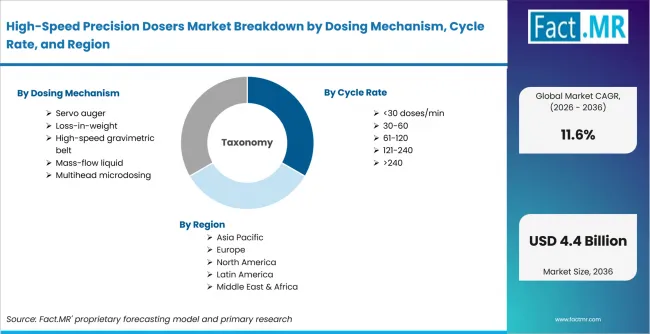
High Speed Precision Dosers Market Breakdown By Dosing Mechanism, Cycle Rate, And Region | Source: Fact.MR
| Attribute | Details |
|---|---|
| Quantitative Units | USD billion |
| Market Definition | Equipment and integrated control systems that dispense measured quantities of powders, pellets, liquids, or inclusions at production-line speed using servo, gravimetric, mass-flow, belt, or multihead dosing mechanisms. |
| Dosing Mechanism | Servo auger; Loss-in-weight; High-speed gravimetric belt; Mass-flow liquid; Multihead microdosing |
| Cycle Rate | <30 doses/min; 30-60; 61-120; 121-240; >240 |
| Accuracy Class | ±0.1%; ±0.25%; ±0.5%; ±1%; >±1% |
| Industry | Food; Pharma; Chemicals; Plastics; Battery / electronics |
| Regions Covered | North America; Latin America; Western Europe; Eastern Europe; East Asia; South Asia & Pacific; Middle East & Africa |
| Countries Covered | United States; United Kingdom; Germany; Japan; France |
| Key Companies Profiled | Bühler; Coperion; GEA; AZO; Qlar (formerly Schenck Process); Tetra Pak |
| Forecast Period | 2026 to 2036 |
| Approach | Hybrid top-down and bottom-up approach using dosing-system applications, production-line use cases, segment shares, country growth, company portfolio review, and verified public evidence. |
Source: Fact.MR analysis. Updated Sep 25, 2026
How is the market segmented?
-
By Dosing Mechanism:
- Servo auger
- Loss-in-weight
- High-speed gravimetric belt
- Mass-flow liquid
- Multihead microdosing
-
By Cycle Rate:
- <30 doses/min
- 30-60
- 61-120
- 121-240
- >240
-
By Accuracy Class:
- ±0.1%
- ±0.25%
- ±0.5%
- ±1%
- >±1%
-
By Industry:
- Food
- Pharma
- Chemicals
- Plastics
- Battery / electronics
-
By Region:
- North America
- Latin America
- Western Europe
- Eastern Europe
- East Asia
- South Asia & Pacific
- Middle East & Africa
Frequently Asked Questions
How big is the High-Speed Precision Dosers Market in 2026?
What is the CAGR of the High-Speed Precision Dosers Market from 2026 to 2036?
Which dosing mechanism leads the High-Speed Precision Dosers Market?
Which accuracy class leads the High-Speed Precision Dosers Market?
Who are the leading companies in the High-Speed Precision Dosers Market?
Who worked on this report


Preview the report firsthand - request a free sample
Free SampleGet the brochure for pricing and purchase details
Download PDF