- Base Value(2026): 860 Mn
- Estimated Value(2026): 860 Mn
- Forecast Value (2036): 1497 Mn
- CAGR (2026 - 2036): 5.7%
Low-Friction Wheel Hub Bearings Market Forecast Outlook 2026 to 2036
The low-friction wheel hub bearings market is valued at USD 860 million in 2026 and is projected to reach USD 1,497 million by 2036, expanding at a 5.7% compound annual growth rate (CAGR).
Key Takeaways from Low-Friction Wheel Hub Bearings Market
- Low-Friction Wheel Hub Bearings Market Value (2026): USD 860 million
- Low-Friction Wheel Hub Bearings Market Forecast Value (2036): USD 1,497 million
- Low-Friction Wheel Hub Bearings Market Forecast CAGR (2026-2036): 5.7%
- Leading Segment in Low-Friction Wheel Hub Bearings Market: OEM / Line-Fit (59%)
- Key Growth Region in Low-Friction Wheel Hub Bearings Market: China (6.8% CAGR)
- Key Players in Low-Friction Wheel Hub Bearings Market: SKF AB, Schaeffler AG, NSK Ltd., NTN Corporation, JTEKT Corporation (Koyo), The Timken Company, ILJIN Group Co., Ltd., C&U Group Co., Ltd., ZWZ (Wafangdian Bearing Group Co., Ltd.), Nachi-Fujikoshi Corp.
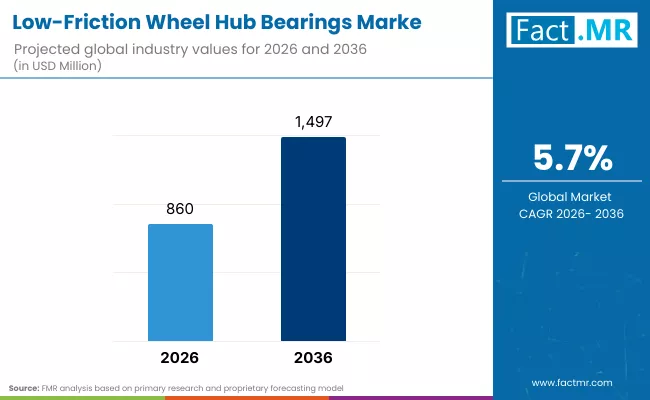
Low Friction Wheel Hub Bearings Market By Industry | Source: Fact.MR
Within the automotive ecosystem, this category has graduated from a commodity component to a strategic enabler of EV range extension and fleet-wide CO2 reduction. As noted by Rickard Gustafson, CEO of SKF, in early 2026: "Less friction means more energy saved... we make industry smarter, more competitive, and more energy efficient."
Control points in this market are defined by proprietary low-viscosity lubrication and advanced seal architectures that reduce torque by up to 64%. Dependency factors have shifted as OEMs increasingly rely on these precision units to offset battery weight, with a 30% friction reduction equating to an effective 1.4 kg reduction in battery mass. Strategic trade-offs involve balancing these specialized, lower-viscosity designs with the extreme reliability required for long-term vehicle warranties, forcing a market consolidation toward Tier 1 innovators.
Low-Friction Wheel Hub Bearings Market
| Metric | Value |
|---|---|
| Estimated Value in (2026E) | USD 860 million |
| Forecast Value in (2036F) | USD 1,497 million |
| Forecast CAGR (2026 to 2036) | 5.7% |
Source: Fact.MR analysis. Updated Feb 4, 2026
Category
| Category | Sub-Segment |
|---|---|
| By Technology Package | Optimized Internal Geometry; Low-Viscosity Grease Systems; Special Coatings; Hybrid Ceramic Elements; Other |
| By Vehicle Segment | Passenger Cars; EVs; Light Commercial Vehicles; Performance Cars; Other |
| By Primary Benefit | Energy Efficiency / Range; NVH Reduction; Extended Bearing Life; Other |
| By Sales Channel | OEM / Line-Fit; Aftermarket Replacement; Other |
| Region | North America; Europe; Asia Pacific; Latin America; Middle East & Africa |
Source: Fact.MR analysis. Updated Feb 4, 2026
Segmental Analysis
What is Driving the Dominance of Optimized Internal Geometry in the Low-Friction Wheel Hub Bearings Market?
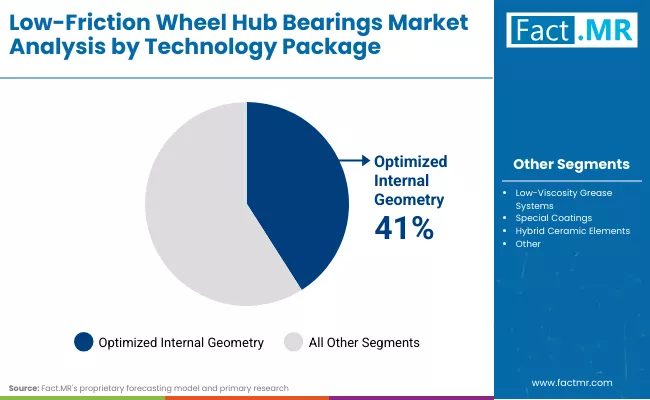
Low Friction Wheel Hub Bearings Market Technology | Source: Fact.MR
Optimized Internal Geometry leads the low-friction wheel hub bearings market with 41% of the market share in 2026. This design innovation improves bearing efficiency by minimizing internal friction and enhancing the smoothness of rotation. The optimization of the internal structure reduces energy losses, making it particularly beneficial for vehicles where performance and fuel efficiency are critical. This technology is widely adopted in passenger cars, EVs, and high-performance vehicles looking to improve overall efficiency and reduce wear over time.
What is the Primary Benefit Driving Demand in the Low-Friction Wheel Hub Bearings Market?
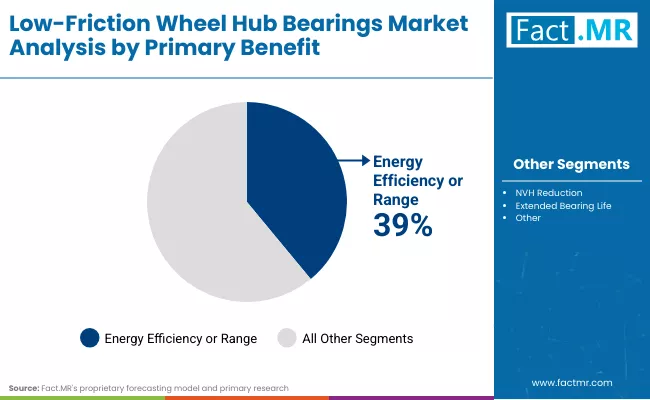
Low Friction Wheel Hub Bearings Market By Primary Benefit | Source: Fact.MR
The primary benefit driving demand for low-friction wheel hub bearings is Energy Efficiency or Range, which holds 39% of the market share in 2026. These bearings are essential for improving the overall energy efficiency of vehicles, especially in electric and hybrid vehicles where energy conservation directly impacts range. By reducing friction, these bearings help vehicles achieve better fuel economy and increase the distance they can travel on a single charge, making them a key component in enhancing vehicle performance and operational costs.
Low Friction Wheel Hub Bearings Market — Drivers, Restraints & Trends
| Country | Drivers | Restraints | Trends |
|---|---|---|---|
| USA | High demand for passenger cars, SUVs, and light trucks with efficiency and fuel‑economy focus increases adoption of low‑friction hub bearings. | EV adoption may shift design toward integrated e‑axle units rather than traditional bearings. | Growth in sealed, long‑life low‑friction bearings integrated with ABS/ESC systems. |
| China | Largest vehicle production globally and tightening fuel‑efficiency standards boost need for low‑friction wheel hub bearings. | Price‑sensitive segments may prefer lower‑cost bearing options. | Increasing local manufacturing and adoption in mid‑premium vehicles. |
| India | Rising vehicle sales and regulatory emphasis on fuel economy drive demand for efficiency‑oriented components. | Lower consumer spending limits rapid uptake of premium low‑friction bearings. | Expansion of aftermarket replacement demand as vehicles age. |
| Germany | Premium and performance vehicle production prioritizes efficiency and reduced rolling resistance. | Electrification and integrated e‑axle trends may reduce traditional wheel bearing roles. | Use of advanced high‑precision, low‑friction bearings tailored for dynamic handling. |
| Japan | OEM focus on reliability, fuel economy, and efficiency supports consistent adoption. | Slow growth in traditional ICE vehicles limits incremental volume growth. | Development of compact, high‑efficiency hub bearings for hybrid and ICE vehicles. |
| South Korea | Solid automotive production with emphasis on efficiency and performance supports low‑friction bearing use. | Competitive pricing pressures on component suppliers. | Trends toward optimized bearing seals and synthetic lubricants for improved longevity. |
| Mexico | Growing vehicle assembly for export with fuel‑efficiency requirements increases demand. | Cost sensitivity in entry‑level segments can limit premium bearing adoption. | Aftermarket replacement growth as fleet ages and efficiency upgrades persist. |
Source: Fact.MR analysis. Updated Feb 4, 2026
Analysis of the Low-Friction Wheel Hub Bearings Market by Key Country
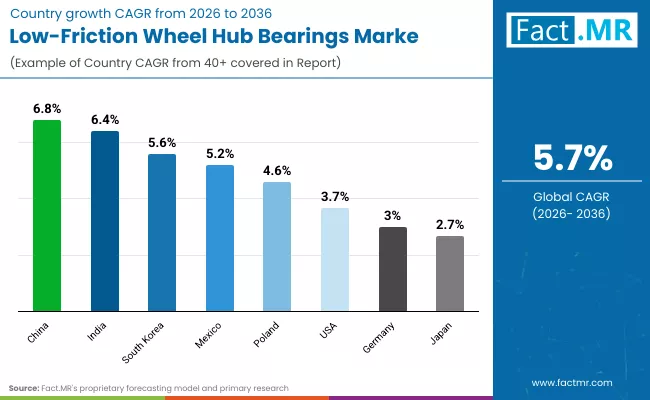
Low Friction Wheel Hub Bearings Market By Country | Source: Fact.MR
| Country | CAGR (Forecast Period) |
|---|---|
| China | 6.8% |
| India | 6.4% |
| South Korea | 5.6% |
| Mexico | 5.2% |
| Poland | 4.6% |
| USA | 3.7% |
| Germany | 3.0% |
| Japan | 2.7% |
Source: Fact.MR analysis. Updated Feb 4, 2026
What Drives the 6.8% Growth in the China Low-Friction Wheel Hub Bearings Market?
China's 6.8% growth in the low-friction wheel hub bearings market is primarily driven by the expansion of the electric vehicle (EV) market and the push for fuel efficiency in traditional internal combustion engine (ICE) vehicles. The government's support for New Energy Vehicles (NEVs), including electric vehicles and plug-in hybrids, is accelerating the adoption of advanced components like low-friction bearings. Furthermore, China's automotive manufacturing hubs are increasingly focusing on producing lightweight, energy-efficient vehicles, creating a substantial demand for low-friction wheel hub bearings to improve fuel efficiency and reduce carbon emissions in both passenger cars and commercial vehicles.
Why is the 6.4% Growth in the India Low-Friction Wheel Hub Bearings Market Significant?
India’s 6.4% growth in the low-friction wheel hub bearings market is driven by the country's rapid automotive sector growth and the increasing demand for fuel-efficient vehicles. As India’s middle class expands, the demand for personal vehicles, particularly SUVs and small cars, is rising, necessitating the need for components that improve fuel efficiency and vehicle performance. Additionally, the government's push for cleaner vehicles and the growing focus on fuel efficiency in both the passenger vehicle and commercial vehicle sectors are boosting the demand for low-friction wheel hub bearings.
How Does the 5.6% Growth Reflect the South Korea Low-Friction Wheel Hub Bearings Market Expansion?
South Korea’s 5.6% growth is influenced by the country's leadership in electric vehicle production and the push for improved vehicle efficiency. South Korea's automotive giants such as Hyundai and Kia are heavily investing in EV technology and energy-efficient components to meet global fuel economy standards. Low-friction wheel hub bearings are essential in reducing the overall energy consumption of electric vehicles and hybrids. The growth of green technologies and the government's support for future mobility initiatives further fuel the demand for these advanced bearings in South Korea.
What Drives the 5.2% Growth in the Mexico Low-Friction Wheel Hub Bearings Market?
Mexico’s 5.2% growth in the low-friction wheel hub bearings market is driven by the country’s role as a global automotive manufacturing hub, particularly in the North American market. Mexico's proximity to the U.S., the USMCA trade agreement, and the growing demand for fuel-efficient vehicles have made it a critical player in the supply chain for automotive components. The continued growth in vehicle production, especially in the compact and electric vehicle segments, is driving demand for low-friction bearings. Additionally, Mexico’s manufacturing plants are increasingly adopting advanced automotive technologies, further enhancing the demand for high-performance wheel hub bearings.
What Contributes to the 4.6% Growth in the Poland Low-Friction Wheel Hub Bearings Market?
Poland's 4.6% growth in the low-friction wheel hub bearings market is driven by the country’s strong automotive sector and increasing investments in electric vehicle production. As a significant supplier to the European automotive market, Poland is experiencing higher demand for energy-efficient components like low-friction bearings. The expansion of the EV market in Europe, along with the growth of the local manufacturing base, is contributing to the steady rise in demand for low-friction wheel hub bearings in the region.
What Factors Drive the 3.7% Growth in the USA Low-Friction Wheel Hub Bearings Market?
The 3.7% growth in the USA low-friction wheel hub bearings market is primarily driven by the demand for fuel-efficient vehicles. As part of the NHTSA’s CAFE standards, automakers are required to meet strict fuel economy targets, driving the adoption of low-friction wheel hub bearings to reduce energy losses in vehicles. Additionally, the increasing popularity of electric and hybrid vehicles is propelling demand for components that enhance overall vehicle efficiency. The market also benefits from the growing focus on reducing carbon emissions in both commercial vehicles and passenger cars.
Why Does the 3.0% Growth in the Germany Low-Friction Wheel Hub Bearings Market Matter?
Germany’s 3.0% growth in the low-friction wheel hub bearings market reflects the country’s focus on high-performance vehicles, particularly in the luxury and electric vehicle segments. As German automakers like BMW, Mercedes-Benz, and Audi push for greater fuel efficiency in their vehicle lineups, the demand for low-friction wheel hub bearings increases. The Euro 7 regulations, set to take effect in 2026, are also driving the adoption of fuel-efficient components like low-friction bearings to meet emission standards and efficiency targets in both ICE and electric vehicles.
What Influences the 2.7% Growth Within the Japan Low-Friction Wheel Hub Bearings Market?
Japan’s 2.7% growth in the low-friction wheel hub bearings market is influenced by the increasing production of hybrid and electric vehicles. As the domestic and export markets for Japanese automakers shift toward eco-friendly vehicles, there is a growing demand for fuel-efficient components like low-friction wheel hub bearings. The country’s focus on advanced engineering and automotive technologies ensures that Japanese suppliers are leading the way in the production of high-performance bearings designed to enhance fuel economy and reduce carbon emissions.
How Are Key Players Competing in the Low-Friction Wheel Hub Bearings Market?
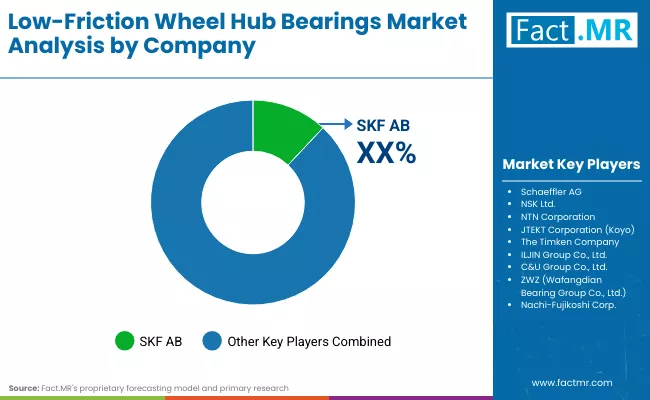
Low Friction Wheel Hub Bearings Market By Company | Source: Fact.MR
In the low-friction wheel hub bearings market, competition is driven by advancements in energy efficiency, durability, and performance. SKF AB and Schaeffler AG lead with their cutting-edge low-friction technology, offering reduced rolling resistance and increased fuel efficiency for automotive applications. NSK Ltd. and NTN Corporation focus on providing high-precision, low-friction bearings to meet the demands of electric vehicles (EVs) and hybrid platforms. JTEKT Corporation (Koyo brand) emphasizes cost-effective solutions that balance performance and price, catering to mass-market demands. The Timken Company integrates advanced lubricants to optimize friction reduction and enhance service life. ILJIN Group and C&U Group target the global market with competitive pricing while maintaining consistent quality. ZWZ and Nachi-Fujikoshi focus on economical production and quality control, ensuring reliable, low-friction bearings for diverse applications. The competitive advantage lies in technological innovation, energy savings, and global supply chains.
Recent Industry Developments
- NSK’s New Low-Friction Hub Unit Bearing (Sep 18, 2024): NSK Ltd. announced a new low-friction hub unit bearing that achieves ~40 % lower friction compared to conventional designs while maintaining water/mud resistance - aimed at extending EV range and improving drivetrain efficiency.
- NTN Expands “Low Friction Hub Bearing” Series (2024): NTN Corporation expanded its low-friction hub bearing portfolio with “Low Friction Hub Bearing IV” and “V”, featuring newly formulated low-torque grease and seal design improvements, reducing rotational friction by up to ~64 % compared to conventional hub bearings - enhancing fuel/electric efficiency for EVs/HEVs.
- SKF Ultra-Low Friction Wheel Bearing (2024): SKF Automotive introduced an ultra-low friction wheel bearing (GEN 3) with an optimized internal geometry, special low-friction grease, and advanced sealing - resulting in reduced rolling resistance and improved energy efficiency; it has been selected for high-volume OEM EV programs.
Key Players of the Low-Friction Wheel Hub Bearings Market
- SKF AB
- Schaeffler AG
- NSK Ltd.
- NTN Corporation
- JTEKT Corporation (Koyo)
- The Timken Company
- ILJIN Group Co., Ltd.
- C&U Group Co., Ltd.
- ZWZ (Wafangdian Bearing Group Co., Ltd.)
- Nachi-Fujikoshi Corp.
Bibliographies
- International Organization for Standardization. (2023). ISO 15312: Rolling bearings - Thermal reference speeds and friction considerations. ISO.
- United Nations Economic Commission for Europe (UNECE). (2024). UN Regulation No. 13-H - Braking systems and wheel-end performance requirements for passenger vehicles. UNECE.
- National Highway Traffic Safety Administration (NHTSA). (2023). Wheel-end integrity, braking interaction, and rolling resistance considerations. U.S. Department of Transportation.
- Institute of Electrical and Electronics Engineers (IEEE). (2024). Low-torque bearing design and sensor integration for electric vehicle wheel hubs. IEEE Xplore Digital Library.
- Society of Automotive Engineers (SAE). (2023). Surface treatments and lubrication regimes for low-torque automotive hub bearings. SAE Technical Paper Series.
Segmentation
Scope of the Report
| Items | Values |
|---|---|
| Quantitative Units (2026) | USD Billion |
| By Technology Package | Optimized Internal Geometry, Low-Viscosity Grease Systems, Special Coatings, Hybrid Ceramic Elements, Other |
| By Vehicle Segment | Passenger Cars, EVs, Light Commercial Vehicles, Performance Cars, Other |
| By Primary Benefit | Energy Efficiency / Range, NVH Reduction, Extended Bearing Life, Other |
| By Sales Channel | OEM / Line-Fit, Aftermarket Replacement, Other |
| Regions Covered | North America, Europe, Asia Pacific, Latin America, Middle East & Africa |
| Countries Covered | United States, Canada, Mexico, Germany, United Kingdom, France, Japan, South Korea, China, India, Brazil, and other countries |
| Key Companies Profiled | SKF AB, Schaeffler AG, NSK Ltd., NTN Corporation, JTEKT Corporation (Koyo), The Timken Company, ILJIN Group Co., Ltd., C&U Group Co., Ltd., ZWZ (Wafangdian Bearing Group Co., Ltd.), Nachi-Fujikoshi Corp. |
| Additional Attributes | Dollar revenue by technology package, vehicle segment, primary benefit, sales channel, and region; regional demand trends, competitive landscape, technological advancements in low-friction wheel hub bearings, operational performance optimization initiatives, and product development strategies |
Source: Fact.MR analysis. Updated Feb 4, 2026
Low-Friction Wheel Hub Bearings Market Key Segments
-
By Technology Package :
- Optimized Internal Geometry
- Low-Viscosity Grease Systems
- Special Coatings
- Hybrid Ceramic Elements
- Other
-
By Vehicle Segment :
- Passenger Cars
- EVs
- Light Commercial Vehicles
- Performance Cars
- Other
-
By Primary Benefit :
- Energy Efficiency / Range
- NVH Reduction
- Extended Bearing Life
- Other
-
By Sales Channel :
- OEM / Line-Fit
- Aftermarket Replacement
- Other
-
Region :
- North America
- USA
- Canada
- Mexico
- Europe
- Germany
- UK
- France
- Italy
- Spain
- Nordic Countries
- BENELUX
- Rest of Europe
- Asia Pacific
- China
- Japan
- South Korea
- India
- Australia
- Rest of Asia Pacific
- Latin America
- Brazil
- Argentina
- Rest of Latin America
- Middle East and Africa
- Kingdom of Saudi Arabia
- United Arab Emirates
- South Africa
- Rest of Middle East and Africa
- Other Regions
- Oceania
- Central Asia
- Other Markets
- North America
Frequently Asked Questions
What is the projected market size for low-friction wheel hub bearings in 2026?
What value is expected for low-friction wheel hub bearings in 2036?
At what rate will the low-friction wheel hub bearings market progress from 2026 to 2036?
Which sales channel dominates demand and what share does it hold?
Which region is expected to experience the fastest growth and what rate is it projected at?
Who are the major players in the low-friction wheel hub bearings market?
Who worked on this report


Preview the report firsthand - request a free sample
Free SampleGet the brochure for pricing and purchase details
Download PDF