- Market Value (2025): USD 1.5 Bn
- Estimated Value (2026): USD 1.6 Bn
- Forecast Value (2036): USD 3.2 Bn
- CAGR (2026-2036): 7.1%
What is the Low-Trans Fat Replacers Market forecast to be worth by 2036?
USD 1.6 billion in 2026 to USD 3.2 billion by 2036 at a 7.1% CAGR.
- The Low-Trans Fat Replacers Market crossed a valuation of USD 1.5 billion in 2025.
- Demand is projected to increase from USD 1.6 billion in 2026 to USD 3.2 billion by 2036.
- The market is forecast to record a 7.1% CAGR from 2026 to 2036 as bakery brands and confectionery manufacturers reformulate fats for label compliance and consistent performance.
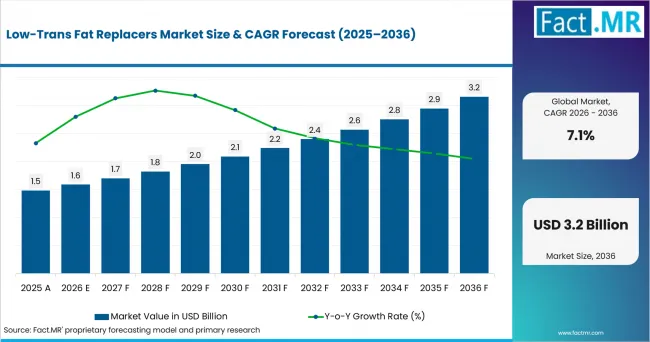
Low Trans Fat Replacers Market Value Analysis | Source: Fact.MR
What are the defining numbers behind Low-Trans Fat Replacers Market growth?
An absolute opportunity of USD 1.57 billion is expected between 2026 and 2036.
- Demand Drivers in the Market
- Trans-fat policy is changing reformulation decisions. The World Health Organization recognized four countries in May 2025 for their efforts to eliminate industrially produced trans fats, highlighting the importance of best-practice policies, monitoring, and enforcement.
- Bakery manufacturers need plastic shortening behavior because laminated dough, cookies and cakes rely on aeration and spread control. Interesterified fats and palm fractions help recreate that structure without partially hydrogenated oils.
- Confectionery brands need filling fats that hold a clean melt and resist bloom. Specialty shea systems and palm mid fractions fit this need when chocolate coatings and filled products face warmer supply chains.
- Foodservice operators value high-oleic frying oils because longer fry life lowers oil turnover. Consistent taste across repeated service cycles also helps quick-service kitchens manage menu quality.
- Retail brands are expected to prefer documented replacer systems where nutrition claims, ingredient declarations and plant-level performance data are available before reformulation starts.
- Key Segments Analyzed
- By Replacement Technology: Interesterified fats are expected to hold 38.00% share in 2026 because they rebuild solid-fat structure without relying on partially hydrogenated oils.
- By Fat Source: Palm and palm fractions are projected to account for 35.00% share in 2026 due to availability and fractionation flexibility for bakery shortenings.
- By Application: Bakery shortenings are anticipated to capture 31.00% share in 2026 as bakers need creaming, layering and mouthfeel in low-trans formulations.
- By Performance Need: Plasticity and shortening are estimated to represent 29.00% share in 2026 owing to their direct effect on dough handling and eating quality.
- Analyst Opinion at Fact.MR
- Fact.MR Principal Consultant Shambhu Nath Jha states, "The commercial test for low-trans fat replacers is nutrition and line behavior together. Food brands need fats that pass label review and still behave correctly in dough and fillings. Suppliers are expected to gain ground where they combine fat-structuring know-how with steady feedstock access."
- Strategic Implications
- Ingredient suppliers should document trans-fat levels, saturated-fat profile and application performance for each replacer system.
- Bakery brands should test shortening systems in production conditions before switching to structured low-trans alternatives.
- Cargill, Incorporated reported in May 2025 that its entire edible oils portfolio met WHO limits for industrially produced trans-fatty acids and that it had helped remove more than 1.5 billion pounds of products containing iTFAs from the global food chain, while supporting hundreds of customers with product reformulation.
- Palm-based fat processors should strengthen traceability and fractionation capacity for customers seeking stronger sourcing assurance.
The UK is projected to record 8.9% CAGR through HFSS reformulation pressure. Indonesia follows at 8.0% as palm oil scale supports structured fat supply. Malaysia reaches 7.6% through specialty fraction capacity. The USA posts 7.1% through FDA trans-fat rules. Germany records 6.7% through oilseed and confectionery demand.
How does the Low-Trans Fat Replacers Market break down by segment?
Interesterified fats lead at 38.00%; palm and palm fractions lead at 35.00%.
Which replacement technology dominates?
Interesterified fats are expected to hold 38.0% share in 2026.
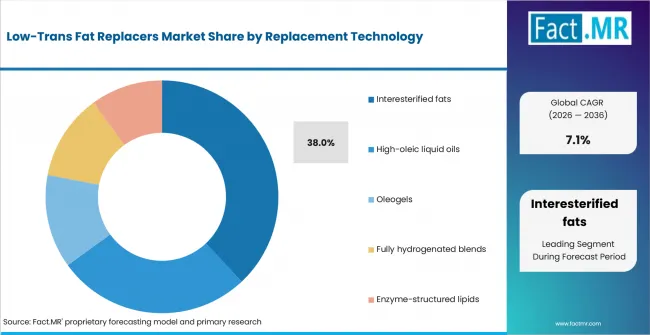
Low Trans Fat Replacers Market Analysis By Replacement Technology | Source: Fact.MR
Interesterified fats lead because they rebuild a useful solid-fat curve without industrial trans fat. Formulators use them when bakery products and spreads require structure, while high-oleic liquid oils and oleogels remain relevant for oxidative stability and specialized texture needs. Cargill, Incorporated showcased Gemini Plus Trans Fat-Free Vanaspati at AAHAR 2025 in March 2025, highlighting its use in traditional HORECA applications such as biryanis, sweets, and parottas.
What leads the Fat Source segment?
Palm and palm fractions are projected to account for 35.0% share in 2026.
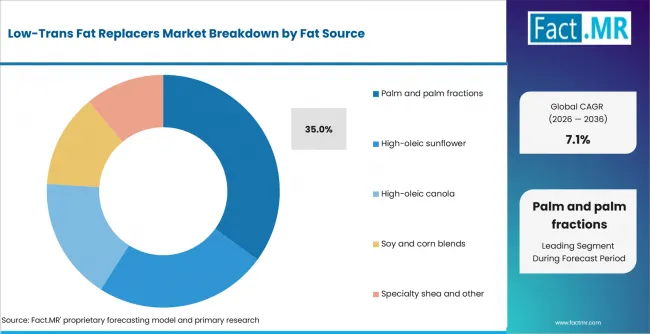
Low Trans Fat Replacers Market Analysis By Fat Source | Source: Fact.MR
Palm and palm fractions lead because fractionation provides hardstocks and mid fractions suitable for bakery, confectionery, and shortening applications. High-oleic sunflower, high-oleic canola, and soy and corn blends also support different stability, cost, and formulation requirements. Commercial interest remains strongest where fat sources provide both functional structure and dependable supply.
How does Application shape demand?
Bakery shortenings are anticipated to capture 31.0% share in 2026.
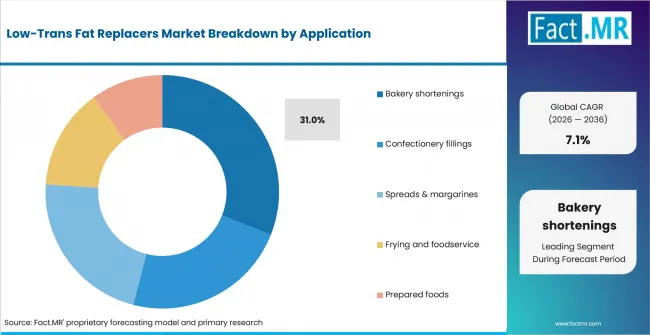
Low Trans Fat Replacers Market Analysis By Application | Source: Fact.MR
Bakery shortenings lead because cakes, pastries, and cookies require fat crystals that support aeration, control spread, and maintain texture. Confectionery fillings, spreads, margarines, frying, and foodservice applications also create demand for replacement fats. Recipe trials remain important because performance can vary with formulation, mixing conditions, and storage requirements.
What supports Plasticity and Shortening within Performance Need?
Plasticity and shortening are estimated to represent 29.0% share in 2026.
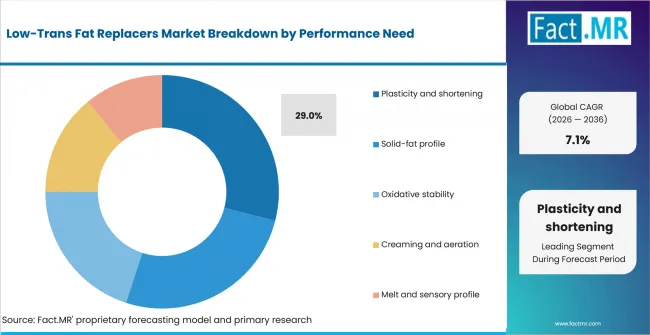
Low Trans Fat Replacers Market Analysis By Performance Need | Source: Fact.MR
Plasticity and shortening lead because replacement fats must perform like conventional solid fats during mixing, sheeting, and baking. Solid-fat profile, oxidative stability, creaming, and aeration also influence formulation decisions. Manufacturers typically assess taste, oil migration, texture, and shelf stability under plant conditions before approving a replacement system.
What is accelerating Low-Trans Fat Replacers Market adoption, and what is holding it back?
Regulatory reformulation drives it; feedstock and functionality limits restrain it.
Drivers Impact Analysis
| DRIVER | (~) % IMPACT ON CAGR | GEOGRAPHIC RELEVANCE | IMPACT TIMELINE |
|---|---|---|---|
| Trans-fat policy compliance in packaged foods | +1.8% | Global | Short term (<= 2 years) |
| Bakery need for plasticity without PHOs | +1.4% | North America, Europe, Southeast Asia | Medium term (2-4 years) |
| Confectionery need for bloom-resistant filling fats | +1.0% | Europe, Asia Pacific | Medium term (2-4 years) |
| High-oleic oil adoption in frying and snacks | +0.8% | North America, Europe | Long term (>= 4 years) |
Source: Fact.MR analysis. Updated Sep 2, 2026
- Trans-fat policy compliance in packaged foods: Trans-fat reduction policies give manufacturers a clear reformulation target for packaged foods. Documented low-trans fat systems are expected to gain preference as brands strengthen compliance programs and replace partially hydrogenated oils across established recipes.
- Bakery need for plasticity without PHOs: Bakery shortenings require a stable fat crystal network that keeps dough workable and supports desired texture. Interesterified fats and palm fractions can provide this functionality, supporting continued reformulation where manufacturers want familiar eating quality without relying on partially hydrogenated oils.
- Confectionery need for bloom-resistant filling fats: Fillings and compound coatings require controlled melting behavior and resistance to fat migration. Specialty palm fractions and shea-based systems can address these performance needs, creating opportunities for suppliers with strong fractionation capabilities and application support.
- High-oleic oil adoption in frying and snacks: Frying oils require oxidative stability, neutral flavor, and dependable performance during repeated use. High-oleic sunflower and canola oils are expected to gain use across snacks and foodservice applications where consistent frying performance and finished-product quality remain important.
Opportunity Impact Analysis
| OPPORTUNITY | (~) % IMPACT ON CAGR | GEOGRAPHIC RELEVANCE | IMPACT TIMELINE |
|---|---|---|---|
| Oleogel systems for lower saturated-fat replacement | +0.9% | Europe, North America | Long term (>= 4 years) |
| Specialty palm fraction capacity for confectionery | +0.8% | Southeast Asia, Europe | Medium term (2-4 years) |
| Private-label bakery reformulation | +0.6% | UK, USA, Germany | Short term (<= 2 years) |
Source: Fact.MR analysis. Updated Sep 2, 2026
- Oleogel systems for lower saturated-fat replacement: Oleogels can structure liquid oils while reducing reliance on hard saturated fractions. Adoption remains selective because processing conditions influence texture and stability, making repeatable scale-up and sensory performance important for broader commercial use.
- Specialty palm fraction capacity for confectionery: Confectionery manufacturers require consistent hardstocks and mid fractions for fillings and coatings. Suppliers with strong fractionation capabilities and reliable traceability can improve responsiveness, formulation consistency, and customer support across specialty fat applications.
- Private-label bakery reformulation: Retailers can reformulate cookies, pastries, and other bakery products once replacement fat systems meet sensory and processing requirements. Suppliers with application laboratories can benefit by helping manufacturers optimize texture, handling, and finished-product quality during reformulation trials.
Restraints Impact Analysis
| RESTRAINT | (~) % IMPACT ON CAGR | GEOGRAPHIC RELEVANCE | IMPACT TIMELINE |
|---|---|---|---|
| Price spread versus conventional fats | -0.7% | Global | Short term (<= 2 years) |
| Palm sourcing scrutiny and documentation load | -0.5% | Europe, North America | Medium term (2-4 years) |
| Functionality gaps in low-saturate systems | -0.4% | Global | Medium term (2-4 years) |
Source: Fact.MR analysis. Updated Sep 2, 2026
- Price spread versus conventional fats: Low-trans fat systems can require higher-value oils or additional structuring steps, increasing formulation costs. Cost becomes a stronger barrier in price-sensitive categories, so brands need a clear performance, nutrition, or compliance benefit before approving reformulation.
- Palm sourcing scrutiny and documentation load: Palm fractions provide valuable functionality, but brands often require detailed traceability and sourcing documentation. Longer approval files can extend switching cycles, giving suppliers with well-documented and verified supply chains an advantage during qualification.
- Functionality gaps in low-saturate systems: Removing industrial trans fat does not automatically recreate the firmness, aeration, or plasticity provided by conventional solid fats. Oleogels and high-oleic oils therefore require careful formulation, especially where manufacturers have limited flexibility to adjust existing processing conditions.
Which countries are scaling the Low-Trans Fat Replacers Market through 2036?
- The country comparison spans 2.11 percentage points and forms two practical growth bands across the forecast period.
- The UK remains 0.84 percentage point above Indonesia through HFSS reformulation pressure and retail nutrition rules.
- Indonesia remains 0.42 percentage point above Malaysia as palm oil scale gives local processors a wider hardstock base.
- Malaysia remains 0.50 percentage point above the USA through specialty oils-and-fats manufacturing depth.
- The USA remains 0.35 percentage point above Germany because FDA rules have already moved PHOs out of mainstream formulations.
- Germany closes the displayed range through rapeseed and soybean feedstocks tied to bakery and confectionery demand.
Comparable CAGRs create different entry conditions because policy pressure and feedstock access differ by country. Full report coverage includes North America; Latin America; Western Europe; Eastern Europe; East Asia; South Asia & Pacific; and Middle East & Africa.
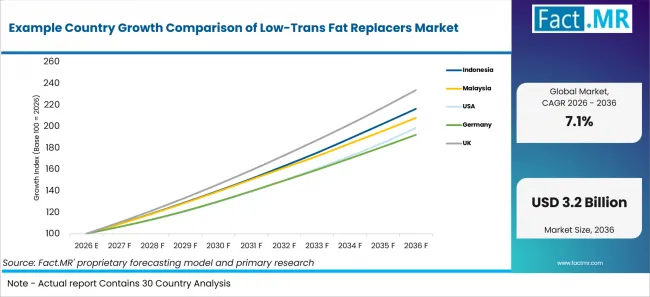
Example Country Growth Comparison Of Low Trans Fat Replacers Market | Source: Fact.MR
| Country | CAGR (2026-2036) |
|---|---|
| United Kingdom | 8.9% |
| Indonesia | 8.0% |
| Malaysia | 7.6% |
| United States | 7.1% |
| Germany | 6.7% |
Source: Fact.MR analysis. Updated Sep 2, 2026
What supports the United Kingdom's growth?
8.9% CAGR, driven by HFSS reformulation pressure and bakery innovation.
Retail and packaged-food rules give the UK a clear reformulation setting for bakery fats. The Department of Health and Social Care reported in January 2026 that the less healthy food advertising rules are expected to remove up to 7.2 billion calories from children’s diets each year. Low-trans replacer suppliers gain a route into bakery and spreads when brands adjust fat systems while protecting taste and texture.
How is Indonesia scaling replacer demand?
8.0% CAGR, supported by palm oil scale and local processing depth.
Indonesia has the feedstock base needed for structured palm-derived fat systems. The Ministry of Agriculture reported in April 2026 that national CPO production reached 51.66 million tonnes in 2025. That scale supports domestic processors serving bakery, snack and confectionery manufacturers that need palm fractions with reliable hardstock behavior.
What supports Malaysia's outlook?
7.6% CAGR, driven by specialty fraction supply and oils-and-fats manufacturing.
Malaysia’s position is shaped by specialty oils-and-fats capability in Johor and other processing hubs. The Malaysian Palm Oil Board reported in June 2026 that crude palm oil production rose 4.9% to 20.28 million tonnes in 2025. The local base helps suppliers pair fractionation capacity with application support for confectionery and bakery customers.
How does the USA sustain adoption?
7.1% CAGR, backed by FDA trans-fat rules and bakery cost control.
The USA has already absorbed major PHO removal work, so demand is tied to replacement quality and cost. USDA Economic Research Service reported on April 30, 2026 that cereal and bakery product prices increased 1.0% in 2025. That pricing context keeps bakery formulators focused on replacers that hold texture without adding unnecessary formula cost.
What underpins Germany's growth?
6.7% CAGR, supported by oilseed supply and confectionery reformulation.
Germany combines a large bakery and confectionery base with domestic oilseed output. Destatis reported in 2026 that the 2025 winter rapeseed harvest reached 4.0 million tons, up 10% from the previous year. That feedstock link supports high-oleic and structured oil conversations among manufacturers that need melt control and clean labels.
Who leads the Low-Trans Fat Replacers Market?
AAK AB as a prominent specialist supplier of vegetable-oil and fat solutions used across bakery and confectionery. Its portfolio fits buyers that need cocoa butter alternatives, low-trans filling fats and application support for fat-bloom control.
Cargill, Incorporated competes through a broad edible oils platform and documented iTFA removal work. The company gives large food manufacturers a route to reformulation at scale, especially where customers need high-oleic oils and technical support across packaged foods and foodservice.
Bunge and ADM compete through refined oils. Fuji Oil Co., Ltd. and Wilmar International Limited compete through specialty fats and regional processing capacity. Fuji Oil Group said in February 2026 that construction of a new Johor refinery began in 2025 to support the production of high-quality, traceable and sustainable specialty oils and fats.
Which companies are the key providers?
Key companies include AAK AB; Bunge; Cargill, Incorporated; ADM; Fuji Oil Co., Ltd.; and Wilmar International Limited.
- AAK AB
- Bunge
- Cargill, Incorporated
- ADM
- Fuji Oil Co., Ltd.
- Wilmar International Limited
Bibliography
- World Health Organization. (2025, May 19). WHO recognizes four countries with life-saving trans fat elimination policies.
- Cargill. (2025, May 28). Cargill earns #1 global ranking for removing trans fats from edible oils portfolio.
- Cargill. (2025, March 4). Cargill showcases full range of innovative food solutions at AAHAR 2025.
- AAK. (2025, October 24). AAK strengthens supply of specialty palm fractions.
- Department of Health and Social Care. (2026, January 5). Landmark junk food ad ban to protect kids’ health.
- Kementerian Pertanian Republik Indonesia. (2026, April 1). Kementan: Hilirisasi CPO tekan impor solar dan perkuat ekonomi nasional.
- Parveez, G. K. A., Puah, C. W., Tan, S. P., Yaakub, Z., Aziz, H. A., Sukiran, M. A., Meganathan, P., Taib, H. M., & Moslim, R. (2026). Oil palm economic performance in Malaysia and R&D progress in 2025. Journal of Oil Palm Research, 38(2), 201–228.
- U.S. Department of Agriculture, Economic Research Service. (2026, June 1). Food prices and spending. Ag and Food Statistics: Charting the Essentials.
- Fuji Oil Europe. (2026, February 10). Fuji Oil and JPG strengthen sustainable oils partnership with new refinery.
This Report Answers
- The report explains how specialty fats and oils are used across replacement technology and fat source. It also covers application demand and performance needs.
- Segment analysis reviews interesterified fats and oleogel bakery fat replacers where manufacturers need solid-fat structure or lower-saturate positioning.
- Country analysis examines the listed markets and the regulation, feedstock or application mechanisms supporting replacer adoption across palm oil fractions and high-oleic oils.
- Competitive analysis reviews providers across vegetable oils, specialty fats, refined oils and confectionery fat systems.
- Application analysis assesses how baking ingredients, melt behavior and shortening performance shape approval decisions.
What does the Low-Trans Fat Replacers Market cover?
The Low-Trans Fat Replacers Market covers edible fat and oil systems that help food manufacturers remove industrial trans fat while preserving application performance. It includes structured blends used in baked goods, confectionery, spreads and high-stability frying fats.
The assessment also covers fats and oils inputs, specialty fat bases and palm oil fractions where the replacer function is tied to plasticity, shortening, solid-fat profile or sensory performance.
What is included in the scope?
The scope includes packaged and bulk ingredient systems sold to food manufacturers for low-trans fat reformulation. It includes shortening systems, industrial margarine bases and application-specific blends linked to butter and margarine applications.
It includes high-stability frying fats, non-PHO oil and fat systems, heat-stable coating fats and vegetable oils used where industrial trans-fat replacement is part of the selling proposition. PHO-based systems may be discussed only as historical or formulation-reference benchmarks, not as replacer products.
What is excluded from the scope?
The scope excludes non-food industrial lubricants, cosmetic emollients, dietary supplements sold as finished consumer products and raw oilseed trading outside food fat-replacement functionality.
Standard cooking oil sales are excluded when trans-fat replacement functionality is absent. Commodity oils are excluded when application functionality is absent.
How Was the Analysis Built?
The analysis draws on 120+ sources, 35+ company portfolios, 25+ countries, and more than 20 industry interviews.
- Primary Research: Primary research includes discussions with manufacturers, service providers, technology developers, distributors, end users, and subject-matter experts. These conversations examine purchasing priorities, product adoption, operational challenges, approval requirements, competitive positioning, and the factors that influence wider market acceptance.
- Desk Research: Desk research covers government statistics, regulatory publications, company filings, trade data, technical studies, industry associations, standards, public policy, and other authoritative sources. Every source used in the analysis is documented in the bibliography.
- Market Sizing and Forecasting: Market estimates combine historical performance, demand indicators, pricing and volume trends, segment shares, company participation, country-level growth, adoption patterns, investment activity, and barriers to market expansion.
- Data Validation and Update Cycle: Findings are validated by comparing primary interviews with public data, company activity, regulatory changes, trade patterns, and industry developments. Regular updates review new product launches, capacity changes, partnerships, approvals, and shifts in commercial adoption.
Segmentation
What is the report’s scope and coverage?
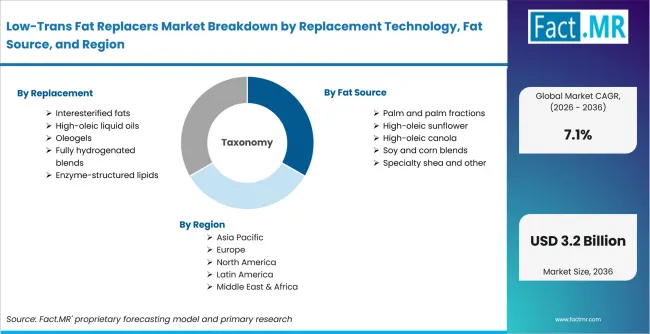
Low Trans Fat Replacers Market Breakdown By Replacement Technology, Fat Source, And Region | Source: Fact.MR
| Attribute | Details |
|---|---|
| Quantitative Units | USD billion in 2026 to USD billion by 2036 at a CAGR |
| Market Definition | Ingredient systems that replace industrial trans-fat functionality in foods, including structured fats, high-oleic oils, oleogels and blends used to deliver plasticity, melt, aeration, shortening and oxidative stability. |
| Replacement Technology | Interesterified fats; High-oleic liquid oils; Oleogels; Fully hydrogenated blends; Enzyme-structured lipids |
| Fat Source | Palm and palm fractions; High-oleic sunflower; High-oleic canola; Soy and corn blends; Specialty shea and other |
| Application | Bakery shortenings; Confectionery fillings; Spreads & margarines; Frying and foodservice; Prepared foods |
| Performance Need | Plasticity and shortening; Solid-fat profile; Oxidative stability; Creaming and aeration; Melt and sensory profile |
| Regions Covered | North America; Latin America; Western Europe; Eastern Europe; East Asia; South Asia & Pacific; Middle East & Africa |
| Countries Covered | United Kingdom; Indonesia; Malaysia; United States; Germany |
| Key Companies Profiled | AAK AB; Bunge; Cargill, Incorporated; ADM; Fuji Oil Co., Ltd.; Wilmar International Limited |
| Forecast Period | 2026 to 2036 |
| Approach | Hybrid top-down and bottom-up approach using reformulation demand, fat-source availability, application fit, country regulation, supplier portfolio review and company development tracking. |
Source: Fact.MR analysis. Updated Sep 2, 2026
How is the market segmented?
-
By Replacement Technology
- Interesterified fats
- High-oleic liquid oils
- Oleogels
- Fully hydrogenated blends
- Enzyme-structured lipids
-
By Fat Source
- Palm and palm fractions
- High-oleic sunflower
- High-oleic canola
- Soy and corn blends
- Specialty shea and other
-
By Application
- Bakery shortenings
- Confectionery fillings
- Spreads & margarines
- Frying and foodservice
- Prepared foods
-
By Performance Need
- Plasticity and shortening
- Solid-fat profile
- Oxidative stability
- Creaming and aeration
- Melt and sensory profile
-
By Region
- North America
- Latin America
- Western Europe
- Eastern Europe
- East Asia
- South Asia & Pacific
- Middle East & Africa
Frequently Asked Questions
How big is the low-trans fat replacers market in 2026?
What is the CAGR of the low-trans fat replacers market from 2026 to 2036?
Which replacement technology leads the low-trans fat replacers market?
Which fat source leads the low-trans fat replacers market?
Who are the leading companies in the low-trans fat replacers market?
Who worked on this report


Preview the report firsthand - request a free sample
Free SampleGet the brochure for pricing and purchase details
Download PDF