- Market Value (2025): USD 61.4 Mn
- Estimated Value (2026): USD 70 Mn
- Forecast Value (2036): USD 259 Mn
- CAGR (2026-2036): 14.0%
What is the berth load monitoring systems market forecast to be worth by 2036?
USD 70 million in 2026 to USD 259.0 million by 2036, at 14.0% CAGR.
- The berth load monitoring systems market was valued at USD 61.4 million in 2025. It is projected to reach USD 70 million in 2026 to USD 259.0 million by 2036.
- The market is expected to expand at 14.0% CAGR during the forecast period as ports increase investment in digital safety infrastructure and condition monitoring.
- Berth load monitoring systems continuously measure forces acting on critical waterfront assets. The information supports safer vessel berthing while helping operators identify abnormal loading before structural damage occurs.
- This approach improves operational planning and reduces maintenance uncertainty.
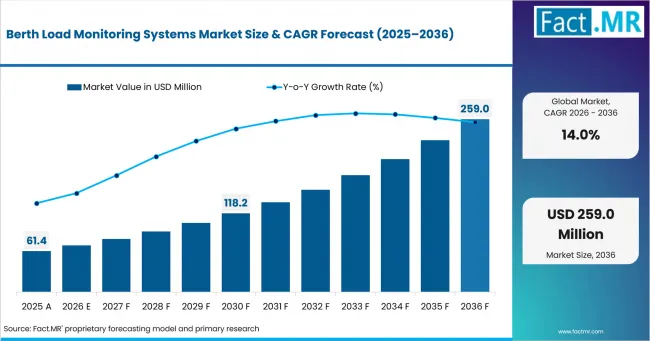
Berth Load Monitoring Systems Market Market Value Analysis | Source: Fact.MR
What are the defining numbers behind berth load monitoring systems market growth?
USD 189 million absolute opportunity by 2036, supported by digital berth management and continuous structural monitoring.
- Demand Drivers in the Market
- Port modernization programs are increasing demand for continuous berth monitoring.
- Larger vessels create greater need for accurate structural load measurement.
- Digital maintenance strategies encourage wider sensor deployment.
- Marine safety standards continue supporting investment in monitoring systems.
- Key Segments Analyzed
- By Measured Asset: Quick release hooks are expected to account for 32.0% share in 2026 because they combine operational control with integrated load monitoring.
- By System Component: Sensor nodes are projected to hold 30.0% share in 2026 as every monitoring platform depends on reliable field measurements.
- By Port Segment: Container ports are forecast to represent 34.0% share in 2026 because they operate high traffic berths throughout the year.
- By Buyer Type: Port authorities are expected to capture 39.0% share in 2026 as they oversee long term infrastructure planning and safety investment.
- By Geography: The United States is projected to record 14.5% CAGR through 2036 as digital port infrastructure continues expanding.
- Analyst Opinion at Fact.MR
- Shambhu Nath Jha, Senior Analyst at Fact.MR, states, "Berth monitoring is becoming part of routine port operations rather than a specialist safety function. Continuous load information helps operators make faster decisions while improving long term asset management."
- Strategic Implications
- Equipment suppliers should develop modular monitoring systems for existing berths.
- Port operators should connect load monitoring with maintenance planning.
- Engineering firms should simplify retrofit installation across older terminals.
- Software developers should improve visualization tools for operational teams.
Growth is being supported by expansion of LNG terminals, offshore energy facilities and automated container ports. Digital twins, predictive maintenance and centralized monitoring platforms are also encouraging wider deployment of connected berth monitoring solutions.
The United States is projected to register 14.5% CAGR through 2036 because smart port investment remains strong. Germany is expected to record 14.1% CAGR as terminal automation projects expand. Japan is likely to achieve 13.8% CAGR through 2036 through continued marine infrastructure upgrades. China is forecast to grow at 13.5% CAGR as coastal ports increase digital investment. India is anticipated to reach 13.1% CAGR through 2036 as new port development programs continue.
How does the berth load monitoring systems market break down by segment?
Quick release hooks lead at 32.0%. Container ports lead at 34.0%.
Which measured asset dominates?
Quick release hooks hold 32.0% share in 2026.
Quick release hooks are expected to account for 32.0% share in 2026 because they combine mooring control with continuous load measurement. Operators gain better visibility during vessel berthing. Bollards remain important across existing ports. Marine Fenders help absorb impact forces. Gangways benefit from movement monitoring. Quay structures support long term asset assessment. Kawasaki announced the release of a Tension Monitoring System for Mooring Line designed to improve safety and work efficiency in ship mooring tasks and related management operations for ships docked at wharfs.
Which system component dominates?
Sensor nodes lead with 30.0% share in 2026.
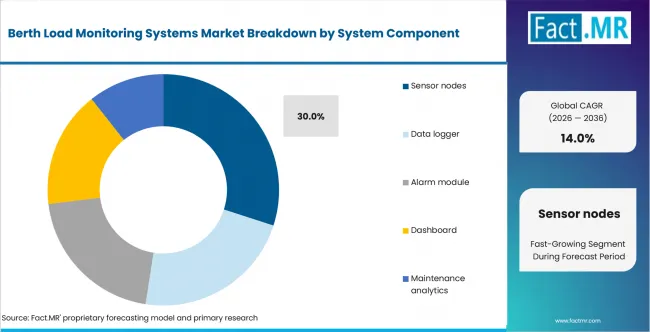
Berth Load Monitoring Systems Market Analysis By System Component | Source: Fact.MR
Sensor nodes are projected to capture 30.0% share in 2026 because they provide the foundation for every monitoring system. Accurate field data improves operational decisions. Data loggers store measurement history. Alarm modules warn operators during abnormal loading. Dashboards simplify system visibility. Maintenance analytics support long term asset planning. Trelleborg Marine & Infrastructure launched SmartDAS (Smart Docking Aid System), an intelligent berthing monitoring technology. SmartDAS detects approaching vessels up to 200 metres away and captures critical metrics including vessel distance, velocity, and longitudinal angle.
Which port segment dominates?
Container ports hold 34.0% share in 2026.
Container ports remain the largest application because they handle frequent vessel movements throughout the year. The segment is expected to account for 34.0% share in 2026. Bulk terminals require dependable berth monitoring. Cruise ports focus on passenger safety. Ferry terminals value operational continuity. Offshore energy facilities manage demanding marine conditions. LNG terminals depend on stable berth performance. Trelleborg announced it is prototyping smart fenders at two ports (one in the Middle East, one in Europe) with the goal of supplying smart fenders by 2025. These fenders will be equipped to capture precise berthing data regarding the accuracy and speed of berthing operations.
Which deployment dominates?
Brownfield retrofit leads market with 37.0%.
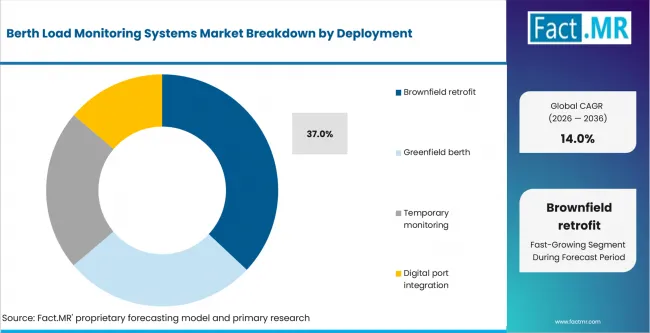
Berth Load Monitoring Systems Market Analysis By Deployment | Source: Fact.MR
Brownfield retrofit is expected to account for 37.0% share in 2026 because many ports prefer upgrading existing infrastructure instead of constructing new berths. Retrofit projects reduce disruption during installation. Greenfield berths adopt monitoring from the design stage. Temporary monitoring supports engineering studies. Digital port integration strengthens centralized operations.
Which buyer type dominates?
Port authorities lead with 39.0% share in 2026.
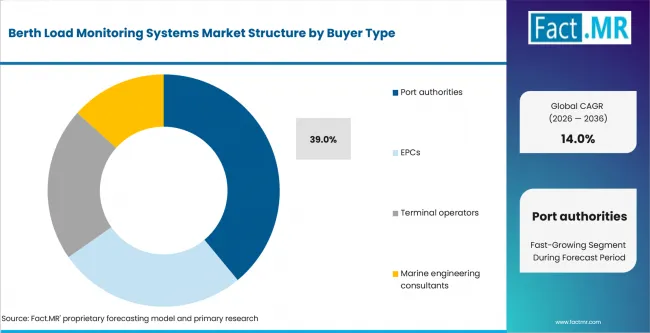
Berth Load Monitoring Systems Market Analysis By Buyer Type | Source: Fact.MR
Port authorities remain the largest customer group because they oversee infrastructure investment and long term safety planning. The segment is expected to account for 39.0% share in 2026. EPCs specify monitoring systems during construction. Terminal operators improve operational control. Marine engineering consultants support system selection and project design.
What is accelerating berth load monitoring system adoption, and what is holding it back?
Digital port upgrades support growth while retrofit costs slow wider deployment.
Drivers Impact Analysis
| DRIVER | (~) % IMPACT ON CAGR | GEOGRAPHIC RELEVANCE | IMPACT TIMELINE |
|---|---|---|---|
| Port modernization projects | +1.1% | Global | Medium term (2-4 years) |
| Greater focus on structural safety | +0.9% | North America, Europe, Asia Pacific | Medium term (2-4 years) |
| Expansion of LNG and offshore terminals | +0.8% | Asia Pacific, Middle East | Long term (≥4 years) |
| Growth of predictive maintenance | +0.6% | Global | Medium term (2-4 years) |
| Wider adoption of digital port systems | +0.5% | Global | Short term (≤2 years) |
Source: Fact.MR analysis. Updated Jul 4, 2026
Port modernization projects
Ports are replacing manual inspection with continuous structural monitoring. Digital systems improve operational awareness and maintenance planning.
Structural safety
Growing vessel size increases the importance of accurate berth load measurement. Continuous monitoring helps reduce infrastructure risk.
LNG and offshore terminals
Energy terminals require dependable monitoring across demanding operating conditions. Reliable load information supports safer operations.
Predictive maintenance
Historical sensor data helps engineers identify unusual loading trends. Early action reduces maintenance disruption.
Digital port systems
Centralized monitoring platforms simplify asset management across multiple berths. Connected infrastructure improves operational visibility.
Opportunity Impact Analysis
| OPPORTUNITY | (~) % IMPACT ON CAGR | GEOGRAPHIC RELEVANCE | IMPACT TIMELINE |
|---|---|---|---|
| Digital twin integration | +0.8% | Europe, North America | Long term (≥4 years) |
| Smart berth analytics | +0.7% | Global | Medium term (2-4 years) |
| Retrofit programs for aging ports | +0.5% | Global | Medium term (2-4 years) |
| Cloud based monitoring platforms | +0.4% | Global | Short term (≤2 years) |
Source: Fact.MR analysis. Updated Jul 4, 2026
Digital twin integration
Live sensor information improves the accuracy of virtual berth models. Operators gain stronger planning capability.
Smart berth analytics
Analytics platforms convert operational data into maintenance insights. Better information supports faster engineering decisions.
Retrofit programs
Older ports increasingly upgrade existing infrastructure with monitoring technology. Retrofit demand creates steady project opportunities.
Cloud platforms
Remote monitoring improves access to operational data across multiple terminals. Cloud systems simplify performance tracking.
Restraints Impact Analysis
| RESTRAINT | (~) % IMPACT ON CAGR | GEOGRAPHIC RELEVANCE | IMPACT TIMELINE |
|---|---|---|---|
| High retrofit costs | -0.7% | Global | Medium term (2-4 years) |
| Integration with legacy infrastructure | -0.5% | Global | Medium term (2-4 years) |
| Limited technical specialists | -0.4% | Developing regions | Short term (≤2 years) |
| Long procurement cycles | -0.3% | Public sector projects | Long term (≥4 years) |
Source: Fact.MR analysis. Updated Jul 4, 2026
High retrofit costs
Existing berths often require engineering modifications before monitoring systems can be installed. This increases project budgets.
Legacy infrastructure
Older terminals may need additional upgrades before digital monitoring platforms can operate effectively.
Technical specialists
Successful deployment depends on experienced engineering teams and proper system calibration.
Procurement cycles
Large infrastructure projects often require lengthy approval procedures. Extended purchasing timelines delay market expansion.
Which countries are strengthening berth load monitoring systems adoption?
United States 14.5%; Germany 14.1%; Japan 13.8%; China 13.5%; India 13.1%.
Based on regional analysis, the berth load monitoring systems market is segmented into North America, Europe, East Asia, South Asia, Latin America and Middle East and Africa.
| Country | CAGR |
|---|---|
| United States | 14.5% |
| Germany | 14.1% |
| Japan | 13.8% |
| China | 13.5% |
| India | 13.1% |
Source: Fact.MR analysis. Updated Jul 4, 2026
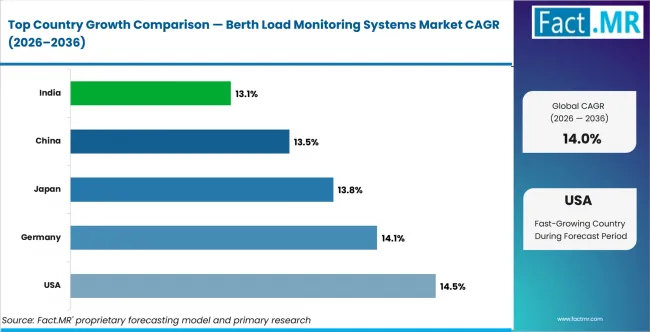
Berth Load Monitoring Systems Market Cagr Analysis By Country | Source: Fact.MR
What is driving growth across the United States?
14.5% CAGR, supported by smart port investment and infrastructure renewal.
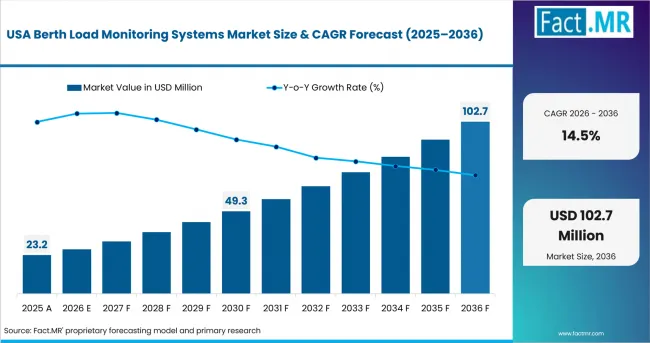
Berth Load Monitoring Systems Market Country Value Analysis | Source: Fact.MR
The United States is projected to record 14.5% CAGR from 2026 to 2036 as port authorities modernize aging berths with connected monitoring systems. Greater cargo movement is increasing attention on structural performance. Digital monitoring also helps reduce inspection time while improving operational planning. Technology suppliers with integrated hardware and software solutions are expected to secure major infrastructure projects.
Why is Germany expanding steadily?
14.1% CAGR, backed by engineering upgrades and terminal automation.
Germany is expected to achieve 14.1% CAGR as commercial ports strengthen operational reliability through continuous berth monitoring. Engineering firms increasingly recommend permanent sensing systems during modernization projects. Reliable asset data supports maintenance planning across busy terminals.
What is shaping demand in Japan?
13.8% CAGR, supported by resilient marine infrastructure.
Japan is likely to register 13.8% CAGR because ports continue improving resilience against demanding operating conditions. Continuous load measurement helps engineers protect waterfront assets while maintaining efficient vessel handling. Long service life remains an important purchasing factor.
Why does China remain a key market?
13.5% CAGR, supported by large scale port expansion.
China is forecast to expand at 13.5% CAGR through 2036 as new coastal infrastructure projects include digital monitoring from the design stage. High cargo throughput creates demand for dependable berth performance. Automated terminals also support wider adoption of connected monitoring equipment.
How is India creating new opportunities?
13.1% CAGR, driven by port development and safety improvement.
India is expected to record 13.1% CAGR by 2036 as commercial ports expand capacity under long term infrastructure programs. New projects increasingly specify monitoring systems during construction. Greater attention to asset reliability supports future demand
Who leads the berth load monitoring systems market?
Engineering expertise and integrated monitoring capability define market leadership.
The market is served by companies that combine berth equipment with digital monitoring technologies. Trelleborg Marine & Infrastructure delivers integrated berth management solutions that connect structural monitoring with wider port operations. Straatman Mooring Systems supports commercial terminals through automated mooring equipment and monitoring technologies designed for demanding marine environments.
Prosertek develops berth equipment that combines operational safety with modern monitoring functions. Mampaey remains active through engineered mooring solutions for ports and offshore facilities.
Future competition is expected to center on complete infrastructure solutions rather than individual monitoring devices. Customers increasingly value lifecycle support, engineering services and software compatibility alongside measurement accuracy. Suppliers that simplify installation and deliver dependable long term performance are likely to strengthen their market presence.
Which companies are the key providers?
Trelleborg Marine & Infrastructure and Straatman Mooring Systems are leading providers. Prosertek and Mampaey remain established participants.
- Trelleborg Marine & Infrastructure
- Straatman Mooring Systems
- Prosertek
- Mampaey
Bibliography
- Kawasaki Heavy Industries, Ltd. (2024, April 8). Kawasaki releases a Tension Monitoring System for Mooring Line for its Safe Berthing/Unberthing Assist System, realizing work efficiency and safety improvements via digitalization of mooring operation. Kawasaki Heavy Industries.
- Trelleborg Marine & Infrastructure. (2025, July 21). Trelleborg transforms port operations through data-driven decision making. Trelleborg Marine & Infrastructure.
- Trelleborg Marine & Infrastructure. (2024, October 3). Smart berth systems. Trelleborg Marine & Infrastructure.
- Straatman Mooring Systems. (2026). Mooring load monitoring system (MLMS). Straatman Mooring Systems.
- Prosertek. (2026). BAS: Berthing aid system. Prosertek.
- Trelleborg Marine & Infrastructure. (2026). Mampaey by Trelleborg. Trelleborg Marine & Infrastructure.
- MS Systems OY. (2026). Structural health monitoring for ports and ships. MS Systems OY.
This Report Addresses
- Strategic assessment of berth load monitoring systems across commercial ports and marine infrastructure.
- Segment evaluation covering Quick-release Hooks and Container Ports.
- Country outlook for the United States, Germany, Japan, China and India.
- Competitive review of Trelleborg Marine & Infrastructure, Straatman Mooring Systems, Prosertek, Mampaey.
- Technology review covering sensor nodes, alarm modules, dashboard analytics, maintenance analytics and digital berth integration.
- Operational assessment covering container terminals, bulk terminals, cruise ports, ferry terminals, offshore energy facilities and LNG infrastructure.
- Market estimates supported by engineering reviews, infrastructure tracking and industry interviews.
What does the berth load monitoring systems market cover?
Monitoring platforms that measure structural loads across marine berthing infrastructure.
The market includes systems that monitor bollards, quick release hooks, fenders, gangways and quay structures. These platforms collect operational data and provide continuous visibility into berth loading conditions.
The study focuses on dedicated berth monitoring technologies. Conventional port automation products without structural load measurement are outside the market scope.
What is included in the scope?
Integrated monitoring solutions developed for marine berths.
The assessment includes sensor nodes, data loggers, alarm modules, dashboards and maintenance analytics. It also covers greenfield installations, brownfield retrofits, temporary monitoring projects and digital port integration.
The analysis includes systems supplied to port authorities, EPCs, terminal operators and marine engineering consultants across commercial marine facilities.
What is excluded from the scope?
General marine automation products are excluded.
Navigation systems, vessel traffic management software and standard inspection equipment without berth load monitoring capability are not included. Standalone industrial sensors designed for non-marine applications also remain outside the scope.
How was the analysis built?
105+ sources, 38+ company portfolios, 27+ countries, 22+ interviews.
- Primary Research: Port engineers, marine consultants, terminal operators and berth equipment manufacturers shared technical and commercial insights. Safety specialists also contributed operational perspectives.
- Desk Research: The study reviewed engineering publications, company documentation, infrastructure projects and marine safety guidance. Industry case studies supported technology assessment.
- Market Sizing and Forecasting: Estimates were prepared using port infrastructure spending, berth modernization activity, marine engineering projects and equipment deployment across major maritime regions.
- Data Validation and Update Cycle: Forecasts were verified through project tracking, supplier discussions and expert review. Installation activity and procurement trends were used to confirm market direction.
Segmentation
What is the report's scope and coverage?
| Attribute | Details |
|---|---|
| Quantitative Units | USD Million in 2026 to USD Million by 2036 at CAGR |
| Market Definition | Systems that monitor structural loads across marine berth infrastructure |
| Measured Asset | Bollards; quick-release hooks; fenders; gangways; quay structures |
| System Component | Sensor nodes; data logger; alarm module; dashboard; maintenance analytics |
| Port Segment | Container; bulk; cruise; ferry; offshore energy; LNG |
| Deployment | Greenfield berth; brownfield retrofit; temporary monitoring; digital port integration |
| Buyer Type | Port authorities; EPCs; terminal operators; marine engineering consultants |
| Regions Covered | North America; Europe; East Asia; South Asia; Latin America; Middle East and Africa |
| Countries Covered | United States; Germany; Japan; China; India |
| Key Companies Profiled | Trelleborg Marine & Infrastructure; Straatman Mooring Systems; Prosertek; Mampaey |
| Forecast Period | 2026 to 2036 |
| Approach | Hybrid top down and bottom up approach using berth investment, marine engineering projects, monitoring deployment and expert validation |
Source: Fact.MR analysis. Updated Jul 4, 2026
How is the market segmented?
-
By Measured Asset:
- Bollards
- Quick-release hooks
- Fenders
- Gangways
- Quay structures
-
By System Component:
- Sensor nodes
- Data logger
- Alarm module
- Dashboard
- Maintenance analytics
-
By Port Segment:
- Container
- Bulk
- Cruise
- Ferry
- Offshore energy
- LNG
-
By Deployment:
- Greenfield berth
- Brownfield retrofit
- Temporary monitoring
- Digital port integration
-
By Buyer Type:
- Port authorities
- EPCs
- Terminal operators
- Marine engineering consultants
-
Region:
- North America
- United States
- Canada
- Europe
- Germany
- United Kingdom
- France
- Italy
- Spain
- Asia Pacific
- China
- Japan
- South Korea
- India
- Singapore
- Latin America
- Brazil
- Argentina
- Mexico
- Middle East & Africa
- GCC Countries
- South Africa
- Israel
- North America
Frequently Asked Questions
Which measured asset leads the Berth Load Monitoring Systems Market?
Which system component leads the Berth Load Monitoring Systems Market?
Which port segment leads the Berth Load Monitoring Systems Market?
Which deployment leads the Berth Load Monitoring Systems Market?
Which buyer type leads the Berth Load Monitoring Systems Market?
Which region leads the Berth Load Monitoring Systems Market?
Which country expands fastest in the Berth Load Monitoring Systems Market?
How does Germany perform in the Berth Load Monitoring Systems Market?
Who worked on this report


Preview the report firsthand - request a free sample
Free SampleGet the brochure for pricing and purchase details
Download PDF