- Market Value (2025): USD 1.4 Bn
- Estimated Value (2026): USD 1.5 Bn
- Forecast Value (2036): USD 2.8 Bn
- CAGR (2026-2036): 6.4%
What is the Lumbar Spine Cages Market forecast to be worth by 2036?
USD 1.5 billion in 2026 to USD 2.8 billion by 2036, at a 6.4% CAGR.
- The lumbar spine cages market reached USD 1.4 billion in 2025.
- Demand is projected to increase from USD 1.5 billion in 2026 to USD 2.8 billion by 2036.
- The market is forecast to record 6.4% CAGR from 2026 to 2036 as cage selection becomes tied to fusion planning.
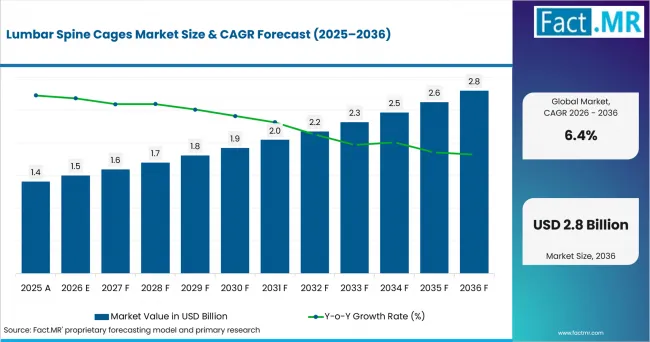
Lumbar Spine Cages Market Value Analysis | Source: Fact.MR
What are the defining numbers behind Lumbar Spine Cages Market growth?
USD 1.3 billion absolute opportunity is expected by 2036.
- Demand Drivers in the Market
- Titanium cage specification is expected to support demand where surgeons need strength and familiar handling. Clear evidence helps hospital review.
- Degenerative disc disease procedures are anticipated to create steady buying need through disc-height restoration and stability goals.
- Direct sales models are expected to remain useful when surgeons need product training before broader hospital adoption.
- Key Segments Analyzed
- By Product Type: Titanium Lumbar Cages are projected to hold 36.5% share in 2026 because strength and familiarity support purchasing confidence.
- By Application: Degenerative Disc Disease is anticipated to hold 30.6% share in 2026 as cage selection often starts with restoration needs.
- By End User: Hospitals are expected to hold 31.3% share in 2026 because spine procedures require operating rooms and implant controls.
- By Distribution Channel: Direct Sales are forecast to hold 32.4% share in 2026 since surgeon education can influence hospital adoption.
- By Material: Titanium Alloys are estimated to represent 36.4% share in 2026 as hospitals compare strength during product review.
- Analyst Opinion at Fact.MR
- Shambhu Nath Jha, Senior Analyst at Fact.MR, states, “Lumbar cage buyers need implants that enter hospital pathways without extra approval burden. Buyers are expected to compare design evidence with service support before expanding use.”
- Strategic Implications
- Manufacturers can strengthen proposals by explaining how cage geometry fits surgeon workflow and fusion intent.
- Hospital procurement teams benefit from clear implant documentation before price negotiations begin.
- Investors need to separate direct lumbar cage exposure from adjacent procedure tools. Demand from surgical instruments is commercially useful only when the same supplier supports spine-surgery workflow.
Germany is projected at 8.3%; Brazil at 7.7%; Australia at 4.4%; USA at 7.1%; Canada at 5.1%; UK at 6.4%; and Japan at 5.7% during 2026 to 2036. Country analysis tests hospital approval and service access.
How does the Lumbar Spine Cages Market break down by segment?
Titanium Lumbar Cages lead Product Type at 36.5% share in 2026. Degenerative Disc Disease leads Application at 30.6% share in 2026.
Why do Titanium Lumbar Cages lead Product Type?
Titanium Lumbar Cages are projected to account for 36.5% share in 2026.
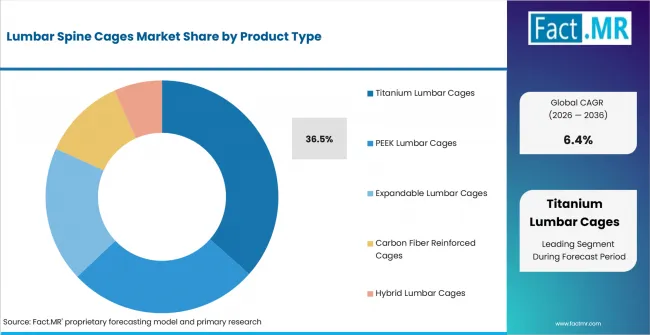
Lumbar Spine Cages Market Analysis By Product Type | Source: Fact.MR
Their lead is supported by high strength and well-established use in lumbar fusion procedures. Hospitals also value the familiar handling profile of titanium implants. 3D Printed Titanium Cages and Porous Titanium Cages gain attention when improved bone contact becomes a key purchase factor.
Why does Degenerative Disc Disease lead Application?
Degenerative Disc Disease is anticipated to hold 30.6% share in 2026.
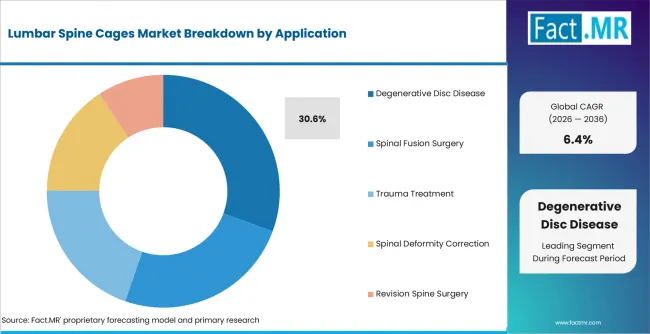
Lumbar Spine Cages Market Analysis By Application | Source: Fact.MR
A large share of lumbar fusion procedures begins with the need to restore disc height and reduce instability caused by degeneration. As a result, this application creates steady demand for interbody cages. Lumbar Disc Degeneration and revision procedures further support adoption where accurate placement and dependable support are required.
How do Hospitals shape End User demand?
Hospitals are expected to represent 31.3% share in 2026.
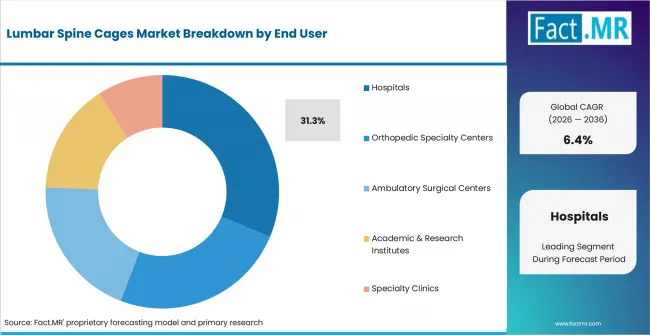
Lumbar Spine Cages Market Analysis By End User | Source: Fact.MR
Most lumbar fusion procedures are performed in hospitals because they require operating-room infrastructure, trained surgical teams and formal implant approval. This gives hospitals a central role in cage purchasing.
What keeps Direct Sales ahead in Distribution Channel?
Direct Sales are forecast to hold 32.4% share in 2026.
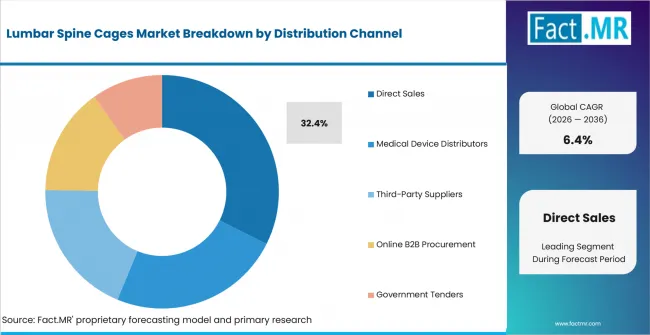
Lumbar Spine Cages Market Analysis By Distribution Channel | Source: Fact.MR
Supplier involvement often extends beyond product delivery to surgeon training, implant selection and procedure-set coordination. This makes direct sales especially useful for complex spine procedures. In contrast, distributors remain important in markets where local stock availability and fast hospital access influence purchasing decisions.
What supports Titanium Alloys within Material?
Titanium Alloys are estimated to represent 36.4% share in 2026.
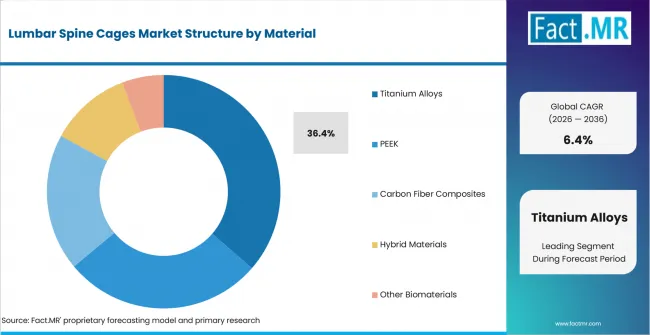
Lumbar Spine Cages Market Analysis By Material | Source: Fact.MR
Material selection often favors titanium alloys because they combine mechanical strength with surface properties suited to lumbar stabilization. Their established clinical familiarity also supports hospital approval. However, PEEK and hybrid materials continue to serve cases where imaging visibility, flexibility or stiffness balance receives greater attention.
What is accelerating Lumbar Spine Cages Market adoption, and what is holding it back?
Demand is expected to rise due to the growing use of titanium cages in degenerative disc disease procedures. High costs and lengthy approval processes may slow adoption.
Drivers Impact Analysis
| DRIVER | QUALITATIVE RELEVANCE | GEOGRAPHIC RELEVANCE | IMPACT TIMELINE |
|---|---|---|---|
| Titanium lumbar cages specification pull | High | Germany | Short term (<=2 years) |
| Application demand around degenerative disc disease | High | Brazil | Short term (<=2 years) |
| Hospital procurement and procedure control | Moderate | Australia | Medium term (2-4 years) |
| Direct sales service and training need | Selective | USA | Medium term (2-4 years) |
Source: Fact.MR analysis. Updated Jul 31, 2026
- Titanium lumbar cages specification pull: Hospitals are expected to favor cages with strength and clear approval documentation.
- Application demand around degenerative disc disease: Procedure planning is anticipated to keep cage demand tied to restoration needs.
- Hospital procurement and procedure control: Approved-list expansion is likely when suppliers provide traceability and dependable set availability.
Opportunity Impact Analysis
| OPPORTUNITY | QUALITATIVE RELEVANCE | GEOGRAPHIC RELEVANCE | IMPACT TIMELINE |
|---|---|---|---|
| Titanium lumbar cage design options | High | Germany | Medium term (2-4 years) |
| Distributor technical support | Moderate | Brazil | Medium term (2-4 years) |
| Degenerative disc disease renewal programs | Selective | Australia | Medium term (2-4 years) |
Source: Fact.MR analysis. Updated Jul 31, 2026
- Titanium lumbar cage design options: Suppliers can convert demand by showing how cage design supports fusion intent without adding review work.
- Distributor technical support: Regional distributors are expected to help where hospitals need training access. Adjacent demand from bone graft substitutes can support the same procedure discussion.
- Degenerative disc disease renewal programs: Providers gain room when cage performance is presented with procedure planning. Minimally invasive surgery can matter when hospitals review patient flow.
Restraints Impact Analysis
| RESTRAINT | QUALITATIVE RELEVANCE | GEOGRAPHIC RELEVANCE | IMPACT TIMELINE |
|---|---|---|---|
| Raw-material cost movement and approval delays for titanium lumbar cages | High | Germany | Short term (<=2 years) |
| Price sensitivity around degenerative disc disease | Moderate | Brazil | Medium term (2-4 years) |
| Slow conversion where titanium lumbar cages lack buyer-side validation | Selective | Australia | Medium term (2-4 years) |
Source: Fact.MR analysis. Updated Jul 31, 2026
- Raw-material cost movement and approval delays for titanium lumbar cages: Conversion slows when buyers cannot compare implants using the same evidence base.
- Price sensitivity around degenerative disc disease: Hospitals may delay orders when price and reimbursement expectations are difficult to align. Medical device coatings can add documentation work when surface claims affect selection.
- Slow conversion where titanium lumbar cages lack buyer-side validation: Smaller suppliers face pressure when service coverage and training proof remain thin.
Which countries are scaling Lumbar Spine Cages Market fastest?
The country comparison is shaped by hospital approval and distributor depth. Germany and Brazil form the upper pair. Australia and USA follow documentation-led review. Canada and UK remain closer to replacement demand.
- Germany shows the highest listed CAGR because hospital buyers place weight on titanium cage evidence before changing approved implant lists.
- Brazil remains above the global rate where distributor access can reduce supply friction for degenerative disc disease procedures.
- Australia stays close to the global path as service dependability becomes part of hospital adoption review.
- USA and Canada are expected to move through stricter value checks. UK and Japan follow careful product evaluation.
The full report provides country-level CAGR analysis across North America; Latin America; Europe; East Asia; South Asia and Oceania; and MEA.
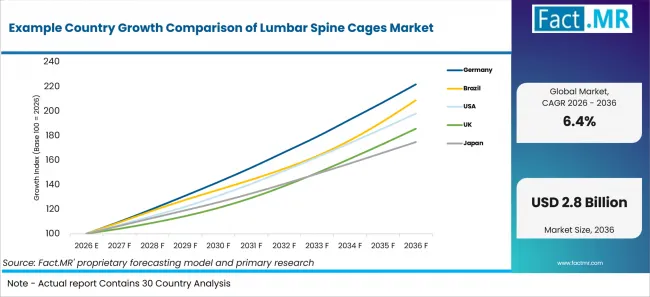
Example Country Growth Comparison Of Lumbar Spine Cages Market | Source: Fact.MR
| Country | CAGR (2026-2036) |
|---|---|
| Germany | 8.3% |
| Brazil | 7.7% |
| Australia | 4.4% |
| USA | 7.1% |
| Canada | 5.1% |
| UK | 6.4% |
| Japan | 5.7% |
Source: Fact.MR analysis. Updated Jul 31, 2026
What supports Germany adoption?
7.4% CAGR, supported by hospital approval discipline and titanium cage specification.
Germany leads the listed countries because hospital committees place strong emphasis on implant evidence before updating surgical preference lists. Titanium cages benefit from established handling familiarity and strength-related confidence.
How is Brazil building demand?
6.7% CAGR, driven by distributor reach and degenerative disc disease demand.
Brazil is building demand through distributors that connect lumbar cage suppliers with hospitals and spine specialists. Degenerative disc disease supports a steady procedure base, while training programs improve surgeon confidence during product conversion.
What shapes Australia demand through 2036?
6.3% CAGR, supported by service reliability and hospital-led procedure control.
Australia’s market development depends heavily on whether suppliers can maintain dependable support across widely dispersed care locations. Hospitals value clear documentation, reliable implant sets and direct assistance during case planning.
How does USA adoption develop?
6.1% CAGR, backed by documentation-heavy procurement and direct supplier support.
USA adoption advances through formal hospital purchasing processes that require committee-ready evidence and detailed surgeon education. Direct sales teams support product demonstrations, training and implant-set coordination.
What supports Canada adoption?
5.8% CAGR, shaped by service coverage and replacement-led demand.
Canada’s growth is closely linked to supplier reach across a large geographic market. Hospitals need dependable inventory access and service support before adopting new lumbar cage systems. Replacement procedures and selective specialty-center demand create opportunities for titanium products.
How does the UK route to adoption differ?
5.4% CAGR, led by life-cycle value checks and supplier accountability.
The UK follows a value-focused adoption path in which hospitals compare long-term clinical and purchasing benefits before changing implant preferences. Evidence packages help suppliers support titanium cage approval, while direct sales teams provide education on newer designs.
What defines Japan performance?
4.8% CAGR, supported by quality expectations and compact hospital networks.
Japan records the lowest listed CAGR because purchasing remains selective and strongly influenced by quality assurance. Hospitals and specialty teams expect precise documentation, dependable supplier systems and clear answers on implant handling.
Who leads the Lumbar Spine Cages Market?
The retained provider list includes Highridge Medical and Medtronic. Globus Medical and Stryker Corporation compete for specification-led and channel-led demand.
Competition will depend on strong documentation, service coverage and reliable inventory. Highridge Medical, DePuy Synthes and Orthofix Medical benefit from broad portfolios and hospital relationships.
From 2026 to 2036, buyers will compare cage designs, surgical training and delivery support. Supplier strength in orthopedic devices, spinal fusion systems, implants and biomaterials may also improve hospital access and repeat orders.
Which companies are the key providers?
Key companies include Medtronic; Globus Medical; Stryker Corporation; Highridge Medical; Johnson & Johnson (DePuy Synthes); and Orthofix Medical.
- Medtronic
- Globus Medical
- Stryker Corporation
- Highridge Medical
- Johnson & Johnson (DePuy Synthes)
- Orthofix Medical
Bibliography
- U.S. Food and Drug Administration. (2024). 510(k) premarket notification K233744: Curiteva Porous PEEK Lumbar Interbody Fusion System.
- Medtronic plc. (2024, May 29). Proposed Infuse TLIF indication granted Breakthrough Device designation by FDA.
- Orthofix Medical Inc. (2024, September 23). Orthofix highlights new products and announces presentation of data supporting the adjunct use of bone growth therapy for lumbar spine fusion at North American Spine Society Annual Meeting.
- Globus Medical, Inc. (2025, March 11). Globus Medical extends versatility of Advanced Materials Science anterior interbody portfolio with launch of COHERE ALIF Spacer and Modulus ALIF Blades.
This Report Answers
- The report provides strategic intelligence on Product Type and Application choices that shape hospital adoption.
- Segment analysis covers Titanium Lumbar Cages and Degenerative Disc Disease as 2026 share leaders.
- Country outlook evaluates Germany and Brazil alongside Australia and USA. Canada, UK and Japan complete the comparison.
- Competitive analysis profiles Medtronic alongside Globus Medical and Stryker Corporation. Highridge Medical completes the retained provider set with Johnson & Johnson (DePuy Synthes) and Orthofix Medical.
- Distribution assessment covers Direct Sales and Hospital Procurement. Distributor and tender-led routes complete the channel view.
What does the Lumbar Spine Cages Market cover?
Lumbar spine cages are used in fusion procedures to restore disc space and stabilize the spine.
The market covers implants used in lumbar interbody procedures. Titanium and PEEK formats are included. Expandable carbon fiber and hybrid cages are included too. Coverage includes direct supplier sales and medical device distribution.
What is included in the scope?
Lumbar spine cages are included when they are purchased for lumbar fusion procedures. Hospitals and orthopedic specialty centers are covered. Spine surgery centers and ambulatory surgical centers are covered too.
The scope includes Product Type and Application. End User and Distribution Channel are included. Material coverage spans Titanium Lumbar Cages; 3D Printed Titanium Cages; Porous Titanium Cages; PEEK Lumbar Cages; Expandable Lumbar Cages; Carbon Fiber Reinforced Cages; and Hybrid Lumbar Cages. It includes degenerative disc disease and related fusion applications.
What is excluded from the scope?
General spine tools and unrelated hospital equipment remain outside the scope of this market.
The scope excludes products that do not serve lumbar interbody cage use. General orthopedic implants are excluded unless they affect cage selection.
How Was the Analysis Built?
The analysis draws on 120+ sources, 35+ company portfolios, 25+ countries, and more than 20 industry interviews.
- Primary Research: Primary research includes discussions with manufacturers, service providers, technology developers, distributors, end users, procurement teams, and subject-matter experts. These conversations examine purchasing priorities, product adoption, operational challenges, approval requirements, competitive positioning, and the factors that influence wider market acceptance.
- Desk Research: Desk research covers government statistics, regulatory publications, company filings, trade data, technical studies, industry associations, standards, public policy, and other authoritative sources. Every source used in the analysis is documented in the bibliography.
- Market Sizing and Forecasting: Market estimates combine historical performance, demand indicators, pricing and volume trends, segment shares, company participation, country-level growth, adoption patterns, investment activity, and barriers to market expansion.
- Data Validation and Update Cycle: Findings are validated by comparing primary interviews with public data, company activity, regulatory changes, trade patterns, and industry developments. Regular updates review new product launches, capacity changes, partnerships, approvals, procurement trends, and shifts in commercial adoption.
Segmentation
What is the report’s scope and coverage?
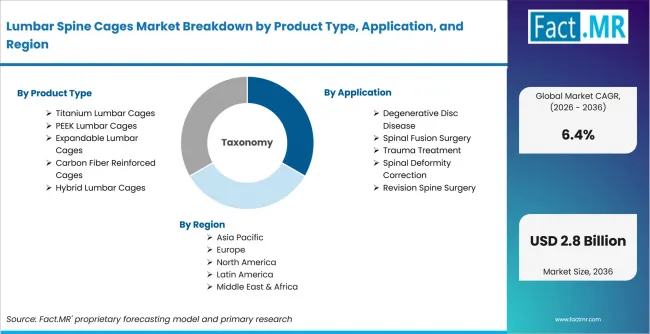
Lumbar Spine Cages Market Breakdown By Product Type, Application, And Region | Source: Fact.MR
| Attribute | Details |
|---|---|
| Quantitative Units | USD billion in 2026 to USD billion by 2036 at a CAGR |
| Market Definition | Commercial buying and supply of lumbar interbody cages used for lumbar fusion procedures. |
| Product Type | Titanium Lumbar Cages; 3D Printed Titanium Cages; Porous Titanium Cages; PEEK Lumbar Cages; Expandable Lumbar Cages; Carbon Fiber Reinforced Cages; Hybrid Lumbar Cages |
| Application | Degenerative Disc Disease; Lumbar Disc Degeneration; Disc Height Restoration; Spinal Fusion Surgery; Revision Spine Surgery |
| End User | Hospitals; Orthopedic Specialty Centers; Spine Surgery Centers; Ambulatory Surgical Centers; Academic & Research Institutes; Specialty Clinics |
| Distribution Channel | Direct Sales; Hospital Procurement; Group Purchasing Contracts; Medical Device Distributors; Online B2B Procurement; Government Tenders |
| Material | Titanium Alloys; Ti-6Al-4V Alloy; Porous Titanium; PEEK; Carbon Fiber Composites; Hybrid Materials; Other Biomaterials |
| Regions Covered | North America; Latin America; Europe; East Asia; South Asia and Oceania; Middle East and Africa |
| Countries Covered | Germany; Brazil; Australia; USA; Canada; UK; Japan |
| Key Companies Profiled | Medtronic; Globus Medical; Stryker Corporation; Highridge Medical; Johnson & Johnson (DePuy Synthes); Orthofix Medical |
| Forecast Period | 2026 to 2036 |
| Approach | Hybrid top-down and bottom-up approach using spine demand, segment shares, country growth, service access, and approval requirements. |
Source: Fact.MR analysis. Updated Jul 31, 2026
How is the market segmented?
-
By Product Type:
- Titanium Lumbar Cages
- 3D Printed Titanium Cages
- Porous Titanium Cages
- PEEK Lumbar Cages
- Expandable Lumbar Cages
- Carbon Fiber Reinforced Cages
- Hybrid Lumbar Cages
-
By Application:
- Degenerative Disc Disease
- Lumbar Disc Degeneration
- Disc Height Restoration
- Spinal Fusion Surgery
- Revision Spine Surgery
-
By End User:
- Hospitals
- Orthopedic Specialty Centers
- Spine Surgery Centers
- Ambulatory Surgical Centers
- Academic & Research Institutes
- Specialty Clinics
-
By Distribution Channel:
- Direct Sales
- Hospital Procurement
- Group Purchasing Contracts
- Medical Device Distributors
- Online B2B Procurement
- Government Tenders
-
By Material:
- Titanium Alloys
- Ti-6Al-4V Alloy
- Porous Titanium
- PEEK
- Carbon Fiber Composites
- Hybrid Materials
- Other Biomaterials
-
By Region:
- North America
- Latin America
- Europe
- East Asia
- South Asia and Oceania
- Middle East and Africa
Frequently Asked Questions
Which Product Type leads the market?
Which Application leads the market?
Which End User category leads the market?
Which Distribution Channel leads the market?
Which Material leads the market?
Which country records the highest listed CAGR?
What is the primary driver in this market?
What is the main restraint?
Why do hospitals lead demand?
Who worked on this report


Preview the report firsthand - request a free sample
Free SampleGet the brochure for pricing and purchase details
Download PDF