- Base Value(2025): 280.0 Mn
- Estimated Value(2025): 280.0 Mn
- Forecast Value (2035): 420.0 Mn
- CAGR (2025 - 2035): 4.1%
Magnesium Chelates Market Forecast and Outlook 2025 to 2035
The global magnesium chelates market is expected to grow from USD 280.0 million in 2025 to approximately USD 420.0 million by 2035, recording an absolute increase of USD 140.0 million over the forecast period. This translates into a total growth of 50.0%, with the market forecast to expand at a CAGR of 4.1% between 2025 and 2035. The overall market size is expected to grow by nearly 1.5 times during the same period, supported by increasing global demand for bioavailable mineral supplements, growing adoption of chelated minerals in animal nutrition applications, and rising health consciousness driving premium nutritional ingredient procurement across various dietary and fortification applications.
Quick Stats for Magnesium Chelates Market
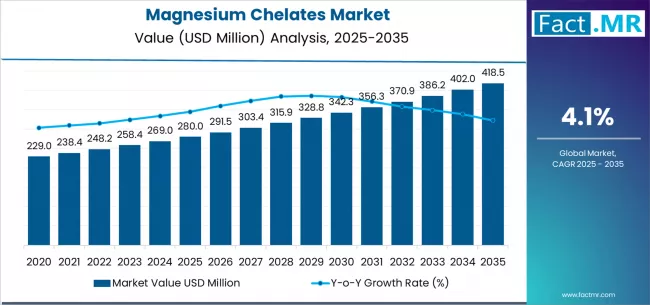
Magnesium Chelates Market Market Value Analysis | Source: Fact.MR
| Magnesium Chelates Market Value (2025) | USD 280.0 million |
|---|---|
| Magnesium Chelates Market Forecast Value (2035) | USD 420.0 million |
| Magnesium Chelates Market CAGR | 4.1% |
| Leading Segment by Type (2025) | Glycinate (45.0%) |
| Leading Segment by Application (2025) | Dietary Supplements (60.0%) |
| Leading Segment by Form (2025) | Powder (70.0%) |
| Key Growth Regions | Asia Pacific, North America, and Europe |
| Top Companies by Market Share | Albion Minerals, Balchem, BASF |
Source: Fact.MR analysis. Updated Oct 30, 2025
Magnesium Chelates Market Key Takeaways
| Metric | Value |
|---|---|
| Market Value (2025) | USD 280.0 million |
| Market Forecast Value (2035) | USD 420.0 million |
| Forecast CAGR (2025-2035) | 4.1% |
Source: Fact.MR analysis. Updated Oct 30, 2025
Why is the Magnesium Chelates Market Growing?
| NUTRITIONAL & HEALTH TRENDS | MANUFACTURING REQUIREMENTS | REGULATORY & QUALITY STANDARDS |
|---|---|---|
| Global Health Consciousness Growth Continuous expansion of health and wellness awareness across established and emerging markets driving demand for high-bioavailability mineral supplement solutions. Aging Population Demographics Growing emphasis on nutritional supplementation and advanced mineral delivery technologies creating demand for high-performance chelated mineral ingredients. Premium Nutritional Performance Superior absorption properties and gastrointestinal tolerance characteristics making magnesium chelates essential for performance-focused nutritional applications. | Advanced Bioavailability Requirements Modern supplement manufacturing requires high-performance chelated minerals delivering precise absorption control and enhanced bioavailability. Processing Efficiency Demands Supplement manufacturers investing in premium chelated minerals offering consistent performance while maintaining processing efficiency. Quality and Reliability Standards Certified producers with proven track records required for advanced chelated mineral applications. | Dietary Supplement Standards Regulatory requirements establishing performance benchmarks favoring high-quality chelated mineral materials. Performance Property Standards Quality standards requiring superior bioavailability properties and resistance to environmental stresses in processing. Industrial Compliance Requirements Diverse nutritional requirements and quality standards driving need for sophisticated chelated mineral ingredient inputs. |
Source: Fact.MR analysis. Updated Oct 30, 2025
DRIVERS
| DRIVERS | RESTRAINTS | KEY TRENDS |
|---|---|---|
| Global Health Awareness Growth Continuing expansion of health and wellness activities across established and emerging markets driving demand for high-bioavailability mineral supplement solutions. Aging Population Demographics Increasing adoption of advanced mineral delivery systems importance in nutritional efficiency and bioavailability optimization. Premium Supplement Demand Growing demand for chelated minerals that support both performance benefits and processing efficiency in supplement manufacturing. | Raw Material Price Volatility Price fluctuations affecting production costs and supply chain predictability for manufacturers. Manufacturing Complexity Complex technical requirements across applications affecting product development and standardization. Technical Qualification Requirements Complex technical requirements across applications affecting product development and standardization. Competition from Alternatives Alternative mineral delivery technologies affecting market selection and development. | Advanced Processing Technologies Integration of advanced chelated mineral processing systems, manufacturing innovations, and quality control solutions enabling superior operational efficiency. Performance Enhancement Enhanced absorption control, improved gastrointestinal tolerance, and advanced bioavailability capabilities compared to traditional mineral systems. Specialized Formulations Development of specialized chelated mineral grades and custom formulations providing enhanced performance benefits and application-specific optimization. Technical Innovation Integration of advanced chelated mineral development and intelligent processing management for sophisticated nutritional solutions. |
Source: Fact.MR analysis. Updated Oct 30, 2025
Analysis of Magnesium Chelates Market by Key Countries
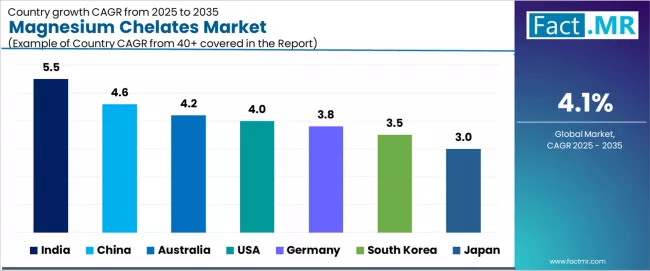
Magnesium Chelates Market Cagr Analysis By Country | Source: Fact.MR
| Country | CAGR (2025-2035) |
|---|---|
| India | 5.5% |
| China | 4.6% |
| Australia | 4.2% |
| USA | 4.0% |
| Germany | 3.8% |
| South Korea | 3.5% |
| Japan | 3.0% |
Source: Fact.MR analysis. Updated Oct 30, 2025
India Leads Global Market Growth with Nutritional Excellence
India is projected to exhibit strong growth driven by expanding health consciousness infrastructure and comprehensive nutritional supplement innovation creating substantial opportunities for mineral suppliers across dietary supplement operations, functional food applications, and specialty nutritional sectors. The country's developing nutritional manufacturing tradition and expanding health awareness capabilities are creating significant demand for both conventional and high-performance chelated mineral ingredients. Major supplement companies are establishing comprehensive local mineral processing facilities to support large-scale manufacturing operations and meet growing demand for efficient nutritional solutions.
- Health consciousness industry modernization programs are supporting widespread adoption of advanced chelated mineral processing across manufacturing operations, driving demand for high-quality nutritional ingredients
- Nutritional processing excellence initiatives and specialized supplement development are creating substantial opportunities for mineral suppliers requiring reliable bioavailability and cost-effective chelated mineral solutions
- Dietary supplement manufacturing growth and nutritional processing development are facilitating adoption of specialty chelated mineral ingredients throughout major industrial regions
China Demonstrates Strong Market Potential with Nutritional Processing Growth
China is expanding supported by extensive supplement manufacturing expansion and comprehensive nutritional processing industry development creating demand for reliable chelated mineral ingredients across diverse manufacturing categories and specialty nutritional segments. The country's dominant supplement production position and expanding nutritional manufacturing capabilities are driving demand for chelated mineral solutions that provide consistent performance while supporting cost-effective processing requirements. Nutritional processors and manufacturers are investing in local production facilities to support growing manufacturing operations and dietary supplement demand.
- Supplement manufacturing operations expansion and nutritional processing capability development are creating opportunities for chelated mineral ingredients across diverse manufacturing segments requiring reliable bioavailability and competitive processing costs
- Manufacturing modernization and processing technology advancement are driving investments in nutritional supply chains supporting performance requirements throughout major industrial regions
- Nutritional manufacturing growth and specialty supplement development programs are enhancing demand for processing-grade chelated minerals throughout supplement production areas
USA Maintains Strong Position with Premium Supplement Innovation
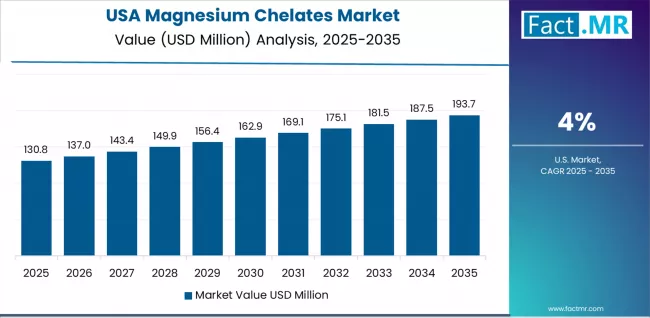
Magnesium Chelates Market Country Value Analysis | Source: Fact.MR
The USA is projected to grow supported by the country's expanding dietary supplement manufacturing base and nutritional processing technologies requiring advanced chelated mineral systems for supplement production and functional food applications. American supplement companies are implementing processing systems that support advanced manufacturing techniques, operational efficiency, and comprehensive quality protocols. The market is characterized by focus on operational excellence, nutritional performance, and compliance with dietary supplement quality standards.
- Premium supplement industry investments are prioritizing advanced processing technologies that demonstrate superior bioavailability and quality while meeting American manufacturing standards
- Nutritional processing leadership programs and operational excellence initiatives are driving adoption of precision-engineered chelated mineral ingredients that support advanced manufacturing systems and performance optimization
- Research and development programs for bioavailability enhancement are facilitating adoption of specialized processing techniques throughout major nutritional centers
Australia Expands Market with Health Innovation
Australia is growing driven by advanced supplement manufacturing development programs and increasing nutritional technology innovation creating opportunities for chelated mineral suppliers serving both dietary supplement operations and functional food contractors. The country's extensive health consciousness base and expanding nutritional awareness are creating demand for chelated mineral ingredients that support diverse performance requirements while maintaining processing performance standards. Supplement manufacturers and specialty ingredient service providers are developing procurement strategies to support operational efficiency and regulatory compliance.
- Advanced nutritional development programs and chelated mineral manufacturing are facilitating adoption of magnesium chelate ingredients capable of supporting diverse bioavailability requirements and competitive processing standards
- Nutritional ingredient innovation and performance-focused manufacturing development programs are enhancing demand for processing-grade chelated minerals that support operational efficiency and bioavailability reliability
- Premium supplement market expansion and specialty nutritional development are creating opportunities for advanced chelated mineral processing capabilities across Australian supplement manufacturing facilities
Germany Focuses on Premium Nutritional Manufacturing
Germany is projected to grow driven by premium supplement manufacturing excellence and specialty chelated mineral capabilities supporting advanced nutritional development and comprehensive dietary supplement applications. The country's established nutritional processing tradition and growing performance supplement market segments are creating demand for high-quality chelated mineral ingredients that support operational performance and nutritional standards. Supplement manufacturers and processing suppliers are maintaining comprehensive development capabilities to support diverse manufacturing requirements.
- Premium nutritional manufacturing and specialty chelated mineral programs are supporting demand for processing-grade magnesium chelates that meet contemporary bioavailability and reliability standards
- Dietary supplement development and performance-focused manufacturing programs are creating opportunities for specialized chelated mineral ingredients that provide comprehensive nutritional support
- Manufacturing modernization and nutritional quality enhancement programs are facilitating adoption of advanced processing capabilities throughout major supplement regions
South Korea Focuses on Advanced Supplement Manufacturing
South Korea is projected to grow at 3.5% CAGR driven by advanced supplement manufacturing excellence and specialty chelated mineral capabilities supporting nutritional development and comprehensive dietary applications. The country's established nutritional processing tradition and growing performance supplement market segments are creating demand for high-quality chelated mineral ingredients that support operational performance and nutritional standards.
- Advanced supplement manufacturing and specialty chelated mineral programs are supporting demand for processing-grade magnesium chelates that meet contemporary bioavailability and reliability standards
- Nutritional development and performance-focused manufacturing programs are creating opportunities for specialized chelated mineral ingredients that provide comprehensive nutritional support
- Manufacturing modernization and nutritional quality enhancement programs are facilitating adoption of advanced processing capabilities throughout major supplement regions
Japan Focuses on Precision Nutritional Manufacturing
Japan is projected to grow driven by precision supplement manufacturing excellence and specialty chelated mineral capabilities supporting advanced nutritional development and comprehensive technical applications. The country's established nutritional processing tradition and growing performance supplement market segments are creating demand for high-quality chelated mineral ingredients that support operational performance and nutritional standards.
- Precision supplement manufacturing and specialty chelated mineral programs are supporting demand for processing-grade magnesium chelates that meet contemporary bioavailability and reliability standards
- Nutritional development and performance-focused manufacturing programs are creating opportunities for specialized chelated mineral ingredients that provide comprehensive nutritional support
- Manufacturing modernization and nutritional quality enhancement programs are facilitating adoption of advanced processing capabilities throughout major supplement regions
Europe Market Split by Processing Application
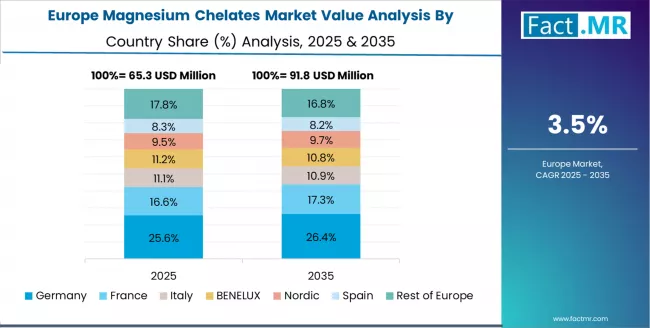
Magnesium Chelates Market Europe Country Market Share Analysis, 2025 & 2035 | Source: Fact.MR
European magnesium chelates operations are increasingly polarized between Western European precision processing and Eastern European cost-competitive manufacturing. German (USD 60.0 million) and UK facilities (USD 45.0 million) dominate premium dietary supplement and functional food chelated mineral processing, leveraging advanced nutritional technologies and strict quality protocols that command price premiums in global markets. German processors maintain leadership in high-performance chelated mineral applications, with major supplement companies driving technical specifications that smaller suppliers must meet to access supply contracts.
France (USD 35.0 million), Italy (USD 25.0 million), and Spain (USD 20.0 million) operations focus on specialized applications and regional market requirements. Rest of Europe (USD 60.0 million) including Eastern European operations in Poland, Hungary, and Czech Republic are capturing volume-oriented processing contracts through labor cost advantages and EU regulatory compliance, particularly in standard chelated mineral ingredients for dietary supplement applications.
The regulatory environment presents both opportunities and constraints. EU Novel Food regulations and dietary supplement directives create barriers for novel chelated mineral ingredients but establish quality standards that favor established European processors over imports. Brexit has fragmented UK sourcing from EU suppliers, creating opportunities for direct relationships between processors and British supplement manufacturers.
Supply chain consolidation accelerates as processors seek economies of scale to absorb rising energy costs and compliance expenses. Vertical integration increases, with major supplement manufacturers acquiring processing facilities to secure chelated mineral supplies and quality control. Smaller processors face pressure to specialize in niche applications or risk displacement by larger, more efficient operations serving mainstream dietary supplement manufacturing requirements.
Premium Quality Standards Define Japanese Market Dynamics
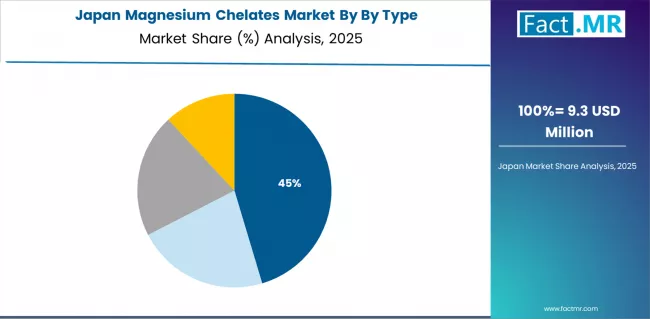
Magnesium Chelates Market Japan Market Share Analysis By By Type | Source: Fact.MR
Japanese Magnesium Chelates operations reflect the country's exacting quality standards and sophisticated nutritional expectations. Major supplement manufacturers maintain rigorous supplier qualification processes that often exceed international standards, requiring extensive documentation, batch testing, and facility audits that can take 12-18 months to complete. This creates high barriers for new suppliers but ensures consistent quality that supports premium product positioning.
The Japanese market demonstrates unique application preferences with Dietary Supplements accounting for 55.0%, Animal Nutrition 25.0%, Food Fortification 15.0%, and Other applications 5.0%. Companies require specific chelation ratios and purity specifications that differ from Western applications, driving demand for customized processing capabilities.
Japanese market demonstrates unique type preferences with Glycinate accounting for 50.0%, Citrate 25.0%, Gluconate 20.0%, and Others 5.0%. Companies require specific molecular binding and bioavailability specifications that differ from Western applications, driving demand for customized chelation capabilities.
Regulatory oversight emphasizes comprehensive nutritional ingredient management and traceability requirements that surpass most international standards. The supplement registration system requires detailed ingredient sourcing information, creating advantages for suppliers with transparent supply chains and comprehensive documentation systems.
Supply chain management focuses on relationship-based partnerships rather than purely transactional procurement. Japanese companies typically maintain long-term supplier relationships spanning decades, with annual contract negotiations emphasizing quality consistency over price competition. This stability supports investment in specialized processing equipment tailored to Japanese specifications.
Market Dynamics Drive Innovation in South Korea
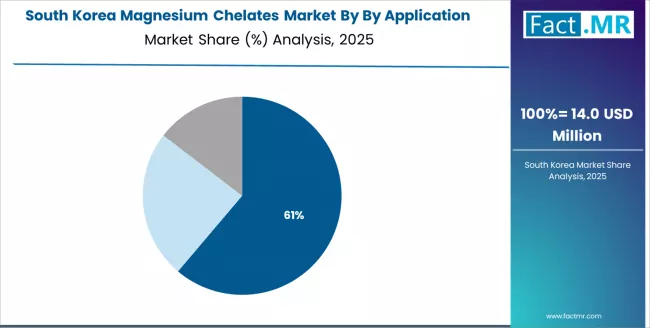
Magnesium Chelates Market South Korea Market Share Analysis By By Application | Source: Fact.MR
South Korean Magnesium Chelates operations reflect the country's advanced supplement manufacturing sector and export-oriented business model. Major supplement companies drive sophisticated ingredient procurement strategies, establishing direct relationships with global suppliers to secure consistent quality and pricing for their dietary supplement and functional food operations targeting both domestic and international markets.
The Korean market demonstrates particular strength in application distribution with Dietary Supplements accounting for 65.0%, Animal Nutrition 25.0%, and Food Fortification 10.0%. This health-focused approach creates demand for specific bioavailability specifications that differ from Western applications, requiring suppliers to adapt chelation and purification techniques.
Regulatory frameworks emphasize nutritional ingredient safety and traceability, with Korean food administration standards often exceeding international requirements. This creates barriers for smaller supplement suppliers but benefits established processors who can demonstrate compliance capabilities. The regulatory environment particularly favors suppliers with comprehensive certification and documentation systems.
Supply chain efficiency remains critical given Korea's geographic limitations and import dependence. Companies increasingly pursue long-term contracts with suppliers in United States, Germany, and Japan to ensure reliable access to raw materials while managing foreign exchange risks. Technical logistics investments support quality preservation during extended shipping periods.
The market faces pressure from rising labor costs and competition from lower-cost regional manufacturers, driving automation investments and consolidation among smaller processors. The premium positioning of Korean supplement brands internationally continues to support demand for high-quality chelated mineral ingredients that meet stringent specifications.
Competitive Landscape of Magnesium Chelates Market
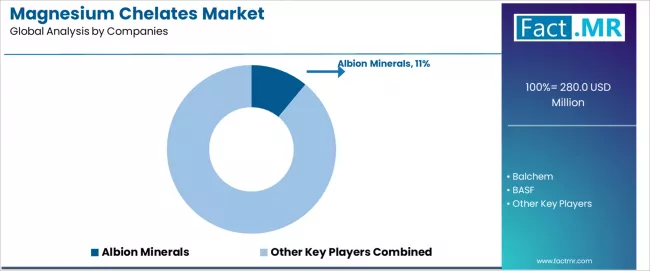
Magnesium Chelates Market Analysis By Company | Source: Fact.MR
Profit pools are consolidating upstream in scaled chelated mineral production systems and downstream in value-added specialty grades for dietary supplements, animal nutrition, and food fortification applications where certification, traceability, and consistent bioavailability command premiums. Value is migrating from raw mineral commodity trading to specification-tight, application-ready chelated minerals where technical expertise and quality control drive competitive advantage. Several archetypes set the pace: global nutritional integrators defending share through production scale and technical reliability; multi-grade processors that manage complexity and serve diverse applications; specialty chelated mineral developers with formulation expertise and supplement industry ties; and bioavailability-driven suppliers pulling volume in premium supplement and functional food applications. Switching costs, re-qualification, bioavailability testing, performance validation, provide stability for incumbents, while supply shocks and regulatory changes reopen opportunities for diversified suppliers. Consolidation and verticalization continue; digital procurement emerges in commodity grades while premium specifications remain relationship-led. Focus areas: lock supplement and nutrition pipelines with application-specific grades and service level agreements; establish multi-grade production capabilities and technical disclosure; develop specialized chelated mineral formulations with bioavailability claims.
| Stakeholder Type | Primary Advantage | Repeatable Plays |
|---|---|---|
| Global nutritional integrators | Scale, production integration, technical reliability | Long-term contracts, tight specs, co-development with supplements/nutrition |
| Multi-grade processors | Grade diversification, application expertise, supply flexibility | Multi-application serving, technical support, quality assurance across segments |
| Specialty chelated mineral developers | Formulation expertise and industry relationships | Custom grades, bioavailability science, performance SLAs |
| Bioavailability suppliers | Application-focused demand and specialized service | Technical bioavailability claims, specialized grades, application activation |
| Nutritional distributors & platforms | Technical support for mid-tier manufacturers | Grade selection, smaller volumes, technical service |
Source: Fact.MR analysis. Updated Oct 30, 2025
Key Players in the Magnesium Chelates Market
- Albion Minerals
- Balchem
- BASF
- DSM
- Gadot Biochemical
- Jost Chemical
- NutraScience Labs
- Titan Biotech
- Jungbunzlauer
- BioCare
- Novotech Nutraceuticals
- Innophos
- Kemin
- Puris
- Valensa
Segmentation
Magnesium Chelates Market Segmentation
| Category | Segments Covered |
|---|---|
| By Type | Glycinate, Citrate, Gluconate, Others |
| By Application | Dietary Supplements, Animal Nutrition, Food Fortification |
| By Form | Powder, Liquid |
| By Region | North America, Europe, Asia Pacific, Latin America, Middle East & Africa |
Source: Fact.MR analysis. Updated Oct 30, 2025
Magnesium Chelates Market Analysis by Type
| Segment | 2025 to 2035 Outlook |
|---|---|
| Glycinate | Leader in 2025 with 45.0% market share; likely to maintain leadership through 2035. Broadest use (supplements, animal nutrition, fortification), mature supply chain, predictable functionality. Momentum: steady-to-strong. Watchouts: raw material price volatility. |
| Citrate | Cost-effective and well-established for dietary supplement applications, but processing complexity limits broader adoption in specialized nutritional applications. Momentum: steady in traditional supplements; flat to slightly up in premium segments. |
| Gluconate | Benefiting from advanced bioavailability requirements due to specialized absorption properties and enhanced performance characteristics. Momentum: rising. Watchouts: manufacturing complexity, technical qualification requirements. |
| Others | Emerging chelated forms including specialty amino acid complexes and novel chelation technologies. Limited market share but growing interest in specialized applications requiring specific absorption profiles. Momentum: selective growth in niche applications. |
Source: Fact.MR analysis. Updated Oct 30, 2025
Magnesium Chelates Market Analysis by Application
| Segment | 2025 to 2035 Outlook |
|---|---|
| Dietary Supplements | At 60.0%, largest application segment in 2025 with established chelated mineral integration. Mature supply chains, standardized processing specifications. Momentum: steady growth driven by health consciousness and premium supplement demand. Watchouts: regulatory changes affecting formulation requirements. |
| Animal Nutrition | Strong growth segment driven by livestock and pet nutrition demand. Glycinate and citrate chelates dominate applications. Momentum: strong growth through 2030, supported by animal health awareness. Watchouts: competition from alternative mineral delivery technologies. |
| Food Fortification | Specialized segment with diverse chelated mineral requirements. Growing demand for fortified foods supporting higher-value nutritional applications. Momentum: moderate growth via functional food expansion and nutritional innovation. Watchouts: regulatory requirements affecting food processing. |
Source: Fact.MR analysis. Updated Oct 30, 2025
Magnesium Chelates Market Analysis by Form
| Form | Status & Outlook 2025-2035 |
|---|---|
| Powder | Dominant form in 2025 with 70.0% share for supplement applications. Dry handling systems, processing advantages, ease of formulation. Momentum: steady growth driven by manufacturing efficiency and processing advantages. Watchouts: moisture sensitivity in certain conditions. |
| Liquid | Important for specialized applications requiring precise control. Value-add through superior solubility properties, custom concentrations, specialized processing. Momentum: moderate growth as specialty applications demand enhanced properties. Processing complexity may limit broader growth. |
Source: Fact.MR analysis. Updated Oct 30, 2025
Scope of the Report
| Items | Values |
|---|---|
| Quantitative Units (2025) | USD 280.0 million |
| Product | Glycinate, Citrate, Gluconate, Others |
| Application | Dietary Supplements, Animal Nutrition, Food Fortification |
| Form | Powder, Liquid |
| Regions Covered | North America, Europe, Asia Pacific, Latin America, Middle East & Africa |
| Countries Covered | United States, Germany, China, Japan, India, South Korea, Australia, and other 40+ countries |
| Key Companies Profiled | Albion Minerals, Balchem, BASF, DSM, Gadot Biochemical, Jost Chemical, NutraScience Labs, Titan Biotech, Jungbunzlauer, BioCare, Novotech Nutraceuticals, Innophos, Kemin, Puris, Valensa |
| Additional Attributes | Dollar sales by product/application/form, regional demand (NA, EU, APAC), competitive landscape, powder vs. liquid adoption, production/processing integration, and advanced processing innovations driving bioavailability enhancement, technical advancement, and efficiency |
Source: Fact.MR analysis. Updated Oct 30, 2025
Magnesium Chelates Market Segmentation
-
By Type :
- Glycinate
- Citrate
- Gluconate
- Others
-
By Application :
- Dietary Supplements
- Animal Nutrition
- Food Fortification
-
By Form :
- Powder
- Liquid
-
By Region :
- North America
- Europe
- Asia Pacific
- Latin America
- Middle East & Africa
Frequently Asked Questions
How big is the magnesium chelates market in 2025?
What will be the size of magnesium chelates market in 2035?
How much will be the magnesium chelates market growth between 2025 and 2035?
What are the key product types in the magnesium chelates market?
Which by application segment to contribute significant share in the magnesium chelates market in 2025?
Who worked on this report


Preview the report firsthand - request a free sample
Free SampleGet the brochure for pricing and purchase details
Download PDF