- Base Value(2025): 276.1 Bn
- Estimated Value(2026): 306.3 Bn
- Forecast Value (2036): 864.8 Bn
- CAGR (2026 - 2036): 10.9%
Carrier Infrastructure in Telecom Applications Market Forecast 2026 to 2036
In 2025, the carrier infrastructure in telecom applications market was valued at USD 276.1 billion. Based on FMR analysis, demand for carrier infrastructure in telecom applications is estimated to grow to USD 306.3 billion in 2026 and USD 864.8 billion by 2036. Fact MR projects a CAGR of 10.9% during the forecast period.
The absolute dollar growth from 2026 to 2036 is USD 558.5 billion. This growth is driven by the global rollout of 5G networks, increasing demand for high-speed internet, and expansion of telecom networks to support IoT, cloud computing, and smart city initiatives. Investments in network modernization and enhanced coverage are further supporting market expansion. However, high infrastructure costs, regulatory approvals, and technological complexity may constrain growth in certain regions.
China leads with a CAGR of 12.8%, driven by rapid 5G deployment and expanding telecom networks. India follows with 11.3%, supported by growing mobile subscriber base and digital initiatives. The USA grows at 8.9%, fueled by modernization of existing networks and adoption of 5G technologies. South Korea shows a CAGR of 8.1%, driven by advanced telecom infrastructure and high connectivity demand. Germany grows at 7.3%, reflecting steady network expansion and enterprise telecom investments.
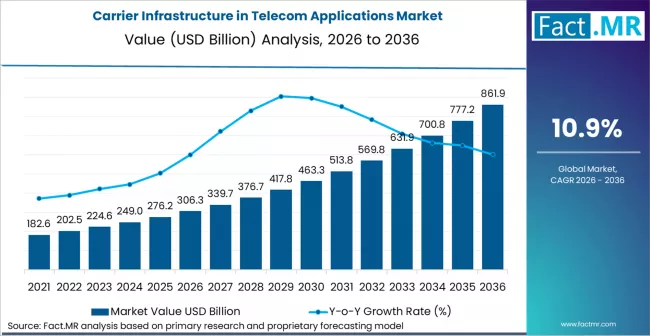
Carrier Infrastructure In Telecom Applications Market Market Value Analysis | Source: Fact.MR
Carrier Infrastructure in Telecom Applications Market
| Metric | Value |
|---|---|
| Estimated Value in (2026E) | USD 306.3 billion |
| Forecast Value in (2036F) | USD 864.8 billion |
| Forecast CAGR (2026 to 2036) | 10.9% |
Source: Fact.MR analysis. Updated Mar 11, 2026
Carrier Infrastructure in Telecom Applications Market Definition
The Carrier Infrastructure in Telecom Applications Market involves the development, deployment, and sale of network infrastructure hardware and software that enable telecommunications carriers to deliver voice, data, and multimedia services across wired and wireless networks.
Market Inclusions
This report covers global and regional market sizes for carrier infrastructure over a defined forecast period, including network segments (core, metro, access), technology types (5G, fiber‑optic backhaul, edge platforms), network equipment (routers, switches, base stations, transmission systems), and end‑use carriers (mobile operators, fixed broadband providers, IoT connectivity providers).
Market Exclusions
The scope excludes end‑user devices (smartphones, modems), standalone enterprise networking equipment not used in carrier networks, and third‑party services not directly tied to carrier infrastructure deployment and operations.
Research Methodology
- Primary Research: Interviews were conducted with network architects, telecom equipment suppliers, and carrier technology planners.
- Desk Research: Data was sourced from industry reports, telecom publications, and trade association statistics.
- Market‑Sizing and Forecasting: A hybrid model combining top‑down telecom investment forecasts with bottom‑up shipment and revenue data was used.
- Data Validation and Update Cycle: Findings were validated through expert review and aligned with recent network build‑out and adoption figures.
Summary of the Carrier Infrastructure in Telecom Applications Market
- Market Definition
- The Carrier Infrastructure in Telecom Applications Market involves the production, deployment, and trade of network hardware and services that enable telecom operators and government entities to deliver mobile, broadband, and fixed-line services. The market includes 2G, 3G, 4G/LTE, and 5G technologies, covering core, metro, and access network segments with equipment such as base stations, routers, switches, transmission systems, and supporting services for network operation and maintenance.
- Demand Drivers
- Rapid global rollout of 5G networks and modernization of legacy telecom infrastructure.
- Growing demand for high-speed internet, IoT connectivity, and cloud services.
- Expansion of mobile networks to support increasing subscriber bases and digital services.
- Government initiatives and national broadband policies encouraging network densification.
- Investment in advanced hardware and software for scalable, reliable, and low-latency networks.
- Key Segments Analyzed
- Component: Hardware (60% share in 2026), Services.
- End User: Telecom Operators (85% share in 2026), Government & Public Sector.
- Technology: 2G, 3G, 4G/LTE, 5G.
- Geography: East Asia, South Asia, North America, Europe; China shows the highest CAGR at 12.8%, followed by India (11.3%), USA (8.9%), South Korea (8.1%), and Germany (7.3%).
- Analyst Opinion at Fact MR
- Shambhu Nath Jha, Principal Consultant, Fact MR, states, “The carrier infrastructure market is transitioning from traditional, hardware-centric networks to advanced, software-defined and virtualized systems to meet growing 5G, IoT, and broadband demand. Operators and governments investing in modernized, scalable networks will drive value creation. Vendors providing integrated solutions, including base stations, core and access network equipment, and managed services, will capture competitive advantage. Market growth is closely tied to national broadband strategies, spectrum availability, and deployment of next-generation technologies through 2036.”
- Strategic Implications/Executive Takeaways
- Prioritize integrated hardware and service solutions supporting 5G and network densification.
- Target telecom operators with scalable infrastructure offerings and service-level guarantees.
- Focus on high-growth regions such as China and India with rapid mobile and broadband adoption.
- Align solutions with regulatory standards, spectrum allocations, and national broadband programs.
- Invest in R&D for software-defined networking, edge computing, and next-generation carrier infrastructure.
- Methodology
- Primary Research: Interviews with network architects, telecom operators, and equipment suppliers.
- Desk Research: Data sourced from telecom reports, government publications, and industry statistics.
- Market Sizing & Forecasting: Hybrid model combining top-down telecom investment forecasts with bottom-up shipment and revenue data.
- Data Validation: Findings validated through expert review, network deployment adoption data, and proprietary Fact MR forecasting models.
Segmental Analysis
Carrier Infrastructure in Telecom Applications Market Analysis by End User
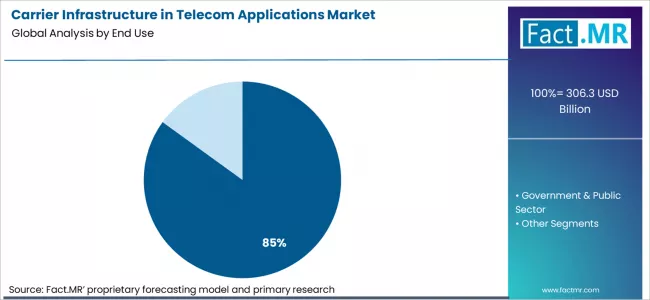
Carrier Infrastructure In Telecom Applications Market Analysis By End Use | Source: Fact.MR
- Market Overview: Telecom operators are expected to capture 85% of the market share by 2026. Operators rely on carrier infrastructure to deliver high-speed, reliable connectivity to subscribers, manage network traffic, and support expansion of mobile and broadband services. Their extensive network requirements make them the primary adopters of telecom infrastructure solutions.
- Demand Drivers:
- Expansion of Mobile and Broadband Networks: Growing subscriber bases and the rollout of 4G and 5G networks drive demand for advanced carrier infrastructure.
- Need for Reliable Connectivity: Telecom operators require robust infrastructure to maintain service quality, reduce downtime, and ensure seamless communication.
- Technological Upgrades: Continuous upgrades to support higher data speeds, lower latency, and network capacity enhance the adoption of carrier infrastructure solutions.
Carrier Infrastructure in Telecom Applications Market Analysis by Component
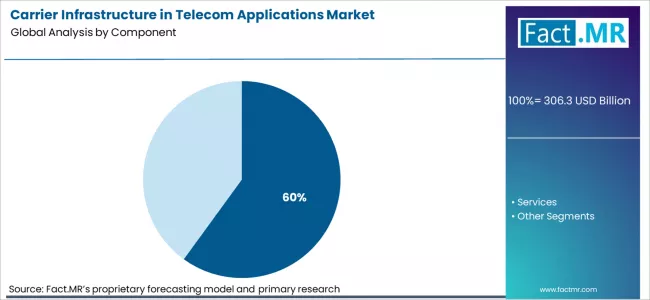
Carrier Infrastructure In Telecom Applications Market Analysis By Component | Source: Fact.MR
- Market Overview: Hardware is projected to hold 60% of the market share by 2026. Hardware components, including switches, routers, base stations, and antennas, form the foundation of telecom infrastructure and are essential for network performance and reliability.
- Demand Drivers:
- Critical Role in Network Deployment: Hardware components enable connectivity, signal transmission, and data management across telecom networks.
- Growing Demand for 5G Infrastructure: The adoption of 5G networks requires upgraded and high-performance hardware to support increased bandwidth and connectivity.
- Reliability and Scalability: High-quality hardware ensures network reliability and supports scalable expansion, meeting the growing data and communication needs of telecom operators.
Key Dynamics
Carrier Infrastructure in Telecom Applications Market Drivers, Restraints, and Opportunities
FMR analysts observe that the carrier infrastructure market in telecom is a growth aligned, connectivity‑driven segment propelled by rising data traffic, 5G rollout, and demand for resilient and high‑capacity networks. Historically, legacy 2G/3G/4G networks used centralized, hardware‑centric infrastructure; as user expectations for speed, low latency, and IoT connectivity have expanded, structural demand has shifted toward scalable, software defined, and virtualized carrier systems. The 2026 valuation reflects this transition, with adoption tied to national broadband policies and network densification rather than incremental upgrades alone.
While traditional macrocell and fixed network elements still represent a large installed base, advanced small cells, edge compute, and fronthaul/backhaul solutions are gaining share because they support densification, capacity scaling, and performance optimization. These advanced systems command higher pricing and service revenues, contributing to net market value growth even as hardware unit growth aligns with telecom CAPEX cycles. The market exists because operators must balance performance, cost, and regulatory requirements to deliver robust, future‑ready networks.
- Network Capacity Demand: Operators deploy densified and software driven infrastructure to replace basic legacy systems and support high data volumes and 5G use cases.
- Standards and Policy Pressure: Spectrum allocation rules and national broadband initiatives push adoption of certified infrastructure that meets defined performance and interoperability criteria.
- Regional Deployment Trends: In North America and Asia Pacific, strong 5G investment and digital services demand drive higher uptake compared with regions with slower infrastructure development.
Regional Analysis
The market analysis covers key global regions, including South Asia, East Asia, North America, and Europe. It is segmented geographically, with specific market dynamics for each region. The full report provides a detailed market attractiveness analysis.
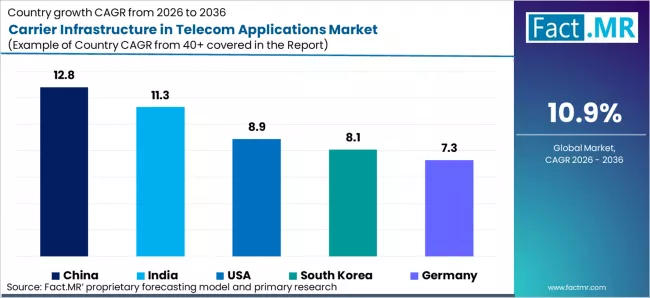
Carrier Infrastructure In Telecom Applications Market Cagr Analysis By Country | Source: Fact.MR
| Country | CAGR (2026-2036) |
|---|---|
| India | 11.3% |
| China | 12.8% |
| Germany | 7.3% |
| South Korea | 8.1% |
| USA | 8.9% |
Source: Fact.MR analysis. Updated Mar 11, 2026
Source: Fact MR (FMR) analysis, based on proprietary forecasting model and primary research
South Asia:
India is a major market, driven by telecom network expansion, 5G deployments, and government digital initiatives. Key players include Ericsson, Huawei Technologies, and Nokia.
- India: Demand for carrier infrastructure in telecom applications in India is projected to rise at 11.3% CAGR through 2036. Growth is supported by government 5G network programs (05-2025) and Ericsson’s regional infrastructure expansions (09-2025).
East Asia:
China and South Korea are leading markets, supported by rapid 5G adoption, telecom modernization, and high network investment.
- China: Demand for carrier infrastructure in telecom applications in China is projected to rise at 12.8% CAGR through 2036. Growth is supported by government 5G infrastructure projects (03-2025) and Huawei Technologies’ network deployment expansions (08-2025).
- South Korea: Demand for carrier infrastructure in telecom applications in South Korea is projected to rise at 8.1% CAGR through 2036. Growth is influenced by nationwide 5G rollout programs (02-2025) and Nokia’s regional infrastructure expansions (07-2025).
North America:
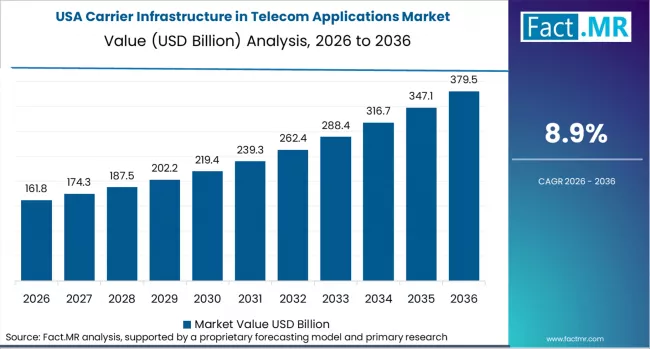
Carrier Infrastructure In Telecom Applications Market Country Value Analysis | Source: Fact.MR
The USA is a key market, driven by telecom network modernization, 5G deployment, and enterprise connectivity solutions.
- USA: Demand for carrier infrastructure in telecom applications in the U.S. is projected to rise at 8.9% CAGR through 2036. Growth is supported by federal 5G programs (04-2025) and Ericsson and Nokia’s network deployment expansions (08-2025).
Europe:
Germany is a major market, supported by telecom modernization, 5G rollout, and enterprise connectivity demand.
- Germany: Demand for carrier infrastructure in telecom applications in Germany is projected to rise at 7.3% CAGR through 2036. Growth is influenced by federal 5G programs (03-2025) and Huawei Technologies’ regional infrastructure expansions (07-2025).
Fact MR's analysis of the carrier infrastructure in telecom applications market in South Asia, East Asia, North America, and Europe consists of country-wise assessments that include India, China, Germany, South Korea, and the USA. Readers can find detailed trends, regulatory updates, and company-specific investments shaping market growth in these countries.
Competitive Landscape
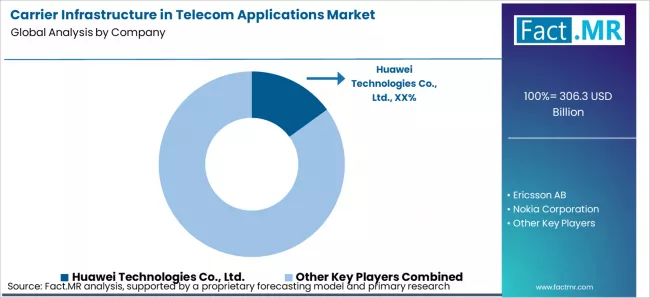
Carrier Infrastructure In Telecom Applications Market Analysis By Company | Source: Fact.MR
What is the Competitive Structure and Buyer Behavior in the Carrier Infrastructure in Telecom Applications Market?
The carrier infrastructure market in telecom applications is moderately concentrated, with major global network equipment providers such as Huawei Technologies Co., Ltd., Ericsson AB, Nokia Corporation, and ZTE Corporation holding substantial share alongside technology and hardware suppliers including Cisco Systems, Inc., Samsung Electronics Co., Ltd., Qualcomm Technologies, Inc., NEC Corporation, Fujitsu Limited, and CommScope Holding Company, Inc. The primary competitive variables are network performance, scalability, standards compliance (such as 5G readiness), integration capability with existing operator infrastructure, and total cost of ownership. Companies with broad product portfolios, strong R&D and standards influence, global deployment experience, and extensive service and support networks hold structural advantages because they can offer end‑to‑end solutions that align with operator requirements for coverage, capacity, and reliability.
Large telecom operators and service providers exert strong buyer leverage by qualifying multiple suppliers, negotiating long‑term supply and maintenance contracts, and standardizing technical specifications to ensure interoperability and network resilience. To manage supplier dependency, these buyers often adopt multi‑vendor strategies, emphasize open and modular architectures, and require performance guarantees tied to service level agreements, which limits individual suppliers’ pricing power. As a result, competition centers on delivering reliable network performance, robust integration support, and future‑proof technologies rather than on price alone.
Key Players of the Carrier Infrastructure in Telecom Applications Market
- Huawei Technologies Co., Ltd.
- Ericsson AB
- Nokia Corporation
- ZTE Corporation
- Cisco Systems, Inc.
- Samsung Electronics Co., Ltd.
- Qualcomm Technologies, Inc.
- NEC Corporation
- Fujitsu Limited
- CommScope Holding Company, Inc.
Report Scope
| Metric | Value |
|---|---|
| Quantitative Units | USD 306.3 billion (2026) to USD 864.8 billion (2036), at a CAGR of 10.9% |
| Market Definition | The carrier infrastructure market for telecom applications includes global production, deployment, and trade of network hardware and services that support mobile technologies from 2G to 5G for telecom operators and government use. |
| Component Segmentation | Hardware, Services |
| Technology Segmentation | 2G, 3G, 4G/LTE, 5G |
| End User Segmentation | Telecom Operators, Government & Public Sector |
| Key Companies Profiled | Huawei Technologies Co., Ltd., Ericsson AB, Nokia Corporation, ZTE Corporation, Cisco Systems, Inc., Samsung Electronics Co., Ltd., Qualcomm Technologies, Inc., NEC Corporation, Fujitsu Limited, CommScope Holding Company, Inc. |
| Forecast Period | 2026 to 2036 |
| Approach | Hybrid top-down and bottom-up modeling validated through interviews with telecom equipment manufacturers and operators, supported by trade data benchmarking and plant-level capacity verification |
Source: Fact.MR analysis. Updated Mar 11, 2026
Bibliographies
- PwC Global. (2025, February). Global telecoms industry revenue rose 4.3% in 2023 to hit US$1.1 trillion, but faces continuing headwinds, even as 5G subscriptions are projected to quadruple by 2028. PwC Global.
- GSMA. (2025, August). The mobile economy Asia Pacific 2025. GSMA.
- Reuters. (2025, September 22). Ericsson, Nokia win $2.7 billion UK deal from VodafoneThree. Reuters.
- Reuters. (2026, March 6). Vietnam in talks with Chinese firms for new 5G contracts despite US warnings. Reuters.
- Associated Press. (2025, August 26). AT&T snatches up wireless spectrum licenses from EchoStar for $23 billion. Associated Press.
This Report Addresses
- Market intelligence enabling assessment of leading countries, technology segments, components, and end users in the global Carrier Infrastructure in Telecom Applications Market.
- Market volume (revenue) estimates and 10-year revenue forecasts from 2026 to 2036, validated through telecom operator CAPEX data, network deployment trends, and 5G rollout adoption.
- Growth opportunity mapping across components (Hardware, Services), technologies (2G, 3G, 4G/LTE, 5G), and end users (Telecom Operators, Government & Public Sector), with major markets including China, India, USA, South Korea, and Germany.
- Segment and regional revenue forecasts by component, technology, and geography, including network modernization, densification, and next-generation deployment trends.
- Competition strategy analysis focusing on network reliability, scalability, integration with existing infrastructure, and 5G compliance, with major players including Huawei Technologies Co., Ltd., Ericsson AB, Nokia Corporation, ZTE Corporation, Cisco Systems, Inc., Samsung Electronics Co., Ltd., Qualcomm Technologies, Inc., NEC Corporation, Fujitsu Limited, and CommScope Holding Company, Inc.
- Adoption dynamics emphasizing telecom operator infrastructure investments for mobile, broadband, and fixed-line networks, supporting IoT, cloud services, and smart city initiatives.
- Report delivery in PDF, Excel, PowerPoint, and interactive dashboard formats for executive, operational, and strategic planning use.
Segmentation
Carrier Infrastructure in Telecom Applications Market Key Segments
-
Component
- Hardware
- Services
-
Technology
- 2G
- 3G
- 4G/LTE
- 5G
-
End-Use Industry
- Telecom Operators
- Government & Public Sector
-
Region
- North America
- USA
- Canada
- Mexico
- Europe
- Germany
- UK
- France
- Italy
- Spain
- Nordic Countries
- BENELUX
- Rest of Europe
- Asia Pacific
- China
- Japan
- South Korea
- India
- Australia
- Rest of Asia Pacific
- Latin America
- Brazil
- Argentina
- Rest of Latin America
- Middle East and Africa
- Kingdom of Saudi Arabia
- United Arab Emirates
- South Africa
- Rest of Middle East and Africa
- Other Regions
- Oceania
- Central Asia
- Other Markets
- North America
Frequently Asked Questions
How large is the demand for Carrier Infrastructure in Telecom Applications in the global market in 2026?
What will be the market size of Carrier Infrastructure in Telecom Applications in the global market by 2036?
What is the expected demand growth for Carrier Infrastructure in Telecom Applications in the global market between 2026 and 2036?
Which end-user segment is expected to dominate the market?
Which region is expected to show the highest growth rate for Carrier Infrastructure in Telecom Applications?
How significant is the growth outlook for India in this market?
What is the growth outlook for the United States in the Carrier Infrastructure in Telecom Applications market?
What is the growth forecast for Germany in the Carrier Infrastructure in Telecom Applications market?
What is the growth forecast for South Korea in the Carrier Infrastructure in Telecom Applications market?
Which company is identified as a leading player in the Carrier Infrastructure in Telecom Applications market?
What is Carrier Infrastructure in Telecom Applications used for?
What does the Carrier Infrastructure in Telecom Applications market include in this report?
How is the market forecast developed in this report?
What is meant by the Carrier Infrastructure in Telecom Applications market in this report?
Who worked on this report


Preview the report firsthand - request a free sample
Free SampleGet the brochure for pricing and purchase details
Download PDF