- Base Value(2025): 10.2 Bn
- Estimated Value(2026): 12.3 Bn
- Forecast Value (2036): 83.0 Bn
- CAGR (2026 - 2036): 21.0%
Frictionless Retail Infrastructure Market Overview, Growth Outlook, and Forecast by Fact.MR
- In 2025, the Frictionless Retail Infrastructure Market was valued at USD 10.2 billion.
- Demand for frictionless retail infrastructure solutions is projected to grow to USD 12.3 billion in 2026 and reach USD 83.0 billion by 2036.
- The market is expected to expand at a CAGR of 21.0% during the forecast period.
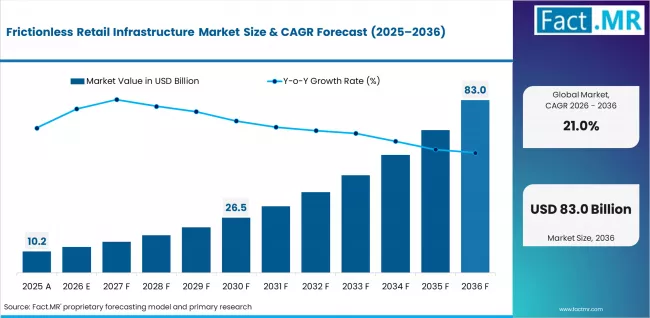
Frictionless Retail Infrastructure Market Value Analysis | Source: Fact.MR
The frictionless retail infrastructure market is projected to create an absolute dollar opportunity of USD 70.7 billion between 2026 and 2036. The market growth is driven by increasing adoption of autonomous checkout systems, AI-powered retail intelligence, computer vision technologies, smart sensors, and embedded digital payment platforms across modern retail environments. Rising demand for cashierless stores, unattended retail formats, real-time inventory monitoring, and seamless customer experiences is accelerating infrastructure investments globally. Expanding deployment across convenience stores, grocery chains, airports, and corporate campuses will further support market expansion. However, high implementation costs, integration complexities, cybersecurity concerns, and data privacy regulations may challenge long-term market scalability.
Summary of the Frictionless Retail Infrastructure Market
- Market Snapshot
- Global Frictionless Retail Infrastructure Market revenue stood at USD 12.3 billion in 2026 and is forecast to reach USD 83.0 billion by 2036.
- At a 21.0% CAGR from 2026 to 2036, the market is set to expand ~6.7x in value, creating an absolute dollar opportunity of USD 70.7 billion.
- Growth is fueled by the increasing adoption of autonomous checkout, AI-based retail intelligence, smart sensors, computer vision, and digital payment infrastructure integrated in the latest retail ecosystems.
- Growing need for cashier-free shopping solutions, unattended retail models, and real-time inventory tracking is driving the global spread of frictionless retail infrastructure.
- Developments in artificial intelligence, IoT infrastructure, retail analytics, robotics, and automated commerce have led to a paradigm shift in realizing innovative store operations, customer engagement, and retail automation strategies within bricks and mortar retail.
- Demand and Growth Drivers
- Increasing adoption of autonomous checkout and cashierless retail solutions
- Growing need for seamless and contactless shopping experiences
- Development of AI-based retail automation and smart store solutions
- Increasing investments in computer vision, IoT infrastructure, and integrated payment solutions
- Expanding penetration of unattended retail in convenience stores, airports, campuses and transit centers.
- Need for solutions that provide:
- Real-time inventory monitoring
- Seamless autonomous checkout
- AI-powered shopper behavior analytics
- Faster queue-free retail experiences
- Automated loss prevention and theft detection
- Smart store operations and workforce optimization
- Enhanced customer convenience and operational efficiency
- Product and Segment View
- Convenience Stores hold 29.2% of store format share in 2026, emerging as the leading deployment segment due to rising adoption of autonomous checkout and grab-and-go retail models.
- Computer Vision & Artificial Intelligence account for 27.4% of technology share in 2026, positioning them as the dominant technology segment across frictionless retail ecosystems.
- Autonomous Checkout represents 23.8% of application share in 2026, reflecting strong demand for cashierless and queue-free shopping experiences.
- Retail Chains account for 36.2% of end-user share in 2026, supported by increasing investments in smart store modernization and retail automation infrastructure.
- Fully Autonomous Stores and Stadiums, Airports & Transit Hubs are projected to witness the fastest growth through 2036 due to increasing deployment of unattended retail formats, AI-powered store operations, and high-speed transactional retail environments.
- Geography and Competitive Outlook
- Adopt smart retail infrastructure such as self-service kiosk and autonomous POS, AI-based store operations, and integrated digital payment ecosystem across North America, East Asia, and South Asia & Pacific (SAP), which drives the strong growth prospect in these regions.
- Major growth markets in the Frictionless Retail Infrastructure Market include India (25.4% CAGR), Japan (22.6% CAGR), China (22.3% CAGR), United States (20.1% CAGR), South Korea (19.4% CAGR), United Kingdom (17.9% CAGR), and Germany (17.3% CAGR) during the forecast period.
- Growth of the market is attributed by:
- Growing investment in the cashierless retail infrastructure
- Increasing implementation of AI-based computer vision solutions
- Proliferation of unattended and autonomous retail solutions
- Increasing smart sensors, IoT infrastructure and retail analytics platforms applications
- Growing demand for real-time inventory visibility and value-added customer experiences
- Prominent players in the market include: Amazon Just Walk Out, AiFi, Zippin, Trigo, Standard AI, Everseen, Sensei, Mashgin, Caper AI, Digit7 and more.
- Analyst Opinion
- Shambhu Nath Jha, Principal Consultant at Fact.MR, opines, “CXO leaders are expected to recognize that future competitive advantage in the Frictionless Retail Infrastructure Market will increasingly depend on deploying autonomous checkout systems, AI-powered retail intelligence, smart store automation, and seamless cashierless shopping experiences rather than relying solely on conventional retail modernization strategies.
Frictionless Retail Infrastructure Market— At a Glance
| Attribute | Details |
|---|---|
| Market Value 2025 | USD 10.2 Billion |
| Market Value 2026 | USD 12.3 Billion |
| Market Value 2036 | USD 83.0 Billion |
| Absolute Dollar Opportunity | USD 70.7 Billion |
| Total Growth | 574.80% |
| CAGR | 21.00% |
| Growth Multiple | 6.7x |
| Key Demand Theme | Rising adoption of autonomous checkout systems, AI-powered retail intelligence, cashierless shopping experiences, smart store infrastructure, embedded digital payments, computer vision technologies, and unattended retail ecosystems |
| Leading Store Format | Convenience Stores |
| Store Format Share | 29.2% |
| Leading Technology | Computer Vision & Artificial Intelligence |
| Technology Share | 27.4% |
| Leading Application | Autonomous Checkout |
| Application Share | 23.8% |
| Leading End User | Retail Chains |
| End User Share | 36.2% |
| Key Growth Regions | East Asia, South Asia & Pacific, North America |
| Key Companies | Amazon Just Walk Out, AiFi, Zippin, Trigo, Standard AI, Everseen, Sensei, Mashgin, Caper AI, Digit7 |
| Segmentation by Component | Hardware, Software, and Services |
| Segmentation by Store Format | Convenience Stores, Grocery & Supermarkets, Specialty Retail, Quick Service Restaurants (QSRs), Stadiums, Airports & Transit Hubs, Corporate & Campus Retail |
| Segmentation by Deployment Model | Fully Autonomous Stores, Hybrid Smart Stores, Assisted Checkout Stores |
| Segmentation by Technology | Computer Vision & Artificial Intelligence, Smart Sensors & IoT Infrastructure, Autonomous Checkout Systems, Retail Operations Software, Robotics & Automation, Embedded Payments & Fintech |
| Segmentation by Application | Autonomous Checkout, Inventory Monitoring, Shopper Behavior Analytics, Loss Prevention & Theft Detection, Queue Management, Dynamic Pricing, Personalized Promotions, Store Traffic Analytics, Workforce Optimization, Supply Chain Visibility |
| Segmentation by End User | Retail Chains, Independent Retailers, Retail Franchise Operators, Hospitality & Foodservice Operators, Transportation & Mobility Operators, Corporate Campuses, Educational Institutions, Healthcare Retail Operators |
| Segmentation by Region | North America, Latin America, East Asia, South Asia & Pacific, Western Europe, Eastern Europe, Middle East & Africa |
Source: Fact.MR analysis. Updated May 14, 2026
Key Growth Drivers, Constraints, and Opportunities
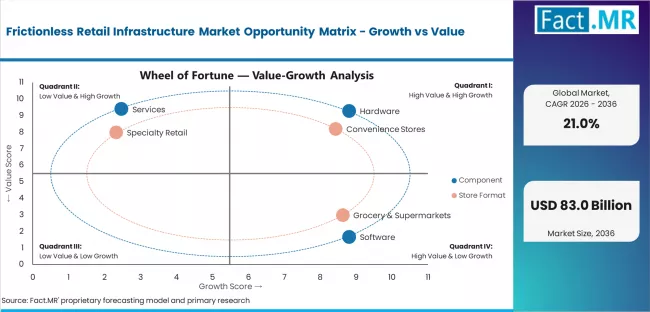
Frictionless Retail Infrastructure Market Opportunity Matrix Growth Vs Value | Source: Fact.MR
Key Factors Driving Growth
- The fast-paced adoption of self-checkout systems, cashierless store formats, and store automation powered by AI is creating demand for frictionless retail infrastructure solutions worldwide.
- Growing implementation of computer vision technology, smart sensors, IoT-based retail infrastructure, and embedded digital payment methodology is driving the market growth in modern retail environments.
- Increasing investment by retailers in real-time inventory tracking, shopper behavior analysis, queue-less shopping, and intelligent store management is enabling adoption in convenience stores, grocery chains, airports, QSRs, and corporate campuses.
Key Market Constraints
- The cost of infrastructure deployment, complexity of integration, and the required capital investment may deter small and medium retailers from the adoption.
- Market players could also face operational and compliance challenges due to data privacy issues, cybersecurity threats, and changing laws pertaining to AI-based surveillance and customer tracking.
- Seamless integration of frictionless retail infrastructure with legacy retail system and traditional store operation is still a big challenge, especially in the traditional retail stores.
Key Opportunity Areas
- The increasing popularity of unattended retail formats, autonomous micro-stores, and AI-based convenience retail is driving the creation of huge market opportunities worldwide.
- With the development of smart retail ecosystem in airports, transit hubs, campuses, healthcare facilities, and hospitality, the request for frictionless retail infrastructure solutions is rising.
- The increasing investments in AI enabled retail intelligence, integrated payment ecosystems, computer vision analytics and real-time store automation technologies are anticipated to drive overall market growth in the foreseeable future.
Segment-wise Analysis of the Frictionless Retail Infrastructure Market
- Convenience Stores account for 29.2% share of the store format segment in 2026, driven by increasing deployment of autonomous checkout systems, growing adoption of grab-and-go retail models, and rising demand for unattended convenience retail infrastructure across urban retail environments.
- Computer Vision & Artificial Intelligence hold 27.4% share of the technology segment in 2026, supported by expanding implementation of AI-powered shopper tracking, product recognition, behavioral analytics, and real-time retail intelligence solutions across frictionless retail ecosystems.
- Autonomous Checkout represents 23.8% share of the application segment in 2026, owing to rising demand for cashierless shopping experiences, queue-free transactions, embedded payment systems, and AI-driven retail automation technologies.
The Frictionless Retail Infrastructure Market is segmented by component, store format, deployment model, technology, application, end user, and region.
Which Store Format Segment Topped the Frictionless Retail Infrastructure Market?
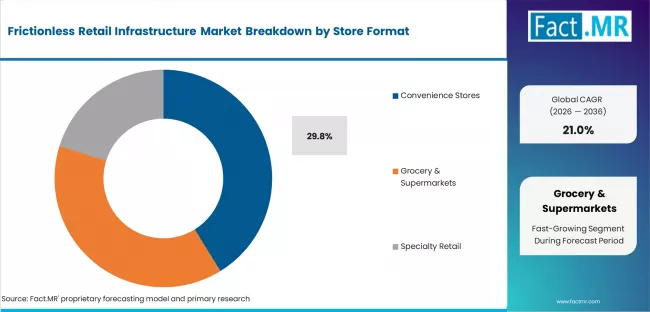
Frictionless Retail Infrastructure Market Analysis By Store Format | Source: Fact.MR
It is predicted that Convenience Stores are expected to account for the largest market share of 29.2% in the market by 2026. This dominant position can be attributed to the high rate of acceptance of autonomous checkout systems, growing implementation of grab-and-go store formats, increasing need for cashierless shopping solutions, and the growth of unattended convenience retail solutions in city centers, service stations, airports, as well as train stations.
Which Technology Segment Accounts for the Highest Share in the Market?
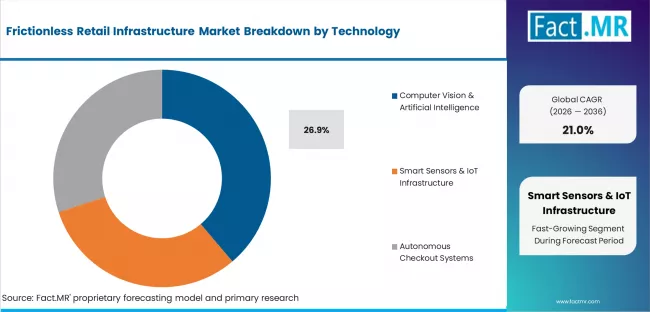
Frictionless Retail Infrastructure Market Analysis By Technology | Source: Fact.MR
It is expected that Computer Vision & Artificial Intelligence will hold the largest share of 27.4% of the technology segment by 2026. This supremacy is attributed to the growing adoption of AI-based shopper tracking, product recognition systems, behavioral analytics platforms, real-time retail intelligence solutions, and autonomous checkout solutions in the futuristic smart retail environments.
Which Application Segment Leads the Market?
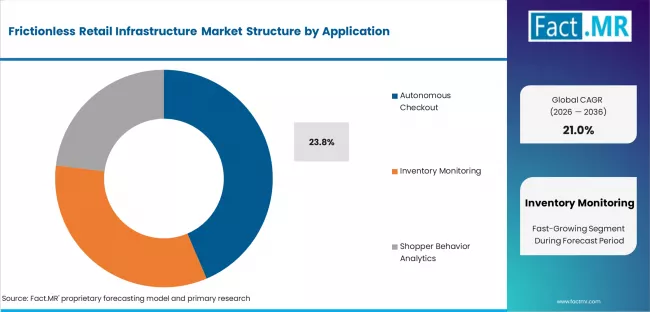
Frictionless Retail Infrastructure Market Analysis By Application | Source: Fact.MR
An Autonomous Checkout format is predicted to hold the highest share of the market, accounting for 23.8% in 2026 as a result of rising popularity of cashierless shopping experiences, transactions devoid of queues, integrated payment systems, and retail automation solutions based on artificial intelligence. Retailers are progressively dedicating resources to the development of autonomous checkout solutions that provide a seamless shopping experience, allowing them to collect customer convenience, operational efficiency, and transaction speed benefits in store environments.
Which End User Segment Holds the Largest Share in the Market?
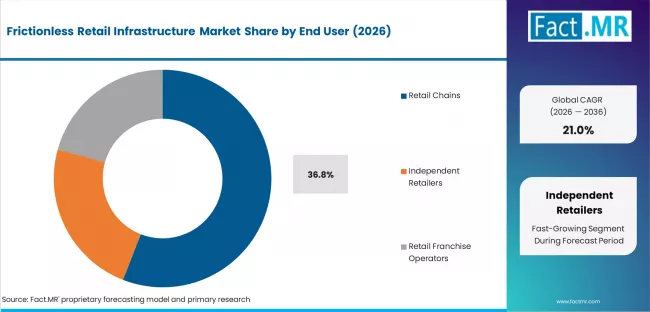
Frictionless Retail Infrastructure Market Analysis By End User | Source: Fact.MR
Retail Chains are expected to emerge as the leading end-user segment, accounting for 36.8% share in 2026. This growth is supported by increasing investments in smart store modernization, AI-powered retail automation, computer vision deployment, inventory intelligence systems, and frictionless customer engagement technologies across large-scale retail networks globally.
Regional Outlook Across Key Markets
The geographies covered in this study include North America, Latin America, Western Europe, Eastern Europe, East Asia, South Asia & Pacific, and Middle East & Africa. Regional analysis includes assessment of autonomous retail adoption, AI-powered store infrastructure deployment, computer vision integration, embedded payment ecosystem expansion, smart retail investments, and the growth of cashierless and unattended retail formats across global retail markets.
.webp "Top Country Growth Comparison Frictionless Retail Infrastructure Market Cagr (2026 2036)")
Top Country Growth Comparison Frictionless Retail Infrastructure Market Cagr (2026 2036) | Source: Fact.MR
CAGR Table
| Country | CAGR (%) |
|---|---|
| India | 25.4% |
| Japan | 22.6% |
| China | 22.3% |
| South Korea | 19.4% |
| United States | 20.1% |
| United Kingdom | 17.9% |
| Germany | 17.3% |
Source: Fact.MR analysis. Updated May 14, 2026
Source: Fact.MR (FMR) analysis, based on proprietary forecasting model and primary research.
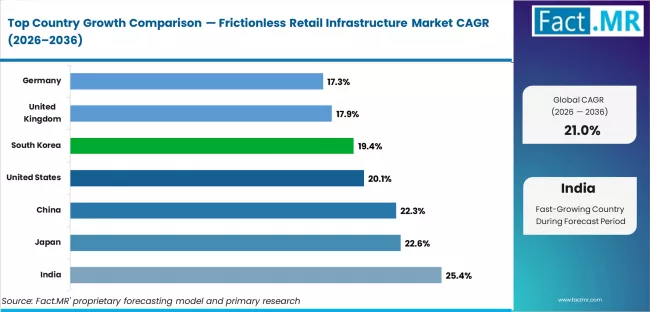
Frictionless Retail Infrastructure Market Cagr Analysis By Country | Source: Fact.MR
North America Frictionless Retail Infrastructure Market
North America acts as the "center of innovation and commercialization" for frictionless retail infrastructure market owing to strong adoption of AI-based retail automation, superior digital payment solutions, mature retail environment, and large-scale investments in autonomous checkout solutions. Amazon Just Walk Out remains the leader in the regional market with a cashierless retail infrastructure and computer vision-based store automation, while Standard Ai, Mashgin, and Caper Ai are increasing installations of smart checkout and retail intelligence solutions in convenience stores, grocery chains, airports, and stadiums.
- U.S.: Demand for frictionless retail infrastructure solutions in the U.S. is projected to rise at 20.1% CAGR through 2036. Growth is driven by increasing investments in autonomous checkout systems, AI-powered shopper analytics, smart store modernization, embedded payment ecosystems, and unattended retail deployments across grocery, convenience retail, airports, and corporate campuses.
- Canada: Market growth in Canada is supported by increasing retail automation initiatives, rising demand for contactless shopping experiences, and expanding deployment of AI-powered inventory intelligence and autonomous retail infrastructure across organized retail environments.
Europe Frictionless Retail Infrastructure Market
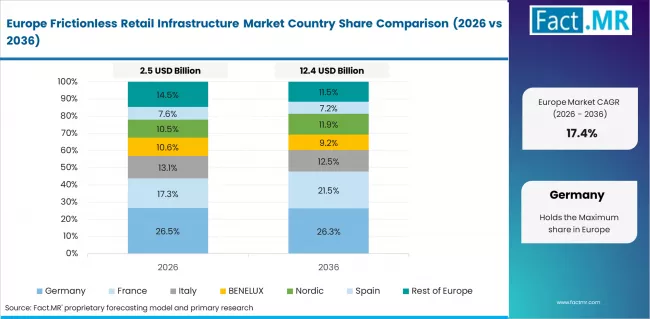
Frictionless Retail Infrastructure Market Europe Country Market Share Analysis, 2026 & 2036 | Source: Fact.MR
Europe is considered the “responsible smart retail-transformation region” in the Frictionless Retail Infrastructure Market as a result of the robust retail digitization, increasing investments in AI-based store automation, rising adoption of cashierless retail formats, and heightened attention towards operational efficiency and data privacy conformance. Trigo continues to dominate in Europe when it comes to grocery automation, with retailers across the continent continuing to invest in computer vision technology and smart stores.
- Germany: Demand for frictionless retail infrastructure solutions in Germany is projected to rise at 17.3% CAGR through 2036, driven by Industry 4.0 adoption, retail automation investments, AI-powered inventory management, and increasing deployment of smart retail infrastructure across grocery and convenience retail sectors.
- U.K.: Frictionless retail infrastructure demand in the U.K. is expected to grow at 17.9% CAGR through 2036 due to rising adoption of autonomous checkout systems, AI-powered customer analytics, cashierless convenience stores, and smart retail modernization initiatives.
- France: Demand for frictionless retail technologies in France is supported by increasing deployment of smart checkout systems, expansion of embedded payment infrastructure, and growing investments in AI-enabled retail intelligence and customer experience optimization platforms.
East Asia Frictionless Retail Infrastructure Market
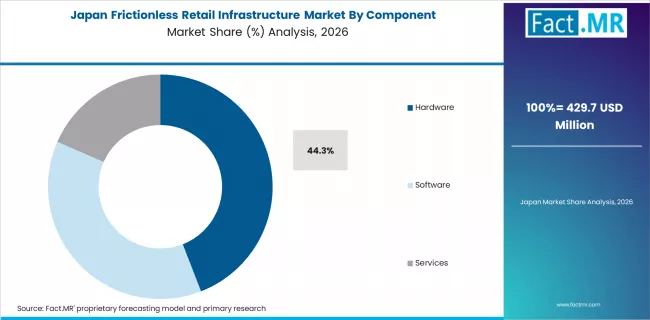
Frictionless Retail Infrastructure Market Japan Market Share Analysis By Component | Source: Fact.MR
East Asia becomes the "launching pad to the world for autonomous retail ecosystems" in the Frictionless Retail Infrastructure Market with mature digital infrastructure, strong AI investments, high mobile payment penetration and faster implementation of smart retail solutions. Regional retailers and technology providers are also building momentum in bringing autonomous stores, AI-powered retail intelligence, and integrated payment ecosystems to urban retail environments.
- China: Demand for frictionless retail infrastructure solutions in China is projected to rise at 22.3% CAGR through 2036, driven by large-scale deployment of autonomous retail formats, AI-powered store operations, smart payment ecosystems, and rapid expansion of unattended retail infrastructure across urban commerce networks.
- Japan: Frictionless retail infrastructure demand in Japan is expected to grow at 22.6% CAGR through 2036 due to increasing investments in retail robotics, smart vending systems, AI-powered convenience retail, and autonomous store automation technologies.
- South Korea: Demand for frictionless retail technologies in South Korea is forecast to expand at 19.4% CAGR through 2036, supported by advanced smart retail infrastructure, strong digital payment adoption, AI-enabled customer analytics, and growing deployment of autonomous convenience stores.
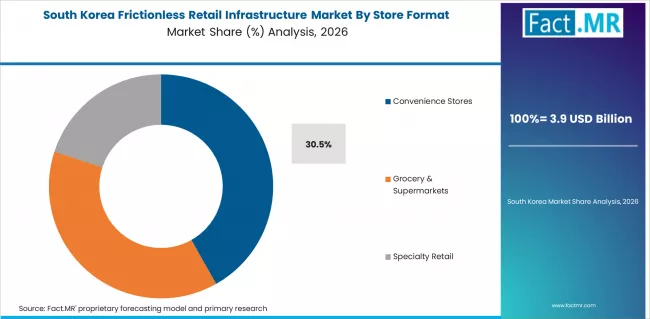
Frictionless Retail Infrastructure Market South Korea Market Share Analysis By Store Format | Source: Fact.MR
South Asia & Pacific Frictionless Retail Infrastructure Market
South Asia & Pacific is becoming the high-growth region for smart and autonomous retail transformation driven by the rapid growth of digital payments, organized retail sector modernization, development of urban retail infrastructure, and growing investments in AI-powered commerce ecosystems. Retailers in the region, as well as other fledgling markets, are rapidly embracing tools such as autonomous checkout, integrated payment solutions and AI-powered inventory intelligence.
- India: Demand for frictionless retail infrastructure solutions in India is projected to rise at 25.4% CAGR through 2036, driven by rapid growth of digital payment ecosystems, expansion of organized retail, increasing deployment of AI-powered convenience retail infrastructure, and rising investments in autonomous checkout and smart store technologies across urban commerce environments.
Fact.MR’s analysis of the Frictionless Retail Infrastructure Market consists of country-wise assessment across North America, Latin America, Europe, East Asia, South Asia & Pacific, and Middle East & Africa. Readers can find detailed insights on regional smart retail adoption trends, autonomous checkout deployment, AI-powered retail infrastructure investments, computer vision integration, embedded payment ecosystem expansion, competitive benchmarking, and long-term growth opportunities across major global markets.
Competitive Benchmarking and Company Positioning
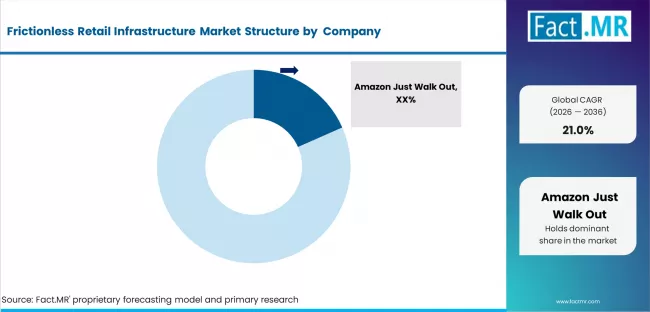
Frictionless Retail Infrastructure Market Analysis By Company | Source: Fact.MR
Leading Companies Shaping the Frictionless Retail Infrastructure Market
The frictionless retail infrastructure market is fairly fragmented, with major players such as Amazon Just Walk Out, AiFi, Zippin, Trigo, Standard AI, Everseen, Sensei, Mashgin, Caper AI, and Digit7. Players in the market are competing in terms of autonomous checkout features, accuracy of computer vision, retail intelligence powered by AI, scalability of smart stores, integrated payment method, and operational efficiency in real-time. Established players are differentiated by sophisticated AI infrastructure, strong retail partnerships, edge computing and cloud solution integration, best-in-class large-scale deployment capabilities, and integrated smart retail ecosystems across grocery, convenience retail, airports, stadiums and corporate campuses.
Leading technology vendors are becoming more engaged in the development of artificial intelligence (AI)-driven cashierless retail platforms, intelligent inventory monitoring, smart shopper analytics and unattended commerce deployments that can deliver greater operational efficiency and customer convenience. Regional, as well as niche specialists, are also competing by providing modular solutions for autonomous retail, smart store infrastructure that can be customized according to retailer requirements, cost-effective deployment models and industry-specific solutions for frictionless retail targeted at mid-size retailers, transit hubs, hospitality environments and enterprise campus retail ecosystems.
Recent Industry Developments
- Amazon Just Walk Out – Portable Checkout-Free Retail Lanes Expansion (January 2026)
- Amazon introduced portable Just Walk Out retail lanes designed for concerts, stadiums, and live events, enabling rapid deployment of cashierless shopping infrastructure and frictionless checkout experiences across temporary retail environments. The launch strengthens Amazon’s position in autonomous retail infrastructure, embedded payment ecosystems, and event-based unattended commerce solutions. [1]
- AiFi – AI-Powered Autonomous Checkout for Hospitals (May 2025)
- AiFi launched AI-powered autonomous checkout infrastructure tailored for hospital retail environments, enabling frictionless shopping experiences for healthcare staff, patients, and visitors through computer vision, smart sensors, and cashierless retail technologies. The initiative expands autonomous retail adoption into healthcare commerce ecosystems. [2]
- Sodexo – Australia’s First FIFO Autonomous Store Launch (February 2025)
- Sodexo unveiled Australia’s first autonomous convenience store for FIFO workers at Rio Tinto’s Gudai-Darri mining village using AiFi-powered cashierless retail infrastructure. The deployment supports unattended retail operations, embedded digital payments, and AI-enabled smart store automation in remote workforce environments. [3]
- Zippin – NRG Stadium Autonomous Store Expansion (August 2025)
- Zippin expanded its checkout-free retail footprint at NRG Stadium by launching five new autonomous stores for the 2025 NFL season. The expansion enhances frictionless concession operations through AI-powered checkout systems, computer vision retail infrastructure, and unattended stadium commerce solutions. [4]
- Amazon Just Walk Out – Nissan Stadium Cashierless Market Deployment (January 2026)
- The Tennessee Titans announced deployment of Amazon Just Walk Out cashier-free markets at the new Nissan Stadium, representing one of the largest autonomous stadium retail infrastructure rollouts globally. The initiative focuses on high-speed concession transactions, queue-free customer experiences, and AI-powered retail automation technologies. [5]
Leading Companies Shaping the Frictionless Retail Infrastructure Market
- Amazon Just Walk Out
- AiFi
- Zippin
- Trigo
- Everseen
- Standard AI
- Sensei
- Mashgin
- Caper AI
- Digit7
Sources and Research References
- [1] Amazon Just Walk Out, “Amazon Just Walk Out portable lanes bring checkout-free shopping to concerts and events”, January 2026
- [2] AiFi, “AI-Powered Autonomous Checkout for Hospitals”, May 2025
- [3] Sodexo, “Sodexo Unveils Australia’s First Autonomous Store for FIFO Workers”, February 2025
- [4] Zippin, “NRG Stadium Launches 5 New Zippin Stores for 2025 Season”, August 2025
- [5] Axios Nashville, “Titans to bring Amazon's cashier-free markets to new Nissan Stadium”, January 2026
Frictionless Retail Infrastructure Market Definition
The Frictionless Retail Infrastructure Market is a set of technologies, platforms, and services that empower automated, cashierless, and intelligent operations in retail end through the combination of computer vision, AI, smart sensors, IoT infrastructure, embedded payments, robotics, and retail analytics. These products enable autonomous checkout, real-time inventory updates, shopper behavior analytics, queue-less shopping, loss prevention, labor optimization, and intelligent store management. In contrast to conventional retail systems, frictionless retail infrastructure is built on AI-powered automation, connected store ecosystems, and real-time operational insights to create seamless customer experiences and efficient store operations. This market is catered to the convenience stores, grocery & supermarkets, specialty retail, QSR's, transit hubs, campuses, and any place you consider part of modern-day retailing across the globe.
Frictionless Retail Infrastructure Market Inclusions
The evaluation report on the frictionless retail infrastructure market encloses estimations of the global as well as regional frictionless retail infrastructure market size for 2025-2036. It offers thorough insights across component, store format, deployment model, technology, application, and end-user segments along with detailed analysis of regional adoption trends, competitive landscape, retail automation, AI integration and smart store infrastructure development. The report also covers analysis of emerging trends in autonomous checkout, computer vision, embedded payments ecosystems, unattended retail, increasingly IoT-enabled store operations, and AI-powered retail intelligence.
Frictionless Retail Infrastructure Market Exclusions
The scope of this report is limited to the infrastructure for traditional retail and physical store automation, which does not include advanced technology such as computer vision, artificial intelligence, smart sensors, IoT infrastructure, autonomous checkout, embedded payments, or real-time retail analytics. The report does not cover traditional POS solutions, standalone self-scanning checkout terminals without AI functionality, legacy inventory management systems, regular surveillance solutions, dumb retail hardware or generic digital payment systems void of auto/AI-enabled retail capabilities.
Frictionless Retail Infrastructure Market Research Methodology
- Primary Research
- Fact.MR applied a triangulation methodology to analyze the market by conducting interviews with autonomous retail platform providers, retail AI companies, computer vision technology vendors, smart sensor manufacturers, embedded payment solution providers, retail automation specialists, enterprise IT consultants, and end users in convenience retail, grocery chains, QSRs, airports, and smart campus ecosystems to corroborate the significant market trends, application scenario, and adoption prospects
- Desk Research
- The study integrates information and data from company annual reports and investor presentations, smart retail adoption studies, retail automation reports, AI and IoT infrastructure publications, government digital commerce schemes, trade journals, technology white papers, industry association information, and enterprise investments in autonomous retail and smart store infrastructure.
- Market-Sizing and Forecasting
- Fact.MR’s market research approach is a combination of employing a Bottom-up approach to revenue analysis of frictionless retail infrastructure providers and Top-down evaluation of global retail automation, AI-based commerce and smart store infrastructure expenditure across key industries and regions.
- Data Validation and Update Cycle
- Market estimates were validated through triangulation of primary interviews, company financial analysis, regional retail automation trends, technology penetration rates, and historical smart retail adoption patterns. Forecasts are periodically updated to reflect changes in AI investments, autonomous checkout deployments, retail digital transformation initiatives, embedded payment ecosystems, and advancements in computer vision and connected retail infrastructure technologies.
Segmentation
Scope of Analysis
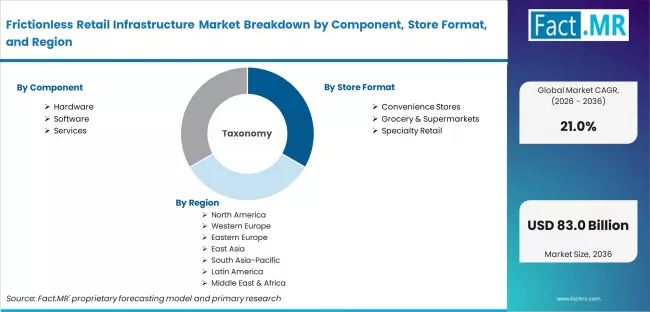
Frictionless Retail Infrastructure Market Breakdown By Component, Store Format, And Region | Source: Fact.MR
Parameter |
Details |
|---|---|
| Quantitative Units | USD 10.2 Billion (2025) to USD 83.0 Billion (2036), at a CAGR of 21.0% |
| Market Definition | The Frictionless Retail Infrastructure Market covers AI-powered retail automation solutions designed to enable cashierless shopping, autonomous checkout, smart store operations, real-time inventory monitoring, shopper behavior analytics, and seamless retail experiences across physical retail environments. These solutions integrate technologies such as computer vision, artificial intelligence, IoT infrastructure, smart sensors, embedded payments, robotics, and retail analytics to optimize retail automation, store intelligence, inventory visibility, customer convenience, and unattended commerce operations across convenience stores, grocery retail, airports, stadiums, corporate campuses, and other smart retail ecosystems. |
| Regions Covered | North America, Eastern Europe, Western Europe, East Asia, South Asia & Pacific, Latin America, Middle East & Africa |
| Countries Covered | USA, Canada, UK, Germany, China, Japan, India, South Korea, Brazil, Saudi Arabia, UAE, and 20+ countries |
| Key Companies | Amazon Just Walk Out, AiFi, Zippin, Trigo, Standard AI, Everseen, Sensei, Mashgin, Caper AI, Digit7 |
| Forecast Period | 2026 to 2036 |
| Approach | Hybrid demand-side and top-down methodology based on adoption of autonomous checkout systems, AI-powered retail automation, smart store infrastructure deployment, computer vision integration, embedded payment ecosystem expansion, and increasing investments in frictionless retail technologies, validated through primary interviews with retail automation providers, AI technology vendors, smart infrastructure companies, retailers, payment platform operators, and retail industry experts across key regions. |
Source: Fact.MR analysis. Updated May 14, 2026
Analysis by Component, Store Format, Deployment Model, Technology, Application, End User, and Region
-
Frictionless Retail Infrastructure Market by Component:
- Hardware
- Vision & Imaging Hardware
- Smart Shelf & Sensor Infrastructure
- Edge & Computing Devices
- Checkout & Payment Hardware
- Software
- Computer Vision Software
- Retail Operations Software
- Payment & Commerce Platforms
- Analytics & Intelligence Platforms
- Services
- Deployment & Integration
- Managed Services
- Consulting & Support
- Hardware
-
Frictionless Retail Infrastructure Market by Store Format:
- Convenience Stores
- Urban Convenience Stores
- Fuel Station Retail
- Autonomous Mini Stores
- Grocery & Supermarkets
- Hypermarkets
- Mid-Size Grocery Chains
- Smart Grocery Stores
- Specialty Retail
- Fashion Retail
- Electronics Retail
- Cosmetics & Pharmacy Retail
- Quick Service Restaurants (QSRs)
- Self-Service Restaurants
- Automated Pickup Stores
- Smart Food Courts
- Stadiums, Airports & Transit Hubs
- Corporate & Campus Retail
- Convenience Stores
-
Frictionless Retail Infrastructure Market by Deployment Model:
- Fully Autonomous Stores
- Cashierless Stores
- Unmanned Micro Stores
- 24/7 Autonomous Retail Pods
- Hybrid Smart Stores
- Assisted Smart Stores
- AI-Enabled Traditional Stores
- Partial Automation Stores
- Assisted Checkout Stores
- Self-Checkout Stores
- Mobile POS Stores
- Smart Cart Assisted Stores
- Fully Autonomous Stores
-
Frictionless Retail Infrastructure Market by Technology:
- Computer Vision & Artificial Intelligence
- Smart Sensors & IoT Infrastructure
- Autonomous Checkout Systems
- Retail Operations Software
- Robotics & Automation
- Embedded Payments & Fintech
-
Frictionless Retail Infrastructure Market by Application:
- Autonomous Checkout
- Inventory Monitoring
- Shopper Behavior Analytics
- Loss Prevention & Theft Detection
- Queue Management
- Dynamic Pricing
- Personalized Promotions
- Store Traffic Analytics
- Workforce Optimization
- Supply Chain Visibility
-
Frictionless Retail Infrastructure Market by End User:
- Retail Chains
- Independent Grocery Stores
- Retail Franchise Operators
- Hospitality & Foodservice Operators
- Transportation & Mobility Operators
- Corporate Campuses
- Educational Institutions
- Healthcare Retail Operators
-
Frictionless Retail Infrastructure Market by Region:
- North America
- USA
- Canada
- Mexico
- Latin America
- Brazil
- Chile
- Rest of LATAM
- East Asia
- China
- Japan
- South Korea
- Taiwan
- South Asia & Pacific
- India
- Singapore
- Australia
- ASEAN
- Western Europe
- Germany
- France
- U.K.
- Italy
- Spain
- BENELUX
- Nordic
- Rest of Western Europe
- Eastern Europe
- Poland
- Hungary
- Czech Republic
- Balkan & Baltics
- Rest of Eastern Europe
- Middle East and Africa
- Kingdom of Saudi Arabia
- United Arab Emirates
- South Africa
- Rest of Middle East and Africa
- North America
Frequently Asked Questions
How large is the demand for Frictionless Retail Infrastructure in the global market in 2025?
What will be the market size of the Frictionless Retail Infrastructure Market by 2036?
What is the expected demand growth for the Frictionless Retail Infrastructure Market between 2026 and 2036?
Which store format segment is expected to dominate the market?
How significant is the growth outlook for India in this market?
Which company is identified as a leading player in the Frictionless Retail Infrastructure Market?
Who worked on this report


Preview the report firsthand - request a free sample
Free SampleGet the brochure for pricing and purchase details
Download PDF